Mainely Tipping Points 16: WOLF TOTEM

Tipping Points 16

WOLF TOTEM

 Millions of Chinese have purchased Jiang Rong’s novel WOLF TOTEM (2004), published in the west in 2008.  The novel, according to its English translator, sparked a heated debate about the national character of the Chinese people.  I would argue that Rong’s metaphors apply to Americans as well.

 In 1969, student Rong took part in Mao’s Cultural Revolution where up to 20-million young city dwellers relocated to rural areas.  Rong went to a remote grassland, Inner Mongolia’s East Ujimqin Banner, and for 11 years lived with and grew to love deeply the traditional herdsmen.  Called Olonbulag Banner in the novel, this grassland produced Genghis Khan and the famed Mongol hordes of the twelfth and thirteenth centuries who overran Rong’s Han ancestors. 

Rong experiences the moment when the Chinese people, who are agrarians, occupy the grassland, try to farm it, and in the process destroy the delicate balance of shepherds, sheep (the right animal for the grassland), and the predator wolves that are the linchpin of this system.  In scant months, the wolves are hunted with military vehicles and slaughtered with rifles.  In a few years, a lush portion of the pristine grassland is fouled by farmers and turns to desert.  In a few decades, the whole grassland becomes a desert, and the herdsmen are penned into individually owned, fenced enclaves and a lifestyle that is a parody of their traditional culture.  

What has been lost is what one Chinese student in the Olonbulag, Zhang, calls “the middle way.”  The Han Chinese, he says, prefer extremes where the east wind overpowers the west wind, or vice versa.  But, the grasslanders use the contradictions inherent in their world, specifically the wolf, who controls the “big life” of the grassland by being a strong predator of the “little lives.”  What derives is a balanced, sustainable system where all within the system must be strong to survive (376).     

 The Han Chinese, says Zhang, “know nothing about life on the grassland.  All they care about is quantity, quantity, quantity.  In the end, they’ll lose everything by being single-minded.”  And, predicts Zhang, “millions of peasants keep having babies and reclaiming the land.  The population equal to an entire province is born every year.  Who can stop all those people from coming to the grassland?” (376).

Rong’s character in the novel, Chen Zhen, visits 30 years after his departure.  Zhen sees that the grassland can no longer support the life it once supported and that livestock numbers are being reduced.  The grassland cannot even support the horses whose “hooves once shook the world” (510).  Motorcycles have to be used instead.  “Mice,” says Zhen, “are kings on the wolfless grassland” (511).  

Zhen fears, when he sees an area supporting huge, penned sheep flocks, that what he is seeing is “a false prosperity,” experienced just before the Inner Mongolian grassland dies off (514).  He discovers that much pasture land is leased to outsiders by Mongolians who have become drunks.  One of the old-timers reports that these “outsiders” from farming-herding areas “don’t give a damn about capacity, so they raise two or three thousand sheep on land that can only support five hundred.  Their sheep graze the land for a few years and turn it into sand; then they get out of their lease, sell their sheep, and go back home to do business with the money they got here” (518).

 Zhen, whose career has been spent studying system models, economic politics and urban and rural issues in China, makes the following assessment:  “We’ve witnessed the `impressive victory’ of an agrarian society over a nomadic herding society.  Current government policy has developed to the stage of `one country, two systems,’ but deeply rooted in the Han consciousness is still `many areas, one system.’  It doesn’t matter if it’s farmland or pastureland, forest or river, city or countryside; all they want to do is mix them all up to create a `unified’ flavor.  With the `impressive victory’ has come a tremendous amount of subsidies, but the grassland could not return even if the subsidies continued for the next century” (510). 

Already, too, children are detached from the workings of nature.  A teenager riding a motorcycle is seen killing a hawk with a rifle.  He is oblivious to the fact that the hawk kills the mice whose overpopulation is helping to kill the grassland.  Once powerful and necessary hunting and guarding dogs, if they are kept at all, have become pampered pets (512). 

 In the spring of 2002, Zhen gets a call from his old friends on the Olonbulag.  Eighty percent of the pastureland is now desert.  The whole area, say the callers, will now be changed from “settlement herding to raising cows and sheep, more or less like the animal pens in your farming villages.  Every family will build rows of big houses” (524).

 Zhen did not know what to say.  But, Rong ends the novel with a “yellow-dragon sandstorm” that “rose up outside his window, blocking the sky and the sun.  All of Beijing was shrouded in the fine, suffocating dust.  China’s imperial city was turned into a hazy city of yellow sand” (524).  The sand storm embodies the national character of the Han Chinese:  they are destroying their habitat because they refuse to understand and live within nature’s mechanisms.     

Dan O’Brien, in an article for EATING WELL magazine (“Buffalo Are Back,” March/April 2009, 49-59), writes that Americans killed 60 million buffalo in the late 1800s.  By 1900 only 400 survived.  Today, writes O’Brien, “the Plains are broken up by fences that hold cattle destined for feedlots.  Most of the native prairie has been plowed under, leaving the land bare to the ravages of wind and water erosion.  Native grasses have been replaced with government-subsidized commodity crops, such as corn, cotton, and wheat.  These crops grow with the aid of petroleum-based fertilizers, pesticides and herbicides that run off into the water.  With less available habitat, native animals and birds are being squeezed out.  To complete the circle, most of the subsidized corn is fed to the cattle that replaced the buffalo” (the right animal for the grassland). 

Lierre Keith, in THE VEGETARIAN MYTH (2009), notes that 99.8 percent of our native prairie is gone, planted to industrially raised corn, wheat, and soy (40).  Nature, she writes, sees bared soil as an emergency and responds with quick-growing annuals (32).  Industrial agrarians plow the soil, creating long rows of one plant separated by bared soil, which results in topsoil loss and a lack of nutrients in industrial food. 

History shows clearly, writes Keith, that the repeated result of grain-based systems is population growth, topsoil loss, and the eventual collapse of a bioregion.  The “last people who know how to live sustainably—how to integrate themselves into the living landscape of grasslands and rivers—are [being] pushed off by the agriculturalists, to disappear into a hostile world where, like the [native] animals, they will surely die” (51).     

The world population is too great; there is no more “new” land.   Keith says, “we’re out of topsoil, out of water, out of species, and out of space in the atmosphere for the carbon we can’t seem to stop burning” (51). 

We are all in Rong’s space of “false prosperity.” The sand storm made by our national character has already arrived.  Minimize local impact by supporting organic (sustainably grown), nutrient-dense foods.  

If you’re looking for more information, see David Montgomery’s DIRT:  THE EROSION OF CIVILIZATIONS (2010) and DIRT!  THE MOVIE.
Mainely Tipping Points 14: Good Fats, Bad Fats

Mainely Tipping Points 14

Good Fats, Bad Fats


Since the late 1970s, Americans have been encouraged by nutritionists, doctors, the government, and industry to eat less fats, especially the saturated fats once traditional in the American diet.  Yet, according to Dr. Mary Enig, an expert in the chemistry of fats, and Sally Fallon, both of the Weston A. Price Foundation, saturated fatty acids constitute at least 50 percent of our cell membranes and are what give our cells necessary stiffness and integrity.  Saturated fats play such an important role in the health of our bones that at least 50 percent of our dietary fats should be saturated.  And among their many other benefits, saturated fats enhance our immune systems (“The Skinny on Fats,” http://www.westonaprice.org/know-your-fats/526-skinny-on-fats.html). 

Today, Americans are deficient in the healthy fatty acids which support the healthy functioning of their bodies.

Beginning in 1980, the government recommended a diet which substituted carbohydrates for healthy fats and which has resulted in national obesity and chronic disease problems—as many scientists of that era feared.  The fats Americans now consume most often are denatured, highly refined, highly unstable, and are too rich in omega-6 fatty acids. 

So, what kinds of fats are healthy and necessary for humans?  Caroline Barringer, writing in the current July/August 2010 issue of WELL BEING JOURNAL and drawing on the work of Enig and Fallon, walks readers through the healthy fats terrain in a few short pages  (“Fats:  Safer Choices for  Your Frying Pan & Your Health,” 30-38).  You can buy a copy at Good Tern, Fresh Off the Farm, or online.  Enig and Fallon’s fully comprehensive information is available on-line.  See, especially, “The Skinny on Fats” and “The Oiling of America” at http://www.westonaprice.org

Understanding the chemical structures of fats and what industrial processing does to those structures helps one begin to understand which fats are dangerous and why.  Remember, Barringer reminds, that all fats are combinations of the following fatty acids.  For instance, beef tallow (which most of us use only to feed our birds in winter) is very safe for cooking and frying and is 50 to 55 percent saturated fat, 40 percent monounsaturated fat, and only 3 percent polyunsaturated fat.

Saturated fatty acid (SFAs) molecules are straight so can stack together tightly, which is why they are solid or semi-solid at room temperature.  The straight nature of SFA molecules makes them very stable, even at high temperatures, and they do not turn rancid easily.

Monounsaturated fatty acid (MUFAs) molecules have a slight bend.  They can still stack closely, but not as tightly as saturated fatty acid molecules, which is why they are liquid at room temperature, but semi-solid when refrigerated.  MUFAs are relatively stable and do not turn rancid easily.

Polyunsaturated fatty acid (PUFAs) molecules have two bends.  They cannot stack together well.  They are unstable, even at room temperature, and are easily damaged by heat, light, moisture, and exposure to oxygen.  They require refrigeration and turn rancid quickly and easily.  Omega 3 and 6 essential fatty acids are in the PUFA category.  But, consume only small amounts of some PUFAs and only if they are organic, unrefined, first cold-pressed or cold pressed, or expeller pressed, or extra virgin. 

 Industrial processing methods affect radically the structure of fats.  Traditionally, Barringer notes, seed and nut oils were extracted by pressing.  Industry crushes the seed/nuts; heats them to 230 degrees or more; presses them using high-pressures to squeeze out all fats, which generates further heat; and uses hexane (a solvent) to extract the last bits of oil.  (Hexane, a petroleum derivative, may cause infertility and central nervous system depression.)  Industry attempts to “boil off” the hexane, but some remains.  If the seeds/nuts are not organic, the hexane acts as a magnet for the chemicals sprayed on the nuts/seeds.  So, the final product is rancid, refined so no nutrients remain, and poisoned. 

Further, Enig and Fallon explain that the damaged molecules form “free radicals” with edges like razor blades.  Barringer notes that these free radicals “wreak havoc on the body, attacking and damaging DNA/RNA, cell membranes, vascular walls, and red blood cells,” which, in turn, leads to further problems.”  

Some of these highly processed oils, which are mostly PUFAs,  then undergo hydrogenation, which transforms oils that are liquid at room temperature to solids, which extends shelf life.  Margarine and shortening, for instance, are hydrogenated PUFA oils.  (MUFAs and some SFAs can be hydrogenated.)  Tiny particles of nickel oxide are added to the oil, then the mixture is exposed to hydrogen gas in a high-heat, high-pressure reactor which chemically straightens any bends in the molecule.  These altered molecules are trans fats.  Now, the oil is thin, watery, and smells foul as it is rancid.  Multiple thickeners and fillers are added, and the oil is steam cleaned (more heat) to remove the odor.  The grey-colored oil is bleached.  The resulting substance is vegetable shortening.  Artificial colors and flavors can be added to produce margarine. 

Our bodies, Barringer explains, do not recognize these kinds of fats as foods.  If we consume them regularly, “we lose the ability to utilize healthy fats properly.”   Further, when healthy fatty acids are displaced by these highly processed fake fats, our bodies become subject to cascading, serious health problems, like cancer, diabetes, birth defects, sexual dysfunction, heart disease, and poor bone health. 

So, Barringer warns, avoid trans fats “like the plague”—which is not easy because the FDA allows industry to claim “zero trans fats” when trans fats are present.  Read labels and look for hydrogenated oils, which are trans fats.  Do not buy products where the following words appear on the label:  refined, hydrogenated, partially hydrogenated, or cold-processed (which is not cold- pressed.)

The safest fats for cooking are lard (pork fat); ghee (melted butter with the milky solids skimmed); tallow (beef and lamb fat); chicken, duck, and goose fat; coconut oil (organic and virgin); and red palm oil or palm kernel oil (organic and virgin).  You can, also, combine these fats.  Barringer likes coconut oil (92 percent saturated fat with powerful antimicrobial and antifungal properties and lauric acid–a medium chain fatty acid found in breast milk) combined with ghee or lard.  (I buy coconut oil by the case online from Wilderness Family Naturals.)  Barringer says red palm oil has a “pungent, paprika-like flavor” that is “best suited for roasting root vegetables,” like roasting red and white potatoes; red, yellow, and orange peppers; fresh garlic, and herbs.

Properly pressed olive oil, peanut oil, avocado oil, macadamia nut oil, and sesame oil are good for stir-frying.  Peanut oil should have limited use as it has a high percentage of omega-6 fatty acid. 

The following oils are unsafe for any kind of heat exposure:  vegetable/soybean oil, corn oil, flax oil, hemp oil, pine nut oil, pumpkin oil (roasted or raw), safflower oil, sunflower oil, and grapeseed oil.  These oils are almost 50 percent omega-6 fatty acids and should be consumed in moderation.  It is hard to find unprocessed versions.  Also, corn and soybean oil should be avoided as they are likely to be genetically modified and are grown with heavy pesticide levels.

Barringer, like Enig and Fallon, concludes that canola and cottonseed oil are unsafe to consume under any circumstances.  Canola is a highly processed industrial oil and does not belong in the human digestive tract.  Plus it is almost entirely a genetically modified crop.  Cotton is “one of the most genetically modified, pesticide-laden crops in America.”  And, asks Barringer, “when did cotton and its seed become a food?” 

Butter, especially real butter, is practically a medicine.  Butter, Barringer explains, is a cofactor that allows our bodies to utilize effectively calcium and other minerals we consume.  Butter contains omega-3 and omega-6 fatty acids in small amounts in a healthful ratio.  Butter contains conjugated linoleic fatty acids (CLA) for better weight management, muscle growth, and protection from cancer.  Butter contains the fat-soluble vitamins A, D, E, and K that help us absorb the trace minerals it also contains, among them zinc, selenium, iodine, chromium, and manganese.  Butter contains butyric fatty acids that provide “proper inflammatory and anti-inflammatory responses to help us heal effectively.”  And, the fat in butter “enhances brain function and increases cell membrane integrity.”    

Eat organic butter!  Eat lots of it every day, especially if you can find raw butter.  (But, not with a lot of bread, which is a carbohydrate.)

Turkey Tracks: Blackberries

Turkey Tracks:  August 14, 2010

Blackberries

“I want that jelly with the berries in it,” Talula announced this summer.  She’ll be 4 in a few weeks, and she loves to be in the kitchen with me.  She loves to eat, is discerning about food tastes already, and asks to help cook at every step. 

The jelly with the berries was blackberry jelly–an older jar made before I figured out how to get rid of the seeds with a food mill.  So far, Talula only uses it on morning toast.  She has not yet discovered the way my grandmother and I eat it:  spread on pancakes with lots of butter.  Or, a dab of it on a hot, short biscuit dripping with butter.  (Southern biscuits are not high and puffy; they’re “short” and flat, more like a pie crust. 

I’m down to one jar of blackberry jelly, and today I went and picked 4 1/2 gallons of fresh blackberries.  It took about two hours.  I was ecstatic since you never know from year to year if you’ll get more.  Last year, for instance, we didn’t get any tomatoes, so we went for two years on what I had put up year before last.  (I used the last jar of roasted tomatoes this past week.) 

It takes a LOT of berries to make a pint jar of blackberry jelly–something most people who take jelly for granted don’t know.  Homemade blackberry jelly or jam, made from wild blackberries, is a thing of joy.  It bears no relationship to what you can buy in a store.  And, it has no added “help,” like pectin.  You just have to pick a red berry or two as you go along for the pectin.  In my family, blackberry jelly was prized, and one never wasted it or ate a lot of it at one time.  One conserved blackberry jam, one treasured it, one let each bite linger on the tongue, because one pint jar of it represented not only a lot of work, but the luck of finding a blackberry patch where one could pick enough berries to make a pint jar of jam.     

Blackberries are part of my childhood.  I learned BLACKBERRY in the summers when we were in Reynolds, Georgia, the home of my mother’s parents.  When blackberries were in season, the adults would organize all the visiting cousin children and would drive us to a patch one or the other of them had found.  We had to pick until there were enough for, at least, a cobbler for dinner, which was eaten in the middle of the day.  There was always great drama since copperhead moccasin snakes love blackberry patches, and we were always scared to wade too deep into the bushes.  After dropping off the berries at the house for the cook, the adults took us swimming in the local pool at the edge of the swamp where free-flowing artesian water that was ice cold cleaned us up, soothed scratches, and made us really hungry for dinner.  

I’ve never found a recipe for those cobblers.  The crust was more like pie crust, crunchy and flakey.  And I don’t think the cobbler was lined, like a pie.  I don’t remember the inside being too watery.  I don’t remember the kind of dish they used either.  I don’t think it was a pie plate.  They used either whip cream or ice cream, but mostly, whip cream.  My father loved blackberry cobbler, and he was always a chief organizer for picking them.

Because the family gathered in the summer in Reynolds, there could be a crowd at dinner.  I remember 10 or 12 people at the table.  And, sometimes the children had to overflow to the kitchen table.  There were probably not enough berries left after the cobbler for jelly making.  Grandmother’s cook made the dinner and the cobbler.  But grandmother always made the blackberry jelly and, at holidays, special cakes and fudge.  I think the recipe I’ve evolved is pretty close to hers.  When my mother was sick with cancer, I picked, cooked, and made two jars for her, which I mailed to her with special packing.  She knew how special they were, what a gift I was sending her.  She didn’t want to take the jars to the dining room in the home where she was living.  No one else would understand, but mother knew BLACKBERRY, and she was not going to share with anyone who thought they were eating plain old jelly.   

I’m so lucky to have access to a dynamite wild blackberry patch.  I’ve been checking up on it over the past few weeks, and today was the day where the stars aligned so I could go pick.  I donned heavy pants, found my wellie boots (I only tripped and fell down once in them this outing), found an old hat, organized a pail I could line with big baggies, a rope to tie the pail to my waist so I could pick with both hands–something Maine friend Margaret taught me–filled up my water bottle, and headed out.  The patch is about 40 minutes away from our house. 

I’ll make the jelly in small batches, starting tomorrow.  I froze 3 gallons so they won’t go bad until I get to them since the full bounty of summer food is pouring forth right now. 

Next summer, I’ll have to try to teach Talula BLACKBERRY.  It’s harder when she can’t learn to pick them.  Their school starts in mid-August, so they miss the full richness of the Maine harvest.   


Turkey Tracks: Hope’s Edge, Our Community Shared Agriculture Farm

Turkey Tracks:  August 14, 2010  

Hope’s Edge:   Our CSA (Community Shared Agriculture) Farm  

We’ve belonged to Hope’s Edge, our CSA farm, for at least five years now.  Our pick-up this year is on Friday, and I look forward all week to driving out to the farm.  It’s a beautiful, serene space.   

What’s cool about Hope’s Edge is that Farmer Tom does not own it.  The owner and her daughter live in the farmhouse, and they have allowed Tom to build a CSA and his own house on it.  There are horses, some rescue ponies, a milk cow and a new calf, and chickens.  Sometimes there are some sheep as well.     

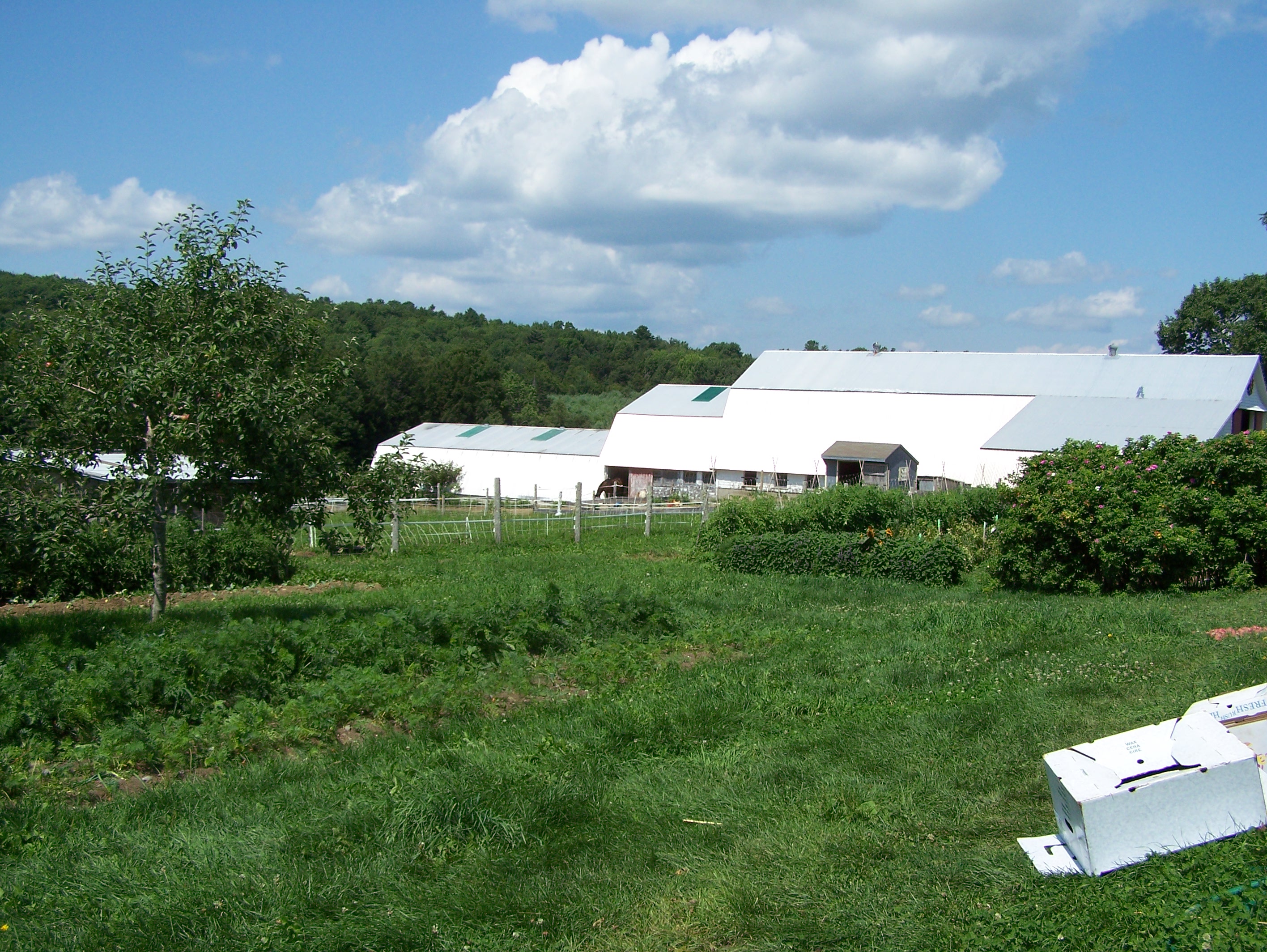
Hills circle the fields, barns, farmhouse, the CSA sheds, and Farmer Tom’s house.   A pond nestles down the hill from the barn, providing a cooling off place for hot CSA workers.  This is a view of the barn and stables from the CSA shed.  Look at how blue the sky can be in Maine.  The old farmhouse is on the far side of the barn.  In the foreground are some garden beds and the first of a line of apple trees.  


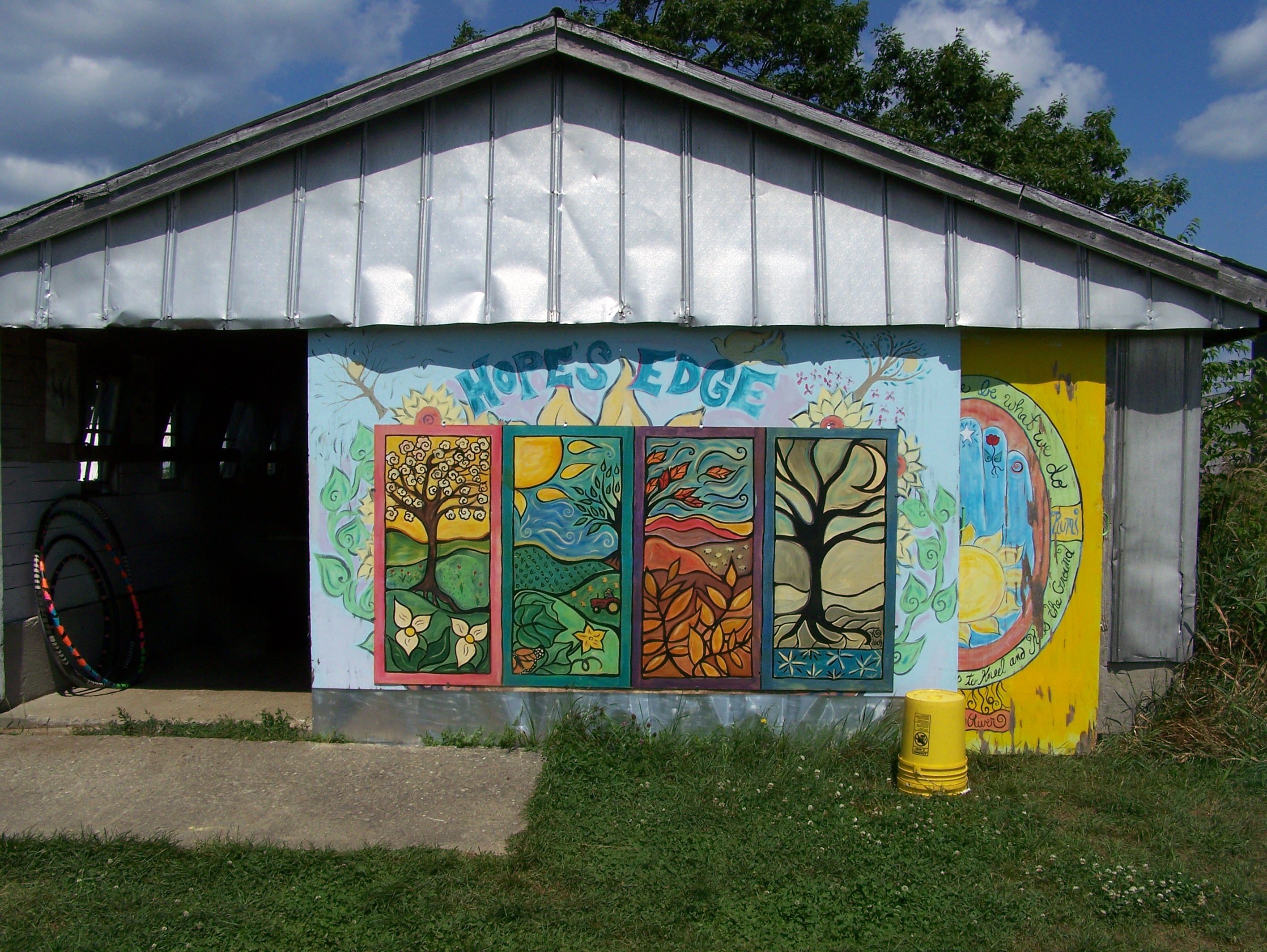
Here’s the CSA shed where we pick up our food.  Inside are refrigerators, some cooking equipment, tables, and LOTS of food.  Behind the shed are more garden beds, a huge oak with a tire swing, and a frog pond that drove our grandchildren quite crazy.  To the right there is another small barn and the entry road.  Across that road are planted crops, including a strawberry bed that gets bigger each year.   


Here’s a bigger picture of the mural.     


We picked up over 12 pounds of food this past Friday.  I could not resist putting it in my garden/mushroom basket and taking a picture:  


Cukes, zukes, tomatoes, cauliflower, broccoli, two kinds of beans (regular and Romano flat), lettuce, herbs, potatoes, an eggplant, a cabbage, carrots, and garlic.  I could have cut a flower arrangement as well, but we were tired after a morning in Augusta, and we have lots of flowers in our own garden.  

It doesn’t get better than this kind of food, does it?  It nourishes our bodies and our spirits.  

Ratatouille, I think.  But with some of the mint I brought from Maine.  And, some basil from our herb garden.

Mainely Tipping Points 15: Rearranging Deck Chairs on theTitanic: The Proposed 2010 USDA Food Guide

Mainely Tipping Points 15

Rearranging Deck Chairs on the Titanic:

The Proposed 2010 USDA Food Guide


The U.S. Department of Agriculture (USDA) and Health and Human Services (HHS) have jointly released the proposed 2010 food guide to a fire storm of criticism.  But first, let’s review recent government food guide history.   

 The USDA presented a new food guide plan and pyramid design in 2005.  It will be considered current until the 2010 guide replaces it.  The 2005 graphic is fronted by a triangle composed of colorful triangular stripes representing five food groups (grains, vegetables, fruits, milk, meat and beans).  Some triangles are bigger than others.  The front triangle is backed by a triangular set of steps with a stick figure climbing upwards.  A USDA web site (www.mypyramid.gov) allows an individual to enter personal information so that one of twelve personal pyramids is assigned.    

 Luise Light, hired by the USDA to design the 1980 USDA food guide, published WHAT TO EAT:  THE TEN THINGS YOU REALLY NEED TO KNOW TO EAT WELL AND BE HEALTHY in 2006, which in part describes how USDA  political appointees manipulated Light’s proposed guide to favor industry.  Light warns that with the 2005 food guide the USDA is trying to please everyone, makers of junk food and proponents of nutritionally important foods.  The 2005 guide, warns Light, is built around calories, which translates that “all foods are good foods.”  One has only to count calories, even junk food calories, to be healthy. 

 But, Light explains, by shifting “the emphasis away from best food choices to a new food democracy where every food is equal,” the USDA ignored “research over the last ten years” that shows “the types of foods, ingredients, and eating patterns that are beneficial for health and weight” (85-86). 

I believe this strategy also removes responsibility from industry for producing unhealthy foods.  By emphasizing individual choice, it becomes the individual’s responsibility not to eat that which makes him or her fat or sick—even though highly processed fake foods, tainted foods, and chemically poisoned foods fill national supermarkets. 

Light explains that “more than half of all consumers in a nationwide survey” responded that they were confused by the new pyramid.  Yet, the USDA allocated no funds to promote the new guide.  Rather, the USDA planned to task industry with helping to educate Americans about food choices.  Light notes that the Idaho Potato Commission immediately announced that carbohydrates, including potatoes, are the best fuel for muscles. 

 But, Light reminds, in reality, the food guide was never meant to be “a tool for health promotion based on the latest scientific studies about healthy eating.”  And, she asks if it isn’t time that nutritional questions are “answered by knowledgeable, independent authorities without a vested interest.”  Right now, people are “told different things at every turn by physicians, teachers, dietitians, the government, and food marketers” (85-86). 

The government released the 2010 proposed food guide this spring and scheduled public hearings and organized a web site for public comments.  Criticism involves, in part, the fact that the proposed guide not only continues down the path that has produced a national obesity epidemic and chronic health problems, it ups the ante on its unscientific position regarding dietary cholesterol and saturated fats by further lowering recommended daily levels.  Under the new rules, one cannot eat an egg.  Or, cheese.  Yet eggs—nature’s perfect food–have sustained humans for thousands of years.  And, properly prepared cheese is a nutrient-dense food.              

Sally Fallon, President of the Weston A. Price Foundation (WAPF), in the winter 2009 WAPF quarterly journal WISE TRADITIONS, agrees that the 2005 guidelines were “not based on science but were designed to promote the products of commodity agriculture and—through the back door—encourage the consumption of processed foods.”  The 2010 guide, Fallon writes, is an exercise in rearranging the deck chairs on the titanic.”  Indeed, Fallon notes, “putting the USDA in charge of the dietary guidelines is like letting the devil teach Sunday school (“President’s Message,” 2-3).   (See www.westonapricefoundation.org for extended analysis.)  

Fallon notes that the “USDA-sanctioned industrialization of agriculture,” has resulted in “a huge reduction in nutrients and increase in toxins in the American diet.”  Government food guides “have caused an epidemic of suffering and disease, one so serious that it threatens to sink the ship of state.”  The 2010 proposed guide is “a recipe for infertility, learning problems in children and increased chronic disease in all age groups.”  And, Fallon notes, while a growing number of Americans are figuring out what’s wrong with government-sponsored nutritional guides, millions in hospitals, nursing homes, prisons, and schools are trapped in the “Frankenstein creation” which is “a tragic and failed experiment” (2-3).   

 The American diet, Fallon notes, contains widespread deficiencies in the fat-soluble vitamins A, D, K, and E.  But, Fallon explains, “there is no way for Americans to consume sufficient quantities of these critical vitamins while confined to the low-fat, low-saturated fat, low-cholesterol, low-calorie cage of the USDA dietary guidelines” (2-3).  

The WAPF argues that dietary cholesterol is a precursor to vitamin D and that our cells need cholesterol for stiffness and stability.  And, the WAPF warns that the USDA committee is ignoring “basic biochemistry” that “shows that the human body has a very high requirement for saturated fats in all cell membranes.”  If we do not eat saturated fats, the body makes them from carbohydrates, but this process “increases blood levels of triglyceride and small, dense LDL, and compromises blood vessel function.”  Further, high carbohydrate diets do not satisfy the appetite, which leads to higher caloric intakes, bingeing, rapid weight gain and chronic disease.  This diet is “particularly dangerous for those suffering from diabetes or hypoglycemia, since fats help regulate blood sugar levels.”

The USDA committee’s solution, Fallon explains, is to “eat more `nutrient- dense’ fruits and vegetables.”  But, Fallon notes, “fruits and v”egetables are not nutrient-dense foods.”  Nutrients in plant foods do not compare with “those in eggs, whole milk, cheese, butter, meat and organ meats.”

Fallon points out that some USDA committee members are concerned with “the choline problem.”  Choline is “critical for good health and is especially necessary for growing children.  If choline intake is too low during pregnancy and growth, brain connections cannot form.  And, if choline is abundant during developmental years, the individual is protected for life from developmental decline” (2-3) 

Excellent sources of choline are egg yolks and beef and chicken liver.  Fallon notes that the National Academy of Sciences recommends amounts of choline consumption that violate the USDA’s proposed cholesterol limits.  So, she argues, “while we watch in horror the blighting of our children’s lives with failure to thrive, learning disorders, attention deficit disorder, autism and mental retardation, the committee is sticking to its anti-cholesterol guns.”  

Analysis on the WAPF web site details how the USDA committee has swept “the dangers of trans fat under the rug by lumping them with saturated fats, using the term `solid fats’ for both.”  This categorization hides the “difference between unhealthy industrial trans fats and healthy traditional saturated fats.”      

Also, notes the WAPF, the USDA committee has promoted “an increase in difficult-to-digest whole grains,” without specifying that all grains, nuts, seeds, and beans need to be soaked to remove the powerful antinutrient phytic acid.  (More on this subject later.) 

I agree with the WAPF assessment that the 2010 guide should be scrapped and that “the committee members should be replaced with individuals who have no ties to the food processing industry or to universities that accept funding from the food processing industry.”  I’ll bet Luise Light does, too.

Turkey Tracks: Zucchini Fritters

Turkey Tracks:  August 9, 2010

Zucchini Fritters

One of my neighbors called me a few days ago.  “Would you like some zucchini?” he asked.

Certainly not!!!!  We are swimming in zucchini.  But, I was more polite.  “No thanks, but thanks for asking.”

Later in the week I stopped by and saw that some of their zucchini had gotten away from them.  About 12 zucchini, the size of zeppelins, were stacked on a counter.  I felt very superior since I ruthlessly go through my plants and pull the zucchini when they are still young and tender. 

Between Hope’s Edge, our CSA, and our garden, we have tons of zucchini.  I get out the food processor and grate them and freeze them into small baggies.  The grated flesh is great in soups all winter, especially with a dollop of frozen basil oil or, even, pesto.  Summer comes rushing back in the first mouthful.  (For basil oil, just process wads of basil with enough olive oil to make an oily mixture and freeze in a small container with a little oil on top.)

Years ago, friend Barbara Melosh gave me a recipe for zucchini fritters, and John asks for it often.  It’s dead easy.  Here it is:

Zucchini Fritters

3 cups shredded zucchini (approximately 2 medium)

2-4 Tablespoons scallions, minced

2-4 Tablespoons parsley, minced

3/4 cup AP flour

1/2 teaspoon baking powder

1/2 teaspoon salt

2 eggs, lightly beaten

Mix together zucchini, scallions, and parsley.   Combine flour, baking powder, and salt.  Add to vegetables and stir.  Add eggs.

Saute in mixture of butter and olive oil until browned–approx. 2-3 minutes per side.  I’ve decided that it’s best to make small-sized fritters as they cook through a little faster.

ENJOY!

On the way to run an errand this morning, I pawed through the zucchini and Lord!!!!  There was a zeppelin zuke.  How did that happen???

Here is Maryann Enright with our zeppelin-sized zucchini:


Turkey Tracks: Granddaughter Quilts

Turkey Tracks:  August 6, 2010

Granddaughter Quilts

I’m behind on making quilts for the people I love.

Indeed, Mike and Tami and Bryan and Corinne have never gotten wedding quilts.   I do have those planned and in one case, fabric collected.

But, while Talula, who will be 4 this September, has a drag-around quilt, she has never gotten a special quilt from me.  And, Wilhelmina has nothing.  She will be 3 this September.

So, I started this past winter to remedy this situation, and I gave both girls their quilts when they came to Maine in early July.

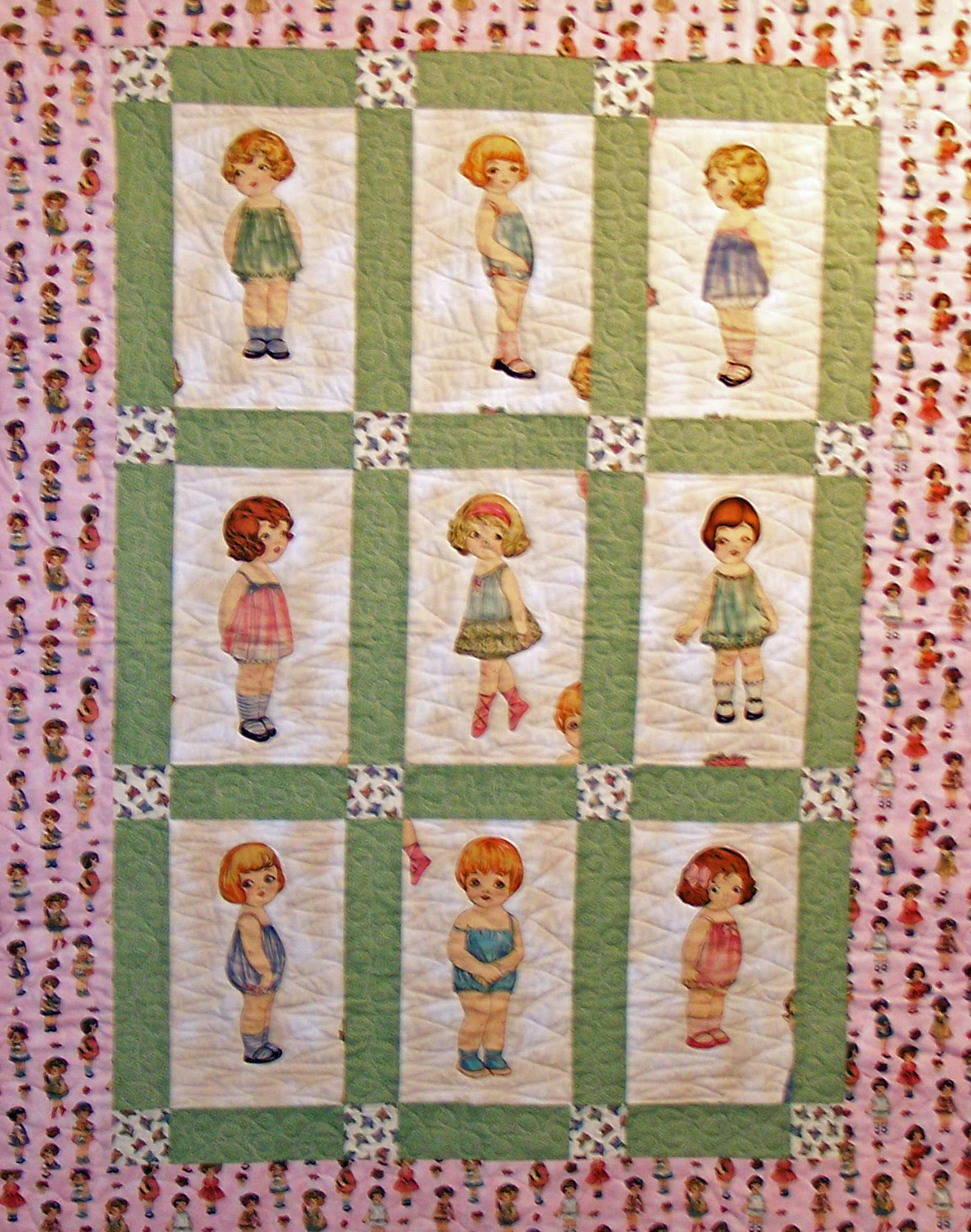
Talula’s quilt has dolls in their underwear.  I made separate clothes for the dolls, fused them with fusible fleece, and they stick to the dolls beautifully.  Talula likes dressing the dolls.  So do I. 

Here’s a picture:  it’s not a great picture as it makes the quilt look crooked, and it isn’t.


Here’s a close-up of some of the dolls dressed with dress, shoes, and a hat:


The  kit came from Fons and Porter–eventually–because apparently the market underestimated the popularity.  When it came, unlike the photo in the magazine, other dolls and decorations intruded on the individual doll blocks, as you can see.  Did they air brush those out?  Or, did they just get greedy?  And, you have to decide which line of dolls to cut, as you cannot cut one line without ruining the adjacent one, which has different dolls.  So, you have to buy more fabric to get to both sets.  Bah Humbug Market!!!

Wilhelmina’s quilt is called “Nursery Rhymes,” and was also from a kit.  Sewing with kits has been a new thing for me and is undoubtedly due to the influence of my Virginia friend, fellow quilter, Rosie Pilkerton.  Rosy loves kits, and she makes the cutest quilts, especially for children.  She and I bought the Nursery Rhymes kits together at the Mid-Atlantic Quilt Show in Williamsburg, VA, a few years back.  I took mine to our quilting trip this past February, and Rosie was offering to sell me hers after a few days.  This kit has a million tiny pieces.  I worked on it night and day all week and had to bring it home to finish it.

I love the prairie points.  They’re my first believe it or not.   


Now you can see all the tiny, tiny pieces.

So, Bryan and Corinne are expecting a girl around Thanksgiving.  Corinne and I had a terrific time one day while she was here picking out fabrics for receiving blankets, the backing for what will be a colorful babyl quilt, and very upscale and interesting fabric for a diaper bag. 

The wedding quilts are on the back burner again!!!!