Turkey Tracks: Blackberries

Turkey Tracks:  August 14, 2010

Blackberries

“I want that jelly with the berries in it,” Talula announced this summer.  She’ll be 4 in a few weeks, and she loves to be in the kitchen with me.  She loves to eat, is discerning about food tastes already, and asks to help cook at every step. 

The jelly with the berries was blackberry jelly–an older jar made before I figured out how to get rid of the seeds with a food mill.  So far, Talula only uses it on morning toast.  She has not yet discovered the way my grandmother and I eat it:  spread on pancakes with lots of butter.  Or, a dab of it on a hot, short biscuit dripping with butter.  (Southern biscuits are not high and puffy; they’re “short” and flat, more like a pie crust. 

I’m down to one jar of blackberry jelly, and today I went and picked 4 1/2 gallons of fresh blackberries.  It took about two hours.  I was ecstatic since you never know from year to year if you’ll get more.  Last year, for instance, we didn’t get any tomatoes, so we went for two years on what I had put up year before last.  (I used the last jar of roasted tomatoes this past week.) 

It takes a LOT of berries to make a pint jar of blackberry jelly–something most people who take jelly for granted don’t know.  Homemade blackberry jelly or jam, made from wild blackberries, is a thing of joy.  It bears no relationship to what you can buy in a store.  And, it has no added “help,” like pectin.  You just have to pick a red berry or two as you go along for the pectin.  In my family, blackberry jelly was prized, and one never wasted it or ate a lot of it at one time.  One conserved blackberry jam, one treasured it, one let each bite linger on the tongue, because one pint jar of it represented not only a lot of work, but the luck of finding a blackberry patch where one could pick enough berries to make a pint jar of jam.     

Blackberries are part of my childhood.  I learned BLACKBERRY in the summers when we were in Reynolds, Georgia, the home of my mother’s parents.  When blackberries were in season, the adults would organize all the visiting cousin children and would drive us to a patch one or the other of them had found.  We had to pick until there were enough for, at least, a cobbler for dinner, which was eaten in the middle of the day.  There was always great drama since copperhead moccasin snakes love blackberry patches, and we were always scared to wade too deep into the bushes.  After dropping off the berries at the house for the cook, the adults took us swimming in the local pool at the edge of the swamp where free-flowing artesian water that was ice cold cleaned us up, soothed scratches, and made us really hungry for dinner.  

I’ve never found a recipe for those cobblers.  The crust was more like pie crust, crunchy and flakey.  And I don’t think the cobbler was lined, like a pie.  I don’t remember the inside being too watery.  I don’t remember the kind of dish they used either.  I don’t think it was a pie plate.  They used either whip cream or ice cream, but mostly, whip cream.  My father loved blackberry cobbler, and he was always a chief organizer for picking them.

Because the family gathered in the summer in Reynolds, there could be a crowd at dinner.  I remember 10 or 12 people at the table.  And, sometimes the children had to overflow to the kitchen table.  There were probably not enough berries left after the cobbler for jelly making.  Grandmother’s cook made the dinner and the cobbler.  But grandmother always made the blackberry jelly and, at holidays, special cakes and fudge.  I think the recipe I’ve evolved is pretty close to hers.  When my mother was sick with cancer, I picked, cooked, and made two jars for her, which I mailed to her with special packing.  She knew how special they were, what a gift I was sending her.  She didn’t want to take the jars to the dining room in the home where she was living.  No one else would understand, but mother knew BLACKBERRY, and she was not going to share with anyone who thought they were eating plain old jelly.   

I’m so lucky to have access to a dynamite wild blackberry patch.  I’ve been checking up on it over the past few weeks, and today was the day where the stars aligned so I could go pick.  I donned heavy pants, found my wellie boots (I only tripped and fell down once in them this outing), found an old hat, organized a pail I could line with big baggies, a rope to tie the pail to my waist so I could pick with both hands–something Maine friend Margaret taught me–filled up my water bottle, and headed out.  The patch is about 40 minutes away from our house. 

I’ll make the jelly in small batches, starting tomorrow.  I froze 3 gallons so they won’t go bad until I get to them since the full bounty of summer food is pouring forth right now. 

Next summer, I’ll have to try to teach Talula BLACKBERRY.  It’s harder when she can’t learn to pick them.  Their school starts in mid-August, so they miss the full richness of the Maine harvest.   
 

Turkey Tracks: Hope’s Edge, Our Community Shared Agriculture Farm

Turkey Tracks:  August 14, 2010  

Hope’s Edge:   Our CSA (Community Shared Agriculture) Farm  

We’ve belonged to Hope’s Edge, our CSA farm, for at least five years now.  Our pick-up this year is on Friday, and I look forward all week to driving out to the farm.  It’s a beautiful, serene space.   

What’s cool about Hope’s Edge is that Farmer Tom does not own it.  The owner and her daughter live in the farmhouse, and they have allowed Tom to build a CSA and his own house on it.  There are horses, some rescue ponies, a milk cow and a new calf, and chickens.  Sometimes there are some sheep as well.     

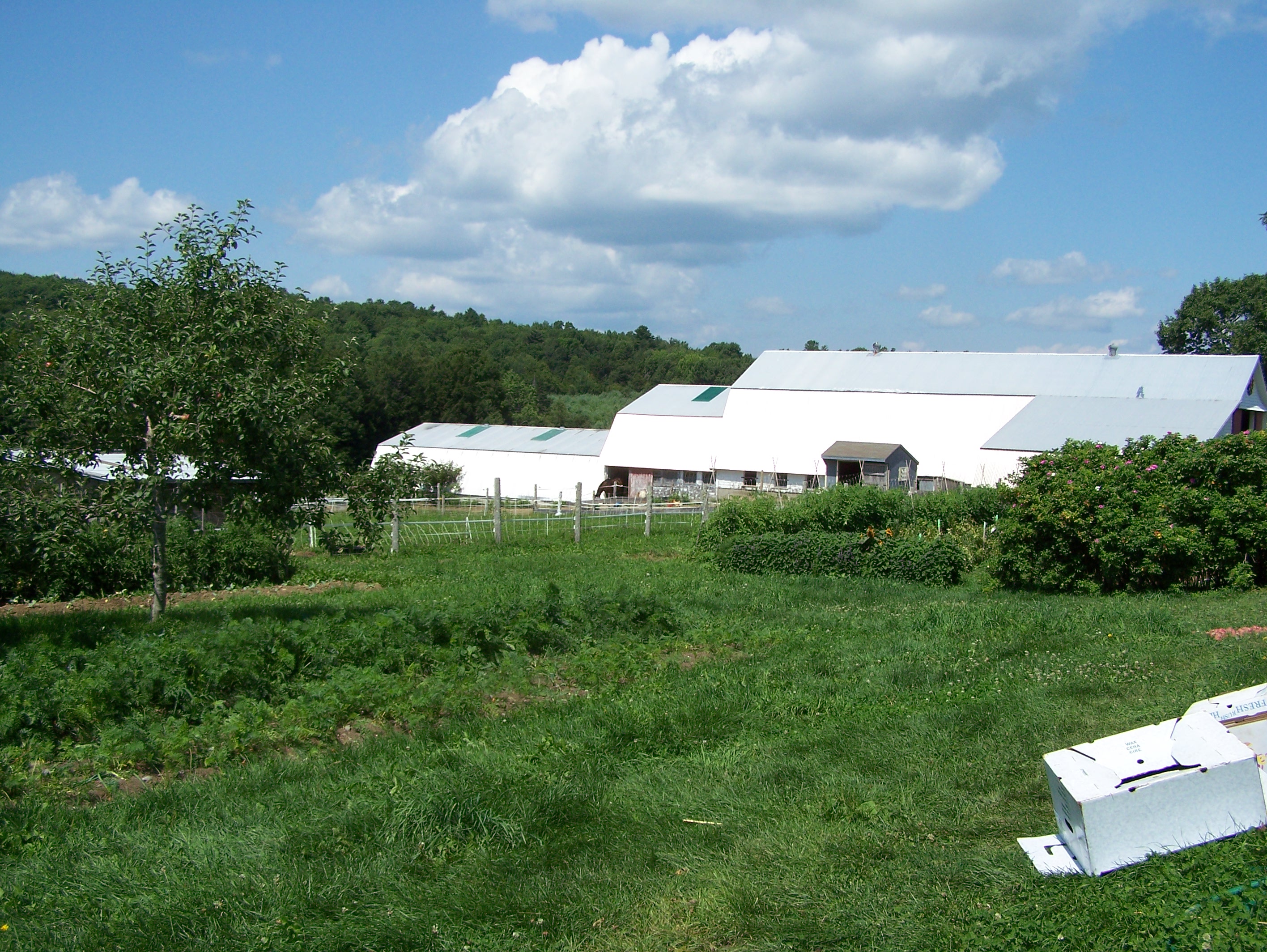
Hills circle the fields, barns, farmhouse, the CSA sheds, and Farmer Tom’s house.   A pond nestles down the hill from the barn, providing a cooling off place for hot CSA workers.  This is a view of the barn and stables from the CSA shed.  Look at how blue the sky can be in Maine.  The old farmhouse is on the far side of the barn.  In the foreground are some garden beds and the first of a line of apple trees.  


Here’s the CSA shed where we pick up our food.  Inside are refrigerators, some cooking equipment, tables, and LOTS of food.  Behind the shed are more garden beds, a huge oak with a tire swing, and a frog pond that drove our grandchildren quite crazy.  To the right there is another small barn and the entry road.  Across that road are planted crops, including a strawberry bed that gets bigger each year.   


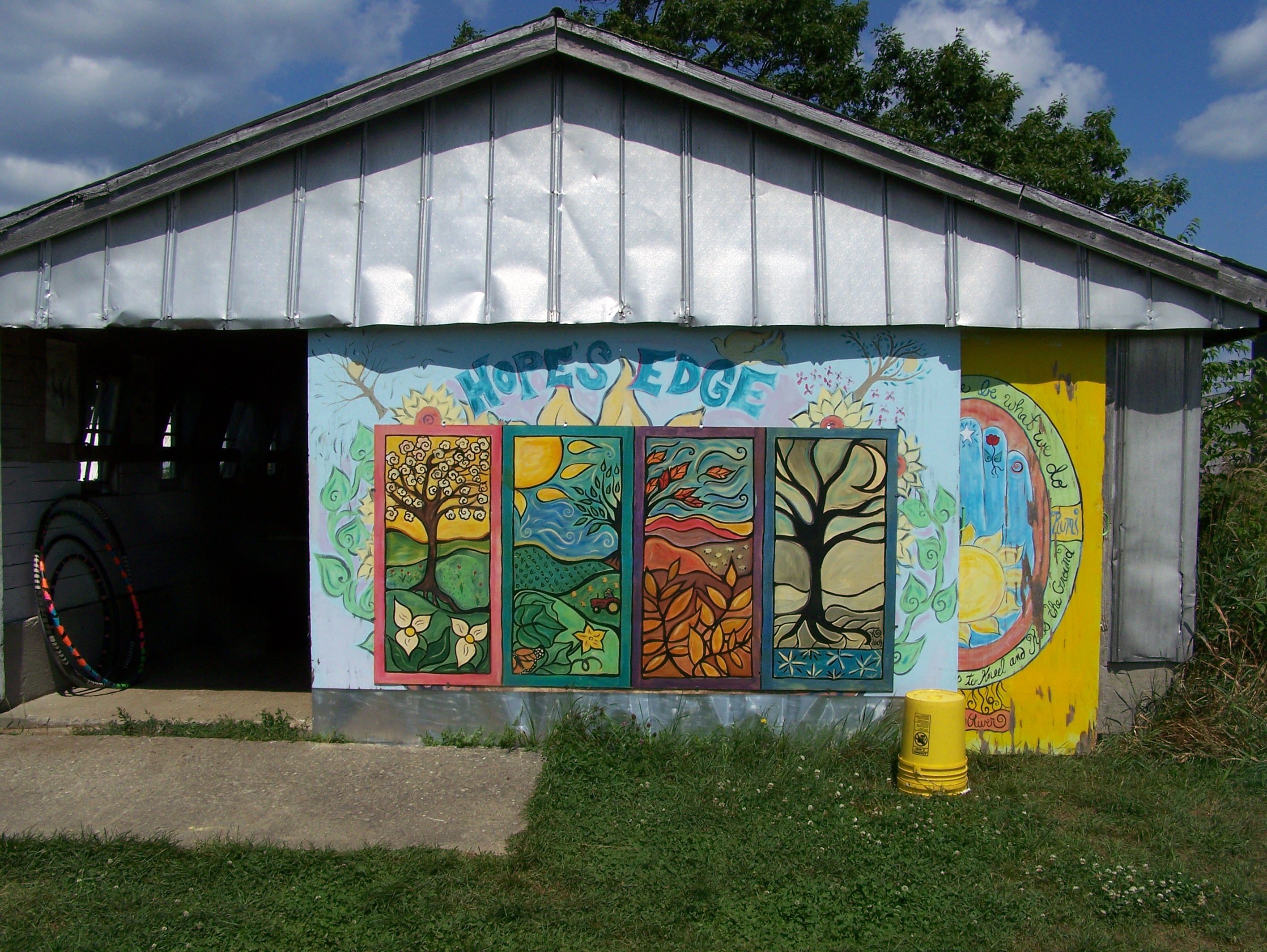
Here’s a bigger picture of the mural.     


We picked up over 12 pounds of food this past Friday.  I could not resist putting it in my garden/mushroom basket and taking a picture:  


Cukes, zukes, tomatoes, cauliflower, broccoli, two kinds of beans (regular and Romano flat), lettuce, herbs, potatoes, an eggplant, a cabbage, carrots, and garlic.  I could have cut a flower arrangement as well, but we were tired after a morning in Augusta, and we have lots of flowers in our own garden.  

It doesn’t get better than this kind of food, does it?  It nourishes our bodies and our spirits.  

Ratatouille, I think.  But with some of the mint I brought from Maine.  And, some basil from our herb garden.

Mainely Tipping Points 15: Rearranging Deck Chairs on theTitanic: The Proposed 2010 USDA Food Guide

Mainely Tipping Points 15

Rearranging Deck Chairs on the Titanic:

The Proposed 2010 USDA Food Guide


The U.S. Department of Agriculture (USDA) and Health and Human Services (HHS) have jointly released the proposed 2010 food guide to a fire storm of criticism.  But first, let’s review recent government food guide history.   

 The USDA presented a new food guide plan and pyramid design in 2005.  It will be considered current until the 2010 guide replaces it.  The 2005 graphic is fronted by a triangle composed of colorful triangular stripes representing five food groups (grains, vegetables, fruits, milk, meat and beans).  Some triangles are bigger than others.  The front triangle is backed by a triangular set of steps with a stick figure climbing upwards.  A USDA web site (www.mypyramid.gov) allows an individual to enter personal information so that one of twelve personal pyramids is assigned.    

 Luise Light, hired by the USDA to design the 1980 USDA food guide, published WHAT TO EAT:  THE TEN THINGS YOU REALLY NEED TO KNOW TO EAT WELL AND BE HEALTHY in 2006, which in part describes how USDA  political appointees manipulated Light’s proposed guide to favor industry.  Light warns that with the 2005 food guide the USDA is trying to please everyone, makers of junk food and proponents of nutritionally important foods.  The 2005 guide, warns Light, is built around calories, which translates that “all foods are good foods.”  One has only to count calories, even junk food calories, to be healthy. 

 But, Light explains, by shifting “the emphasis away from best food choices to a new food democracy where every food is equal,” the USDA ignored “research over the last ten years” that shows “the types of foods, ingredients, and eating patterns that are beneficial for health and weight” (85-86). 

I believe this strategy also removes responsibility from industry for producing unhealthy foods.  By emphasizing individual choice, it becomes the individual’s responsibility not to eat that which makes him or her fat or sick—even though highly processed fake foods, tainted foods, and chemically poisoned foods fill national supermarkets. 

Light explains that “more than half of all consumers in a nationwide survey” responded that they were confused by the new pyramid.  Yet, the USDA allocated no funds to promote the new guide.  Rather, the USDA planned to task industry with helping to educate Americans about food choices.  Light notes that the Idaho Potato Commission immediately announced that carbohydrates, including potatoes, are the best fuel for muscles. 

 But, Light reminds, in reality, the food guide was never meant to be “a tool for health promotion based on the latest scientific studies about healthy eating.”  And, she asks if it isn’t time that nutritional questions are “answered by knowledgeable, independent authorities without a vested interest.”  Right now, people are “told different things at every turn by physicians, teachers, dietitians, the government, and food marketers” (85-86). 

The government released the 2010 proposed food guide this spring and scheduled public hearings and organized a web site for public comments.  Criticism involves, in part, the fact that the proposed guide not only continues down the path that has produced a national obesity epidemic and chronic health problems, it ups the ante on its unscientific position regarding dietary cholesterol and saturated fats by further lowering recommended daily levels.  Under the new rules, one cannot eat an egg.  Or, cheese.  Yet eggs—nature’s perfect food–have sustained humans for thousands of years.  And, properly prepared cheese is a nutrient-dense food.              

Sally Fallon, President of the Weston A. Price Foundation (WAPF), in the winter 2009 WAPF quarterly journal WISE TRADITIONS, agrees that the 2005 guidelines were “not based on science but were designed to promote the products of commodity agriculture and—through the back door—encourage the consumption of processed foods.”  The 2010 guide, Fallon writes, is an exercise in rearranging the deck chairs on the titanic.”  Indeed, Fallon notes, “putting the USDA in charge of the dietary guidelines is like letting the devil teach Sunday school (“President’s Message,” 2-3).   (See www.westonapricefoundation.org for extended analysis.)  

Fallon notes that the “USDA-sanctioned industrialization of agriculture,” has resulted in “a huge reduction in nutrients and increase in toxins in the American diet.”  Government food guides “have caused an epidemic of suffering and disease, one so serious that it threatens to sink the ship of state.”  The 2010 proposed guide is “a recipe for infertility, learning problems in children and increased chronic disease in all age groups.”  And, Fallon notes, while a growing number of Americans are figuring out what’s wrong with government-sponsored nutritional guides, millions in hospitals, nursing homes, prisons, and schools are trapped in the “Frankenstein creation” which is “a tragic and failed experiment” (2-3).   

 The American diet, Fallon notes, contains widespread deficiencies in the fat-soluble vitamins A, D, K, and E.  But, Fallon explains, “there is no way for Americans to consume sufficient quantities of these critical vitamins while confined to the low-fat, low-saturated fat, low-cholesterol, low-calorie cage of the USDA dietary guidelines” (2-3).  

The WAPF argues that dietary cholesterol is a precursor to vitamin D and that our cells need cholesterol for stiffness and stability.  And, the WAPF warns that the USDA committee is ignoring “basic biochemistry” that “shows that the human body has a very high requirement for saturated fats in all cell membranes.”  If we do not eat saturated fats, the body makes them from carbohydrates, but this process “increases blood levels of triglyceride and small, dense LDL, and compromises blood vessel function.”  Further, high carbohydrate diets do not satisfy the appetite, which leads to higher caloric intakes, bingeing, rapid weight gain and chronic disease.  This diet is “particularly dangerous for those suffering from diabetes or hypoglycemia, since fats help regulate blood sugar levels.”

The USDA committee’s solution, Fallon explains, is to “eat more `nutrient- dense’ fruits and vegetables.”  But, Fallon notes, “fruits and v”egetables are not nutrient-dense foods.”  Nutrients in plant foods do not compare with “those in eggs, whole milk, cheese, butter, meat and organ meats.”

Fallon points out that some USDA committee members are concerned with “the choline problem.”  Choline is “critical for good health and is especially necessary for growing children.  If choline intake is too low during pregnancy and growth, brain connections cannot form.  And, if choline is abundant during developmental years, the individual is protected for life from developmental decline” (2-3) 

Excellent sources of choline are egg yolks and beef and chicken liver.  Fallon notes that the National Academy of Sciences recommends amounts of choline consumption that violate the USDA’s proposed cholesterol limits.  So, she argues, “while we watch in horror the blighting of our children’s lives with failure to thrive, learning disorders, attention deficit disorder, autism and mental retardation, the committee is sticking to its anti-cholesterol guns.”  

Analysis on the WAPF web site details how the USDA committee has swept “the dangers of trans fat under the rug by lumping them with saturated fats, using the term `solid fats’ for both.”  This categorization hides the “difference between unhealthy industrial trans fats and healthy traditional saturated fats.”      

Also, notes the WAPF, the USDA committee has promoted “an increase in difficult-to-digest whole grains,” without specifying that all grains, nuts, seeds, and beans need to be soaked to remove the powerful antinutrient phytic acid.  (More on this subject later.) 

I agree with the WAPF assessment that the 2010 guide should be scrapped and that “the committee members should be replaced with individuals who have no ties to the food processing industry or to universities that accept funding from the food processing industry.”  I’ll bet Luise Light does, too.