Turkey Tracks: November 8, 2010
Long-Armed Sewing Machine, “Lucy”
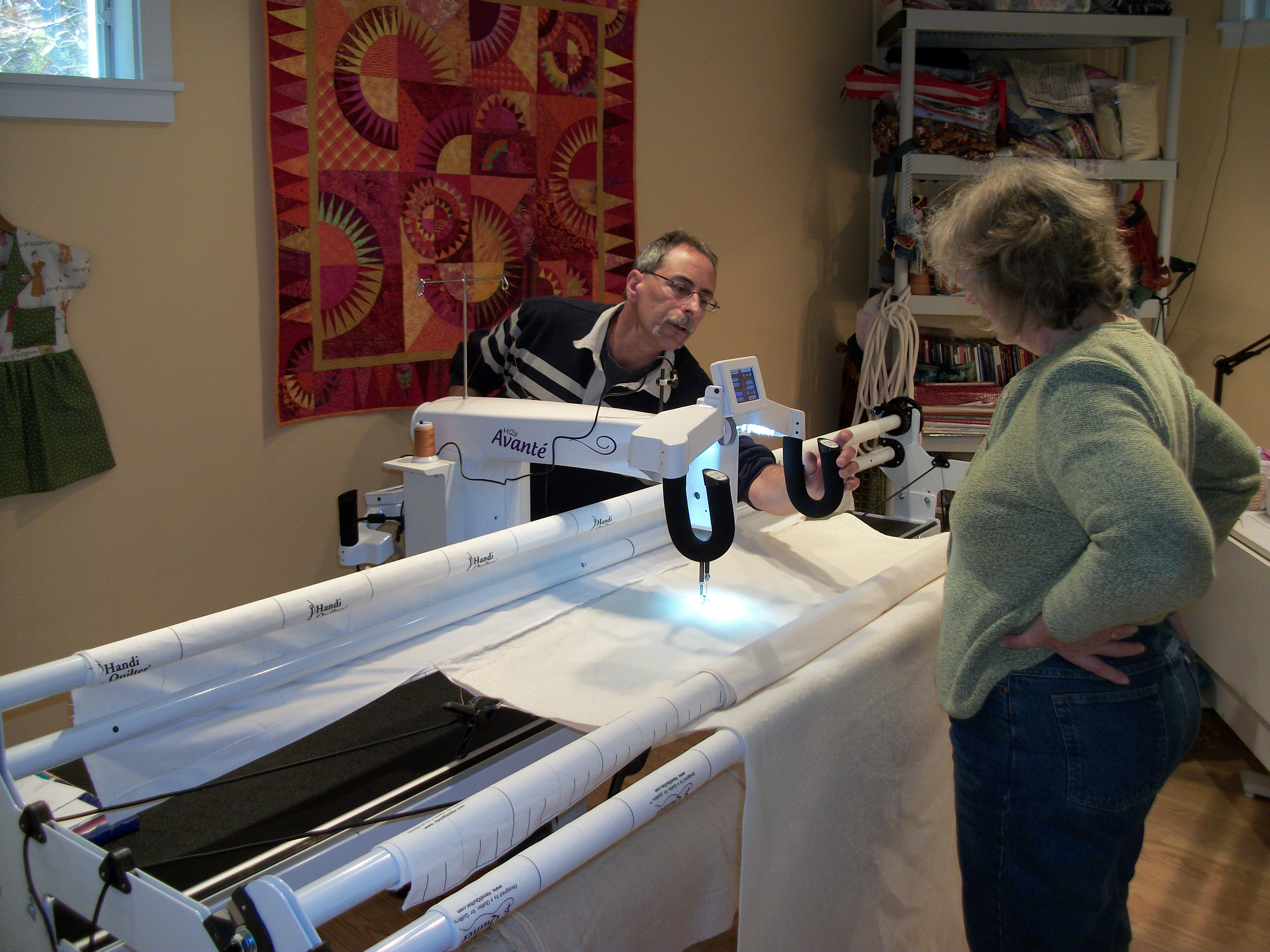
I’ve wanted a long-arm sewing machine for a long time, as I said in an earlier post. But I was not sure what kind to get, who would service it, how to set it up, what kind of table would be sturdy, and could I really learn to be as good on it as Joan Herrick is. (Joan is a fellow member of Coastal Quilters, a chapter in the Maine state quilters’ guild, Pine Tree Quilting Guild.) Joan is an amazing long-arm quilter. When I got some money from my mother’s estate, I took the plunge. John named the daunting looking machine “Lucy” after we set her up. Mother would be pleased as she had a secret desire to quilt but never took the plunge.
I got a Handi Quilter Avante, and it came to me from Utah. I’ve tried all the machines in this class–made for the home hobbiest–and kept returning to it. It has an 18-inch throat, which means I have an 18-inch strip to quilt before I have to roll up the quilt top. For those of you who don’t know, a long-arm sewing machine slides back and forth on tracks, so you quilt from side to side on the quilt. You roll the top, batting, and backing onto rollers, so you don’t have to pin all the layers together. And, long-arms today have stitch regulators that keep stitches even across the quilt. Even my first halting practice session made my work look beautiful. But, there is a learning curve. Free-motion stitching on a domestic machine involves using small muscles. The long-arm requires you to learn to harness big muscle movements down to fine work. There are, also, extra handles that can be installed for close, fine work. With those, you sit on a stool. For everything else, you stand and have at it.
Also, you can operate the machine from the front or the back. The back handles are used when you want to use a pattern you trace with a laser beam or grooved boards that a stylus fits into to trace a pattern. I got two of these board patterns which I’ve never been able to manage on a domestic machine: Bishop’s Fan and a Clamshell patterns. And I came home with a few laser-traced patterns, but I was terrible at those when Gerri showed me how to do them. More practice there for sure! And, I’m partial to my own designs anyway.
John and I spent a very fun day putting together the elaborate and sturdy table Lucy inhabits–a real learning experience for me. We were able to get 8 feet of the possible 12 feet table set up, so I can handle quilts up to about 83 inches wide. That’s a pretty big quilt. But, it turns out Lucy has had TWO bad computer boards and does not work, so she is in Sanford (3 hours south) getting new innards. I went down to Sanford for training for 2 days (a fabulous experience–thank you Gerri Waitte) and made another trip back to take Lucy to be fixed when it became clear that there was another bad board involved. (I didn’t want to ship Lucy down to Sanford.) Karen Johnson, or KJ, who just got her learner’s license, drove most of the second trip which was great practice for her, especially as it was pouring rain . Sanford Sewing Machine has been terrific about getting Lucy fixed. Tim Sansevieri even made a trip up to change out the first board, but it also was bad, as we discovered when he had been gone about an hour. All of this board business is just a bit of frustrating bad luck and a fluke for both Handi-Quilter and Sanford Sewing Machines, and Lucy will be off and running shortly. Likely we will pick her up when we fly back home from Charleston in early December.
Here’s a picture of Tim and Lucy in my quilt room:

 Louisa Enright's Blog