Turkey Tracks/Books: My Current Read Pile

Turkey Tracks/Books:  June 26, 2011

My Current Read Pile

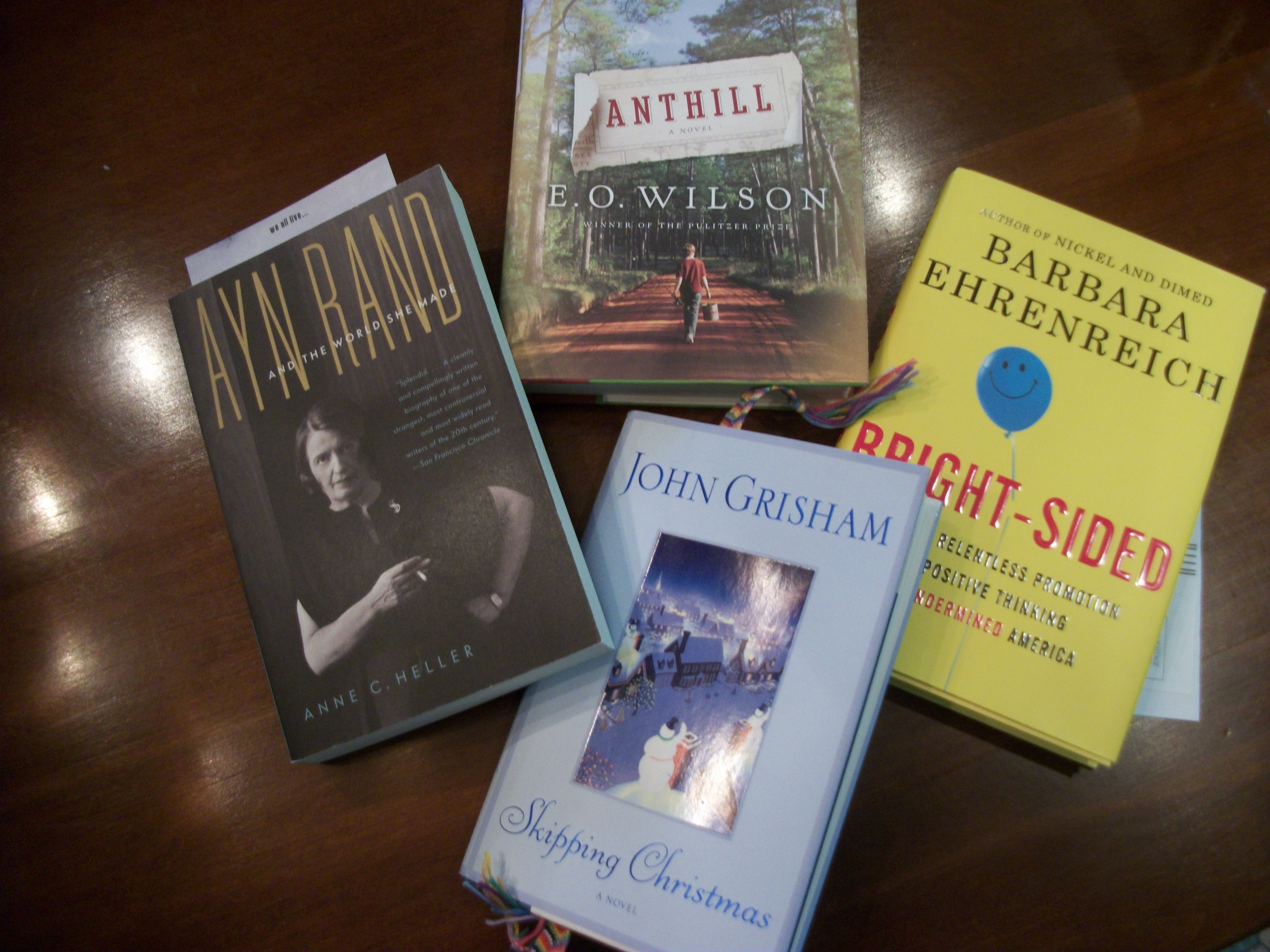
Here’s a picture of my current read pile:

I have, for what is, I’m sure, a brief moment, caught up with my magazines and journals.

Despite the title, John Grisham’s SKIPPING CHRISTMAS might not wind up advocating that stance at all.  So, I look forward to finding out what happens.  This book was a gift from a friend after I wrote a piece about my dislike of–and refusal to participate in–the commercial nature of Christmas.

The biography of Ayn Rand interests me because I’d like to see if she “walked her talk.”  Her economic and social theories have had a powerful impact in this country.  For instance, Congressman Paul Ryan’s budget was derived from Rand’s “objectivism” philosophy.  Her “super man” heroes come too uncomfortably close to the theories that guided Nazism maleness for me.  But, it will be good to refresh my knowledge of her theories.  I read her novels too many years ago–actually when I was in high school.

E. O. Wilson’s book on ants won the Pulitzer one year.  He’s an emeritus scientist at Harvard, and a naturalist to the core.  He’s also a southerner, and he captures a number of southern mindsets in the characters in this book.  The sections on ants are not just about ants; they’re about over population and an unimpeded use of available resources–to the point where nature can no longer support an out-of-synch ant population.  This section is a warning to humans, actually.  As a novel, the book doesn’t quite work–because it isn’t sure what it should be.  But as something else–the inner thoughts of a major scientist, it’s well worthwhile.

Barbara Ehrenreich’s BRIGHT-SIDED was recommended by a Camden friend who knows I think the unbridled optimism of Americans–especially with regard to medical problems like cancer–is a problem that helps us to ignore what we must do to begin to heal our environment, ourselves, our country, and our world.  As long as we can say “the problem is that you aren’t trying hard enough,” we cannot begin to understand what is actually wrong, how we’ve been poisoned, and so forth.

Turkey Tracks: Rabbit Visitor

Turkey Tracks:  June 29, 2011

Rabbit Visitor

Margaret told me that a neighbor’s rabbit was coming down to her garden to visit.  There’s so much activity in that garden now:  meat chickens, layer chickens, and pigs.  The rabbit must be drawn to the activity and life.

John was quite surprised to see the rabbit one morning while we were waiting for the Associated Buyers truck to deliver our joint food order:

Here’s a close-up of said rabbit:

John would like to add rabbits to our place.  I could do that.  Only, he wants pet rabbits, and I would want meat rabbits.

I wonder how that’s going to work out?

Turkey Tracks: Introducing Chickie Honey Ginger

Turkey Tracks:  June 26, 2011

Introducing Chickie Honey Ginger

Here she is:  our new addition to our flock:  Chickie Honey Ginger:

She’s a Freedom Ranger, which is both a meat chicken and a layer.   Even though she’s only 10 weeks old, she is as big as the other full-grown hens.  But, she’s still very “baby chickie” too.

And let me tell you that everything one reads about not upsetting the pecking order in the flock is true.  I took the two older Marans to Rose and brought in Chickie Honey Ginger, and the two Wheaten Americaunas in particular have made her life miserable.  The rooster does what he can, and she sleeps next to him most nights, but it has taken a week for some sense of order to return to the flock.  She hangs out sort of near the rest of the hens most of the time now, but she really is still very young.

A better strategy would have been to have just brought in all four of the new additions at one time.  But, the others are two weeks younger still, and I worried about them since my chicks are now penned.  I’ll bring them in this next week:  two CB Marans and a Wheaten Americauna.  There wasn’t much choice since we processed the meat chicks this past Saturday.

Our freezer is crammed full with 24, beautiful, healthy FR chickens.

Turkey Tracks: The Best Bouquet this Spring

Turkey Tracks:  June 26, 2011

The Best bouquet This Spring

The white-tipped radish are long, thin French Breakfast Radish.   The round ones are Cherry Belles.

We’ve been slicing the French Radishes in half, sprinkling salt over them (real sea salt that is just air dried), and eating them for breakfast with slices of cheese and a selection of meats (salami, prosciutto, liverwurst).  Yummo!

The Cherry Belles are a bit more peppery, and I usually slice them into our salads.  They’re also good in a stir fry or steamed, either sliced or just whole.

I cut the garlic scapes–it’s the garlic flower–on one kind of our garlic plants this year.  I didn’t know what garlic scapes were when I first came to Maine.  Garlic scapes are delicious! cut up and added to soups or stir-frys.  They come in just when the stored garlic is getting either dried out or moldy.  They have such a crisp, light garlic taste.

Here are the potato buckets BEFORE the last two days of rain.  You should see them now!

Turkey Tracks: Garden Tour June 2011

Turkey Tracks:  June 2011

Garden Tour June 2011

How about a mostly flower garden tour?  You see the veggies all the time here, but the June gardens in Maine are astonishingly beautiful.  I didn’t get a picture of the lilacs–which have taken 6 years to bloom heavily, but the garden is so fragrant with them.  I also have lots of peonies, though there is only one picture here.

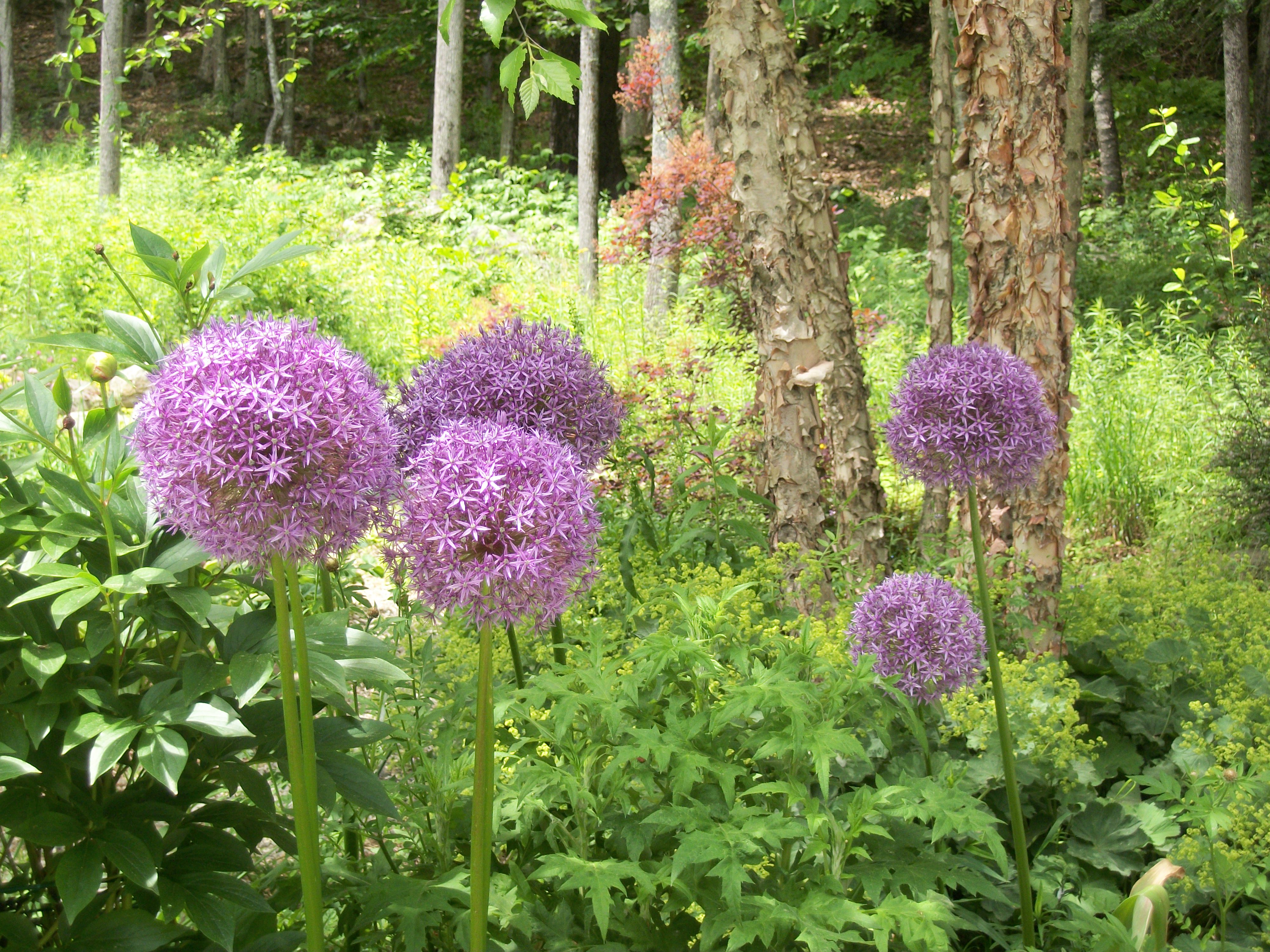
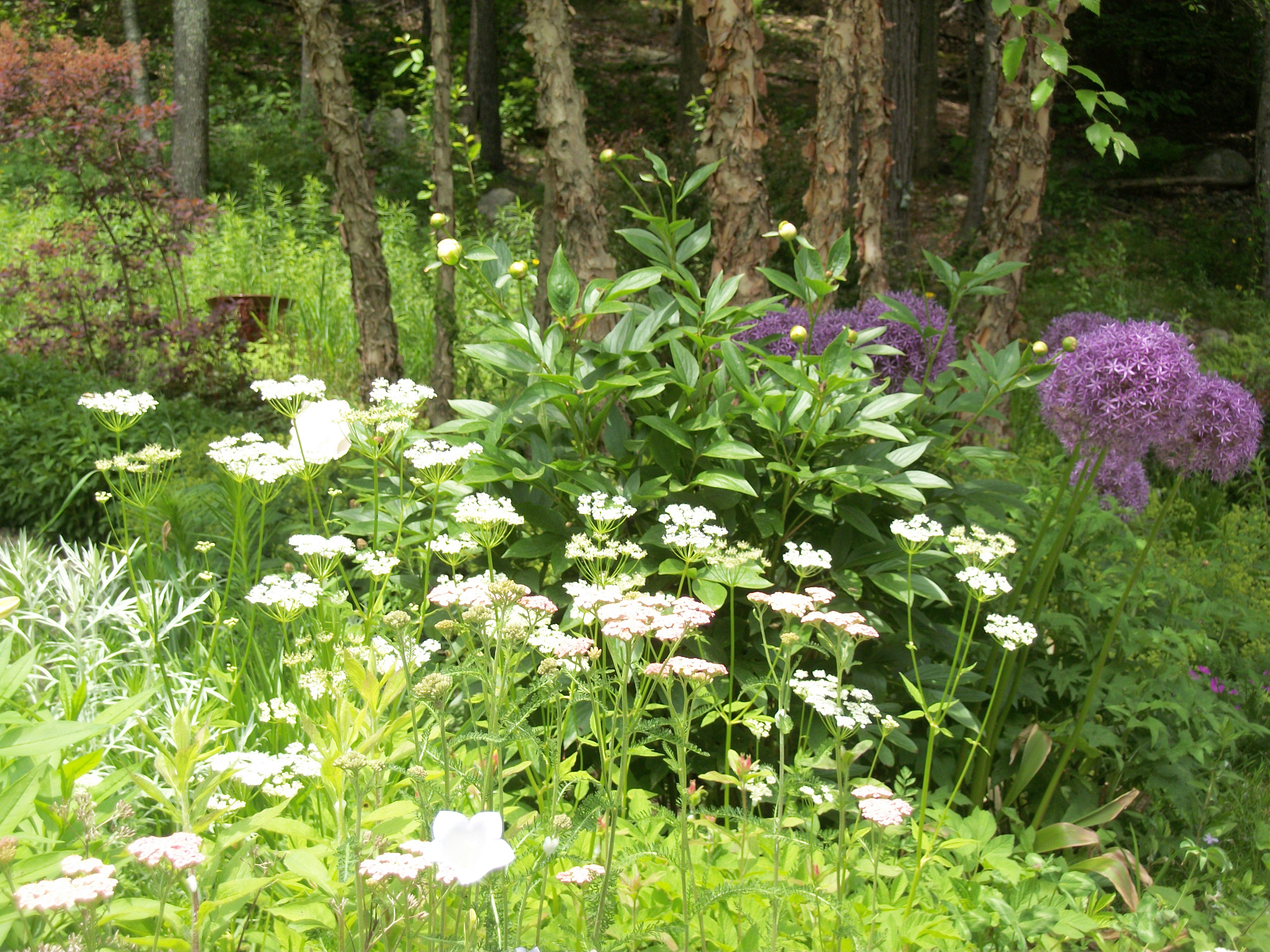
Here’s a picture of the allium bulbs beneath the river birches:

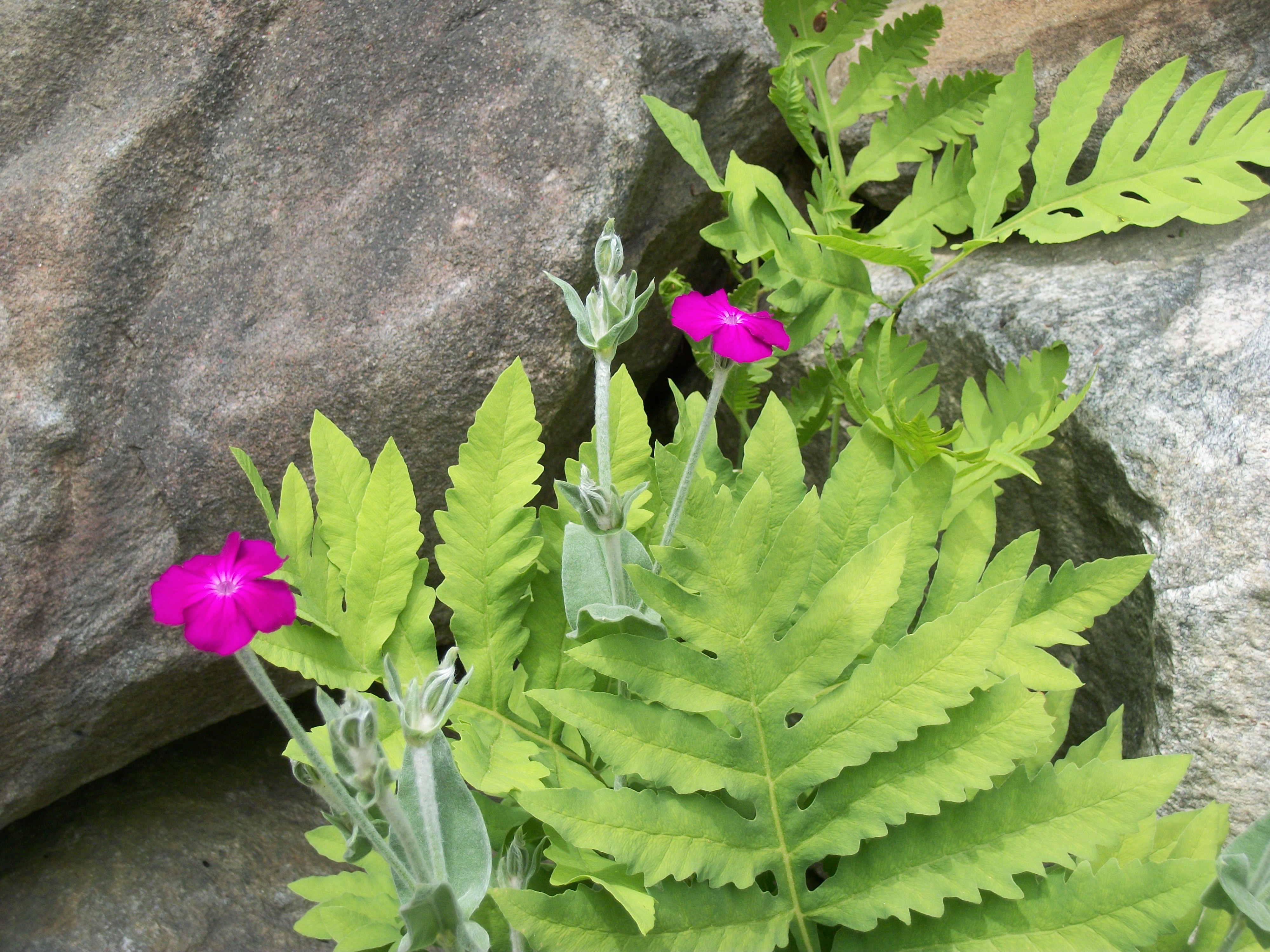
Here’s a pic of a Maine fern and Rose Campion, both of which grow here like weeds, on the rock wall in the back:

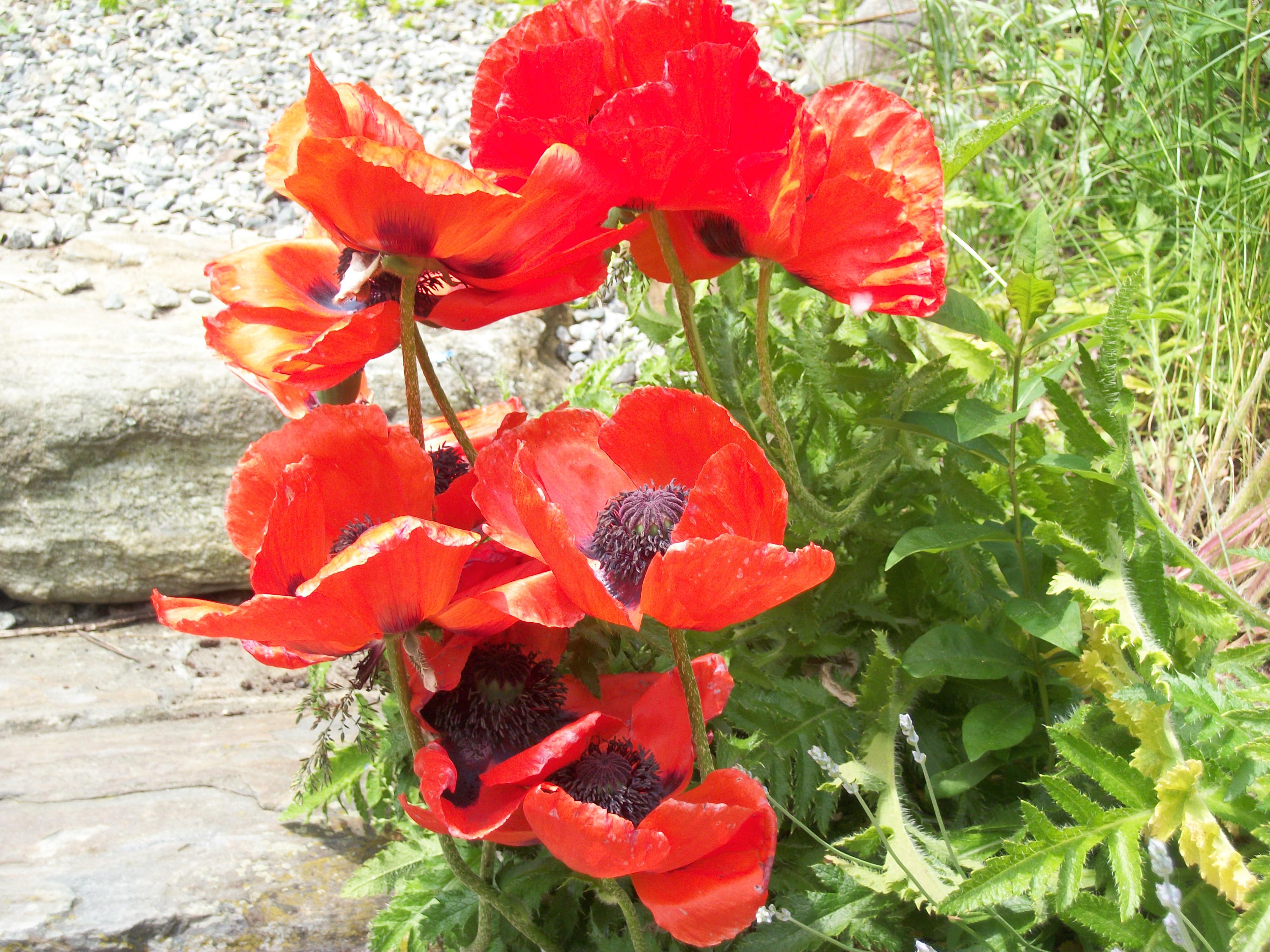
Here’s a pic of red poppies near the stone steps to the upper back of the house:

Here’s a pic of some white peonies just bursting into bloom:

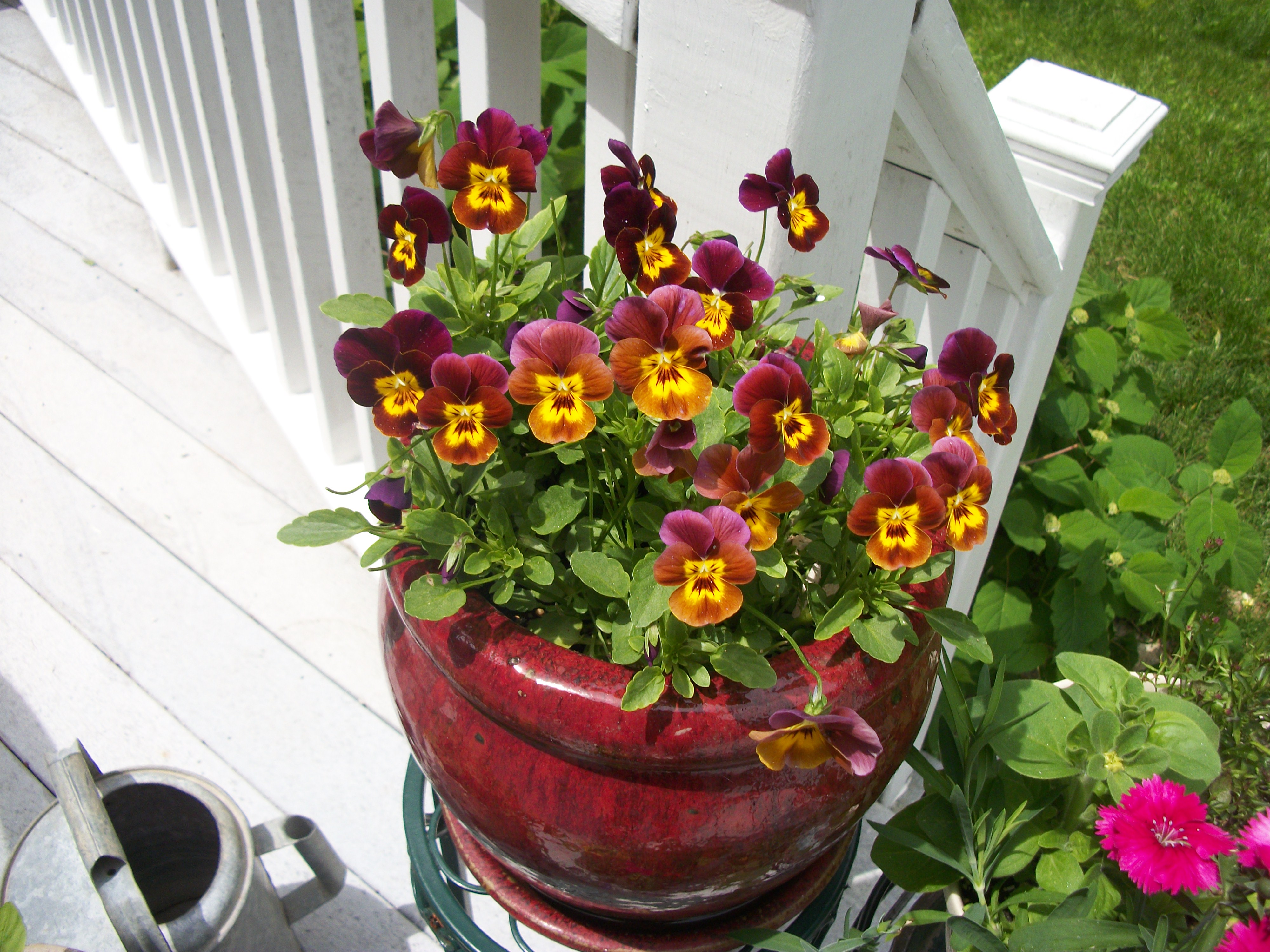
Here’s a picture of some really interesting violas on the back porch.  I knew when I saw them that they would look so great in this particular pot.

Here’s a picture of a hanging basket filled with lavender petunias.   They are so fragrant, especially in the heat.  I love the spicy sweet smell of petunias.

Here’s a pic of geranium, with Lady’s Mantle back of it, atop the driveway rock wall:

And, finally, a picture of the wall garden.  This picture shows how beautiful one’s garden can just blend into the woods.

Book Club Reading List 2011-2010

Our book club gathered last week to pick our next slate of books.  There are six members, and we each present a list of 5 books we have chosen for the book club’s consideration.  The members then each vote on two of our books, votes are counted, and the high counts join the list.  After all the books are chosen, we assign books to particular months.  We try to match shorter books with months where we are busier, for instance.  And similar books get separated across the months, as are the two urban garden books on this slate of books.

Because we are all very different people, we bring different books to the table for consideration.  I wind up reading books I would not choose on my own, and that’s usually a really good thing for me.   It’s also interesting to see who does or does not like a book–interesting discussions reveal aspects of a book we might not have considered on our own.

Book Club Reading List 2011-2010

2011

July:  THE RED THREAD, Nicholas Jose–two pairs of lovers across the centuries, set in Shanghai

August:  MY EMPIRE OF DIRT, Manny Howard–800 square-foot backyard “farm” in Brooklyn changes Howard’s life when he decides to try to eat out of it for one month.

September:  CUTTING FOR STONE, Abraham Verghese–Twin brothers (Indian/British) share a love for medicine.  Novel moves back and forth from Ethiopia and New York.

October:  TO KILL A MOCKINGBIRD, Harper Lee–now classic tale of racism.

November:  THE HARE WITH THE AMBER EYES, Edmund de Waal–family memoir revolving around the inheritance of a collection of ornamental Japanese carvings known as netsuke.

December:  MAJOR PETTIGREW’S LAST STAND, Helen Semonsen–in a small English village, Pettigrew values the quiet life and honor, duty, decorum, but begins a friendship with Jasmina Ali, a Pakistani shopkeeper, which results in culture clashes and a funny, barbed, and winsome book.

2012

January:  THE SWEET LIFE IN PARIS, David Lebovitz–cookbook author and Chez Panisse pastry chef Lebovitz gathers some of his best stories about Paris in this hilarious book.

February:  FARM CITY, Novella Carpenter–in a ghetto in Oakland, CA, Carpenter begins farming a vacant lot next to her apartment.  As she grows bolder, she brings in bees and animals:  chickens, rabbits, and pigs.

March:  THE WHITE WOMAN ON THE GREEN BICYCLE, Monique Roffey–Trinidad, an unforgettable love story that is brimming with passion and politics.

April:  SILK, Allesandro Baricco–powerful and erotic tale that reveals how one man’s desire threatens to ruin his life.

May:  LET THE GREAT WORLD SPIN, Colum McCann–portrait of NYCity, 1974 ; winner, National Book Award, reviewed as “an emotional tour de force.”

June:  LYRICS ALLEY, Leila Aboulela–Egypt and Sudan, a warm, well-crafted story that foregrounds romantic love and the search for spirituality and meaning.

Turkey Tracks: Do Yourself a Favor: Cook and Eat Dark Leafy Greens

Turkey Tracks:  June 19, 2010

Do Yourself a Favor:

Cook and Eat Dark Leafy Greens

Dark Leafy Greens are chock full of nutrients.  I’m talking Lambs Quarters, Bok Choy, Collards, Turnip Greens, Mustard Greens, Chicory, Dandelion, Kale, Parsley, Dock, Endive, and Watercress.  (Lamb Quarters and Dock are wild greens:     for dock, see http://eatingmymoccasinsnow.blogspot.com/2009/04/dock-rumex-crispus.html; for lambs quarters see http://www.google.com/search?hl=en&rlz=&=&q=lamb+quarters,+image&um=1&ie=UTF-8&tbm=isch&source=og&sa=N&tab=wi&biw=1362&bih=669.

I’m leaving out spinach, chard, and beet greens because they have high levels of oxalic acid that can cause a number of unpleasant side effects:  kidney stones and the reduction of the body’s absorption of calcium and iron among them.  Though I love spinach and chard, I eat these greens sparingly and, pretty much, only in season.

I try to cook several batches of dark leafy greens in a week, and I cook enough of them at one time to have leftovers.  Cold greens are delicious drizzled with a vinaigrette or a tahini or peanut dressing.  But, my favorite leftover use is to use the greens inside an omelet–with added cheese.  An omelet of goat cheese and cooked greens is great for breakfast, lunch, or dinner.  And, the combination of greens, egg, and cheese is…delicious!

According to Rachel Albert-Matesz and Don Matesz, in their cookbook and guide, THE GARDEN OF EATING, kale has 250 percent more vitamin C than an orange, 4, 450 percent more Vitamin A, and more potassium, iron, phosphorus, calcium, and protein (308).  Rachel A-M has a terrific web site, too:     http://www.thehealthycookingcoach.com/.   I highly recommend the cookbook.  I’ve yet to cook something bad from it, and it has significantly expanded my ability to  cook greens and to create satisfying meals without using grains.  Her web site has the cheapest prices–it’s under $30.

These dark leafy greens need to be cooked.  They don’t lose substantial nutrients, and cooking reduces some of the bitter compounds that can hinder digestion and absorption of nutrients.  Think of cooking them for at least 10 minutes.  This aspect of dark leafly greens makes me hesitate about juicing them, too.

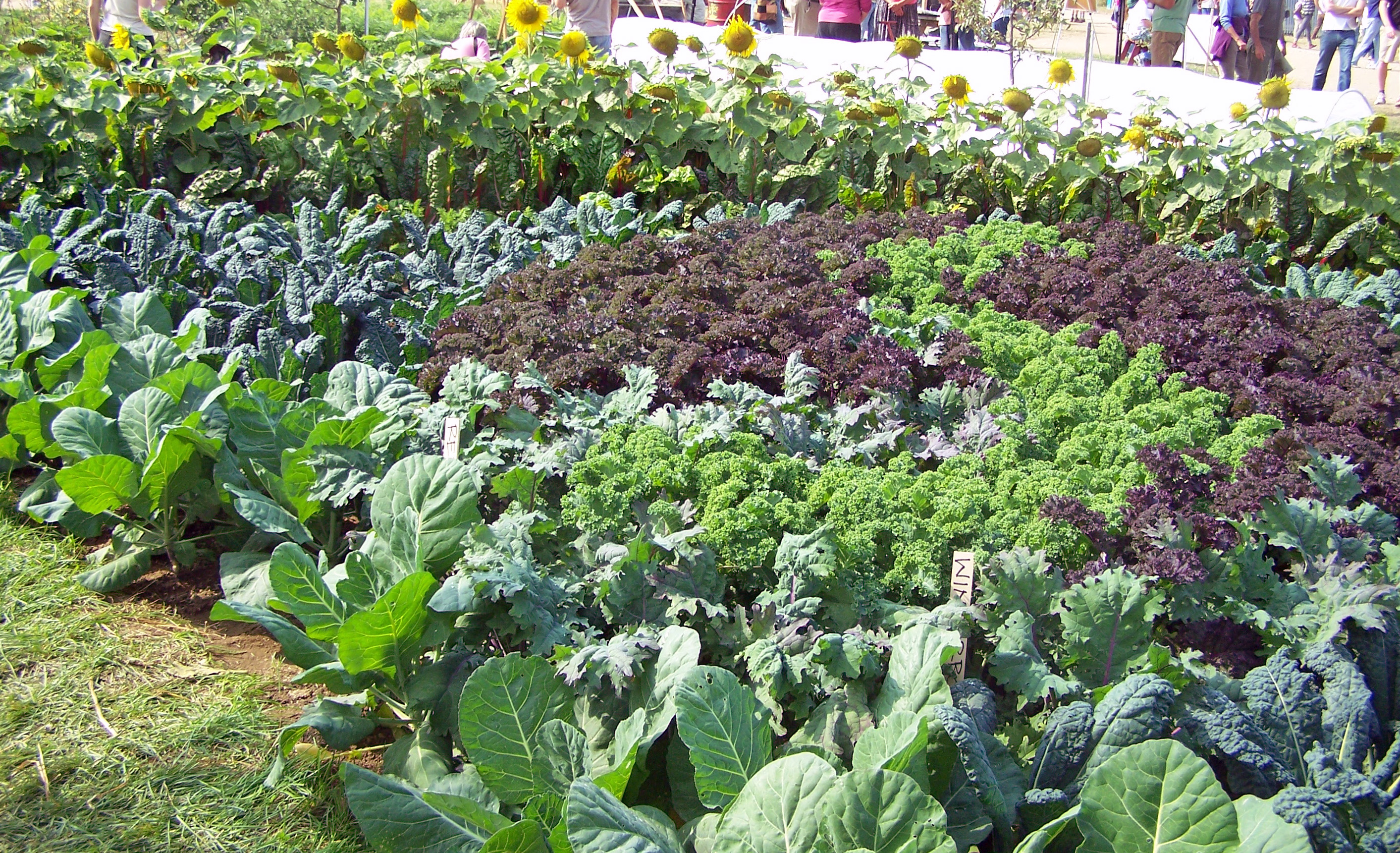
My favorite greens are kale and collards.  Kale comes in various, beautiful forms, and each tastes slightly different.  You might recall a picture I took of some kale forms at the Maine Organic Farmers’ and Growers (MOFGA) fair last year.  Collards are in the foreground.
There are two principal ways to cook greens:  boil whole leaves/stems or pan saute and steam greens in a large, covered frying pan or pot.  I use both methods.  I boil when I want to prep greens ahead.  I particularly like kale boiled, chopped, and, later, sauteed in butter.  In both cases, you need to strip or cut (collards) the leaf from the fibrous stem.  Kale stems are more tender than collards.  Rachel A-M cooks kale stems and chops them when tender and adds them back to the leaves.  I’ll confess, usually I give the stems, which always have a few remaining bits of leaves, to the chickens as they take true delight in them.

For boiling, bring water to boil, drop in the whole leaves, and cook until tender–at the most from 5 to 10 minutes.  Drain, immerse in cold ice water to preserve color, and chop.  If you layer the leaves, then roll them, you can slice off strips.  Turn the strips and cut off bite-sized pieces.  Refrigerate for up to three days.

To pan saute, your imagination is the limit of fun combinations for additions.  Start by stripping leaves from stems.  Roll leaves and slice and cut, again, to make squares.  Sometimes, though, I just roughly chop greens.  Here’s a picture of two bunches of  leafy green kale.  When cooked, there will be enough for four servings.  John and I eat one serving each hot and then we have an asset in the kitchen:  cooked greens to be used in other ways, like an omelet.  Or, eaten cold.  The point I’m making is that greens COOK DOWN rather a lot, so buy enough.

Kale is tenderer than collards.  And, collards, in particular, benefit from the addition of meat broth for liquid, or an extra chicken/turkey wing in the pan.  When I make broth, I always pull off several small 1-cup Mason jars to use when cooking greens.

The basic method is to start by pan frying a chopped onion in good oil/fat.  I use unrefined coconut oil, or duck fat, or saved bacon grease, depending upon what kind of flavors I want.  Adding bits of flavoring meat, like pancetta or bacon, is nice at this stage.  Add some chopped garlic just before you get ready to add the greens.

But, before that, consider what kind of SPICES you’d like to have running around the pan.  Perhaps some combination of spices–cumin, cinnamon, coriander, turmeric, for instance.  Curry powder?  Put those kinds of spices into the pan and let them fry in the fat for a moment or two–with the garlic if you’re using it.  Mustard is a nice addition.  Any of the hot pepper spices, like paprika or red pepper.  And nutmeg is lovely with greens.  Thyme or sage is nice.  Gingeroot is lovely.

You could throw in some sliced apples in the fall.  Or, a handful of dried fruit in the winter.  (Think of drizzling in some honey or maple syrup at the end if you go in this direction–with a bit of fruity vinegar to spark the tastes.)

A handful of cleaned seaweed (dulse, for instance) gives some heft and adds iodine, which I think about since I don’t eat grocery store salt.

Adding other vegetables is also nice:  carrots, mushrooms, cauliflower, daikon radish, celery, bell pepper strips.

USE WHAT YOU HAVE IN THE KITCHEN.

When your veggies and spices are sweated out/mixed in, throw in the greens.  If they have enough water from washing, you can begin to turn them with tongs until they wilt down.  If you don’t have enough liquid, add water/bone broth (about a cup) to the pan–mopre for collards–wilt down the leaves, and cover and cook for 5-10 minutes.  Collards will require longer cooking.  Remove the lid and cook down any remaining liquid at high heat before serving.

ENJOY!
Turkey Tracks: Prudy’s Quilt

Turkey Tracks:  June 15, 2011

Prudy’s Quilt

My friend Prudy Netzorg is incredibly generous!

She gave me two quilt tops last fall:  a smaller child’s quilt featuring dogs and a lap quilt of bright, lively colors.  (Prudy has a wonderful eye for color.)

I loved both, but knew that she, too, loved one of them especially, but had just lost energy around finishing it.

I had gotten the long-arm just before Prudy’s generosity, and there is a HUGE learning curve for long-arms.  So, Prudy and I agreed that we would go together to buy backs for her tops, and I would pay for those in return for using the quilts as learning tools.  Prudy would bind them and give the little one to a local fund-raising charity for auction and would keep the other.

I tried a pantograph pattern on the smaller one–and learned a lot–to include that I didn’t especially care for narrow patterns.  They repeat too quickly.  I did think the pattern looked like a dog’s footprint and a group of balloons rising–both motifs in the print.

I just finished the larger, bright one.  I think it mostly came out looking pretty good, but it is not perfect, and I like perfect.  I did, however, learn a lot, especially about using templates.

Here’s the quilt finished without the binding, which Prudy will do.  I remember a hot pink binding…


Here’s a detail of the border.  I special ordered a hot pink thread, which I think came out nicely.

Here’s another detail:

Another thing I learned is that it is necessary to take a picture of the whole quilt or draw a quilting pattern–especially with a pieced quilt like this one.  Once the quilt is rolled up on the back roller–which happens as you quilt the length of it–you can’t see what you did at the other end.  I got confused on which way I quilted the pieced blocks, for instance.  I put the loops on the pinwheel blocks in two different places.  And, at one end, I forgot what I did at the other with two blocks.

I did walk away with a new comfort level with templates, and the quilt is lively and fun.

Thanks Prudy!!

Turkey Tracks: Sardines For Dinner

Turkey Tracks:  June 15, 2011

Sardines For Dinner

Here’s what we had for dinner last night:

There are lots of good reasons to eat sardines.  They’re a little fish and are low on the food chain, so they don’t carry the heavy metal levels (mercury!) bigger fish carry.  They’re full of calcium!  They’re delicious!  They’re quick!  (Be sure to buy some that are NOT in soy sauce.  The ones in flavored sauces, like tomato and mustard, are usually full of stuff you don’t want.)  We had some fresh ones in Italy once–just caught and pan fried.  They were beyond delicious!

Surrounding the sardines, what you see is local carrot, local feta, local sweet radishes just coming in now, shaved spring onion from the garden, local hydroponic tomato (cut up and sprinkle tomato with salt to release the flavor), and local lettuce from our neighbors Susan and Chris Richmond of Golden Brook Farm.  The rest of the ingredients are not local:  dried lemon thyme, olive oil, lemon, balsamic vinegar, olives, stuffed grape leaves from a can, avocado, and a cuke.   At least the produce came from California–I don’t buy food from outside our borders.

The chocolate is fair trade.  One of the best of these is Equal Exchange’s dark chocolate with sea salt and toffee bits.

And, of course, REAL MILK, which is fabulous with the chocolate!

PS:  Canned sardines and grape leaves are one of the few things I eat out of a can as most cans are lined with a mixture that releases BPA–a heinous chemical that can seriously harm humans.

Turkey Tracks: Around and About–June 2011

Turkey Tracks:  June 15, 2011

Around and About–June 2011

Chive is in full bloom everywhere now.  Here’s one in Margaret and Ronald’s garden.  I have three or four now as well.  They reseed themselves all over the place.  The leaves are wonderful snipped with scissors over a salad, over cheese (goat, feta, yogurt), or soup.  But, I didn’t know until coming to Maine that the flowers are also delicious.  I kept asking people at potlucks, “what are these lavender things in the salad?”   The chive is one of the earliest herbs to come back in Maine spring (and yes it is still spring here; we don’t get summer until July 4th or so), and it lasts all summer and up to a killing frost.

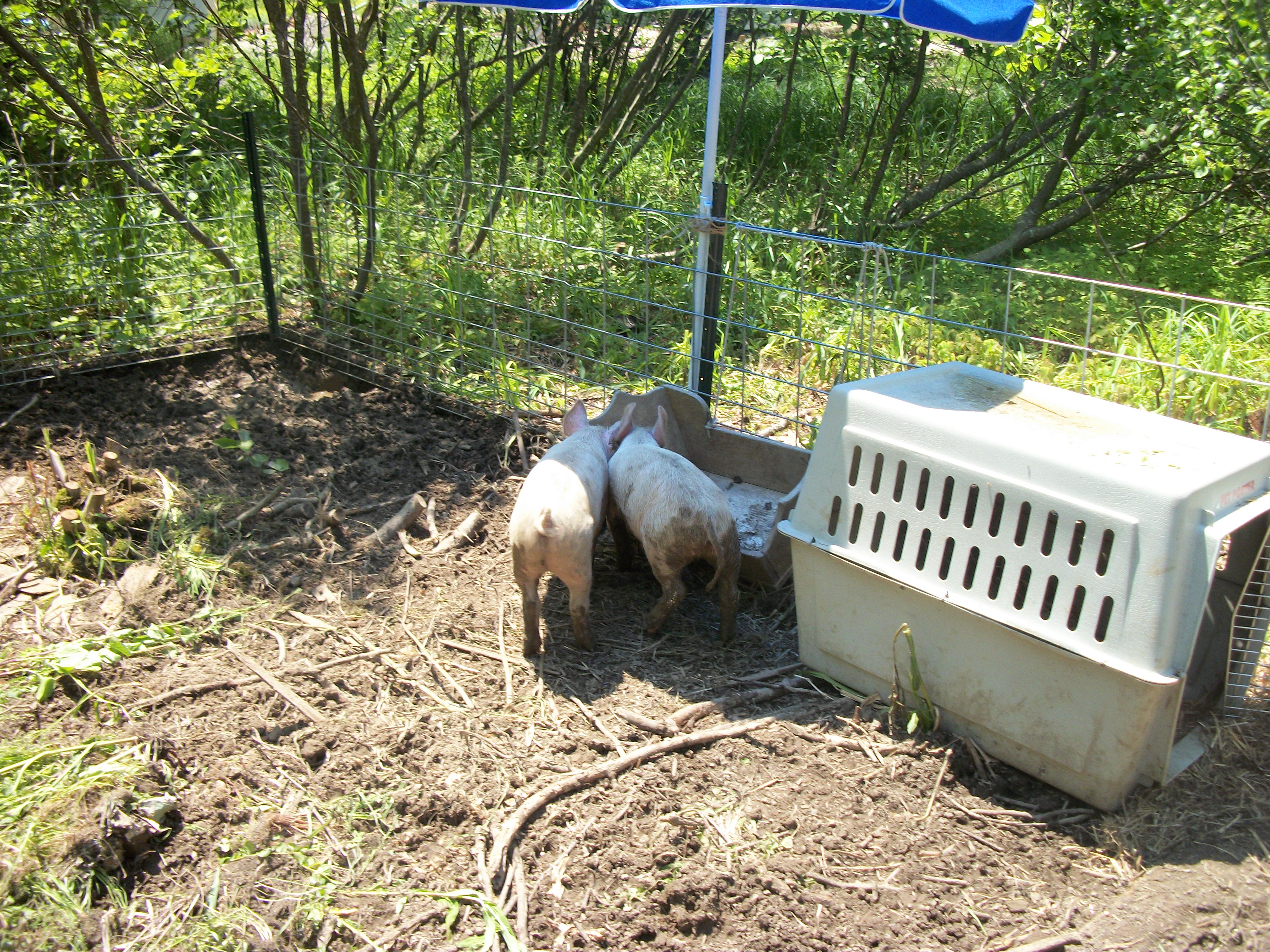
Margaret got  two pigs about 10 days ago.  They’re pink, so will sunburn; thus, the umbrella.  Margaret has always wanted to see what pigs would do on their land.   She’s talked about it as long as I’ve known her.  Now she’ll find out.  She’s moved them once already, and they had completely tilled their former pen at least a foot deep overnight.   They’re now in an area filled with alders–an area M&R would like to clear out for more gardens.  So, they just cut down the alders, put the pigs in, and voila!

I’m still awestruck at how big pigs will get and how quickly they do it and how much they eat–all info gleaned from FARM CITY, by Novella Carpenter, which is a terrific read!

M&R are also raising Freedom Ranger chicks.  Here’s one–a beauty–with her tail cocked and ready to fly!

The lupines are blooming everywhere–all along the side of the roads.  It’s a glorious sight.  Maine lupine come in a variety of colors:  the most common is blue/purple, but there are also pink and lavender shades and white.   Here’s some up at our neighbor’s home, Sarah Rheault:

Here’s some on the side of a road leading west out of Camden.  Lupines line both sides of the road:

Rose and Pete have finished their bread oven, and Rose is learning how to use it and developing recipes.  Here’s a pic of some bread in progress:

Our River Birches are something to behold.  I couldn’t resist taking this picture of the shedding bark:

We went out for lunch today and came back via Barrett’s Cove–one of our swimming holes and a beautiful view.  Here it is:

This little tour does not begin to cover everything exciting that is happening these days.  But, that’s Maine for you!