Turkey Tracks: Blueberry Buckle

Turkey Tracks:  July 24, 2011

Blueberry Buckle

We’re still making desserts this summer from recipes in RUSTIC FRUIT DESSERTS, Julie Richardson and Cory Schreiber:  http://www.amazon.com/Rustic-Fruit-Desserts-Crumbles-Pandowdies/dp/1580089763.   (A book suggested by Tara Derr.)  We freeze about 20 pounds of ORGANIC wild Maine blueberries every August, which our wonderful CSA, Hope’s Edge, makes available to us.  I don’t know if you’ve ever had wild Maine blueberries.  They are much smaller than the big round ones most people can get in supermarkets.  And, they’re chock full of flavor.  Once you’ve had these little guys, the big blueberries seem utterly tasteless.  So, be warned!

Now, the “wild” Maine blueberries are anything but wild.  Yes, there are some wild blueberries at the edges of our woods.  But, commercial wild blueberries are a wild myth!  They’re heavily cultivated, actually.  And in the harvest year, which is every other year, the commercial (as in NOT organic) are heavily sprayed with all sorts of heinous and poisonous pesticides and herbicides that get into the watershed (atrazine compounds)–in Maine we have a LOT of watershed–just take a look at a map of  Maine–and that stay in the ground for up to 175 days, like the organophosphates often used as pesticides.  Organophosphates attack an insect’s nervous system.  And it remains a mystery to me why people think a compound that attacks nervous systems is NOT going to affect THEIR nervous systems–especially when it hangs around for 175 days on the ground, gets tracked into homes on shoes and clothes, and when it, often, gets INTO the plants and berries themselves and CANNOT be washed out.

Many of these chemicals kill bees and any other insect that gets in the spray, which, in turn, affects the bird population.  But, since commercial bees (poor things) are trucked in from across the country to pollinate the crop BEFORE it is sprayed, it’s our LOCAL bees and hives that are at risk.  (How dumb is that?)    And, many of these chemicals affect a human’s endocrine system (read reproductive ability), cause birth defects, cancer, and so on.  (How doubly dumb is that?)  The EPA is going to render a new verdict on atrazine in the near future, and it’s already been banned in Europe.

So, if you want to try a “wild” Maine blueberry–for heaven’s sake–buy organic ones.  Or come up here and pick some yourself!

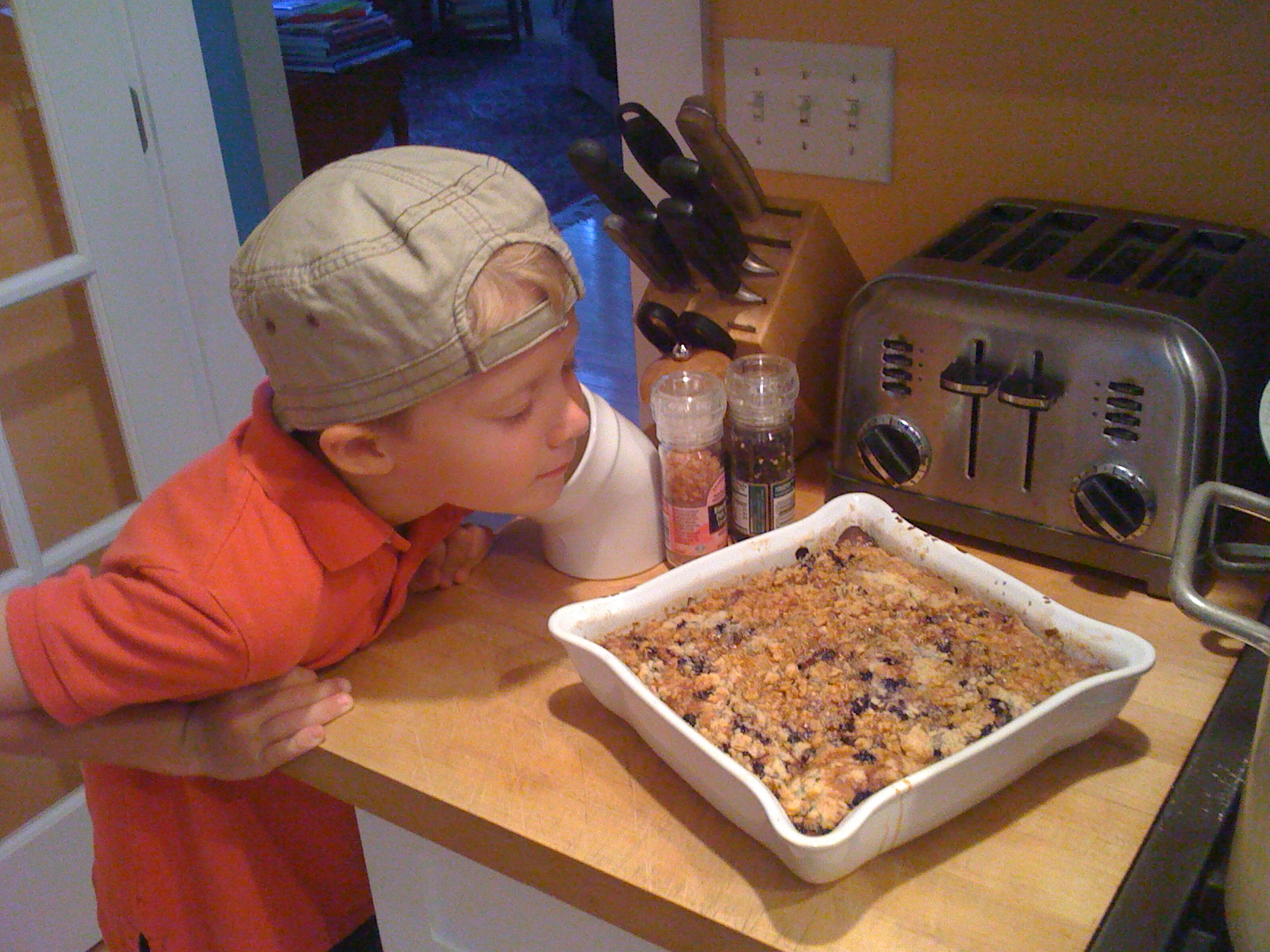
Anyway, since I usually make blueberry cobblers, making a blueberry buckle was an experiment.  So, far, it’s been voted the favorite dessert and has been repeated once more.  (It’s GREAT for breakfast too.)  It’s a rich cake, studded with blueberries and lemon, topped with a crunchy crumb topping, and drizzled with an intense lemon glaze when it’s still warm.  Here’s a picture:

Here’s a better one!
Turkey Tracks: “Corinne’s Beach Braid,” A Quilt

Turkey Tracks:  July 24, 2011

“Corinne’s Beach Braid,” A Quilt

Last February during my annual trip to Williamsburg, VA, to quilt with my Virginia quilt friends and to attend the Mid-Atlantic Quilt Show, I started a special quilt for my daughter-in-law–and new mother–Corinne–whose birthday is the day after mine.  Pisces!  ( And yes, we both love water.)

I used a French Braid pattern from FRENCH BRAID QUILTS, by Jane Hardy Miller and Arlene Netten, which I have long admired.

http://www.amazon.com/French-Braid-Quilts-Dramatic-Results/dp/1571203265/ref=sr_1_1?s=books&ie=UTF8&qid=1311529589&sr=1-1.

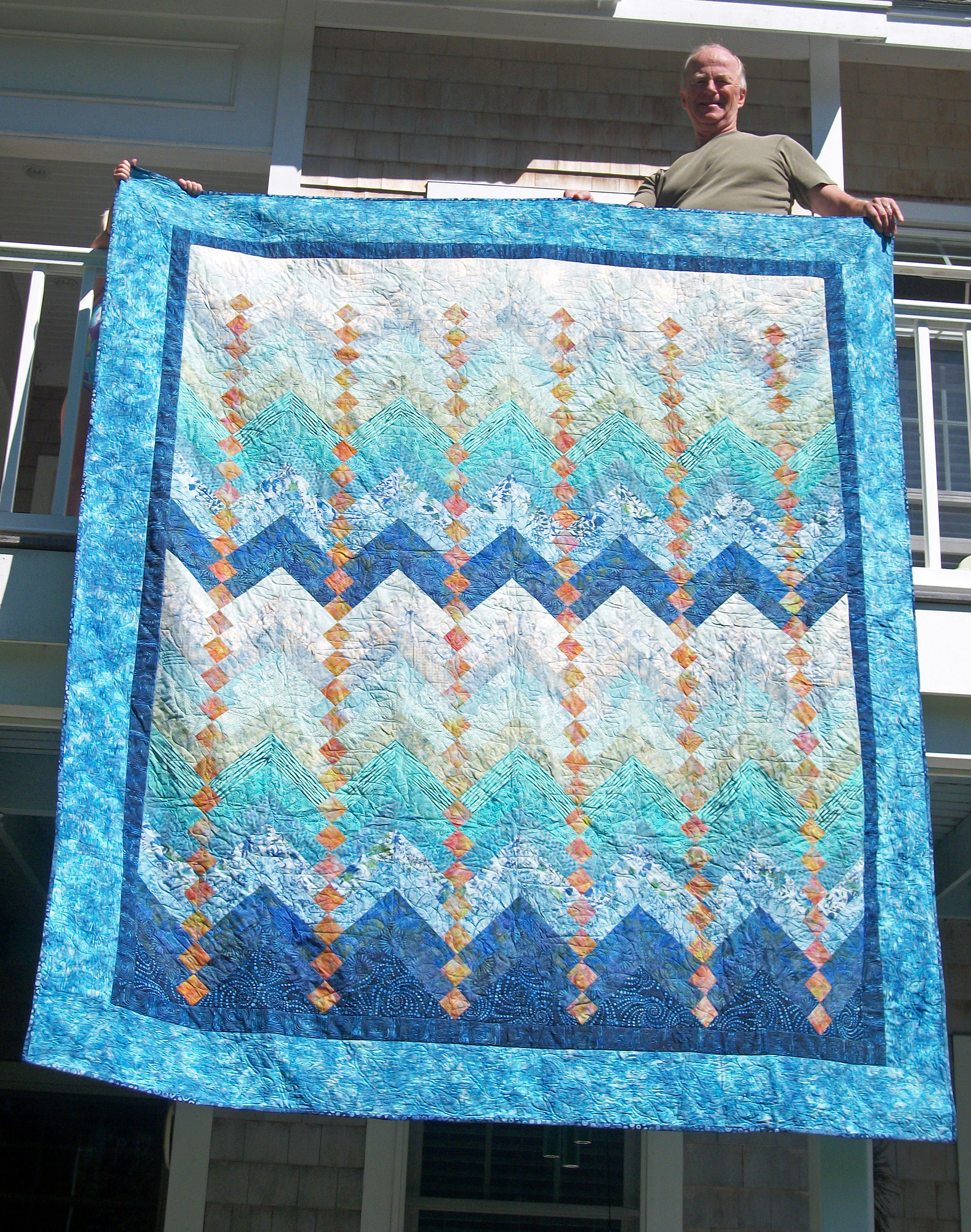
Since Corinne lives on Isle of Palms, SC, 2 blocks from the beach, I wanted to use blues, greens, and sandy colors, from light to dark–with a contrasting inner diamond of red/orange–all batiks.

To execute the pattern I picked from the book, one was supposed to pick about 10 fabrics for a run, with 2 for starting and ending triangles.  (These quilts can be directional, with a run of fabrics that moves from light to dark, or vice versa.)  I came home with more like 14 in total.  So, the two runs together, made for a LONG narrow quilt, which I realized when I saw the first few runs actually completed.  I knew I had to add two more runs at a minimum and that I would be bumping up against my long-arm machine width limit of about 83 inches.

I had used all of the orange-ish batik fabric I was using for the inner diamonds, and I was lucky enough to find it THE LAST DAY of the big quilt show in Williamsburg.

Finally, I discovered Anne Bright pantographs for the quilting and found two that had beach motifs–I ordered the one with sea horses, stars, big conch shells, and so forth for the body of the quilt, and the one with flip-flops and shells for the border–which would mean I would have to repin the quilt sides after quilting the top and bottom borders and the body of the quilt to get at the side borders.   You can see Anne Bright’s web site at http://www.annebright.com/shop/category/store/paper-pantographs/.

So, here’s the finished quilt across the end of the bed:

And, here it is from out upper front porch–in bright sun which has distorted the colors.  John and valient Talula (tiny hands on the left) are holding it.  You can just about make out the flip-flop pattern on the bottom border.

Several long-arm quilters strongly suggested that I use a poly thread–So Fine–for the bobbin thread.  As it is fine, a bobbin goes a long way.  And, So Fine seems to make the top,  cotton thread stand up.  But, the downside, I discovered, is that the elaborate patterns I used on the body of the quilt and on the borders and the stitch-in-the-ditch I did so well do not show on the back of the quilt at all.  See:

Here are some close-ups of some of the braids:

I really love this quilt, and I’d love to make more with the French Braid pattern.  It’s a fun pattern to do and would lend itself to all kinds of interesting color schemes and fabrics.  From now on though, I’m remaining an all-cotton girl!