Some Air Fryer Meals

The new oven came this week. Whew!

But meanwhile, I am still enjoying the Air Fryer.

So I thought I’d share some recent air fryer endeavors.

I cooked the asparagus in the picture below in the microwave for about two minutes–in a glass shallow pan covered with a cloth. The chicken tenders I put into a bowl with a little melted duck fat and then coated each one with the gluten-free panko I bought and ground finer–so there is just a light coating here.

They were good–but maybe cooked just a bit too long, which made them be a bit dense. I used the roasting feature–but I think I’ll try a shorter time next (maybe 6-8 minutes, turn them over halfway) and then finish with the air broil to brown the coating. I had enough left over to top a supper salad–which I make while cooking my noon dinner.

For the next meal, I cooked the broccoli in hot water until tender–in a pot on the stove top. The cod fillet I thawed, coated with some melted ghee using a brush, then patted the top with the panko mix. I cooked on air fryer for about 10 minutes as this fillet was thick. I think I checked it at about 8 minutes.

It was flaky and DELICIOUS. This one was a win-win. Hmmm, a dollop of tartar sauce, or, for me, some homemade mayo, would be a nice addition.

I had a meeting Thursday morning, and when I got home I was so hungry. I had bought this little loin steak, so thought I’d try it in the air fryer as I was feeling lazy about the outside grill or pan-frying it. (I reheated my leftover broccoli in the microwave.) I cut up one small russet potato and did not soak it in ice water for 30 minutes, which does make the browning more even I think. I tossed the slices in a tablespoon of melted duck fat in a bowl. The potatoes cooked in under 15 minutes (I shake them every few minutes and almost burned them this time–at under 15 minutes.) And the steak cooked on roast in about 10 minutes.

The potatoes were delicious. The steak was fine, but felt a bit tough. I had enough steak to top my supper salad–which is always nice. So, steak in the air fryer works fine, but isn’t as nice as the grill.

I like asparagus roasted in the air fryer. But I don’t really like broccoli cooked that way–it is tough. Maybe if one par-boiled it until almost tender and then air broiled it? But that seems like way too much trouble.

So, the air fryer is a learning curve, but one I’m enjoying. And I’m feeling more confident with using it to its best potential. And it is so easy to clean up. There is no grease all over the stove top from pan-frying something. Yes, I could easily have fried the potatoes in a pan with some duck fat–but the air fryer does use much less fat–and the texture of the air fryer potatoes, unfortunately for my body, is awesome!
Low Country Drainage Strategies

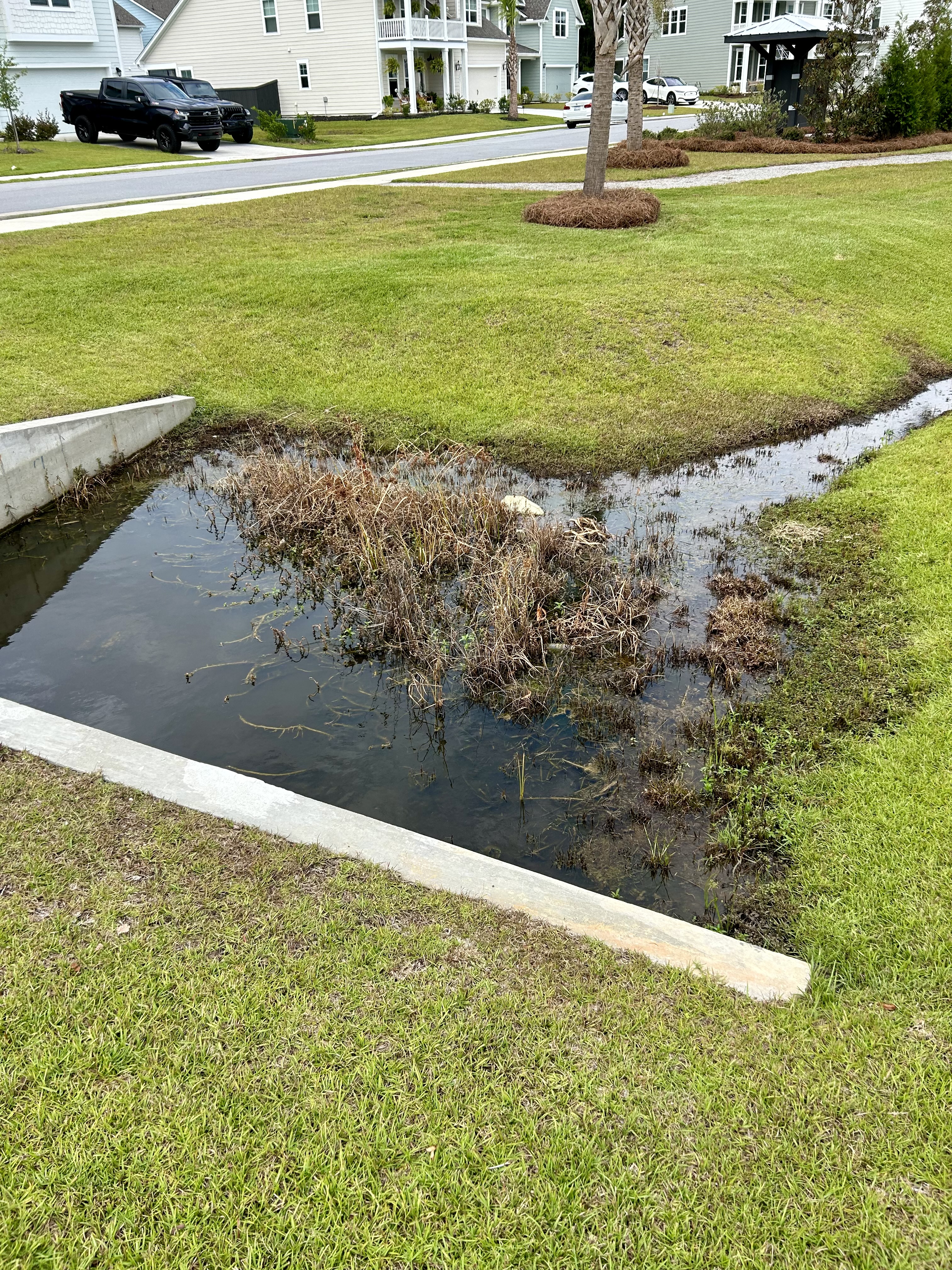
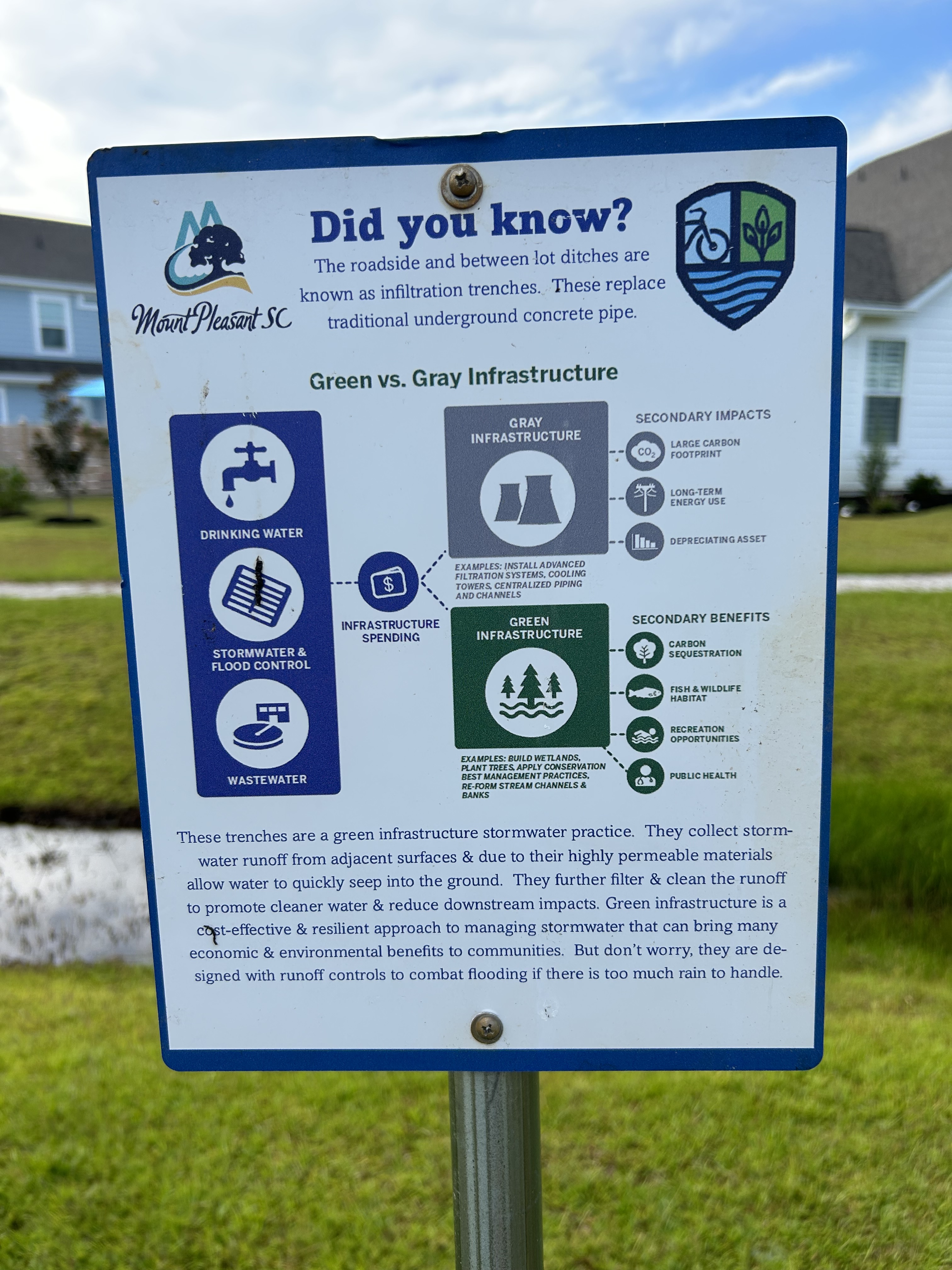
My subdivision has an interesting way to manage drainage from a wetland from above the property and from accumulating serious storm-water deluges, as in tropical storms and hurricanes.

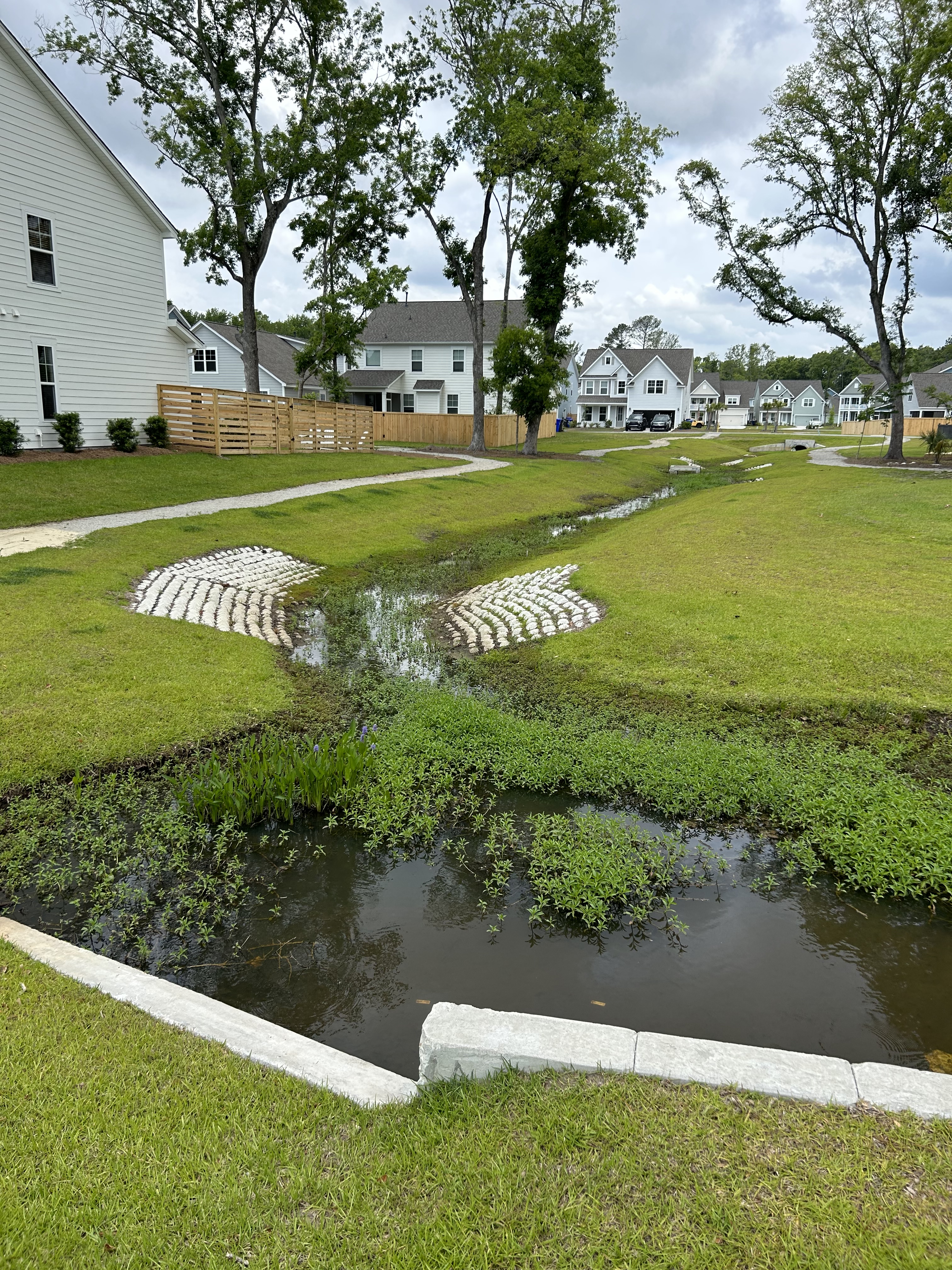
A creek/infiltration trench/bio-swale winds across the middle of our subdivision property. What we have is a hybrid of all three of the above categories, I think, though this explanatory sign limits the creek to an infiltration trench.

This pic below is taken from a viewpoint downstream from my home–which would be on the left along the street where you see the culvert. Back of me is another street and culvert and the place where this stream exits the property into the drainage system along the road next to our subdivision. (We hope there is an exit point into the region’s drainage systems. No-one seems sure, and I have not yet walked back to the exit point.)

Wet bio-swales and infiltration trenches can and do have vegetation. Vegetation can slow down water run-off and trap sediment picked up as water rushes along a path. But vegetation can also get too dense and clog up the flow. The balance is tricky and involves how the sides slope. Both EPA and Clemson University have sites that discuss this slope issue.

Sloping sides in general are a protective feature in the Low Country. All of our houses in this subdivision have the land graded so that it is sloping away from our foundations, for instance.

Here’s where the stream crosses the road at the side and back of my house. To the far left, behind a row of our houses, are the woods where the wetlands are located. That property is owned by someone else. The groundskeepers hired by our HOA sprayed this vegetation–which is a bad idea for several reasons. Spray could/will kill the little fish seeded into all the water ponds and this stream and the wetland in the woods–fish bred to eat mosquito larvae. And, killing the vegetation will serve to clog up the stream. And the spraying has created an eye-sore. If plants are not wanted, they should be weeded out, not sprayed. Wet bio-swales and infiltration trenches both can be planted with pretty water plants, but our stream is kind of wild.

One of the really pretty things in the ponds near me in Maine were the Pickerel Rush plants that grow along some of the pond edges. Pickerel Rush will bloom from spring to fall–sending up spikes of blue/purple flowers. It is a shallow water aquatic plant.

Here it is trying to grow in our stream, and you can see it’s been top-trimmed:

And here is where the groundskeepers cut back some kind of grass with a weed-whacker, but left the tops in the creek bed–which will cause clogging.

I’m finding that the research I’ve done about bio-swales, infiltration trenches, sloping grading designs/plans, and mosquito control strategies (those fish, but not, for me, the night-time spraying with synthetic pyrethroids that are lethal for aquatic critters) to be a really interesting learning curve.

I will forego a rant on the degree to which we are awash in toxic chemicals in the Low Country. In Maine, where the “state bird” is the mosquito, and in the town where I lived, where a dedicated group of folks understood the dangers of being awash with toxic chemicals, public spraying was…stopped.

The local children, of course, are fascinated with this stream. Me, too.

Ragdoll Cats

First, DIL Tami reminded me after seeing the post on coyotes that they have found three carcasses, mostly bones and tails, in their front yard in recent weeks: a raccoon and, I think, two opossums. The raccoon tail was really big. And the opossum tail wasn’t small either.

This family has two medium-sized dogs, so family members are going outside with the dogs when they go out now. A 6-foot fence surrounds the back yard, but… None of us put it beyond coyotes to surmount a fence. Better safe than sorry.

Our weather has been delightfully cooler. I’m sitting here now wearing a long-sleeved t-shirt and thinking about long pants. But it will get warmer later today. Walking has been delightful recently.

We did not get one drop of rain out of Ophelia. I was hoping for an outlier rain band as it whirled around, so I put out all the fall fertilizer. I did have to get the hoses out and water deeply.

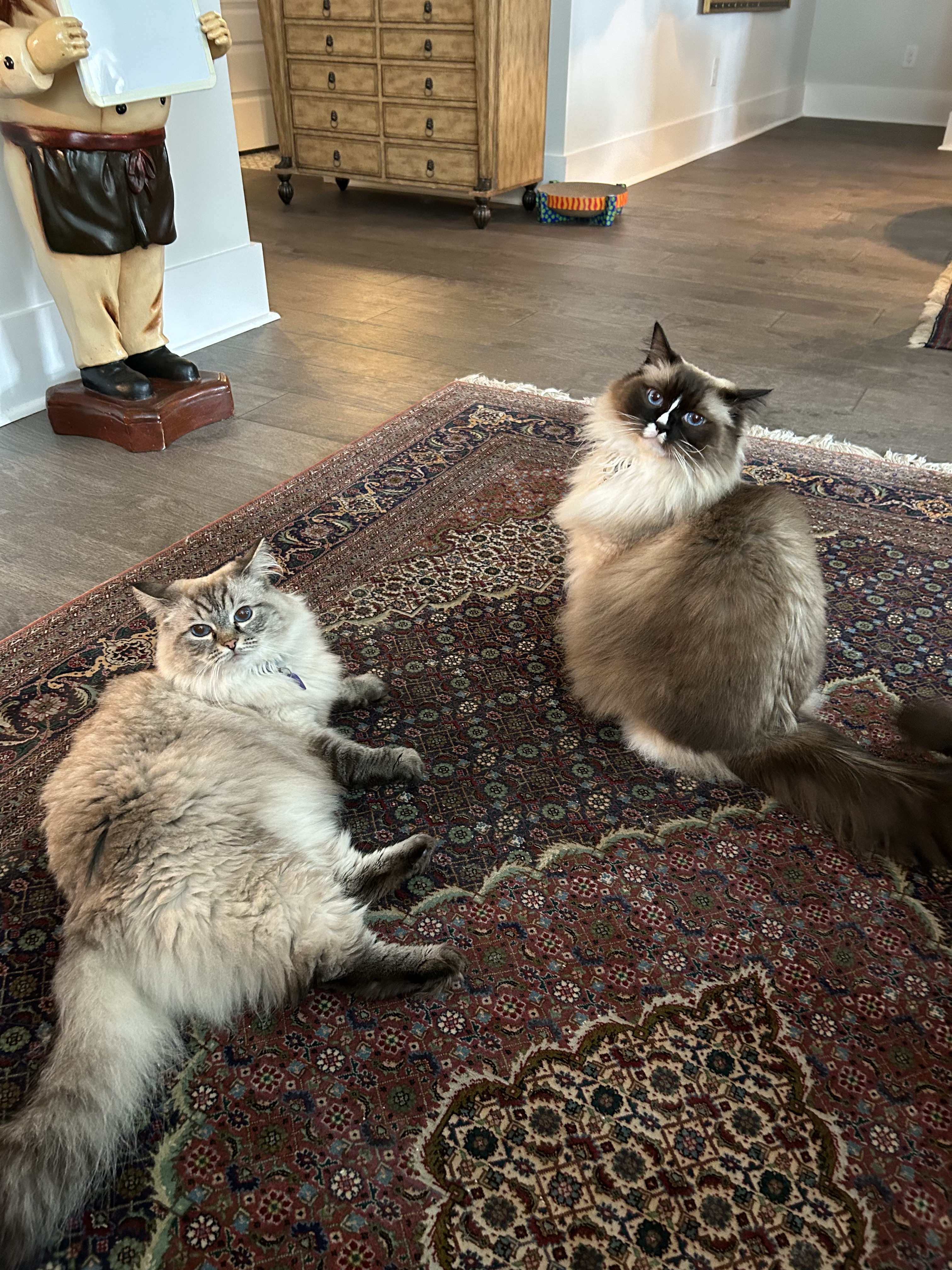
My back-door neighbor has been away, and I checked on her two beautiful cats while she was gone. They clearly missed her so I went over and loved on them. By Friday, the male was waiting for me when I opened the front door, and the female came running right away. She is usually more cautious.

Reba is on the left, and Toby is on the right. They are Ragdoll cats, which is totally new to me. They are called “rag dolls” because they go limp when one picks them up, which I did not test out.

The breed was developed in California back in the 1960s. These cats are known for gentleness and are affectionate. Both showed me their bellies by Friday, and Toby gave me some toe licks.

https://en.wikipedia.org/wiki/Ragdoll

I’m obsessed with hand-quilting Traverse. I think because I’m almost to one end, having started in the middle. The quilting is slow, but going well. And “Summer Camp” is partially loaded on the longarm and is waiting for me.

The family is gathering to celebrate a granddaughter’s 16th birthday today. How did that happen? I’m looking forward to seeing my family all together (except for the young men away at their colleges) tonight.

Coyotes?

Oh, yes. They live here among us in coastal South Carolina.

A few months back, my back door neighbor had one sleep next to her front door on her porch–leaving evidence of hair and mud.

And last week, she saw one next to a small pond near where she was walking out along the road where many of us walk. I wish I’d seen that coyote, but will start looking more now.

Out on the barrier islands near me (Isle of Palms and Sullivan’s), coyotes have been seen frequently cavorting on the beach in the early morning. Of course they are a risk to the dogs being walked out there early morning. And to dogs left outside in fenced yards.

In 2022, there were 59 sightings on Isle of Palms according to Ryan Warren, an animal control officer on the island.  Of course these sightings may involve some of the same coyotes who live on the island now.

I’m thinking that late summer/early fall is when this years coyote pups are getting pretty big and need more food. Female coyotes give birth in April or May, and need about six months to be able to hunt on their own. They leave mom at about one year. Mating pairs are monogamous. And, yes, coyotes can and do mate with wolves and other (probably wild) dogs if they can’t find a coyote mate.

BUT, also, human urbanization has forced many animals to figure out how to live in more urban environments. Foxes have. Some bears have, especially in Alaska–info which is the result of watching a LOT of tv programs on wild life. It is interesting to me that programs on the “dog” family have NOT included coyotes. Foxes, wolves, African wild dogs, yes. But nothing I’ve seen on coyotes. (But I have not looked either.)

One coyote in this region followed a doctor into his work space, scaring both of them. The doctor went out another door, and the coyote left that way too. There are lots of videos of coyotes walking down sidewalks in this region.

Coyotes are a mixed bag. They can and will eat dogs and cats. But they also eat rats, mice, rabbits, Canadian geese, and so on.

Here’s an interesting site filled with pictures and information about “urban” coyotes:

And here’s a local article:

https://www.postandcourier.com/moultrie-news/news/coyote-found-in-shem-creek/article_697f4e0c-4e4b-5d51-a4e0-0739d31fa186.html

One thing is for sure: coyotes are here to stay.

A Mid-Week Update: September 2023

Good Morning!

It’s Wednesday, and I’ll be off to the Wando Library this morning to meet the Patchwork Gals, who meet there once a month. They are a “splinter” group of the regional Cobblestone Quilters group.

I actually went to the Wando library to “rent” more books yesterday morning. I can buy, for $1 each, books featured on a kiosk in the library. After I’m done, I return the books so they can be recirculated again. Here’s what I brought home yesterday.

I’m reading the Oysterville Sewing Circle, by Susan Wiggs. She’s a new author for me, and trying out new authors or revisiting ones I know is…fun.

And, here is my current book marker: a recent card from friend Betsy Maislen, who made this gorgeous “Hunter’s Star” quilt designed by Bonnie Hunter.

I started loading the “Summer Camp” mystery quilt on the longarm yesterday. The next step is to baste it before quilting it.

And I’m making progress with hand-quilting Traverse. I started in the middle and am nearing the end of one side. That gold bar below the green crosses is about half way.

I’m liking the use of thread colors that don’t stand out and the texture that is developing. AND, my stitches on the back are getting better as my hands learn Tara Faughnan’s method of quilting with a bigger needle, thicker threads, and without a hoop. (She has a good online class on hand quilting.)

I did finish the dark gold row above last night and am thinking about how to quilt that next big bar.

Back in Maine, when I had packed up all my quilting things for moving, I set up a little sewing area and started piecing 1 1/2 and 2-inch squares that I had cut from the Cotton+Steel/Ruby Star Society project. The 1 1/2 squares went into four-patch blocks, light and dark. So when “Summer Camp” came off the design wall (which I vacuumed yesterday), I got out the bin with the four patch blocks and started sewing some together to create an 8-inch block.

Yes, but maybe this way…if I have enough squares to do something like 3 by 3 rows. These are just pinned, not sewn. I can see one of the 2-inch 4-patches as the corner stones. But who knows?

Meanwhile, the Mexican sage plant burst into bloom. That plant is new to me. (It got thirsty before the recent rain, thus the yellow? Unless it is getting ready to go dormant as it is now fall?)

The blooms are quite awesome, aren’t they?

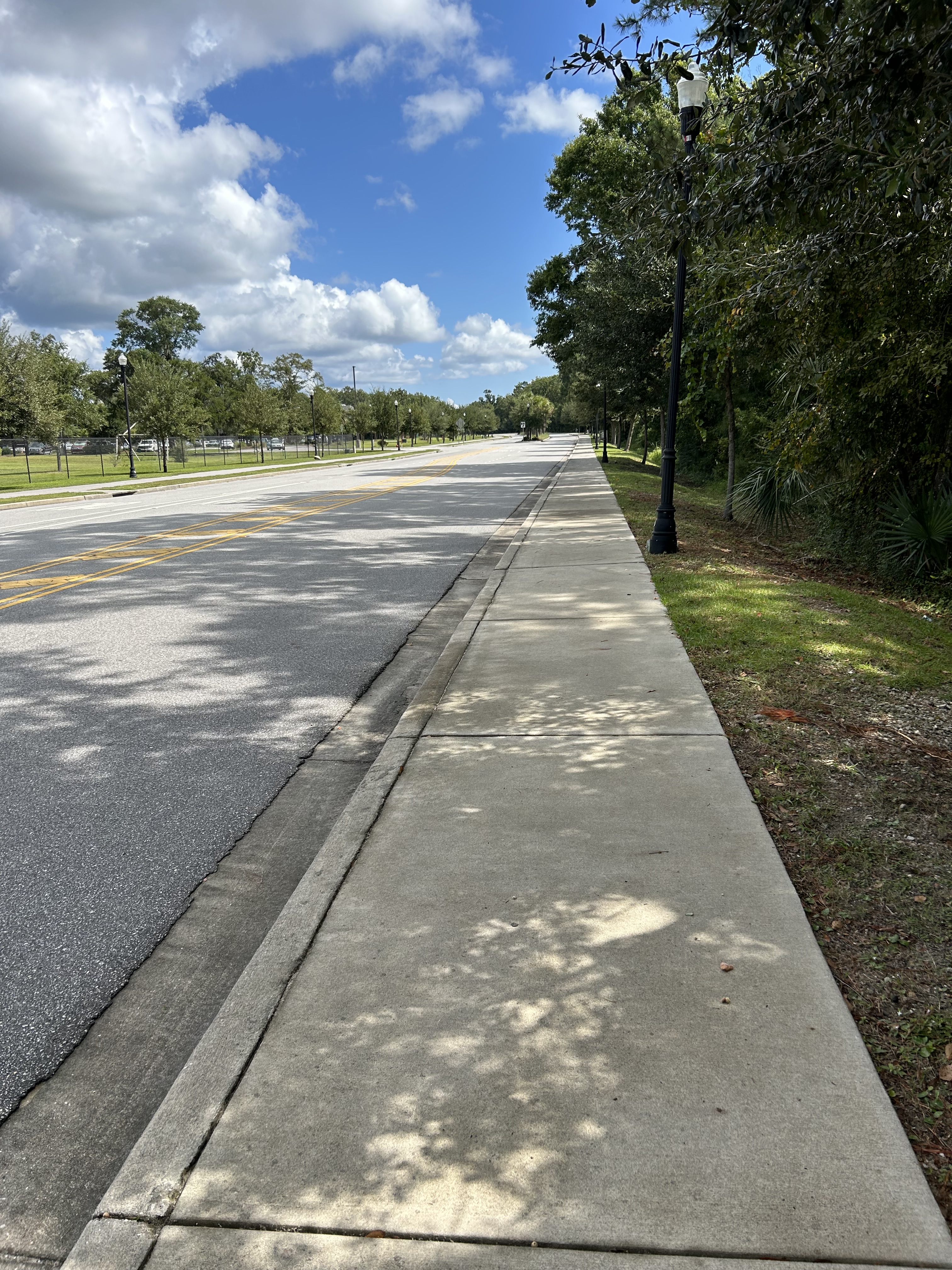
And with the cooler weather, I’ve been walking more–but on the shady side of this mostly quiet road that runs outside my development. There are two schools on the left side, and my development is ahead about 1/4 mile on an entry road to the left.

Enjoy your day today, everyone!

Stick Insect

One of my neighbors has figured out I am interested in insects. She sent me this picture the other day. This insect is new to me.

It is a stick insect–a walking stick version.

They can range from 1 to 12 inches and live mostly in temperate or tropical environments. They are masters of camouflage. They are herbivores. They are parthenogenetically organized, so females can produce unfertilized eggs that grow into new stick insects. These insects reach maturity between three months and one year, and usually live up to two years. More than 3,000 species of stick insect exist, many of which are susceptible to habitat destruction, pesticide use, and collection for the pet trade.

Who knew? Stick insect pets?

Here’s a nice to information used above and more:

https://www.nwf.org/Educational-Resources/Wildlife-Guide/Invertebrates/Walking-Sticks

“Summer Camp” Mystery Quilt

Well! How fun is this quilt?

Super fun.

This mystery was designed by Bill Kerr and Weeks Ringle of the Modern Quilt Studio. No quilt in this mystery is going to look identical to anyone else’s quilt.

We all chose our own palettes while considering our field/background fabric—and there were really helpful videos for all the steps along the way. I’ve quilted for decades, and my current quilts are now numbering in the low 200s. But I learned a whole lot from Bill and Weeks with this quilt.

There were 6 weekly releases of blocks—and each week we had 4 sets of 2 blocks to do, BUT we would chose ONE of the two blocks in each set to make.  In each set of two blocks, one block often would be more complicated than the other.  So there was a nice range of difficulty.  Sometimes there were extra blocks we all did—or maybe we also had to manipulate further an earlier block. We made something like 20-30 blocks each week.

There was, also, a choice of three sizes of quilt to make and three different ways to create one’s final top.  I chose the middle one.  I was tempted by the more difficult one, but kept coming back to the one I did. And I love how it came out.

Those participating had a closed Facebook group where we could talk–and I so enjoyed the support, but also the fun–the sense of humor–that permeated this group. There were lots of posts describing which “cabin” they were currently in, that ranged from enjoying after-quilting eating/drinking pleasures in the “party” cabin to someone presently occupying something like the “thinking too hard” cabin. On and on it went and often sent me into chuckles of amusement.

The pattern for Summer Camp will be for sale on the Modern Quilt Studio web site–and you can also see there the other assembly versions and the quilts others have made.

This quilt is the second mystery quilt Bill and Weeks have designed. You can see the first one (“New Day,” made last winter) on their web site. That pattern is for sale now. And there have been hints that they will do another mystery quilt.

Would I make another mystery quilt with Bill and Weeks?

I’d be tempted. For sure.

A Butterfly

So, today I am, like others here along the South Carolina coast, waiting to see if Hurricane Lee does indeed make the predicted turn to the north.

While that turn north would make me happy, it would also mean that it likely would head to the Gulf of Maine coast, where so many of my friends live. They have had the wettest spring/summer on record, so the ground is soft and already wet. It is still raining every day or every few days in coastal Maine, say my friends. High wind would likely topple trees–so my Maine friends are worried.

I’ve seen quite a few of these beautiful butterflies soaring around my flowering beds in recent weeks.

What interesting patterns on the wing undersides:

It’s a Variegated Fritillary:

Variegated Fritillary. Identifying Characteristics: Variegated Fritillary butterflies have a wingspan of 1.75 to 2.25 inches. The coloring of this species is tawny brown to burnt orange with black dots and lines.

38 Common Butterflies found in South Carolina! (2023)

Beach Finds: Shark Teeth

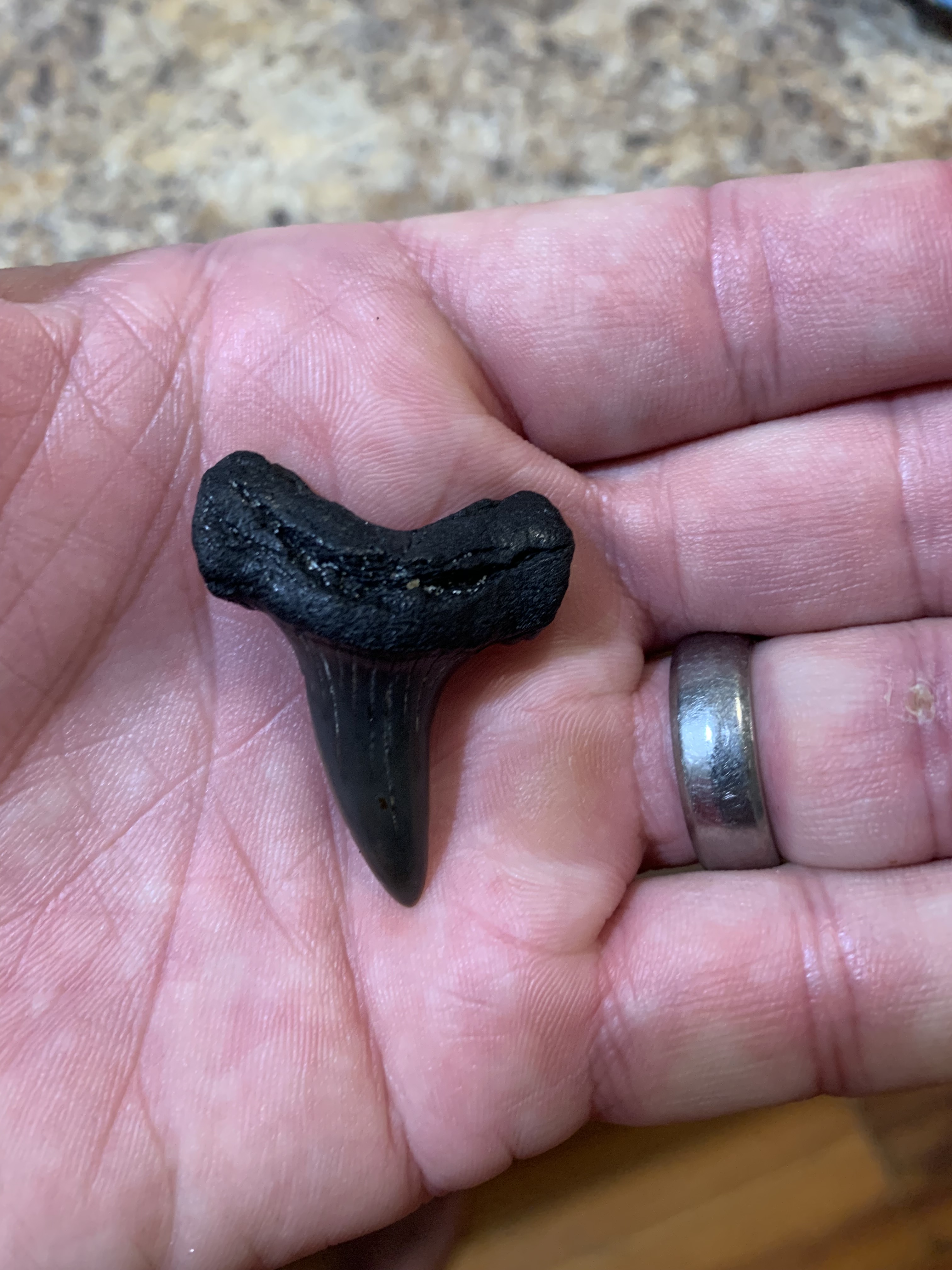
Son Bryan, DIL Corinne, and their three girls scour the beach when they arrive there, looking for prehistoric shark teeth.

This one, found recently, is a rare find–as it is SO BIG and not broken. It is from a GRANDPARENT to the famous Megalodon shark, an apex predator back in its time. (There are folks here who can identify these shark teeth.)

Megalodons were HUGE sharks, kin maybe to today’s Great White Sharks. Here’s info from Britannica about the size of this shark:

“This data suggests that mature adult megalodons had a mean length of 10.2 metres (about 33.5 feet), the largest specimens measuring 17.9 metres (58.7 feet) long. Some scientists, however, contend that the largest forms may have measured up to 25 metres (82 feet) long. Studies estimate that adult body mass ranged from roughly 30 metric tons (1 metric ton = 1,000 kg; about 66,000 pounds) to more than 65 metric tons (about 143,000 pounds), adult females being larger (in both length and mass) than adult males” (https://www.britannica.com/animal/megalodon).

Here is another recent find that is smaller but in good condition:

The idea of the great Megalodon sharks has sparked a novel that, in turn, has sparked several movies called THE MEG. Wikipedia explains:

Meg: A Novel of Deep Terror is a 1997 science fictionhorror novel by American author Steve Alten, and the first novel in the MEGseries. The novel follows the underwater adventures of a Navy deep-sea diver named Jonas Taylor.”

I will confessed I watched the movie–I stumbled into it one night. And it was interesting to view how the movie portrayed the bigness of the Megalodon shark.

Here’s a link to more info on the Megalodon from wiki:

https://en.wikipedia.org/wiki/Megalodon

The Cobblestone Quilters

The Charleston regional quilt group is The Cobblestone Quilters, and yesterday morning I went to meet them–having joined online a few days before Saturday. The doors open at 9 am, and the meeting is from 9:30 to late morning and is followed by a lunch a member can purchase–or just attend with one’s own lunch. Classes can and do happen in the afternoons.

The CQ quilters meet in a church in Hananan, which is west of Mt. Pleasant and about a 25 minute drive. The WAZE app took me there without incident–though just as I got on the 526 interstate highway, the heavens unleashed a gully-washer downpour of sheets of much-needed rain.

I had made contact with the CQ membership chairperson online, and I met her immediately as I came through the door. And she introduced me to nearby gracious lovely women who, in turn, introduced me to other gracious lovely women. To say I was welcomed is an understatement.

This group of about 75 members is super well organized. The large room was lined with all sorts of tables filled with events and activities for members to participate in or just enjoy–each manned by member volunteers. This group does a lot of community out-reach, from making donation quilts for various charities to supporting another group’s filling and packing Christmas boxes for lonely sailors who arrive in the Charleston harbor over the holidays. Next time I will do a better job of taking illustrative pictures. I was kind of in shell-shock at the amount of goodness I saw displayed I think.

The large room was filled by the time the meeting started. And I started feeling a bit woozy with all the chemical smells that a packed room with lots of people causes me to have. But I made it through to the break before knowing I had to take Benadryl or I had to get some fresh air. The worry here is whether I can drive safely if I don’t make a change. So I made my apologies and, regretfully, left.

Why didn’t I take pictures of the part of Show and Tell I did see? There were amazing and gorgeous quilts of all kinds displayed by these excellent quilters. I have definitely found a great quilt group. For sure.

There are two Cobblestone “splinter groups” that meet here in Mt. Pleasant later in the month: the Patchwork Gals meet monthly in the morning at the Wando Library, about which I recently blogged; and the Indigo Quilters meet in the early evening not far from me. I met women who go to the Patchwork Gals at the CQ meeting. I will attend both of those meetings later this month.

Note: In my Northern Virginia regional quilt group of 20+ years ago, now called Quilters Unlimited, the small groups that met outside of the regional guild meeting were called “bees.” And in Maine, actual local groups formed that were group members of the Pine Tree State guild–like The Coastal Quilters that met in Camden, Maine. Our other group in Camden, Maine, The Mt. Battle Modern Quilt Guild, which I helped start , belonged to the Modern Quilt Guild, which is a different “parent” organization than the Pine Tree Quilters Guild.

So, I came home energized, but sad I had to leave early, and hungry–and to find that my neighborhood did not get more than one drop of rain. So, today I will need to water outside.