My subdivision has an interesting way to manage drainage from a wetland from above the property and from accumulating serious storm-water deluges, as in tropical storms and hurricanes.
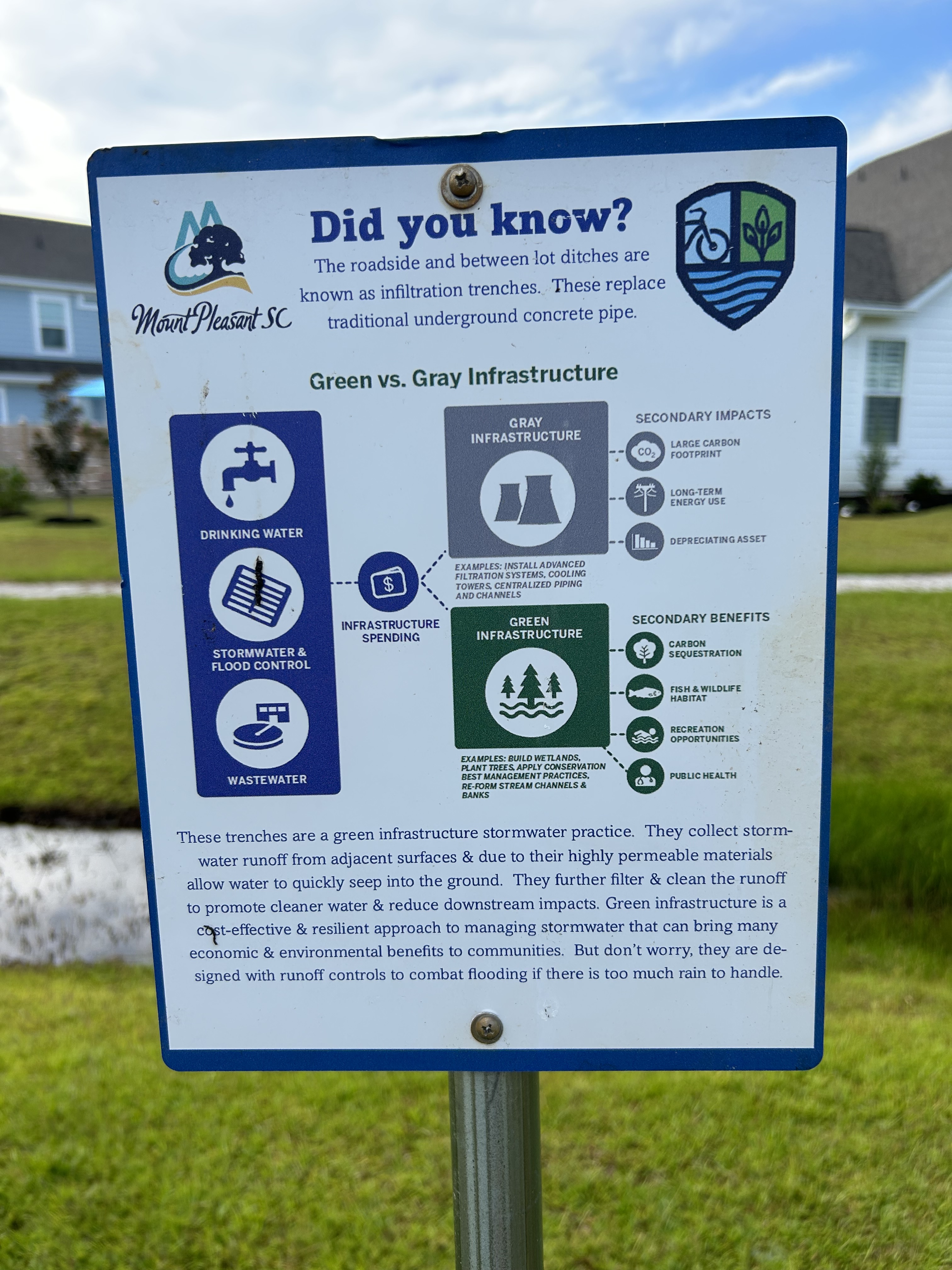
A creek/infiltration trench/bio-swale winds across the middle of our subdivision property. What we have is a hybrid of all three of the above categories, I think, though this explanatory sign limits the creek to an infiltration trench.
This pic below is taken from a viewpoint downstream from my home–which would be on the left along the street where you see the culvert. Back of me is another street and culvert and the place where this stream exits the property into the drainage system along the road next to our subdivision. (We hope there is an exit point into the region’s drainage systems. No-one seems sure, and I have not yet walked back to the exit point.)
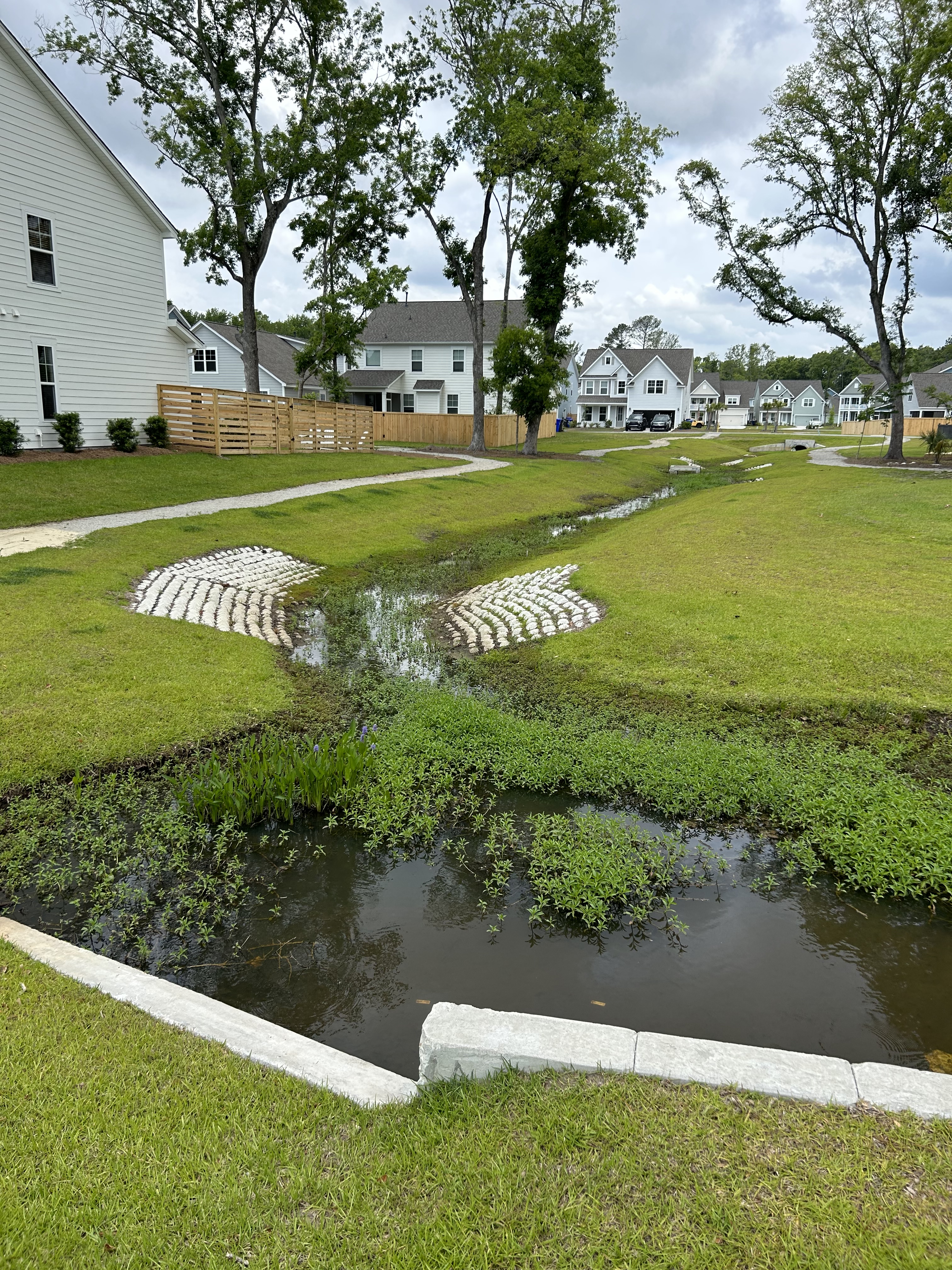
Wet bio-swales and infiltration trenches can and do have vegetation. Vegetation can slow down water run-off and trap sediment picked up as water rushes along a path. But vegetation can also get too dense and clog up the flow. The balance is tricky and involves how the sides slope. Both EPA and Clemson University have sites that discuss this slope issue.
Sloping sides in general are a protective feature in the Low Country. All of our houses in this subdivision have the land graded so that it is sloping away from our foundations, for instance.
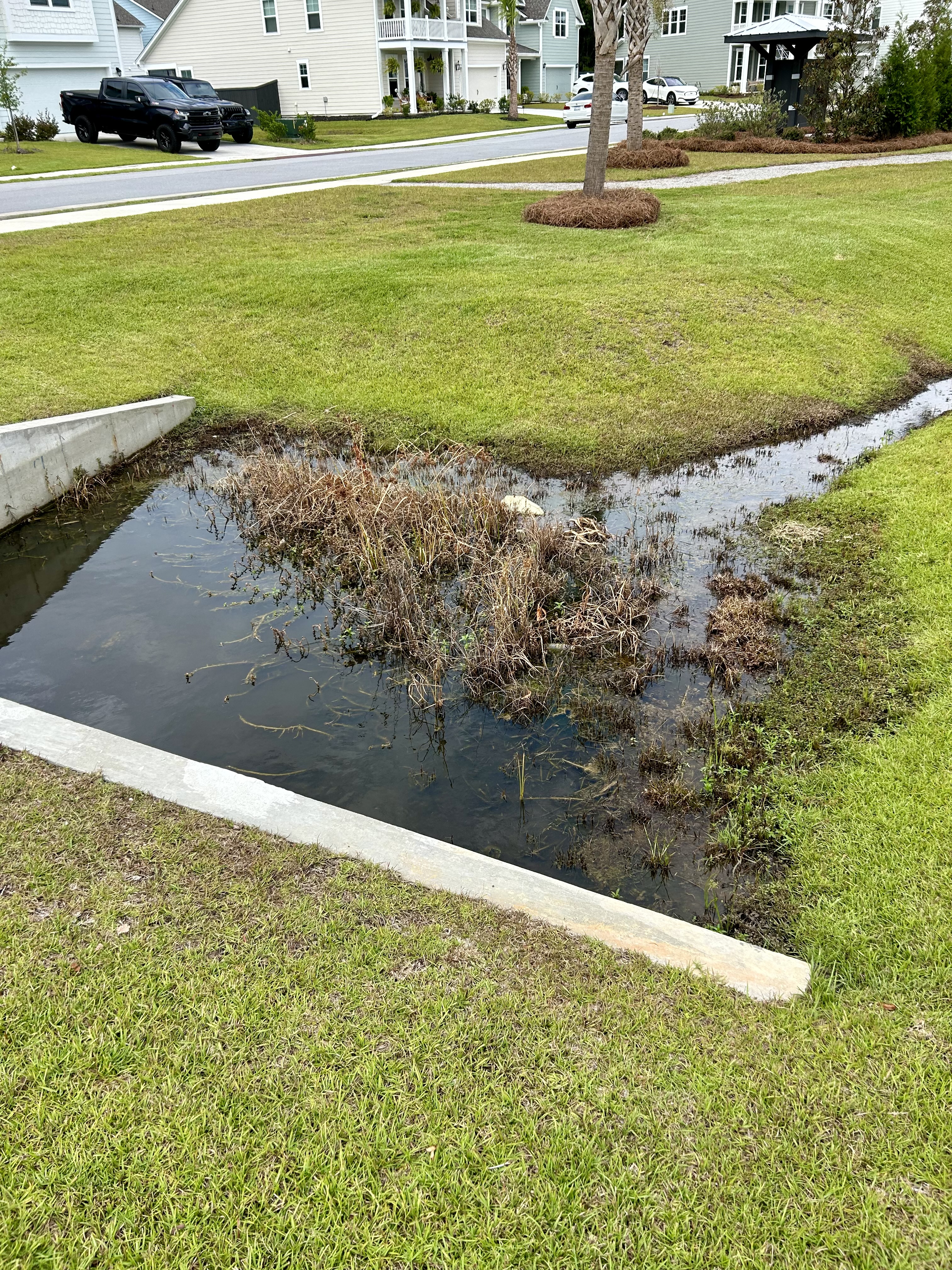
Here’s where the stream crosses the road at the side and back of my house. To the far left, behind a row of our houses, are the woods where the wetlands are located. That property is owned by someone else. The groundskeepers hired by our HOA sprayed this vegetation–which is a bad idea for several reasons. Spray could/will kill the little fish seeded into all the water ponds and this stream and the wetland in the woods–fish bred to eat mosquito larvae. And, killing the vegetation will serve to clog up the stream. And the spraying has created an eye-sore. If plants are not wanted, they should be weeded out, not sprayed. Wet bio-swales and infiltration trenches both can be planted with pretty water plants, but our stream is kind of wild.
One of the really pretty things in the ponds near me in Maine were the Pickerel Rush plants that grow along some of the pond edges. Pickerel Rush will bloom from spring to fall–sending up spikes of blue/purple flowers. It is a shallow water aquatic plant.
Here it is trying to grow in our stream, and you can see it’s been top-trimmed:

And here is where the groundskeepers cut back some kind of grass with a weed-whacker, but left the tops in the creek bed–which will cause clogging.

I’m finding that the research I’ve done about bio-swales, infiltration trenches, sloping grading designs/plans, and mosquito control strategies (those fish, but not, for me, the night-time spraying with synthetic pyrethroids that are lethal for aquatic critters) to be a really interesting learning curve.
I will forego a rant on the degree to which we are awash in toxic chemicals in the Low Country. In Maine, where the “state bird” is the mosquito, and in the town where I lived, where a dedicated group of folks understood the dangers of being awash with toxic chemicals, public spraying was…stopped.
The local children, of course, are fascinated with this stream. Me, too.

 Louisa Enright's Blog