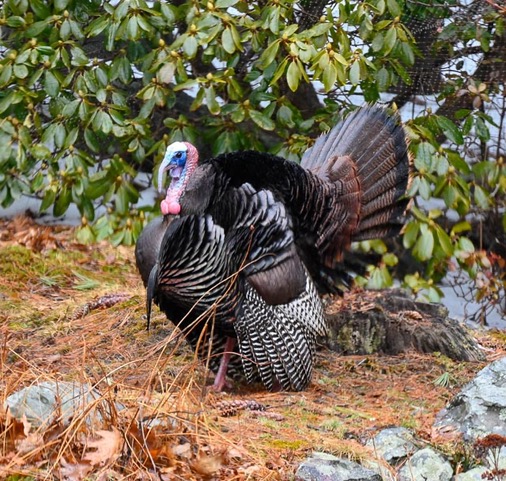
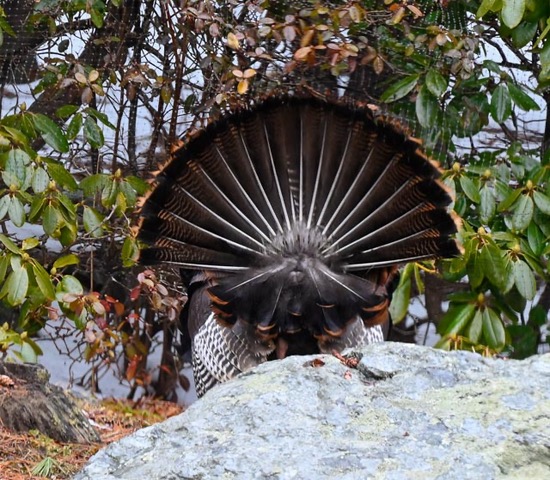
My Camden friend Marsha Smith sent me these pictures, and they bring back fond memories. A large gaggle (sometimes also called a rafter) of turkeys spent the winter in the woods that surrounded my house on two sides. They often roosted in the tall pines, and it was so fun to watch them get themselves up that high–as they are heavy birds. They would go up the hill in back of the house before launching to give themselves the advantage of more height with relation to the tops of the pines. Those flights always reminded me of the big C-135 transport planes taking off from the runway near one of the homes my family occupied on Offutt Air Force Base in Nebraska.
Anyway, the turkeys were so fun to watch, especially when the males started to display their feathers in the spring. Note that their heads turn blue as part of this effort.
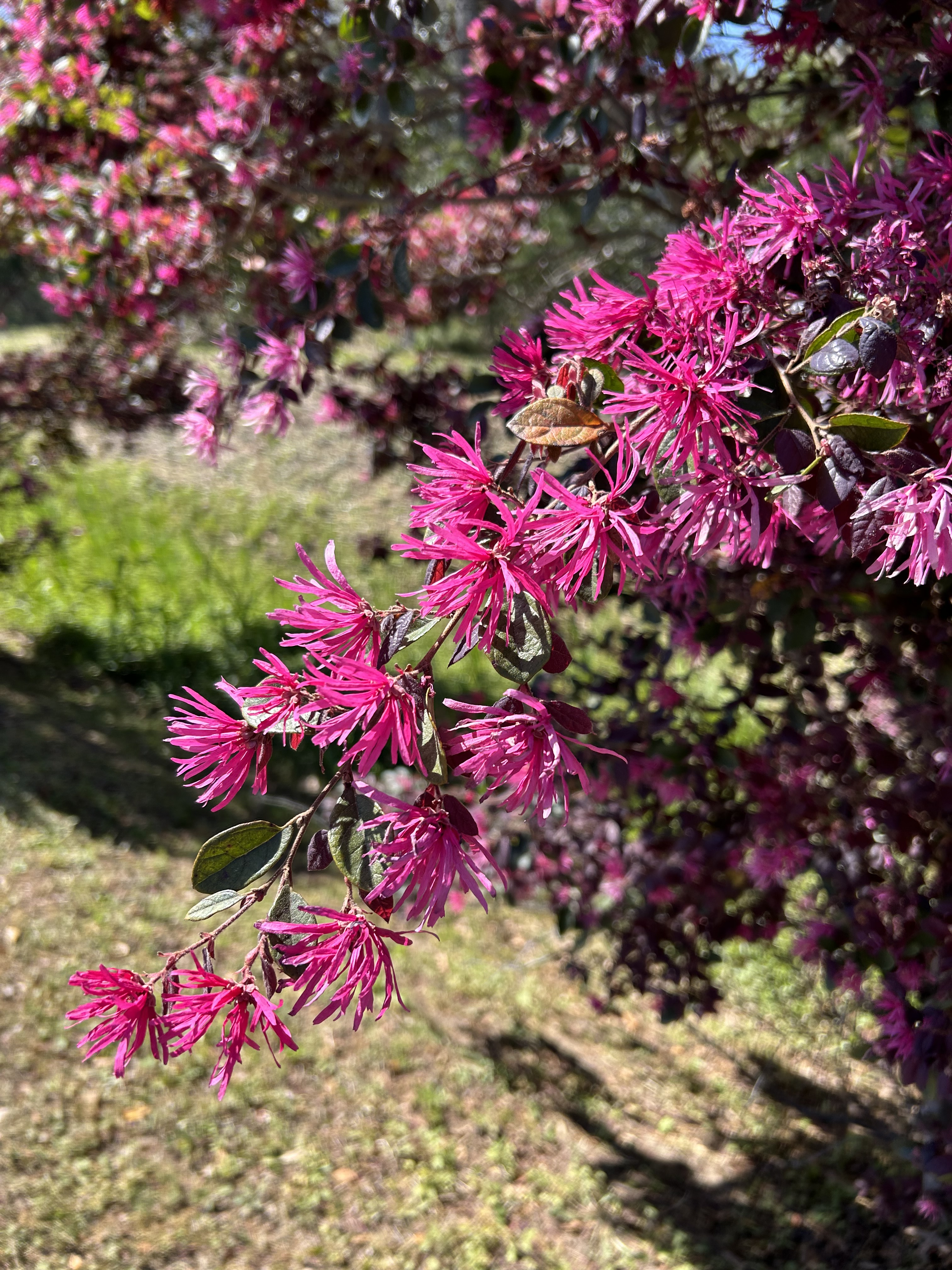
This shrub/small tree is new to me. On my walk, it lines the highway along both sides for long stretches. Along highway 17, it is trimmed back to the size of trimmed boxwoods–forming neat rectangles that line the sides of the highway and glow pink. In my neighborhood, it is a common planting beside and in front of the houses.
I finally slowed down to see what it was–deciding it was not an azalea form.
The feathery blooms are different–and pretty.
See?
As near as I can tell, this plant blooms for rather a long time.
Wikipedia says this plant is in the witch hazel family.
“The Ruby Loropetalum is a great shrub for screening and adding rich, red color to the landscape. If you’re looking for a shrub that’s hard to kill, this one’s for you! The Ruby Loropetalum is the most popular Loropetalum! This Ruby Loropetalum produces bright, pink flowers in the spring and pushes out new growth. As the new growth hardens off, it turns from red to ruby. Loropetalums are evergreen! They hold their leaves throughout the winter months still adding ruby color to your otherwise barren landscape. The Ruby prefers full sun. The more sun it gets, the more color you will have.
This loropetalum will reach 6 feet tall and about 6 feet wide. In the landscape, this Loropetalum is great for hedges, natural areas, small privacy screenings, and berm plantings. They break up all the green and function well. Use this loropetalum in the back of the landscape. They get large in size, so close to your house is not a good idea. We suggest planting out in the yard or in natural area where they can grow.”
This plant can handle full or partial sun. It attracts birds, bees, and butterflies. It is drought tolerant when established. And the flowers are FRAGRANT.
What’s not to like?
The redbuds have been blooming for some weeks now:
And the azaleas are in full bloom. I’ll have to drive some neighborhoods to get some pictures. Or, visit one of the plantation gardens where azaleas will be featured.
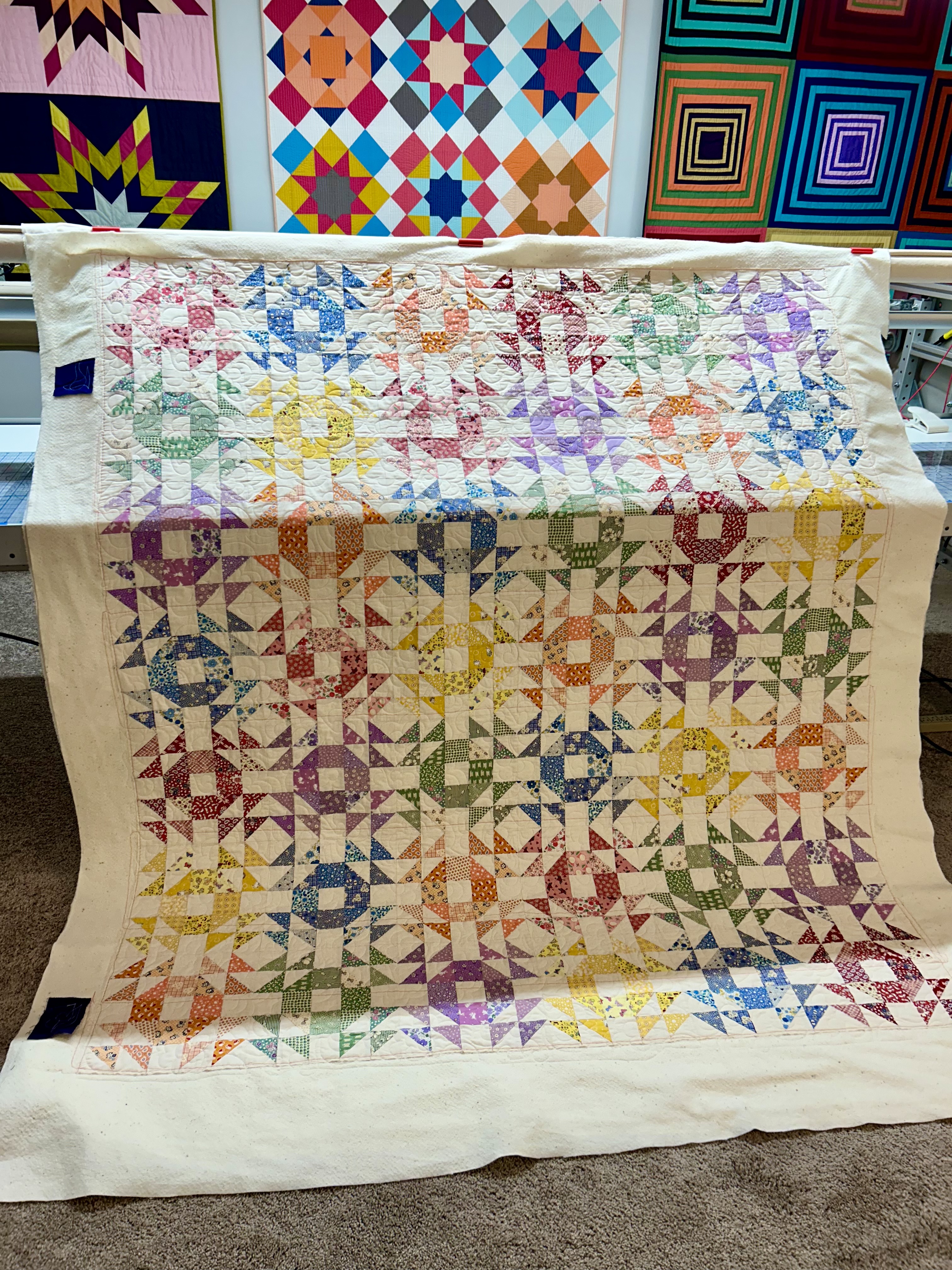
But I’m sewing on the binding now. But I’m really happy with how this quilt came out. The panto longarm quilter Wendie Currie suggested is just providing awesome texture–the muslin back is so, so pretty.
The pantograph is “Garden Frills Too.”
It’s hard to get consistent light in this room where the longarm lives. I have great light on the quilt when it is on the machine–from a light bar–but not in the rest of the room
I had a very busy weekend–which included the Cobblestone quilt show that they do every 2 years. I took random pics, and will show those soon.
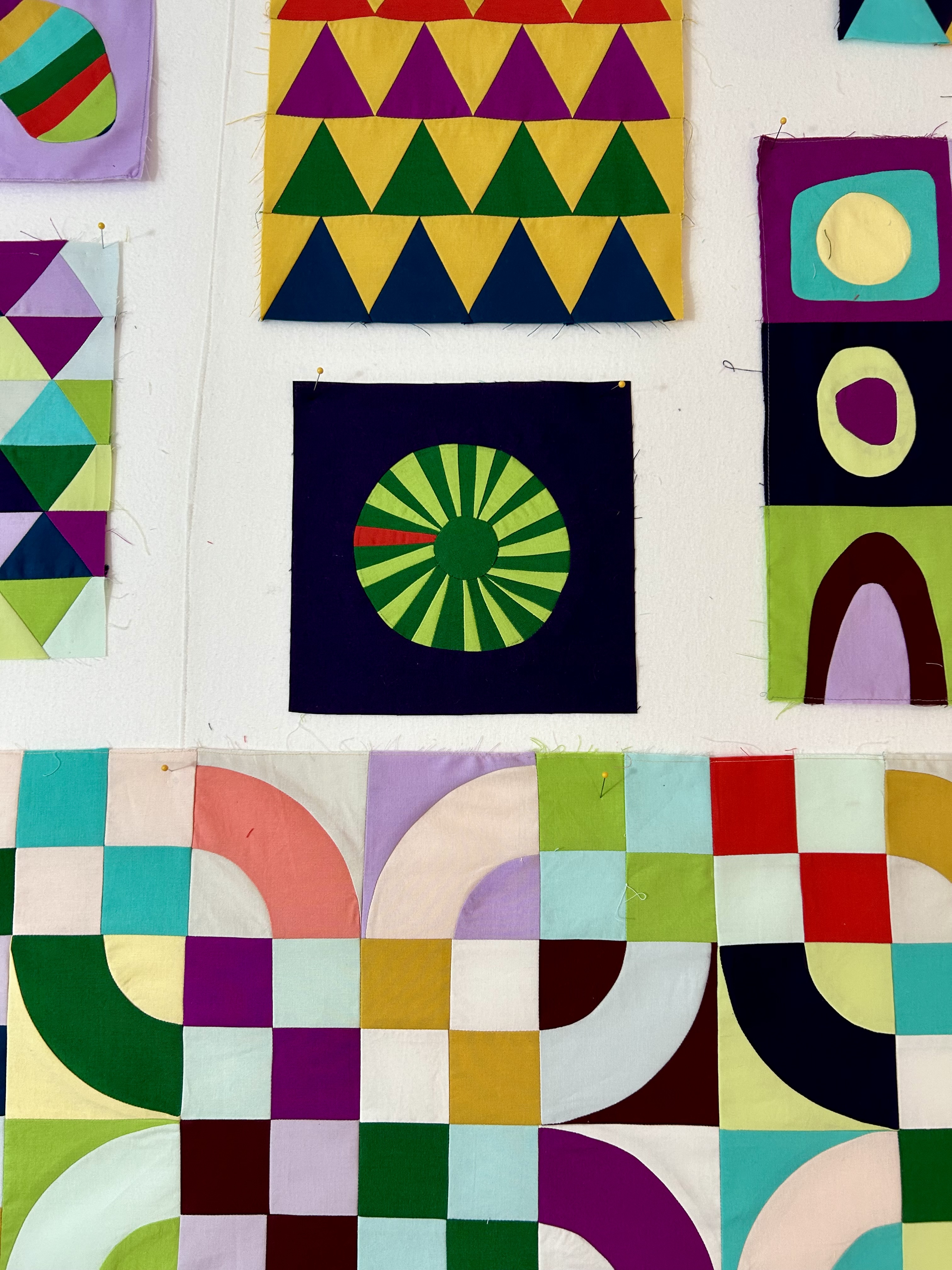
The last block in the Tara Faughnan online class “Blocks” is called “Wheels.” I made 4, and the last one is this little guy below. This block draws on other blocks we explored: the curves in Serpentine, the lines in Lines, and the 6-minute inset method of Squircles.
Here are the other three “Wheels” blocks. The aqua and red “Wheels” used the inset method, and I hand appliquéd the lavender block as I was a little afraid to try on of the big blocks with the inset method first. I do prefer the inset method, having tried both, and it proved to be quite easy.
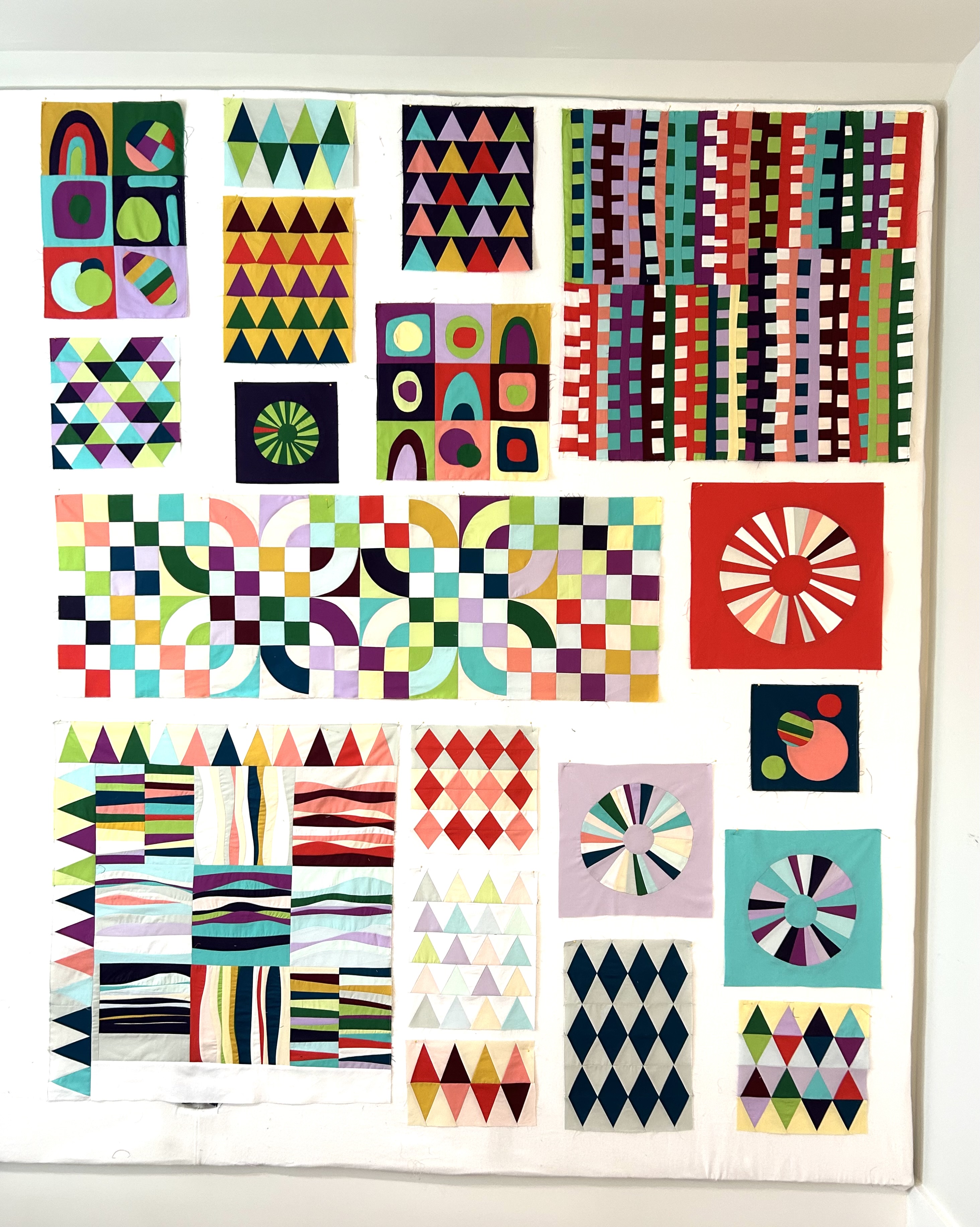
Here’s where my design wall is now. I only had one triangle block that didn’t want to play here–and it can become a big table-top hot pad gift for someone’s kitchen I think.
Is this arrangement going to be an improv quilt, or shall I break it up? When I chose what colors to use in a new block, I often did that while thinking where the new block would go in an improv quilt and what it would be near.
I have a light grey Kona in my stash–so maybe I’ll start to link up the blocks on the upper top left using it and just see how that goes.
This class was–and is–so much fun. I have really enjoyed the time for play and creativity–and an improv quilt would capture this 6 months of my life.
Meanwhile, I bought a whole cabbage and cut big slices out of it and roasted them in the oven. There were some beautiful dark green outer leaves, so I blanched those and cut them into thin strips. And with the smaller ends of the cabbage, after cutting the thick slices, I made a fresh salad–by pounding the finely cut pieces with a bit of salt to melt out the juice.
A grilled flank steak, some refrigerator “asset” roasted peppers and carrots, and some potatoes smashed with raw butter rounded out this delicious meal. I did, however, overcook the flank steak. I do like it much more rare. It’s hard to tell sometimes with flank steak just how done it is–and they do have thick and thin areas.
Well, the tops are all done. Now I have to longarm quilt them.
To back up, I’ve been on a mission to use up fabrics in my stash. So, some months back. I pulled out a collection of 1920-1930 reproduction “feed sack” prints I bought when a local store in Maine went out of business over 20 years ago. Along my quilty way, I moved more to the modern side of quilting, so I never used those fabrics.
Of course, LOL, I had to buy a few more prints to round out the color families I had. That’s the way this “using fabric issue” goes, right.
Anyway, I started with a pattern I saw called “Modern Vintage,” by Camille Roskelley and Bonnie Olaveson, which I saw in Vol. 16 of Quilt Lover’s Favorites (Better Homes and Gardens)–which used a traditional 10-inch block called “Single Wedding Ring.” (Thank you Joan Herrick for that information.)
Then while attending my local Charleston Modern Quilt Guild, I saw the “series” quilt challenge that some members did and showed–a series of three quilts that riffed off of the first original quilt they had made. And I was inspired–especially as I still had MORE of this fabrics.
“Bubbles” happened next, at about 48 inches square:
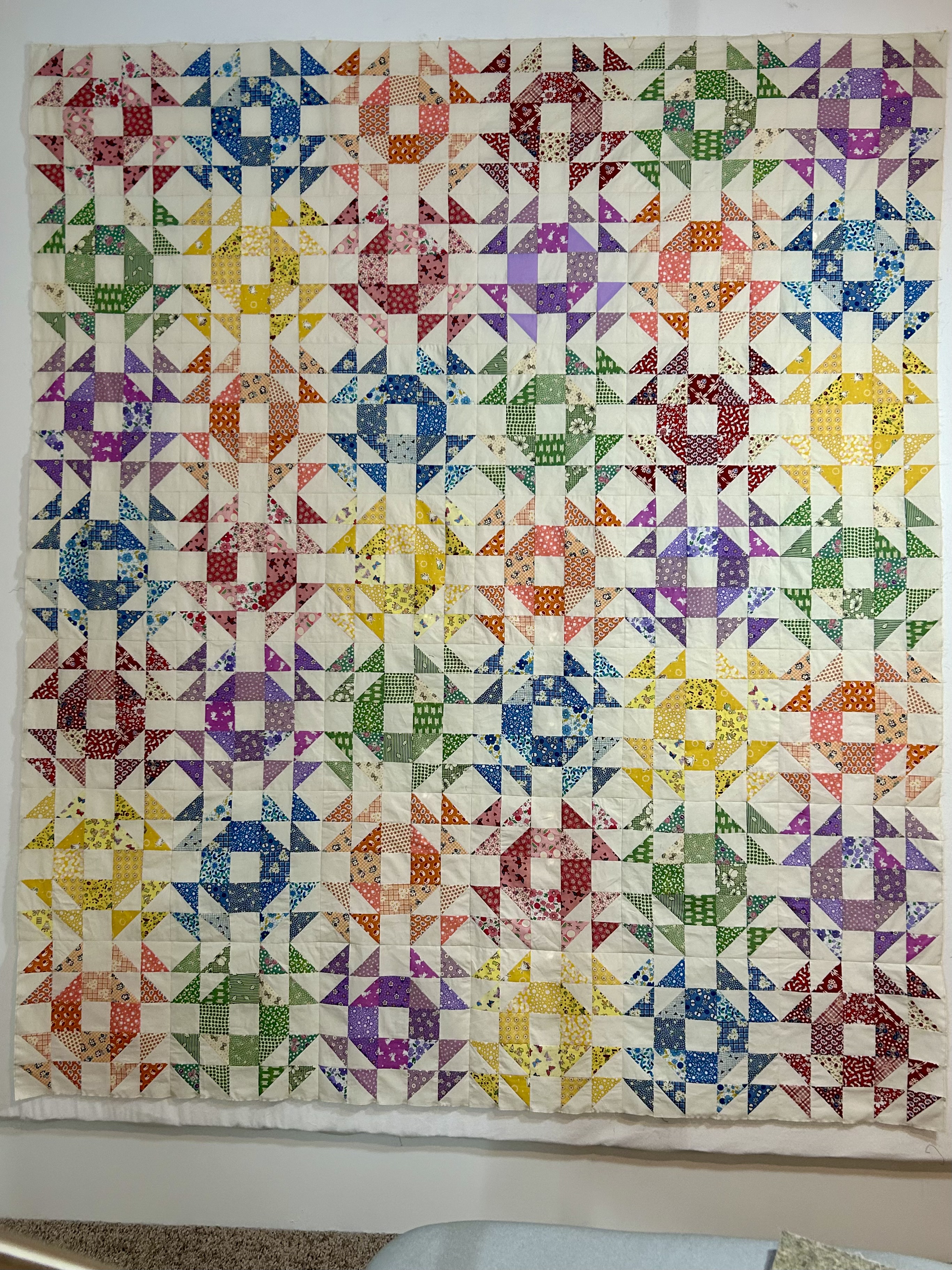
Yesterday I finished the “Pinwheels” top–it’s about 60 inches square. And Lordy Mercy! All those half-square triangles–but I have wanted to make a quilt with the intense use of lined-up half-square triangles for some time. Breaking up the lines in the center seemed a fun thing to do.
I still have some fabric–probably enough for a small baby quilt.
I don’t know…
Maybe I’ll donate it or play with a few blocks with the leftover half-square triangles or cut squares.
Meanwhile, the last block of the online Tara Faughnan “block” class is here, so I’ll take a break from the reproduction fabrics regardless.
Well, I do have to start longarm quilting them–and with longarm quilter Wendy Currie’s suggestions, will try out a few new pantographs.
It is a rainy Saturday morning, and today I will finish the final top of my series of 3 tops made with the 1920-30’s reproduction fabrics. So, pics tomorrow most likely.
AND, the new and final block, the 6th, of my online class with Tara Faughnan dropped yesterday. It’s called “Wheels,” and I can’t wait to try to make it. My improv project with the other blocks on the design wall could use some round blocks. I have so enjoyed this class. Friend Betsy in Vermont is already at her sewing machine this morning as she sets out to start this new block.
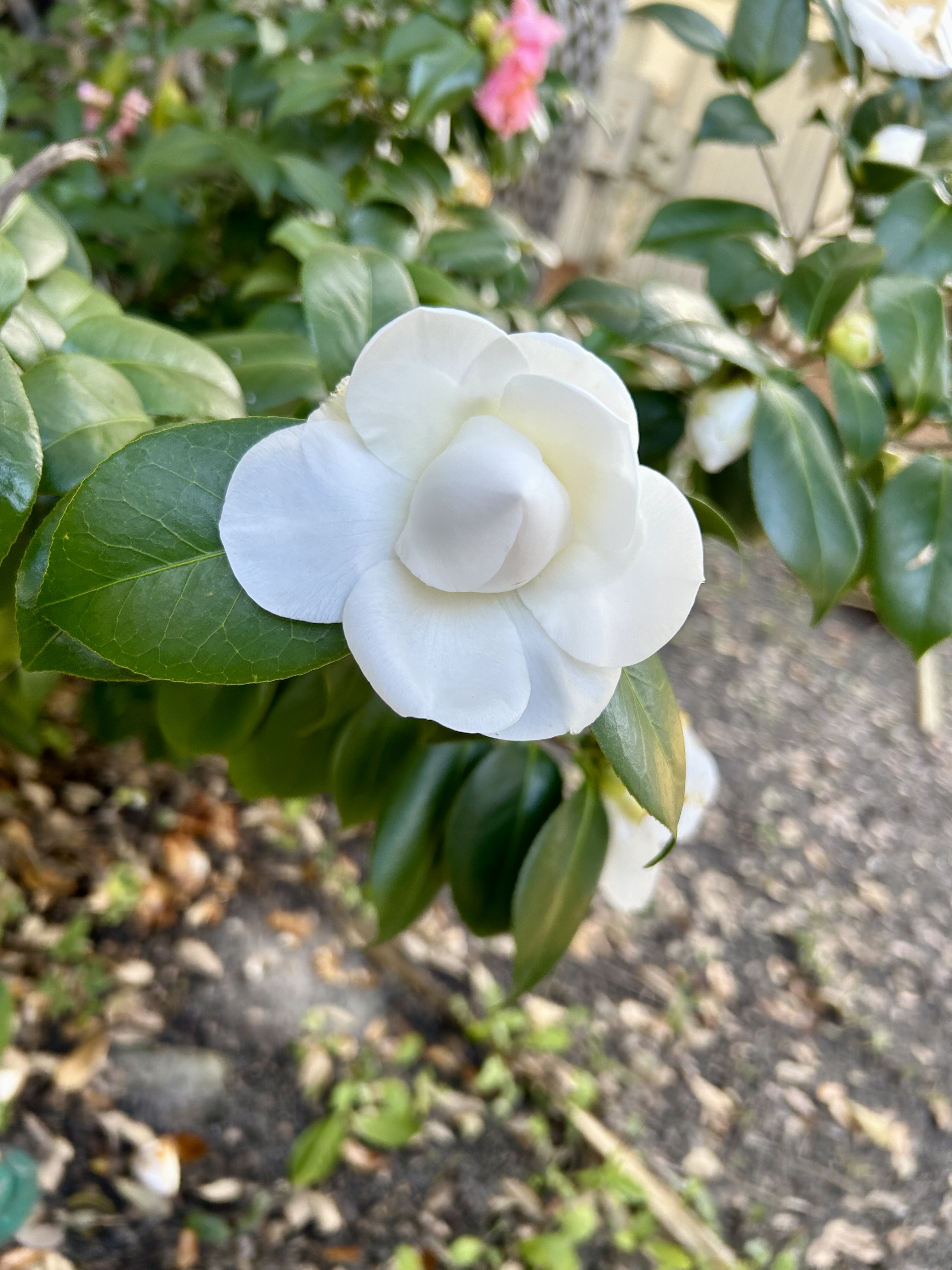
Camellias bloom in South Carolina in the winter months. Son Bryan and DIL Corinne have the prettiest white one in the front of their house, and this year it is loaded with blooms. It is backed by a pink one that is also blooming this year, but there wasn’t an open bloom when I took this picture.
These plants are so pretty with their glossy green leaves.
I have one spot on the shady side of my house. I could put a camellia plant there. Hmmmm…
I listen to books upstairs when I sew. And my little iPod that fits into my Bose speaker started to come apart at the seams. The humidity? I don’t know. Anyway, I thought it worth a try to try to glue it, so off to Home Depot I went and came home with a Gorilla glue gel that would work with plastics.
With paper towels and plastic gloves, I glued around the edges and clamped them shut. YEAH!! It did work and the iPod will keep going for a while now.
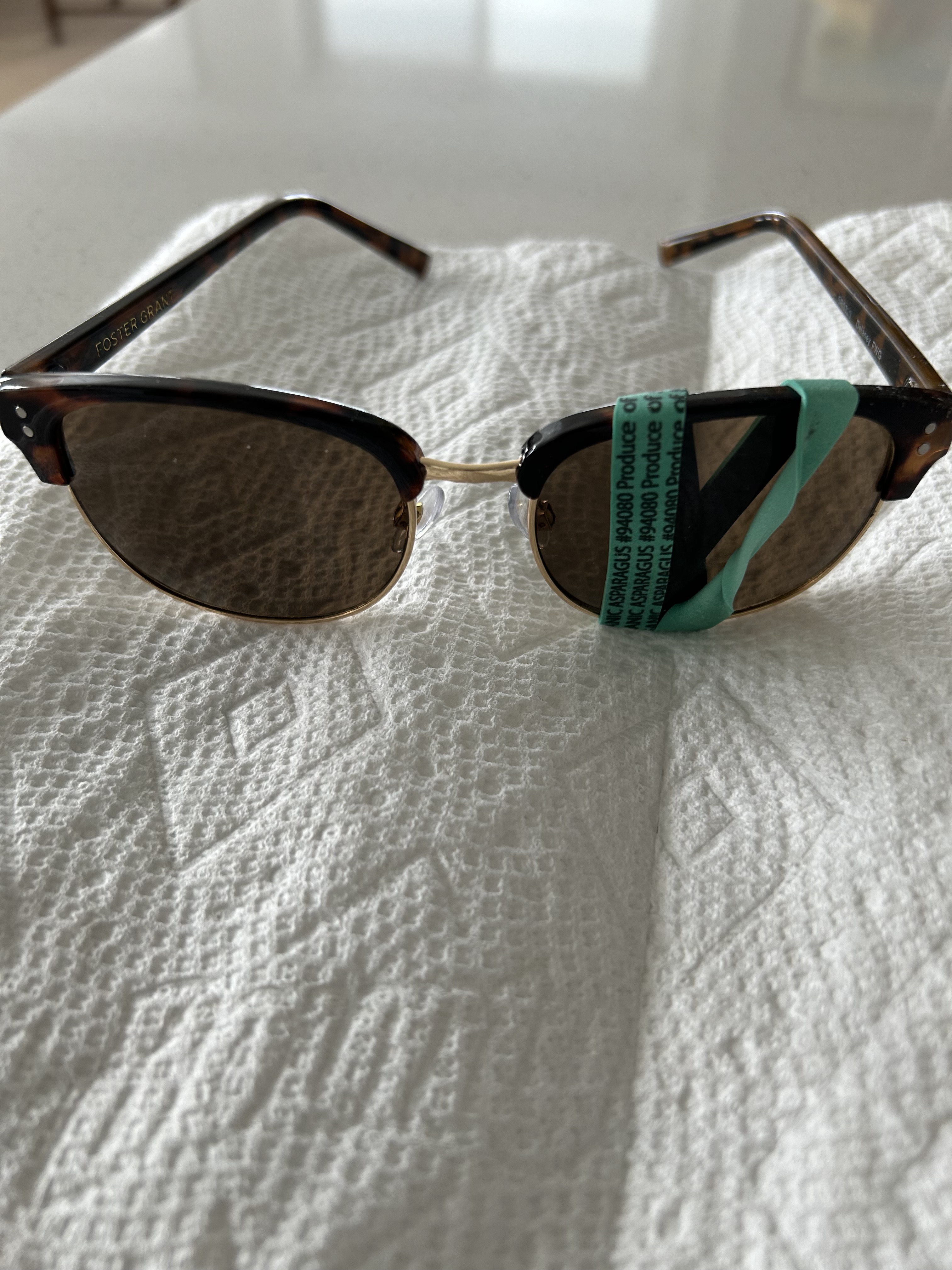
With that success I thought to try to glue the top of my cheap sunglasses back to the frame. Clamps wouldn’t work, so I tried a rubber band.
Yep. That worked too. Only somehow I got glue on the lens–probably from the gloves–those baggy thin clear ones painters use–and when I cut the rubber bands off I scratched the lens. Ugh!
Still, the glue did work fine. The glasses were fixed except for the glue and the scratch.
New glasses from the drug store are now back in the car. I do need sunglasses here with the rich sunlight and my cataract/lens eyes.
Now, on to that quilt top upstairs. Then I have to quilt all 3 of them on the longarm and sew down the binding. The hand quilting project on “Happy” is coming along. That will take some time though.
I remember the summer when I was 9 or 10, when we lived on Barksdale Air Force Base in Shreveport, Louisiana. That summer, my mother packed us up and took us to her home in rural Georgia as she deemed we would be safer there as polio struck mostly children and mostly in the summer heat.
As an adult, I’ve always been curious about what caused “polio” to erupt in that time frame which included that summer in my life, especially after reading that polio, the virus, had never spread so widely before that time. And I know two people of my age who had polio as children and suffered horribly then and have had permanent problems with their legs and feet their whole lives.
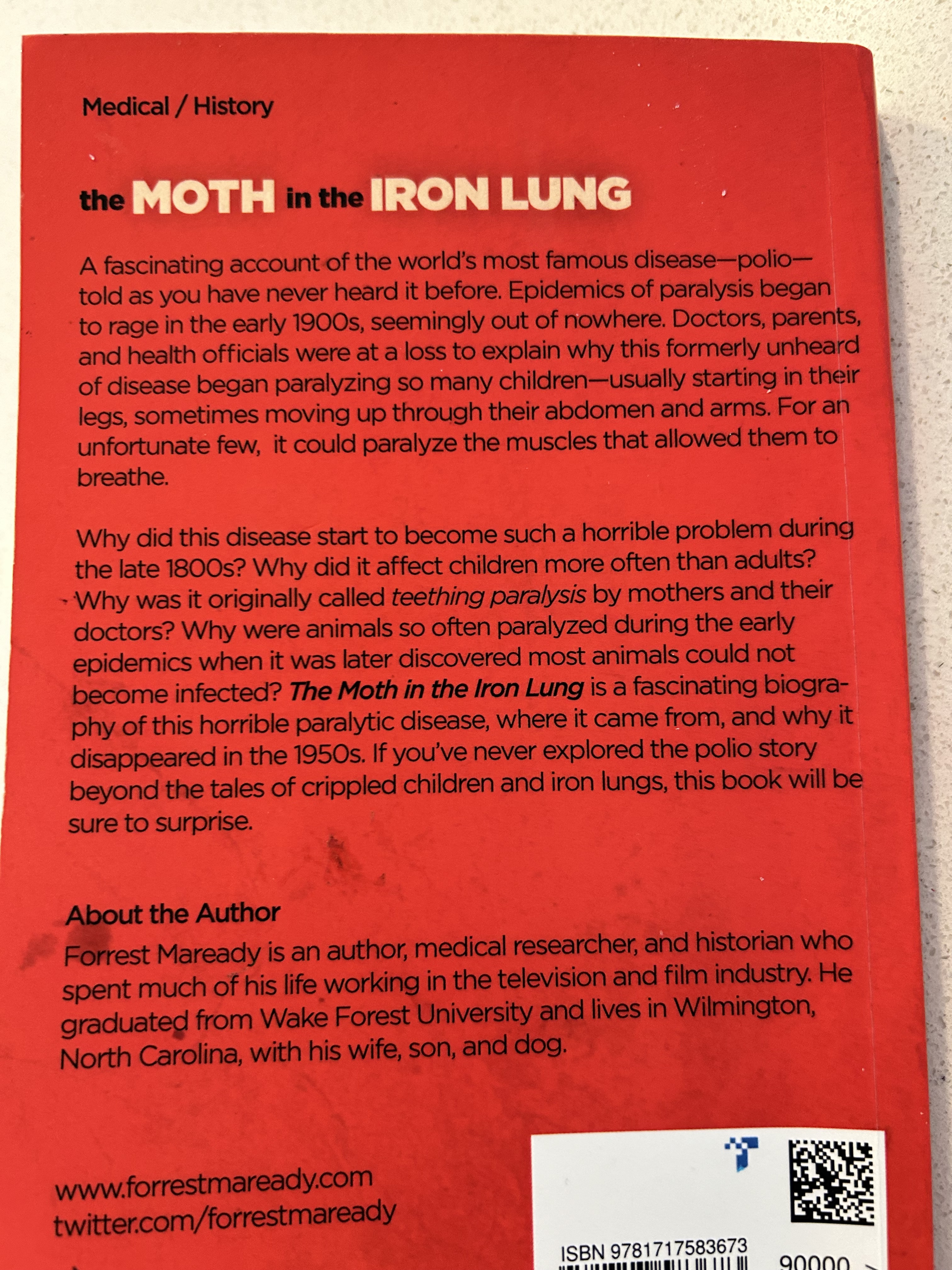
When I saw someone I follow online recommend this book by Forest Maready, I thought, ok, I’ll take a look and ordered it. Reading it was like following the plot of a murder mystery, and I was fascinated.
The back cover:
Maready starts with chronicling the first-recognized cases of “infantile paralysis” in the early 1800s in Europe and America. The paralysis always struck children about the time they were “teething” their first molar teeth. Horrifically, remedies involved deadly mixtures of mercury and arsenic. It is now known that mercury causes paralysis, so these remedies only made these children worse. But, why did only children get “polio” in the first place?
In 1856, Etienne Trouvelot arrived in Boston from France, bringing with him moth eggs as he raised silkworms and wanted to improve the line of silkworms he had. One type of the moth eggs he had were those of the Gypsy moth–which he dropped by accident in the yard of his American home. They hatched, and the saga of the utter destruction the gypsy moth created over time on the East Coast is now well known. By the spring of 1889 in Boston the Gypsy moths were devouring plants, starting with oak trees, and moving to food crops and fruit trees and anything they could eat. The moths were everywhere–on plants, on houses, even underfoot on the streets. Each spring, the moths spread outward in their search for food.
“Polio” means “grey.” And “myelitis” means lesions on the spinal cord. We know now that neurons inside the spinal cord come in two categories: grey matter in the center of the cord and white matter on the outside.”Poliomyelitis” means lesions in the grey matter of the spinal cord–which could only be seen in these early medical times during an autopsy. Further, lesions in the front half of the grey matter of the spinal cord cause muscle paralysis in the lower extremities, but if also in the back half, cause a loss of sensitivity/feeling. If the problem remained in the lower spine, paralysis was the problem. If the inflammation traveled up the spine, breathing problems start–and that produced the need for the iron lung that comes along eventually.
Meanwhile, people tried an arsenic poison called Paris Green to kill the Gypsy moths and other destructive insects, like the potato beetle which was impacting food production by 1874. Paris Green was sprayed directly on insects–and on food plants. Arsenic can and does cause lesions on the spinal cord. But Paris Green didn’t work well, so a mixture of lead arsenate was used on all plants, including garden vegetable plants. Later, investigators found residue from these poisons on foods, and industry hired “scientists” to do “studies” that said these poisons were not harmful.
Polio cases increased, and the term “epidemic” started being used. The first “polio epidemic” was in Rutland, Vermont, in 1894. But not all those who got this “polio” or who died from it, had the typical “polio” paralysis or other typical polio symptoms.
We now also know that many other things can cause a poliomyelitis paralysis condition. The polio virus is an enterovirus; it thrives in the gut. The coxsackievirus, echovirus, other enteroviruses (intestinal), and bacterial (like streptococcus) infections can causes poliomyelitis and its ensuing paralysis. But an infection has to get inside the nervous system to do its damage. And the question remains, how does that happen? Maready discusses some possible ways.
So why did children of teething age become sick first? One answer is that when little, their gut is next to their lower spine. As they grow, that proximity changes. But no one knows for sure.
As history advances, man invents better and better ways to spray poisons on insects and plants. After World War II, even planes are used to spray crops. And poisons, like DDT, come into the market. But this environmental situation and growing knowledge of other causes for “poliomyelitis” is ignored by “modern” medicine, which tries to find a vaccine that can prevent the polio virus itself. Meanwhile, poliomyelitis infections make the jump from rural areas to urban areas alongside the spraying campaigns and the better supply lines for fresh foods into urban areas.
My opinion: this whole story is a fascinating history. The end result is that there really is not much of a consensus on what actually happened back in the day. But true polio today from the actual virus is rare–unless it is caused by a live “polio virus” vaccine used outside of the US, which banned those vaccines for use here as they do shed and cause polio.
Plus, the famous iconic photo of dozens of iron lungs in a hospital environment was staged. There were never more than 1,157 iron lungs in operation in the United States in the 1950s. And an irony for me, also, is that when my mother took us to rural Georgia that summer, she may well have put us into more danger. I remember watching small “dustcropper” planes spray poisons over crops. But, we lived in town, and the family farm was outside the town.
Still, this journey we are on to manage crops and insects with poisons that are dangerous to mammal lives, continues unabated today. We are all living with a roulette wheel in terms of health outcomes. And “medicine” and public health are still ignoring environmental poisons while looking for vaccines for individual diseases.











 Louisa Enright's Blog