A history of what we call “Polio.”
I remember the summer when I was 9 or 10, when we lived on Barksdale Air Force Base in Shreveport, Louisiana. That summer, my mother packed us up and took us to her home in rural Georgia as she deemed we would be safer there as polio struck mostly children and mostly in the summer heat.
As an adult, I’ve always been curious about what caused “polio” to erupt in that time frame which included that summer in my life, especially after reading that polio, the virus, had never spread so widely before that time. And I know two people of my age who had polio as children and suffered horribly then and have had permanent problems with their legs and feet their whole lives.
When I saw someone I follow online recommend this book by Forest Maready, I thought, ok, I’ll take a look and ordered it. Reading it was like following the plot of a murder mystery, and I was fascinated.

The back cover:
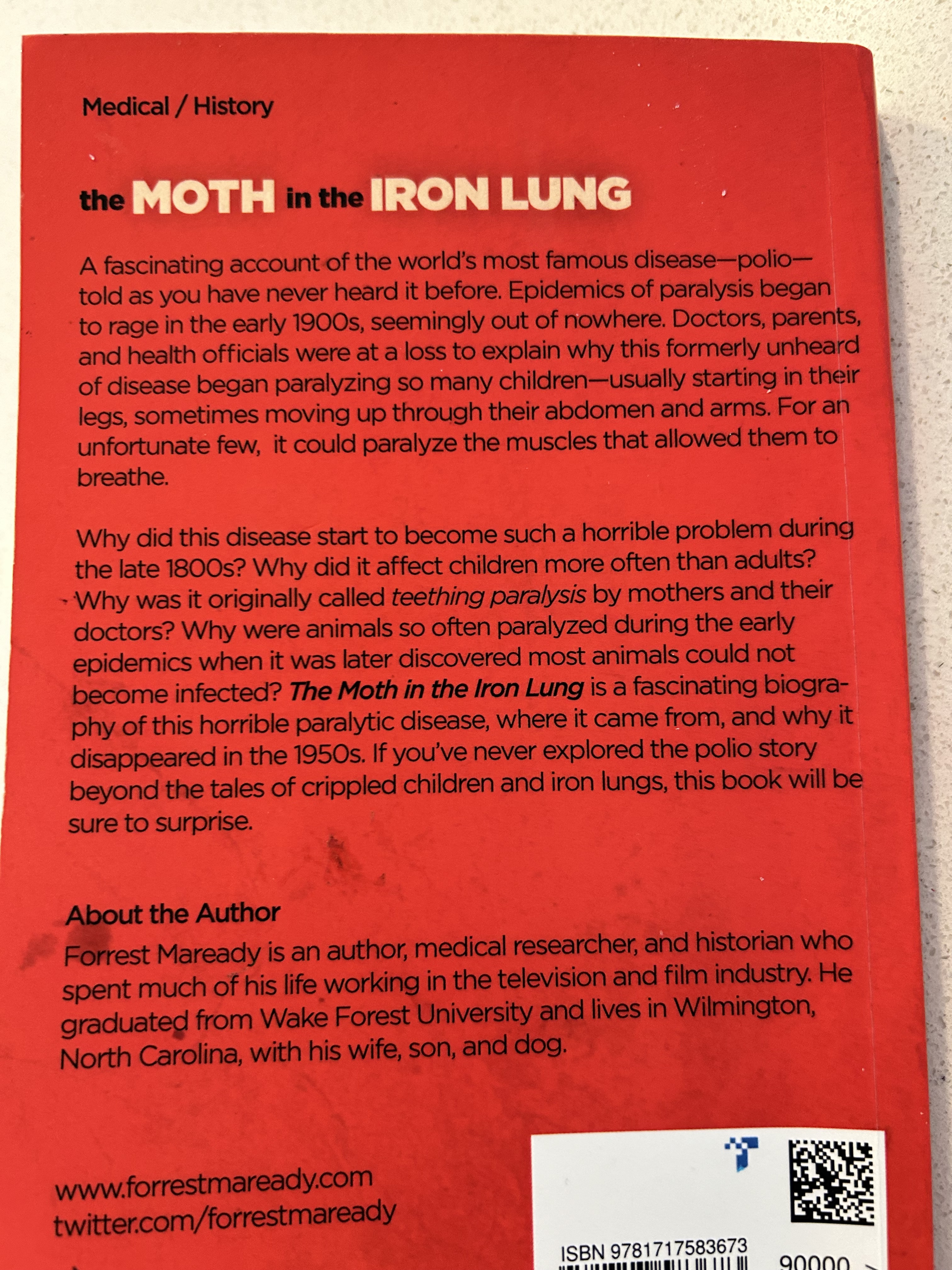
Maready starts with chronicling the first-recognized cases of “infantile paralysis” in the early 1800s in Europe and America. The paralysis always struck children about the time they were “teething” their first molar teeth. Horrifically, remedies involved deadly mixtures of mercury and arsenic. It is now known that mercury causes paralysis, so these remedies only made these children worse. But, why did only children get “polio” in the first place?
In 1856, Etienne Trouvelot arrived in Boston from France, bringing with him moth eggs as he raised silkworms and wanted to improve the line of silkworms he had. One type of the moth eggs he had were those of the Gypsy moth–which he dropped by accident in the yard of his American home. They hatched, and the saga of the utter destruction the gypsy moth created over time on the East Coast is now well known. By the spring of 1889 in Boston the Gypsy moths were devouring plants, starting with oak trees, and moving to food crops and fruit trees and anything they could eat. The moths were everywhere–on plants, on houses, even underfoot on the streets. Each spring, the moths spread outward in their search for food.
“Polio” means “grey.” And “myelitis” means lesions on the spinal cord. We know now that neurons inside the spinal cord come in two categories: grey matter in the center of the cord and white matter on the outside.”Poliomyelitis” means lesions in the grey matter of the spinal cord–which could only be seen in these early medical times during an autopsy. Further, lesions in the front half of the grey matter of the spinal cord cause muscle paralysis in the lower extremities, but if also in the back half, cause a loss of sensitivity/feeling. If the problem remained in the lower spine, paralysis was the problem. If the inflammation traveled up the spine, breathing problems start–and that produced the need for the iron lung that comes along eventually.
Meanwhile, people tried an arsenic poison called Paris Green to kill the Gypsy moths and other destructive insects, like the potato beetle which was impacting food production by 1874. Paris Green was sprayed directly on insects–and on food plants. Arsenic can and does cause lesions on the spinal cord. But Paris Green didn’t work well, so a mixture of lead arsenate was used on all plants, including garden vegetable plants. Later, investigators found residue from these poisons on foods, and industry hired “scientists” to do “studies” that said these poisons were not harmful.
Polio cases increased, and the term “epidemic” started being used. The first “polio epidemic” was in Rutland, Vermont, in 1894. But not all those who got this “polio” or who died from it, had the typical “polio” paralysis or other typical polio symptoms.
We now also know that many other things can cause a poliomyelitis paralysis condition. The polio virus is an enterovirus; it thrives in the gut. The coxsackievirus, echovirus, other enteroviruses (intestinal), and bacterial (like streptococcus) infections can causes poliomyelitis and its ensuing paralysis. But an infection has to get inside the nervous system to do its damage. And the question remains, how does that happen? Maready discusses some possible ways.
So why did children of teething age become sick first? One answer is that when little, their gut is next to their lower spine. As they grow, that proximity changes. But no one knows for sure.
As history advances, man invents better and better ways to spray poisons on insects and plants. After World War II, even planes are used to spray crops. And poisons, like DDT, come into the market. But this environmental situation and growing knowledge of other causes for “poliomyelitis” is ignored by “modern” medicine, which tries to find a vaccine that can prevent the polio virus itself. Meanwhile, poliomyelitis infections make the jump from rural areas to urban areas alongside the spraying campaigns and the better supply lines for fresh foods into urban areas.
My opinion: this whole story is a fascinating history. The end result is that there really is not much of a consensus on what actually happened back in the day. But true polio today from the actual virus is rare–unless it is caused by a live “polio virus” vaccine used outside of the US, which banned those vaccines for use here as they do shed and cause polio.
Plus, the famous iconic photo of dozens of iron lungs in a hospital environment was staged. There were never more than 1,157 iron lungs in operation in the United States in the 1950s. And an irony for me, also, is that when my mother took us to rural Georgia that summer, she may well have put us into more danger. I remember watching small “dustcropper” planes spray poisons over crops. But, we lived in town, and the family farm was outside the town.
Still, this journey we are on to manage crops and insects with poisons that are dangerous to mammal lives, continues unabated today. We are all living with a roulette wheel in terms of health outcomes. And “medicine” and public health are still ignoring environmental poisons while looking for vaccines for individual diseases.

 Louisa Enright's Blog
As a nurse I find the book very interesting. My library doesn’t have it, but they do have a summary of the book — I may read through it and then maybe purchase the book.
Also, a memory was stirred up of us (as children) running behind the trucks spraying for mosquitoes…… Lord knows what we were exposed to. I was fortunate and my parents forbade it! Funny how at the time I thought I was being punished and they were silly, but now…… that “smoke” was probably DDT. Ugh!!!!!!!
Thank you for sharing the book!!!