Last Tuesday late afternoon we were about to get another thunderstorm, and I went out to move a plant on the screened back porch and saw a HUGE insect on the outside of a screen. What on earth?
All of you who follow this blog know that I had to immediately figure out that insect.
I’ve never seen a grasshopper like this HUGE creature. S/he is almost 3 inches long! With lightening from the storm already starting, I had to go outside to get pictures.
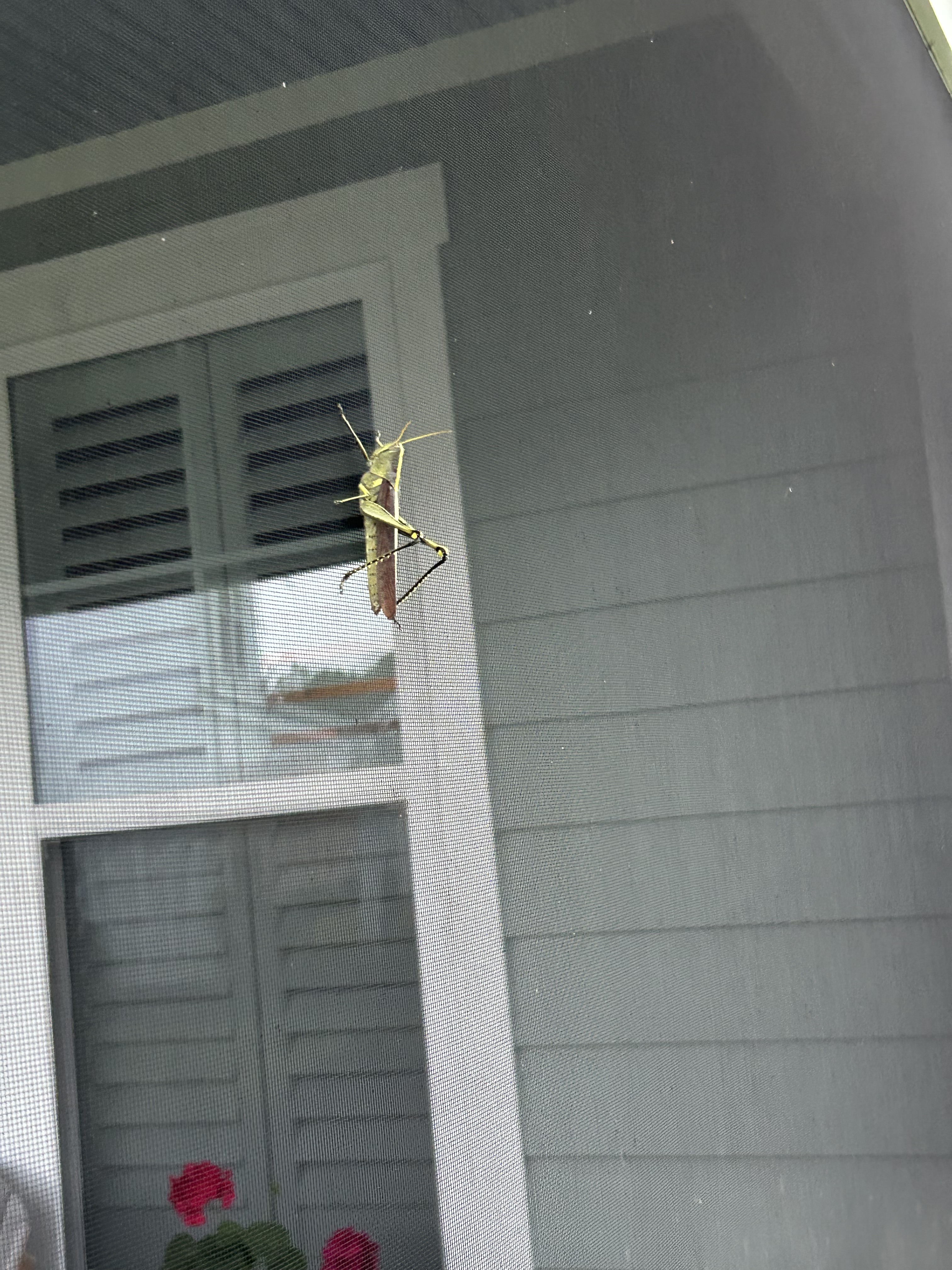
What on earth kind of grasshopper is this one?
Look at the gorgeous markings too. Huge back legs…

It’s an Eastern Lubber Grasshopper. What does “lubber” mean? Here’s a quote from the information link below:
“Lubber” is derived from an old English word “lobre” which means lazy or clumsy. This term has come to mean a big, clumsy, and stupid person, also known as a lout or lummox. In modern times, it is normally used only by seafarers, who term novices “landlubbers”.
Here’s a stock photo I found that shows the size of this huge creature in a human hand.

But don’t try to pick them up as one will spray a noxious toxic mixture at you–which is why it has few predators.
It can’t fly, so it lumbers along walking.
What kind of damage? Here’s a quote for the informational link below:
“Lubber grasshoppers are defoliators, consuming the leaf tissue of numerous plants. They climb readily, and because they are gregarious they can completely strip foliage from plants. More commonly, however, they will eat irregular holes in vegetation and then move on to another leaf or plant. Lubber grasshoppers are not as damaging as their size might suggest; they consume less food than smaller grasshoppers (Griffiths and Thompson 1952). Damage is commonly associated with areas that support weeds or semi-aquatic plants such as irrigation and drainage ditches, end edges of ponds. Grasshoppers developing initially in such areas will disperse to crops and residential areas, where they cause damage. Thus, as is the case with many grasshoppers, monitoring and treatment of areas where nymphal development occurs is recommended to prevent damage to economically important plants. Also helpful is to keep vegetation mowed, as short vegetation is less supportive of grasshoppers.”
We got 6 inches of rain Monday night and 3.5 inches in the late afternoon storm Tuesday. The grass and plants outside are now happy. But the ants aren’t, and that is another story to tell as they are coming inside my house.
PS: It’s Saturday morning now, and the grasshopper comes and goes on my back porch screen. Likely s/he came from the bio swale/stream that runs through our neighborhood or the wetlands above it. I don’t see any apparent damage to the roses though.

 Louisa Enright's Blog