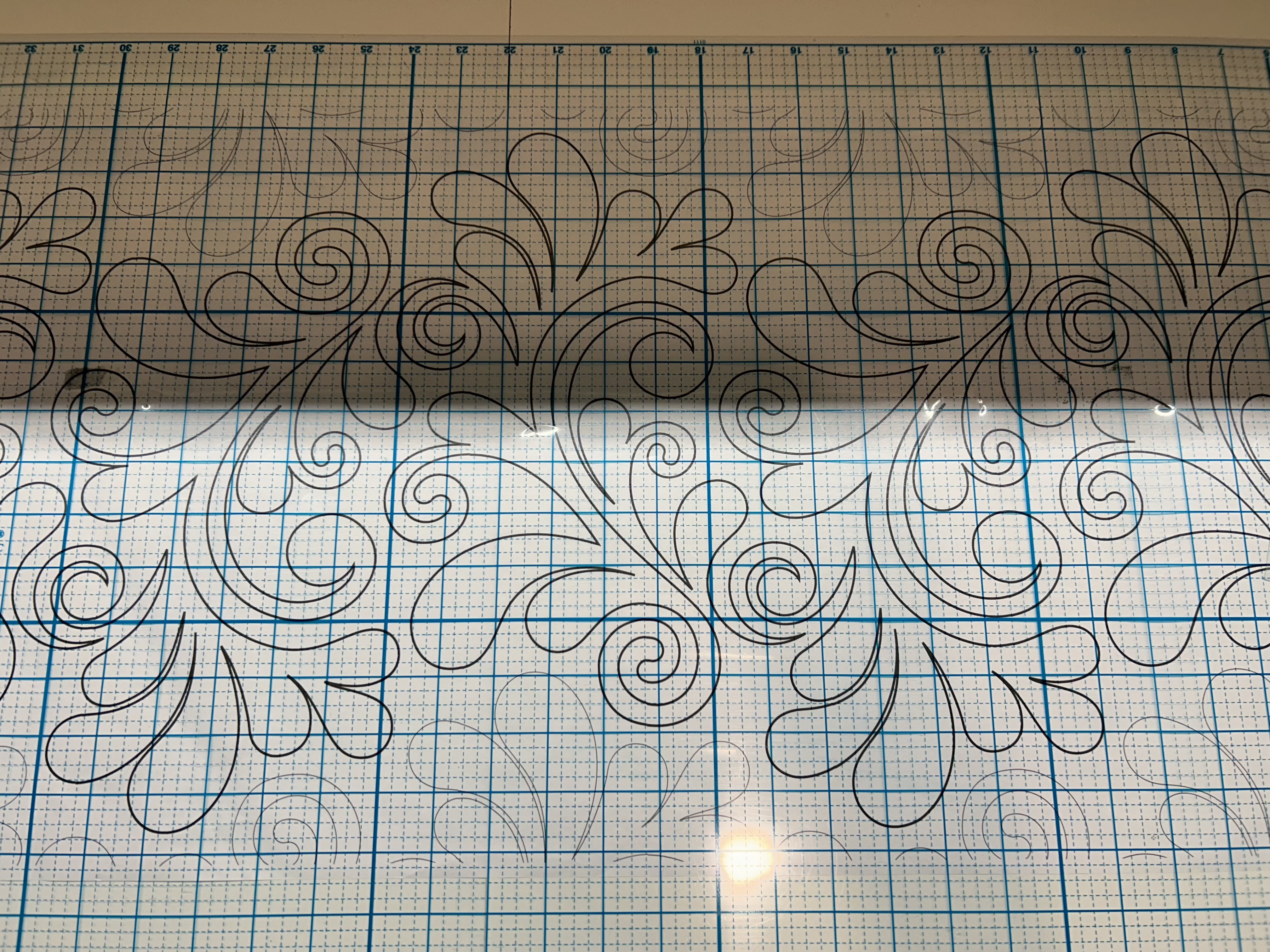
It took me a while to quilt it as I had planned to use a daunting pantograph for the first time: “Nemesh’s Feather Grande” by Bethanne Nemesh.
I was intimidated. For sure.
But once I got organized with this panto, I found it was fun to use–all those cute swirls. And it lays down what would be a double/wider run, which means a more intense run, but double the amount it does on the quilt–so less runs to do.
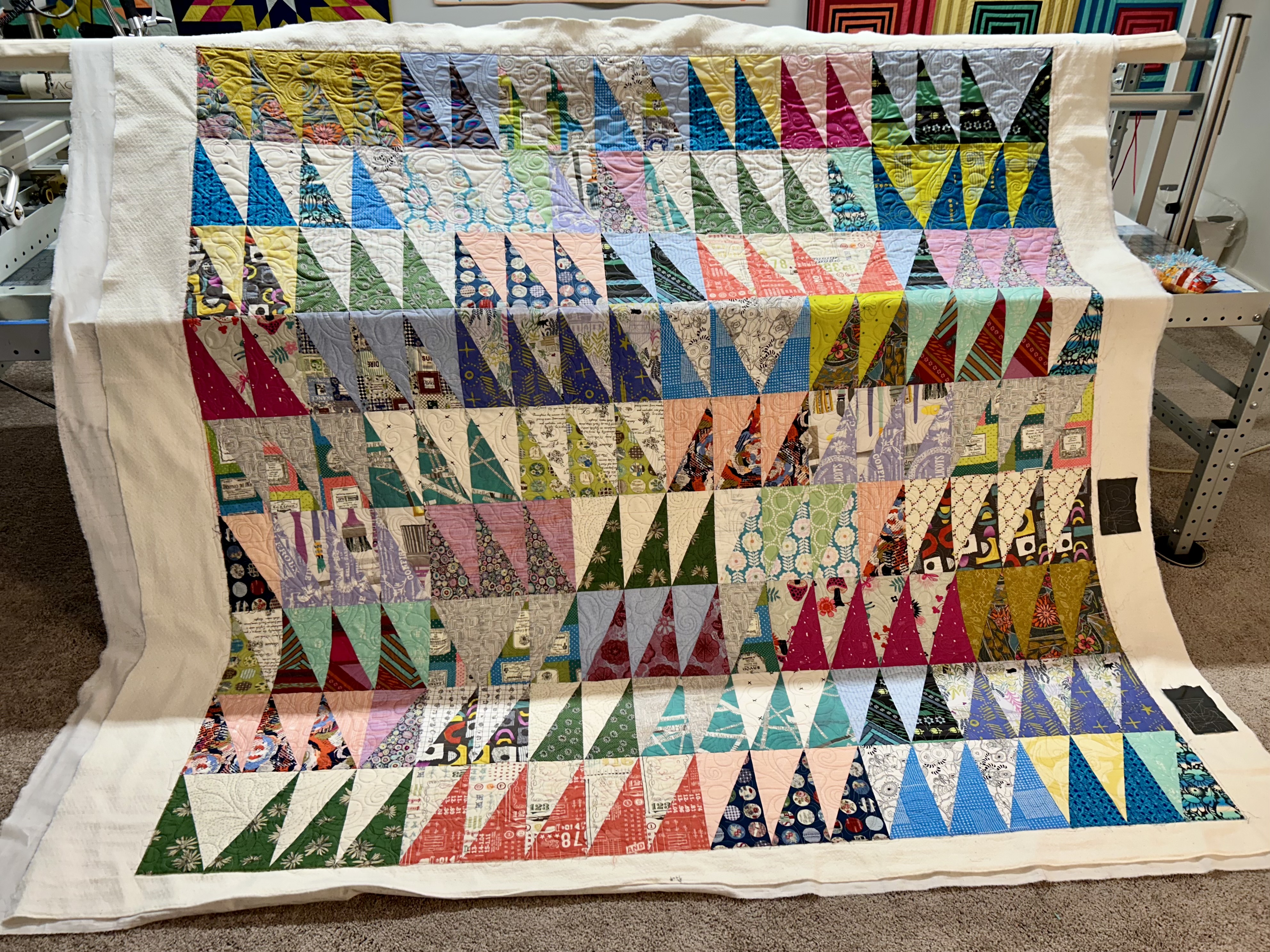
It proved to be PERFECT. The texture is just awesome. Here is “Arrowheads” just finished.
Here’s a close-up of the texture:
And here is “Arrowheads” all trimmed and bound and ready for me to sew down the binding. I lay out a quilt on the floor to lay out the binding so I don’t play “binding roulette” with where a seam falls near a corner.
I’m liking this striped binding a lot:
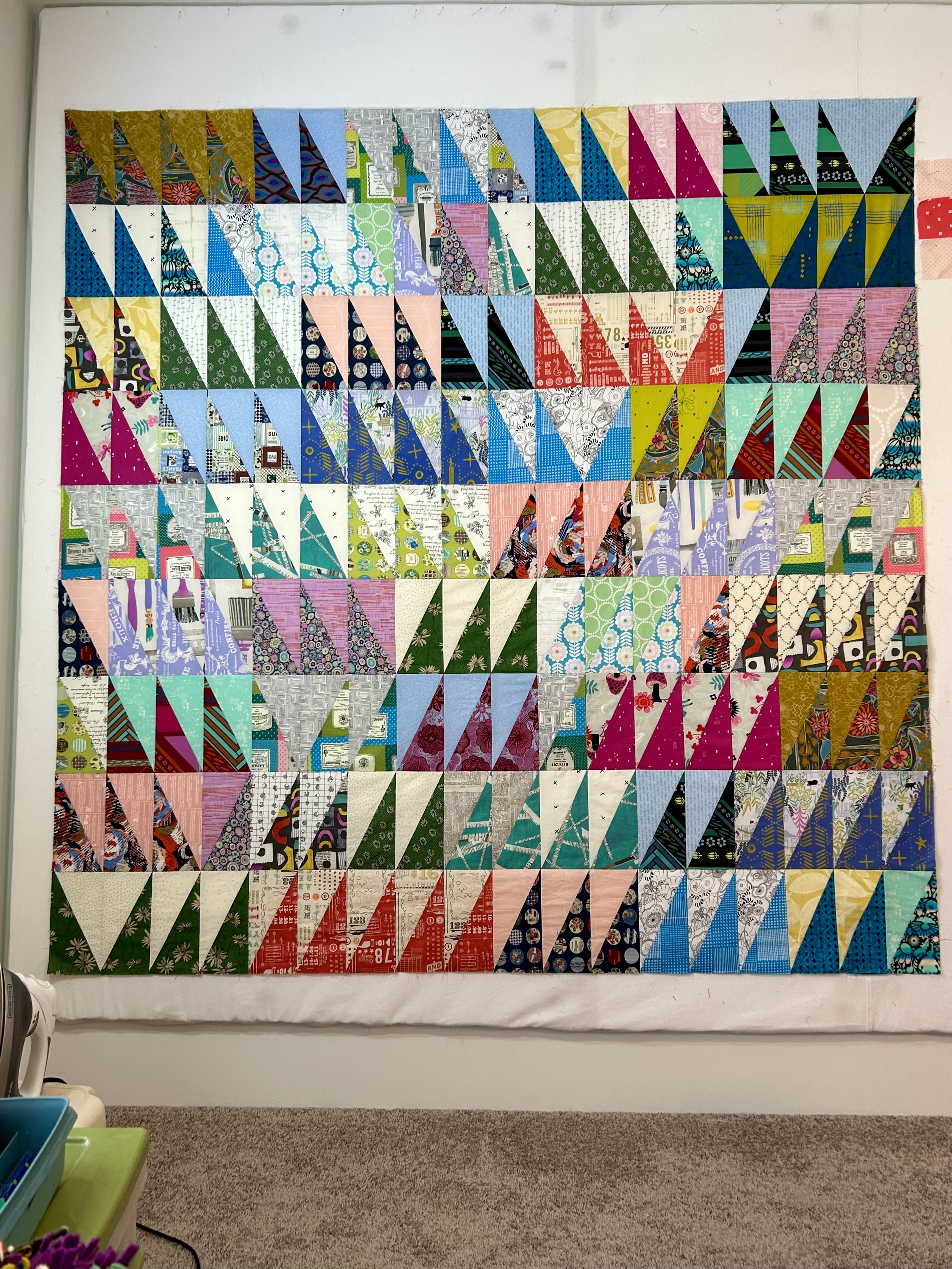
“Arrowheads” is the first quilt in a series–using Latifah Saafir’s Hurty ruler–with which I am currently obsessed.
The second quilt, “Diamonds,” will come off the design wall later today–and I’ll likely use this same pantograph to quilt it. And I have enough of this striped binding to use it again. And I have a backing.
I have two more ideas to play with regarding at least a third quilt.
Meanwhile, I’m loving pulling so many cool fabrics out of my stash to make these blocks. This project is allowing me to play to my heart’s content.
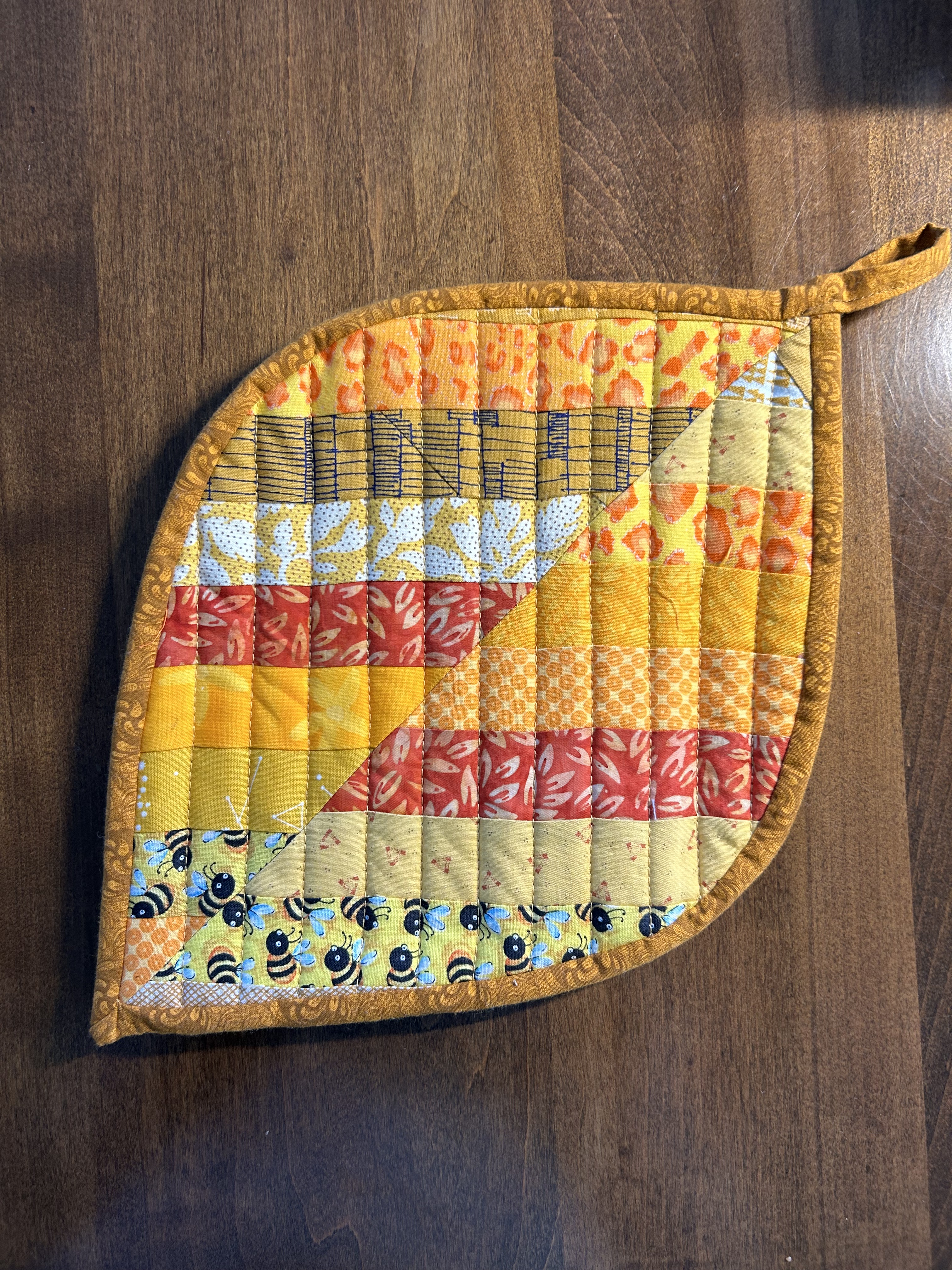
With the last of my units made for my online monthly class with Tara Faughnan, I made these adorable POTHOLDERS. (And the rope trivet for a neighbor, who also collected two of these potholders yesterday.)
I wanted to just play with the leftover “hourglass” units I’d made to see what kind of patterns would emerge. Two of these (hourglass squares in the middle) are just the straight hourglass units–and they make the intriguing square–which would make a nice quilt block if set off with sashing. Hmmmm. Two use trimmed hourglass units combined with the half-rectangle triangle units and trimmed in an improv way. And one just uses up the remaining scraps from this month’s “play” block.
What was really fun was to figure out this new way to bind a potholder so that one leaves a tail that can be made into a loop. This way means NO need to join the two binding ends somewhere in the middle of the little potholder (about 6 inches finished). The end tail just folds over–turn in the raw ends–and sew it down. Then make the loop and sew it to the potholder. I sewed just outside the actual potholder as that was easier.
I’m sewing down binding on the last two projects from this month’s class, and it’s a good thing as the next project comes November 1st. It’s all good, and I certainly enjoyed this October project.
It’s cooler now, so it’s time for warmer dishes. I made a lamb stew the other day, and it has been rich and delicious. I bought a rolled leg of lamb some time back and unrolled it. I cut the thicker piece into a roast and cut the thinner piece into chunks for k-bobs or a stew–and froze the two packages. The roast was cooked some time back, and now, this stew.
I wanted some turnips, but couldn’t find any organic ones. They were a fall staple in Maine. But, I did find parsnips, so included those. The green is collards. The rest is chopped onions browned with lots of garlic–then carrots, potatoes, the parsnips, red peppers that needed using, some onion chunks, and herbs–all thrown into the pot after I browned the onions and garlic–then when the mixture started caramelizing, I threw in the meat and cooked for a bit, the added water.
I’ve worked out how to easily handle the binding now–and I do like the zig-zag stitch to hold it down–sewn from the front. And the loop encloses itself so just needs to be doubled back and sewn to the potholder–which means no need to join the circle of a binding when the ends meet. Here the ends meet at the bottom of the leaf.
Reminder, I got this idea from Amira Ameruddin’s video on Instagram: amira_littlemushroomcap. This leaf potholder idea was featured on the weekly post I get from Aurifil threads that highlights various quilt/sewing projects using Aurifil threads.
I spent HOURS yesterday watering plants and grass. It is so dry. My grass was trying to die–and this centipede grass is a water hog, for sure. It makes a mat like a rug that is 2 or more inches deep. My neighbors who have irrigation systems have grass that isn’t showing stress and browning, so I knew that mine browning was not due to fall/winter, but due to lack of water. So…watering had to happen. (My new little sprinklers are really helping as they have so many different, reliable settings that let me direct water to exactly where I want it to go.)
Here’s the last piece I’ll piece for this month’s “Hourglass” block in Tara Faughnan’s “Block 2” online class. I pretty much used up all the remaining blocks I had made and the scraps I had cut from this palette. (I just finished quilting the second half-rectangle triangle piece I did–the bright one. So now it needs facing or a binding.)
How fun is this? I’ll hand quilt it in some sort of incoherent wacky way to highlight the improv nature of this block. I also have a stack of potholders to sew–where I played with improv arrangements with this block. They’re fun. Pics when they are all done.
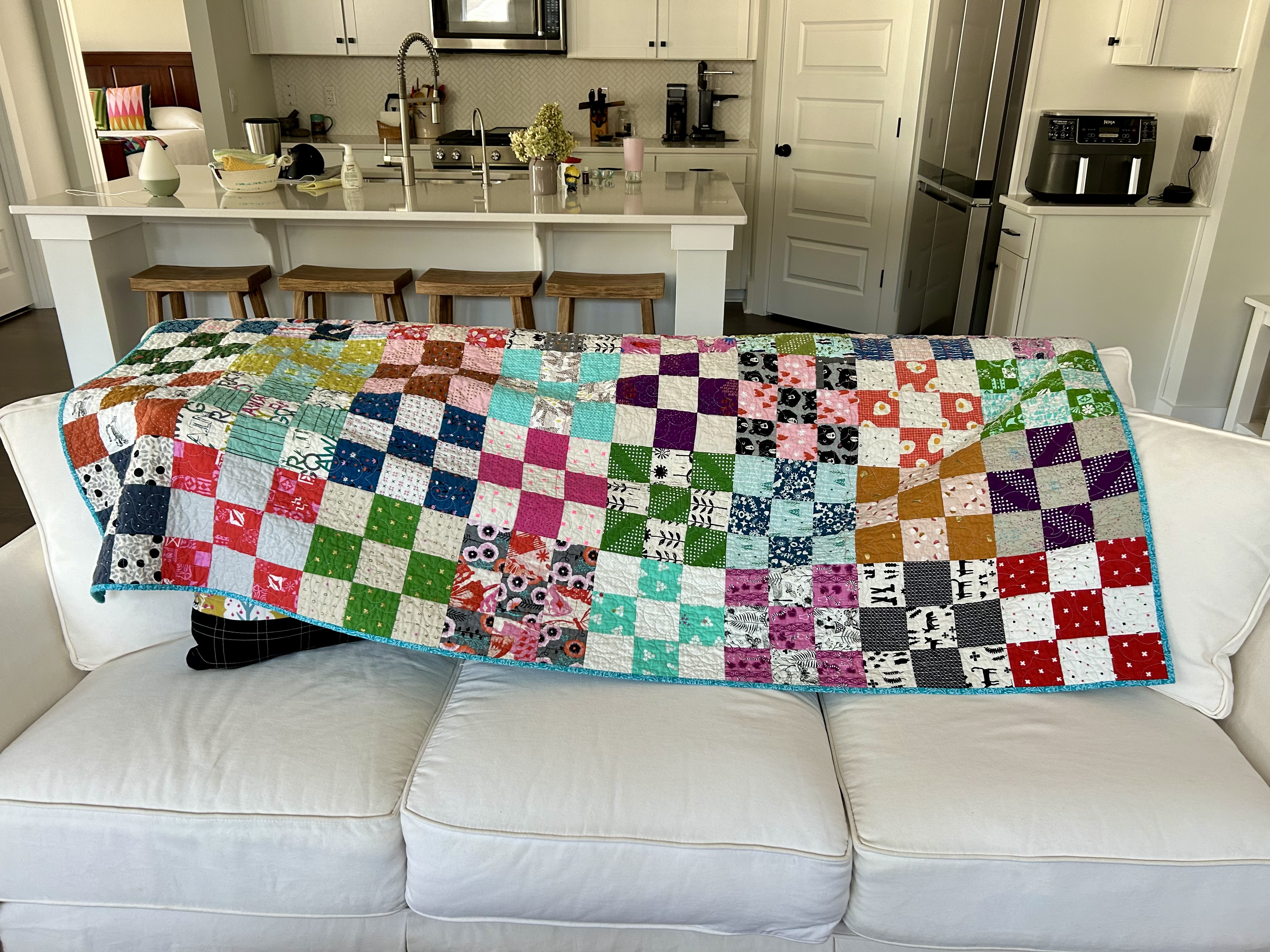
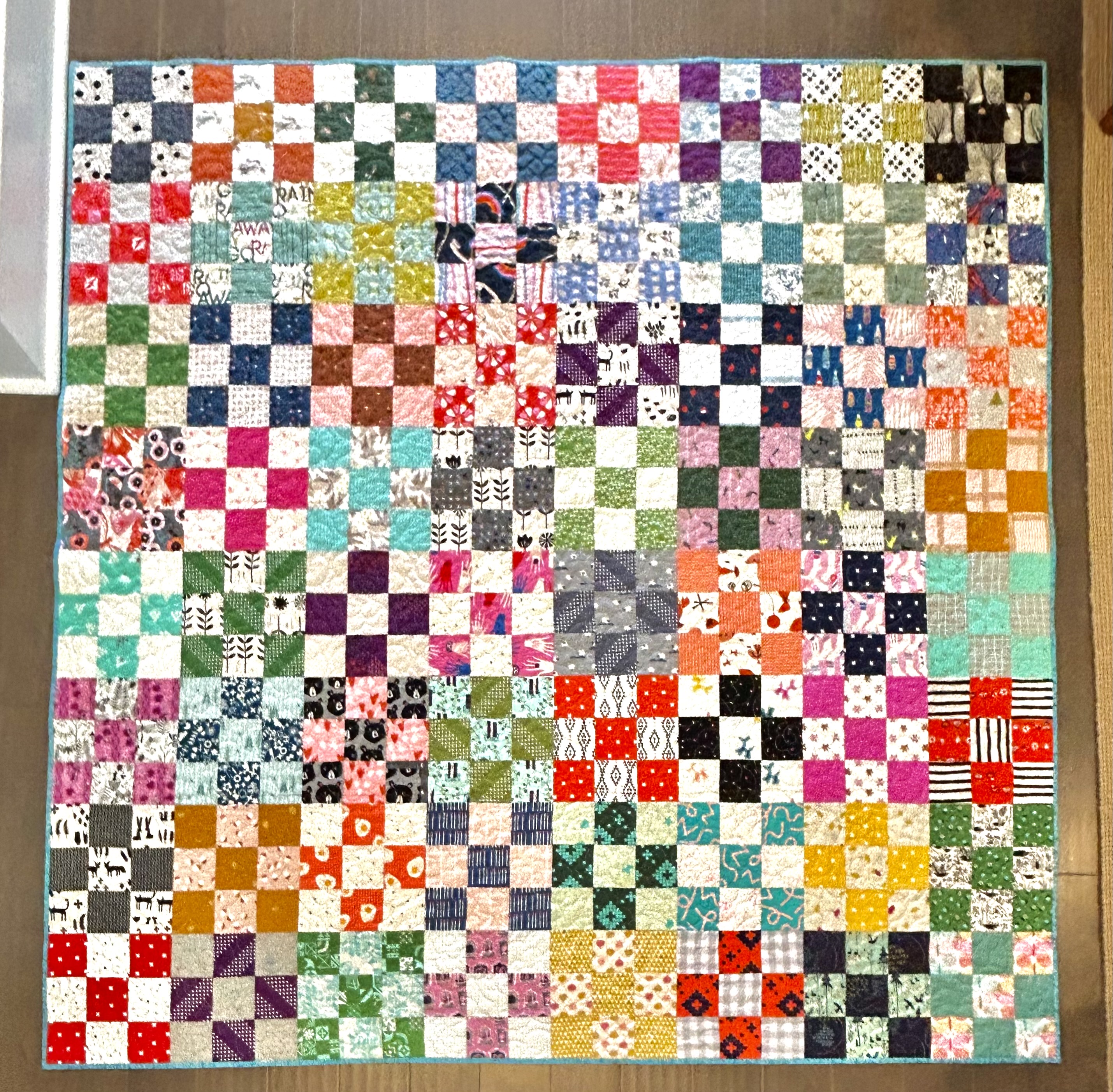
“Pot Pourri 4” is washed and ready to mail to a niece with a new baby girl. I like to hang a recently washed quilt over the sofa back to make sure all the moisture drys out before I mail it. And I’ll mail on Monday as I don’t like my quilts traveling on weekends.
I’ve grown very attached to this quilt–it is so lively and fun.
It is just a great scrappy quilt.
The Charleston Modern Quilt Group met this week. As always, the Show and Tell quilts were awesome. They are on that group’s open web site if you want to see more. But here is the latest from Cathy Beemer–another amazing quilt top.
I thought I was done piecing “Diamonds,” part 2 of my series with half-rectangle blocks. BUT, I realized I needed one more row as the width was 72, as planned, but the math escaped me for the length, which was only 64 inches!!! I put the top back on the design wall and thought about the issue for two days–and woke up yesterday with the best solution to extend the quilt. Yeah!!! Taking apart one row to add another inside the top was needed, and that is now done. I’m working on filling in that row. Our brains are amazing. Give them a problem to solve and give them time to solve it.
Here’s a really fun quilt–be sure to scroll down to see the maker’s dress as it matches the gingham used in this quilt. (You might have to copy this link to get to this post.)
This quilt is super bright, yes. And I think the bright neon thread is a gutsy choice that works well.
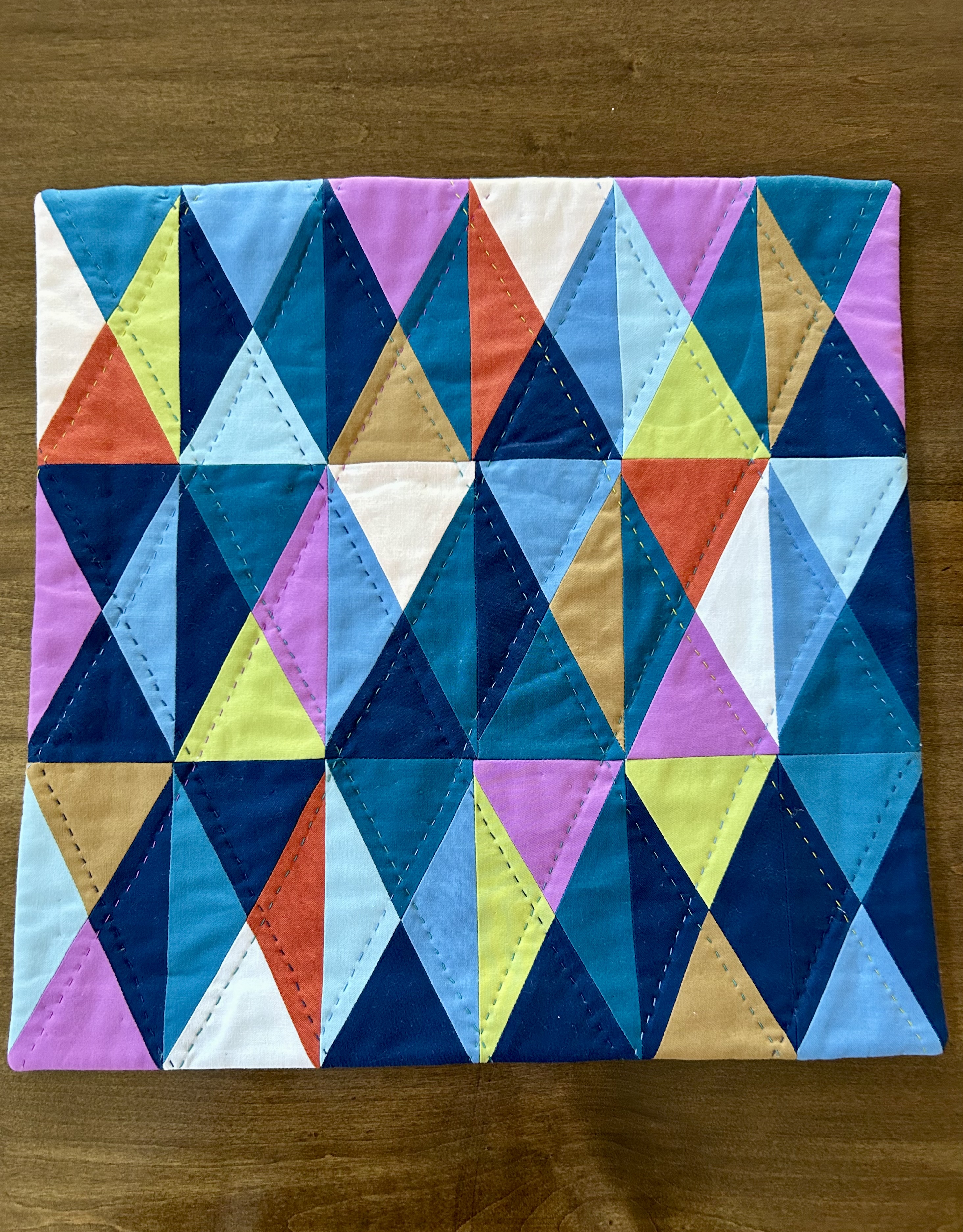
This little project from Tara Faughnan’s online “Blocks 2” class is finished. I tried facing for the first time, and it worked well I think. I like the clean, modern look facing gives.
This one (18-inches square) can be used as a decorative table topper I think. Here it is with large and deep rope bowl I made as an example. But a thinner vase with flowers would be lovely and more in proportion.
I’m hand quilting the bright version now.
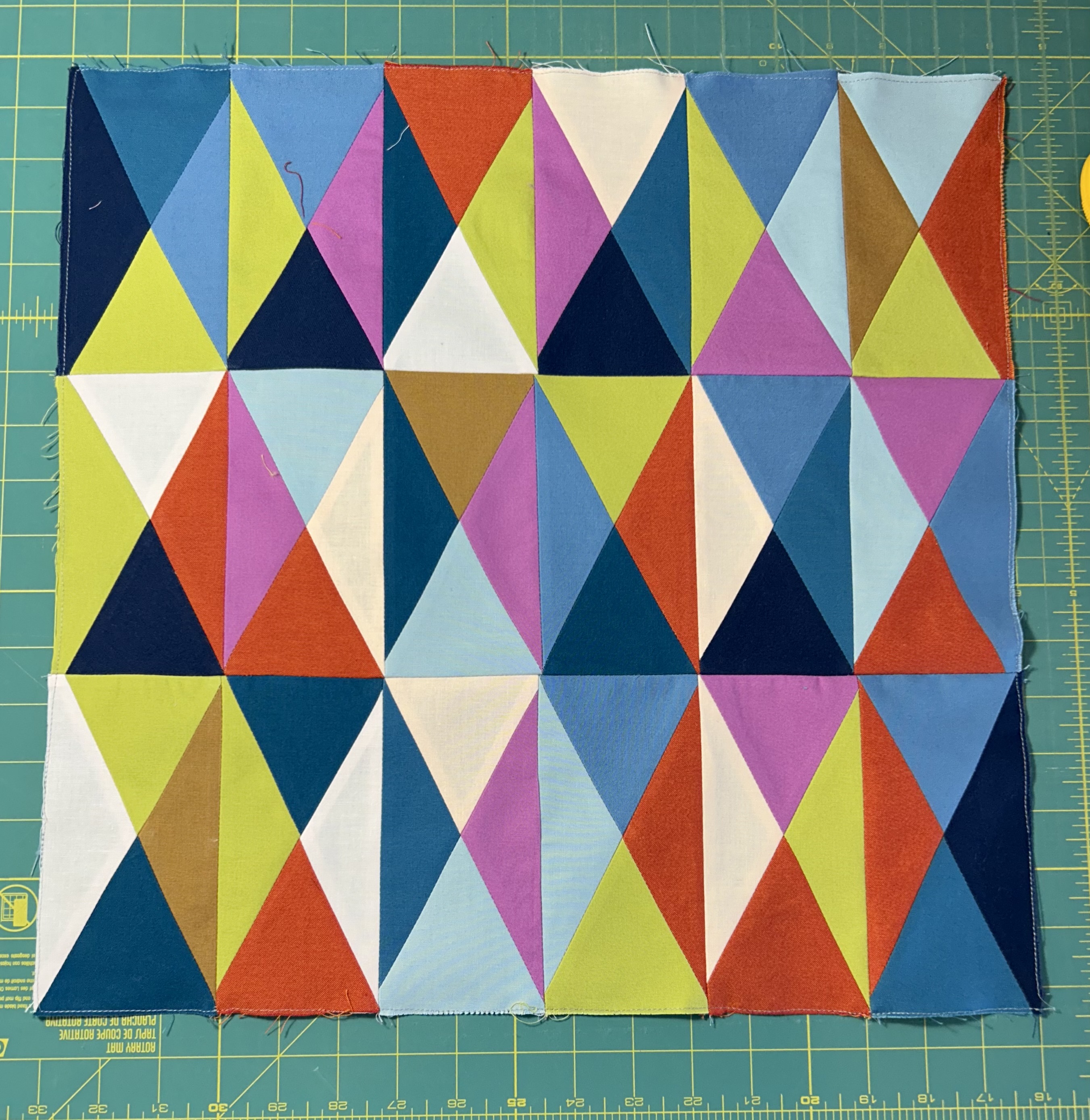
I never would have thought of this “hourglass half-rectangle block” on my own, and I am intrigued. Note: you have to cut two of the half-square rectangle blocks on the diagonal to get the 4 colors of the hourglass block–then sew those two halves together.
I’m now making some potholders while playing with versions of a straight hourglass block combined with this half-rectangle hourglass block–and having lots of fun trimming blocks into pieces that will make a kind of collage look for the potholders. Pics to follow at some point.
There is a quilt on the longarm, the design wall if FULL of blocks that need to be sewn together for two quilts–plus some Glitter blocks in process. There are ropes waiting for me to make trivets and baskets, the “play” with Tara Faughnan’s first block class this season (Hourglass block) is ongoing, and the leftover fabrics from Prickly Pear are waiting for me to use them to try out an alternative block or two and maybe make a lap quilt…
So in the midst of all that chaos, yesterday I couldn’t resist this leaf potholder–and it took me all afternoon as, for me, there was a learning curve–starting with when I cut the two slabs separately on the diagonal and the joined rows didn’t line up. Probably I didn’t cut each on the same diagonal angle. Add into the learning curve that that I cannot easily cut the leaf shape on the slabs free hand. I needed a freezer paper template, LOL. And that it worked better to cut out the leaf with scissors. That meant two more slabs to make. But who cares? It is a learning curve. You do need TWO slabs so each half of the front and back is different from the other side on the front and back. (That is also true of the little Hourglass half-square rectangles I’ve been making. You need two half-square rectangles to make the 4 colors.)
I also didn’t cut binding wide enough to manage two slabs, a batting layer, and a layer of fluffy Insul-Brite–next time, 2.75 wide binding I think. AND, this little potholder DOES need bias binding for all the curves. I managed with straight binding, but it was tricky. A walking foot is absolutely necessary.
BUT, it is so darn cute! I can see it in scrappy reds, in winter blues, in spring greens, etc. And like most learning curves, once you’ve “gotten” something, it all goes much, much faster.
A reminder, this idea was created by Amira Ameruddin, and there is a video on Instagram: amira__littlemushroomcap. Her video made it look easy and fast, and maybe it is…now. You really DO have to quilt all the layers before cutting out the leaf. Amira only uses one batting layer, but I don’t think that would really protect with a potholder.
Also, if the binding process goes faster next time, maybe I will try this binding zig zag method from Stitched In Color. I think it would be a nice addition–if I can do it as nicely as Rachel Hauser does. She makes this method look very elegant.
Another learning curve yesterday was making FACING for one of the 18-inch square Hourglass half-square rectangle little quilts, and that went well. I do like the “clean” look of that method. BUT, putting on a hanging sleeve would mean putting it on after the facing is done. Just noting. I don’t intend to hang this little quilt. The bright one will be hand quilted next.
Here they are side by side before I faced the one on the left. I do really like this block: big or little! I will try it out big for my quilt series on the half-square rectangle using Latifah Saafir’s Hurty ruler.
Today, I’ll–RIGHT NOW–go upstairs and do at least ONE row on the longarm quilt. Then I’ll walk. I don’t have to cook today, so the rest of the day will be mine to play upstairs.
And life has included watering outside as it is again very dry. But our weather has been spectacular for days now. This morning we had a little colder weather, and I needed warmer clothes and slippers on my bare feet.
And life has included that there are a host of quilty projects happening.
The most recent “Pot Pourri” quilt made from the 3 1/2 inch Cotton+Steel/Ruby Star squares is finished. It is “Pot Pourri 4.” There are MORE quilts from these blocks not called by that Pot Pourri name. And…I still have about half a bin each of the colored and neutral squares.
PP4 came out much cuter than I had thought it would be–but what could go wrong? It’s scrappy goodness from great fabric prints!
The backing is a turquoise wideback that works well. I used a kind of light seafoam green thread and a pantograph that was new to me and suggested by Wendy Curry, my Canadian online longarm quilting friend: Rhododendron. It was a fun panto to sew. I used the backing fabric for the binding.
My online class “Blocks 2” with Tara Faughnan has started. The first block with which we are playing is the Hourglass block, also known as “Broken Dishes.” It’s long been a favorite of mine. Tara, as is usual, had dozens of ways to manipulate it–modern, improv, and traditional.
What drew my interest in my current moment of making a series of at least 3 scrappy quilts from the half-rectangle block–using Latifah Saafir’s Hurty Ruler–was Tara’s example of taking that half-rectangle block and making it into an hourglass form.
I set up a palette from my solid stash that came as close to Tara’s palette as I could–though I did limit the number of colors but made sure to have darks, mediums, and light fabrics included. And then I made two quilt versions of the half-square rectangle hourglass blocks I made (3 by 6 inches)–one dark and one light/bright.
Here’s the dark one–which is 18 inches square. I’m hand quilting it with my 12-weight cotton threads–just a simple grid. I pulled threads that match these colors. I might try facing these two little quilts, as I need to learn to do that well. It’s all about play, right? And with the binding on PP4 finished, I was missing night hand sewing. Otherwise, tv makes me so restless.
I got the lighter one sewn together last night and will layer it today. I’ll use the brighter threads to match the brighter colors.
I like both of them, but I have no idea how I’ll use these two blocks–but I do have some ideas. And I think this block would make an awesome bigger quilt. But I’m not going there right now.
I will play with the traditional hourglass block before I break up this palette. Maybe just a few blocks…LOL.
The design wall is FULL!
I’ve got the blocks set now for the second half-square rectangle quilt. The first is on the longarm and is now basted and waiting for me to finish it. I’m using a challenging panto that is new to me, so I’m hesitant I think, but also engaged in these other projects.
To remind you, here is “Arrows” which is on the longarm.
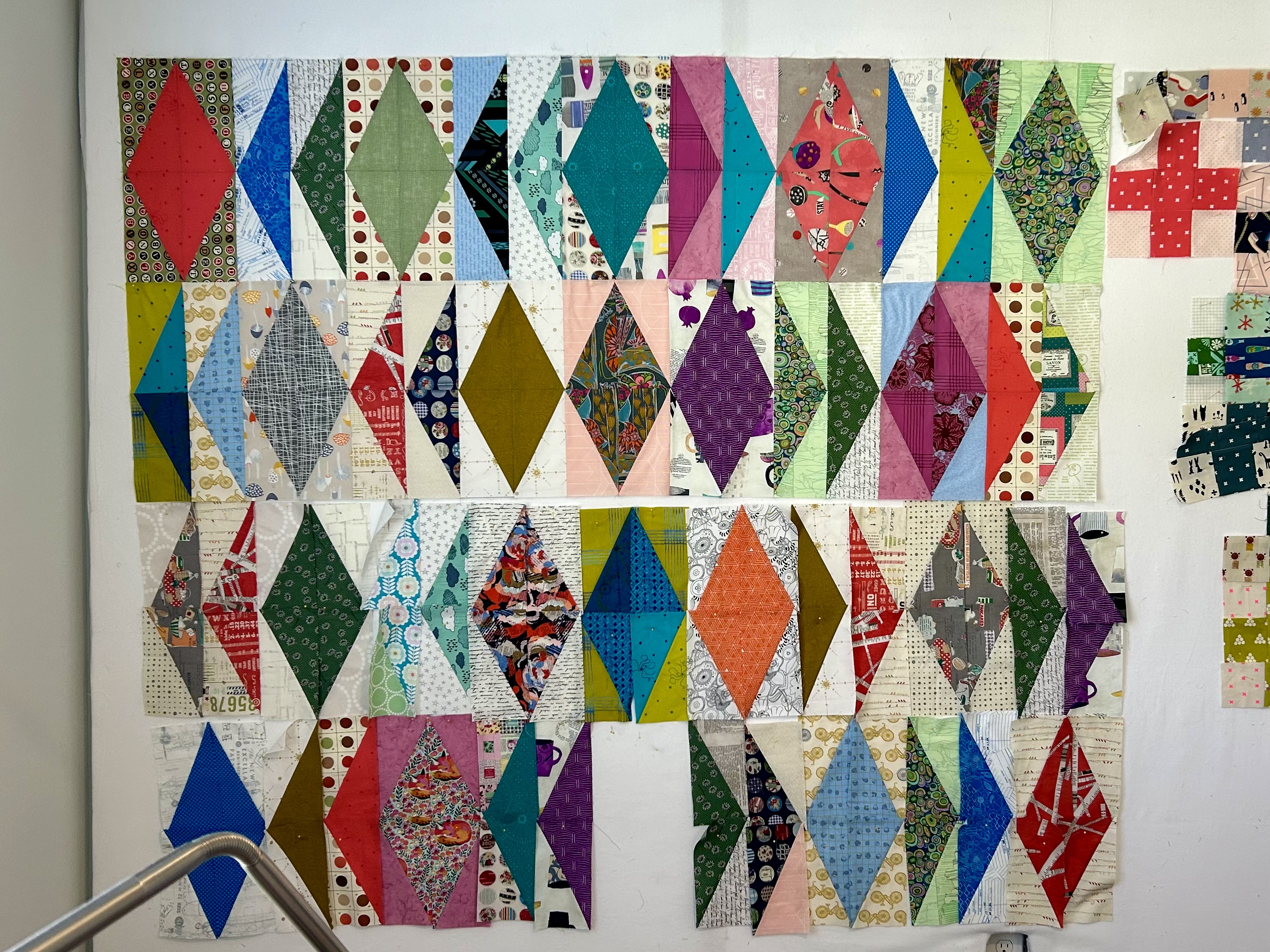
Here’s the second quilt: “Diamonds.” I changed out the bottom row diamond and am making one I like better. The top two rows are sewn together–after days of moving blocks around and trying out more diamonds than originally planned. And, playing with ways to NOT make the diamonds altogether symmetrical. Or, all of the neutral backgrounds symmetrical–as would be typical in a traditional quilt. I wanted the edges to feel a bit…scattered.
PP5: Crosses–is on the right and needs to have its rows sewn together to free up space to finish it–which is not far from being done.
I also know what I’ll do for the third quilt in this series–and am already looking forward to starting it.
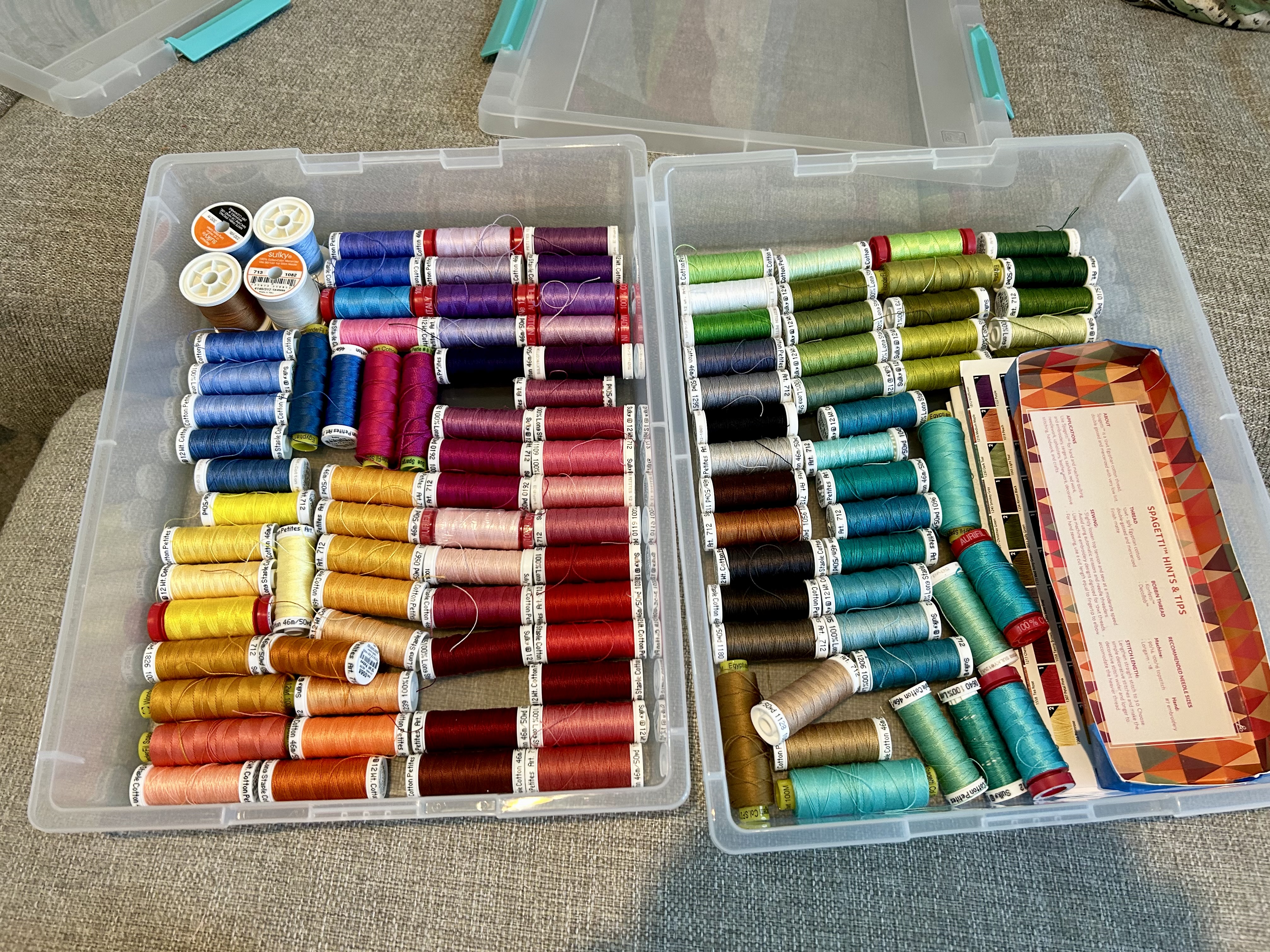
I also got tired of pawing through my 12-wt thread spools for the “right” color and put them all into shallow boxes where I can see them all at one glance. I’m loving that!
OK, folks. That’s it for now, and I’m sending all of you my best wishes for a lovely week.
She is just super creative, especially with modern improv quilts.
Her post today features a “mug rug” that is big enough for a mug and a small plate. It strikes me that a set of those would be a nice gift for…someone.
AND, she features a ruler that intrigues me as well: a Square in a Square ruler. You all who read on a regular basis should know that I adore clever rulers. And this one covers such a basic quilt block task. She used it to make a Snail’s Trail block as well if I’m reading right.
The hesitations I had about moving to South Carolina were primarily three: heat, snakes, and alligators.
I’ve gotten used to the heat, though I do live in air-conditioning, and I do miss the crisp cool air of Maine where windows can be often open for a lot of the year. Here in the tropics, humidity and moisture is an issue, and the AC does control it, but opening a window is not a good idea.
We see alligators in our ponds off and on. They seem to come and go via the underground water drainage system of culverts so common in this Low Country.
You can clearly see alligators should one venture into your…garden…which is highly unlikely in my neighborhood. Alligators do occupy some places and paths in parks and golf courses where ponds or wetlandsare involved.
Wetlands are all around my neighborhood, and I can tell you that I wouldn’t put one foot into those woods without donning boots and snake protectors on my lower legs. Not one foot. LOL. And I’m not especially snake phobic. I just honor the snakes’ privacy in their habitats.
We do have garter snakes here in the neighborhood. And they are WAY bigger than the garter snakes in my Maine garden. Here’s one in my back door neighbor’s garden. When we touched it with a rake, it COILED, which made both of us back off immediately until it got identified as “garter.” In this picture, one can see that the head is not wide and shaped like a triangle wedge, but we weren’t sure.
Here’s another one in another neighbor’s garden.
Garter snakes actually eat garden pests. I would go so far as to say they signal a healthy garden habitat. Or, one in the making. I rather think it has a cute little face, and it looks at one with curiosity, not malignancy.
We also have water snakes that eat things in the water. At least one showed up here on a road after a long dry spell where the creek from the wetland dried up. It eats aquatic creatures. It was dead in the road, and I don’t know if it was killed or run over by accident. And I’m sure, somewhere, there are the types of “black” snakes–rat snakes–that eat rodents. And I’m sure there are many other types of snakes here as well.
But this one! Which was found on a neighbor’s porch that backs up to the woods and wetland…
Our knowledgable neighborhood snake identifier said it was a Hognose Snake or a juvenile moccasin–and to leave both alone.
“Hognose” is used as a kind of a general term for snakes identified by an upturned nose. They are harmless and eat frogs. They are also more prone to being in woods and not wetlands. Some people have them as pets.
Moccasins DO like wetlands. A juvenile would have a green section at the end of its tail. In the neighbor’s picture, we can’t see the tail. They are seriously poisonous, but are not terribly aggressive unless backed into a place where they don’t feel safe. Or, stepped on.
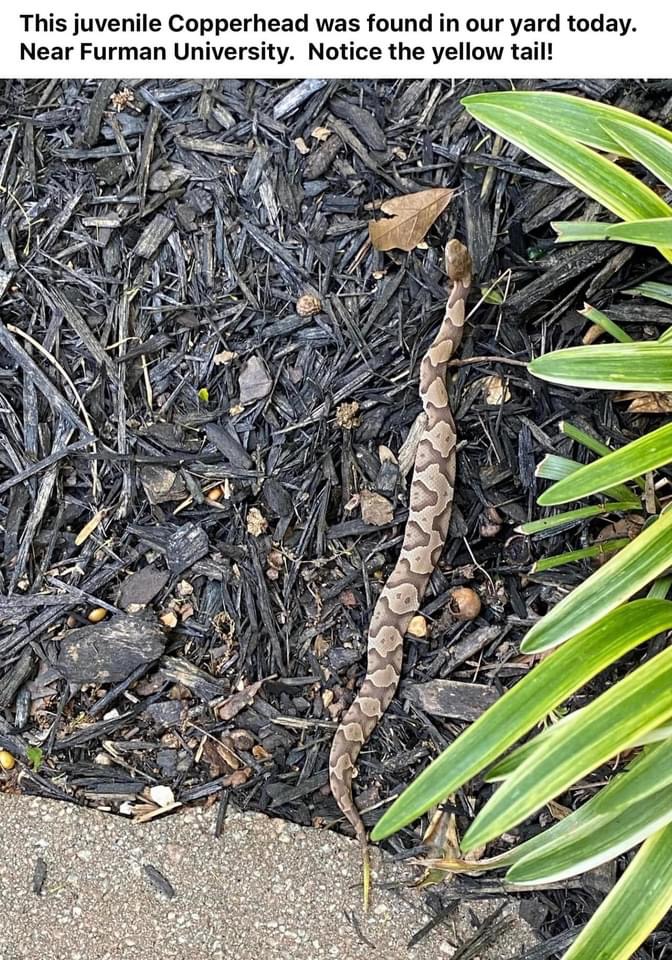
Their close relative is the Copperhead–and you can see the green tail section of a juvenile in the picture below. They are very orange, not dark like a moccasin.
The South Carolina Department of Natural Resources has good information on snakes and on moccasins and copperheads specifically at dnr.sc.gov. Or just search on SC and moccasins and copperheads.
The natural world is an amazing place, filled with wonders and dangers.











 Louisa Enright's Blog