The hesitations I had about moving to South Carolina were primarily three: heat, snakes, and alligators.
I’ve gotten used to the heat, though I do live in air-conditioning, and I do miss the crisp cool air of Maine where windows can be often open for a lot of the year. Here in the tropics, humidity and moisture is an issue, and the AC does control it, but opening a window is not a good idea.
We see alligators in our ponds off and on. They seem to come and go via the underground water drainage system of culverts so common in this Low Country.
You can clearly see alligators should one venture into your…garden…which is highly unlikely in my neighborhood. Alligators do occupy some places and paths in parks and golf courses where ponds or wetlandsare involved.
Wetlands are all around my neighborhood, and I can tell you that I wouldn’t put one foot into those woods without donning boots and snake protectors on my lower legs. Not one foot. LOL. And I’m not especially snake phobic. I just honor the snakes’ privacy in their habitats.
We do have garter snakes here in the neighborhood. And they are WAY bigger than the garter snakes in my Maine garden. Here’s one in my back door neighbor’s garden. When we touched it with a rake, it COILED, which made both of us back off immediately until it got identified as “garter.” In this picture, one can see that the head is not wide and shaped like a triangle wedge, but we weren’t sure.

Here’s another one in another neighbor’s garden.
Garter snakes actually eat garden pests. I would go so far as to say they signal a healthy garden habitat. Or, one in the making. I rather think it has a cute little face, and it looks at one with curiosity, not malignancy.

We also have water snakes that eat things in the water. At least one showed up here on a road after a long dry spell where the creek from the wetland dried up. It eats aquatic creatures. It was dead in the road, and I don’t know if it was killed or run over by accident. And I’m sure, somewhere, there are the types of “black” snakes–rat snakes–that eat rodents. And I’m sure there are many other types of snakes here as well.
But this one! Which was found on a neighbor’s porch that backs up to the woods and wetland…

Our knowledgable neighborhood snake identifier said it was a Hognose Snake or a juvenile moccasin–and to leave both alone.
“Hognose” is used as a kind of a general term for snakes identified by an upturned nose. They are harmless and eat frogs. They are also more prone to being in woods and not wetlands. Some people have them as pets.
Moccasins DO like wetlands. A juvenile would have a green section at the end of its tail. In the neighbor’s picture, we can’t see the tail. They are seriously poisonous, but are not terribly aggressive unless backed into a place where they don’t feel safe. Or, stepped on.
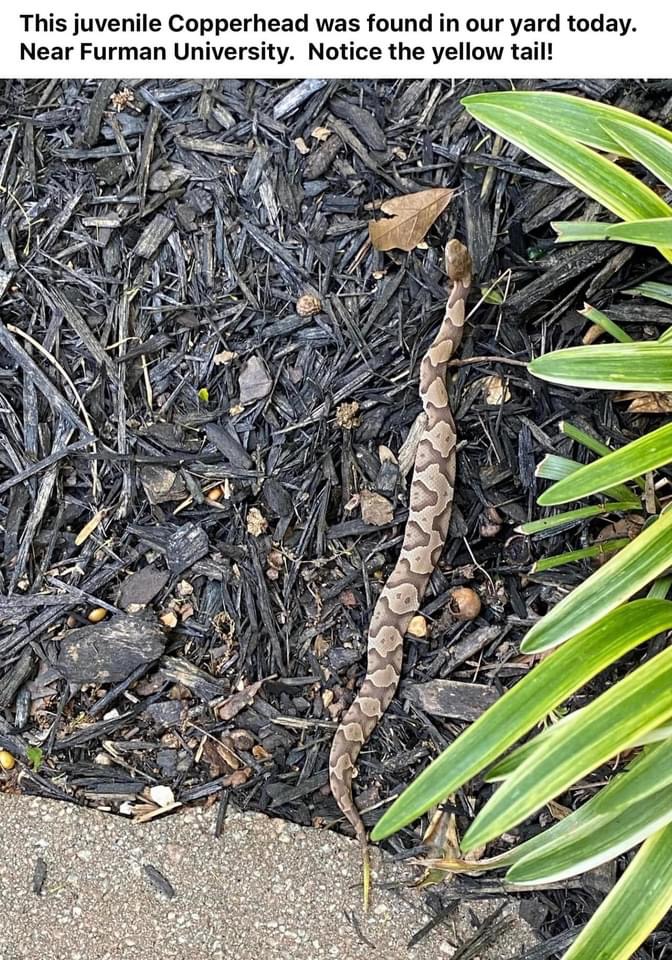
Their close relative is the Copperhead–and you can see the green tail section of a juvenile in the picture below. They are very orange, not dark like a moccasin.
The South Carolina Department of Natural Resources has good information on snakes and on moccasins and copperheads specifically at dnr.sc.gov. Or just search on SC and moccasins and copperheads.
The natural world is an amazing place, filled with wonders and dangers.
 Louisa Enright's Blog