Beloved neighbor and I saw this very interesting, very big bird while walking the other day. Neither one of us had a clue as to its identity. It was not alarmed by our presence, unlike the usually wary wading birds.
It continued to stroll slowly along the ditch, which is part of the elaborate system of flood management in the “Low Country.” Water in ditches like this one is channeled out to the coastal marshes. This bird’s strolling involved standing momentarily on its left leg while using its right foot to wiggle and scratch the botton of the ditch.

And:

Neither of us surfaced the word “stork” to identify this bird. We were more focused on heron, crane, ibis, egret, and so on. Note the bald dark head, the sturdy dark beak that turns a kind of tan at the end, the black legs, the black feathers at the tail and along the bottom of the folded wings.
It took me a little time, but I finally identified this fascinating bird. And I learned that the black on the wings is much more prominent that one might expect when they are folded.
Here’s some more info on “Wood Storks” from the Cornell Lab of Ornithology:
“Large, white Wood Storks wade through southeastern swamps and wetlands. Although this stork doesn’t bring babies, it is a good flier, soaring on thermals with neck and legs outstretched. This bald-headed wading bird stands just over 3 feet tall, towering above almost all other wetland birds. It slowly walks through wetlands with its long, hefty bill down in the water feeling for fish and crustaceans. This ungainly looking stork roosts and nests in colonies in trees above standing water.”

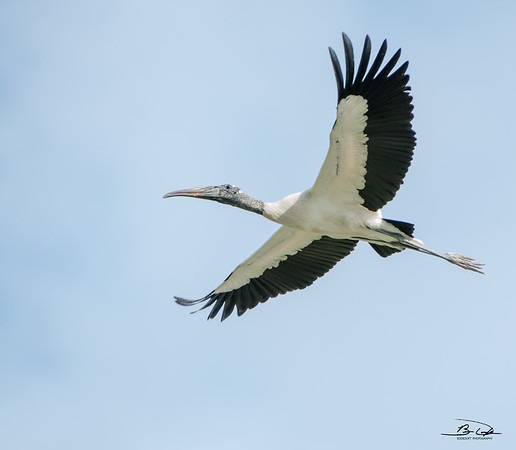
And for Cornell labs:
“Wood Storks occur only in a few areas in the United States, so to get a look at one, head to a wetland preserve or wildlife area along the coast in Florida, South Carolina, or Georgia. Wood Storks tend to be busily foraging with their head down and body held horizontally, but their large size should help them stand out amongst the other pale herons, ibises, and egrets in wetlands even if you can’t see their hefty bill. If they aren’t foraging in areas with standing water, check nearby trees for groups of roosting Wood Storks, or look up in the sky for soaring birds with black-and-white wings. They are mostly silent, but during the breeding season, sounds of begging chicks might help you find a colony.”
This Wood Stork was our gift of the day from…nature.
 Louisa Enright's Blog