Turkey Tracks: Visiting Essex Farm, Essex, NY

Turkey Tracks:  June 13, 2012

This is part 3 of a longer story.  Scroll down for the beginning…

Visiting Essex Farm

When we arrived, we first saw a small flock of sheep in a fenced pasture alongside the farm road.
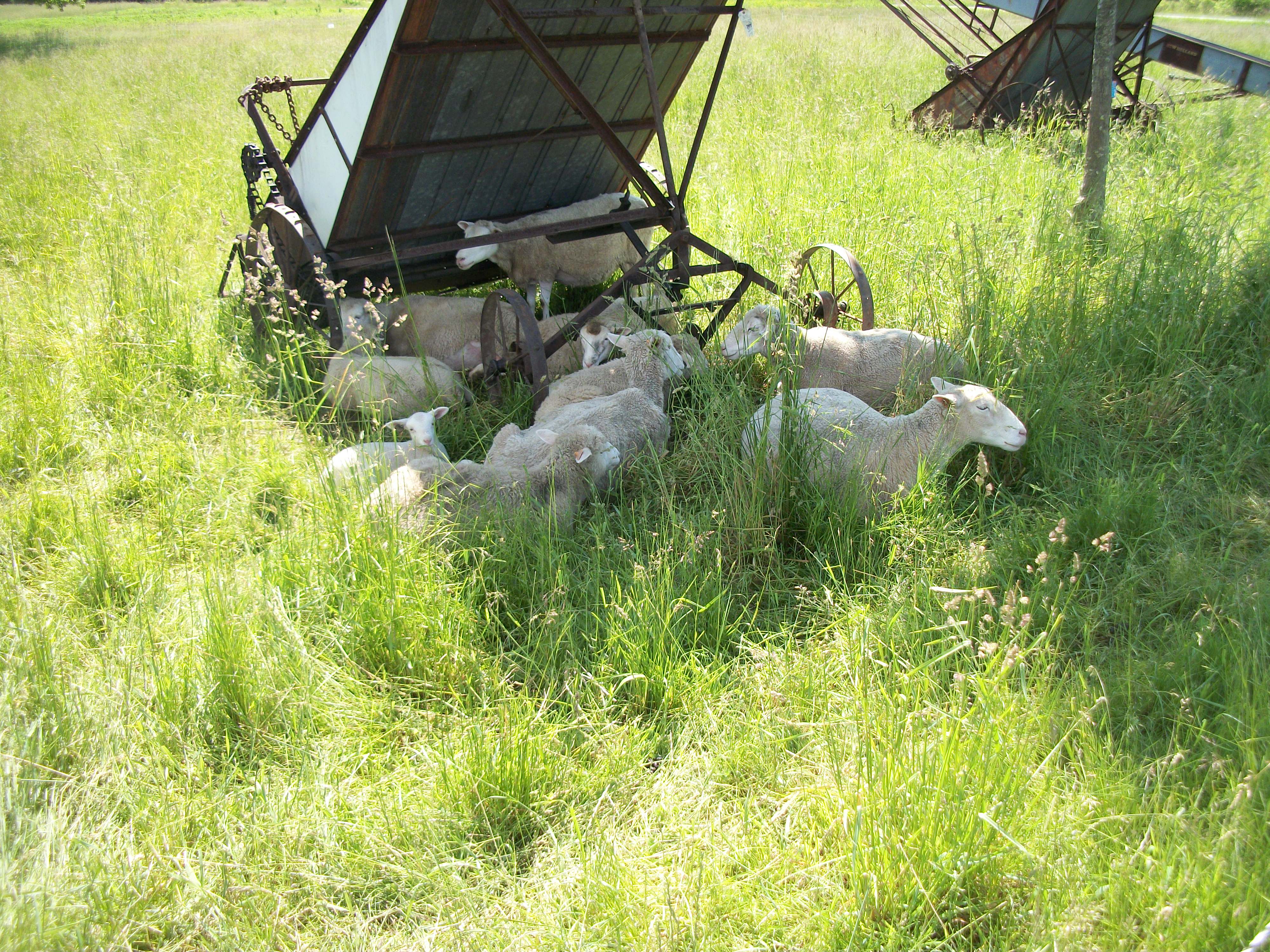
We knew that all of this farm equipment would be made for draft horses to pull.

There was a sheep mother nursing her baby just separated from this small flock–and Kristin told us later in our tour that Mark had just given her this flock for her birthday.  Someone had gifted him with them, and he knew that Kristin had been wanting some sheep for some time.  She’s now looking into animal guard dogs that are bred to live with and protect the animals in their care–as the sheep will be permanently pastured some way from the house.  Essex Farm is 500 acres, which is a lot of land.

We parked and started down the driveway toward the farm buildings, and a small woman with very blue eyes and a big hat stepped from a group of people and said,  “Hi, I’m Kristin.”

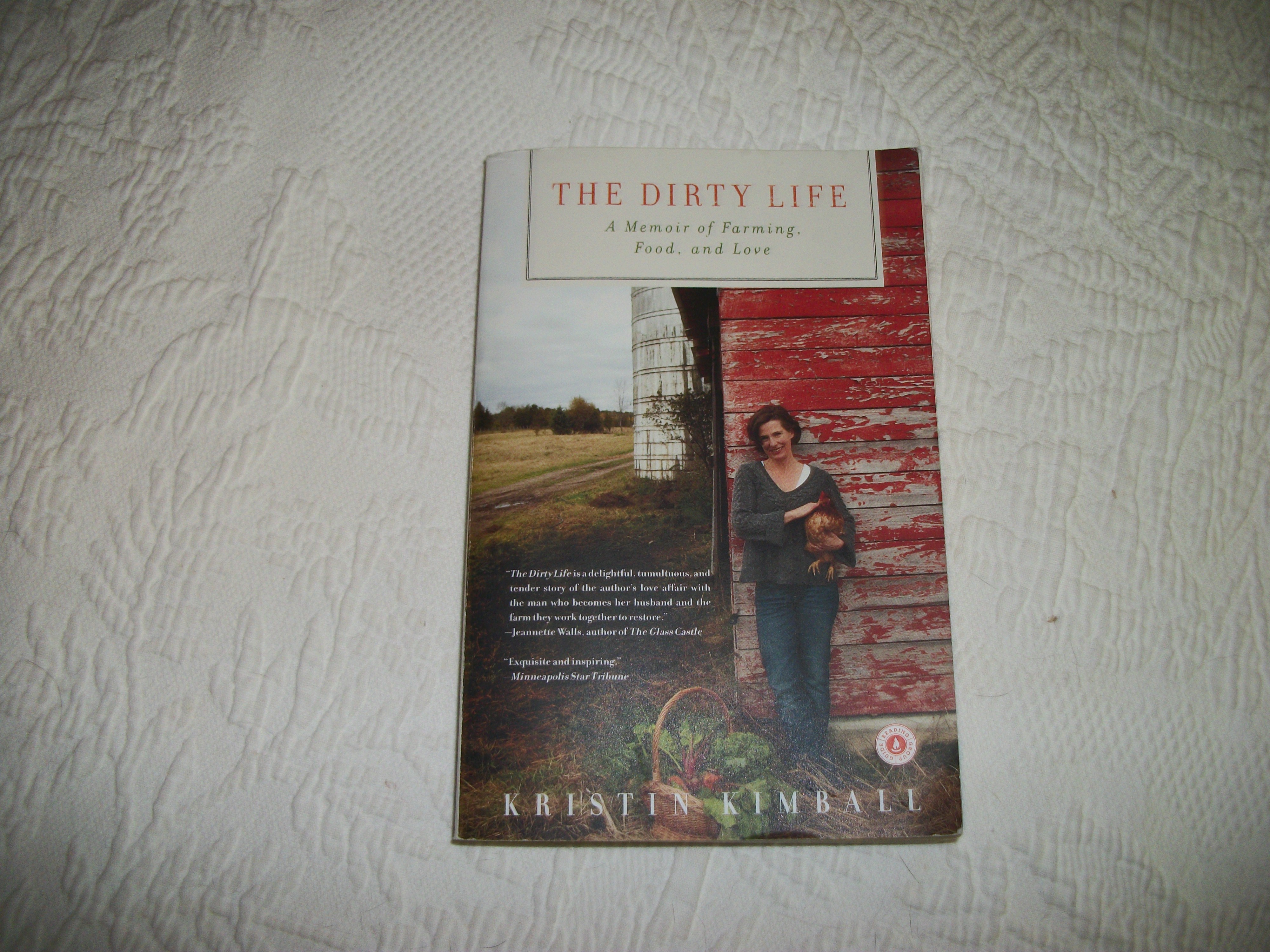
And, there she was–though she looked quite different from the picture on the cover of her book, THE DIRTY LIFE.  Now there are no traces of the city.  Her hair is long and braided, her fair skin glows with health, she’s lean and fit and muscular, and she radiates a very special kind of energy and interest that welcomes her guests to the farm.

There is a hint of some tension, and we soon learned that Mark had pulled a back muscle and was flat on his back at the farmhouse and in great pain and had care of the children.  Somehow, people appear to take care of the children, to collect the eggs from the hen trailer to the north of the farmhouse, to let the horses out of the barn, to prepare a chili for the potluck lunch and for a fundraiser for the local Waldorf school later that evening–and so forth.  It’s a Saturday morning–and the farm crew works, except in high-activity times, from Monday to Friday.  (The CSA weekly food pickup is on Friday.)  Kristin excuses herself from time to time, but makes us feel as if nothing on this earth is stressful or will get in the way of our visit.  And those of us who had read her book knew that this kind of juggling is something she and Mark are well used to doing.

Kristin begins the tour by answering questions about the farm and how it works in the farm’s trailer–where work meetings and common meals take place.  Half of this trailer is a field kitchen–the other half is filled with long tables.  The walls are covered with lists, individual workers’ clip boards, maps of the farm, and so forth.  We begin to realize that the administrative side of a diversified farm that feeds 220 people everything they need all year long is quite complicated.  (This farm’s goal is to replace the grocery store with healthy, clean, nutrient-dense food.)

I love this picture of Kristin.


Outside the trailer is a huge refrigerated truck body and a long open building where CSA members pick up their food–it’s lined with freezer chests.  We begin, though, by walking north, toward the farmhouse and the barns.

Here’s the farmhouse–and the window Kristin writes about in the book is still broken.  The barns and other out buildings are beyond.

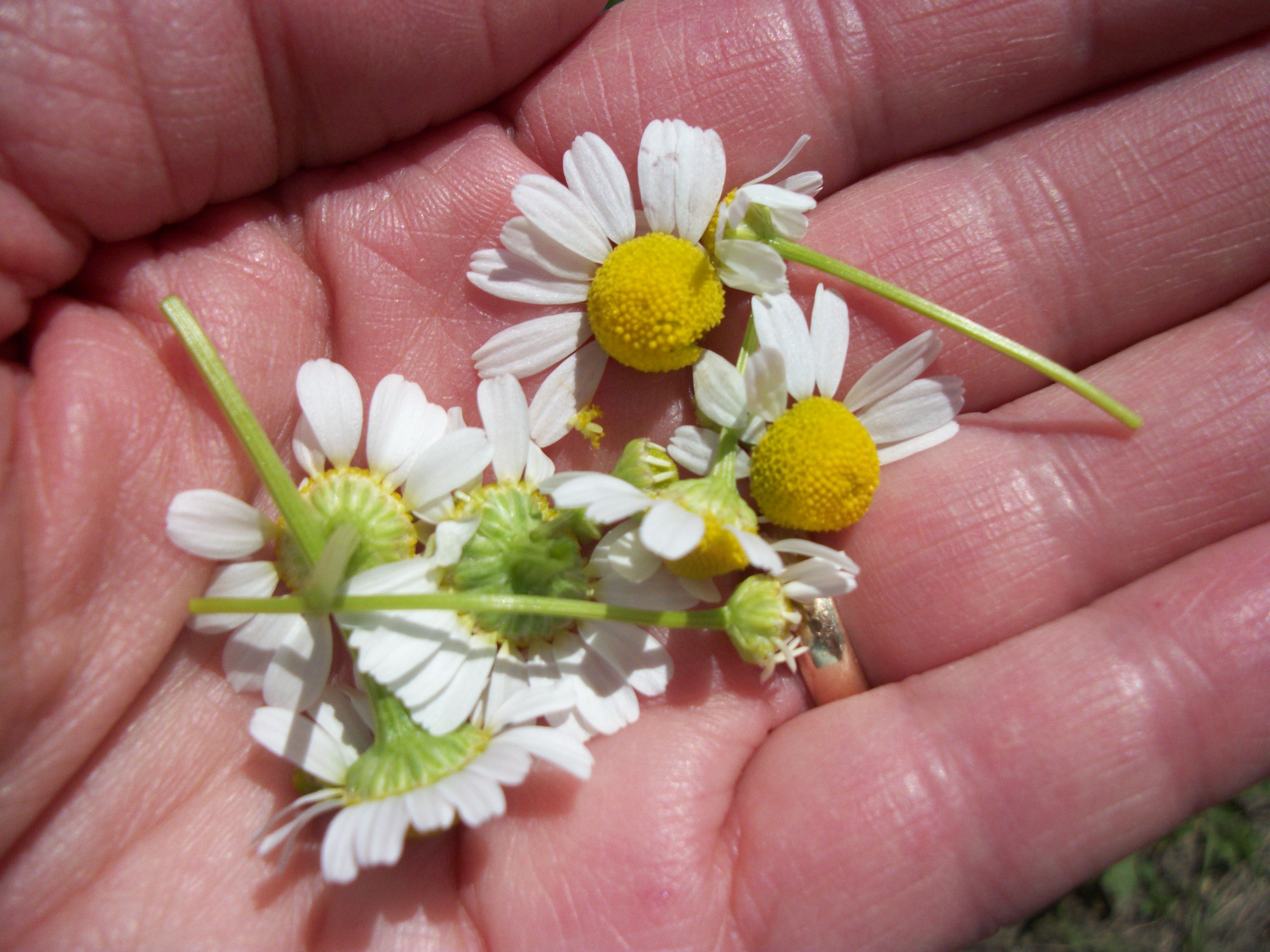
The fields near the farmhouse are the “home” fields and are reserved for herbs and flowers.  Here’s a group of guests with Kristin in the chamomile flower row, helping to pull the flowers.  Tara is in the blue plaid shirt on the left, in the front.

Kristin told us that chamomile tea is made with the chamomile flowers.  She dries them and adds dried mint, lavender, and lemon balm–to make their tea–an idea that really appeals to me.  I’ll be looking for some chamomile plants for this year and seed for the next.   Here are the flowers:
We stop at a hoop house dedicated to raising meat chickens.  The layers are in a tractor in a pasture beyond the barns and are moved daily.  Each small pen within the hoop house houses chickens of different ages (one week, two weeks, etc.).  When they are old enough to be ok with cool nights–which means they have grown enough feathers–they, too, are moved into tractors that allow them to free range on grass.  I think, as with Joel Salatin’s Polyface Farm in Virginia, these chickens “follow” the cows as they rotate through pastures around the farm.

Here’s Tara holding a week old chick, whom she immediately wanted to take home!

These chickens are Cornish crosses, and those of you who read my blog know that I’m not a fan of them.  I tried to interest Kristin in Freedom Rangers, but they had tried them and thought they took too long to develop and didn’t get as big as the Cornish crosses.  They DO take longer, but that means, too, that their bones are really developed, can support their bodies, and have all the minerals they should have for really healthy bone broths.  Before Cornish crosses, it would take 5 months or so to grow a chicken to roasting weight.  Cornish crosses develop in SIX WEEKS!  As for size, the FRs Rose raised were huge–often 6 or 7 pounds in 12 weeks.  Rose does not have the space Kristin and Mark do, so the size/time taken may be a factor of supplemental feeding???

The farm is now powered by a bank of solar panels, which Kristin thought she would hate to see.  But, she thinks they fit in surprisingly well.  I think they got a grant to help install these panels… which, if true, is exactly the sort of help we need to be giving small, diversified farmers who are healing and using our farm lands.

The draft horses were just being let out of the barns as we drew near.  These gentle giants are magnificent creatures.  I think there are four teams here, but Kristin said on really busy days there are 5 or 6 teams in the fields as some of the workers also have teams of their own.  The white pony belongs to the girls.

I didn’t know these draft horses came in a “paint” color.  This one was really friendly.  His partner is also a “paint.”

Gentle giants:

Kristin and Mark are in the process of “tiling” some of their fields as they are too wet.  Tiling is a drainage method that puts a big pipe in a deep trench that drains the water from the field.  Kristin feels that their area is getting wetter and wetter–which is something we are seeing in Maine as well.

They planted this rye crop in the tiled field, and it’s doing beautifully.  They will harvest the grain and will bale the rye straw and use it for insulation in the home they want to build–a green building method that people are beginning to use more and more.  See, for instance, the current issue of YES! magazine, which is available online.  Straw comes from grain plants and hay is made from grass.  (Kristin’s new book will be about building this home and will have more farm stories.)  Here’s the rye field with the barns/outbuildings in the background.
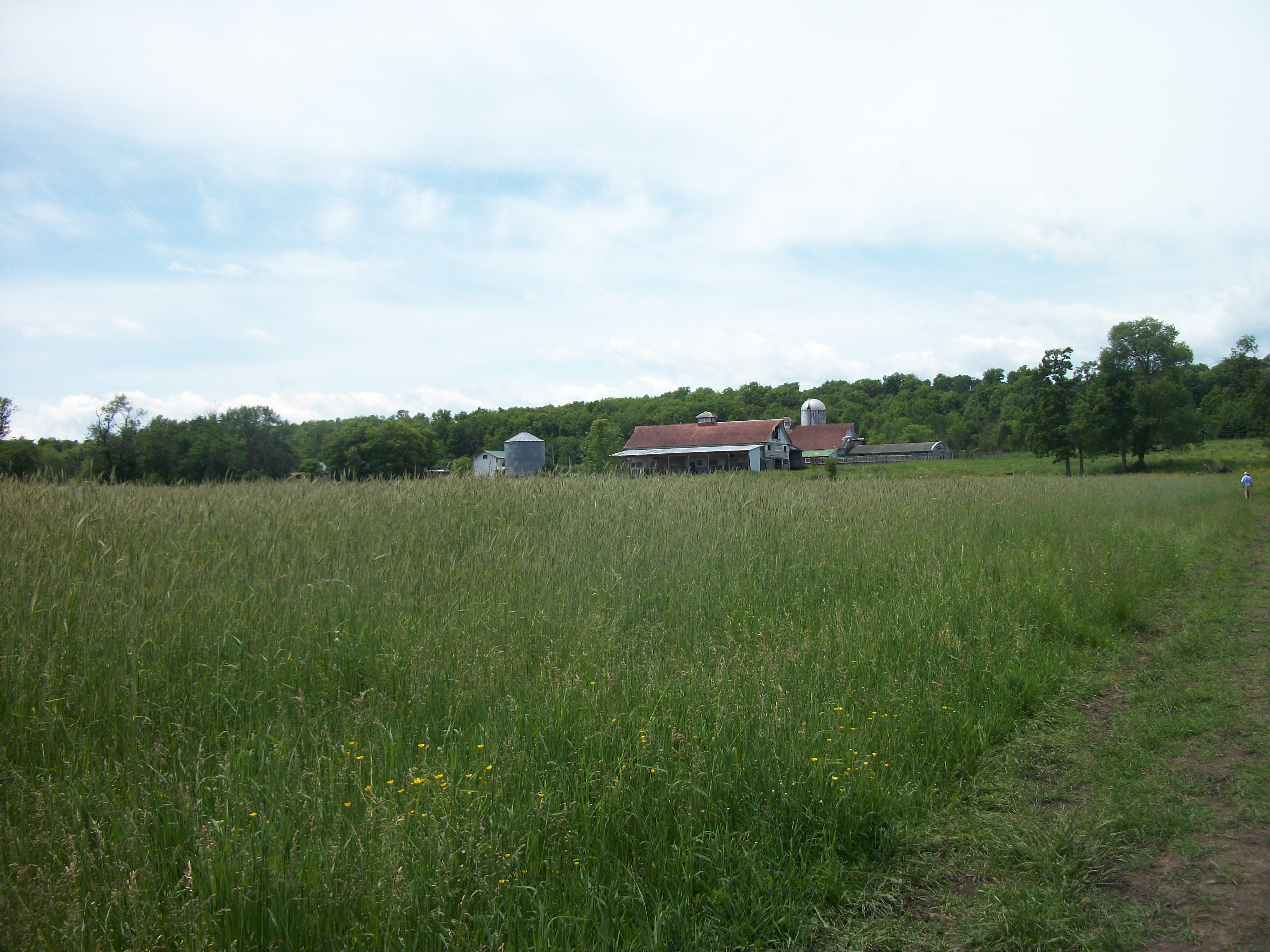
The field that has the best dirt for growing produce is called  “Small Joy,” and we are walking toward it.
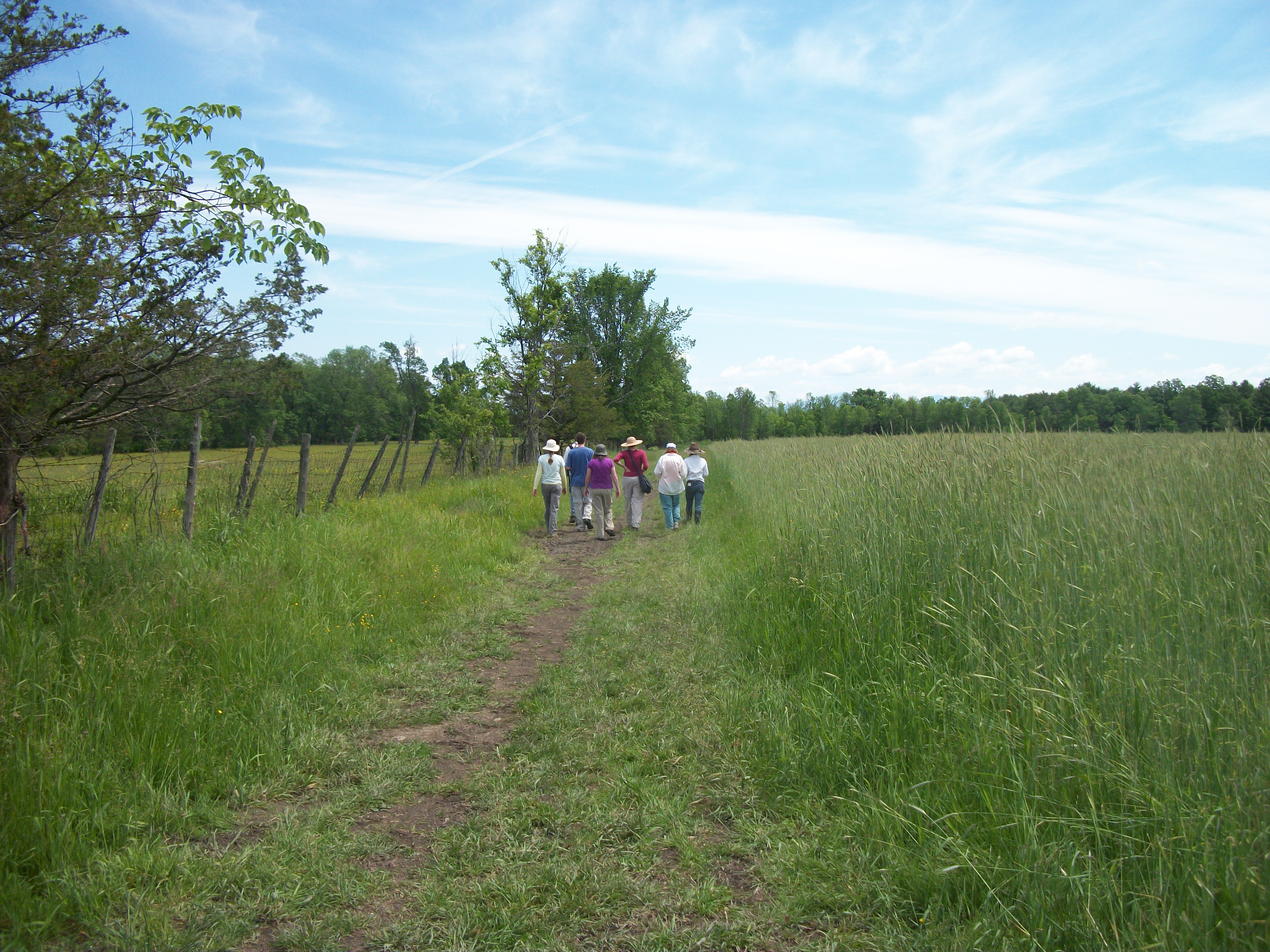
Here are Kristin and Tara in front of Small Joy.  You can see how long it is and how much has to be planted to feed 220 people year round.  That’s garlic behind them.  Garlic is planted in the fall, and the scapes, or flower pods, are just coming up now.  Most garlic won’t winter over beyond about now, so it’s lovely to get the scapes in June.  We cut them up and stir-fry them, put them in soups, put them into mayonnaise, and so forth.  They have a light, lovely garlic taste.

We cross Small Joy and circle back to the house–by way of the sheep.  After a fun potluck lunch–where Kristin adds in a fabulous chili with dried beans and sausage–all made on the farm–and bread with deep yellow spring raw butter–and sour cream–and lovely raw milk–I take these pictures of the shed where CSA members pick up their food.  It takes a lot of  Mason jars to put up food for the winter.

And here’s the working end of the meat chicken processing–open air, as it should be.  The cones are where the chickens are suspended to drain out blood into the funnel below them.  The table makes cleaning the chickens easy.  there are also vats for hot water, a really good plucker, and a vat for cooling off the cleaned chickens.  Everything can be washed off when the work is done.

We left Kristin and Essex Farm reluctantly.  But everyone was tired and it was time to go.  We didn’t see the highland cattle, or the pigs, or the sugar bush (maple syrup), or the borrowed dairy bull, or the dairy cows.  And I didn’t take so many pictures I should have.  I am particularly regretting not taking a shot of the buckets full of eggs from the layers–brought down from the upper pastures by a sweet young woman who stopped by to say “hi” and got drafted into helping out.

I could have stayed on that farm forever!  It’s so full of life and love and energy and good things happening.  It makes me think there is hope for healthy, nourishing, nutrient-dense food in America

Turkey Tracks: Going to Essex Farm, Essex, NY

Turkey Tracks:  June 13, 2012

This is part 2, scroll down for part 1 of this story

Going to Essex Farm, Essex, NY

Essex Farm in Essex, NY, is due west of Camden, Maine–as I discovered when I got out our maps.  Essex is about 6 1/2 hours from Camden, which includes crossing Lake Champlain on the Charlotte-Essex ferry.

My original plan with Tara Derr Webb was to drive south to her place in Accord, NY, which is near Kingston, NY (about 90 minutes north of NY City), travel with her to Essex on Saturday morning, spend the night in Essex, travel back to Accord, and then head home.  The maps showed us both that Essex is waaaay closer to Camden than Accord.   Besides, Tara was in the midst of final packing and would be leaving Accord on Tuesday.

We agreed to meet at the Essex Inn on Saturday morning, June 9th.   I had invited John to come with me, as neither of us had ever been west in Maine, nevermind seeing northern New Hampshire and Vermont.  He and I would drive to Essex on Friday and stay at the Inn, which also had what looked like a nice restaurant.

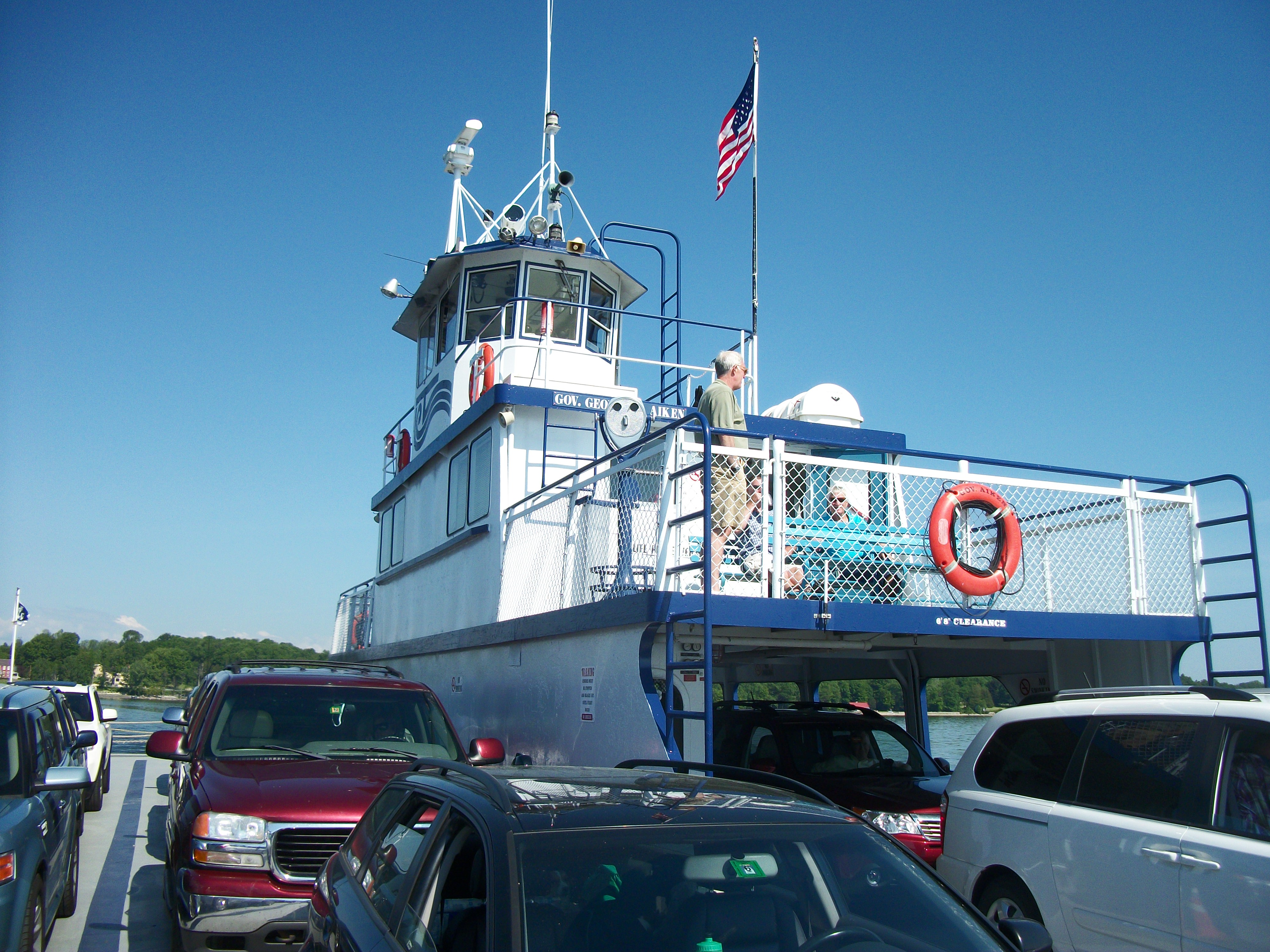
Western Maine is beautiful, and one gradually drives up into the mountains which host some pretty amazing ski resorts.  In New Hampshire and Vermont, we drove through the White Mountains and across the northern part of the Green Mountains.  The scenery is breathtaking–filled with dense mountains, rushing rivers, and mountain farms.  Outside of Burlington, Vermont, we went south to get on the Charlotte-Essex Ferry.  Lake Champlain is bordered by lush farms and ringed by mountains–on the New York side, it’s the Adirondacks.   Here’s what we saw at the ferry:

If you’ve never been on a car ferry, here’s what one looks like:

John had loved the whole day–going through tiny mountain towns, stopping to eat in Goram and talking to local people.  But we were both blown away by the beauty of Lake Champlain, with its ring of mountains.  Here’s John on the ferry:

The town of Essex is tiny, but is visited, in summer, by folks escaping the city who want some cool lushness.  Here’s what the Essex Inn looks like:

We settled in, had tea on this beautiful porch, had a lovely dinner inside, and slept well–anticipating seeing Tara and Kristin and Mark and the farm the next morning.

TurkeyTracks: Essex Farm in Essex, NY–THE DIRTY LIFE

Turkey Tracks:  June 13, 2012

This is Part I of a longer story…

Essex Farm–THE DIRTY LIFE

About 10 years ago, Kristin Kimball, a Harvard graduate, was earning enough with her free-lance writing to live in New York City.  One day Kristin drove six hours (Pennsylvania, I think) to interview a first-generation farmer named Mark, a Swarthmore graduate who had cobbled together an agricultural degree since he always knew he wanted to farm.  Kristin’s life changed forever upon meeting Mark.  She left behind high heels, meeting for coffee, and all the entertainment a large city offers.

That meeting started Kristin on a journey which led to Essex Farm in Essex, NY–which is just south of Burlington, Vermont, and, of course, across the narrow end of Lake Champlain.  Essex Farm had been leant to them to see if they could make a go of it, which is, in itself, a large bit of the magic that surrounds this story and this journey.  Essex Farm, when they first saw it in the fall, was “sleeping,” as Mark expressed it.  They spent that first winter in an apartment in town (while waiting for the leases of the current tenants of the farmhouse to expire) and spending the days on the farm repairing equipment and some of the buildings.  They bought their first cow and learned to milk her.

Together, over the past nine years, Kristin and Mark have built a farm that feeds 220 people all year long with all the food they need–pork, chickens, beef, milk, eggs, various grains ground into flour, maple syrup, honey, and about 40 different kinds of vegetables, including all the root vegetables that get one through a “north country” winter.  They now have hired 12 employees  and are the largest employer in Essex.  And, they have produced two beautiful little girls and are going to build a family home just behind the major farm buildings.

Kristin’s memoir of their first year on the farm–a year culminating in their marriage–was published in 2010–THE DIRTY LIFE.  It’s a tale of great joys and great despair.  It’s a tale of learning who you really are and what’s important in life.  It’s a tale of learning a whole passel of new skills–like farming with draft horses.  It’s a tale of commitment and how they supported themselves and how a community supported and held them in their times of greatest need.  It’s a tale, now, of many lives being lived fully and, perhaps, of the raising of a new generation of farmers, for Essex Farm has spawned four farms now and two children who will, at least, grow up to know how to farm.

So, Tara Derr Webb read THE DIRTY LIFE about 18 months ago.  Tara grew up with our two sons and had recently moved from the West Coast to Charleston as she and her husband Leighton were ready to put down more permanent roots.  Both Tara and Leighton have forgotten more about food than I will probably ever know.  And now they both wanted to participate in some major way in the farm/food/restaurant matrix.

After reading THE DIRTY LIFE, Tara knew she wanted to do more, personally, with the farm end of the foodway.  So, she signed up to visit several WOOF (Worldwide Organization of Organic Farmers or, also, Willing Organization of Organic Farmers) farms.  The first was near Atlanta.  After being there almost two weeks, a goat mother died just after birthing.  Tara put the baby in her car and brought her home to Isle of Palms, SC, and raised her.   She also made what will probably be lifelong friends on that farm.

Tara wanted to move further north–to the Husdon Valley area of New York–itself a farm foody place.  So she and Leighton rented land for a year to try out the northern farming experience.  They didn’t like it–didn’t like the cold, didn’t feel it was right on their skin.  So, they have just rented land north of Charleston that they will begin to farm.  (They now have three goats and plan on getting about 100 chickens.)  There will also be a restaurant, but you can let Tara herself tell you that part of the story on her Farmbar website.)

When we were in Charleston in late May, Tara was there as well–figuring out fence lines, working out details for their move back South and so forth.  She told me Kristin was having an open house June 9th and asked it I would like to come.  I slept on it, but knew I had to go.

Yes, I said, and got out maps as soon as I got home.

XXX

Interesting Information: 10 Salt Myths

Interesting Information:  June 4, 2012

Ten Salt  Myths

This past Sunday’s New York Times ran a long piece by Gary Taubes called “Salt, We Misjudged You” (Opinion, 8-9).  Taubes traces the history of how salt became demonized in the 1970s and 1980s–without adequate scientific data to justify such a stance.  It might seem like “common sense” to relate salt intake to high blood pressure problems since salt can make one thirsty.  But that HYPOTHESIS has not proven to be true–as I related in Mainely Tipping Points Essay 38, located on this blog.

Meanwhile, Taube notes, many prominent organizations are promoting a low-salt diet, among them the USDA, the Institute of Medicine, the CDC, and the NIH.  Their view is based on a 30-day trial of salt, the 2001 DASH-Sodium study.  That study suggested that lowering salt intake “modestly lowered blood pressure,” but it “said nothing about whether this would reduce hypertension, prevent heart disease or lengthen life.”  And, I would ask, how would one know if the salt reduction was a factor or if other foods eaten or not eaten were factors?

The recommendations from these large organizations is ignoring, deliberately, recent research showing that salt reduction is dangerous to human health.  Recent research using some 100,000 people in 30 countries showed that salt consumption has been, Taubes writes, “remarkably stable among populations over time.”  Four recent studies “reported that the people eating salt at the lower limit of normal were more likely to have heart disease than those eating smack in the middle of the normal range.”  This “normal range” is considerably higher than recent recommendations by the USDA in its food guide.

In November of last year, Taubes writes, both the USDA and the FDA held hearings to “discuss how to go about getting Americans to eat less salt (as opposed to whether or not we should eat less salt).  Proponents speaking against salt consumption argued that “the latest reports suggesting damage from lower-salt diets should simply be ignored.”

OK.  That’s not scientific.  That’s BELIEF SYSTEM, and I’ve said many times on this blog, uncritical BELIEF SYSTEMS are dangerous.  They can, like this one about salt, kill you.  Taubes says the following:

“This attitude that studies that go against prevailing beliefs should be ignored on the basis that, well, they go against prevailing beliefs, has been the norm for the anti-salt campaign for decades.”

Mortin Satin, PhD, Vice President, Science and Research, The Salt Institute, writing in the Spring 2012 Wise Traditions, the journal of the Weston A. Price Foundation, lists 10 myths about salt (http://www.westonaprice.org/vitamins-and-minerals/salt-and-our-health).  Some will surprise you.

Myth 1:  We eat more salt than ever before.  NOPE.  Our salt consumption today is about one half of the amount consumed between the War of 1812 and the end of World War II–which was about 3.3 teaspoons per day.  Increased refrigeration and not using salt as a preservative are factors.

Myth 2:  Our knowledge of the major sources of salt in our diet (80% from processed foods) is unquestionable.  NOPE.  This notion is based on a single paper from 1991 which involved 62 people and dietary recall–which is not reliable.  (It’s amazing to me how often dietary recall is being used in studies  The most recent I can recall is that study saying red meat was bad for you.)

Myth 3:  Our salt consumption continues to rise every year.  NOPE.  See Myth 1.

Myth 4:  The thirty-year public health initiative in Finland represents a successful model of salt reduction.  NOPE.  Health benefits were marginally worse than countries that did not reduce salt consumption.

Myth 5:  Current levels of salt consumption result in premature cardiovascular disease and death.  NOPE.  Data shows that the higher the salt consumption, the longer the life expectancy.  (Mainely Tipping Points 38 discusses the connections between cutting salt consumption and heart problems.)

Myth 6:  Cutting back on salt will improve the overall diet.  NOPE.  Salt enhances foods that would be bitter without it, like the all-important greens.  (Somewhere else I read that salt helps you break down and digest meats.)

Myth 7:  Reduced salt levels are critical to the DASH diet.  NOPE.  Data shows moving to a DASH diet significantly impacts blood pressure without any changes in salt consumption.  (I am NOT a fan of the DASH diet–too many carbohydrates and fructose.  It’s useful if you’ve been eating junk food, but I believe the GAPS diet and the Paleo diet are better choices.)

Myth 8: There is a clear relationship between salt intake and blood pressure.  NOPE.  There, famously, is not a clear relationship.  Satin gives a really good example using the standard hospital saline IV drip, which gives about 4.5 teaspoons of salt per day in addition to the teaspoon of salt taken in food.  Blood pressure, checked every 4 to 6 hours, does not change.

Myth 9:  Reducing salt intake can do no harm.   NOPE.  It can seriously harm you, and Satin gives a long list of worrisome outcomes.  Mainely Tipping Points 38 does as well.

Myth 10:  The U.S. Dietary Guideline process is valid.  NOPE.  Satin notes that these guidelines have not been peer-reviewed and are based on the lowest quality of information–opinion.  Or, in my terms, on BELIEF SYSTEM.  These guidelines are not independent or objective, according to Satin, who walks through why.   I would say that the USDA guidelines about so many food issues–among them consumption of salt, saturated fat, meat, the amount of carbohydrates deemed ok, and so many of the issues I’ve been covering in my essays–are now so far off track that it’s far, far better to totally ignore them.

Let your body decide your salt intake.  But, use GOOD salts–as discussed in Mainely Tipping Points 38.  They include real salt dried from seawater–not the fake salts in the grocery store.  Real salt is full of minerals.

Turkey Tracks: Charleston Trip Highlights

Turkey Tracks:  June 3, 2012

Charleston Trip Highlights

I am posting this entry mostly for our far-flung greater family, who will enjoy the pictures.

However, I did not take as many pictures as I might have taken.  I get caught up in the moment and forget…   I did not, for instance, take a single shot of Bryan and Corinne’s Ailey.  I was too busy drinking her in.  At 18 months, she is in constant motion, smiles and laughs all the time (except when she gets tired or when someone tries to hold her still), and takes two good naps a day.  It’s probably just as well since Bryan is not at all sure he wants her picture on the internet.

But, in no particular order, here’s the best of the pictures I came home with.

First, you know I love trees.  Bryan took me to see this beauty over on Sullivan’s Island.  Sullivan is just south of Isle of Palms island, and both are just north of the entrance to Charleston’s harbor.  This tree is an old live oak, and the only thing it’s missing is festoons of grey moss.

Here’s a close-up view of the amazing trunks:

These trees are protected, and they should be.  There’s one over on, I think, St. John’s island, which is south of Charleston and much more really a part of the low-country land system than an actual barrier island.  It is called the Angel Oak.  Some have said it’s the oldest tree on the East Coast.  We always talk about seeing it.  One of these days we will…

On Sunday 20th, the whole family went to the Riverdogs–the local baseball farm team that feeds into the Yankees.  The stadium is beautiful.  The baseball was terrific.  And there were lots of events for the children as this Sunday was a “children’s day” at the field.  Both grandsons are learning baseball, and we went to see their last game on Saturday morning.  By the end of the game, both boys were getting a bigger sense of how the plays work and why they are being taught certain skills.  Both brought gloves, and we had seats just back of the Riverdogs’ dugout, so we dodged lots of fly balls.  Someone rolled Bo a baseball over the top of the dugout sometime during the game, which thrilled all of us.

Here’s a picture of John and Mina in the stands.  Mina is an Enright–and I constantly see Maryann, Jim, Kim, and Kerry in her face.

Here’s the view behind the stadium, which you see if you go up to the restrooms or for food.  The river is the Ashley, I think.  And this view is what the “low country” rivers look like–postcard pretty.

:

After the game and after Miss Ailey, who had enjoyed the outing with all her relatives, had been taken home to her bed, the players lined up and autographed whatever the children brought.  Bo got his ball autographed.  The rest of the children got hands, arms, and shirts autographed.  Here they are in line:

Here they are reaching the first player:

And, here they are, now they are in the swing of the event:

John and Michael supervised:

And here’s a picture of the four kiddos on the way out of the now-nearly empty stadium–tired, but happy, as were we all!

Bill Murray, the actor, is a part-owner of the Riverdogs.  During the game, he caught a foul ball, and when people realized it was him, he turned and bowed to all.   He’s always been a favorite actor of mine.  He does comedy, yes, but he also does serious.  If you’ve never seen him in RAZOR’S EDGE, rent it and take a look.

We also went as a family to Bee City, which is near Summerville, SC.  It has bees and honey, but the real draw is the petting zoo, which is quite good.  I saw at least three animals I’ve never seen before.  There was an interesting building housing South Carolina flora and fauna–among which are TONS of poisonous snakes and the alligators that are everywhere in the low country.  (Maine has NO poisonous snakes YET and certainly NO alligators!)  Seeing the snakes brought back Georgia childhood memories of being taught to look for snakes constantly, especially when picking blackberries.  And, of once when fishing looking down to see a coiled cottonmouth moccasin about to strike me.  We learned that the state beverage of SC is MILK!

Anyway, Mike had his wits about him–unlike his mother who was, frankly, sightseeing– and took this picture of Miss Talula Bee Honey, produced by bees in a front yard on Isle of Palms :

We went to swim team practice–here’s Mina waiting on the steps for Talula to finish a lap.  Mina spends most of this waiting time on the bottom of the pool peering at you through goggles.  Talula can swim the lap, only she does not quite know it yet and grabs the side every few feet to rest.  She’ll learn in another few weeks, I feel sure.

Here’s Kelly, all done after an hour of swimming laps.  Pretty impressive, this hour of laps…  So healthy for all the children…

Here’s John, overseeing the action:

We went to Bo’s Poetry Cafe at his school–East Cooper Montessori.  Bo had memorized and recited a fairly long Shell Silverstein poem that his classmates really liked:

We went to the girls’ graduations from their little pre-kindergarten school at the fabulous Isle of Palms recreation center.  What a gift that place is to local residents.

I saw, also, Leighton and Tara Derr Webb’s new rented digs–lovely land with a classic low-country house on enough acreage for a small farm–all of which has waterfront on the intercoastal waterway north of Charleston.  They move back to Charleston mid-June.  And, Tami and I had breakfast with Lisa Hartley and her daughter Sophie at Hominey Grill–all of which is always a real treat!

We had many nurturing, fun, very tasty meals with Bryan, Corinne, and Ailey–and they took us to dinner at one of Charleston’s many good, exciting restaurants–The Grocery.  Bryan is a really good cook, and Corinne makes the best homemade ice cream ever!  Our time with them was low-key and very pleasant.

And, we all had some really good beach times–we rode lots of waves and came home with good tans.  I, in fact, came home with a new bathing suit since chlorine has eaten out the black fiber in the center back my old one, leaving only the see-through mesh.  When I showed it to Tami, she said “oh my gosh, you’ve been x-rated on the beach, Mom!”

Turkey Tracks: Home Again, Home Again

Turkey Tracks:  June 3, 2012

Home Again, Home Again

You may have noticed that I have not written on the blog in a while.

At least I hope you’ve noticed!

We are just back from spending 10 days with our children and the grands, who are all in Charleston, SC.  We had a packed schedule, so I did not even attempt to do more than check on email every few days.

We returned to the kind of garden growth that occurs overnight in Maine in the spring–knee-high grass and weeds, and a garden not planted yet, due to cool, rainy weather before we left.   And, because I didn’t want to leave our house/dog/chicken sitter with the garden and a bunch of planted pots to water.

Linda McKinney had completely cleaned the house from top to bottom when we got home, and it shone and sparkled.  What a terrific gift!!

I’ve spent the week regrouping (unpacking, getting groceries, resting, getting plants, mixing up potting soil, moving compost, etc.) and tackling the yard.  The veggie garden is almost all planted.  The long bed in front will still get beets, carrots, and all the beans when it quits raining again.  I’m still looking for a spot for a Blue Hubbard squash.  The big blue tubs have been topped with compost and amendments and planted with winter squash.  The flower pots have been filled with potting soil and some plants and distributed about the decks and porches.  Hanging baskets have been bought and hung.

We penned the chickens two days ago.  They got out by early afternoon.  Yesterday they stayed put.  I bought a BIG, deep, long-handled fishing net to catch them when they get out.  I also want to use it to catch and tame that wild rooster Cowboy!  He needs some lap/carrying around time.  In a few more days we’ll take down all the preventive fencing–once we’re sure they chickens have mostly accepted confinement.  A just-planted garden would drive them wild–what with all the newly turned dirt.  They would immediately dig up everything.

Meanwhile, we continue to look a bit like a fenced camp–chicken wire everywhere.  And, the whole time I was planting the garden, the chickens were circling it and begging to come in and dig for worms.  They loved it when I poked some worms through the wire holes for them.  Chickens can beg very prettily.  It’s hard to resist them.

John has cleaned all the porches, and we dragged out the porch cushions.  So, summer is officially here now!

Turkey Tracks: “Nora’s Friends: Peter and Benjamin Rabbit” Quilt

Turkey Tracks:  May 16, 2012

Nora’s Friends:  Peter and Benjamin Rabbit Quilt

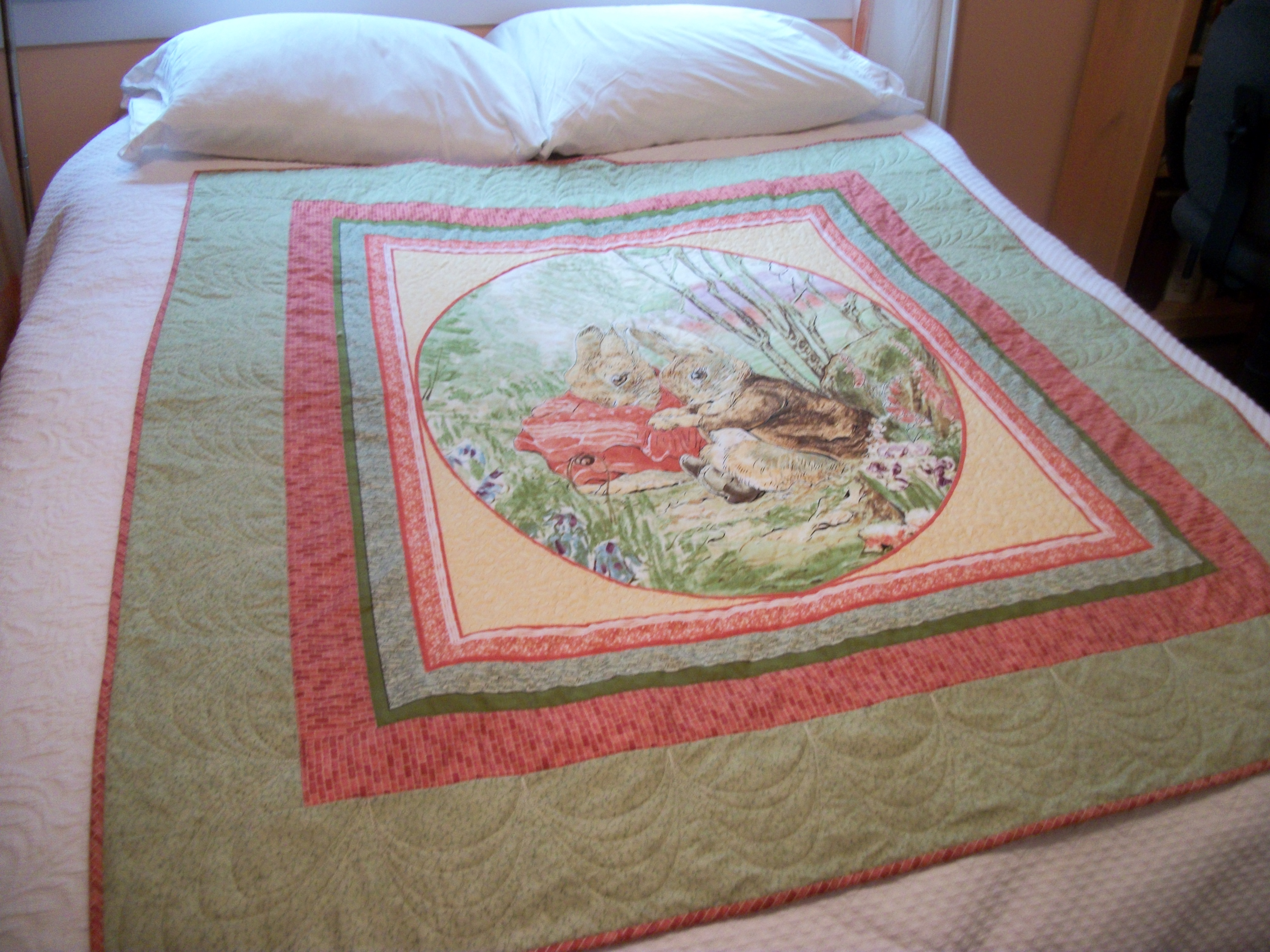
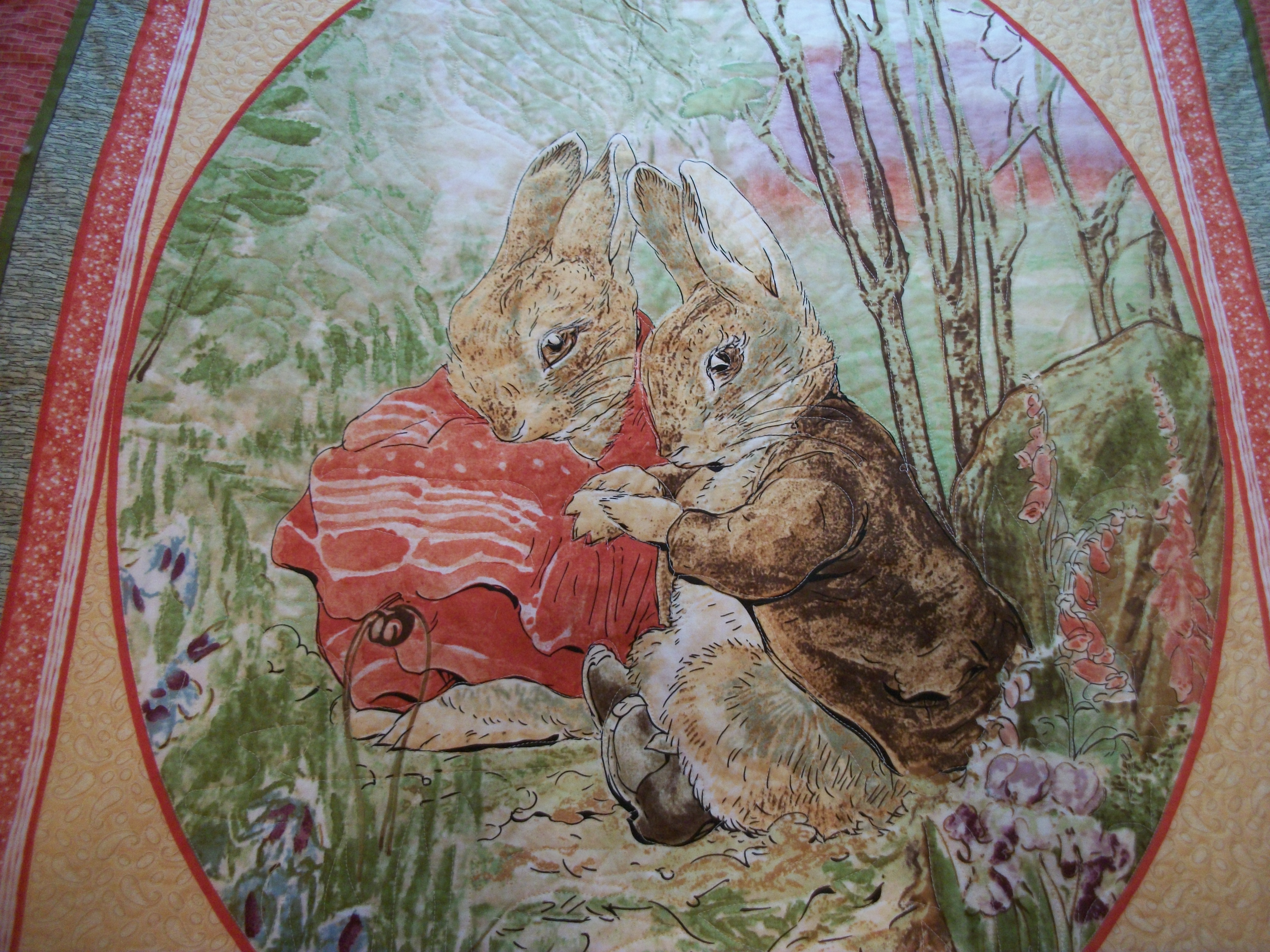
My dear friend Rosie Pilkerton gave me this fabric panel about two years ago.  The kit was meant as a wall hanging–or an infant quilt–and came with backing and batting.  Rosie made it as a wall hanging and did a lot of wonderful free-motion quilting around the scene of the two rabbits.

Nora is Julia’s little sister–and I wanted a quilt she could love to death for her.  So, I added borders and made the quilt larger for a growing almost-toddler.

Here’s the finished quilt:

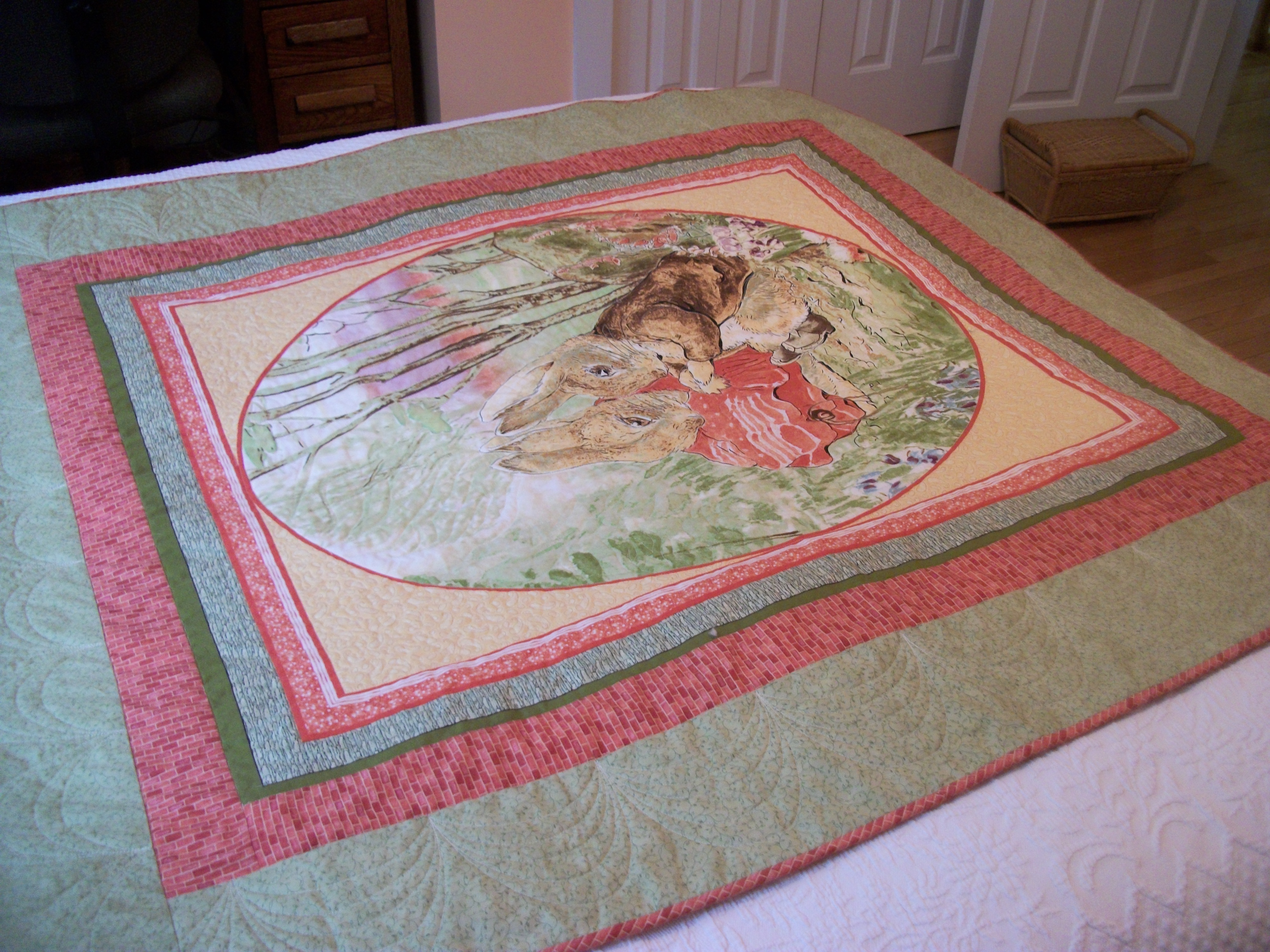
And another view:

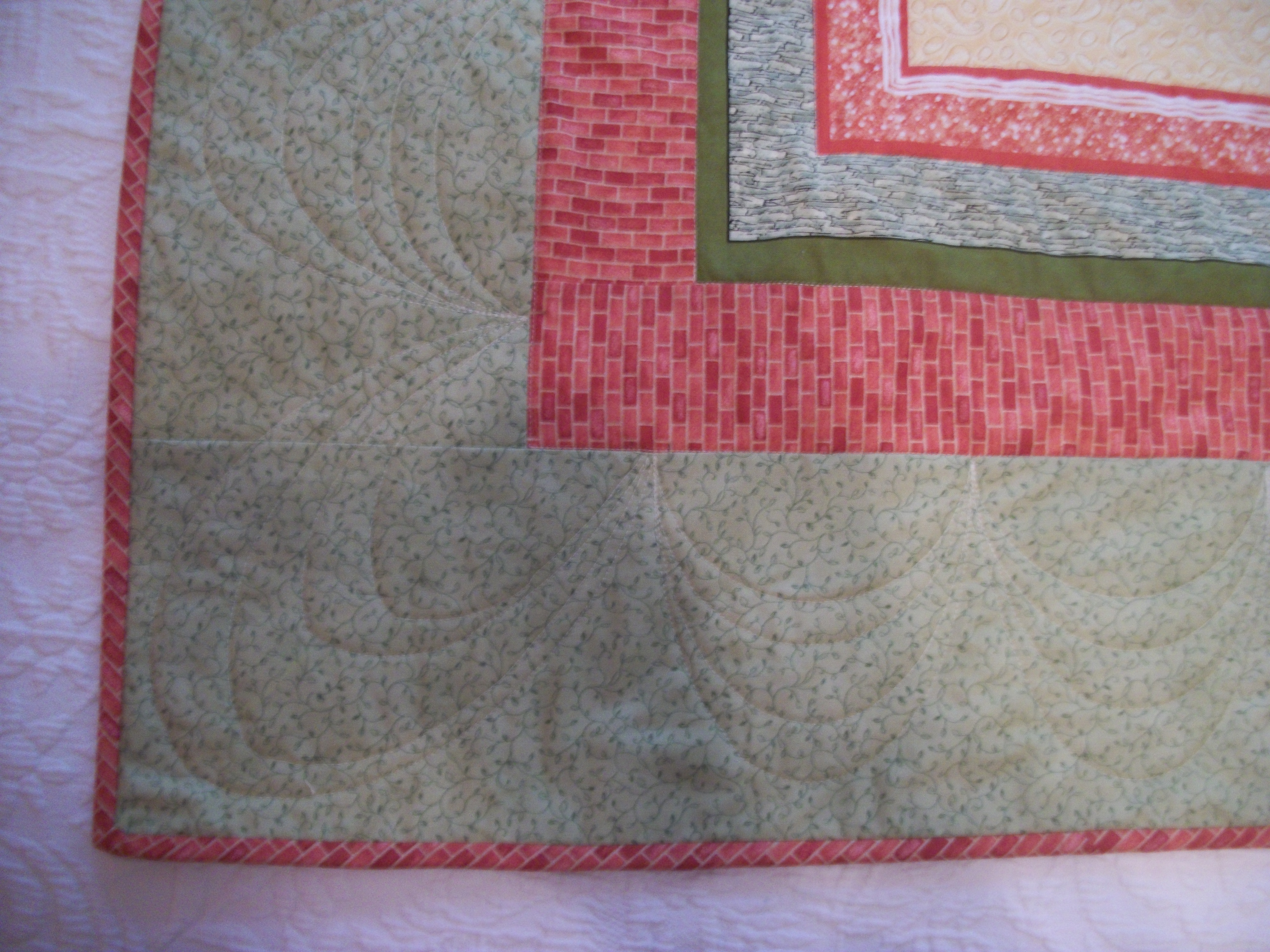
You can see that I put in a wide outer border so that I could practice with the Constantine Quilts swag ruler–which is easy once you get the hang of it and which is so much fun and which makes a really nice border.  Constantine Quilts is an Australian company, but they now have an American distributor, Quilted Memories, LLC.  There are great videos on Utube to show you how to use these “no-nonsense” long-arm rulers.  I started with the 5-inch swag ruler and just ordered the 8-inch.  The number denotes the WIDTH of the swag.

Here’s a close-up of this adorable panel:

Here’s a view of the borders.  I like the red brick fabric I found–it spoke to me of English garden brick walls and bunnies who find ways around them.  I used it for the binding as well.

I was able to take this quilt back to the domestic machine and sew all the “stitch-in-the-ditch” borders down–that worked really well actually–with a walking foot, of course.

The backing is a soft cream polka-dot fabric, which blended beautifully with the front.  And you can see how pretty that swag border is from the back.  And, the nice lines made when I stitched down the borders from the front.

Thanks you again, Rosie.  Nora thanks you as well!

Turkey Tracks: “Julia’s Jungle” quilts

Turkey Tracks:  May 16, 2012

Julia’s Jungle Quilt

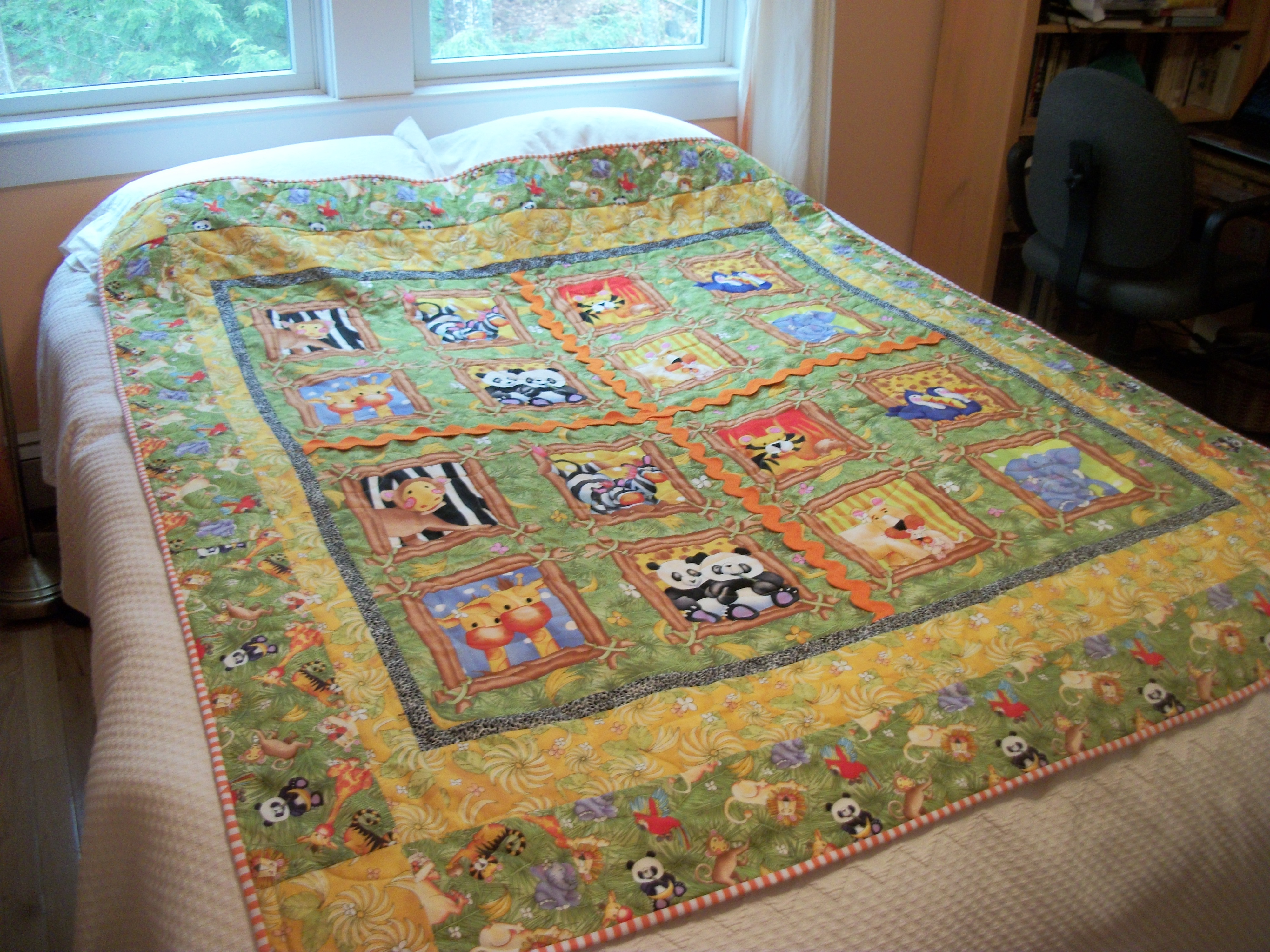
Steve, Ann, and their daughter Joann (one of my favorite people in this world) visited last week–driving up from Boston for the day.  Joann has two little girls, so I got myself organized, pulled down two quilting kits I had collected along my quilting way, and made them each a quilt.  These quilts are loosely quilted so as to be soft and cuddly and are meant to be dragged around, washed, and loved to death.

Here’s “Julia’s Jungle”–made from a kit assembled by Debbie at Quilt Diva’s in Rockland.  Debbie and Doris of Quilt Divas have a terrific selection of kid-friendly fabrics.

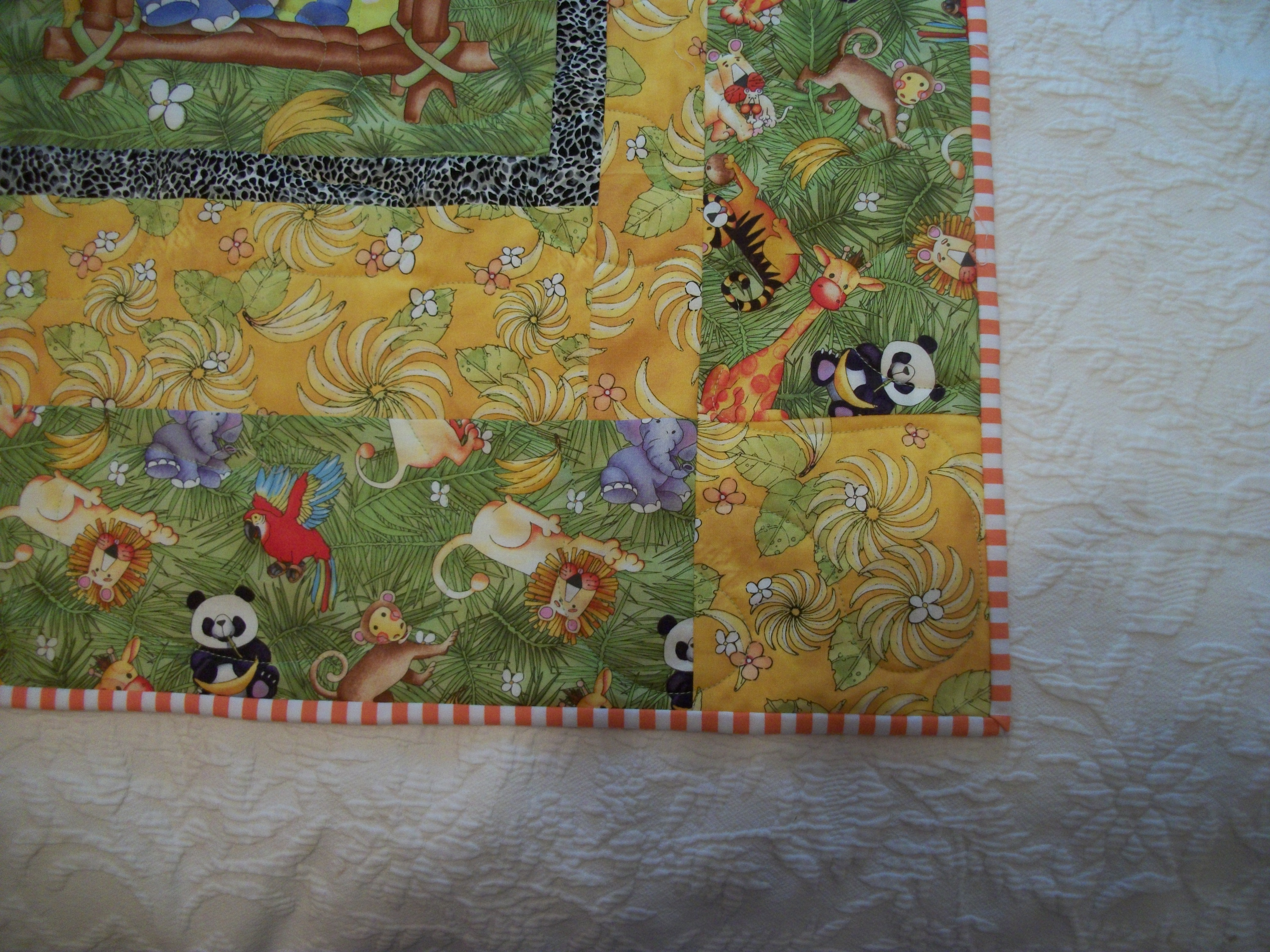
I especially like the orange-stripe binding on this quilt–which Debbie included in the kit packet.

Here’s a close-up of one of the panel’s animals:

Here’s  a picture of the borders–the black and white animal print works really well, don’t you think?

One of the fun things Debbie did when putting this kit together was to include some big, orange rickrack, which she used to separate what is really two panels.  Both the rick-rack and the orange-striped binding really drew me to this kit.

I like the backing I found for this quilt:

Joann reports that Julia loves her quilt.  I am so glad.  I had fun making it.

Interesting Information: “Work Till You Drop”

Interesting Information:  May 11, 2012

“Work Till You Drop”

The government wants to increase line speed at poultry plants.

Gabriel Thompson, writing in “The Nation” (14 May 2012), describes what it was like to work on a chicken processing line in rural Alabama.

Thompson processed 7,000 chicken breasts each night.  The pace of the line was “as relentless as such numbers suggest.  We often didn’t even have time to wipe bits of chicken flesh from our faces, and I took to popping ibuprofen during breaks to quell the swelling of my hands.”  One wall of the break room was lined with dispensers filled with painkillers–for sale.

The repetitive nature of the work causes lineworkers to get musculoskeletal disorders like carpal tunnel syndrome or tendinitis.  Thompson met one worker who couldn’t hold a glass of water.  Another had had three surgeries on her wrists.  Another’s thumb joint had “almost disappeared after twelve years of line work.”

Current government-approved line speed is 91 birds a minute–which, Thompson writes, fails to “take worker safety into consideration.”  In January, the USDA proposed allowing plants to run the line speed at 175 birds a minute–nearly double the present limit.  On-line inspectors would be cut, creating a cost-savings for the USDA.  Poultry workers would now be responsible for inspecting birds.

This new plan will make foods safer, argues the USDA, since inspectors can now focus their attention on pathogens, like salmonella and campylobacter.  “BIG MEAT,” writes Thompson, will save about $257 million a year by operating at higher speeds.

Workers’ safety has, of course, gotten lost among the dollars saved.  But, workers have never been important to capitalism.  Workers are totally and completely expendable when industry pushes for classic speed up.  And don’t for one minute think that what’s behind this move is any government concern for its citizens’ safety or safer food.  This story is a perfect example of how industry can manipulate government into being a willing handmaiden to its purposes when good citizens do not realize what is happening to their fellow Americans.

What can you do?

Write USDA, of course.  And your congressmen.

You could, also, stop buying chicken parts.  Buy the whole chicken and cut it up yourself and tell your local store why you’re doing it.  You’ll reap a reward if you do your own cutting:  bones for chicken stock which we now know you can easily, effortlessly cook in your crock pot.

Most of all, you can realize that cheap chicken comes to you with enormous costs for way too many people:

the chickens themselves, which are miserably treated and fed very poorly on corn and soy;

the growers, who are caught in a terrible system created by and run for industry profit;

the workers who are injured processing the chickens;

the people who live on land near poultry processing plants, whose water is ruined and whose land is saturated with chicken waste;

the waste stream which has to handle all those plastic trays that hold the chicken parts;

and you, the consumer, who are being fed an inferior industrial product that’s, yes, cheap, but which is tasteless and has no texture.

My own chickens have personalities.  They have a sense of humor.  They are affectionate and social.  They can tell you they want a treat and can and do lead you to where the treats are located.  Just today, they spent the morning in the now-deep needs-to-be-cut grass in the front yard, sunbathing.  Their sense of joy was a pleasure to see.  The rooster watched over them, never lying down himself.

Mainely Tipping Points 42: What’s Wrong With Grains?

Mainely Tipping Points 42:  May 9, 2012

Part II:  The Paleo Diet 

What’s Wrong With Grains?


Paleo Diet advocates argue that humans are genetically wired to eat meat, foraged vegetables, fruits, nuts, and seeds.  Paleo peoples, they argue, did not eat grains, legumes, or dairy and were, as described in Part I of this series, superbly healthy.

What is it about grains that makes so many, varied researchers (see Part I) forbid us to consume grains or caution us to prepare them properly if we do?

First, we’re eating too many grains on a daily basis.  Luise Light, M.S., Ed.D, wrote WHAT TO EAT, in part, to make the case that Americans are eating way too many grains.  As detailed in Tipping Points 12, Light was hired by the USDA to produce the 1980 food guide.  Light’s team of scientists concurred that two (women/children) to three (men) daily servings of whole grains were optimal.  A serving is usually one piece of bread or one-half cup of grains.  When Light sent the new food guide to the office of the Secretary of Agriculture (a political appointee), it came back changed:   grain servings now numbered six to eleven.  Light was horrified, furious, and feared, especially, that the alteration would increase national risks of obesity and diabetes.    

William David, M.D., a preventive cardiologist who recently published WHEAT BELLY, a “New York Times” bestseller, describes how many feet grain products occupy in the average grocery store (pg. 13).  How much of your grocery store does the bread aisle, the cereal aisle, the pasta aisle, the cracker aisle, the cookie aisle, the chip aisle, the baking aisle, the wheat products in the fresh and frozen food cases, and the store bakery occupy?  How many servings of grains are you eating daily?

Secondly, grains are mostly carbohydrate.  Wheat, David writes, is “70 percent carbohydrate by weight, with protein and indigestible fiber each comprising 10 to 15 percent” and with a tiny bit of fat rounding out the package (32).  Today, a host of American nutritional “experts” promote eating whole-grain products as they are complex carbohydrates, unlike simple sugars. 

But, David writes that the carbohydrate in wheat is split between amylopectin A (75 percent) and amylose (25 percent).  Amylopectin A is “efficiently digested by amylase to glucose, while amylose is much less efficiently digested, some of it making its way to the colon undigested.”  Amylopectin A is the most digestible of the amylopectin forms found in plants, which means that wheat increases blood sugar more than other complex carbohydrates.  In effect, “eating two slices of whole wheat bread is really little different, and often worse, than drinking a can of sugar-sweetened soda or eating a sugary candy bar.” (32).  Indeed, the glycemic index of whole grain bread (72) is higher than sucrose (59) or of a Mars bar (68) (pg. 32). 

Third, grains, like all plants, have developed powerful—and mostly underestimated– chemical properties in order to carry out their life agendas.  Rob Wolf, in THE PALEO SOLUTION, notes that if you eat a grain, “that’s it for the grain.”  But, grains don’t go down “without a fight” and  grains are “remarkably well equipped for chemical warfare” (88).

Wolf does a really good job of explaining the adverse impact on humans of the chemicals in grains—information that is both widely available and, for the most part, ignored.  This subject is complicated:  I can only try to summarize the highlights.  Hopefully, you will investigate more deeply, especially if you are having digestive problems, arthritis, diabetes, neurological problems, or infertility.     

All grains, writes Wolf, contain a variety of proteins, called lectins.  These proteins cause more damage when derived from the gluten-containing grains—wheat, rye, barley, and oats.  Lectins are “not broken down in the normal digestive process,” which leaves “large, intact proteins in the gut.”  Grains also contain protease inhibitors, which “further block the digestion of dangerous lectins “ (85-99).

Serious problems occur when undigested proteins “are transported intact through the intestinal lining.”  For one thing “these large, intact protein molecules are easily mistaken by the body as foreign invaders like bacteria, viruses, or parasites,” so the body begins to create antibodies to attack them.  In addition, the undigested lectins damage the intestinal lining during passage, which allows “other proteins to enter the system,” and the body creates antibodies for them.  These antibodies can attach themselves to organs and, even, your brain.  Attachment causes a “wholesale immune response” that destroys the tissue of that organ (85-99).

When the intestinal wall is damaged, writes Wolf, the “chemical messenger, cholecystokinin (CCK) is not released—so the gall bladder and the pancreas malfunction, which results in nondigestion of the fats and proteins we have eaten.  Removing the gall bladder is the mainstream solution, but this procedure is akin to “killing the `canary in the coal mine.’ “  Wolf believes removing grains from the diet and allowing the gut to heal is a better solution.

Grains, notes Wolf, also contain antinutrients, like the phytates, which help prevent premature germination of the grain.  Phytic acid, in humans, binds to calcium, magnesium, zinc, and iron, which means your body can’t absorb these minerals.  Malabsorption is one reason ancient peoples who started settled agricultural lives “lost an average of six inches in height” (93-94). To partially mitigate the impact of phytic acid, the Weston A Price Foundation advocates grains be soaked, sprouted, or fermented.

Nora T. Gedgaudas, CNS, CNT, in “Grains:  Are They Really a Health Food?:  Adverse Effects of Gluten Grains” (May/June 2012, “Well Being Journal”), notes that grains contain goitrogens, which are substances that inhibit the thyroid.  She also notes that “chronic carbohydrate consumption, in general, depletes serotonin stores and greatly depletes the B Vitamins required to convert amino acids into many needed neurotransmitters”—which may be a cause of today’s “rampant serotonin deficiencies, clinical depression, anxiety, and some forms of ADD/ADHD in our populations” (3). 

Fourth, grains are addictive.  Wolf says grains “contain molecules that fit into the opiate receptors in our brain….the same receptors that work with heroine, morphine, and Vicodin” (96).  Gedgaudas says the morphine-like compounds in gluten-containing grains, called exorphins, are “quite addictive” and leave “many in frank denial of the havoc that gluten can wreak” (5).  She calls gluten a “cereal killer” (4).  Davis agrees and writes that grains can produce the same vicious circle of addiction and withdrawal that crack cocaine does (44-45).   

Fifth, and maybe the most important reason of all, as Davis explains in WHEAT BELLY, is how since the 1950s the wheat that humans have eaten for the past several centuries has been radically changed by industry to increase yield and to allow patents.  These changes have introduced gene changes that “are hundreds, perhaps thousands, of genes apart” from the pre-1950s wheat (22).  Wheat now contains a new “protein/enzyme smorgasbord” that has never been tested on humans (22). 

Davis warns that if you eliminate wheat for several weeks and try to eat it again, you will likely have extreme reactions.  In his clinical practice, however, eliminating wheat has consistently produced weight loss, the loss of the dangerous “wheat belly,” and the cessation of many chronic conditions. 

In Tipping Points 32, I discussed Konstantin Monastyrsky’s 2008 book, FIBER MENACE:  THE TRUTH ABOUT FIBER’S ROLE IN DIET FAILURE, CONSTIPATION, HEMORRHOIDS, IRRITABLE BOWEL SYNDROME, ULCERATIVE COLITIS, CHROHN’S DISEASE, AND COLON CANCER.  Monastyrsky believes one should eliminate grains gradually as the body has to adjust, which is what I am doing—though I am having severe reactions when I eat wheat these days.  Swedish Bitters, a tonic made from greens, helps with any constipation that ensues with the cessation of eating a lot of grain fiber.