Turkey Tracks: Ailey Brings Her Parents To Maine

Turkey Tracks:  September 18, 2011

Ailey Brings Her Parents to Maine

At barely 10 months, Ailey got her parents organized for a September trip to her grandparents home in Camden, Maine–to celebrate her father’s birthday.  It was Ailey’s very first trip to Maine, if you don’t count last year when she came while still growing!

They all arrived on a rainy day that threw up a few possibilities of delay, but Ailey nixed those and they came in mostly on time:

After the 2-hour drive north with her parents and her Lovey, she right to Pop Pop, which pleased him enormously:

Ailey loved the two dogs around Pop Pop’s feet and belly laughed over and over in delight at their presence.  In fact, she is a happy baby who laughs a lot.

Ailey loved hiking and took her parents off to hike several times.  Here she is on the Rockerfeller property just above our house, property which they so graciously allow us to enjoy.

We loved Ailey’s purple hat!

Heading for the pond bridge:

And, into the woods without the hat:

Around the lower pond:

Ailey loved our chickens, and I think Bryan got some good shots.  If he sends me one or two, I’ll post them here.  Hint, hint.  Meanwhile, she’s got chickens on her pj’s:

Ailey came prepared for several kinds of activities.  Here are her dancing shoes:

Ailey wanted to see Hope’s Edge, the frogs there, the tire swing, and all the food.  She hadn’t expected to see Farmer Tom’s tractor:

Here she is with her parents at Hope Edge’s “front door.”

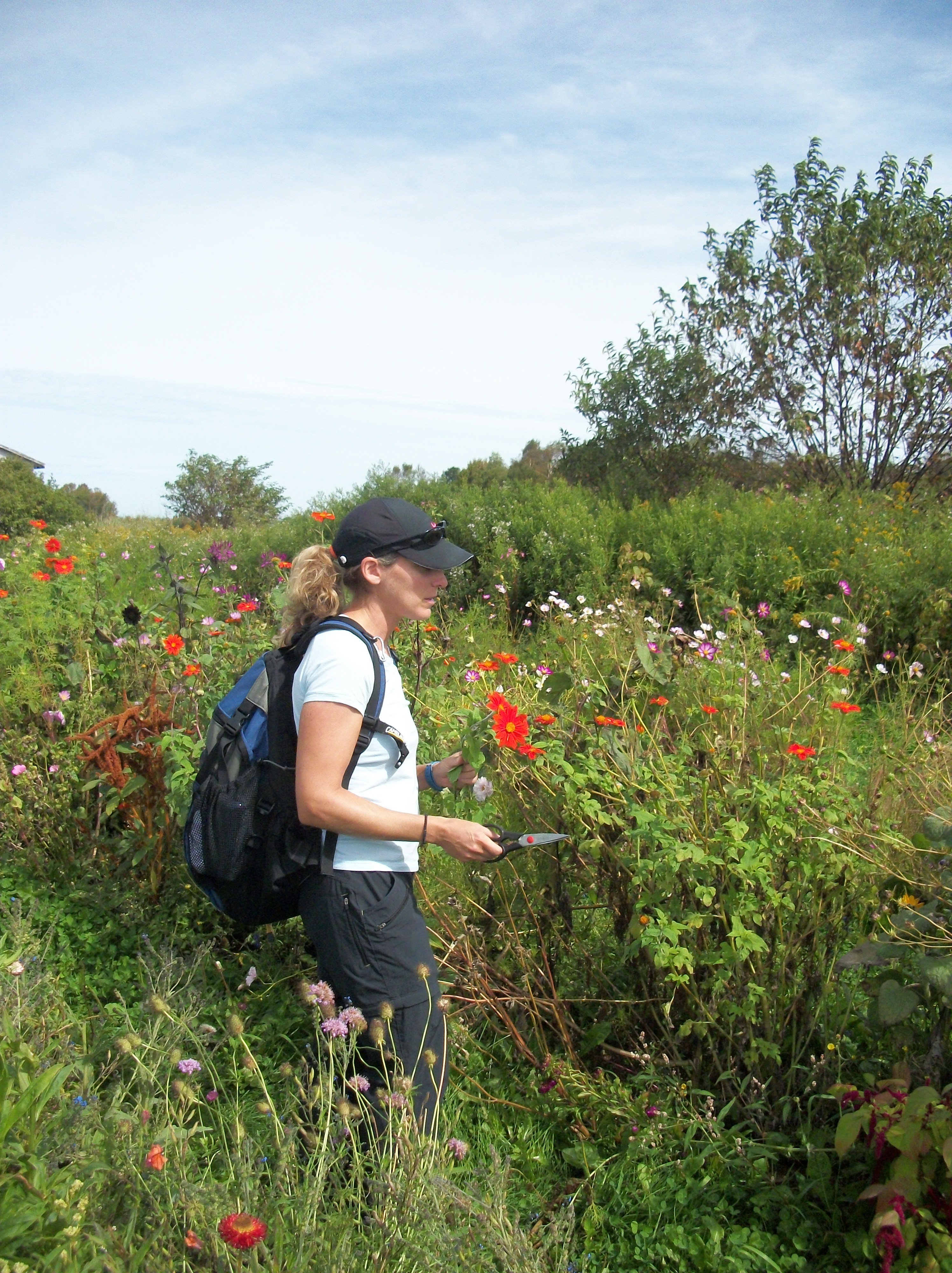
Ailey couldn’t quite take in the frogs in the little pond back of the shed.  And, Bryan’s weight on the tire swing made the limb groan with ominous cracking sounds.  So Ailey will have to grow into those pleasures at Hope’s Edge.  She did enjoy seeing all the animals (cows, sheep, chickens, horses, tiny ponies).  And she loved watching her mother cut and arrange some flowers from the cutting garden, which is fading away now.

Corinne with sluggish bees on the New Zealand zinnas:

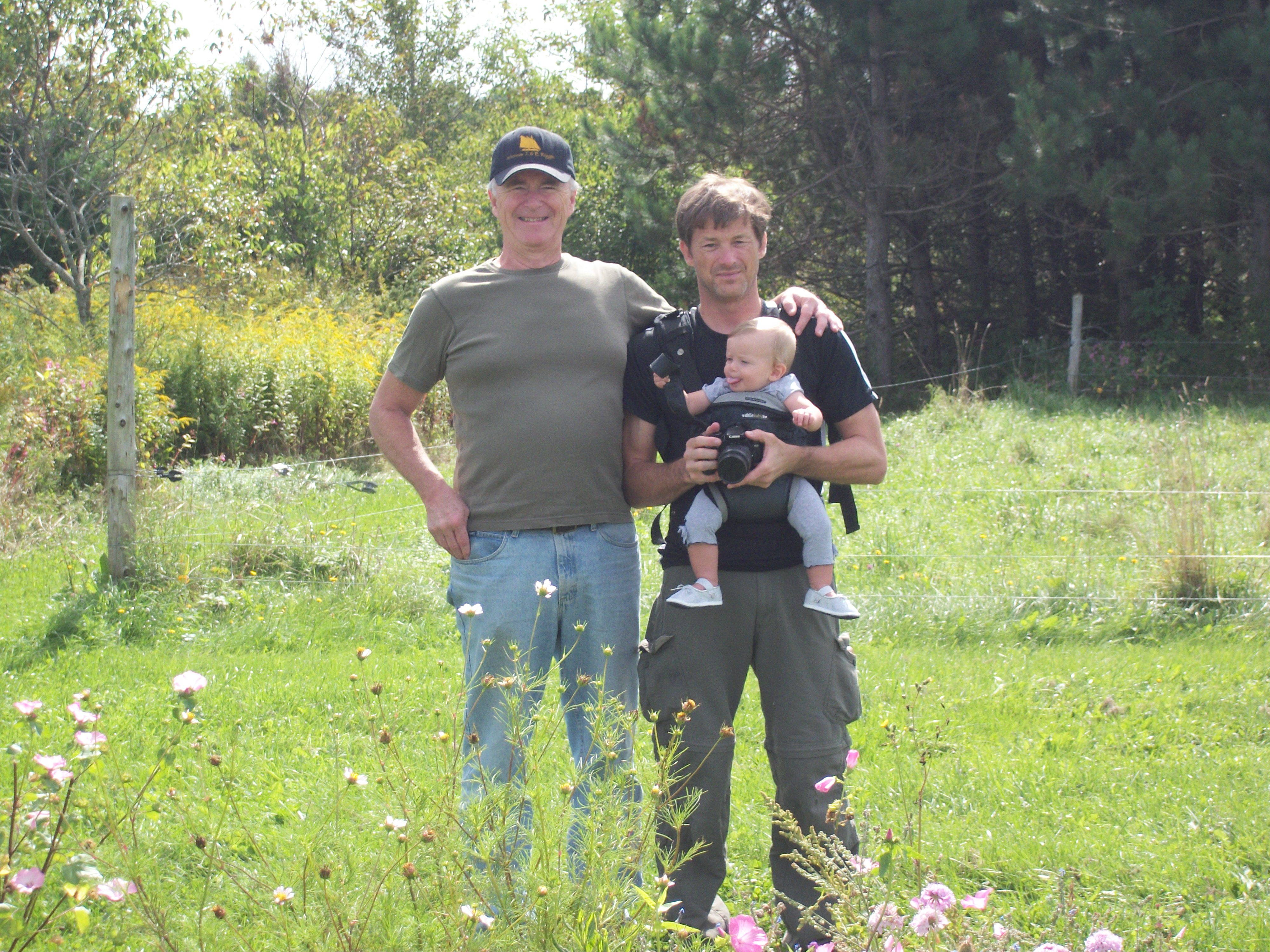
Pop Pop, Bryan, and Ailey at the far end of the cutting rows.  Note the glitter shoes:

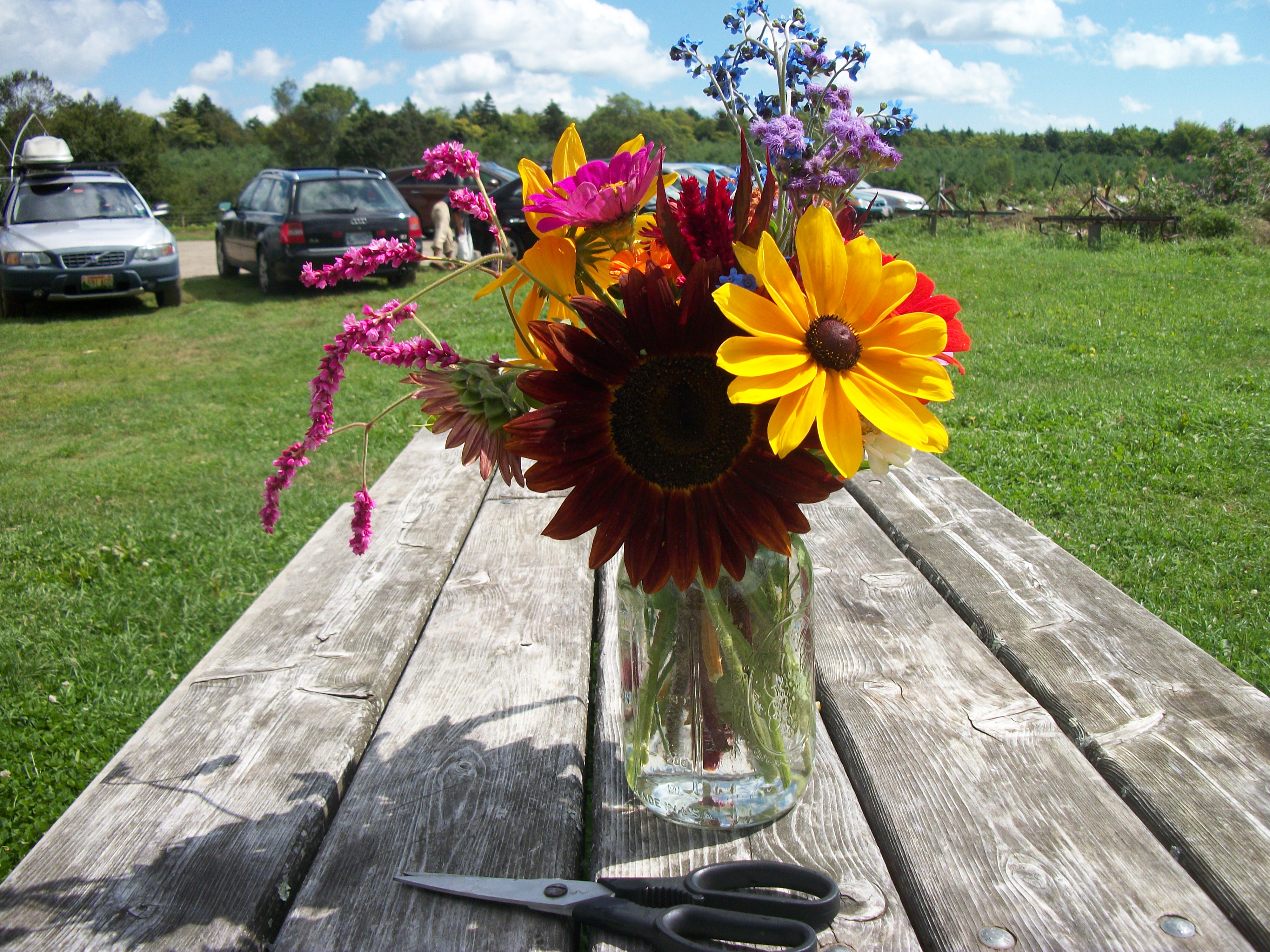
Corinne’s flower arrangement:

Pop Pop measuring out the copious amount of food we took home:

Here are out onions and garlic drying in the Hope’s Edge barn.  The onions are strung in layers up the rafters of the barn:

Here’s another view:

Ailey brought her parents to Maine, in part, to celebrate her Daddy’s birthday.  So we did just that!

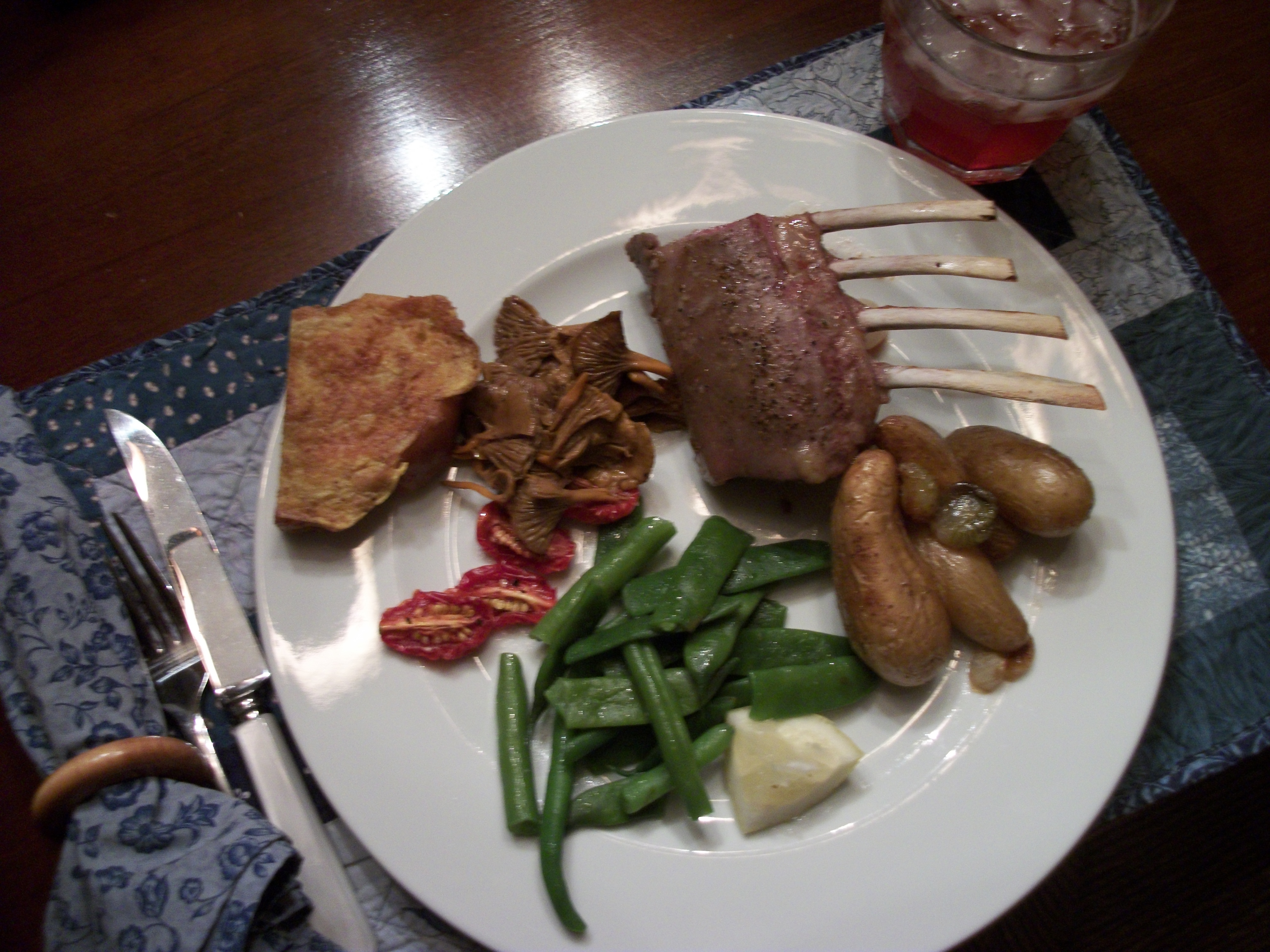
Here’s his birthday dinner:

Baby lamb racks, La Ratte fingerling potaotes with baby white onions (our garden), green beans (Hope’s Edge), native golden chanterelle mushrooms (gift of Charlie and Joan Herrick of Northport), slow roasted saladette tomatoes, sweet/sour style (Hope’s Edge), dried French toast from breakfast, and fudgy, homemade chocolate cake made with local butter, our eggs, real cream, really good chocolate (Lovey).

All in all, we had a wonderful visit!

Turkey Tracks: Quilt in Progress, September 2011

Turkey Tracks:  September 18, 2011

Quilt in Progress

September 2011

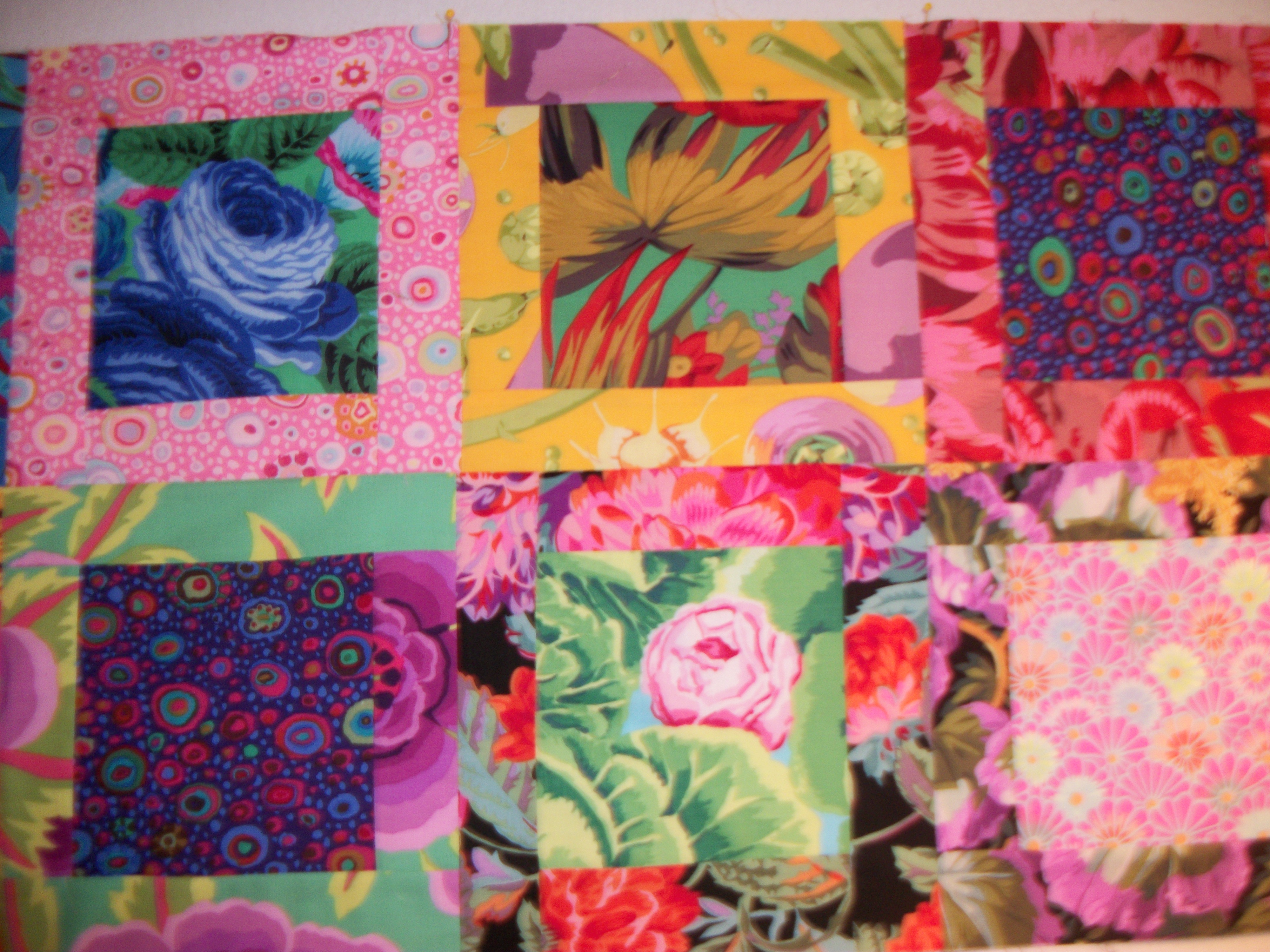
Here’s a peek at the quilt I’m working on these days:

And, here it is coming together on the design wall:

This quilt is such a happy quilt.  I’m so enjoying working with it–which hasn’t been often enough since I’ve been so busy processing harvest food.

The fabrics are all Kaffe Fasset prints, which I love.  And though it can seem jumbled a bit at this stage, I’ve seen it made up, and I really like it.  I bought the kit from Marge at Maine-ly Sewing in Nobleboro, Maine.  She sells online too:  http://mainelysewing.com/

It’s on Lucy the long-arm now, being quilted with lime green thread, which is looking quite pretty, and with a “sweet pea” pantograph.  The backing is a lime green print I got on sale at Quilt Diva’s in Rockland.  It has a linear print of leaves whose panels were QUITE hard to line up properly in order to get the right width.

I haven’t decided what to name it yet.  Happy Quilt isn’t quite right.  Layer cake isn’t either.  It will come to me…

Turkey Tracks: More Socks

Turkey Tracks:  September 18, 2011

More Socks

When I first started making socks, I bought a fair amount of sock yarn at various sales around and about Maine.

So, I’m systematically working away at…making socks.  Which isn’t a hardship because I’m clearly obsessed with making them…

OK, I took a break this summer and made a sweater that I’m sewing together now, so I’m sure you’ll see it here soon.

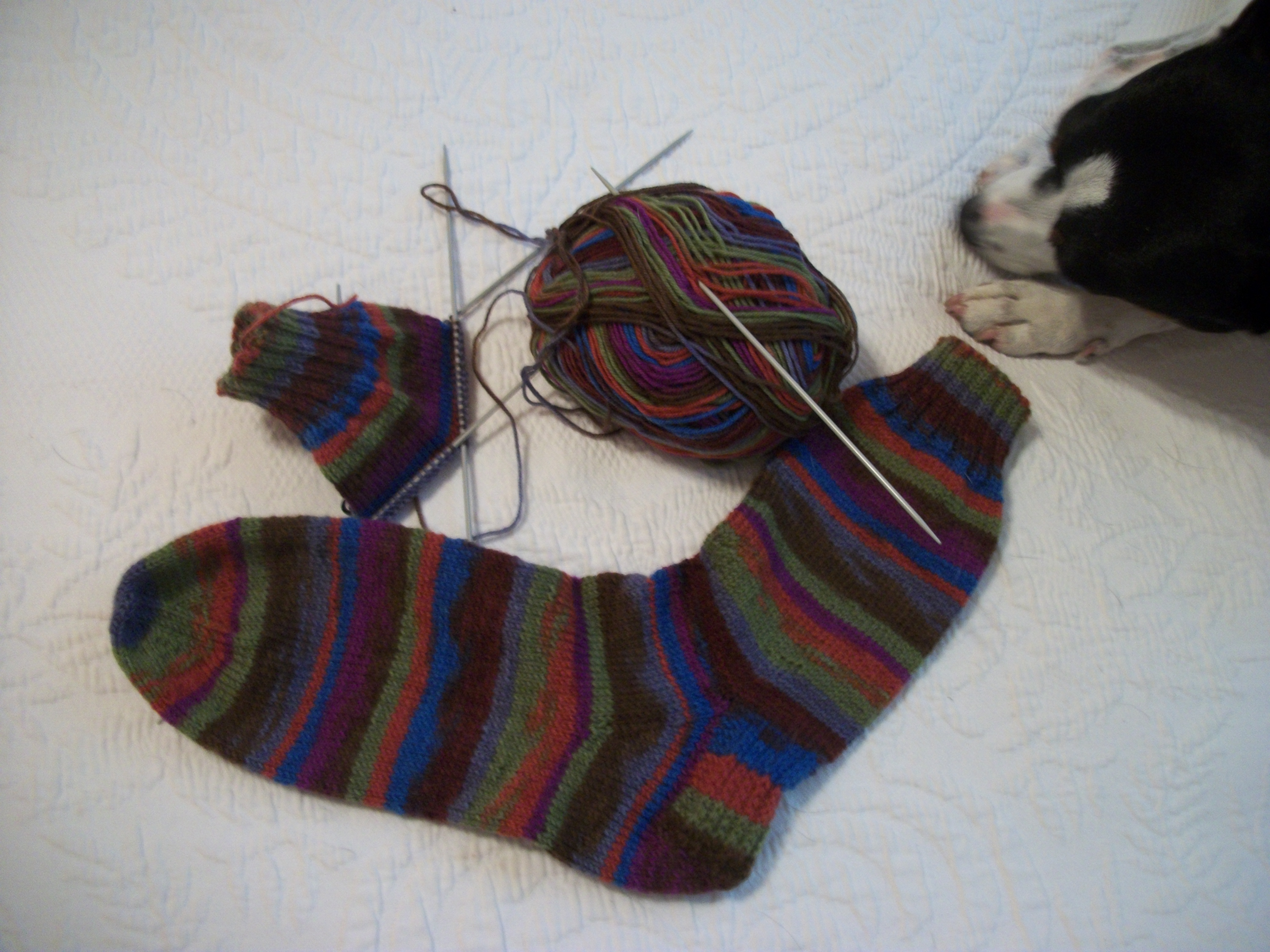
Anyway, here’s the current pair of socks “in progress.”

But, aren’t they pretty?  They are a Kaffe Fasset yarn that makes the funky colorful designs.

I’m looking forward to making more of Cookie A’s intricate patterns, but…not until I use up the yarn I already have.  Cookie A’s designs wouldn’t show up well with a yarn like this one.

As I write, on the second sock I’m past the heel turn and well into working down the stitches on the gusset.  On to the toe!

Mainely Tipping Points 33: GO WILD!

Mainely Tipping Points 33

GO WILD!


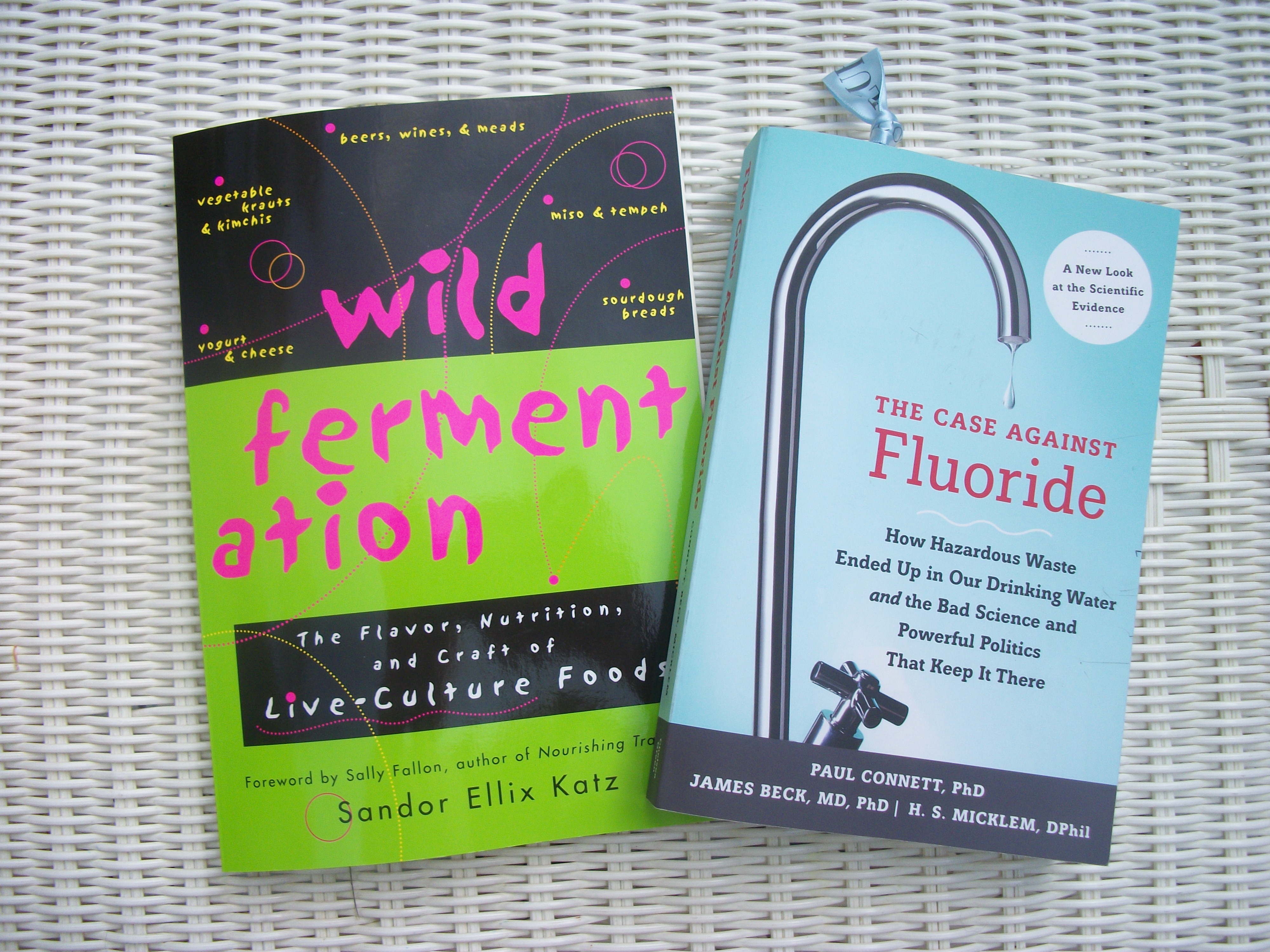
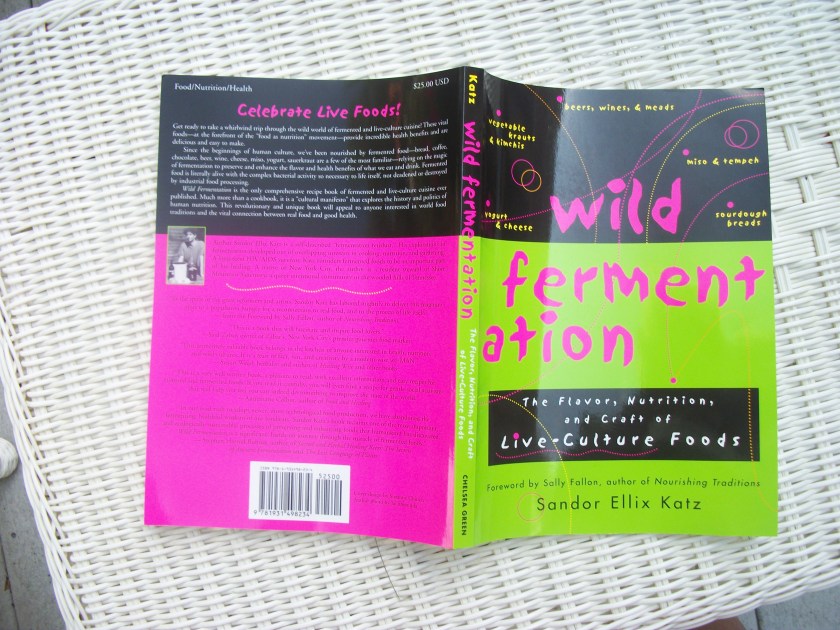
Sandor Ellix Katz’s WILD FERMENTATION: THE FLAVOR, NUTRITION, AND CRAFT OF LIVE-CULTURE FOODS arrived last week.  I found myself dropping all other activities and reading it straight through. 
By noon the next day I had a ball of cloth-wrapped cheese hanging from a kitchen knob, dripping away the last of its whey. 
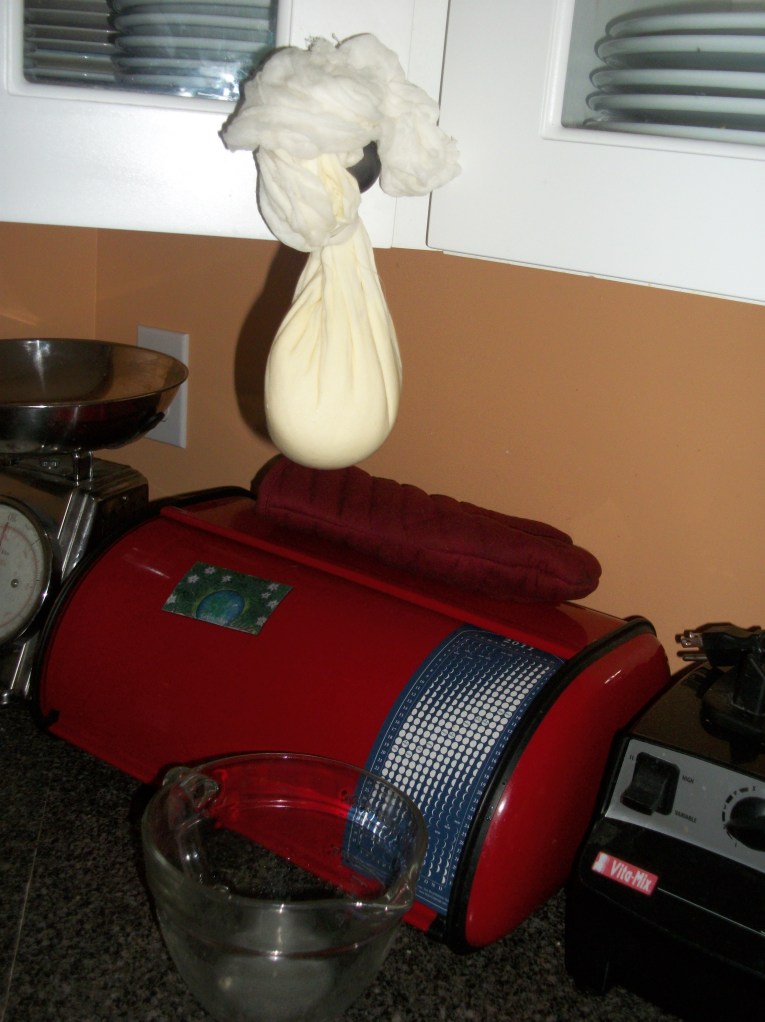
In two days’ time I had a quart mason jar filled with fermenting kale leaves, or Gundru, a Tibetan ferment.  (You can’t imagine how many kale leaves it takes to fill a quart jar once you’ve wilted them in the sun and pounded them so that they release their juices—the leaves of about eight kale plants.)  And now I’m eyeing the crocks over my stove, bought for decorative purposes mostly, and wondering what from the fall harvest I can ferment next. 

Katz, who is a charming writer, would say “lots of things.”  And, indeed, Katz discusses how to ferment vegetables, fruits, beans, dairy, grains and breads, beverages, wines, beers, and vinegars.  “Fermentation,” writes Katz, gives us many of our most basic staples, such as bread and cheese, and our most pleasurable treats, including chocolate, coffee, wine, and beer” (2).

Microscopic bacteria and fungi, or microflora, are, writes Katz, agents of transformation; they feast upon decaying matter and shift dynamic life forces from one creation to the next (2).  That’s why “fermented foods and drinks are quite literally alive with flavor and nutrition.  Their flavors tend to be strong and pronounced,” like “stinky aged cheeses, tangy sauerkraut, rich earthy miso [made traditionally, which can take several years], smooth sublime wines.  Human have always appreciated the distinctive flavors resulting from the transformative power of microscopic bacteria and fungi” (5).     

But, why should we home cooks ferment anything?  First, fermented foods we make for ourselves are guaranteed to be very rich in enzymes. 

You might recall me writing in earlier Tipping Points essays about Edward Howell’s theory on enzymes.  Howell, who died in 2000 at the age of 102, spent his life studying the role of enzymes in health and disease.  He posited that if one does not eat enzyme-rich foods, the body has both to use existing stored enzymes and to work harder to digest foods, all of which takes a toll.  Ron Schmid, in THE UNTOLD STORY OF MILK, notes Howell’s assessment that humans have lower levels of starch-digesting enzymes in their blood than other creatures and higher levels in their urine, which means their resident enzymes are being used up faster.  And, as Schmid notes, based on various studies, it’s clear that diets deficient in enzymes result in shortened life spans (101-105).  Certainly this assessment is a piece of the growing body of information pointing toward the health problems associated with starchy carbohydrate-heavy diets. 

Second, fermentation removes toxins from foods.  All grains, nuts, seeds, and tubers contain inhibitors (phytic acids) which block human absorption of nutrients.  These inhibitors are inactivated by traditional food preparation methods that involve soaking in acids, like whey or lemon juice, which begins a fermentation process, or by sprouting (101-105).  Few, if any, commercial foods have been properly prepared so as to inactivate nutrient inhibitors while, at the same time, preserving nutrients.  Thus, unless you are properly preparing these foods, your body isn’t getting all of the nutrients in these foods and is, to add insult to injury, struggling to digest them. 

Fermentation can remove toxins as powerful as cyanide from cassava, an enormous tuber used in tropical regions of the Americas and, now, in Africa and Asia.  Other toxins fermentation can eliminate or reduce include nitrites, prussic acid, oxalic acid, nitrosamines, and glucosides (7). 

Third, fermentation preserves food because it produces “alcohol, lactic acid, and acetic acid, all `bio-preservatives’ that retain nutrients and prevent spoilage.”  Hence, highly perishable foods, like vegetables, fruits, milk, fish, and meat, can be stored after harvest for consumption in leaner seasons.  Or, as Captain James Cook discovered during his eighteenth century explorations, preserved fermented sauerkraut prevented scurvy during long ocean voyages (5).      

“Microscopic bacteria and fungi,” writes Katz, “…are in every breath we take and every bite we eat.”  These microflora are “in a symbiotic relationship” with humans.  They “digest food into nutrients our bodies can absorb, protect us from potentially dangerous organisms, and teach our immune systems how to function” (2).  Most importantly, writes Katz, “we need to promote diversity among microbial cultures” in our bodies because “biodiversity is increasingly recognized as critical to the survival of larger-scale ecosystems” (11).        

Not all fermented foods are alive when you eat them.  Bread, for instance, must be cooked.  But, the most nutritious fermented foods, such as yogurt, are consumed alive (7).  Or, such as sauerkraut, which I make by the half-gallon and keep in our refrigerator as a ready “asset” to compliment a meal.  I used red cabbage for my current batch, and it is the loveliest deep ruby color.   

 Live yogurt and sauerkraut couldn’t be easier to make, and I have time-tested recipes for both in the recipe section of this blog.  I have not yet tried Katz’s recipe, but it has some really exciting suggested additions.  Plus, Katz’s sauerkraut lives in a crock in a cool place and does not require refrigeration.   

 Fourth and finally, fermenting is a political act, an act that stands in stark opposition to what Sally Fallon Morell of the Weston A. Price Foundation, who wrote the introduction to WILD FERMENTATION, describes as “the centralization and industrialization of our food supply.”  Real culture, writes Fallon, “begins at the farm, not in the opera house, and binds a people to a land and its artisans.”  Many commentators, notes Fallon, have said that America lacks culture.  But, “how can we be cultured when we eat only food that has been canned, pasteurized, and embalmed?” (xii).  Food artisans ferment food, and they are increasingly being regulated out of existence by the government in the name of “food safety”—which is nothing more than industry’s power in a so-called “free market” to eliminate all its competitors.    

Katz writes the following:  “Thinking about mass food production makes me sad and angry.  Chemical mono-crop agriculture.  Genetic engineering of the most basic food crops.  Ugly, inhumane factory animal breeding.  Ultra-processed foods full of preservative chemicals, industrial byproducts, and packaging.  Food production is just one realm among many in which ever more concentrated corporate units extract profits from the Earth and the mass of humanity” (163). 

 Katz encourages us to “draw inspiration from the action of bacteria and yeast, and make your life a transformative process.”  Wild fermentation, he writes “is the opposite of homogenization and uniformity, a small antidote you can undertake in your home, using the extremely localized populations of microbial cultures present there to produce your own unique fermented foods” (21).  

Take back your power, Katz urges, to “use your fermented goodies to nourish your family and friends and allies.  The life-affirming power of these basic foods contrasts sharply with the lifeless, industrially processed foods that fill supermarket shelves” (166).  Remember that “wild fermentation is a way of incorporating the wild into your body,” so that you become “one with the natural world” once more (12).       

Don’t wait, like I did, to get a copy of Katz’s WILD FERMENTATION.

GO WILD now!  

Turkey Tracks: Roasting Tomatoes

Turkey Tracks:  September 15, 2011

Roasting Tomatoes

September is the “red” month in Maine.

Or, in other words, September is when our tomatoes turn…red.

September is when my kitchen gets really interesting:

Those gorgeous yellow and Black Krill tomatoes on the left–and more red tomatoes–come from my neighbor Susan McBride of Golden Brook Farm.  The large red tomatoes to the right are ours; they’re Brandywines, and I think they are probably the best eating tomato in the whole world.

I’ve made a dense tomatoes sauce that I freeze in past years.  But, now that we don’t really eat pasta very much–too much of a carb hit–I looked around for a different way to preserve tomatoes for the winter–and, indeed, for early summer since our tomatoes take much longer to ripen.  Remember that summer doesn’t really arrive in Maine until July 4th!

Last year I made tomato soup and froze it, and it’s been so delicious all year.  And, I roasted tomatoes and put them into smaller jars.  It takes a LOT of tomatoes to fill a pint mason jar.   But, the flavor is dense and very rich.  So that’s what I decided to do with this year’s crop extras.

ROASTED TOMATOES

Start the oven at 375.

Put on a pot of water to boil–a large one if you have it.

Put a large bowl filled about half way with ice in  your sink.  Add some water, not too much as you don’t want to spill out the cold water when you put in the tomatoes.

When the water boils, drop in tomatoes to fill the pot, and after about a minute, lift each out and drop it into the ice water.

Let your pot reboil and add more tomatoes, etc., until all are done.   Meanwhile, take out the cold tomatoes, run a paring knife around the stem section to remove it, and slip off the skins.  Chuck up the tomato into a baking pan.

For about five pounds of tomatoes, add a chopped up onion, 4 to 5 cloves of garlic smashed and roughly cut, a couple of handfuls of basil, some salt, and a drizzle of really good cold-pressed, organic olive oil over the top–no more than 1/4 cup total.  Mix it all up with your hands–GENTLY.

Here’s what things look like at this stage:

Cook the tomatoes for about an hour, then stir gently.  Now you have to start checking on them about every 30 minutes.  And, when they start to “cook down,” more frequently.

The smell all over your house will be absolutely mouthwatering!

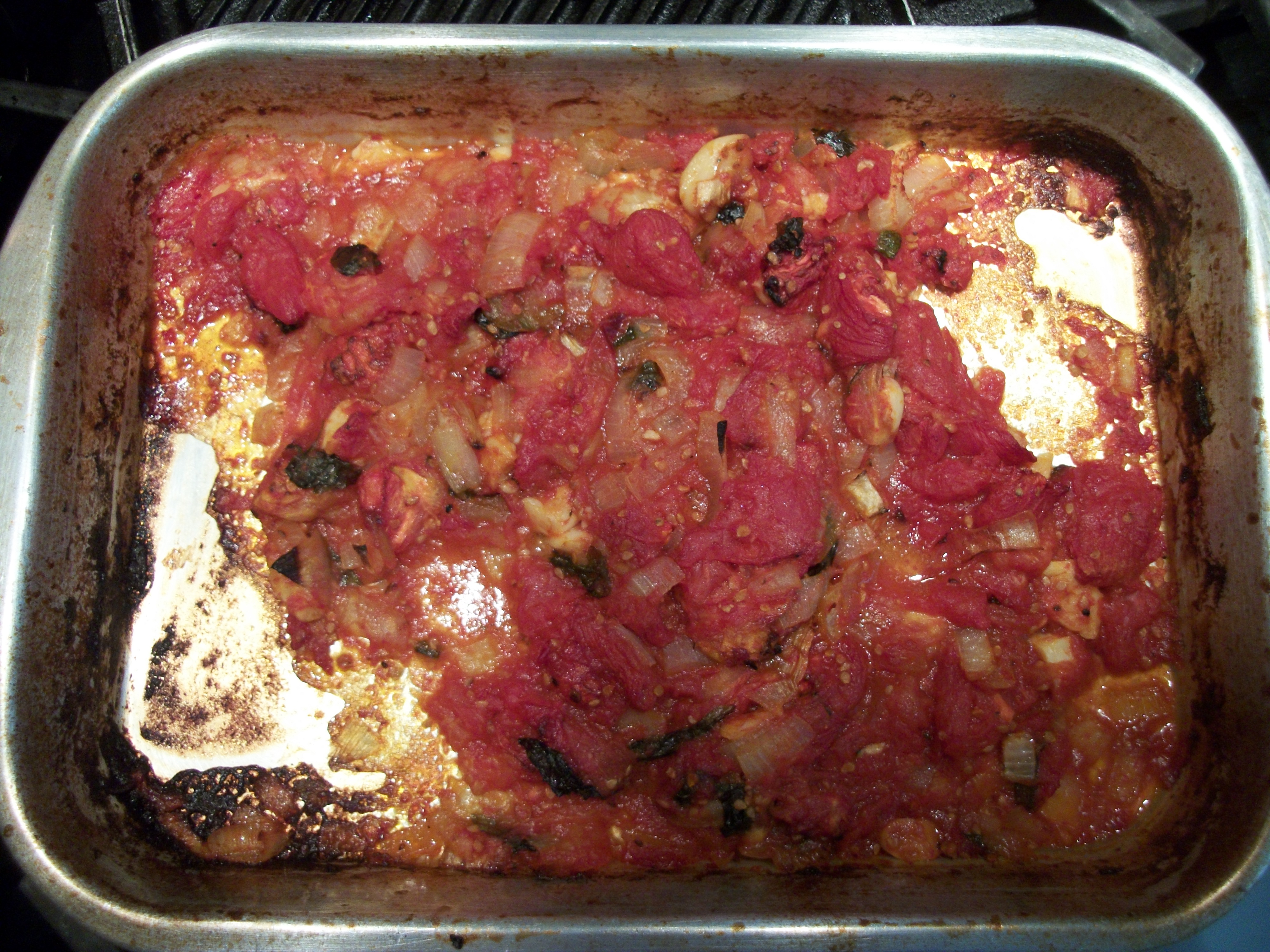
Here’s what they look like all finished up, which will take at least 2 hours total:

Load the tomatoes into pint mason jars–a canning ring funnel is a great help with hot food going into mason jars.  Be sure to leave at least an inch at the top for freezing expansion.  Cap the jars and put them upside down on a counter so they form a vacuum–you’ll see the cap is pulled down.  And, yes, you must freeze them.  You cannot can tomatoes cooked in oil–too dangerous.

Use these gorgeous tomatoes to enrich winter soups, to drizzle over meatloaf or stuffed peppers–saving a bit for some sauce on the side, or over pasta.

Enjoy!

Turkey Tracks: Love Lies Bleeding: Hope’s Edge Flowers

Turkey Tracks:  September 2, 2011

Love Lies Bleeding:  Hope’s Edge Flowers

Today is Friday, and on Friday’s I got out to Hope’s Edge, our CSA (Community Shared Agriculture) farm,  to pick up our food.  I take a Mason jar and a pair of scissors along with me and cut a bouquet of flowers from the three long rows of flowers Farmer Tom plants for us each year.  I can fill the jar with water so the flowers don’t wilt hopelessly on the way home.

How pretty is this view?  Not even Hurricane Irene diminished this view.

Each week the selection of flowers changes as different varieties come into their own.

Here’s a bouquet from a few weeks ago.  Outrageous, huh?

That amazing dark pink draping “flower” is called Love Lies Bleeding.

Here’s last week’s bouquet:

And, here’s a picture John took on a recent visit that I really like:

Hope’s Edge folks are hard-working folks who raise the most amazing food for us to eat!  We are so blessed!

I wish for you a CSA program like Hope’s Edge.

Books, Documentaries, Reviews: My Read Pile September 2011

Books, Documentaries, Reviews:  September 2011

My Read Pile–September 2011

Just finished Sandor Ellix Katz’s WILD FERMENTATION.  LOVED IT!  I can’t think why I have not gotten it sooner.  I’ll be writing the next Mainely Tipping Points on it.  I sat down and read it straight through, and in hours had a cheese ball dripping whey and had a quart jar of kale fermenting.

THE CASE AGAINST FLUORIDE has been written by 3 MAJOR scientists who know what they’re talking about.  The EPA recently lowered the amount of fluoride allowed in municipal water systems.  And, most people get way too much fluoride already in tooth paste–especially children who SWALLOW it.  (Try telling a two-year old not to swallow tasty toothpaste!)  So, more on fluoride later, but meanwhile know that it is very dangerous, that it’s a waste product of industry, and that you should filter it out of your water.  Better still, read about it and try to get it out of your local system.  The time is right!

TOOTH PASTE RECIPE

By the way, the best recipe for toothpaste is just to mix baking soda with good sea salt–equal proportions.  But it in a jar and dip your wet toothbrush into it.  If you want some flavor, get some essential oil of peppermint and use one drop on the wet toothbrush.  Or, some essential lime oil, sweet orange, or one of the oils that are ok to put into your mouth if you rinse them out.  Peppermint essential oil has some nice anti-fungal properties, among other good effects.

Turkey Tracks: New Chickens

Turkey Tracks:  September 2, 2011

New Chickens

Over the summer, I have replenished and expanded, by one, our chicken flock.

First, two of the older Copper Black Maran hens went to Rose’s farm.  She wanted more dark brown eggs, and we have the new CB chickens, so she will keep the best of those roosters and try to place the rest.  Remember, that we got a “straight run” of 15 CBM chicks from Tom Culpepper last May.  Half of all “straight runs” are, statistically, male.  To no one’s surprise, we have 7 CB Maran roosters.  Indeed, half of all just-born farm animals are male.  And, you cannot keep a lot of males.  Rose has a big flock, so she may be able to have two strong roosters.  But, maybe not.  They still have to go into the same chicken house at night.  Anyway, Rose now has breeding stock to reproduce the CBMs next spring, and I have a back-up CBM rooster.

Napoleon, or “Nappy,” has been rehomed to a lovely woman just starting a flock up north of Belfast.  Rose has agreed to part with one of the two older hens so Julia can have a pair and can raise babies.  Nappy was a terrific rooster with the hens–he took such good care of them–but when they were laying or when he was fenced, he was very protective of the coop and the hens.  He was just too aggressive for the grandchildren or for Jessica’s children–when she comes to take care of the house, chickens, and dogs when we go to Charleston or otherwise travel.  As beautiful as he was–and he was GORGEOUS, it wasn’t worth the risk.

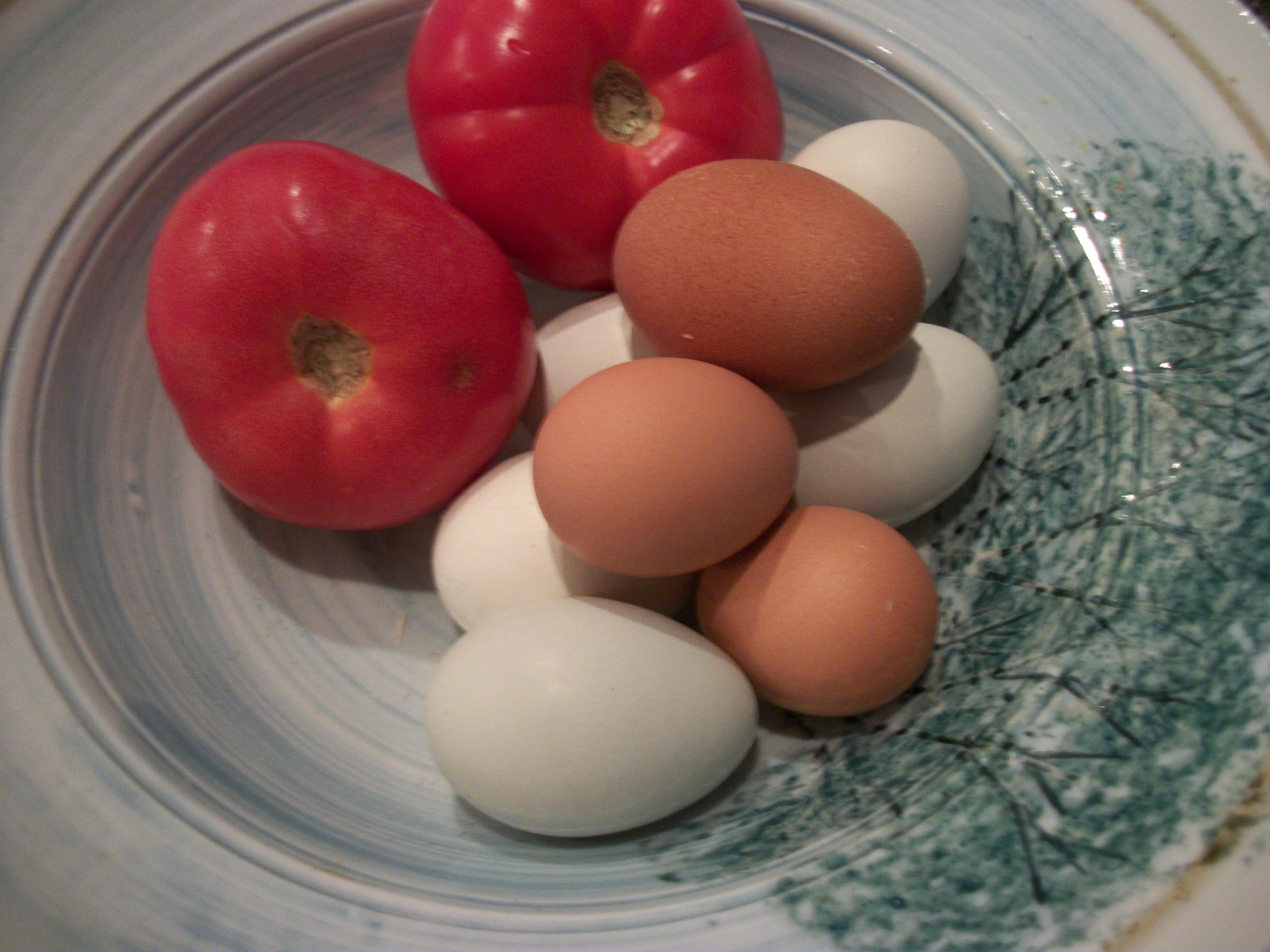
Valentine, otherwise listed here earlier as Chickie Honey Ginger, changed her name when she got a bit bigger.  She’s a sweetheart–a Freedom Ranger meat bird/layer.  She’s HUGE, and, at first, layed a tiny little rosy brown pullet egg when she was only barely four months old.  Here’s a picture.  The larger, darker brown egg is Chickie Annie’s, a CBM who is a year old now.  The cool thing about Valentine’s eggs are that, even as tiny pullet eggs, they are almost always double yolked!

Here’s a picture of Valentine with our 3 “older” hens now–the two wheaten Americaunas, Sally and Nancy, and the CBM chick I raised last summer, Annabelle, or Chickie Annie.

Valentine is only about 10 days older than the CBMaran chicks and the “blue egg” chicks Rose raised this spring.  But, she’s TWICE their size.  She kind of moves between the older hens and the newer three, 2 CBMs and 1 wheaten Americauna from Rose’s rooster William–part of Rose’s “blue egg” chick bunch this spring.  The new girls are scared to death of the old girls and scared of us, though they are gradually settling in now and will come close to us.  I took this picture of them hanging out on the edge of the “chicken briar patch,” the raspberries, about a week ago.

That’s Pearl and Rosie, with our new roo, Pretty Pierre.  Ninja is in the briar patch.  These names come from the grandchildren this summer.

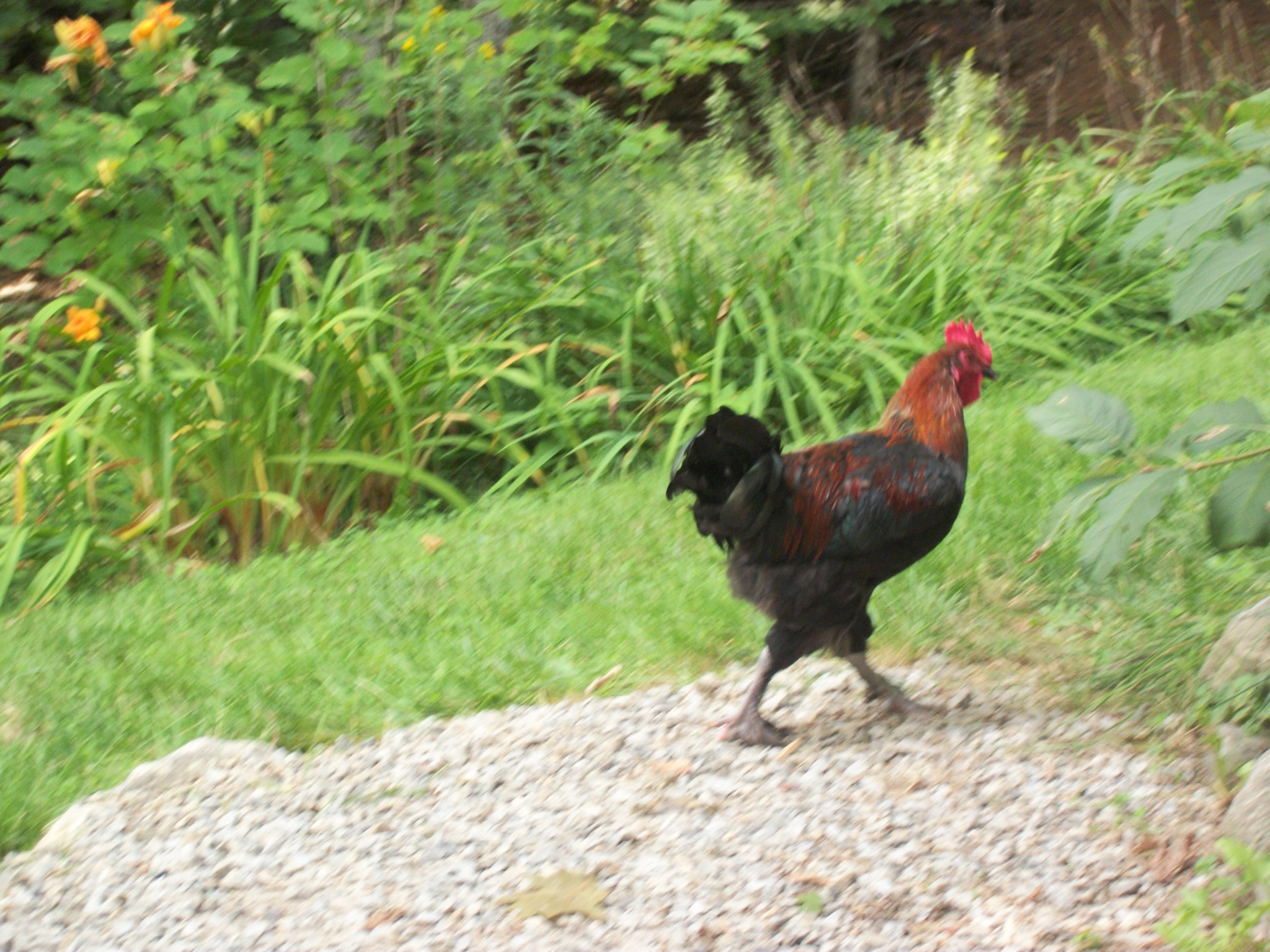
Here’s a picture of Pierre, the best I can do at the moment since he’s new to the group and is only just learning his roo duties.  AND, how to crow.

When Pierre first came, Valentine was very taken with him.  She tried to follow him, and that totally freaked Pierre out.  Remember she’s a very impressive fully grown hen, and he’s just a baby really.  When he got upset, she got even more upset, fluffed up all her feathers, which made her look even bigger, and charged him.  Mercy!  That was his first hour outside the coop cage.  John and I had to get him down out of the tall bushes to put him to bed in the coop that night.

Something happened the next day, as she had a torn comb and was all bloody.  John and I took her inside, washed it off, and put some calendula cream on it.  Here she is with her poor bloody head:

By the second night, she was sleeping next to Pierre in the coop.

So, we go into the fall and winter with 8 chickens–7 hens and a rooster.  The new girls will start laying this month.  We will be rolling in soy-free eggs from healthy chickens.  And, Valentine follows me everywhere when I’m in the yard, earnestly talking to me the whole time.

Chicken love!

Turkey Tracks: Brown Paper Bag Book Project

Turkey Tracks:  August 29, 2011

Brown Paper Bag Book Project

One of our local artists, Robinsunne, came to speak to the Coastal Quilters a few years back–http://robinsunne.com.  She brought a book she had made using brown paper lunch bags.  I loved it on sight and knew that one day I would make one.

I’ve tried to show the grandchildren how to make one for two years running now, but they don ‘t quite get it yet.  There was nothing left to do but make one myself, which I did as a birthday card for my son Michael.  I found the project to be as much fun as I had imagined.  And, I will make more.  They do take a bit of time.

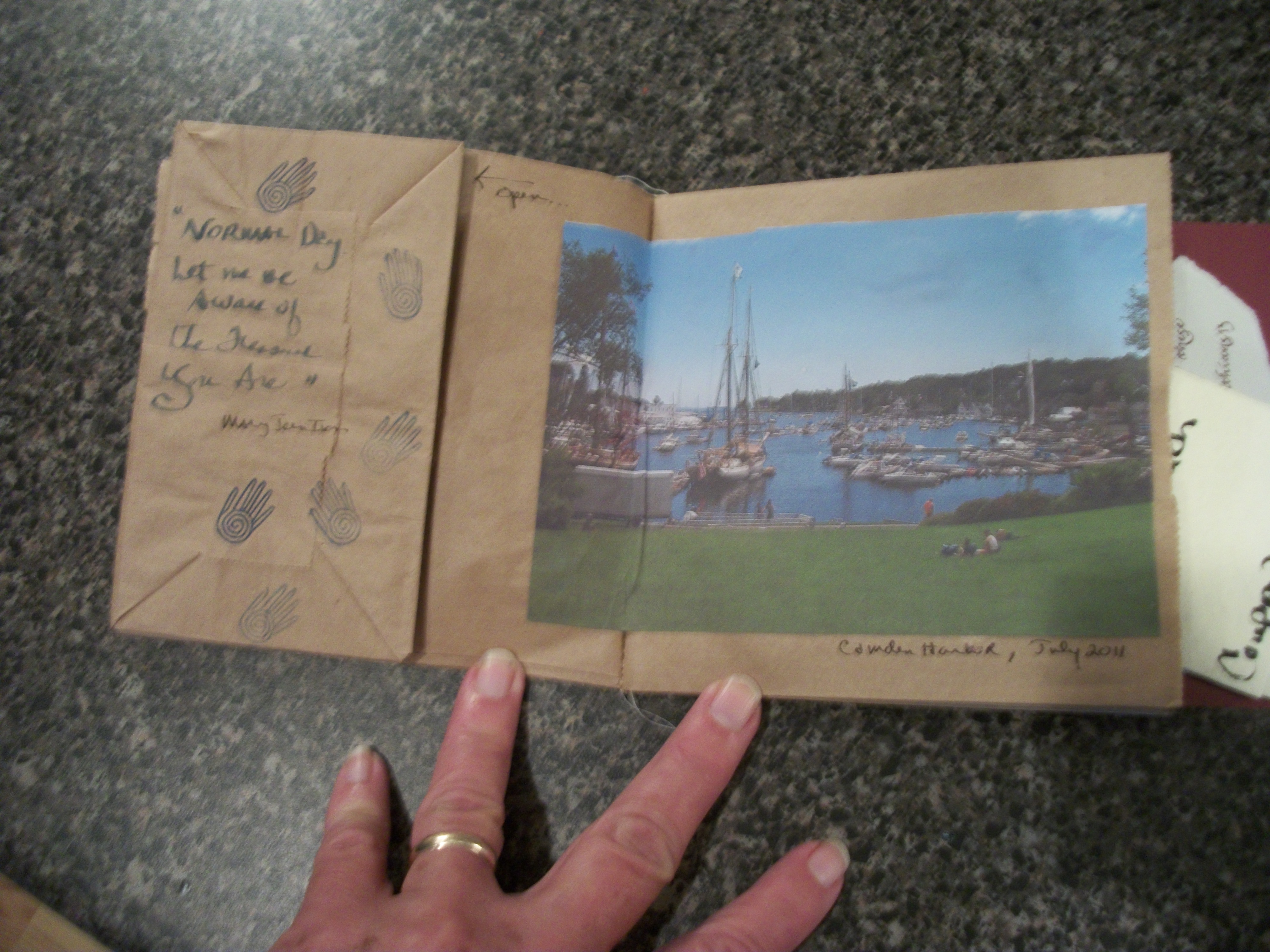
Here’s the outside of the brown paper lunch bag book–the buttons come from a quilt shop in Charleston, SC–People, Places, and Quilts.

First, you take 3 or 4 of the brown paper lunch bags and ALTERNATE having the top and the bottom on the left-hand side.  Put them in a pile, fold them in half, and sew down the middle of the crease.  It’s a good idea to have the OUTSIDE  bag–when you fold inside– with the opening to the left as that becomes your front cover.

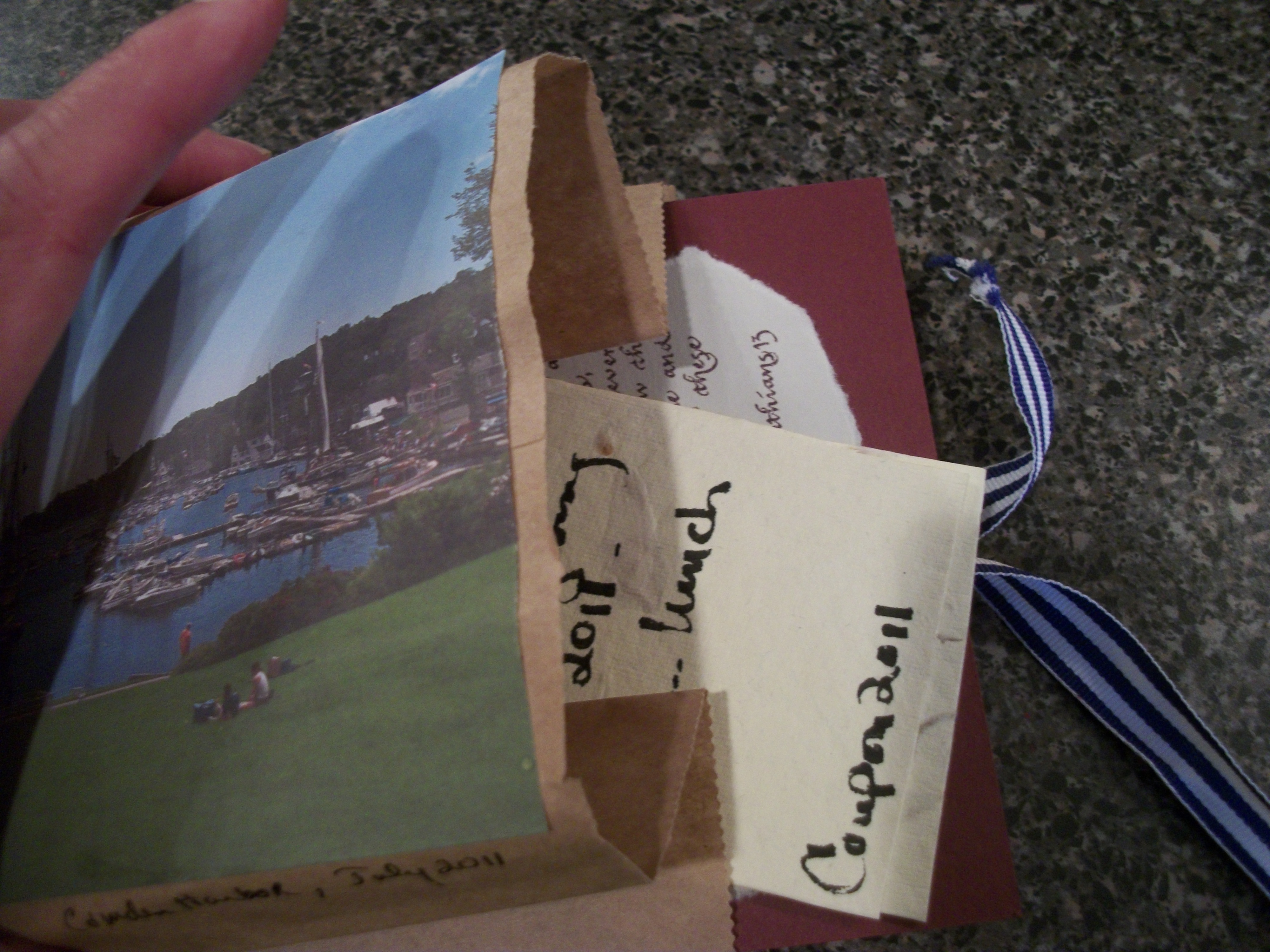
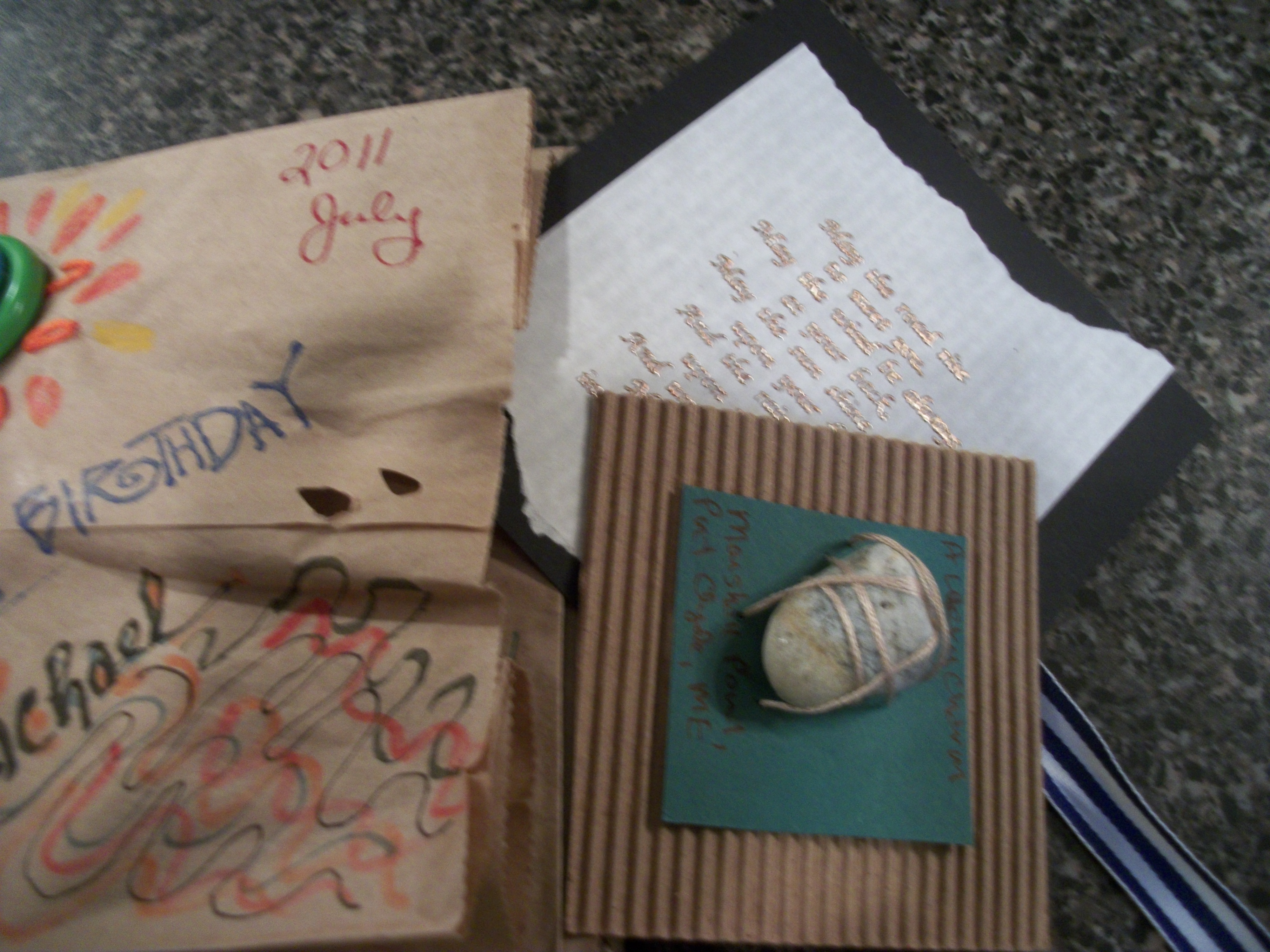
Here’s how to use the open top of the bag:  stuff it with interesting objects, coupons, sayings written down, recipes etc.

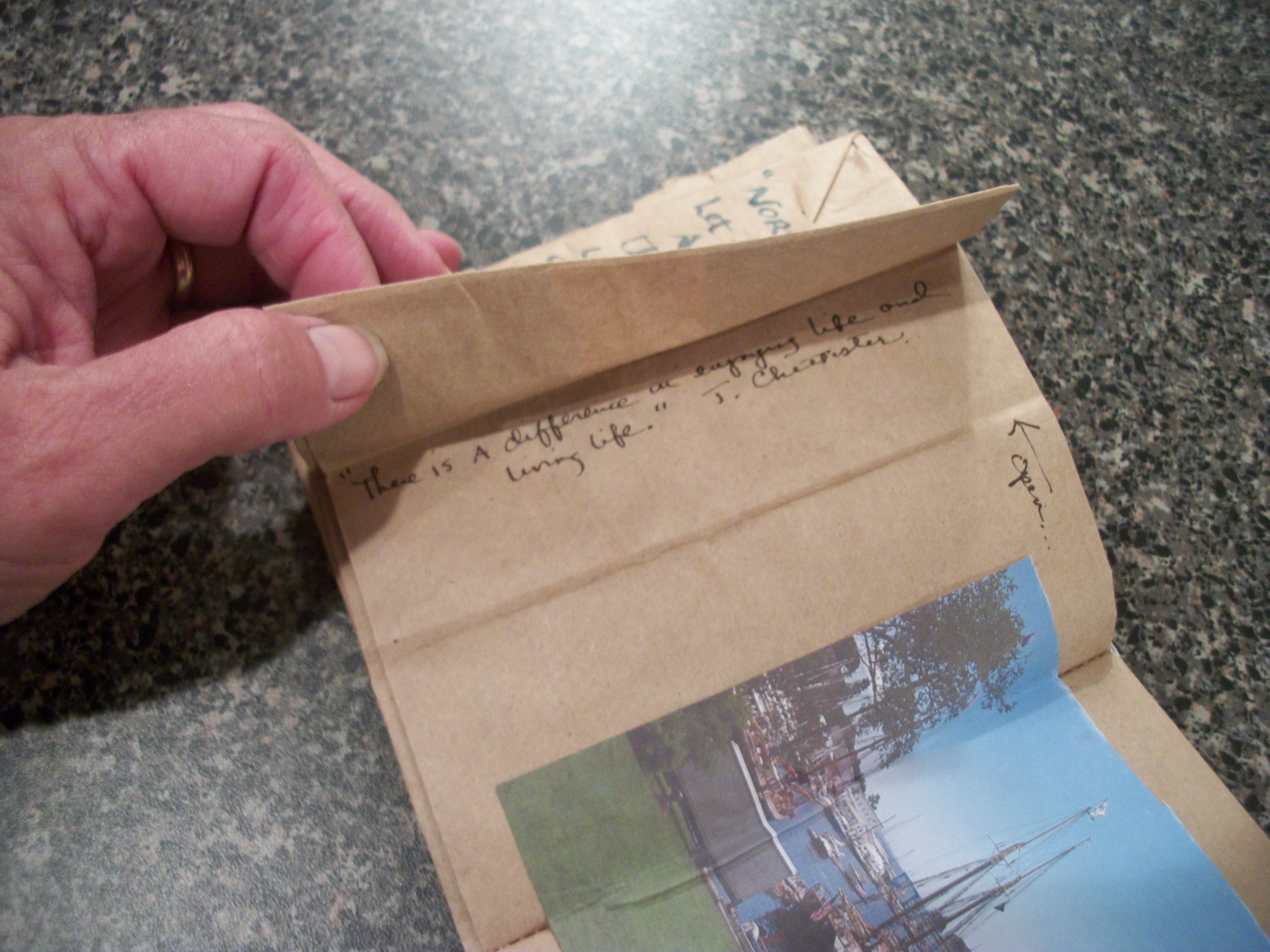
Here’s what the bottom part of the bag looks like within the book–a flap is created on the page that can be folded back to reveal a surprise of some sort:

See..

Found objects can be “artfully” presented and tucked into one of the book’s pockets:

Sewing onto the paper–as with the buttons on the front–proved to be more difficult than I’d thought–because of the inner folds of the unfolded bag top.

Stamping is a nice way to decorate the bag.

So, try one yourself!

Interesting Information: The Food Renegade’s Take on Orange Juice

Interesting Information:  August 28, 2011

The Food Renegade’s Take on Orange Juice

I’ve just added THE FOOD RENEGADE’s web site to the links on my blog.

The food renegade , Kristen Michaelis, is a woman after my own heart.   She loves nutrient-dense real foods, is a fan of the Weston A. Price Foundation’s work, and is inspired by Michael Pollan and  the poet/author Wendall Barry.

Kristen cooks SOLE food–Sustainable, Organic, Local, and Ethical food.

We’ve also read many of the same books.

She’s also a nutrition coach and has lots of tutorial videos on her site, like how to make kombucha, butter, buttermilk, and so forth.

Here’s a recent piece she did on what’s in orange juice–you know, the fresh kind that’s supposed to be “just squeezed.”

http://www.foodrenegade.com/?s=orange+juice

Even I was surprised about the chemical flavor packs the industry adds back into what is–and I did already know this info–highly processed juice.  Apparently these flavor packs are geared to specific tastes different groups of people have.  People in Peru, for instance, have a different flavor pack put into their orange juice.

I knew commercial orange juice was bad food–and wrote about it in a recent Tipping Points 30, an essay called “The Very Bad Breakfast”–in the essay section of this blog.  If I thought before that orange was a dangerous product, I now think it’s dangerous and a fake food.

Read about this orange juice and weep for what has been done to our food.

But don’t despair, just stop shopping in your local grocery store!  And if you’re going to drink orange juice, which is, by the way, full of fructose and, after being squeezed, has no fiber, squeeze your own.