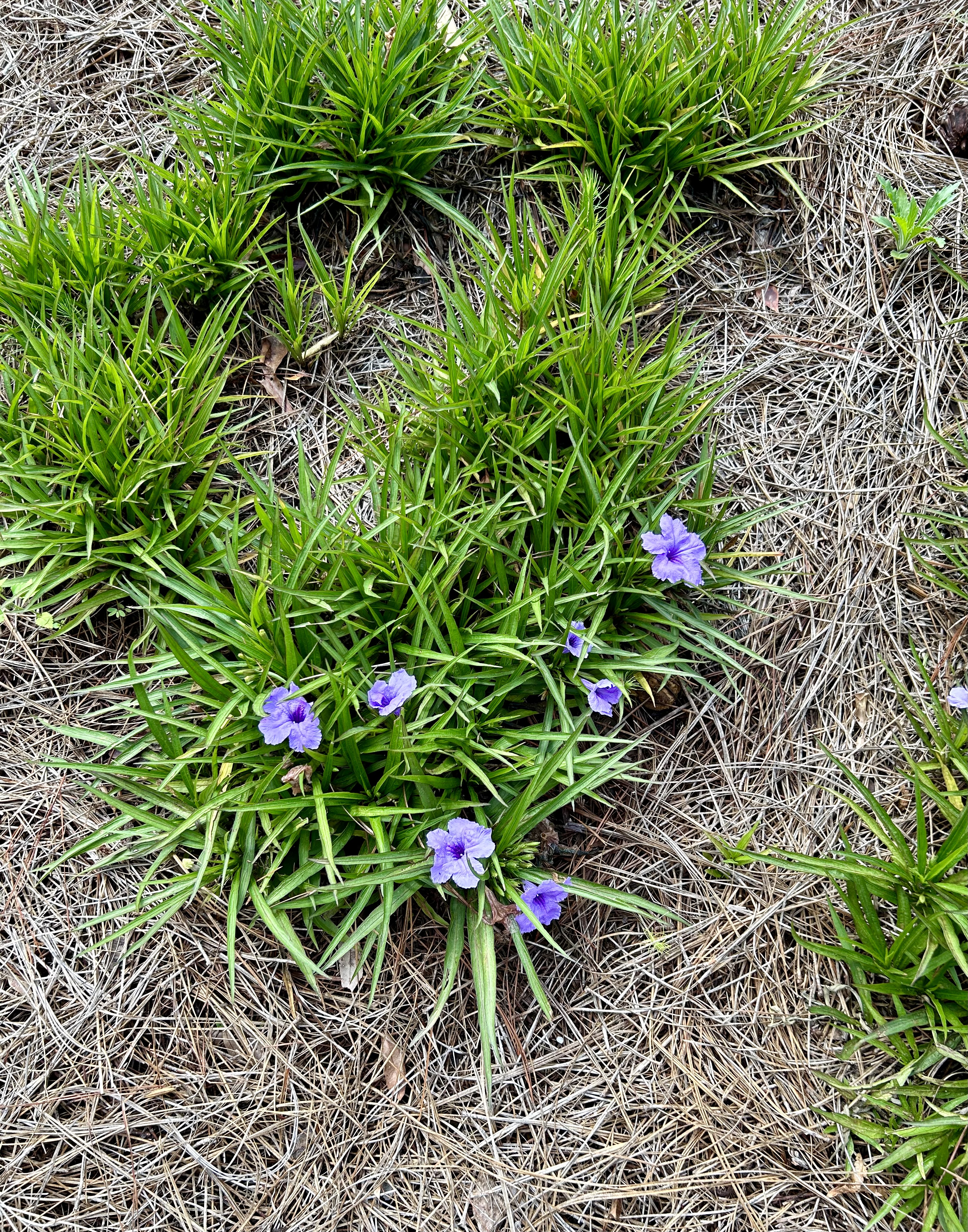
I was outside most of yesterday—the DWARF Mexican Petunia plants came, and I had to dig TWENTY holes, amend them, plant them, and water them. I know you know that with the clay here, digging and amending involved the shovel, the Maddox, two bags of sand, 1 1/2 bags of compost/manure, bone meal, my heavy boots (to support my formerly sprained ankle which does get sore with the hard digging), the hose, yada, yada…. Each plant is healthy, but tiny, but I basically had to dig a trench down the front of the front bed to get the holes deep enough to amend them properly. Then I had to put back the pine straw and fussy it back around the plants. They look perky this morning.
I think the front azaleas are struggling with the heat. They are, again, a pale color. I don’t want to fertilize them in this heat, but will spend more time watering them I think. The ones on the side of the house are a rich green color.
While the hose was out I spot watered the now dry patches in the grass and all the shrubs. And went on to do the far side of the house and then went around back to water as well. I kind of like the Zen of these watering moments—and walking neighbors stop to visit.
I started outside in the fairly early morning—having discovered while having my morning coffee that the plants had been on my doorstep since yesterday afternoon late. I took them to the hose and soaked them. They were beautifully packed for shipping. It was HOT, so after an hour of digging, I was totally soaked with sweat and feeling the heat. Likely temps had reached 90+. The sun is on that front bed until mid-afternoon—so I went inside and showered to cool off. I went back when the sun was on the back of the house so the front was shady. There was still hard work to do, but there was shade and a strong breeze. Coastal rain clouds raced by, but none stopped to give us some much-needed rain.
A friend sent me a post this morning that described a huge solar spot/flare on the sun right now. Very huge–bigger than Earth. Apparently sun flares can impact our weather in negative and unpredictable ways.
I have not sewed upstairs for two days now, what with one thing and another. BUT, the third border is now on “the quilt from hell,” and the darker border is making that quilt sing. One more side to go.
I finally figured out what this plant is. I found a place to park the car near the nearby traffic rotary where it lives, walked over, and got some good pics. I was surprised to see that the plant also comes in white and a pale pink.
It’s a Dwarf Ruellia, or Mexican Petunia, which is not a petunia. The parent plant grows 3 feet tall and is very invasive. But the dwarf will spread, but is more easily controlled. And it is so darn cute. It is a perennial.
This dwarf plant will do sun or shade, and it can manage some cold winters. They will die back in cold weather, like a lot of perennials, and emerge in the spring.
I ordered 20 plants in the violet color, and they are now on the way here. I’m going to put them in the front bed, where they will make a nice border line and will be backed by the taller azaleas (white) that bloom in the early spring. I have the sand, compost, and fertilizer all ready for them.
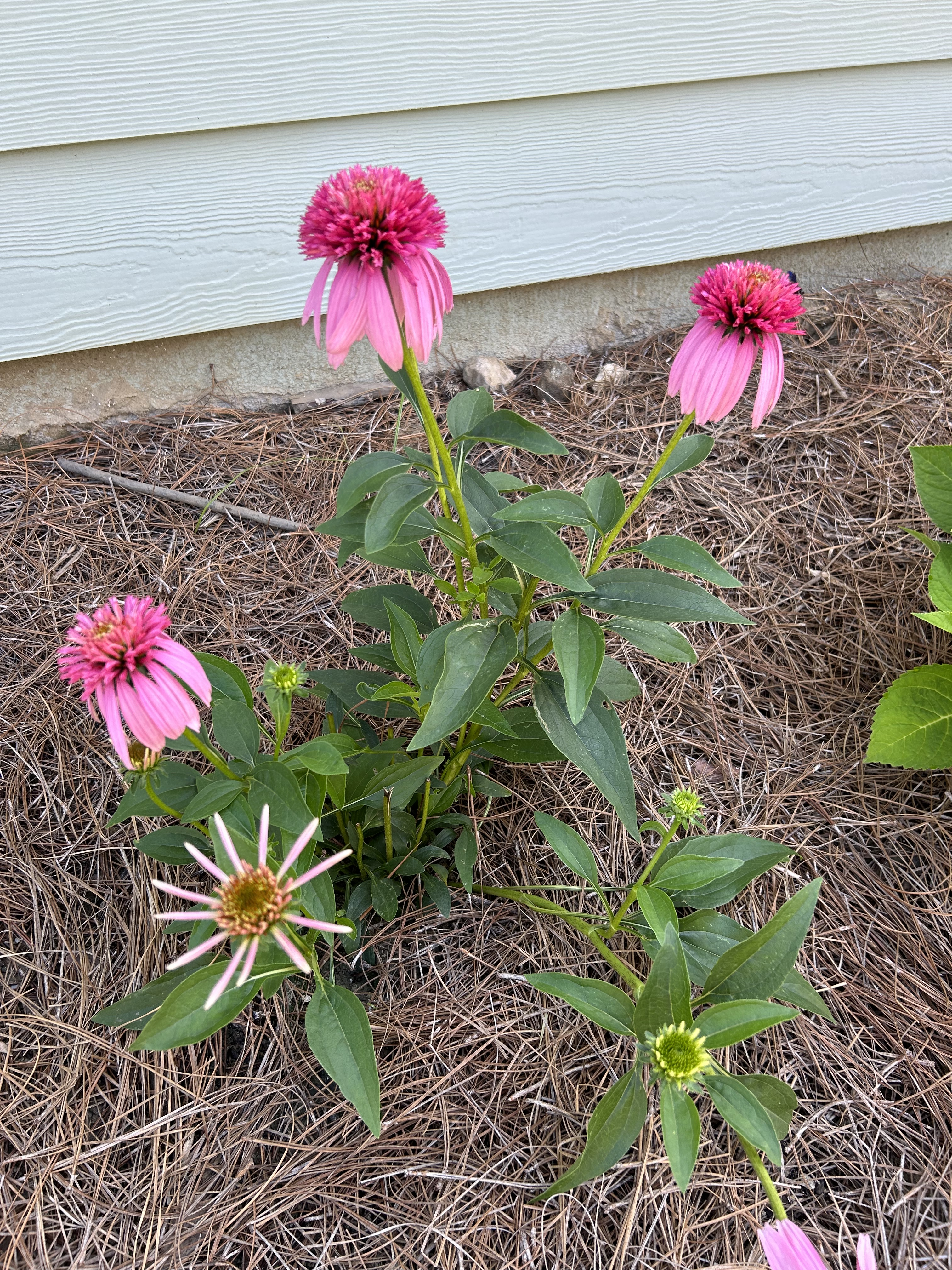
Look at this fancy Cone Flower! I’ve never seen anything like it and couldn’t resist bringing it home when I started planting this bed. It’s thriving, and I hope it will come back next year. Sometimes fancy cone flowers are more fragile in terms of winter.
The Limelight hydrangea is covered with blooms. This plant will get much bigger and will fill the space around it. The blooms will turn rust red in the fall. And the viburnum to the left has flower heads and has doubled in size with new growth.
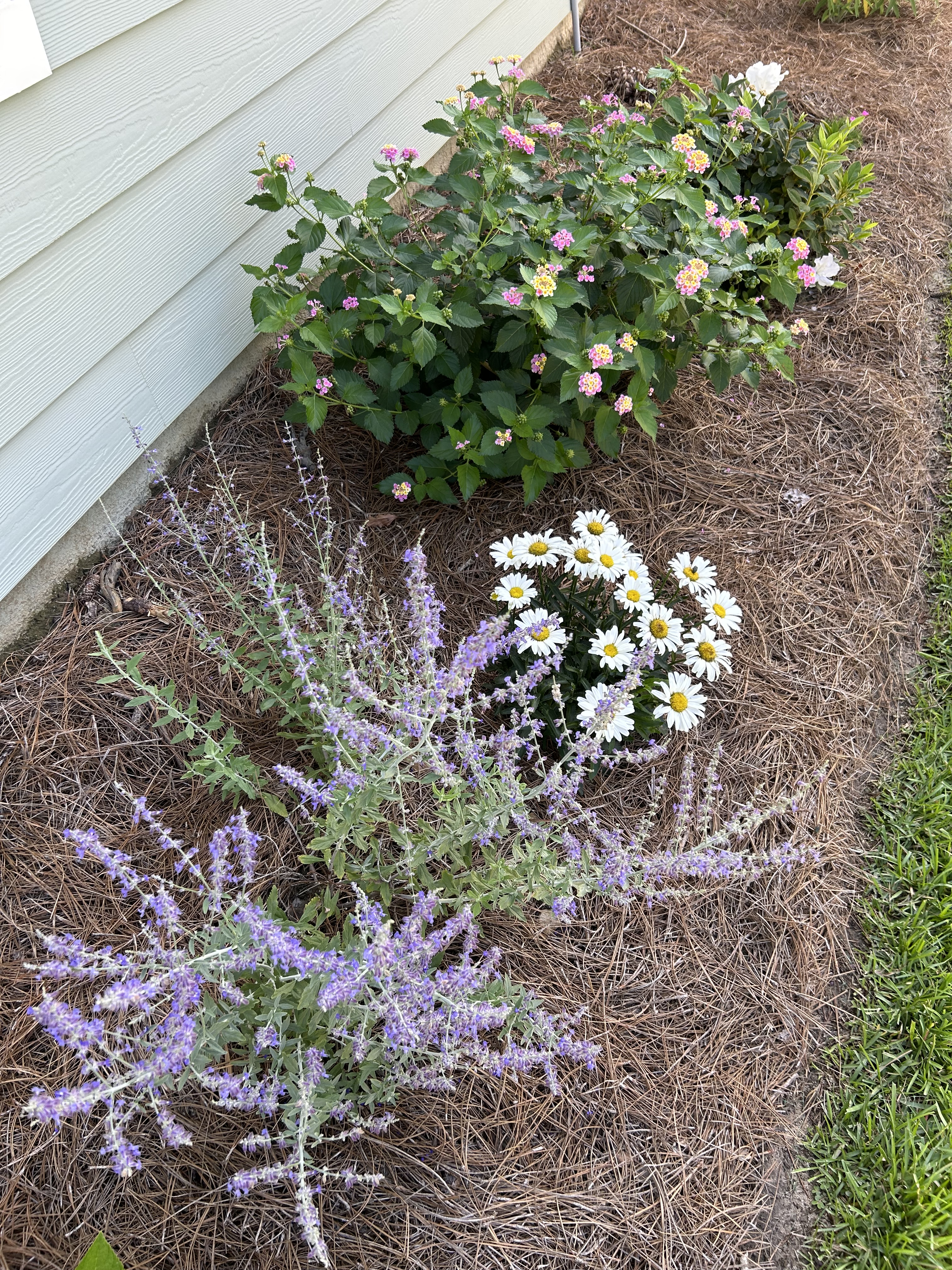
Lantana thrives here–and I found one I really like. There are perennial and annual forms of Lantana. This one is perennial. I cut it back regularly as it can get very rangy–and I do like to bring the cut pieces inside. The flowers last quite a while in a vase.
The Russian sage is happy. Time will tell about the daisy and the clay soil. But it has had two bloom flushes this year. I just deadheaded it again yesterday.
The vitex is also happy. This one can get big too, so I’ll trim it carefully to encourage sideways growth. I don’t want it to be a tree, but will let it be a tall shrub.
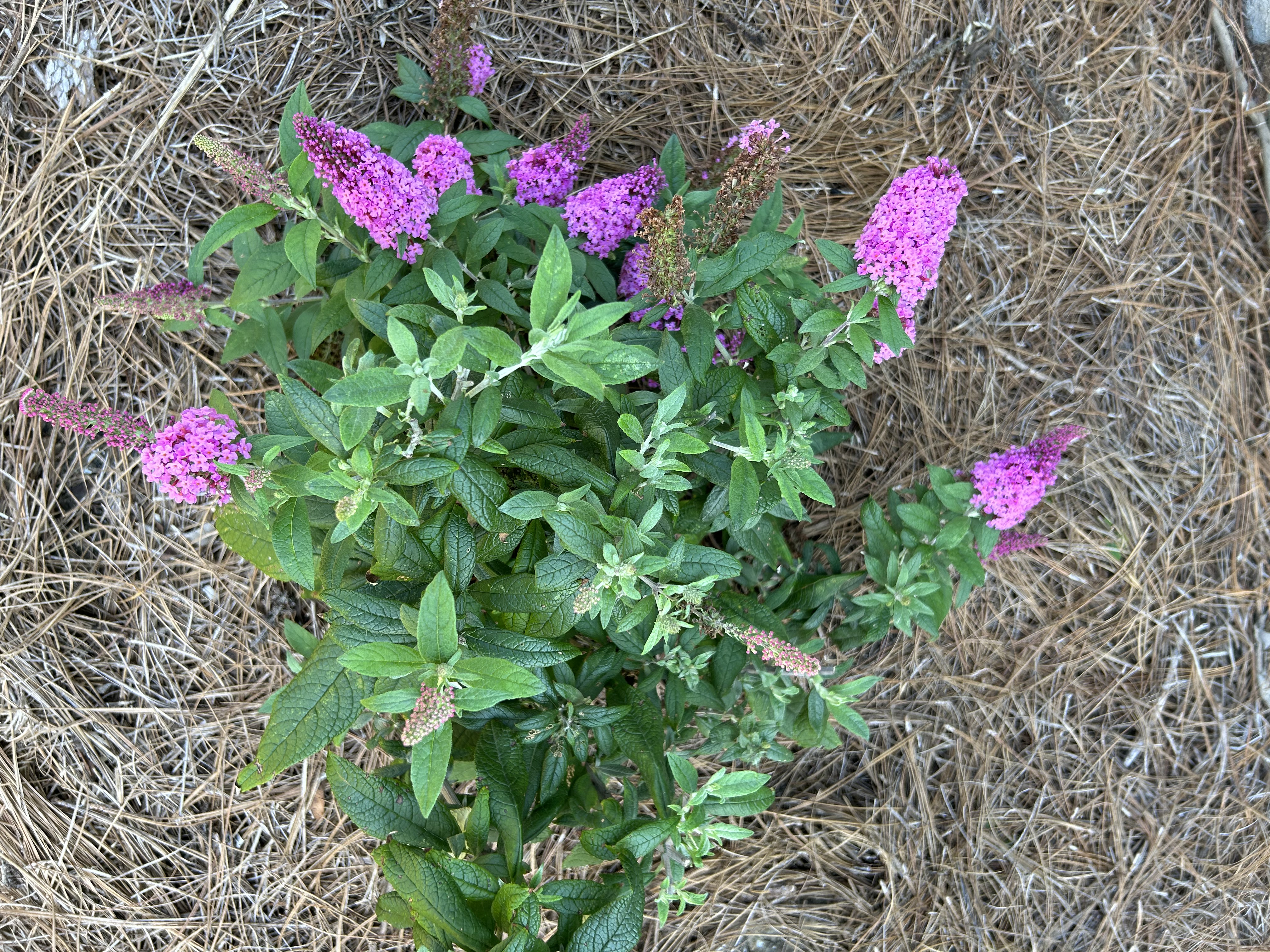
The dwarf Butterfly Bush is happy. I didn’t realize it was a dwarf when I bought it. If it doesn’t survive the winter, I’ll replace it with a standard size. The blooms are so pretty, but these blooms don’t last long in the house anyway. So I suppose it does not matter about the dwarf size that has no long stems involved.
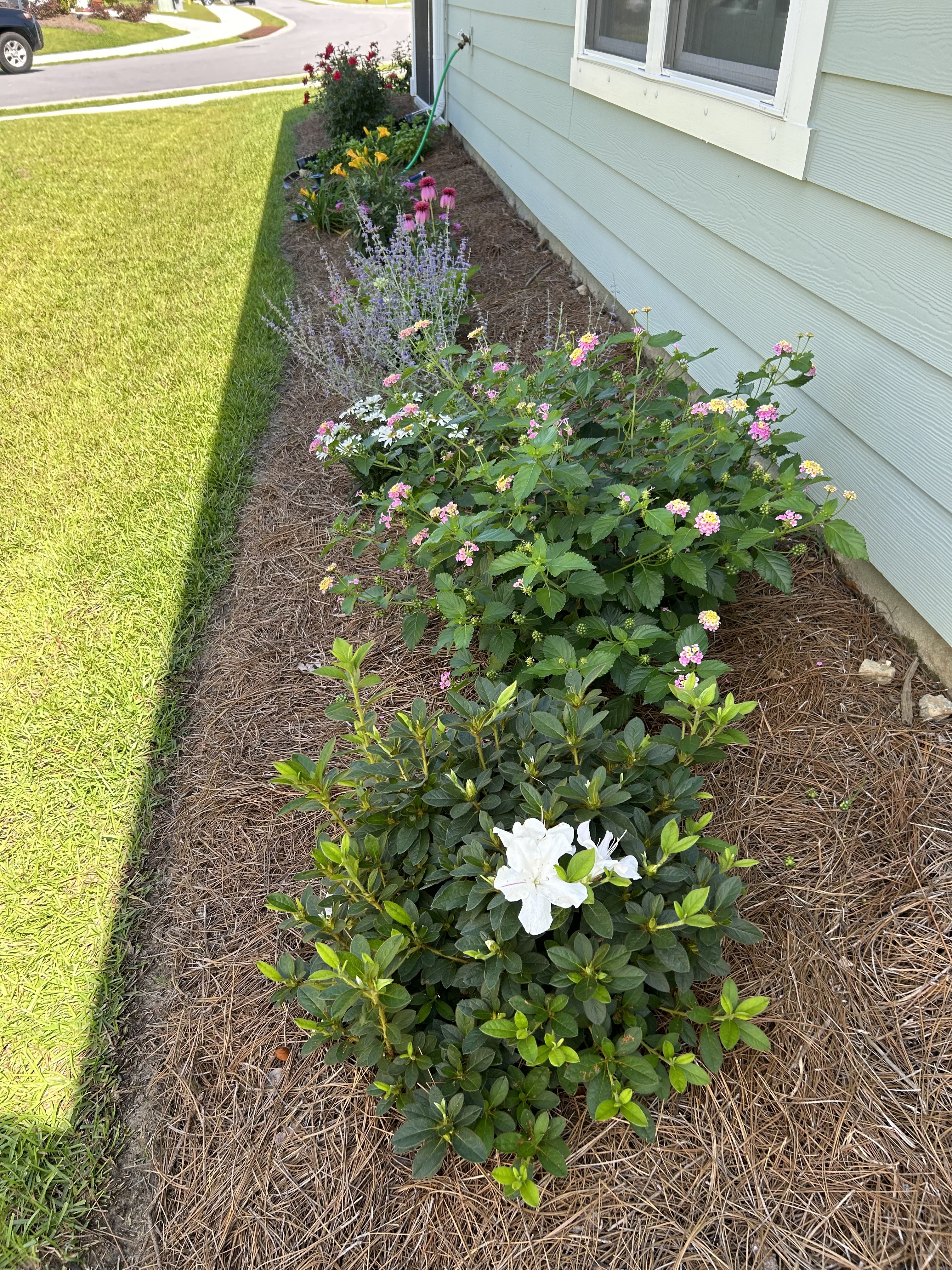
I have three of the azalea/rhododendron hybrids that will bloom all summer and into the fall: this white one and two red/orange ones (different colors) scattered among other plants in this long bed. And they are all starting to bloom now. My back door neighbor has a long row of these plants down the size of her house, and they are starting to bloom too. Hers are a kind of deep rosy pink. What a find!
Here’s a long view of part of this bed–which is filled with blooming plants to encourage and support pollinators in this new neighborhood. And, yes, the roses continue to thrive and bring joy. I cut back the spikes they were sending up, and now they are branching out to the sides and are about to bloom in earnest again.
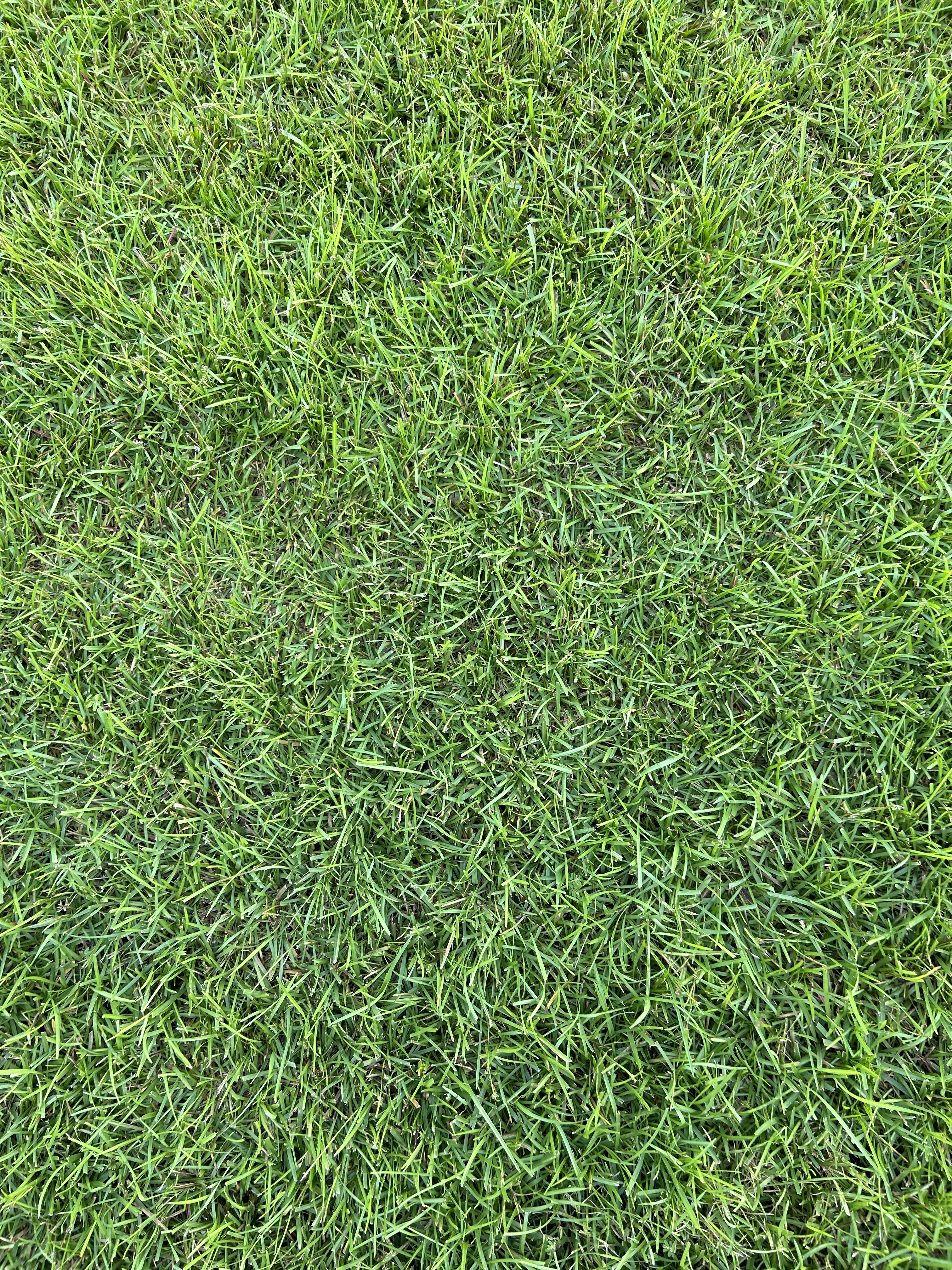
The grass is also thriving now and all the care and amendments are working. Whew! It is now covering remaining bare spots and is sending up seed stems every week. This grass is a real water hog though, so I keep an eye on the dryness. We’ve gotten good rain recently so I have not had to water. It is sitting on clay soil which turns to cement without water.
Walking on it is like walking on a deep, thick rug. And the apple green color is so pretty.
They come in white and various shades of pink, from dark to light.
I stopped to take this picture over on Isle of Palms.
And this pic is from Isle of Palms, too. But crepe myrtles are everywhere here and range in size from big trees to shrubs–size depends on how one prunes them. I have seen them cut off in a straight line about 10-15 feet up in the fall, and in the spring they form a new, compact top.
Crepe Myrtles bloom for most of the summer and into the fall here in South Carolina.
The tree planted out front by the builder is a Willow Oak. It’s doing well, but eventually it will get really tall and big. While it is very hardy here, I think it is likely too big for the scale of my neighborhood and house.
So, I’m exploring replacing it with a Crepe Myrtle, where the scale of the tree would be much better.
Look down by the stop sign beyond the tree. That cute little fire plug was recently installed in my neighbor’s yard. My heart fluttered when I saw it as in Maine, my house was rural and there was no city water. I had a well. The only water I might be able to count on with a house fire would have come from the pumper fire truck–assuming it could even get up my challenging, curving driveway.
On the way home from Isle of Palms last Friday, I could see a full blown house fire on Goat Island, a small island sitting between IOP and the mainland. Access to Goat Island is only by boat, and of course there is no fire engine. Flames rose into the sky, along with plumes of black smoke. SMALL emergency boats with flashing red lights were racing up the channel toward the house. It burned to the ground, of course.
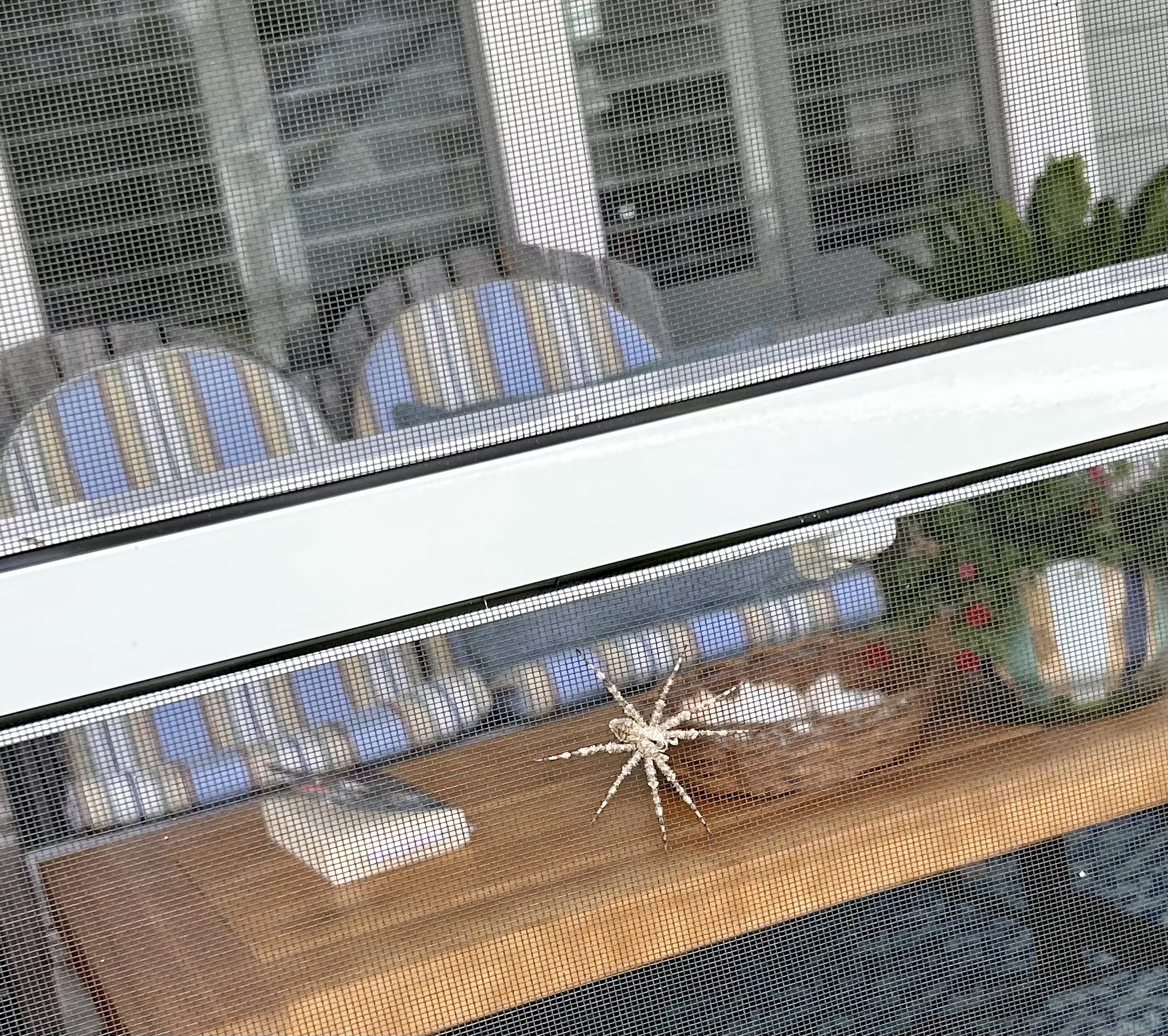
And THIS very interesting critter has been living on the outside screen of my back porch for the past three to four days. Her/his legs make this spider about 2 inches big.
I posted this picture to our local neighborhood Facebook group, asking if anyone could identify what kind of spider this one is. I thought maybe a Wolf spider as it is one of four big spiders in South Carolina. But the coloring was…wrong.
In due time, a neighbor identified this spider, and it is NOT a Wolf spider. S/he is a White-Banded fishing spider (Dolomites albineus). Measurements for spiders are kind of confusing–in that some seem to use just the body length, while others use the whole length, including the legs. The inclusion of the legs can make a bigger profile, of course.
By this morning, another neighbor said she has had two around her house as well.
We have a lot of cache water basins here (low-country drainage methods)–and some have sprinkler/fountains in the middle (beauty, yes, but also mosquito control). But there is standing water in drainage ditches, too, and water plants grow there. Likely this area is a good habitat for this spider.
This spider literally can “walk on water” to hunt prey. They have hairs that can repel water, and they can capture an air bubble on their abdomen that allows them to swim and dive (Wikipedia).
This spider can build webs, but the webs are not used for catching prey since they hunt their prey. The webs are used by the female as a sac to protect her eggs, which she carries nestled beneath her head, held secure in her fangs. Thus, if female, she is part of the “nursery egg” grouping of spiders.
But, why is this critter NOT in or near the water right now? Is s/he a she, and is she working currently on laying eggs? In a typical year, this spider can create and carry multiple egg sacs in warm weather. She can and will try to eat her mate. Freezing temperatures kill them, but the eggs can overwinter and hatch in the spring.
Ah, these spiders can and do venture far from water. They can and do capture and eat other insects, including “flies, moths, beetles, mayflies, and other insects.” Thus, s/he is using my porch screen as a perch from which she can strike. And she is a help for control of insects in my garden, as she is when she kills insects on a tree that are harming it.
Here is a nice site that contains much more information about this spider.
By the way, the Wolf spider is the South Carolina state spider. Who knew? The Wolf spider is also a predator who does not rely on a web to capture its prey. And if carries a web sac on its back. Local information on the Wolf spider:
I planted five little blue-eyed “grass” plants yesterday. Turns out this perennial is NOT a grass, but a form of iris.
I saw what I think is this plant in the rotary planting area of a Rifle Range road rotary near me. It’s low, and the little blue-violet blooms are so sweet. I’m pretty sure it is a variant of blue-eyed grass, but I am not dead sure. It turns out there ARE various forms of it. And if “they” are planting it in a rotary center, it’s hardy. Plus, it will spread. The “leaves” look like mondo grass–spiky and short. Turns out mondo grass is a lily relative, not a true grass either.
BUT, I couldn’t find any blue-eyed grass plants locally, so I ordered 5 little plants from Amazon to try them out–and planted them in the round curve of the bed border on the left side of the front of the house–where the bed turns to go along the long side of the house where I’ve planted so many plants now. (Those plants are blooming and filling in that bed beautifully now, and I may bore you with pics soon.)
Who knew Amazon sold plants? Son Michael says he’s been ordering plants from Amazon for some time. And I can tell you they came BEAUTIFULLY packed and were really healthy.
Here’s a description of blue-eyed “grass”–and there are pictures of this perennial at this site:
“Despite its common name, blue-eyed grass is not a grass. The genus Sisyrinchium is a large group of annuals and perennials in the iris family (Iridaceae). But many species are low growing with narrow leaves that appear grass-like and many grow in grasslands. All are native to North or South America. Most are not well known and only a few are used as ornamentals. The taxonomy of the group is quite confused, so the number of species varies from 50 to 150, depending on which classification system is used. Some species have many natural variants that were likely mis-named as species – so more research is needed to figure out the true relationships.” (From Wisconsin Horticulture web site: https://hort.extension.wisc.edu/articles/blue-eyed-grass-sisyrinchium/ )
And here are some images of various forms of this plant:
The plant I ordered is the “Lucerne” variant. The one in the rotary has flowers that are low to the ground and don’t seem to have the higher stem that Lucerne has. It is probably a variant.
Maybe someday I’ll get a better picture of the plants in the rotary–when there is no traffic.
I couldn’t resist the adorable blocks being made in the Modern Quilt Studio’s “Modern Mystery Quiltalong Summer Camp” taking place now. The participants are full of helpful assists and have lots of good humor.
I’m crazy. I know. There are two quilts on my design wall already, the quilt from hell, and Traverse waiting to be hand quilted. But at the very least I’ll print out all the directions.
However… I already have my cutting table covered with solids, so why not? I kept telling myself I absolutely SHOULD NOT start another project, but I really liked what I was seeing online (I found this group on a Facebook page), and I walked away and walked back for two days before I realized I was already putting together a palette and watching videos.
You can go online and see what has tempted me so strongly. I really like this organization and did review its lively patterns and mystery quilt results that people have posted on FB. There is an Instagram account as well.
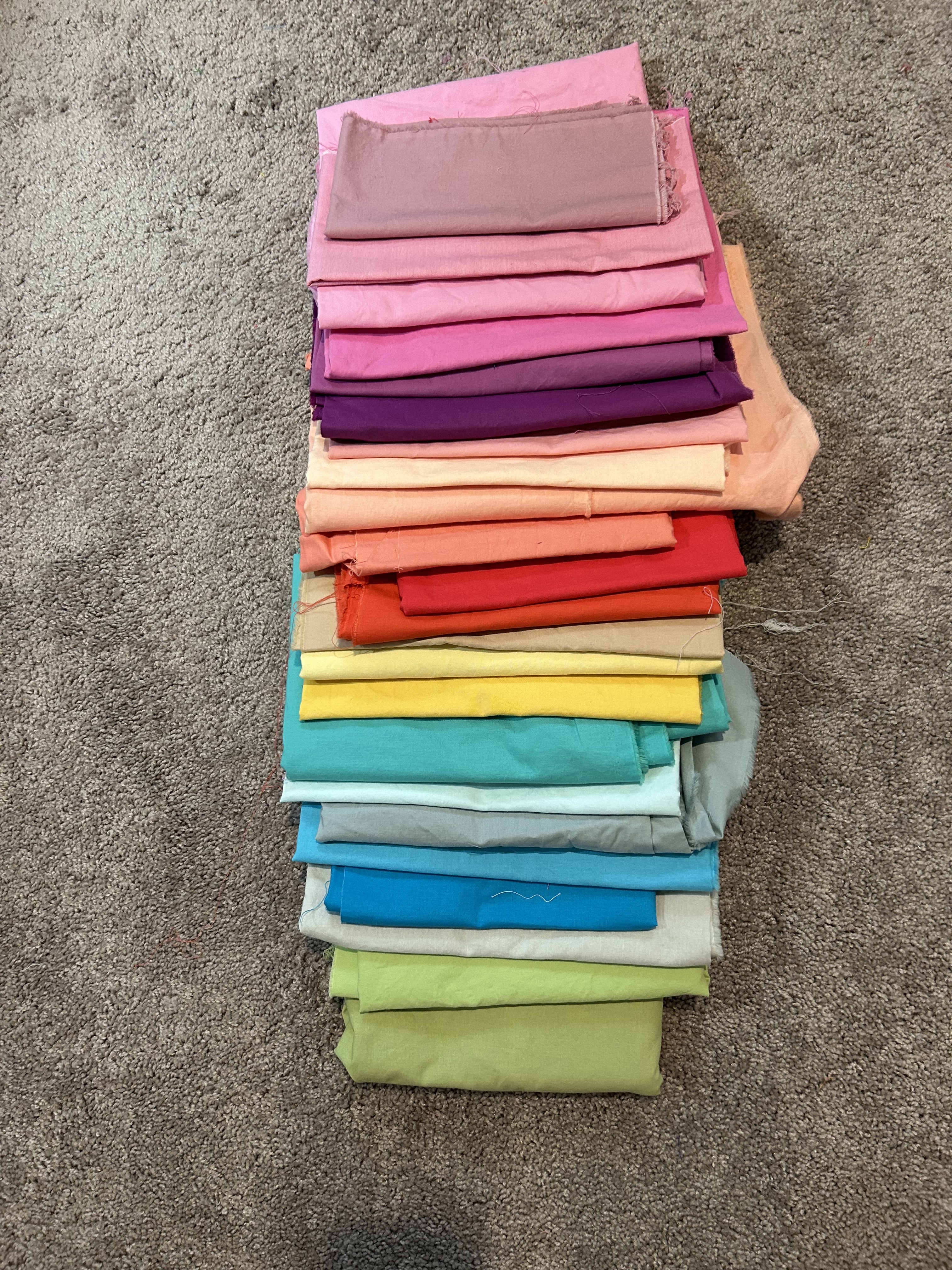
I have been working in solids for these past 4 or 5 years, as longtime readers know, so I have a solid stash of colors. Here’s the palette I’ve made for this project:
I’m going to remove the dark magenta from this palette as I’m going to use a dark olive green for what is called the “field” fabric that will surround the modern blocks (Kona Juniper 409). The magenta will not show up on a dark green. Per the helpful videos, I’ve included some duller, lighter fabrics that will make the brights shine in the quilt.
The cutting and sewing are easy–and the block load coming weekly now is doable, for sure. I’m already learning some new piecing methods–and it is always fun to get directions for various blocks to make. Out of the initial 8 blocks, one chooses 4 to make. These first blocks are what I was seeing as people made theirs and shared.
Crazy, yes. But happy too. And energized with my creative work.
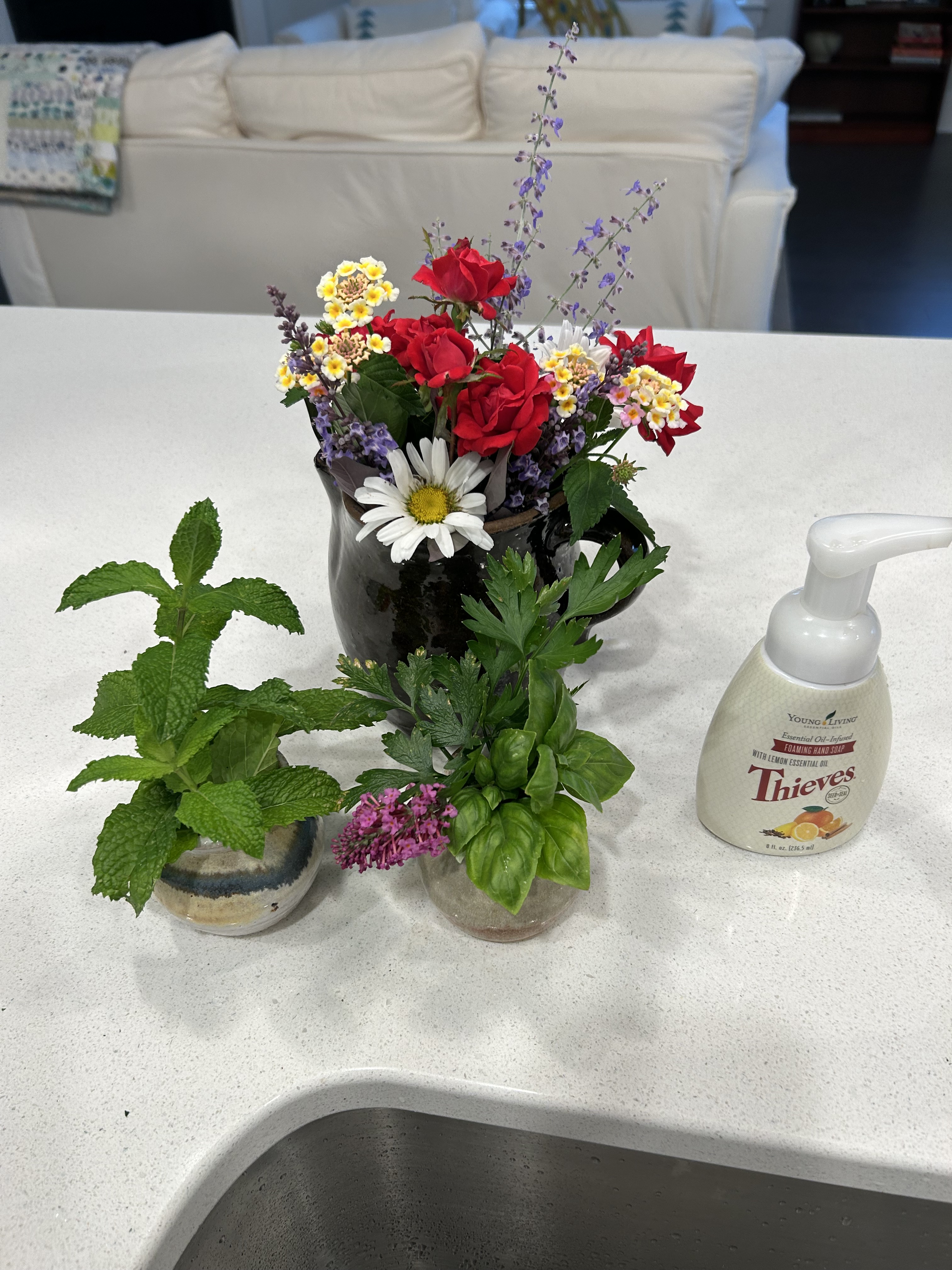
Here’s a little bouquet I cut when I pruned and deadheaded the other day.
I think perhaps I’ve planted the last plant in this very long sunny bed. Unless I suppose, I happen across another perennial that wants to come home with me. But, mostly, I want to see how these plants spread and if they hold their own. I don’t want to overcrowd this bed. The last two plants are on the far end and are another Encore (everblooming) azalea and another “Frost Proof Gardenia.” The herbs below are basil, mint (perennial), and Italian parsley (it will come back for a second year and seed itself).
I still need a hose solution…
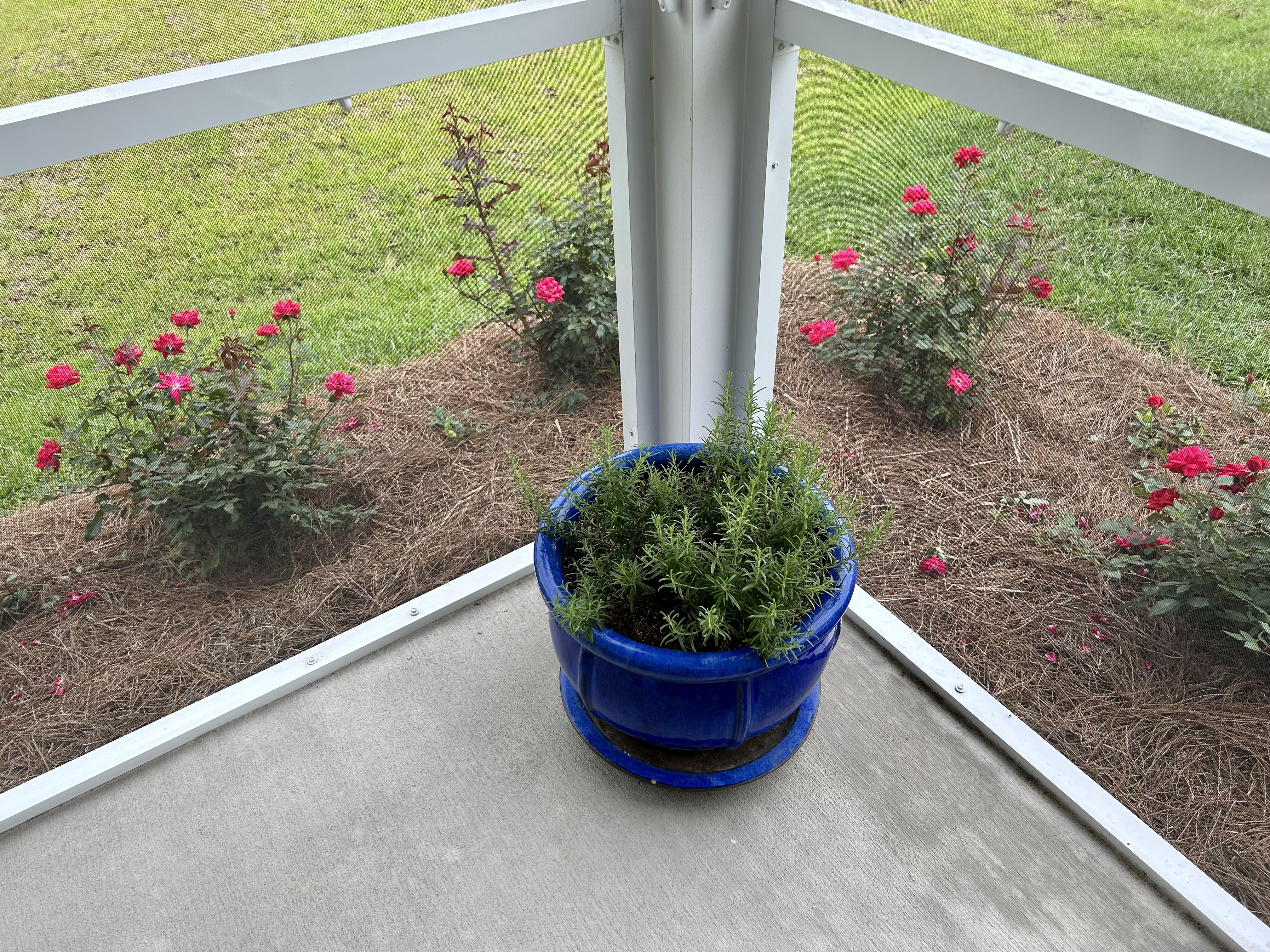
The roses are THRIVING and the moment and are covered with blooms and new growth. And unlike the roses in islands in highways, these have lots of leaves all the way down–which means they are getting the nutrition they need.
The roses are so cheerful. And, pretty.
The Asiatic Jasmine (which is not really jasmine) is spreading nicely now. It is sending out shoots underneath the pine straw in many cases.
Here it is in the long bed on the sunny side of the house. For the moment, I’m not planning on doing anything else with this bed as the ground cover will cover it. And, it will bloom and be fragrant in the spring.
On the front (street) side of this bed I planted one of the gardenias, and the luscious smell from it greets one at the garage door area.
These two plants below were among the first ones of the first I planted. They are to the left of the screen porch door and are under my bedroom windows. Each will get MUCH bigger. The Limelight hydrangea is forming blooms. And on the left, the viburnum will bloom next spring.
These herbs are mostly doing ok. I put some compost on them the other day. The lavender and the taller thyme are blooming.
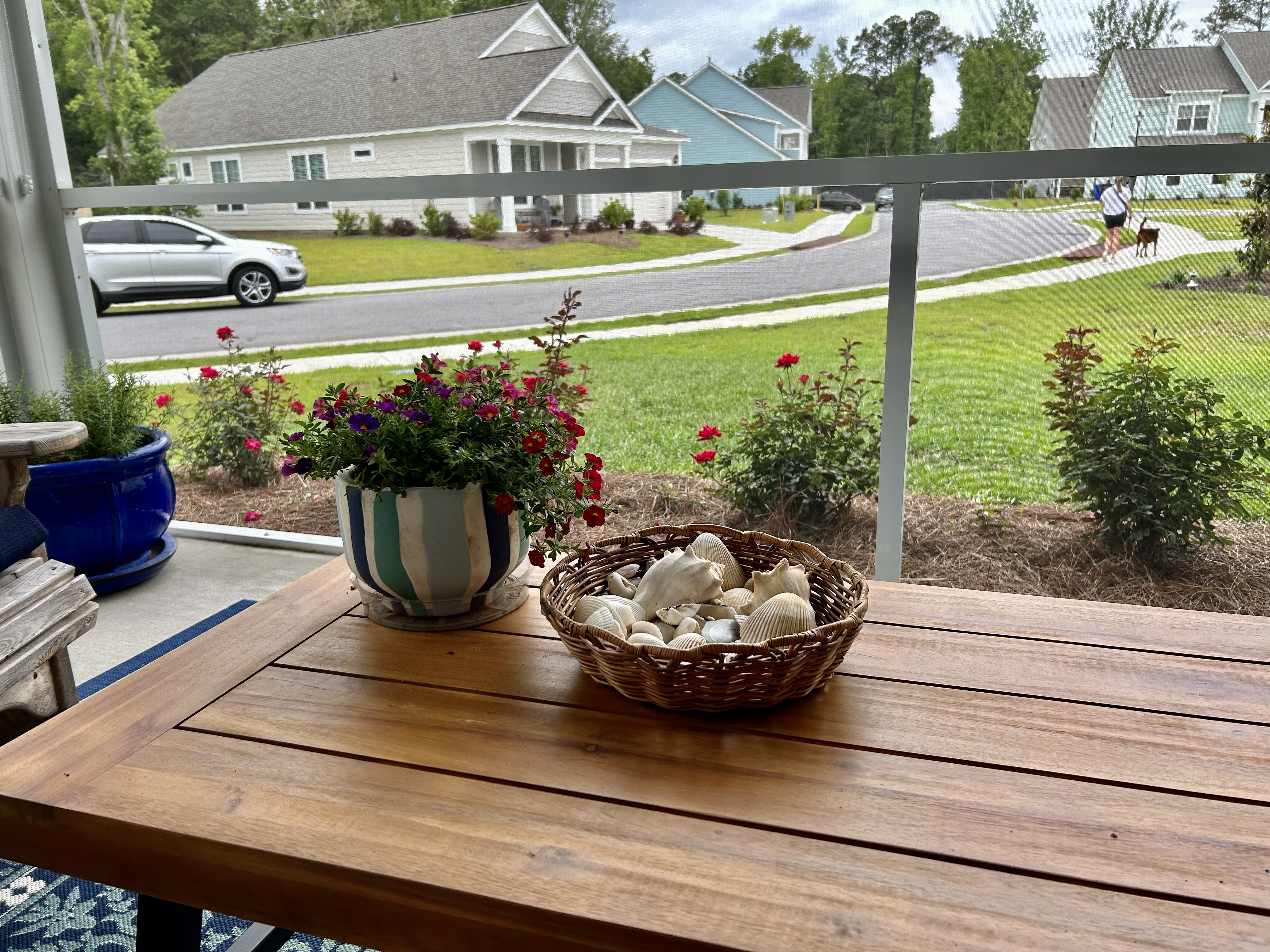
The rosemary in the pot on the porch is thriving. I use it all the time.
As is the newly planted small pot on the table–with an annual I know but whose name is not on the tip of my tongue this morning.
We are expecting rain today, which is now needed again. The grass will be happy, the new plants will be happy, and I will be happy as I’m going to have time to sew. The Traverse quilt is only lacking 2 pieced rows now, and one of those is half finished.
The “Frost Proof Gardenia” I planted on the shade side of the house is BLOOMING and is covered with buds. I couldn’t believe how fragrant it is. I cut two blooms and brought them into the house to occupy one of the little pottery vases that sit next to my kitchen sink. The pottery vase on the left holds a sprig of mint and some blooms from the Vitex I planted last week.
I often bring herbs from the into the house and put them into these vases, so their goodness is available when I’m cooking. I particularly like the mint in the bowls of fresh fruit I’ve been eating lately (blueberries, raspberries, blackberries, cut up cantaloupe).
We had two nights and one day of really good rain, so yesterday when the sun emerged again, I dug a hole for the azalea that has been waiting for me to plant. After all that rain, the digging into the clay was easy, so I went ahead and dug the last two holes I will need on the sunny side of the house. And I prepped them with sand and compost mixed with the clay. I hope the sand will provide the drainage needed here and the compost will provide food for the plants.
I am off this morning to buy one more of these amazing azaleas that will bloom all summer and another gardenia. I would love a Tea Olive shrub, but the remaining area I could plant isn’t sunny enough for one. Plus, even the shrub versions get too tall for most area around this house. The plantings, for the most part, need to be kept to shorter choices. And, more shallow rooted.
I’ve been busy these past few days–part of which involved buying and planting more plants. And more amendments, some of which like sand and compost are HEAVY. And I left the wheelbarrow in Maine and don’t want to buy another one as the planting here is almost done now.
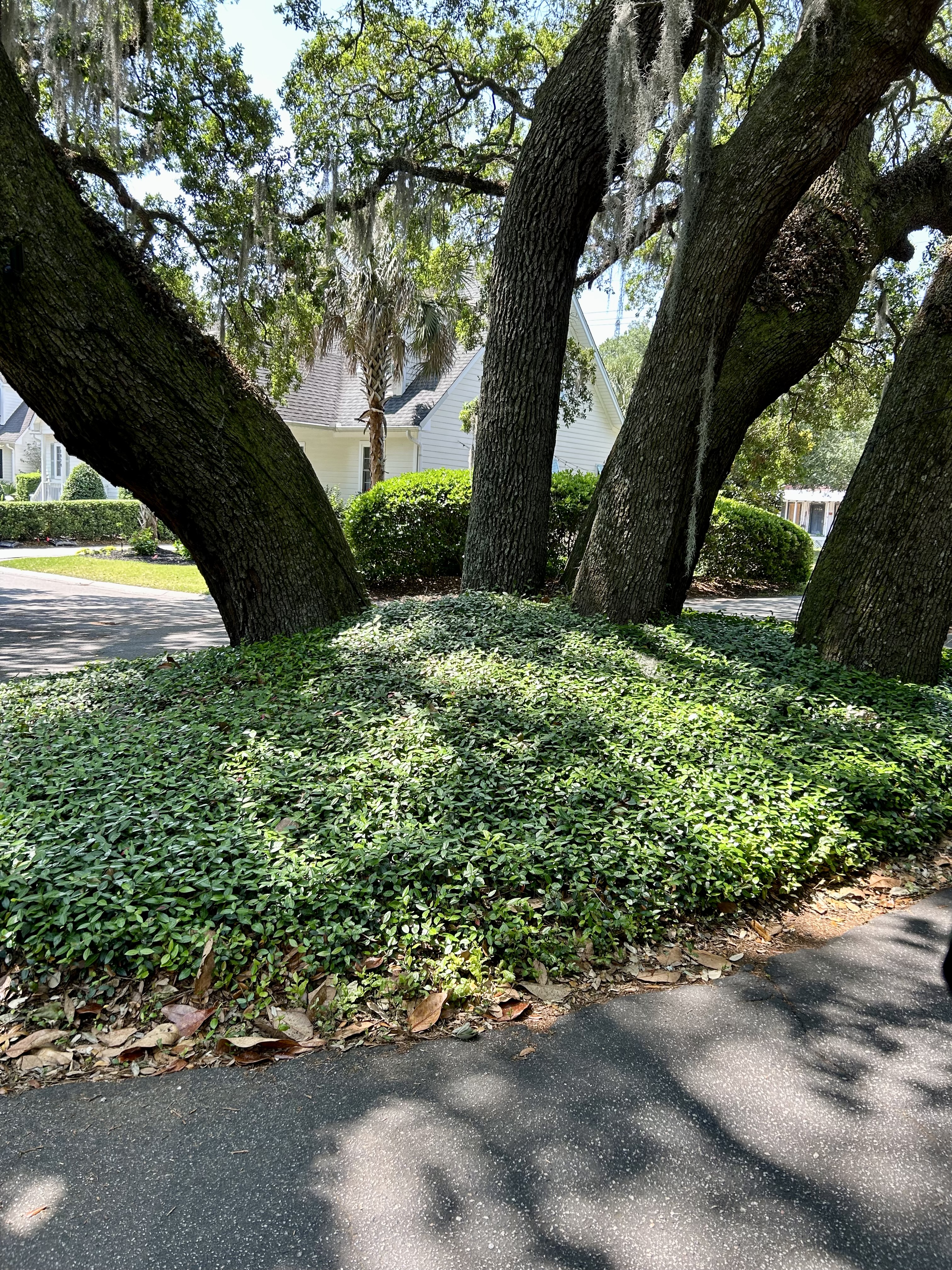
First, here’s a beautiful street island covered by the Asiatic Jasmine ground cover I’ve planted here. Those trees are live oaks, and you can see this ground cover thrives in their shade. And my AJ is spreading now in good form. It seems to be happy.
The plants I added to this sunny bed are all perennials or shrubs that thrive here–and they all bloom–so my garden will draw in pollinators. And for the past few days, I’ve seen a butterfly on the butterfly bush I planted last week.
Yes, I was very inspired by watching the live documentary in which DIL Tami Enright, director of The Bee Cause Project, participated this past week. I learned a lot, actually. And I decided I wanted everything I planted here to bloom and not just be plants that “hold down” places in the beds that surround the house.
I added Russian Sage, a Mexican sage (new to me), some pink dianthus nestled along the pine straw border, and a perennial lantana that is such a pretty color. (There are two forms of lantana here: annual and perennial. The annual plants I’ve seen here are either white or a vivid yellow. I have enough white and there is already yellow with the Stella D’Ora day-lilies. Besides, I lucked into finding this lantana which is exactly what I wanted. I trimmed it back a bit after I took this picture to encourage it to be less “leggy.”)
Last week, I planted in this long sunny bed a white Encore Azalea, Autumn Joy, that is some kind of Rhododendron Hybrid that will bloom spring through fall. How cool is that? It comes in other colors too.
At the far end of the bed is a “Flip-It” Chaste Tree/shrub that will get tall, die back in winter, and come back in the following spring. One keeps it as tall or short as one wants by trimming, depending on where it lives.
It is called a Chaste Tree as it has herbal properties that some claim can cause a loss of libido. It’s called Flip It because the underside of the leaves are the most beautiful soft lavender.
This vitex plant blooms with long purple spikes, so thrives in dry conditions. I didn’t add any compost to its planting hole, but did add a lot of sand for drainage and some fertilizer to give it a good start. This plant hates having wet roots–so time will tell if it can manage the clay here, augmented by sand for drainage.
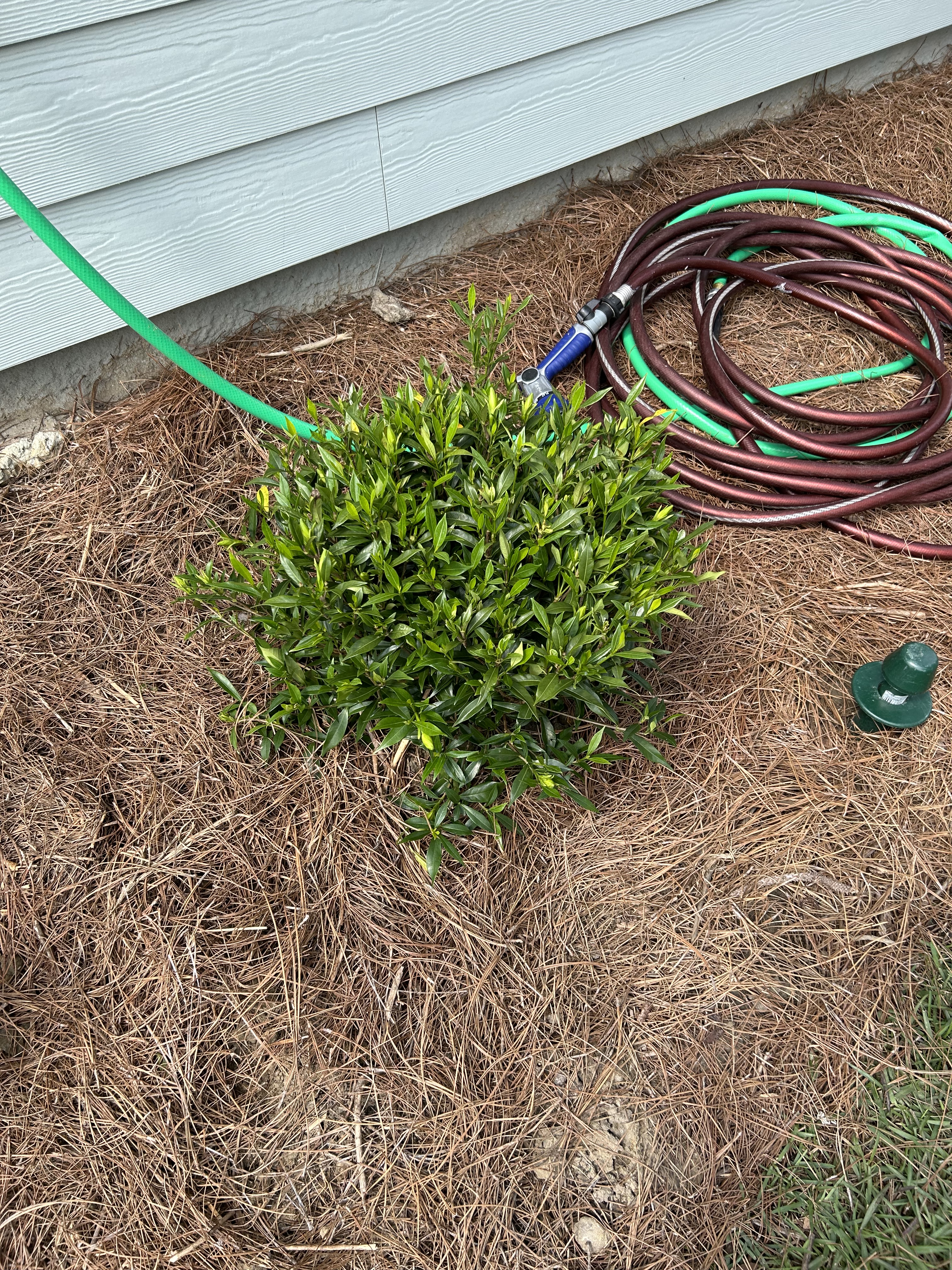
And on the far side of the house–the shade side–I planted a fragrant white “Frost Proof Gardenia” that will bloom spring and summer. I wanted a plant that would get big enough to form a kind of visual barrier to the equipment on that side of the house.
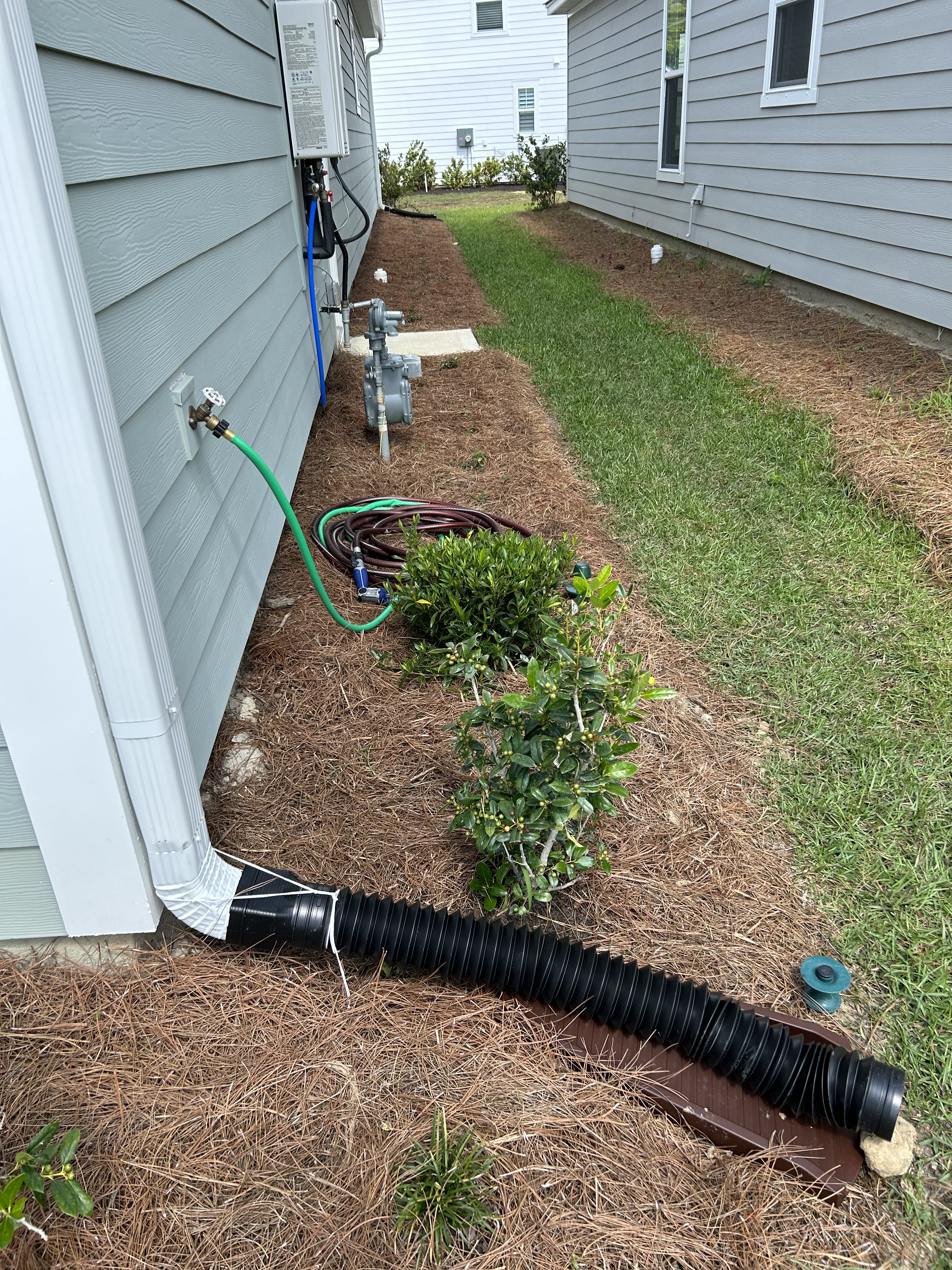
Here’s the long view. It’s hard to know yet how much these holly bushes will fill in at this corner. This gardenia will get about 2 feet tall and 3 feet wide. I’ll have to figure out something attractive on both sides of the house for the hoses. (A gas line runs along this bed to that piece of equipment, so I’m not comfortable doing more digging in this area.)
Digging all those holes–was made much easier by the purchase of this very heavy Maddox. I left a totally good Maddox in Maine. I had no idea I’d be digging holes in clay in SC!!! Or, trying to.
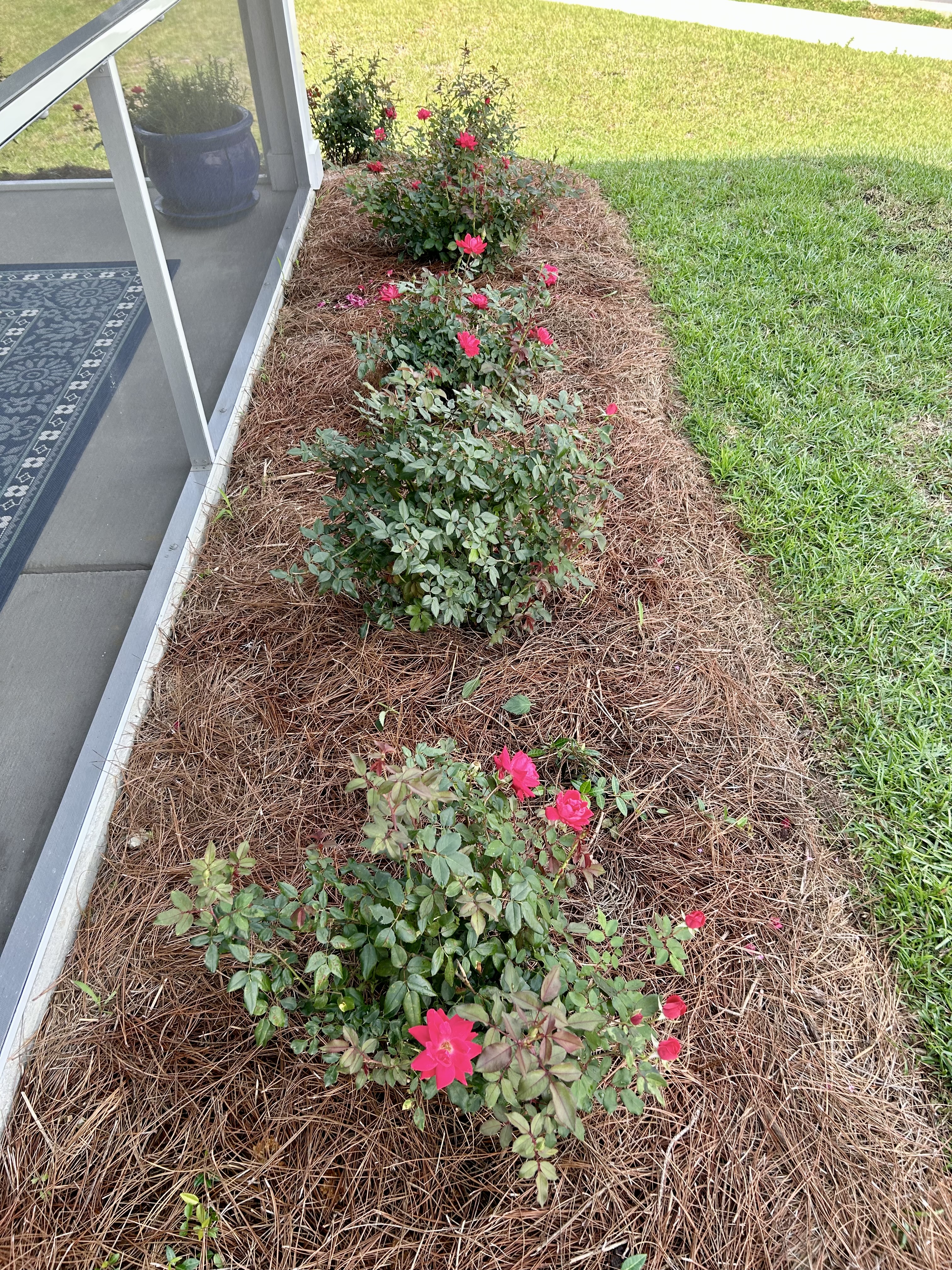
The roses do seem to be thriving. They have a lot of new growth and are starting to spread sideways. I’ve lightly trimmed the tops off and on so they will spread sideways. They are about to put out a new flush of flowers.
The grass is doing well mostly and is a healthy deep green color. There are some bald spots where the grass is just sitting down on clay. I’ve added some manure compost to some of those spots in the hope it will give them something to feed on in the sterile clay. There are pieces of the grass in those spots; it just needs a bit of help with the clay. And, apparently, lots of water.
Centipede grass is tricky, as I’ve said. But I’m hoping I’m learning to understand it better. It does not like competition, for one thing, so I’ve spent many hours after a heavy rain hand-pulling weeds in the early morning or late afternoon. I don’t mind that work; it gets me outside in the sun. I’ve filled several big grocery plastic bags with weeds–and the grass is showing the results now. Clearly, this grass LOVES water.
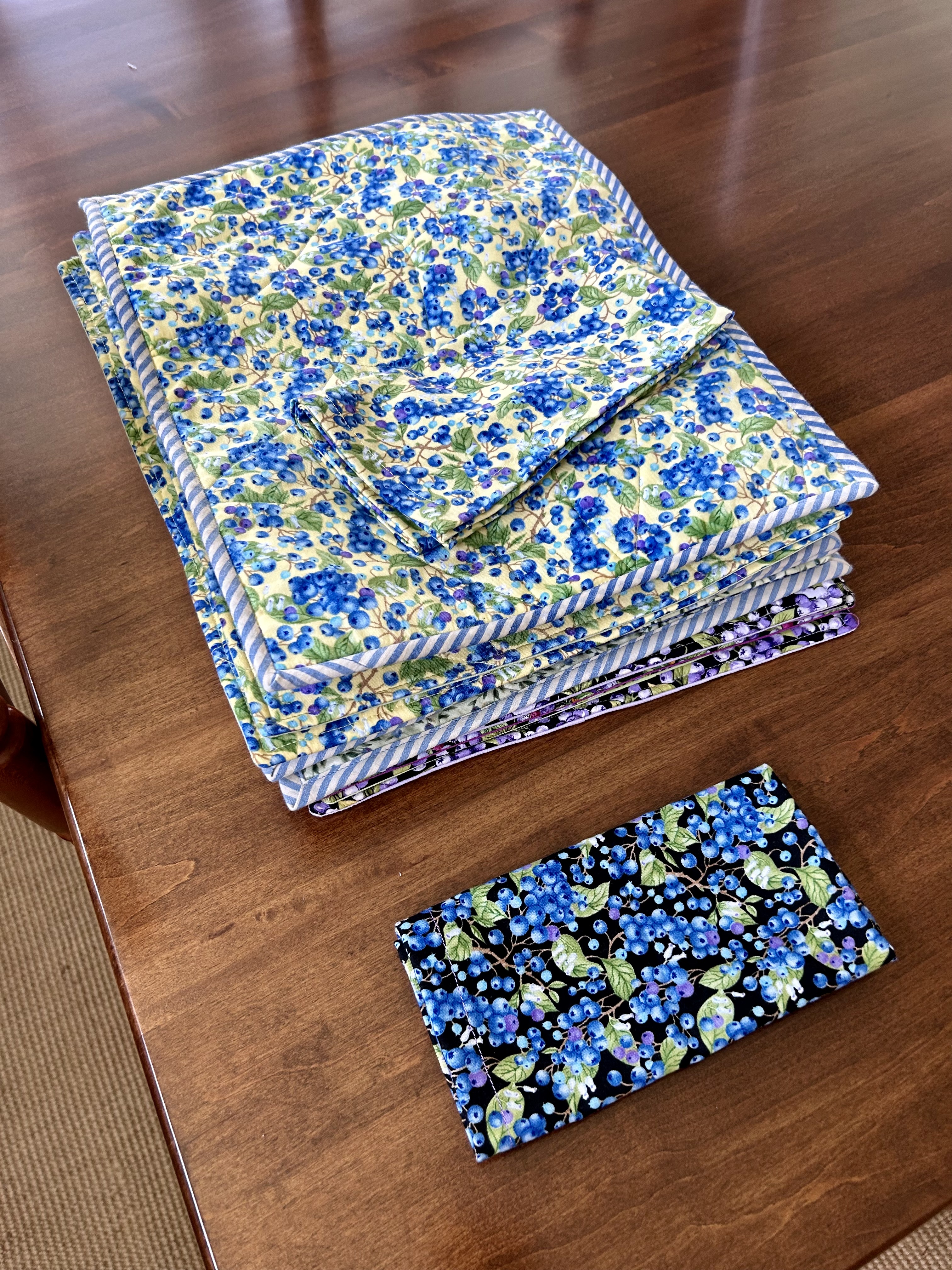
I’m taking a rest day today, for the most part. I’ll sew placemats after my dinner. The finished placemat pile is growing–I think I have six more to make. Each has its own napkin and most napkins are solids. The napkin to the side of the pile in an extra and is smaller–maybe it would be nice in a bread basket?
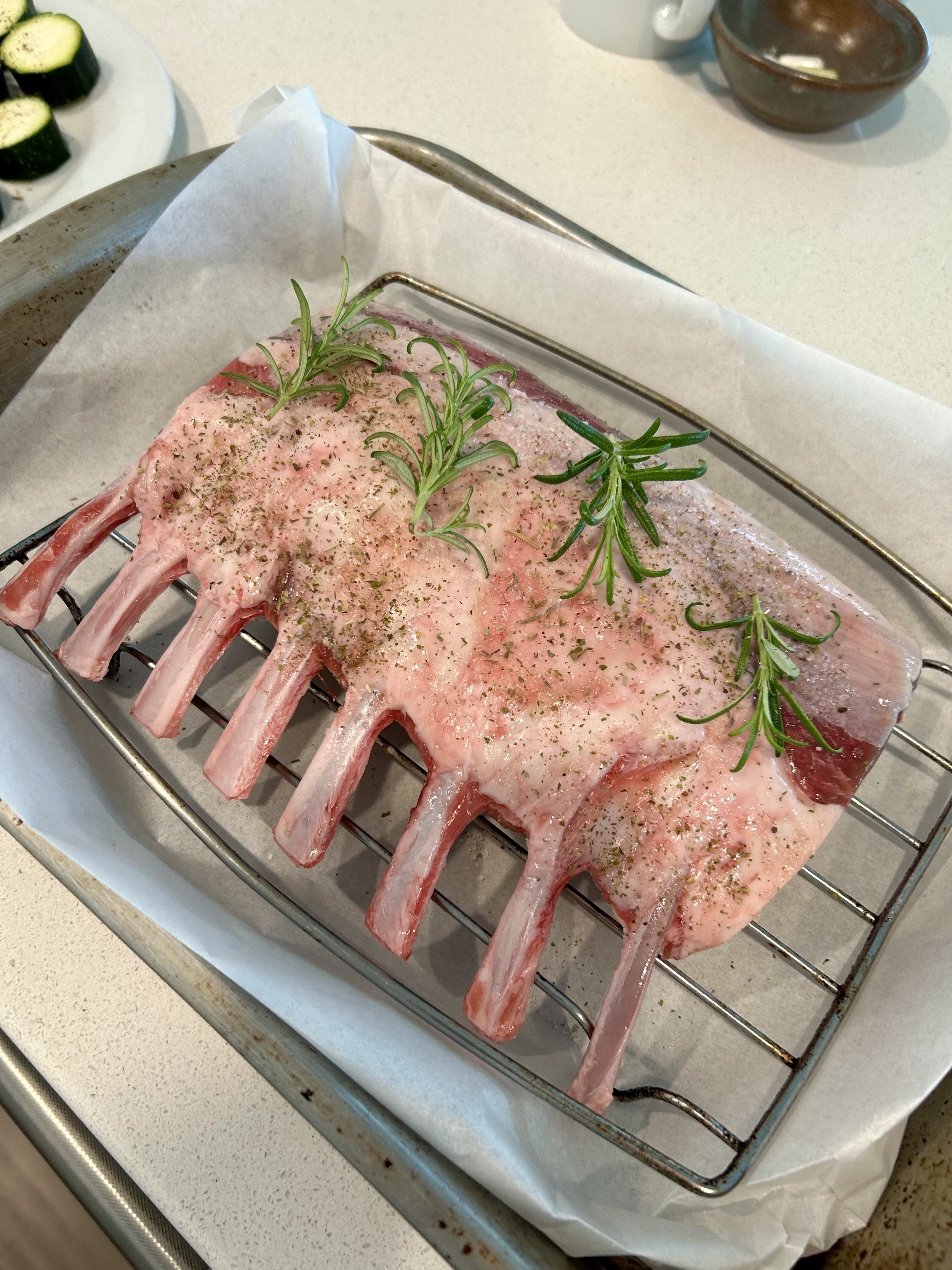
Dinner in a bit is lamb rack, baked sweet potato, roasted zucchini, some cut fresh veggies from yesterday, fruit for dessert (cantaloupe, raspberries, blackberries with a hint of maple syrup and mint from the garden), and an espresso with raw honey and raw cream–and time on the porch to read.
Have a great weekend! And thanks for reading this far, if you did!
***Today at 10 am is DIL’s Tami’s live bee interview in Athens, Georgia. Now, 330,000 educators have signed up to view it live, along with school children and some adults. Details are on yesterday’s post. It can be viewed taped later, which I will do as I have a dentist appointment this morning.
***
I grew up with pine straw being used in my Georgia grandmother’s magnificent gardens and on her open back yard areas.
I remember that in the shady back yard areas, people visited together in a ring of metal garden chairs, or worked in the summer kitchen to can tomatoes, or ate some wonderful and special food at the long wooden outdoor table. This backyard area got new pine straw a couple of times a year.
New pine straw is prickly on children’s bare feet, which was our condition most of the time in our summer visits, unless we were made to put on shoes to run up the block to the local grocery store to get something someone needed immediately, like, for instance, cold coca-colas for a morning backyard chit-chat break. But no weeds came up under the pine straw, which offered a pretty way to cover a shady back yard space that would not have supported grass.
This use of pine straw would have predated the current market for wood chips and/or mulch made of composted wood pieces mixed with composted dirt which now is used to cover garden beds. But here in the Deep South, pine trees are abundant and are sources of…pine straw. And pine straw, unlike mulch, covers dirt and keeps one’s feet clean.
The builder of my house and neighborhood used pine straw around the new houses. And that triggered memories for me. Honestly, I don’t remember what grandmother had in her formal flower beds, but I don’t remember weeding being a huge issue either.
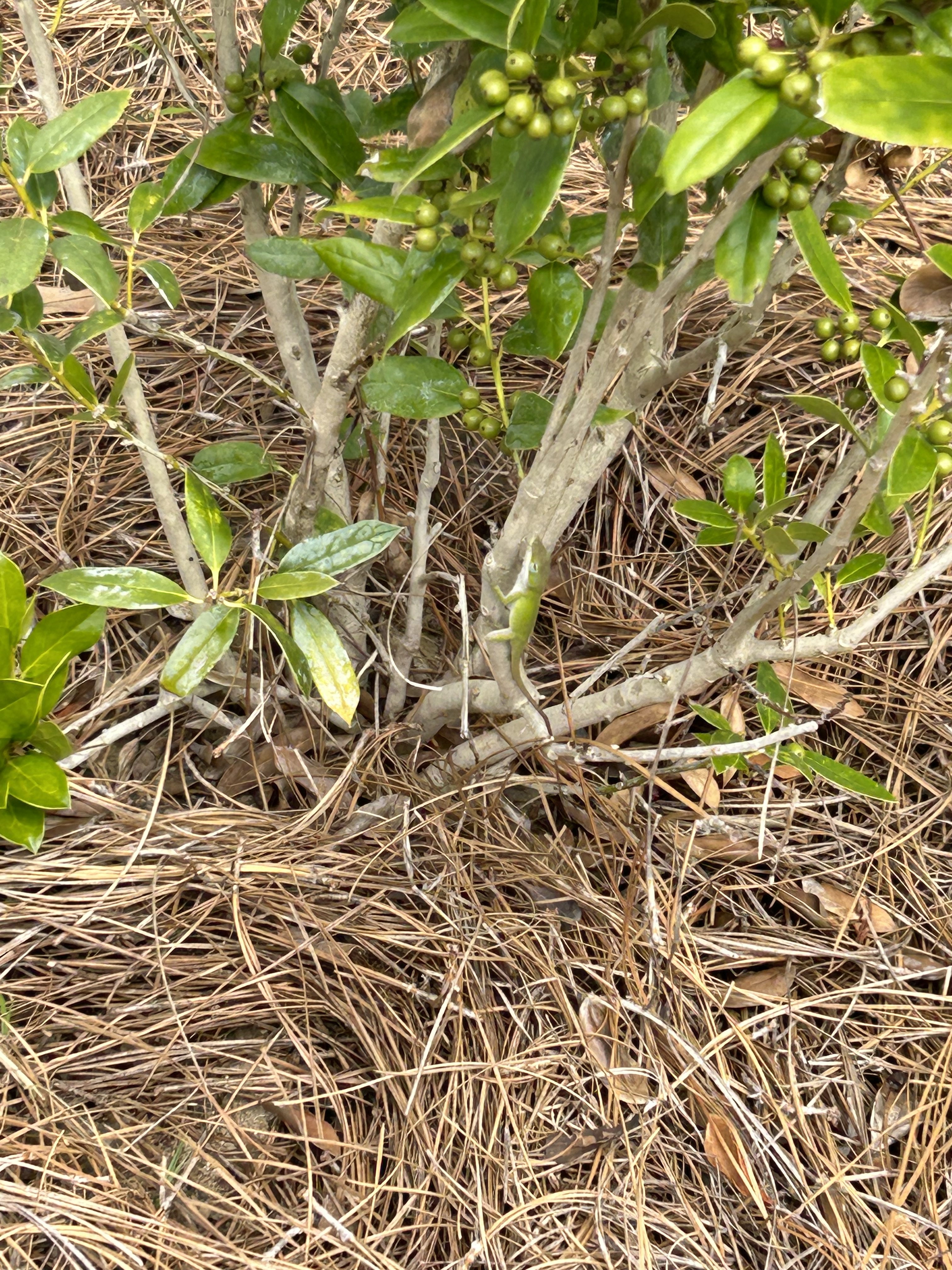
As an aside, look what I saw in my front garden bed the other day. One of the little lizards so common in the South. Hello, my friend.
I’m seeing, also, tiny little black rain frogs in the pine straw when I have an occasion to disturb it. So the pine straw is doing a good job holding in moisture. And these tiny frogs will consume smaller insects I think. Pine straw, thus, is a natural part of the habitat here. And it is inexpensive and not heavy to transport.
After years and years of mulching in both Virginia and Maine, I’m enjoying this reunion with pine straw being used in one’s garden. I’ve been in my new home since early January, and I’ve only had a few sprigs of grass or weeds spring up in my pine straw beds, so I am kind of amazed, actually. That is so not true of other forms of mulch I’ve used over so many years. I had to do a lot of weeding in both Virginia and Maine.
Pine straw is high in acid and is a boon to acid-loving southern plants like azaleas, camellias, rhododendrums, tea olives, and many more southern plants.
It’s really easy to lift the edge of a pine straw mat and fold it back to weed beneath, which I had to do along some of the beds’ edges where the pine straw covered the centipede sod mats that come with a grid of plastic to hold them together. It’s a bit like folding back the covers on a bed one is making up. Then, when the sodded grass and its plastic grid is cut and removed, one just refolds the turned back pine straw edge.
Many of my neighbors are taking out the pine straw and putting in types of wood-chip mulch. Heavy wood chip mulch without added compost will retard weed growth, but it also pulls nitrogen out of the soil for a year or two while it degrades, which is not so good for the plants. Or so I read many years ago. And heavy compost mixed with wood chips feeds weeds as well as plants.
One neighbor told me she thought the pine straw harbored insects, which I took to maybe mean the dreaded palmetto bugs. But I’ve been outside a lot working in my beds, and I have not seen more than a spider or two. And, yes, a few of the tiny rain frogs. And that beautiful lizard, which also eats bugs.
The folks coming around to spray garden insecticides help foment this dread of “insects,” of course. Inside and outside. Can I just say data today clearly shows that herbicides and insecticides are WAY more dangerous than any insect–especially for children, which are happily abundant here in this neighborhood. (I love living where there is a healthy mix of human ages.)
One DOES have to treat for termites here. They are a menace. And once in Maine, carpenter ants got into one of my dry storage spaces upstairs, and I had to spray for those. And, then there was the time when we brought home bedbugs in, probably, our suitcases after traveling. That was a terrible spraying event. Terrible. So, yes, there is sometimes a need to stop a particular kind of destructive insect. But there are always health costs involved as well. Face it, we live in ways that encroach on the balance of the natural world all the time. But I hope that I’m making the point that insects are also part of the natural world and each has their place in it.
THUS, it makes no sense to me to spray to kill ALL insects (and creatures) in your lawn and on the whole of your house when many are needed in gardens and are doing no harm. My little lizard friend is here to EAT some of my insects, as are those tiny frogs, as are the spiders–insects and frogs and spiders that may have moved to my lawn and beds to escape death, as one sprayer predicted while standing on my front porch.
I can live with my insects for now. I baited some for roaches inside and in the garage where the big garbage cans live. And the house was treated for termites. But for me, that’s it for now.
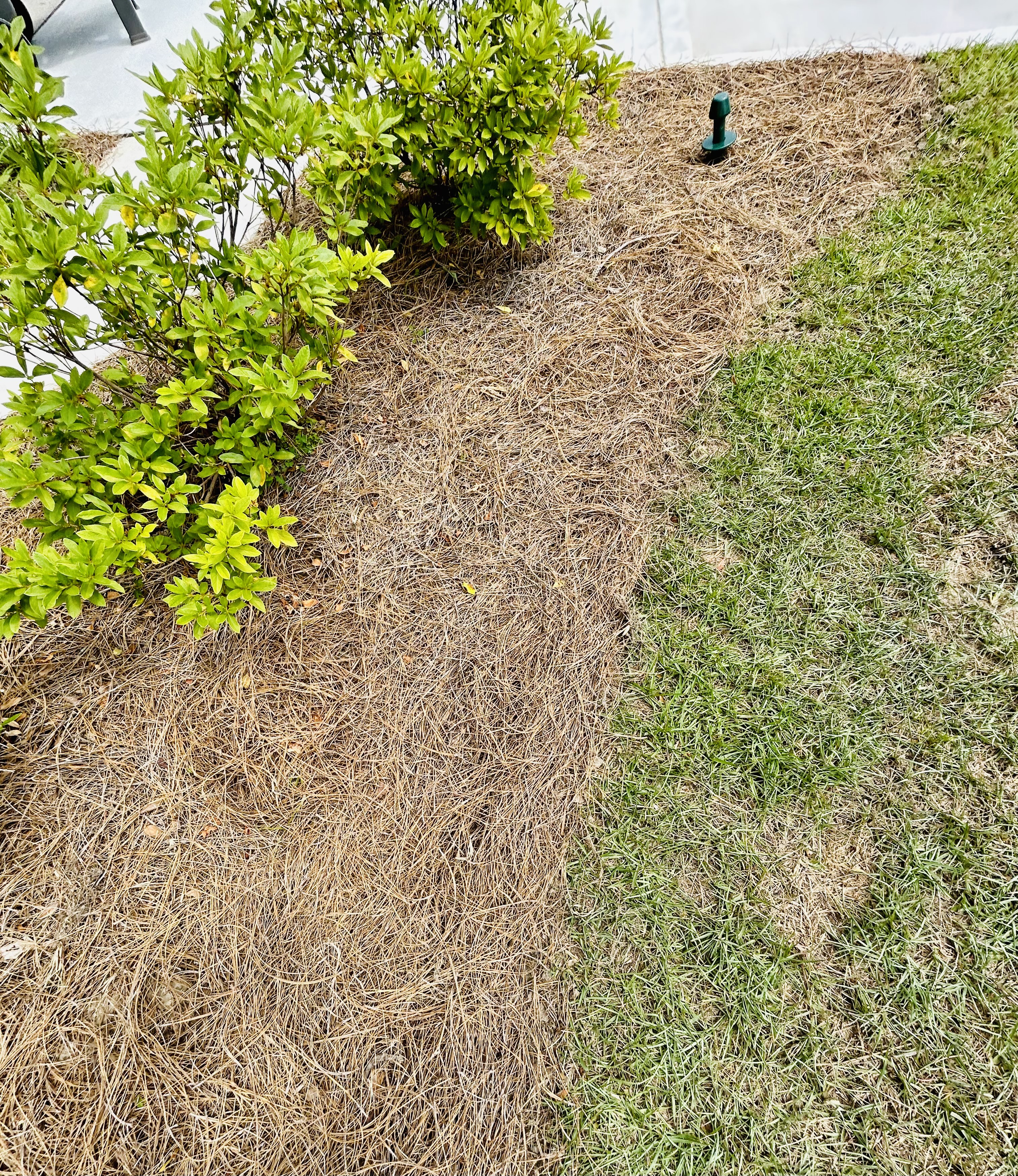
And Alex, who mows for me, put down more pine straw Monday.
Look at how fluffy and pretty it looks:
Those azaleas and hollies are HAPPY.
I’m really liking recalling my Georgia pine straw memories–which are supporting what I think is the best thing to do in my own southern garden now.


















 Louisa Enright's Blog