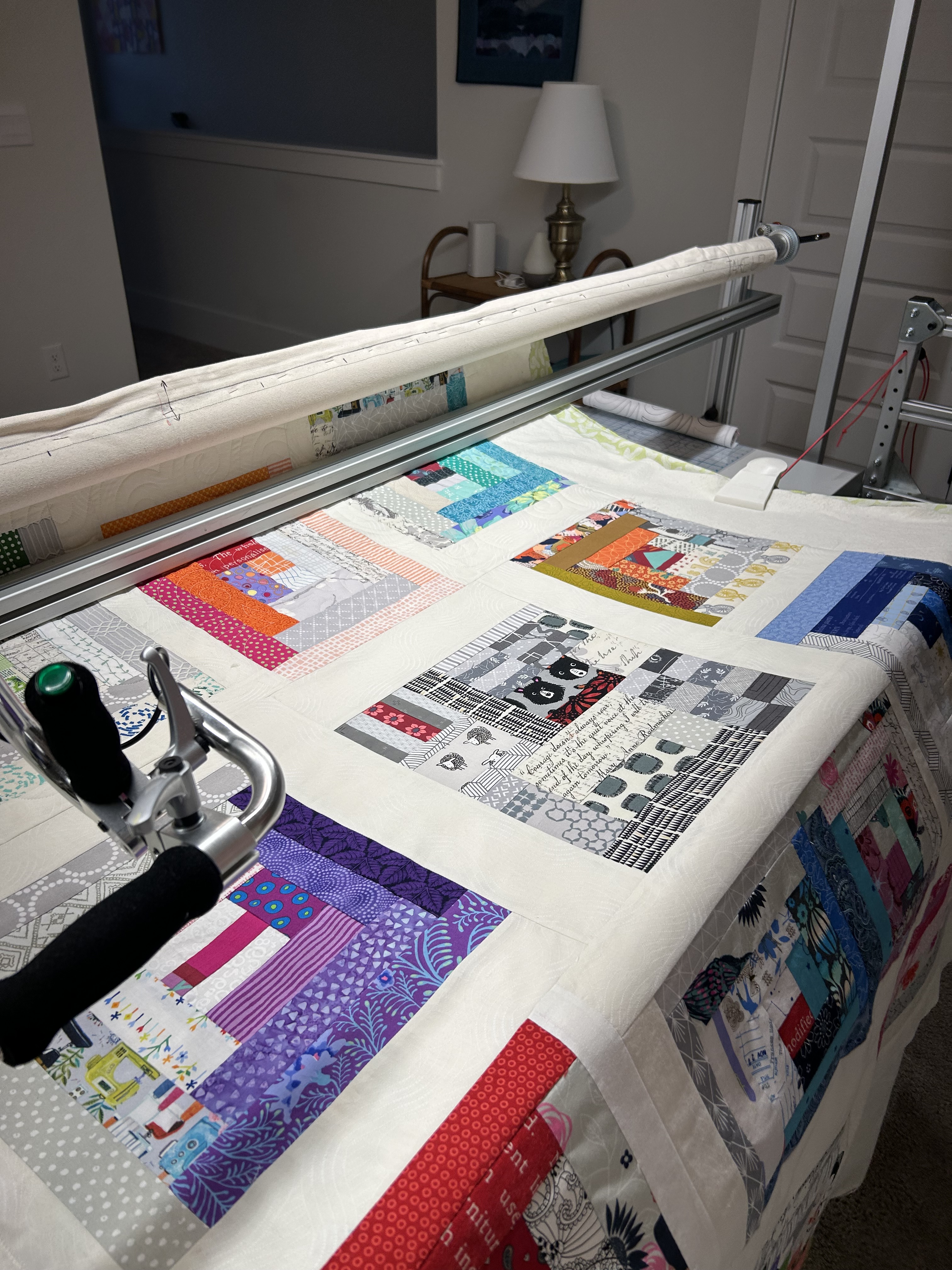
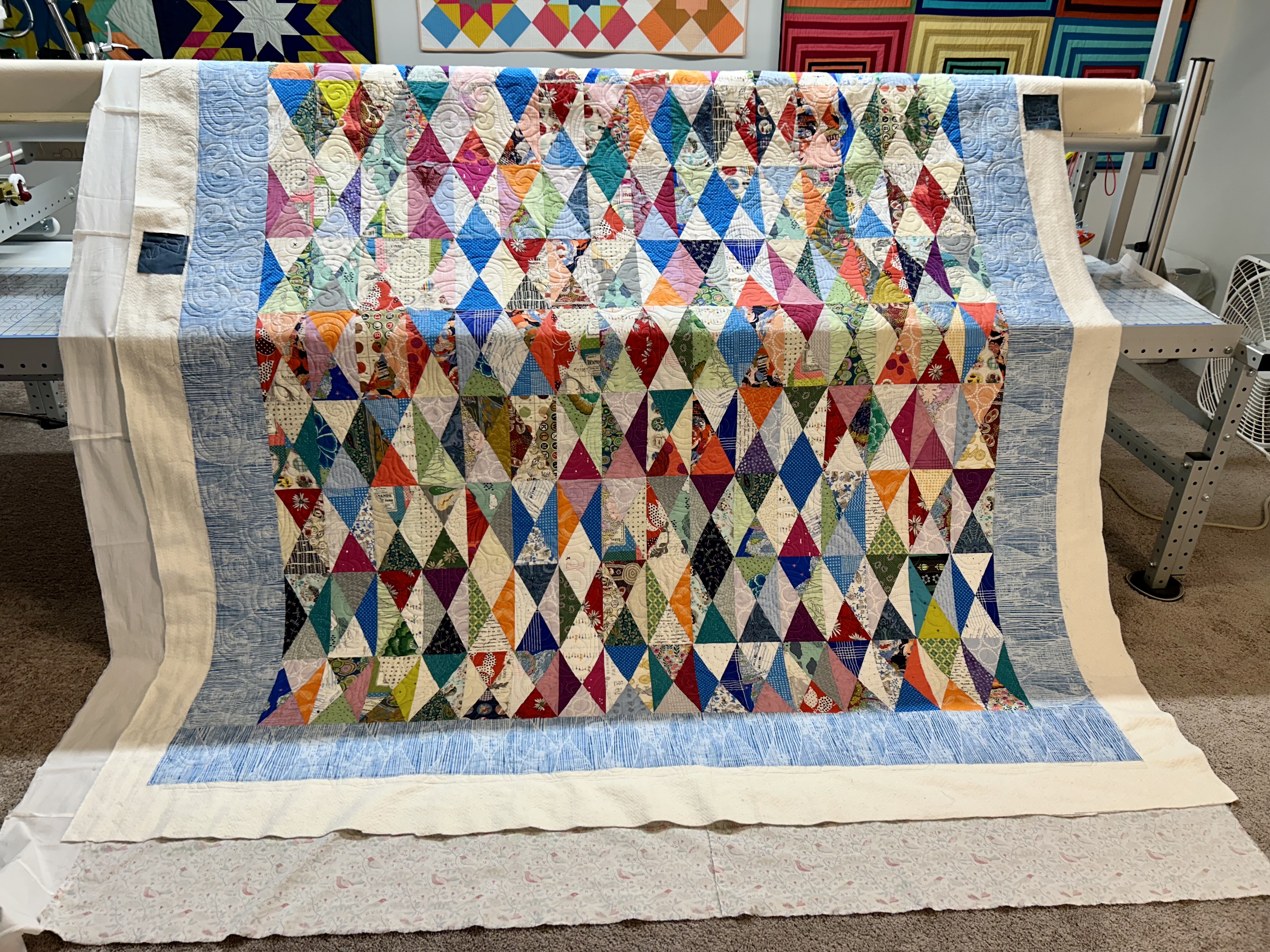
“Diamonds” is the second quilt in my half-rectangle triangle series, made with the use of Latifah Saafir’s Hurty ruler.
If one joins the two cuts this ruler helps make (left and right angle cuts), one gets a “diamond.” Or, a long triangle. (This quilt is 72-inches wide and 80 inches long. I don’t have a great space to get a good photo of a quilt this size, so this is about the best I can do–and it takes a step ladder to get above the quilt.)
I didn’t want this quilt to have the diamonds all be “matchy,” so from the center I displaced them in a way that also prevented the formation of the neutral diamonds that form when the diamonds line up. I wanted the areas beyond the center to sort of “come apart” as the eye moved away from it.
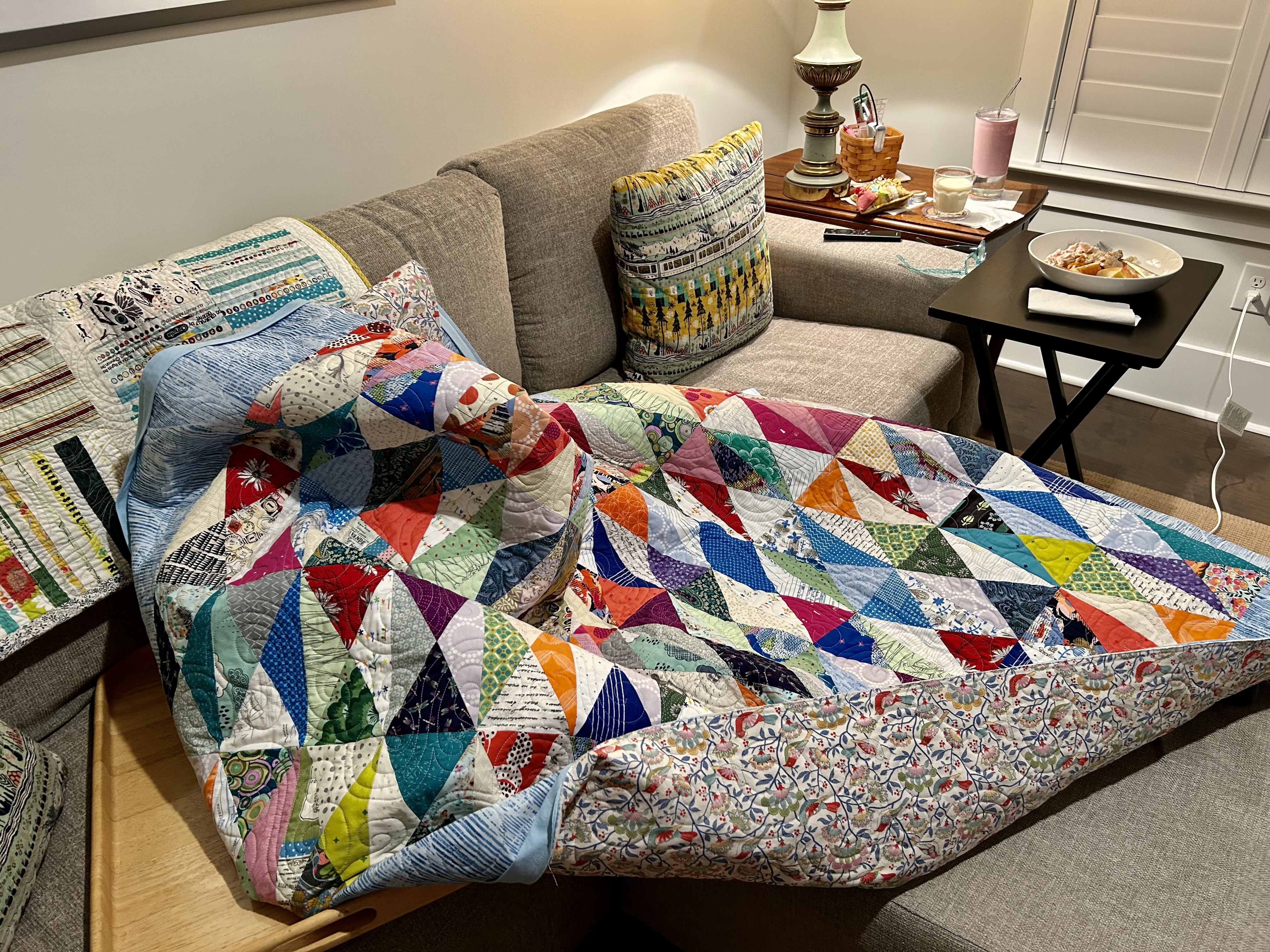
Here’s the backing, which I truly love. It’s the perfect backing in that it does not take away fron the quilt’s front, but just adds this neutral layer.
I quilted with a soft grey thread and used the Nemesh’s Feather Grande panto, as I did with “Arrowheads.” The texture is just awesome.
The colors are coming through in the pics above a bit dull. Here’s a shot that has better color.
And I’ll print this photo out for my greeting cards:
To remind, here’s the first quilt in this series: “Arrowheads.”
I’m well into the third quilt now and am thinking the series will be 4 quilts.
I am really enjoying making this series, and I really like these two quilts.
I will start cooking my part of our meal in an hour. Dinner will be around 4 at my younger son’s house, and I’ll go over early afternoon. My cooking part will be roasted Brussel sprouts and a platter of garlicky roasted carrots and sweet peppers. I’ll bring the green salad ready to assemble. Bryan is going to cook the turkey on his fancy wood chip grill that smokes things. There will be also mashed potatoes with raw butter. And pies for dessert, to include the family chocolate chess pie which is super rich and which I can’t eat due to the gluten in the pie shell. (Yes, that is sad, but life is messy, isn’t it?)
It is overcast and hopefully it will rain as it is very very dry. So likely, there will not be a walk on the beach today.
I went to Whole Foods to get the organic veggies, and the Christmas trees are in place.
I stood for a moment or two and inhaled the smell of green fir trees–which I do miss here in South Carolina. Hiking in the Maine woods was always filled with this wonderful scent. But here the tall pines sway over the woods. They are long-needled and quite spectacular.
I also bought a butternut squash for one of my favorite dishes, which is to roast skinned chunks with fresh rosemary, garlic, salt, and good olive oil.
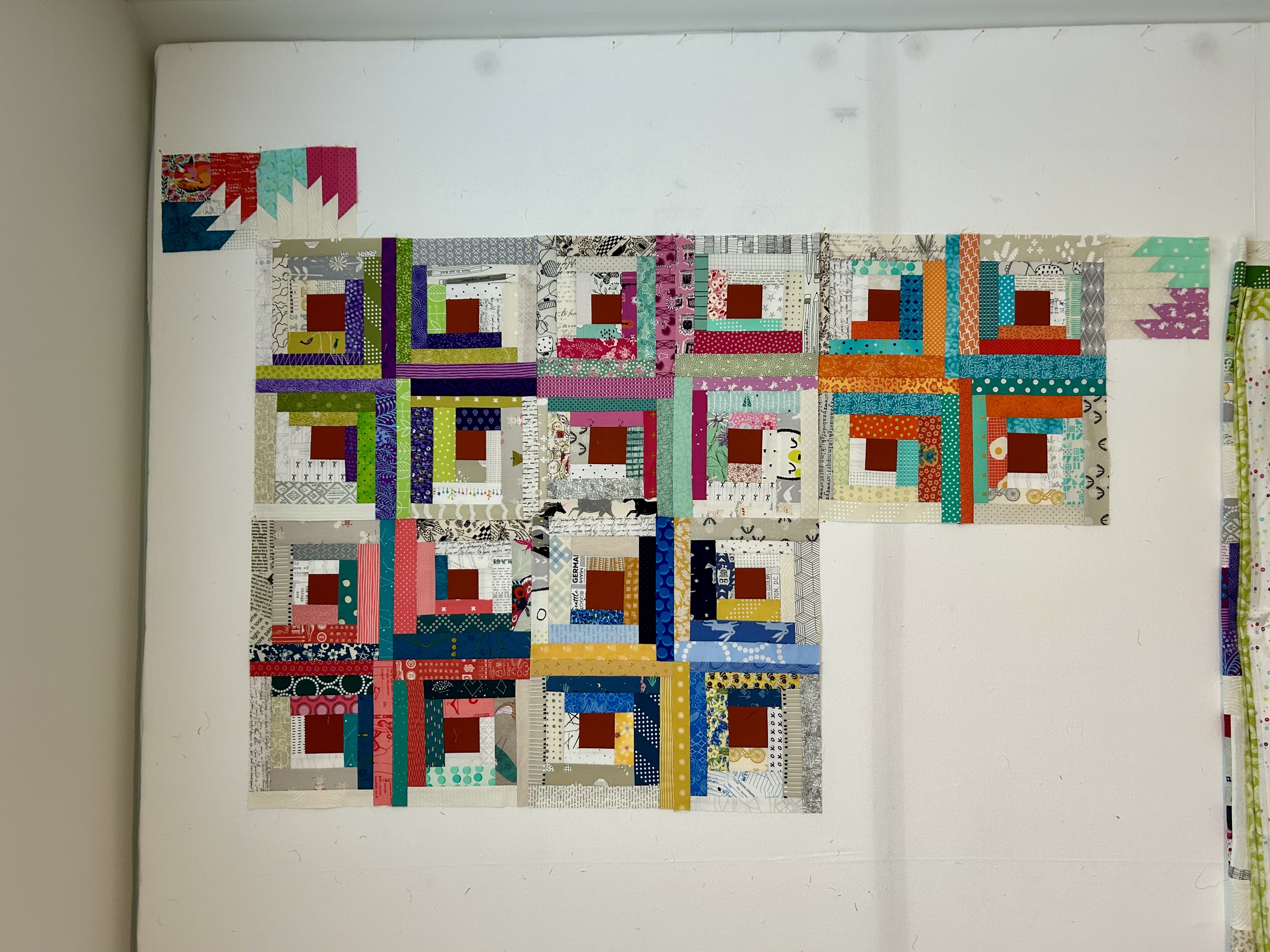
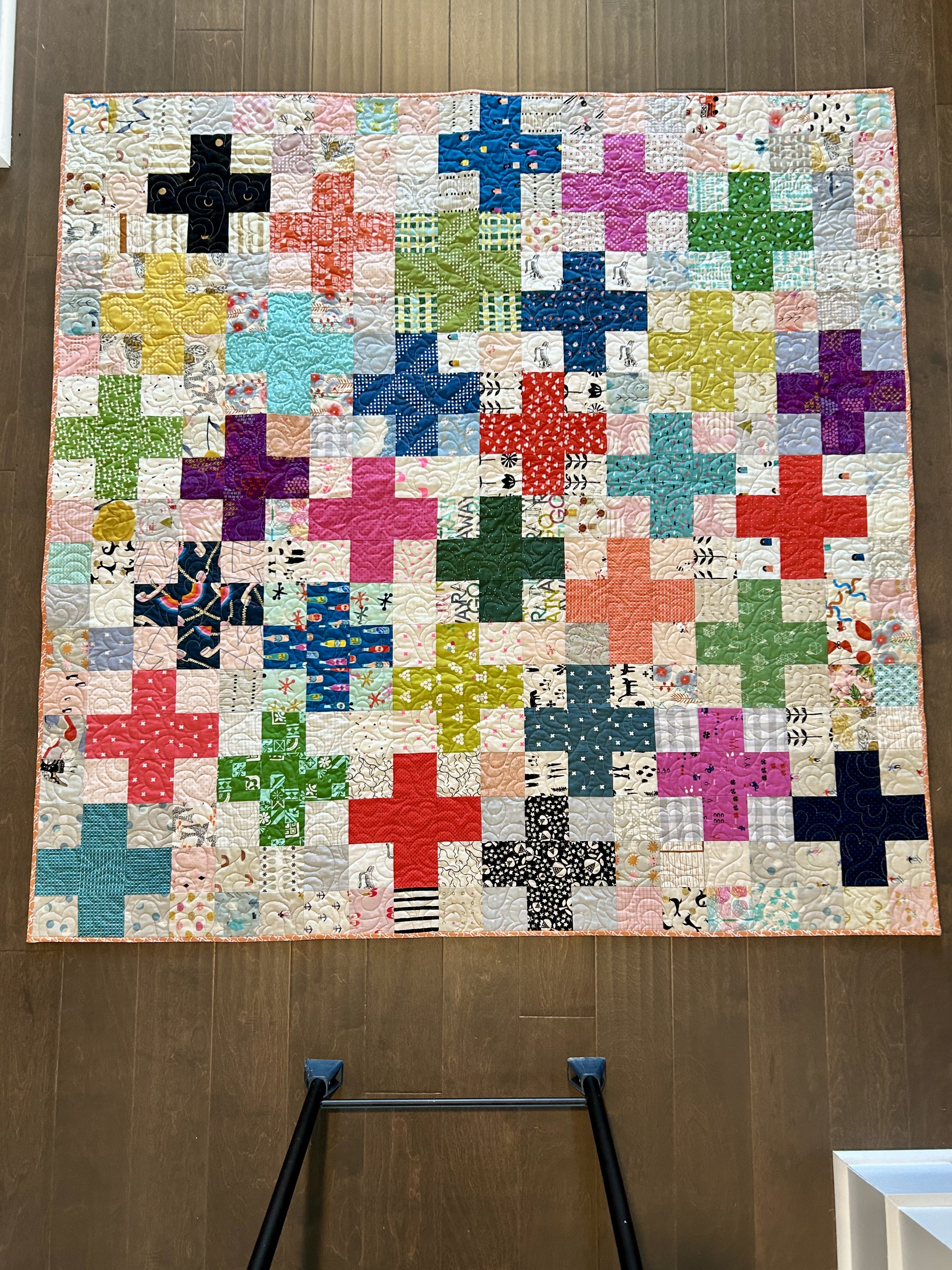
The ” Pot Pourri 5: Crosses” quilt is off the design wall and ready to go on the longarm. The backing I ordered (also Ruby Star Society) is adorable. It’s washed and ready to be ironed and organized.
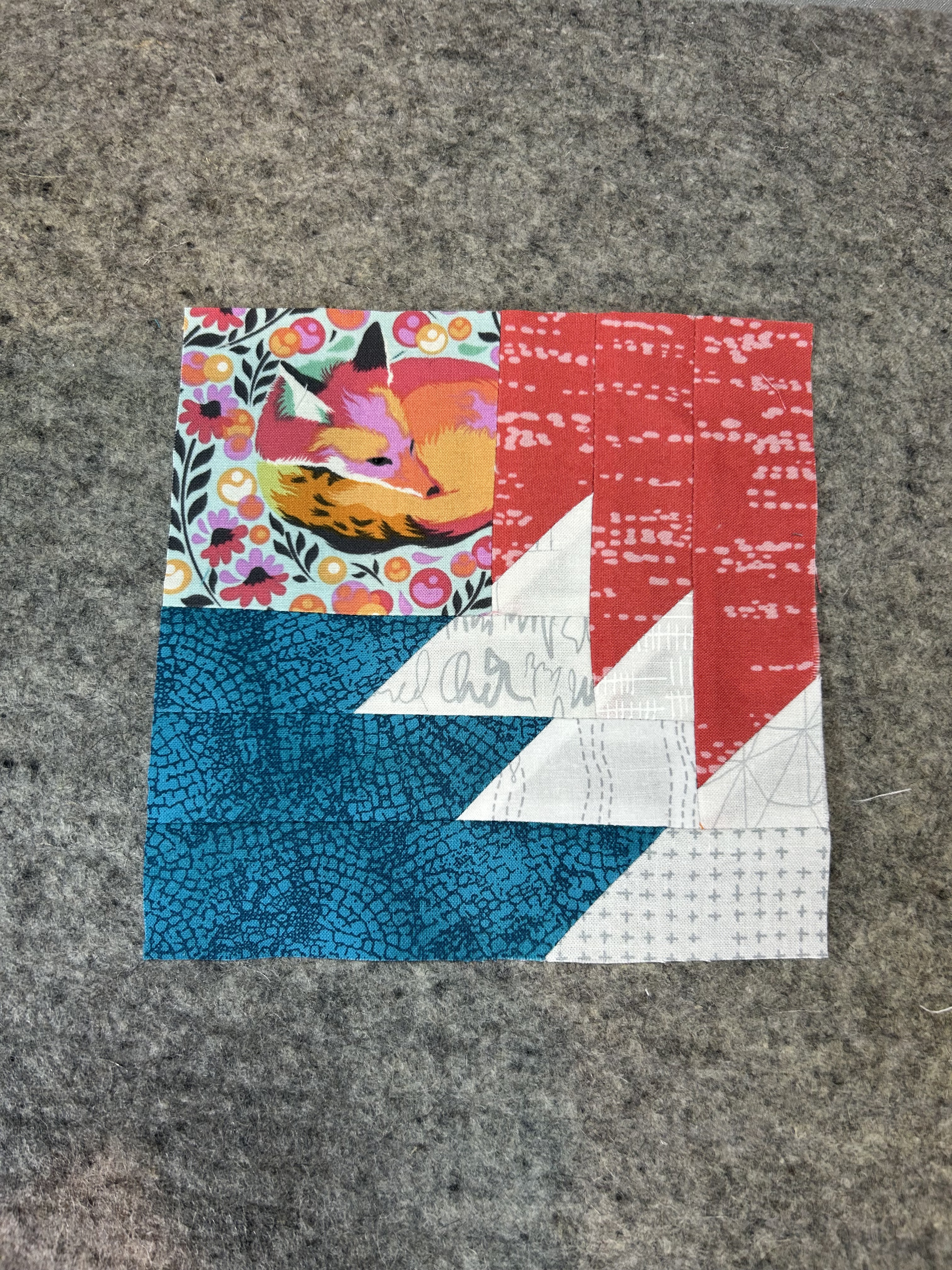
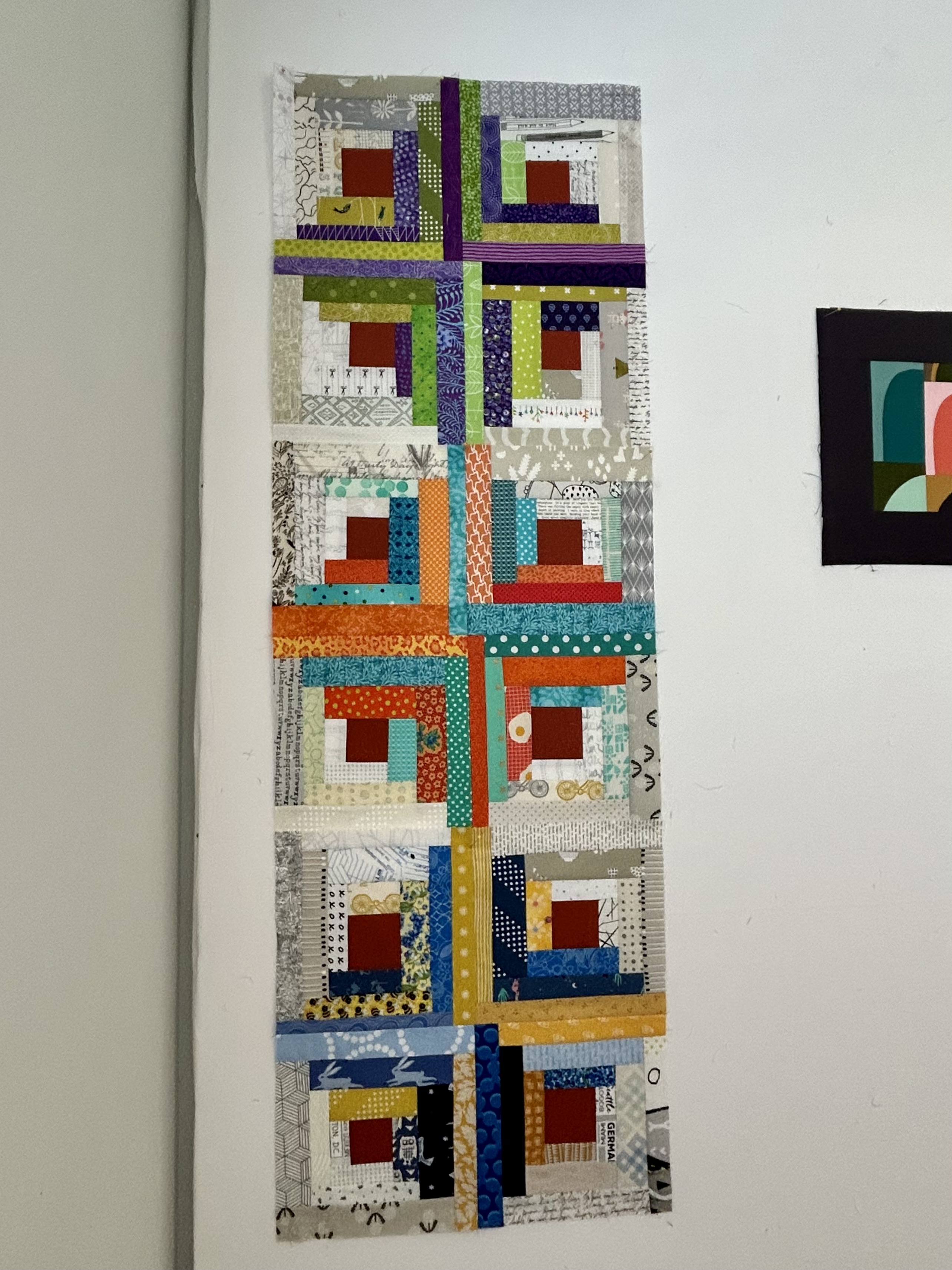
AND!!! Ta da!! Here’s this month’s work from my online Blocks 2 class with Tara Faughnan. I could have gone on and on, but…
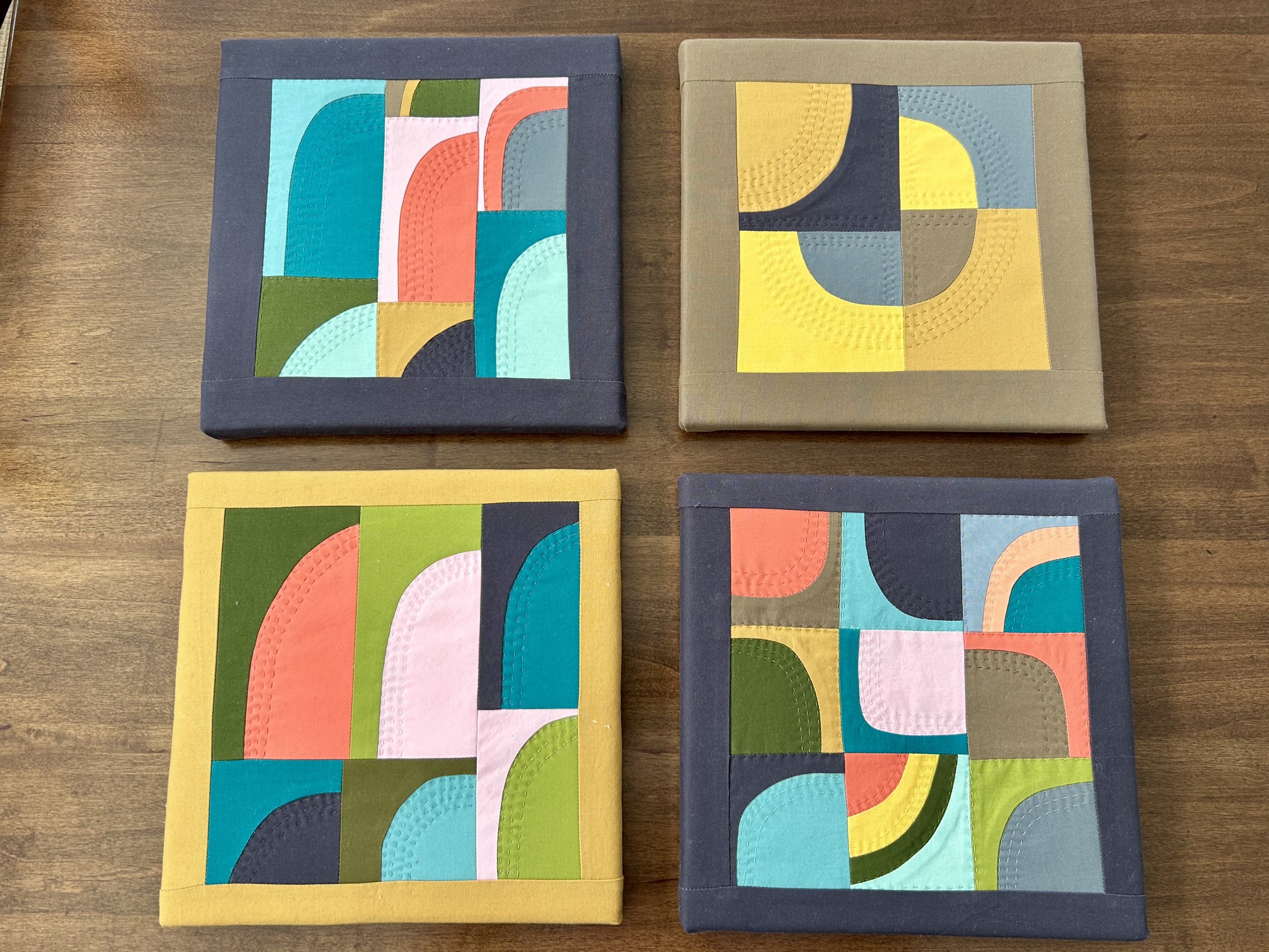
I hung the grey piece in the front hall next to the alarm system box. My walls are a soft grey. The rest are all installed on stretched canvas frames.
I’ll hang the big blue one in my quilt room. But the rest will be gifts. I’ve really enjoyed learning how to wrap a block around stretched canvas and am pleased with the outcome.
Months ago, the Charleston Modern Quilt Guild challenged members to “make the Churn Dash block modern.” The reveal was at our meeting last week, and members outdid themselves with their creativity.
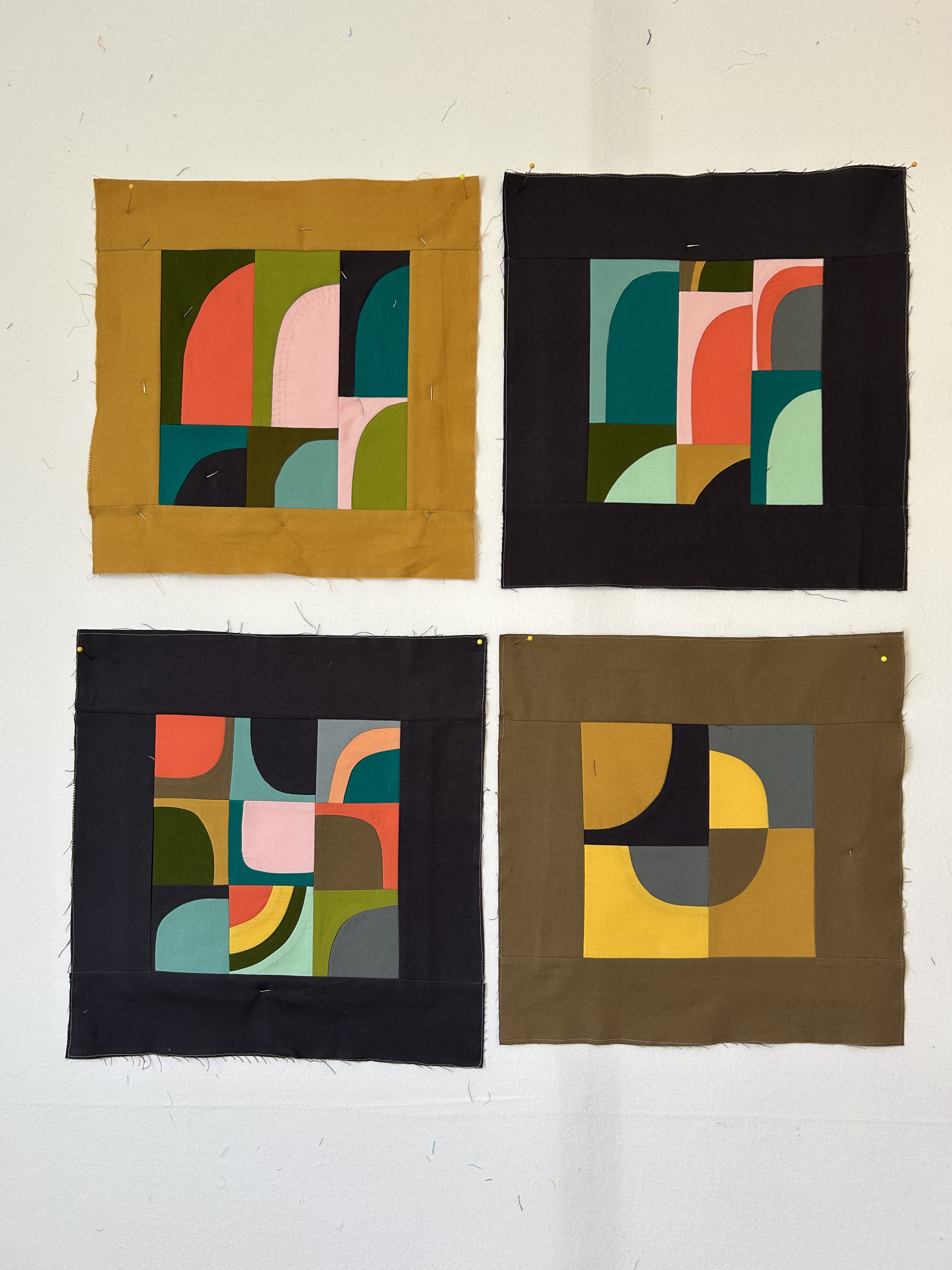
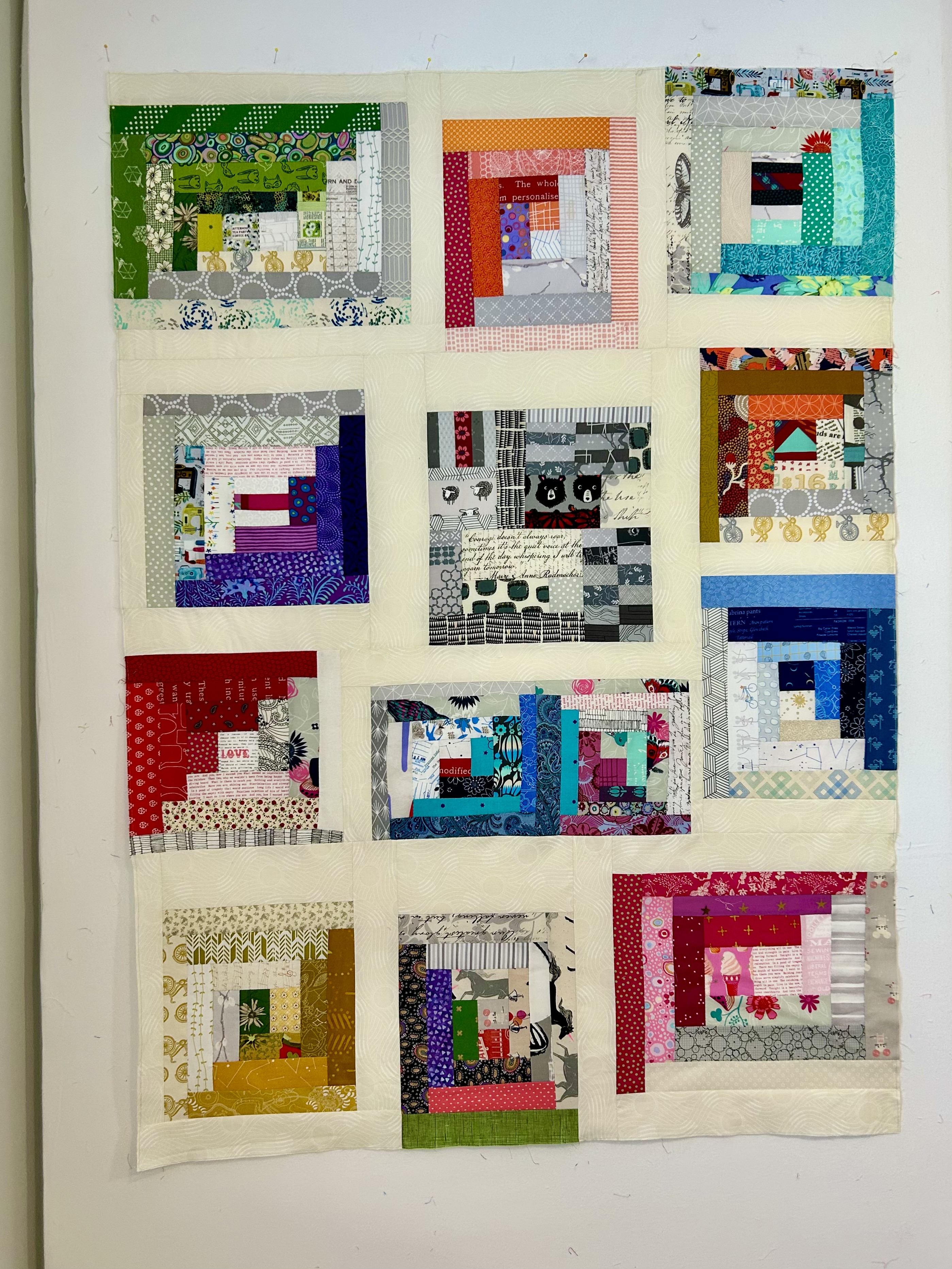
Here’s my effort. The Churn Dash block is a 9-patch block, so I made 9 blocks, using the three elements in the Churn Dash block, to create each of the blocks below. And I had a super good time doing it too. The quilt is now a big 9-patch.
The Churn Dash block is actually fairly simple: it has a center square, 4 corner half-square triangles, and 4 sets of 2-color rectangles that surround the center square.
The red block in the middle is the closest block to the original. I used the Cat’s Cradle ruler to make the four corner pieces that alter this original block unit. The extra square at the corner is part of the Cat’s Cradle half-square triangle ruler construction. (Thanks you Rick Sanchez for demonstrating this ruler to me.)
Here’s the backing, before I go on. The pantograph is New Wave, from Willow Leaf Designs, sold at Urban Elementz. But I had it made a bit larger than the regular one. (Thanks Urban Elementz.) (And thanks to longarm Canadian quilter Wendy Currie for suggesting this pantograph.). I quilted with a medium grey cotton thread from Signature. The larger panto version was trickier to use as it has a long, long stretch in one place that demands total concentration and steady hands and the need to be bodily positioned to make that sweep without pausing.). Still, you don’t really notice my bobbles unless you are super picky–the panto just blends everything together in its intensity. It provides beautiful texture.
Now I want to talk briefly about my other 8 blocks that surround the center. *The blocks discussed will be below the text.
As I went along making these blocks, I got bolder with regard to moving the three elements around the space. But this block–the last one I made–is the only one that moved the center square to another location. This center combines the 4 corner half-square triangles, now made using a riff on the curved Drunkard Path block, due to the addition of a center piece. Putting 4 of these curved blocks together makes the circle with the square in the middle. (I learned this block in my Blocks 1 online class taught by Tara Faughnan last year.) The large half-rectangle triangle represents the regular 2-color side rectangles. I used the Hurty ruler to make all the half-rectangle triangle blocks I used (Latifah Saafir). The strip of 4-patch blocks basically just rounds out this block as the 3 Churn Dash units are already present in the other two pieces of this block.
Below, the corner half-square units are intact, and the center has a circle in the middle (inset circle method learned in my Blocks 1 online Tara Faughnan class last year). The side rectangles have become curved. But, what a cool block this is! I love it. And I love that it came along inside some play time.
Below, the corner half-square triangles are the Cat’s Cradle version, and when combined, they form a larger triangle. The center square is striped, and the 4 side units are now half-rectangle triangle units combined to make a bigger statement.
Below is a simple block. The corner half-square triangles are cut with a stripe. And the side rectangles are now half-rectangle triangles set with a regular rectangle (dark blue) that surround the plain center. In this block I added a third color–the lighter blue.
Below, the Cat’s Cradle half-square triangles surround the center. Two corners are two half-rectangle triangles, and two corners combine a half-rectangle triangle with two squares, a dark and a light square that work to make the little strip of dark squares.
Below the center is a 4-patch block. The side rectangles are now stripes, and the corners are the curved block I’ve been using.
Below, there are more curves. The center is a pinwheel. The corners are the curved Drunkard Path blocks. And the side rectangles have become a 4-patch block. Hmmm. this block would make circles if you put 4 of them together.
Below, more Drunkard Path units are on the corners, the side rectangles are intact, and the center is split into parts with the addition of the small strips that break it up.
I am now wondering how some of these blocks would work out if used butted up next to each other. But that’s a project for another day.
And I will say that I could not have made these blocks without having taken Tara Faughnan’s online Blocks 1 class last year. AND, that I’m learning even more with the play of this year’s Block 2 class.
The light these days has changed a lot. There are long shadows everywhere just a little after noon. The winter solstice is coming.
But, here’s Jose starting to tile in the afternoon. The aqua blue (two coats) are waterproofing layers, due to the concrete sitting right on clay–which is like cement when dry, but like soup when wet. Thus, the staining on the concrete.
The tile is done, but grouting will come the next day.
Done!
And my “outdoor room” is ready to go again.
I spend a lot of time in this space.
There was enough tile to do the little outside platform.
I am really happy with this decision and this outcome.
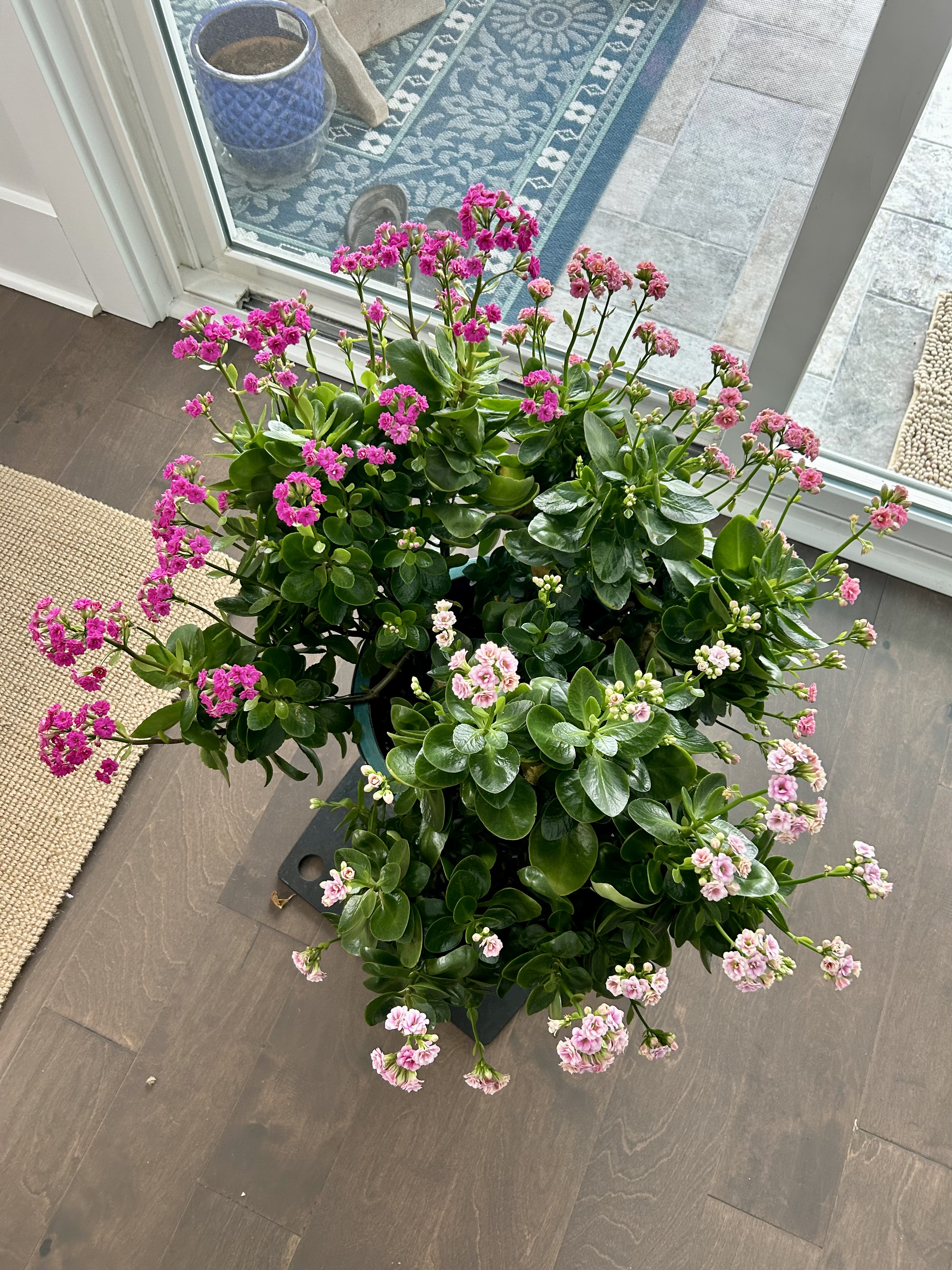
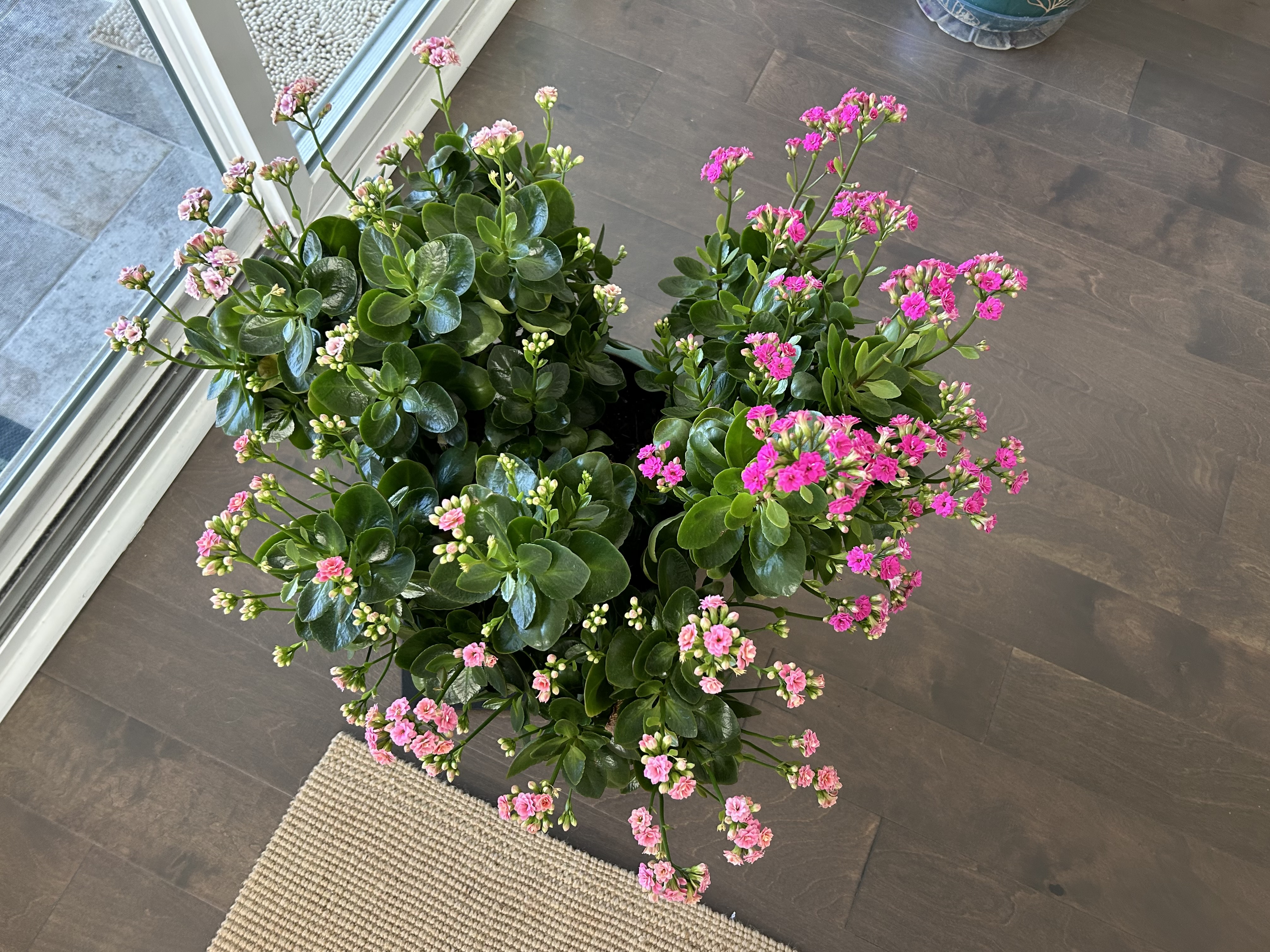
My neighbor, who moved here from California, gave me a small pot of Kalanchoe plants on my birthday in March last year. The flower heads were enormous and so colorful–the heads were made up of composite flowers all grouped together. There were three separate plants in the pot.
Kalanchoe are succulents, and they thrive in California. I knew nothing about them, as I had spent almost 20 years in Maine. The flowering heads stayed blooming for weeks and weeks before stopping.
Then, the plants started to…grow. So I repotted them sometime last summer.
Now look!
They are covered with blooms that are about to color up. They are little, not the big heads, but… How exciting!
This plant doesn’t like temps below 45 degrees, so I’m keeping a close eye on how cold it is getting at night. I will bring this big pot inside if temps drop into the high 40s.
When my neighbor comes over–often using the porch entrance–she stops to pet this plant and to exclaim over its size. It reminds her of California, of course.
I’m sorry I’ve been AWOL, sort of, these past days.
But I’ve been…busy.
The screened porch, my “outdoor room,”got tiled. My neighbors tiled theirs, and they held my hand about organizing getting mine done. It’s so pretty, and more on that in a separate post soon. The concrete sits right on the clay here, and it was so ugly, so stained and dirty looking.
I have been having so much fun with this month’s “Block 2” block in the online class with Tara Faughnan: Log Cabins. And with learning how to install blocks on stretched canvas frames. Here’s the one I mounted yesterday–using the fabric palette I pulled in early November. It’s…so handsome.
With my sweet neighbor in tow, I found Michaels’s yesterday, and they had such a lovely selection of these stretched canvas frames. And the prices were terrific! They even had a “buy one, get two more free” sale, so I came home with 3 of the 12-inch frames as well. The frame above at 18 by 24 was perfect for this piece. Michael’s has 3 levels of quality to choose from, and the cheapest one is perfect for my needs as it is thinner. All of them are coated with acid-free gesso.
I will take a picture of ALL of this month’s completed projects when I finish the last one I’ll make this month. My goal is to finish it today.
It’s time to return to the design wall projects. And, I do have the third quilt in my half-rectangle series underway. It uses the half-rectangle “hourglass” form I learned in last month’s block class, which featured the hourglass block. And today I’ll try to finish the “Crosses” scrap quilt that is all laid out and about half sewn together. (The adorable backing for it came yesterday and is already washed. I’m nearing the end of sewing down binding on the second quilt in the series so I’ll soon need another hand-sewing project.)
Both of my quilt groups met this week: one at night and one the next morning. In the modern group, our “make the Churn Dash block modern” challenge quilts were due. It was so fun to see the awesome creativity our members produced. I will do a separate post on mine soon.
I was very late to the morning quilt meeting as it was also the day to retrieve the raw milk, which comes every other week and which sells out now in a few hours. The delivery was running late, so we all just…waited. But, success, and I delivered the milk the next day to my two sons’ houses, which sometimes includes short visits at each house or outside in the driveway. I absolutely thrive on raw dairy and have for over 20 years now. (In my book, commercial dairy is a dead food that is almost, now, a fake food. No wonder it disagrees with so many people.) In two weeks I use 3 half-gallons, and I freeze one of those as an emergency back-up and just switch the frozen one out when I get the next three jugs. See the gorgeous cream on the top? Yummy!
And now it’s time to shop for the Thanksgiving dinner. I’ll provide a green salad, roasted Brussel sprouts, and the roasted carrots/sweet pepper/garlic dish I like. I went out to Chucktown Acres farm with DIL Corinne to get our organic, locally raised turkey, and they had raw butter as well, so I came home with three containers. Two went to the freezer and one went with Corinne to be used in the mashed potatoes–a dish the children have requested.
We’ve had a cold spell. Or what gets called “cold” here in coastal South Carolina. I turned on the heat this week and am in warmer clothes. And it’s been too cold to have my noon meal out on the porch, which I miss. But the cool weather is great for walking, and it is sunny and so cheerful outside. I’ll need one more grass mowing I think, but that should do it.
And, now, hurricane season is over for the year! Here, we dodged a few bullets that proved to be terrible for others in the region–and that’s a story that is still ongoing. Western North Carolina is suffering terribly.
I am having such fun with this month’s block play. Tara Faughnan gave us a whole packet of patterns that included much more than recognized log cabin forms–we also got triangles and a big hexagon. I am still playing with these patterns. (Tara uses a foundation piecing method where the template patterns printed on regular typing paper can be reused over and over.)
I noted some time back that Tara takes her small “play” blocks and mounts them on stretched canvas frames. I was intrigued…
So, what emerged for me was a really fun–and at times frustrating–learning curve. I ordered 10-inch square canvas frames, a hand-held stapler, and, eventually some felt for the back and some little sawtooth hangers.
Here’s what happened:
The hexagon was just totally scrappy, made from my strips to try out this pattern, and I will make another one as it was so fun.
I quickly learned that I needed a bigger size outer block than a 12.5 inch square to make the corners square up nicely. (There are online videos showing how to do the corners–indeed, how to do the whole process.) Something like a 14-inch square is better for me.
And, I discovered that my cheap stapler…had to go. And that maybe the staples I was using were too large, too long. The length of a staple is called its “legs.” I adore tools, as many of you probably recognize, so I purchased an electric (battery driven and rechargeable) stapler, but have not tried it yet. I also got a smaller staple. The stapler is all charged and ready to go.
For this block–which needs its dark blue border–I ordered some 12-inch canvas frames. And I can’t wait for them to come. Maybe today. (This block is made from the palette that I pulled for this month. And, yes, the yellow green fabrics featured uses Kona pickle as its key color.)
I wanted the backs to look nice, so that was a learning curve too. The trick is to get a wide enough felt backing (glued down) so that the sawtooth hanger still can work and so that the felt covers more of the back.
I redid the borders on the hexagon block so that it had wide enough pieces to go around to the back without struggling and stretching–which can throw off the alignment on the front. But this felt could have been cut wider. It was my first try. I glued it on the edges with a strong “tacky” glue–the same one I use for rope bowls to stabilize cut rope ends. (Note that the fabric on the left bottom corner is closer to being an almost perfect fold–which should run next to the edge of the canvas.)
This one is better:
Nailing the tiny nails into the sawtooth was an issue–until I used a pincher type pliar to hold that tiny nail until I got it started. (That pliar is also good to pull a staple if needed, along with a screwdriver thin enough to pry out the staple.) And I taped the sawtooth center to hold it steady while I nailed.
Now, I am waiting for the 12-inch canvases to arrive (along with more 10-inch ones). And I’m still sewing blocks. More on those later.
For this block, I made a tiny quilt and hung it in the front hall. I just used the leftover grey strips to make it–and try out this pattern. It’s kind of funky–and I like “kind of funky.”
But…hmmm. For these long skinny log cabin types, what about a rectangle frame??? I love the neat look of these blocks on stretched canvas.
This pic does not do this quilt justice. It is such a fun, fun and handsome quilt. I have loved every minute of making it–using the Hurty ruler by Latifah Saafir.
Part of the creative fun for me was changing directions of the block in an orderly manner. When you put both sides together (left cut and right cut) you get an “arrowhead.” Thus the name. If you look at the upper right block, you can see one. I then had these “arrowheads” travel down the quilt on a diagonal that ends on the loser left. It is subtle–and I love subtle patterns.
This quilt is the FIRST in what will be a series using the half-rectangle triangle.
This pic shows truer colors and better sense of the size of the block:
I quilted with a pale grey and used the same Nemesh’s Feather-Grande panto that I later used in the second quilt in this series, “Diamonds,” which came off the longarm yesterday, was trimmed, and which get its binding installed this morning. (It too is a wonderful quilt.) The backing is a great low-volume wideback from the Hawthorne Supply Company–and due to the “quiet” print, the grey thread works well.
Here’s a close-up of the “Arrowhead.”
Here’s a good look at the texture from the panto–and of my beautiful blocks.
I can’t wait to show you “Diamonds” when the binding is done. I do sew bindings by hand.
This curved leaf potholder from Amira Ameruddin–found on Instagram (amira__little mushroom cap)–really needs a bias binding. Note that I made my top and bottom as Amira showed, then used a freezer paper template to cut out my leaf as I was hopeless with freehand cutting.
Start binding on the right side of the bottom of your leaf–after choosing which side you want to be the top side of your potholder. At the pointed upper end, treat that like a normal mitered quilt corner. ***Note that when I am almost to the end, I folded the binding at the start over.
Overlap the binding and sew to the end of the potholder edge.
Back up to reinforce.
Trim the hanging strip–and turn under and press the end you just trimmed. **Note that I trimmed this one a bit shorter than I should have.
Fold the strip in half and press it so you get a center line.
Line up the cut edge with your pressed fold center line.
Press and pin the hanging strip together.
Close up the bottom side and pin. ***Note that to zig-zag (or however you want to sew down your binding) you will be doing that from the top side AND ***you will want your pins to be pinned with the heads on the bottom as you sew, so you can easily pull them out as you proceed. So, my pin below will need to be reversed when I pin the binding down.
On the top side, sew down the binding. I use a zig-zag stitch–and I remove the pins as I go around. ***Start at the side that is underneath where the binding ends–not the strip side. And just start at the edge of where the top binding lies–not on that upper binding.
When you get back to that starting point, change to a straight stitch and go down the length of your hanging strip. Sew down the folded end as best you can. It can be tricky to handle the thickness, but if you turn the potholder and use something to help the feed dogs grab the bulk, you’ll be ok. I suppose whip stitching that end closed is not a bad idea either.
Turn the loop and sew it down. ***Turn to whichever side you think would be the best back side. I found that sewing it down outside the bulk of the binding was easier.
If you missed grabbing some part of the binding, just catch it with a hidden whip stitch done by hand. I am terrible at this machine sewing down of binding–and on this curved leaf potholder with the added layer of the Insul-Brite, I think maybe is also a factor of making the binding thicker and trimming well before turning the binding and sewing it down.
This machine sewing of a binding has been a learning curve for me.
I’m getting there with each try. And these potholders are visually forgiving and will be used and washed, so there’s no need to be crazy about perfection.