Turkey Tracks: January 23, 2012
Ailey Teething
Look at all those teeth! Each one meant unsettled nights for her parents.
She’s still drooling…
This pic is my current favorite of this youngest granddaughter.

Turkey Tracks: January 23, 2012
Ailey Teething
Look at all those teeth! Each one meant unsettled nights for her parents.
She’s still drooling…
This pic is my current favorite of this youngest granddaughter.
Books, Documentaries, Reviews: January 23, 2012
FRIDAY NIGHT LIGHTS
John and I love stories. In the evenings, we watch movies or television series. We love nothing better than getting hold of a long television series which we can watch night after night. We don’t have to wait to see what happens next because we can always sit up later to watch and see. And there are no ads. And I can knit or sew quietly to my heart’s content.
We just finished FRIDAY NIGHT LIGHTS–which ran for 5 years. There are 76, wonderful episodes. We both loved the series.
Now, neither John nor I follow sports, and this series is about high-school football in West Texas. Only, it’s also about problems that people struggle with every day: politics, race, parenting, acquiring and keeping good jobs, and so forth. The characters are wonderful–not a stereotypical one in the bunch. The stories compelling, and we are still grieving that it’s really over, that we’ve watched them all.
Warning: watch the first episode, and you’ll be hooked.
Mainely Tipping Points 38: January 23, 2012
PLEASE PASS THE SALT
If you were to make me choose between sugar and salt, I’d choose salt every time. I’m almost always the first one at the table to say “please pass the salt.”
I like to think I inherited my salt-loving tendency from my maternal grandmother—Louise Phillips Bryan of Reynolds, Georgia. So, when the salt wars began in the 1970s—that time when many of the false, unscientific notions about food and body chemistry took root–I didn’t pay a bit of attention. Grandmother lived to be ninety and ate mostly local, nutrient-dense food. She ate fried bacon nearly every morning alongside her three (small) buttered pancakes, with, if she had it, homemade blackberry jam. If not, she had locally made cane syrup, whose molasses-like pungency can curl your toes.
I think Grandmother would have lived much longer if she hadn’t taken—apparently largely unsupervised– an early form of an estrogen replacement supplement. Like many women of that time, she was told that post-menopausal estrogen would help keep her facial skin supple. She died of uterine cancer.
So, given all the ongoing warnings about the dangers of salt, imagine my delight at discovering in just the past few years that there is a real salt that’s full of good-for-you minerals. It’s that reasonably priced grey, wet “Celtic” salt that can be found in our local coops (cooperative membership stores) and, sometimes, in expensive, small jars in mainstream grocery stores. (The pricy, pink Himalayan salts are also ok, but are mined, so some of the nutrients are long-gone. Nothing beats the barely processed, grey Celtic-type salt for overall health benefits.)
The first versions of this Celtic-type salt came from the coast of Brittany, in France; thus, the “Celtic” name association. According to Sally Fallon Morell and Mary Enig, PhD, in NOURISHING TRADITIONS, this real salt contains about 82 percent sodium chloride; 14 percent macro-minerals, “particularly magnesium”; and “nearly 80 trace minerals,” including “organic iodine from the minute bits of plant life that are preserved in the moist Celtic sea salt” (48-49).
This Celtic-type salt is also made in Maine, up near Machias, by the Maine Sea Salt Company. Owner Stephen C. Cook evaporates salt water in solar houses without added heat. He advertises that he never heats this water to speed up the process and never uses drying agents. He makes both the grey Celtic salt and a whiter, drier salt which might be more processed in that the water might be heated before going into the solar house. One warning: real salt attracts moisture, so store it in a covered container or a salt pig.
I’m finding that this Celtic-type salt is really salty—a little goes a long way. And, as my taste buds have welcomed real salt, I’m also finding that “pouring” fake salt with added iodine is not very—well–salty.
White sea salt has usually been highly processed with both heat and chemicals, which kills its nutrients, including the natural iodine salts. White sea salt is probably better than “pouring” salt because it isn’t a fake salt and it does not contain additives. But, be sure to check the label. It is, however, a dead food.
“Pouring” salt is a fake salt. Morell and Enig explain that potassium iodide is added in amounts “that can be toxic”–in order “to replace the natural iodine salts removed during processing.” Additives, including dangerous aluminum compounds, are added to enable the “pouring.” Dextrose is added to “stabilize the volatile iodide compound,” which turns the mixture purple, so a bleaching agent is used to turn the “salt” white again (48-49).
Morell and Enig write that the iodine in iodized salt is an inorganic version that can cause thyroid problems if used in excess. And they note further that certain vegetables, like cabbage and spinach, can block iodine absorption. In addition to Celtic-type salt, we also get iodine from “sea weeds, fish broth, butter, pineapple, artichokes, asparagus and dark green vegetables.” Morell and Enig also caution that one needs “sufficient levels of vitamin A, supplied by animal fats” to properly utilize ingested iodine. Among the signs of iodine deficiency are muscle cramps and cold hands and feet (44).
Salt is a powerful preservative. It’s also a powerful enzyme activator. Morell and Enig write that Dr. Edward Howell, the noted enzyme researcher whose work I’ve referenced in earlier essays, observed that those whose diets are composed almost entirely of raw foods, like the Eskimos, do not need much salt; but those who subsist on a diet composed largely of cooked foods, like the Chinese, require greater amounts of salt to activate enzymes in the intestines” (48).
Howell’s observation resonates with the growing body of knowledge that links much of our health to how well our gut is functioning. Anyway, Howell’s observation probably explains why I feel the need to salt the cooked foods I eat and don’t put much salt on salad. Probably, we each have already found our own salt balances and sensitivities—unless we have been needlessly terrified about salt consumption.
Morell and Enig note that early research showed a correlation between salt and high-blood pressure. But, correlation is not causation. And, indeed, subsequent research, including a “large study conducted in 1983 [Robert A. Holden et al] and published in the July 15, 1983, Journal of the American Medical Association, found that dietary salt did not have any significant effect on blood pressure in the majority of people. In some cases, salt restriction actually raised blood pressure.”
Since 1983, many studies have demonstrated not only that there are no benefits to a low-sodium diet, but that, as Morell notes in “The Salt of the Earth,” in the Summer 2011 “Wise Traditions,” which is available online, “lower sodium is associated with higher mortality.” Major studies vindicating salt are listed in a sidebar article (“More Studies Vindicating Salt”). Morell cites a 2010 “government-funded study published in the Journal of the American Medical Association” which found that “even modest reductions in salt intake are associated with an increased risk of cardiovascular disease and death.”
The Weston A. Price Foundation folks are very worried about our government’s unscientific low-sodium position. In “The Salt of the Earth,” Fallon writes that salt is “vital to health” and that there is no viable substitute. The human body’s “interior is salty, and without salt the myriad chemical reactions that support enzyme function, energy production, hormone production, protein transport and many other biochemical processes simply can’t work.”
Anecdotally, I can tell you that one of our family members fell prey to the low-sodium demonization of salt. She landed up in the hospital in a lock-down ward because she could not distinguish reality from her hallucinations and bad dreams and was utterly terrified. With restored salt levels, she reclaimed her sanity in short order.
Fallon explains that though our bodies require “salt concentrations in the blood to be kept constant,” Western people today “consume about half the amount of salt that they consumed traditionally.” Real salt, writes Fallon, “provides two elements that are essential for life and for good health: sodium and chloride ions.” Neither can be manufactured by the body, so must be obtained from food. Sodium is present in a variety of foods, but chloride ions can only be obtained from salt.
So, why do our government’s 2010 food guidelines lower salt from 6 grams to 3.5 grams—which is less than the one teaspoon of our absolute daily salt requirement? And why are food companies not objecting, since they rely on salt for flavor? Perhaps it’s because a fake chemical salt is being readied to enter the market.
January 23, 2012
Somehow I seem to have not shared with you the amazing weekend in late September/early October we spent at the Camden International Film Festivalk or CIFF, as we know it locally. We’ve attended almost since it began–maybe missing the first year. Every year it gets better and better, and it’s been fun watching many of the films we’ve seen go on to national prominence. CIFF’s national and internationational reputation is growing, growing, so that helps with the quality of the films submitted.
Many of the films have the power to blow holes in the watcher’s head. This year we saw a number of those. Among them was SEMPER FI: ALWAYS FAITHFUL–the story of one of the largest water contamination disasters in U.S. history. The location, the Marine base Camp Lejeune, where the Marines, for DECADES, covered up the fact that the drinking water was lethal. The tip of the iceberg here is that this kind of pollution is likely to be found at many military bases and is, also, being covered up. The hook of the film is that Marine (myth?) is that the Marines are one big family where family members are loved and protected.
Here’s a recent Washington Post story about the film.
And, here are some other titles to watch for or be aware of:
HELL AND BACK AGAIN–the CIFF opening night film about a 25-year old career soldier whose wounds in Afghanistan mandate his return to a civilian life and to a life where his physical well-being is compromised forever–something young soldiers, who are willing to die during service, somehow, never see coming.
DOWNEAST–this story of the struggtle to replace a closed canning factory way up “downeast” with a lobster-packing business–which replaces 128 lost jobs with new work–garnered a standing ovation from the audience–especially when the audience realized the new owner and his family were present in the audience. Entrepreneur Antonio Bussone runs headlong into entrenched local politics–to include those on the local boards who also work with lobsters and who do not want his business to come to fruition. The film is an excellent look at the complexity of local change, of what happens when businesses close locally and move elsewhere–in this case to Canada.
A “SECRET CINEMA” early screening of an unnamed film about a social movement in South Africa protesting evictions from squatter homes near major cities.
Another “SECRET CINEMA” early screening about “the unregulated international machine that produces–though ambition, emotion, greed, hope, disillusionment–beauty. Set in Russia and Japan (Russian girls are chosen to go to Japan to work as fashion models), the film details the terrible exploitation that occurs to under-age Russian girls. In many ways, the practices detailed in the film play into the sex trade.
UNFINISHED SPACES–a film set in Cuba about architects chosen in the early 1960s to design and build Cuba’s National Art Schools. The amazing buildings were halted before they were fully completed–for political reasons–and are now being completed.
BETTER THIS WORLD–a chilling film about two young men from Midland, Texas, who attend the 2008 Republican convention with the goal of protesting. But, they have been drawn into these actions by a man hired as an undercover government informant. They are arrested by a zealous prosecutor on terrorism charges, though they did nothing violent. (They made molatov cocktails, but abandoned them.) One is turned against the other through threats of prison time and promises of plea bargains. It’s a terrible story that every American should know.
A program of short films started each day, and for the first time we attended and enjoyed them.
Turkey Tracks: January 20, 2012
Some Favorite Pictures
Bryan took this picture on their visit in September. It took me a while to pry it out of his camera, but it arrived not too long ago.

We had our house trim painted in September–thus the ladders next to the rock wall. And you can see how social our chickens are. They’ll come get in your lap if you let them–which Ailey is clearing worrying about. Chickens are especially friendly if you’re eating anything. In this pic they’re after the millet treat next to us.
Here’s another favorite picture–taken over Christmas when Mike, Tami, and the four kiddos were with us.

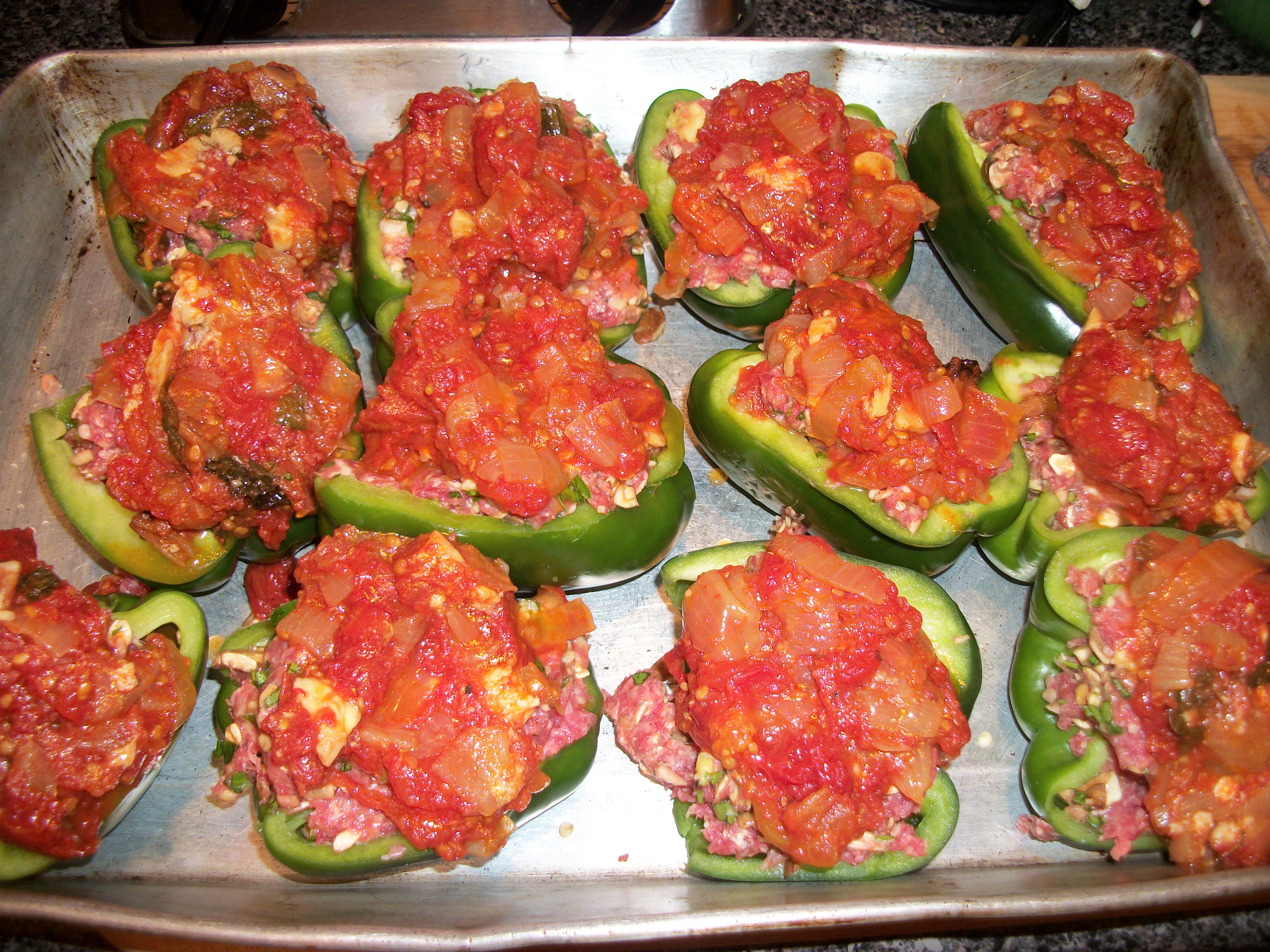
Talula and I were making stuffed green peppers–using the meatloaf recipe that’s already on this blog. Here’s another view:

Here’s a pic of the stuffed green peppers ready to go into the oven. They are topped with the roasted tomatoes I made last August and September and froze in mason jars. That recipe is on the blog as well. It takes about 45 minutes at 350 degrees to cook them.
Tami or Mike took this pic of John and Penny, who is the most affectionate dog.

Maryann came over Christmas and spent hours and hours playing with the children, who truly love her and her gentle ways with them:

Kelly came to us with a VERY loose tooth. It took days and days with all of us periodically checking “how loose is it now,” but eventually it came out. To our surprise, he lost the OTHER ONE the next day. The tooth fairy only had a $5 bill found late at night after everyone else was in bed and, so, was completely broke after two nights of lost teeth.

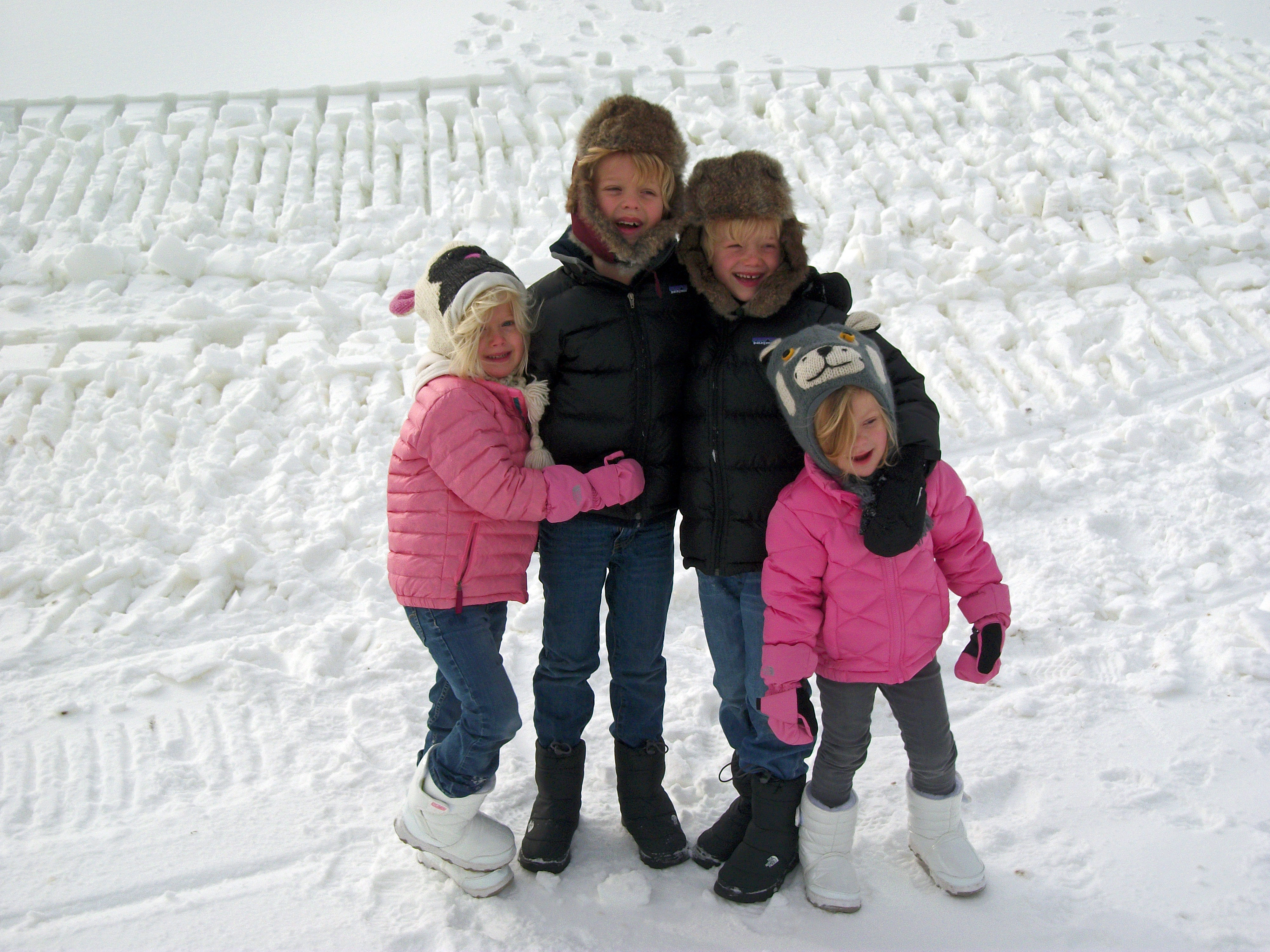
Here are the kiddos at the Snow Bowl, which is walking distance from our house. We signed them up for a week of ski lessons while they were here, and to our amazement, by Friday, the boys were riding the T-Bar lift alone and Talula had mastered the Mighty Might Lift and the beginning slope in fine fashion. Wilhelmina made progress, but kept running out of energy and would fall and lie down in the snow. (Skiing is hard work.) Her teacher told Tami the following: “This little girl won’t come up out of the snow. She told me she’d get up if I gave her chocolate.”
And, of course we got a Christmas tree. And of course it’s Maine grown.

We put it outside on the upper porch and decorated it with white lights and pine cones. We never did slow down enough to string popcorn and cranberries for it.
Turkey Tracks: January 20, 2012
Chicken Feed Recipe Posting
The chicken feed recipe is one of the most popular posts on this blog. For over a year now it ranks second in the number of hits. The first are the essays on the most recent science about the dangers of adding fluoride to our water.
I’ve had a request to repost the recipe. But, how about if I tell you how to get to it on the blog?
On the right sidebar, below the comments, is a search tab. The title of the exact post is “Chicken Feed Recipe”–and the recipe is at the end of that post. There is a picture of a jar of mung bean sprouts up front. The posting date is February 9, 2011.
You can also search the blog by putting in one of the categories: chickens, craft projects, quilting, recipes.
Now, as to the chicken feed recipe. I’ve found a local place where I can buy organic whole wheat and organic cracked corn in large sacks. (I’m forgetting the poundage and am not going out to the garage right now to check–they’re probably 25-pounders.) So I’ve been buying a sack of each of those and using about 3 parts each of the wheat and corn–then add in the other grains and peas in one-part increments. I’ve got a used big yogurt container and a lot of those BIG ziplock plastic bags, and I put all the bags of grains/peas/grit in a circle on the garage floor–the wheat and corn first as I use more of those–and fill a bag at a ziplock bag at a time with each ingredient in its proportion. I put the filled separate bags into a big plastic garbage can, and I’m good for several months. (I’ve got 8 chickens right now, and I last did this mixing before Thanksgiving. I think I pulled the last mixed bag out this week.)
Remember though that I also give my chickens a big bowl of torn bread, whole raw milk, and raw meat (hamburger usually) every morning. I add in whatever fat I’ve got from frying bacon or a meat roast and, sometimes, leftovers I think they’ll like. (They have to compete with the dogs for tasty leftovers.) In our currently frigid weather, I warm the milk for them, and they LOVE that. They purr and talk and thank me quite nicely. We’ve got frozen ground and snow, so I’m also supplementing with whatever greens I can find for them–they love kale–and I will start some mung bean sprouts for them today.
Turkey Tracks: January 18,, 2012
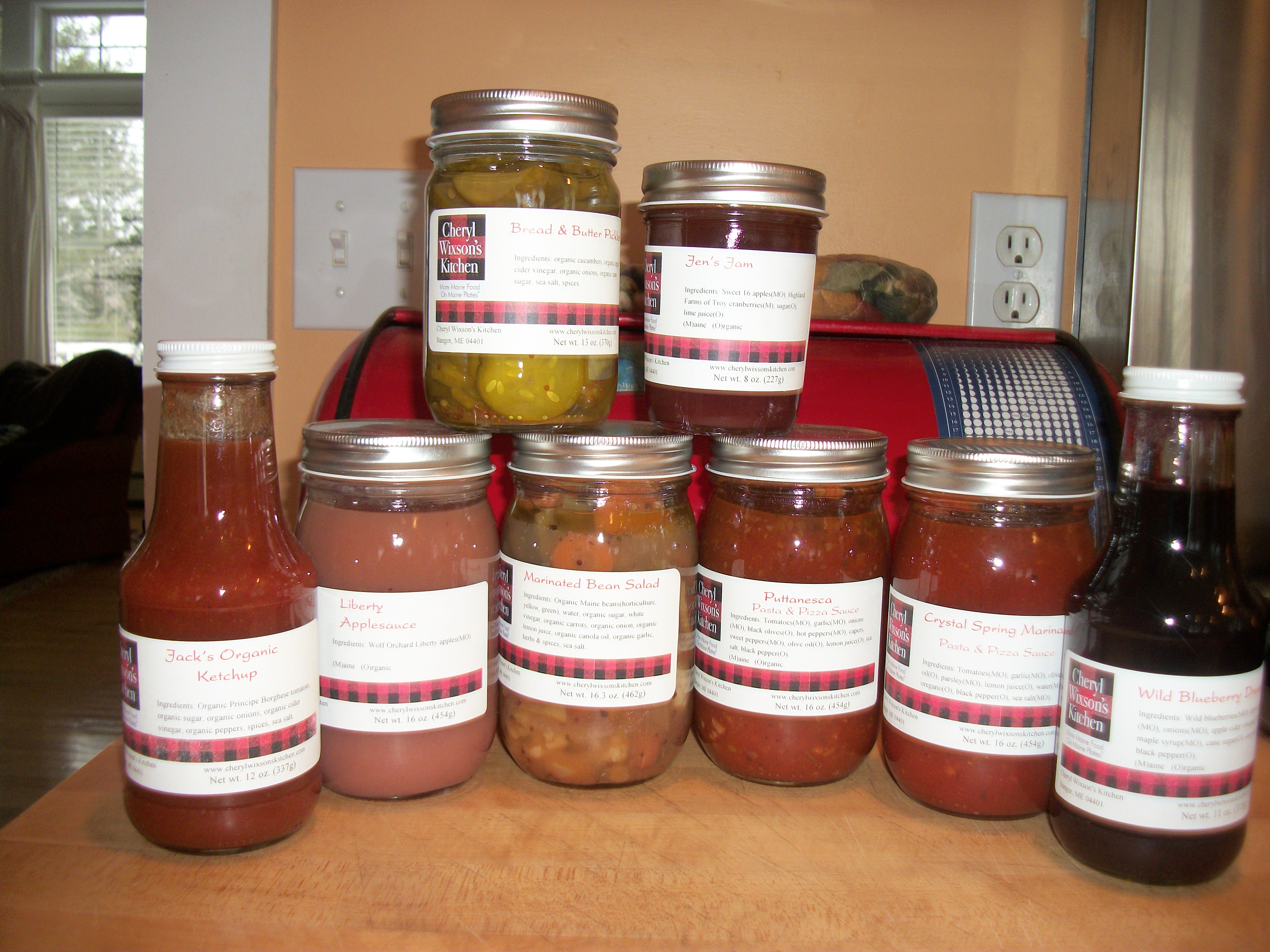
Cheryl Wixson’s Kitchen CSA Postscript
Here’s our January CSA order:

How Cool is THIS!
Turkey Tracks: January 18, 2012
Blue Tango Quilt
To continue my scrappy quilting saga and the using up of cut scraps…
At least four years ago, for a Coastal Quilters’ program, I made a set of blocks to illustrate “how to make” and the versatility of half-square triangle blocks. On the “how to make” side, I can tell you I learned early on from my Virginia quilting buddies to cut the light/dark squares you’re going to layer a bit bigger–as much as a half-inch bigger–layer the blocks, draw a line down the center diagonal, sew a quarter-inch from the center line on each side, and cut apart your blocks on the center line, press, and trim them to exact size.
At the meeting, people could place the blocks into a design on the portable design wall we had set up. There are, literally, dozens of beautiful combinations. I took those blocks, added to them, and made one of my favorite designs:
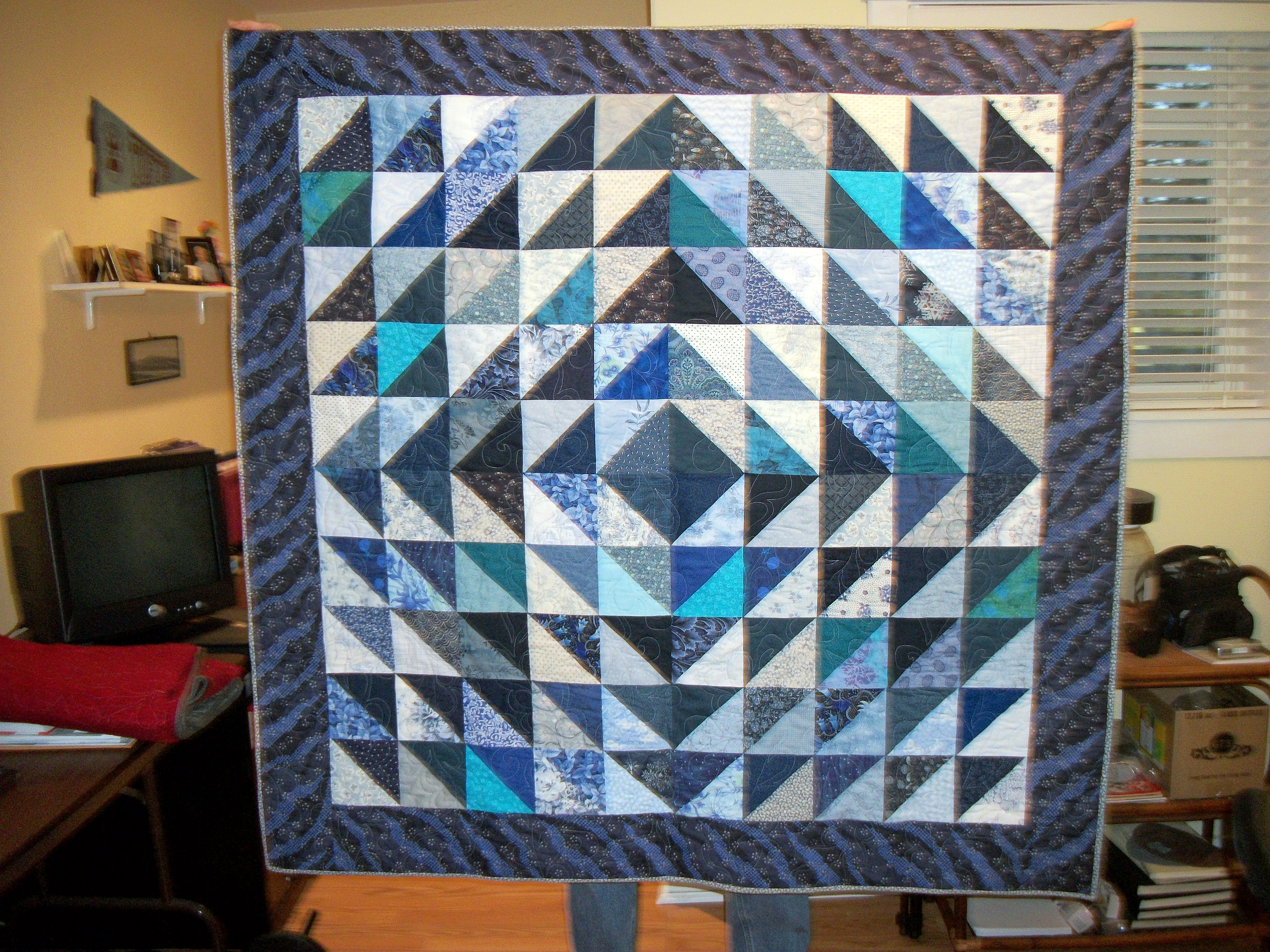
I called this quilt Blue Tango.
I had a large piece of fabric that has been in the stash for years and years that worked perfectly for both the border and the backing. I really like the very lively movement it brings to the quilt. And, here’s another light binding–something different for me as I tend toward dark bindings.
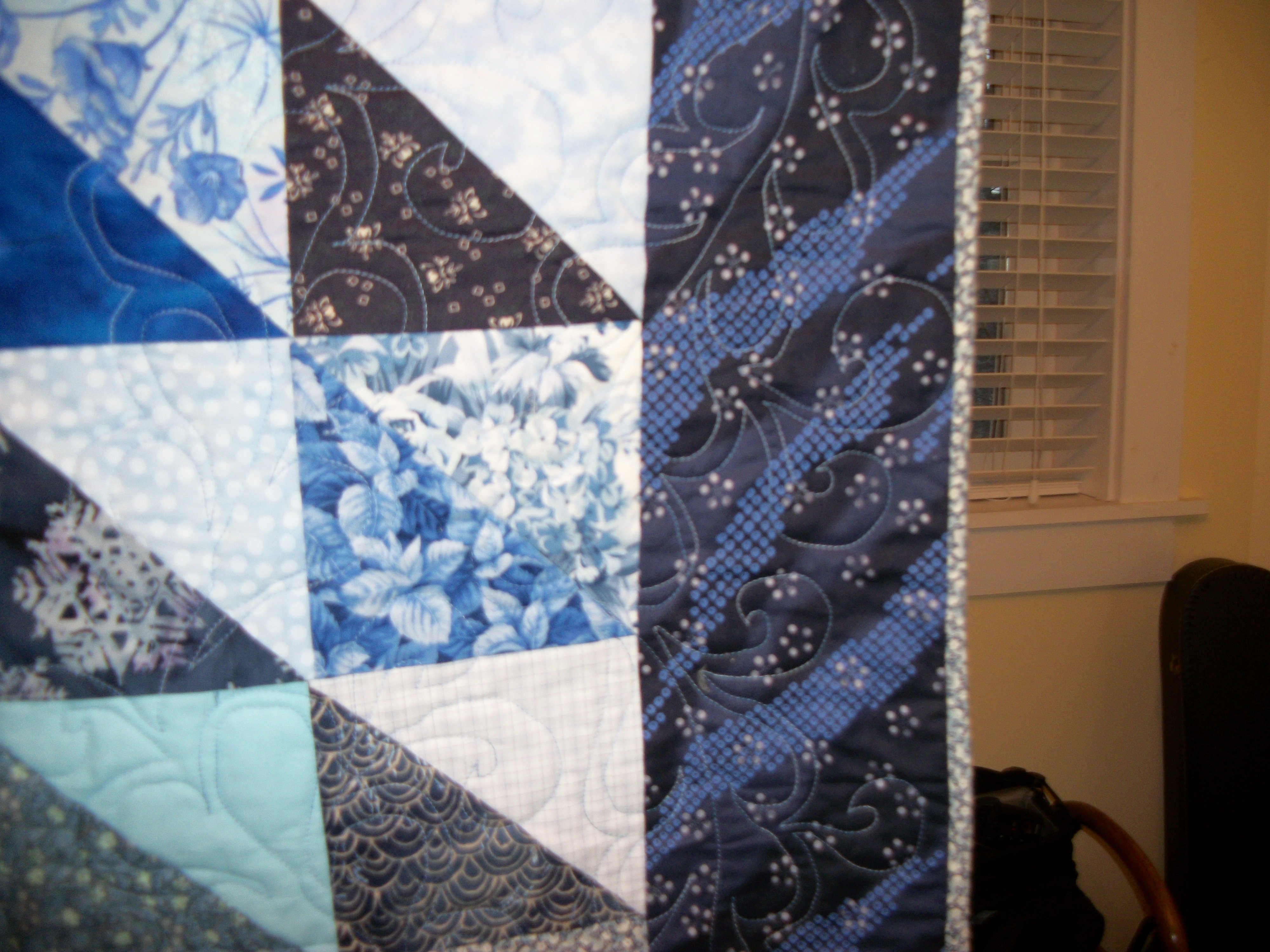
I quilted Blue Tango with the “Chocolate Feather” pantograph. I’m getting slightly better, but learning to have complete control with the machine while using a pantograph is still hard, and it’s been nice to have all these quilts to practice on.

I’m going out today to get backings for four quilt tops that are finished or nearly finished. How fun is that?
Interesting Information: January 18, 2012
Pepperidge Farm Hot Dog Buns
I bought a package of Pepperidge Farm hot dog buns when Mike and family were here in mid December. I found the leftovers yesterday–the package had fallen behind a straw basket filled with onions that sits in the front of the cabinet. The expiration date said December 18. They were still good. Still plump, soft, pristine… No sign of mold. No sign of decay of any kind. Hot dog bun Twinkies.
I’d put in a picture to prove it, but I immediately threw them in the trash–which went out to the garage this morning.
Mercy!
Turkey Tracks: January 17, 2012
Rose’s Pretty Eggs
Rose Thomas has the prettiest eggs in the whole world.
I got some over Christmas as our own flock was mostly resting and as Mike, Tami, and the four kiddos were coming.
Here’s what one sees when one opens one of Rose’s egg cartons:

The really dark brown egg is from a Copper Black Maran. The white egg on the far left is from a Barbanter. The blue eggs are from Americaunas. The rosy tan eggs are from Red Sex-Links or Freedom Rangers. I’m not sure what the other darker brown eggs are from–maybe Marans who are not painting so dark. And, that little olive egg on the far lower right is from a Cooper Black Maran and Americauna cross.
They’re like Easter Eggs, right?
And the yolk color is a deep, amazing orange.
Rose feeds organic feed grown and sold in Maine–which has some soy–since she has a big flock–but she supplements with milk when she can get it, seaweed, whole grains, greens from her hoop houses, and household leftovers, including meat and fat. On cold winter mornings, she takes her flock some warm mash–made from grains.
Please Maine farmers, grow and mix us some feed that is SOY FREE!
With a small flock, I can mix my own whole grains–and there is a good recipe elsewhere on this blog–but those with larger flocks cannot afford to do that.
 Louisa Enright's Blog