Turkey Tracks: Blackberries

Turkey Tracks:  August 14, 2010

Blackberries

“I want that jelly with the berries in it,” Talula announced this summer.  She’ll be 4 in a few weeks, and she loves to be in the kitchen with me.  She loves to eat, is discerning about food tastes already, and asks to help cook at every step. 

The jelly with the berries was blackberry jelly–an older jar made before I figured out how to get rid of the seeds with a food mill.  So far, Talula only uses it on morning toast.  She has not yet discovered the way my grandmother and I eat it:  spread on pancakes with lots of butter.  Or, a dab of it on a hot, short biscuit dripping with butter.  (Southern biscuits are not high and puffy; they’re “short” and flat, more like a pie crust. 

I’m down to one jar of blackberry jelly, and today I went and picked 4 1/2 gallons of fresh blackberries.  It took about two hours.  I was ecstatic since you never know from year to year if you’ll get more.  Last year, for instance, we didn’t get any tomatoes, so we went for two years on what I had put up year before last.  (I used the last jar of roasted tomatoes this past week.) 

It takes a LOT of berries to make a pint jar of blackberry jelly–something most people who take jelly for granted don’t know.  Homemade blackberry jelly or jam, made from wild blackberries, is a thing of joy.  It bears no relationship to what you can buy in a store.  And, it has no added “help,” like pectin.  You just have to pick a red berry or two as you go along for the pectin.  In my family, blackberry jelly was prized, and one never wasted it or ate a lot of it at one time.  One conserved blackberry jam, one treasured it, one let each bite linger on the tongue, because one pint jar of it represented not only a lot of work, but the luck of finding a blackberry patch where one could pick enough berries to make a pint jar of jam.     

Blackberries are part of my childhood.  I learned BLACKBERRY in the summers when we were in Reynolds, Georgia, the home of my mother’s parents.  When blackberries were in season, the adults would organize all the visiting cousin children and would drive us to a patch one or the other of them had found.  We had to pick until there were enough for, at least, a cobbler for dinner, which was eaten in the middle of the day.  There was always great drama since copperhead moccasin snakes love blackberry patches, and we were always scared to wade too deep into the bushes.  After dropping off the berries at the house for the cook, the adults took us swimming in the local pool at the edge of the swamp where free-flowing artesian water that was ice cold cleaned us up, soothed scratches, and made us really hungry for dinner.  

I’ve never found a recipe for those cobblers.  The crust was more like pie crust, crunchy and flakey.  And I don’t think the cobbler was lined, like a pie.  I don’t remember the inside being too watery.  I don’t remember the kind of dish they used either.  I don’t think it was a pie plate.  They used either whip cream or ice cream, but mostly, whip cream.  My father loved blackberry cobbler, and he was always a chief organizer for picking them.

Because the family gathered in the summer in Reynolds, there could be a crowd at dinner.  I remember 10 or 12 people at the table.  And, sometimes the children had to overflow to the kitchen table.  There were probably not enough berries left after the cobbler for jelly making.  Grandmother’s cook made the dinner and the cobbler.  But grandmother always made the blackberry jelly and, at holidays, special cakes and fudge.  I think the recipe I’ve evolved is pretty close to hers.  When my mother was sick with cancer, I picked, cooked, and made two jars for her, which I mailed to her with special packing.  She knew how special they were, what a gift I was sending her.  She didn’t want to take the jars to the dining room in the home where she was living.  No one else would understand, but mother knew BLACKBERRY, and she was not going to share with anyone who thought they were eating plain old jelly.   

I’m so lucky to have access to a dynamite wild blackberry patch.  I’ve been checking up on it over the past few weeks, and today was the day where the stars aligned so I could go pick.  I donned heavy pants, found my wellie boots (I only tripped and fell down once in them this outing), found an old hat, organized a pail I could line with big baggies, a rope to tie the pail to my waist so I could pick with both hands–something Maine friend Margaret taught me–filled up my water bottle, and headed out.  The patch is about 40 minutes away from our house. 

I’ll make the jelly in small batches, starting tomorrow.  I froze 3 gallons so they won’t go bad until I get to them since the full bounty of summer food is pouring forth right now. 

Next summer, I’ll have to try to teach Talula BLACKBERRY.  It’s harder when she can’t learn to pick them.  Their school starts in mid-August, so they miss the full richness of the Maine harvest.   
 

Turkey Tracks: Hope’s Edge, Our Community Shared Agriculture Farm

Turkey Tracks:  August 14, 2010  

Hope’s Edge:   Our CSA (Community Shared Agriculture) Farm  

We’ve belonged to Hope’s Edge, our CSA farm, for at least five years now.  Our pick-up this year is on Friday, and I look forward all week to driving out to the farm.  It’s a beautiful, serene space.   

What’s cool about Hope’s Edge is that Farmer Tom does not own it.  The owner and her daughter live in the farmhouse, and they have allowed Tom to build a CSA and his own house on it.  There are horses, some rescue ponies, a milk cow and a new calf, and chickens.  Sometimes there are some sheep as well.     

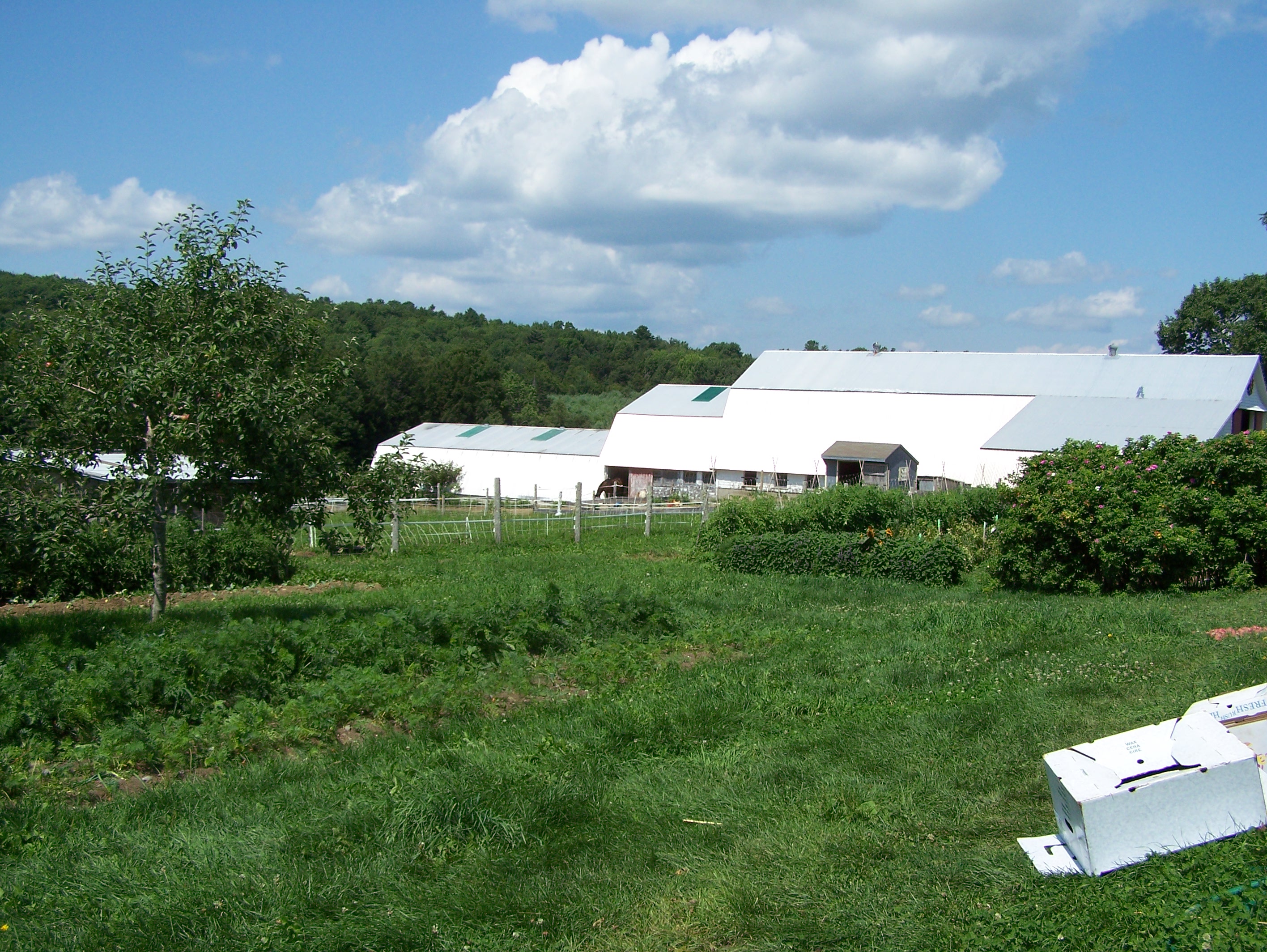
Hills circle the fields, barns, farmhouse, the CSA sheds, and Farmer Tom’s house.   A pond nestles down the hill from the barn, providing a cooling off place for hot CSA workers.  This is a view of the barn and stables from the CSA shed.  Look at how blue the sky can be in Maine.  The old farmhouse is on the far side of the barn.  In the foreground are some garden beds and the first of a line of apple trees.  


Here’s the CSA shed where we pick up our food.  Inside are refrigerators, some cooking equipment, tables, and LOTS of food.  Behind the shed are more garden beds, a huge oak with a tire swing, and a frog pond that drove our grandchildren quite crazy.  To the right there is another small barn and the entry road.  Across that road are planted crops, including a strawberry bed that gets bigger each year.   


Here’s a bigger picture of the mural.     


We picked up over 12 pounds of food this past Friday.  I could not resist putting it in my garden/mushroom basket and taking a picture:  


Cukes, zukes, tomatoes, cauliflower, broccoli, two kinds of beans (regular and Romano flat), lettuce, herbs, potatoes, an eggplant, a cabbage, carrots, and garlic.  I could have cut a flower arrangement as well, but we were tired after a morning in Augusta, and we have lots of flowers in our own garden.  

It doesn’t get better than this kind of food, does it?  It nourishes our bodies and our spirits.  

Ratatouille, I think.  But with some of the mint I brought from Maine.  And, some basil from our herb garden.

Mainely Tipping Points 15: Rearranging Deck Chairs on theTitanic: The Proposed 2010 USDA Food Guide

Mainely Tipping Points 15

Rearranging Deck Chairs on the Titanic:

The Proposed 2010 USDA Food Guide


The U.S. Department of Agriculture (USDA) and Health and Human Services (HHS) have jointly released the proposed 2010 food guide to a fire storm of criticism.  But first, let’s review recent government food guide history.   

 The USDA presented a new food guide plan and pyramid design in 2005.  It will be considered current until the 2010 guide replaces it.  The 2005 graphic is fronted by a triangle composed of colorful triangular stripes representing five food groups (grains, vegetables, fruits, milk, meat and beans).  Some triangles are bigger than others.  The front triangle is backed by a triangular set of steps with a stick figure climbing upwards.  A USDA web site (www.mypyramid.gov) allows an individual to enter personal information so that one of twelve personal pyramids is assigned.    

 Luise Light, hired by the USDA to design the 1980 USDA food guide, published WHAT TO EAT:  THE TEN THINGS YOU REALLY NEED TO KNOW TO EAT WELL AND BE HEALTHY in 2006, which in part describes how USDA  political appointees manipulated Light’s proposed guide to favor industry.  Light warns that with the 2005 food guide the USDA is trying to please everyone, makers of junk food and proponents of nutritionally important foods.  The 2005 guide, warns Light, is built around calories, which translates that “all foods are good foods.”  One has only to count calories, even junk food calories, to be healthy. 

 But, Light explains, by shifting “the emphasis away from best food choices to a new food democracy where every food is equal,” the USDA ignored “research over the last ten years” that shows “the types of foods, ingredients, and eating patterns that are beneficial for health and weight” (85-86). 

I believe this strategy also removes responsibility from industry for producing unhealthy foods.  By emphasizing individual choice, it becomes the individual’s responsibility not to eat that which makes him or her fat or sick—even though highly processed fake foods, tainted foods, and chemically poisoned foods fill national supermarkets. 

Light explains that “more than half of all consumers in a nationwide survey” responded that they were confused by the new pyramid.  Yet, the USDA allocated no funds to promote the new guide.  Rather, the USDA planned to task industry with helping to educate Americans about food choices.  Light notes that the Idaho Potato Commission immediately announced that carbohydrates, including potatoes, are the best fuel for muscles. 

 But, Light reminds, in reality, the food guide was never meant to be “a tool for health promotion based on the latest scientific studies about healthy eating.”  And, she asks if it isn’t time that nutritional questions are “answered by knowledgeable, independent authorities without a vested interest.”  Right now, people are “told different things at every turn by physicians, teachers, dietitians, the government, and food marketers” (85-86). 

The government released the 2010 proposed food guide this spring and scheduled public hearings and organized a web site for public comments.  Criticism involves, in part, the fact that the proposed guide not only continues down the path that has produced a national obesity epidemic and chronic health problems, it ups the ante on its unscientific position regarding dietary cholesterol and saturated fats by further lowering recommended daily levels.  Under the new rules, one cannot eat an egg.  Or, cheese.  Yet eggs—nature’s perfect food–have sustained humans for thousands of years.  And, properly prepared cheese is a nutrient-dense food.              

Sally Fallon, President of the Weston A. Price Foundation (WAPF), in the winter 2009 WAPF quarterly journal WISE TRADITIONS, agrees that the 2005 guidelines were “not based on science but were designed to promote the products of commodity agriculture and—through the back door—encourage the consumption of processed foods.”  The 2010 guide, Fallon writes, is an exercise in rearranging the deck chairs on the titanic.”  Indeed, Fallon notes, “putting the USDA in charge of the dietary guidelines is like letting the devil teach Sunday school (“President’s Message,” 2-3).   (See www.westonapricefoundation.org for extended analysis.)  

Fallon notes that the “USDA-sanctioned industrialization of agriculture,” has resulted in “a huge reduction in nutrients and increase in toxins in the American diet.”  Government food guides “have caused an epidemic of suffering and disease, one so serious that it threatens to sink the ship of state.”  The 2010 proposed guide is “a recipe for infertility, learning problems in children and increased chronic disease in all age groups.”  And, Fallon notes, while a growing number of Americans are figuring out what’s wrong with government-sponsored nutritional guides, millions in hospitals, nursing homes, prisons, and schools are trapped in the “Frankenstein creation” which is “a tragic and failed experiment” (2-3).   

 The American diet, Fallon notes, contains widespread deficiencies in the fat-soluble vitamins A, D, K, and E.  But, Fallon explains, “there is no way for Americans to consume sufficient quantities of these critical vitamins while confined to the low-fat, low-saturated fat, low-cholesterol, low-calorie cage of the USDA dietary guidelines” (2-3).  

The WAPF argues that dietary cholesterol is a precursor to vitamin D and that our cells need cholesterol for stiffness and stability.  And, the WAPF warns that the USDA committee is ignoring “basic biochemistry” that “shows that the human body has a very high requirement for saturated fats in all cell membranes.”  If we do not eat saturated fats, the body makes them from carbohydrates, but this process “increases blood levels of triglyceride and small, dense LDL, and compromises blood vessel function.”  Further, high carbohydrate diets do not satisfy the appetite, which leads to higher caloric intakes, bingeing, rapid weight gain and chronic disease.  This diet is “particularly dangerous for those suffering from diabetes or hypoglycemia, since fats help regulate blood sugar levels.”

The USDA committee’s solution, Fallon explains, is to “eat more `nutrient- dense’ fruits and vegetables.”  But, Fallon notes, “fruits and v”egetables are not nutrient-dense foods.”  Nutrients in plant foods do not compare with “those in eggs, whole milk, cheese, butter, meat and organ meats.”

Fallon points out that some USDA committee members are concerned with “the choline problem.”  Choline is “critical for good health and is especially necessary for growing children.  If choline intake is too low during pregnancy and growth, brain connections cannot form.  And, if choline is abundant during developmental years, the individual is protected for life from developmental decline” (2-3) 

Excellent sources of choline are egg yolks and beef and chicken liver.  Fallon notes that the National Academy of Sciences recommends amounts of choline consumption that violate the USDA’s proposed cholesterol limits.  So, she argues, “while we watch in horror the blighting of our children’s lives with failure to thrive, learning disorders, attention deficit disorder, autism and mental retardation, the committee is sticking to its anti-cholesterol guns.”  

Analysis on the WAPF web site details how the USDA committee has swept “the dangers of trans fat under the rug by lumping them with saturated fats, using the term `solid fats’ for both.”  This categorization hides the “difference between unhealthy industrial trans fats and healthy traditional saturated fats.”      

Also, notes the WAPF, the USDA committee has promoted “an increase in difficult-to-digest whole grains,” without specifying that all grains, nuts, seeds, and beans need to be soaked to remove the powerful antinutrient phytic acid.  (More on this subject later.) 

I agree with the WAPF assessment that the 2010 guide should be scrapped and that “the committee members should be replaced with individuals who have no ties to the food processing industry or to universities that accept funding from the food processing industry.”  I’ll bet Luise Light does, too.

Turkey Tracks: Zucchini Fritters

Turkey Tracks:  August 9, 2010

Zucchini Fritters

One of my neighbors called me a few days ago.  “Would you like some zucchini?” he asked.

Certainly not!!!!  We are swimming in zucchini.  But, I was more polite.  “No thanks, but thanks for asking.”

Later in the week I stopped by and saw that some of their zucchini had gotten away from them.  About 12 zucchini, the size of zeppelins, were stacked on a counter.  I felt very superior since I ruthlessly go through my plants and pull the zucchini when they are still young and tender. 

Between Hope’s Edge, our CSA, and our garden, we have tons of zucchini.  I get out the food processor and grate them and freeze them into small baggies.  The grated flesh is great in soups all winter, especially with a dollop of frozen basil oil or, even, pesto.  Summer comes rushing back in the first mouthful.  (For basil oil, just process wads of basil with enough olive oil to make an oily mixture and freeze in a small container with a little oil on top.)

Years ago, friend Barbara Melosh gave me a recipe for zucchini fritters, and John asks for it often.  It’s dead easy.  Here it is:

Zucchini Fritters

3 cups shredded zucchini (approximately 2 medium)

2-4 Tablespoons scallions, minced

2-4 Tablespoons parsley, minced

3/4 cup AP flour

1/2 teaspoon baking powder

1/2 teaspoon salt

2 eggs, lightly beaten

Mix together zucchini, scallions, and parsley.   Combine flour, baking powder, and salt.  Add to vegetables and stir.  Add eggs.

Saute in mixture of butter and olive oil until browned–approx. 2-3 minutes per side.  I’ve decided that it’s best to make small-sized fritters as they cook through a little faster.

ENJOY!

On the way to run an errand this morning, I pawed through the zucchini and Lord!!!!  There was a zeppelin zuke.  How did that happen???

Here is Maryann Enright with our zeppelin-sized zucchini:


Turkey Tracks: Granddaughter Quilts

Turkey Tracks:  August 6, 2010

Granddaughter Quilts

I’m behind on making quilts for the people I love.

Indeed, Mike and Tami and Bryan and Corinne have never gotten wedding quilts.   I do have those planned and in one case, fabric collected.

But, while Talula, who will be 4 this September, has a drag-around quilt, she has never gotten a special quilt from me.  And, Wilhelmina has nothing.  She will be 3 this September.

So, I started this past winter to remedy this situation, and I gave both girls their quilts when they came to Maine in early July.

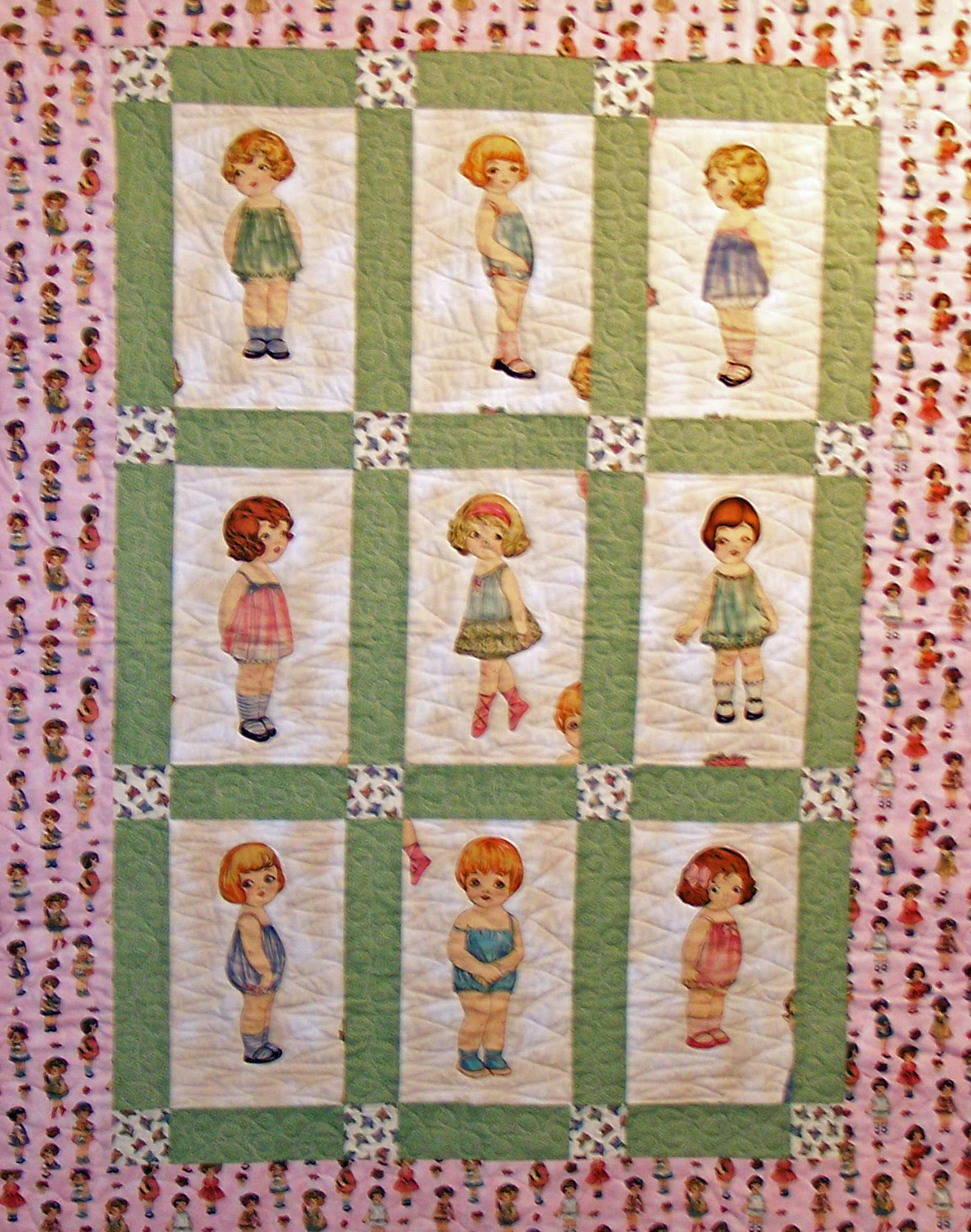
Talula’s quilt has dolls in their underwear.  I made separate clothes for the dolls, fused them with fusible fleece, and they stick to the dolls beautifully.  Talula likes dressing the dolls.  So do I. 

Here’s a picture:  it’s not a great picture as it makes the quilt look crooked, and it isn’t.


Here’s a close-up of some of the dolls dressed with dress, shoes, and a hat:


The  kit came from Fons and Porter–eventually–because apparently the market underestimated the popularity.  When it came, unlike the photo in the magazine, other dolls and decorations intruded on the individual doll blocks, as you can see.  Did they air brush those out?  Or, did they just get greedy?  And, you have to decide which line of dolls to cut, as you cannot cut one line without ruining the adjacent one, which has different dolls.  So, you have to buy more fabric to get to both sets.  Bah Humbug Market!!!

Wilhelmina’s quilt is called “Nursery Rhymes,” and was also from a kit.  Sewing with kits has been a new thing for me and is undoubtedly due to the influence of my Virginia friend, fellow quilter, Rosie Pilkerton.  Rosy loves kits, and she makes the cutest quilts, especially for children.  She and I bought the Nursery Rhymes kits together at the Mid-Atlantic Quilt Show in Williamsburg, VA, a few years back.  I took mine to our quilting trip this past February, and Rosie was offering to sell me hers after a few days.  This kit has a million tiny pieces.  I worked on it night and day all week and had to bring it home to finish it.

I love the prairie points.  They’re my first believe it or not.   


Now you can see all the tiny, tiny pieces.

So, Bryan and Corinne are expecting a girl around Thanksgiving.  Corinne and I had a terrific time one day while she was here picking out fabrics for receiving blankets, the backing for what will be a colorful babyl quilt, and very upscale and interesting fabric for a diaper bag. 

The wedding quilts are on the back burner again!!!!

Mainely Tipping Points 12: The 1980 USDA FOOD GUIDE

Mainely Tipping Points 12

The 1980 USDA Food Guide


The tipping point for our current national relationship to food begins in earnest in the 1970s.  There are many facets to this fifty-year history:  massive national changes are never simple.  History shows these changes were not made for good scientific reasons.  They were made from a bubbling stew that contained, at least, potent, but unsupported beliefs; unchecked political power; the personal advancement of some; and corporatism.        

One piece of this much larger history begins when the USDA hires Luise Light, M.S., Ed.D., to produce the 1980 USDA food guide which would replace the “basic four” guide.  (The food pyramid guide arrives in1992.)  When the USDA call came, Light had just finished her graduate studies and was teaching at New York University.  Light’s book WHAT TO EAT:  THE TEN THINGS YOU REALLY NEED TO KNOW TO EAT WELL AND BE HEALTHY (2006) documents what she calls the “bizarre” something that occurred during her time at the USDA (17). 

The first USDA effort to establish national dietary guidelines came from Wilbur Olin Atwater, an agricultural chemist, in 1902.  Atwater introduced the notion that the calorie is a good means to measure the efficiency of a human diet.  Atwater calculated which foods produced which amounts of energy, and he stressed eating more proteins, beans, and vegetables and less fat, sugar, and other starchy carbohydrates (www.healthy-eating-politics.com/usda-food-pyramid.html). 

In 1917, Caroline Hunt devised the first USDA food guide.  Hunt came to the USDA from the University of Wisconsin-Madison, where she was director of the home economics program (http://eatdrinkbetter.com/2009/12/07/how-long-have-we-known-what-to-eat/#more-2637).  Hunt ignored Atwaters advice to limit fat and sugar intake and emphasized newly discovered vitamins and minerals.  She divided foods into five groups:  meat and milk, cereals, vegetables and fruit, fats and fatty foods, and sugar and sugary foods (www.healthy-eating-politics.com/usda-food-pyramid.html). 

In 1940, the National Academy of Sciences released the first Recommended Dietary Allowances (RDA), and the USDA, in post-war 1946, when food is no longer under war-time restrictions, released a new guide which offered seven food groups supporting the RDA requirements.  Once past milk, meat, and grains, the categories are somewhat incoherent:  milk and milk products; protein products; cereal products; green and yellow vegetables; potatoes and sweet potatoes; citrus, tomato, cabbage, salad greens; and butter and fortified margarine (www.healthy-eating-politics.com/usda-food-pyramid.html). 

Other guides, which contained contradictory advice, existed.  So in 1956 the USDA revised its guide to the “basic four”:  milk, meat, fruits and vegetables, and grain products (www.healthy-eating-politics.com/usda-food-pyramid.html).  But, by the 1960s, writes Light, “rising rates of heart disease, high blood pressure, stroke, and diabetes” prompted a “furious debate” among nutritionists about “whether the basic four food groups were more of a marketing tool for food commodity groups than a useful technique for improving eating practices and protecting the public’s health” (13).  In the late 1970s, the USDA decided to redo the food guide.    

 Light devised a plan for the new food guide “based on studies of population diets, research on health problems linked to food and nutrition patterns, and the newest dietary standards from the National Academy of Sciences “(15).  She convened two expert groups “representing both sides of the government’s nutrition `fence,’ agricultural scientists who studied nutritional biochemistry and medical scientists who studied diet and chronic disease.” The new guide would, for the first time, “target levels for fat, sugar, sodium, fiber, calories, and trace minerals” (15). 

The daily guide Light and her team recommended is as follows, with lower servings for women and less active men:  five to nine servings of fruits and vegetables; two to three servings of dairy; five to seven ounces of protein foods (meat, poultry , fish, eggs, nuts, and beans); two to three servings of whole-grain breads, cereals, pasta, or rice; four tablespoons of good fats  (olive, flaxseed, expeller cold-pressed vegetable oils); and limited amounts of refined carbohydrates.  Fats would provide 30 percent of calories, and sugars, no more than 10 percent of calories (17). 

Light sent the new food guide, which was in the form of a pyramid, to the office of the Secretary of Agriculture (a political appointee), and it came back changed.  Servings in the whole-grain category were increased from two to three servings to six to eleven servings, and the words “whole grain” were eliminated.  Dairy was increased from two to three servings to three to four servings.  Protein foods went from five to seven ounces daily to two to three servings.  Fats and oils went from four tablespoons to “use moderately.”  And sugars went from no more than 10 percent of the diet to “use moderately” (17).  The pyramid form was gone. 

Light was horrified, furious, and feared, especially, that the whole-grain alteration would increase national risks of obesity and diabetes.  Light laments the notion that any product with wheat (white bread, Twinkies, Oreos, bagels) would now be considered equivalent to a whole-grain product with intact fiber and nutrients.  She laments the fact that when Congress later set the USDA guide into “legislative `stone,’ “ it became illegal not to serve the expanded number of grain servings—which affected all publicly funded food programs, like the food stamp program and the public school lunch programs.  She laments the plight of poor people who would now feel hungry all the time as cheap carbohydrates would not fill them up and would make them fat.  And, she laments the loss of credibility and integrity of a USDA tasked with being a source of reliable nutritional information, but which had ignored deliberately “research-based dietary advice” in order to “bolster sales of agricultural products” (17-21).     

Thus, Light notes, Americans increased their “consumption of refined grain products from record lows in the 1970s to the six to eleven servings suggested in the new guide.”  By the 1980s, Americans were consuming one hundred forty-seven pounds of wheat flour and cereal products, and by 2000, two hundred pounds, for an increase of 25 percent (21).  And, presently, two-thirds of Americans are overweight or obese (3).  Additionally, “we’re continuously massaged by subtle, misleading persuasions to forget the consequences and indulge today” (5). 

Food, Light writes, is a big part of what some have called a “third industrial revolution” (4).  We are now “eating foods and ingredients unknown to our ancestors and even to our parents and grandparents.  Our foods have changed dramatically, but our nutritional requirements still mirror those of our ancient Paleolithic ancestors” (9).  Light writes that “in the past fifty years food has been transformed into packaged products designed by industrial engineers for long shelf life, profitability, and repeat purchases.”  And, “after sixty years of eating `scientifically,’ we seem to have reached the moment of truth.  The great Western experiment in reinvented food has proven itself to be a health disaster” (31). 

Additionally, as our environment has changed drastically, we struggle now with serious air, water, and soil pollution.  “Pollutants stored in our tissues,” writes Light, “cause damage to our immune and neuroendocrine systems, impairing our health and inhibiting our ability to digest, absorb, and utilize the nutrients we consume” (10).  And, “pollutants can raise nutrient requirements leading to nutritional shortfalls that interfere with growth, reproduction, bone strength, muscle tone, and body functions.”  This syndrome of “nutritional malaise,” Light assesses, is causing as many as 70 million adults to “suffer from some form of digestive malady…”—which is, in turn, producing more serious diseases, like diabetes, high blood pressure, cancers, osteoporosis, asthma, and arthritis” (10).  Worse, “genetic damage from toxic products can be passed on from one ge-neration to the next…” (241). 

Light’s ten rules for healthy eating center on not eating polluted, synthetic food, which includes industrially raised animals and eggs; on eating nutrient-dense whole foods; on eating natural fats (butter, olive oil, and nuts) and avoiding synthetic fats (highly processed vegetable oils, like soy, corn, safflower, cottonseed, and canola); and on avoiding all refined and processed foods. 

In 1992, eleven years later, the USDA issued a revised food pyramid which endorsed what Light calls “a healthy eating message” that has “never been so explicit again” since it, in turn, was altered along the lines heard in the era of the basic four food groups:  all food is good food (246-247).

Turkey Tracks: Birthday Quilt

Turkey Tracks:  July 16, 2010

Birthday Quilt

I love my birthday.  It’s March 17th, and I look forward to it every year. 

This year, the grandchildren sent me a special present:  a paper quilt.

I loved it on sight.

And, I propped it on the wall in our craft/laundry room area, but didn’t get it hung until just before they came.

Here’s what it looks like:


You can see their names at the top.  I love the colors.  And, I think it’s the coolest quilt ever.

Mainely Tipping Points 13: The Failure of the Low-Fat, High-Carbohydrate American Diet

(Oops!  Read TP 12 first; it’s part of a series in the essays) 

Tipping Points 13

The Failure of the Low-Fat, High-Carbohydrate American Diet


 When Luise Light and her team of experts attempted to scientifically formulate the 1980 USDA Food Guide, they accepted two current dietary ideas as truth:  fat should be no more than 30 percent of the diet, and since the end of World War II, and especially in the 1960s, Americans had been experiencing “rising rates of heart disease, high blood pressure, stroke, and diabetes” (13, Luise Light, WHAT TO EAT:  THE TEN THINGS YOU REALLY NEED TO KNOW TO EAT WELL AND BE HEALTHY).

Current historians show us that the low-fat premise that has governed the American diet for the past fifty years sprang from belief, not science, and became part of American cultural and economic practices when the stars aligned around a constellation that included the political power of a congressional committee, media acceptance of its recommendations, and the firmly-held beliefs of a handful of people.

Science writer Gary Taubes, in his myth-exploding article “The Soft Science of Dietary Fat,” published in “Science” magazine in March 2001, questioned the idea that there ever was an epidemic of heart disease after World War II (http://www.nasw.org/awards/2001/The%20soft%20science.pdf).  When Taubes interviewed Harry Rosenberg, Director of the National Center for Health Statistics (NCHS), Rosenberg said a heart disease epidemic never existed.  First, in 1949 the International Classification of Diseases (ICD) added arteriosclerotic heart disease as a new category under the general category of heart diseases.  Between 1948-1949, the new category appeared to raise coronary disease death rates about 20 percent for males and 35 percent for females. 

Again, In 1965, the ICD added a category for coronary heart disease, which added more deaths to the statistical data as physicians began using the new categories.  Furthermore, Rosenberg explained, by the 1950s, Americans were healthier, so more were living to be 50-year-olds who would go on to die of chronic diseases like heart disease, which physicians were now listing on death certificates under the new categories.  Taubes reports that Rosenberg said that, in actuality, risk rates of dying from a heart attack remained unchanged.

Taubes also discussed the fact that between 1989 and 1992, three independent research groups (Harvard Medical School; The University of California, San Francisco, funded by the U.S. Surgeon General’s Office; and McGill University, Montreal) used computer models to work out added life expectancy for a person eating a low-fat diet that controlled saturated fats.  All three models agreed, but their conclusions have been ignored by media. 

The Harvard study showed that if a person’s total fat consumption was less than 30 percent of their daily total calories and if their saturated fat consumption was 10 percent of that 30 percent, a healthy nonsmoker might add from 3 days to 3 months of life.  The latter two studies showed net increase of life expectancy would be from three to four months.  Taubes noted that the U.S. Surgeon General’s office tried to prevent the University of California study from being published in “The Journal of the American Medical Association (JAMA), but JAMA published it in June 1991.

The Lipid Hypothesis is the “scientific” paradigm calling for a low-fat diet.  The Lipid Hypothesis is the premise that ingested fat, especially saturated fat, raises blood cholesterol levels, and high cholesterol levels cause chronic heart disease (CHD).  Yet, many, many scientists now have argued that these cause-and-effect links have never been proven and, in fact, cannot be proven.  More recently than Taubes, Michael Pollan, in IN DEFENSE OF FOOD (2008), traces this history and current thinking on dietary fats in a section entitled “The Melting of the Lipid Hypothesis” (40-50). 

So how did the Lipid Hypothesis and the low-fat paradigm get installed with scant scientific data to support it?  Biochemist Ancel Keys is a key player.  In the mid 1950s, Keys (University of Minnesota) claimed that his epidemiological Seven Countries Study showed a correlation between the consumption of dietary fat and heart disease.  But, an epidemiological study cannot control or eliminate variables, and correlation is not proved causation.  Furthermore, many now, among them Taubes and Uffe Ravnskov, claim that Keys eliminated countries whose statistics did not fit his hypotheses, like France, Holland, Switzerland, Norway, Denmark, Sweden, and West Germany, where national populations ate 30 to 40 percent of their calories as fat and whose death rates from CHD were half that of the United States.  Nevertheless, in 1961, the American Heart Association began advocating low-fat diets for men with high cholesterol levels.

Also in the 1950s, Nathan Pritkin, was diagnosed with heart disease.  Though he had no college degree and no scientific training, Pritkin created and published a low-fat, aerobic exercise regime that sold millions of copies.  Pritkin also suffered from leukemia, and it began causing complications and pain in the early 1980s.  Pritkin committed suicide in 1985.        

In 1977, the Congressional Select Committee on Nutrition and Human Needs, chaired by Senator George McGovern, promoted the low-fat hypothesis—despite objections by scientists expert in the field.  Taubes determines that “a handful of McGovern staffers…almost single-handedly changed nutritional policy in this country” by initiating “the process of turning the dietary fat hypothesis into dogma” (4).

In 1976, Taubes reports, after two days of testimony, this committee turned “the task of researching and writing the first `Dietary Goals for the United States’” over to Nick Mottern, a labor reporter with “no experience writing about science, nutrition, or health” (5).  Mottern relied on Harvard School of Public Health nutritionist Mark Hegsted’s low-fat beliefs.  Hegsted, unlike E. H. Ahrens, whose laboratory at the Rockefeller University in New York City was doing seminal research on fat and cholesterol metabolism, saw no risks associated with such a major change to the American diet.  Ahrens, as early as 1969, was concerned that eating less fat or changing the proportions of saturated to unsaturated fats could have profound and harmful effects on the body (3-6).  Nevertheless, the Select Committee published Mottern’s dietary guidelines. 

Next, Taube relates, Carol Tucker Foreman, a political appointee at USDA who later forms a public relations and lobbying firm whose clients have included Phillip Morris, Monsanto (bovine growth hormone), and Procter and Gamble (fake fat Olestra), hired Hegsted to produce “Using the Dietary Guidelines for Americans,” which supported the McGovern Committee Report.  Foreman hired Hegsted despite the fact that Philip Handler, National Academy of Sciences (NAS) President and an expert on metabolism, had told her that Mottern’s Dietary Goals were “`nonsense’ “ (6).

When NAS released its own dietary guidelines a few months later (watch your weight and everything else will be all right), the media criticized the NAS for having industry connections.  Hegsted later returned to Harvard where his research was funded by Frito-Lay.

So, a consensus was achieved, oneTaube says is “continuously reinforced by physicians, nutritionists, journalists, health organizations, and consumer advocacy groups such as the Center for Science in the Public Interest” (1).  And, science was “left to catch up” (7).

 Only, science never has.  And, what has emerged is that all calories are not equal and substituting carbohydrates for fat has caused weight gain and diabetes.  And, according to lipid biochemist Mary Enig, substituting highly-processed fats for time-honored, traditional fats is causing chronic heart disease.   

Pollan notes that in a 2001 review of the relevant research and report by “prominent nutrition scientists” at the Harvard School of Public Health, “just about every strut supporting the theory that dietary fat causes heart disease” was removed, except for consuming trans fats and consuming fats that alter ratios of omega 3 to omega 6 fatty acids (41-42).  Pollan notes the Harvard scientists stated the following in their report’s second paragraph:  “`It is now increasingly recognized that the low-fat campaign has been based on little scientific evidence and may have caused unintended health consequences’ “ (43).    

Pollan assesses that the low-fat ideology of nutritionism has been nutrition’s “supreme test and, as now is coming clear, its most abject failure” (41).

Turkey Tracks: Mid-July

Turkey Tracks:  July 16, 2010

I’m not sure where the past month has gone.  We are in full summer in Camden, Maine, so we are outdoors a lot.  And, the grandchildren came in early July (almost 7, 5 1/2, almost 4 and almost 3), so we are preoccupied with spending time with them.  They arrived just as our first strawberry patch ever was closing down, and they picked out the rest over the next few days.

Our strawberries are “Sparkles.”  John had some years back announced that he didn’t like strawberries and wasn’t eating any more.  Home grown, heritage strawberries turned him around, and he couldn’t get enough of them.  These berries bear no resemblance to commercial strawberries that are the size of golf balls and are sour and which are coated with up to 8 or 9 heinous chemical mixtures.  Sparkles fill your mouth with the taste of warm sunshine and sweetness.  I was able to freeze a fair amount of them, and we have been making ice cream with them.  If you have a food processor, it’s dead easy.

Food Processor Ice Cream:

Put several cups of real heavy cream (if you can’t get it, don’t waste your time or waistline eating the pasteurized stuff as it has no vitamins or enzymes in it, only empty calories) or plain yogurt or keifer (hopefully made from real milk) into the bowl of a food processor.  Add something sweet to taste–honey or maple syrup.  If you use stevia, make sure you aren’t using one with rice maltodextrin as that stuff is bad for you and nasty tasting–it’s a fake chemical food.  Add at least 1 Tablespoon of Arrowroot (buy it in bulk; it’s way cheaper)–it’s what makes the mixture smooth.  Turn on the processor, pour in at least 3-4 cups FROZEN fruit, and voila!  Lovely, soft ice cream.  If you have leftovers, add a Tablespoon of some liquor to keep it soft.  We never have leftovers…

Raspberries are coming in now, and mine are going to produce enough for all of us to eat and share.  We’ll probably go to a local organic farm to pick raspberries to freeze for winter.  There’s a pie I want to try as well, from one of Ruth Reichl’s memoirs.  (If you have not read the three memoirs and love food and cooking, you may want to read them:  Tender At The Bone, Comfort Me With Apples,  and Garlic and Sapphires.)  

Blueberries are around the corner.  I’ve ordered 15 pounds of organic berries to freeze for winter smoothies and cobblers.  Commercial blueberries, even the heralded small “wild” berries of Maine, which are by far the tastiest, are sprayed with an array of chemicals–some of which get into the local water and kill the fish and amphibians.  Some kill birds, bees, butterflies, etc.  If they kill those living things, they can kill you!  Or, make you really sick.  In fact, blueberries made the Environmental Working Group’s list of foods to avoid this year at position No. 5.

Here’s what the garden looks like now, with Bowen (almost 7) in front:

The plant on the right with yellow blooms is Beedy Parker Kale.  That’s garlic on the left, with celery and radish in front.  The potatoes are coming up well to the right of Bowen’s shoulder.  We’ve picked peas until we’re tired of them.  Beans are coming on strong.   That’s a yellow squash up front.  And, we’ve got broccoli to cut in the middle of the garden.

Here’s the dreaded zucchini, with lush tomatoes in front of the day lilies and raspberries fringing the yard:


 We have 14 winter squash and pumpkin hills in the meadow and Brussel Sprouts, cabbage, and more broccoli along the driveway. 

The chicken report is a bit different.  Our broody hen has given up trying to sit on eggs, though I suspect one of the Wheatens is starting to get the urge.  Here’s a picture of the chicks Rose Thomas incubated in June:

These chicks are Americana/Wheaten and Maran.  None of the Marans made it. 

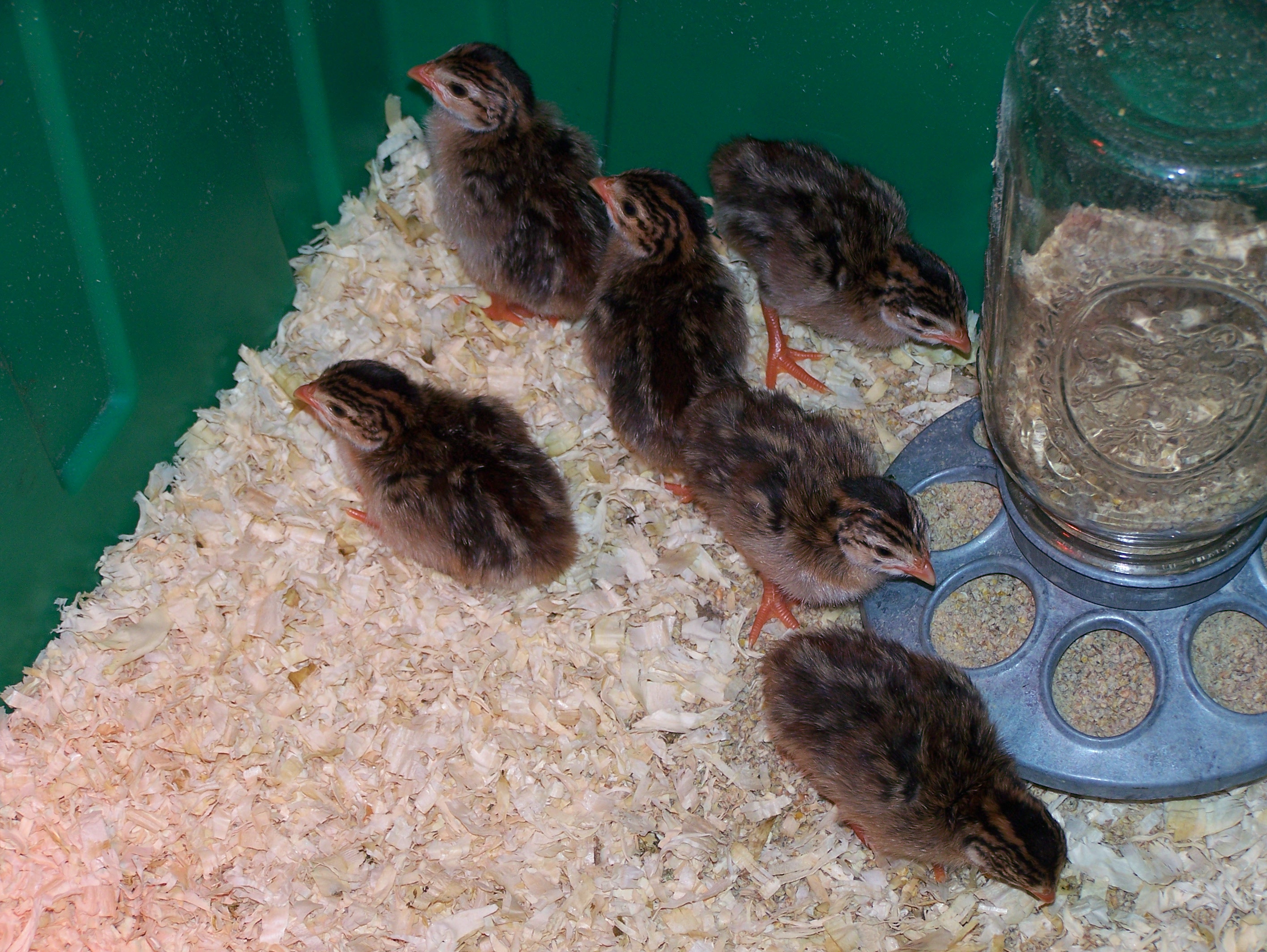
Here’s a picture of the six Guinea hens she also incubated:

Guinea hens take 26 days to hatch.  Chickens take 21.  So, Rose was quite proud of these babies.  She also had a hen sitting on eggs in the middle of the chicken pasture.  That hen will stay there 26 days, with the male close by.  Guineas lay eggs communally, but only one hen will sit the eggs.  I wonder if something like that goes on with chickens as our broody hen gathered all the eggs underneath herself out of our two boxes, and the other hens seemed to be cooperating. 

I started over 20 eggs timed to hatch July 14th.  One caught me by surprise on the 12th and tried to hatch in the egg turner with the humidity too low.  It didn’t make it out of the shell.  One hatched.  The rest are dormant.  We will open them later today to see what the story is.  Were they unfertilized?  Did something go wrong? 

The Marans are proving hard to hatch…  But, the one chick we have, named Orphan Annie, seems to be thriving.  Rose thinks her Maran, who recently hatched a brood, might take her.  But, she is rapidly becoming a pet…

So, everything is growing well:  veggies, fruits, chickens, and grandchildren.

Turkey Tracks: A Quiet Sunday in June

Turkey Tracks:  June 14, 2010

A Quiet Sunday in June

Yesterday was filled with small pleasures.  It was a soft day.  The clouds sat right down on the mountain tops, and the fog bank drifted in and out over the land.  We went for a little ride in the car to poke around and pick up a few things, like ice cream cones in town.  Here is Shirttail Point, our swimming hole on the river.  Note the clouds on the mountain beyond:


The truck belongs to three people in a canoe who came up just after I took the picture.

The garden is doing well.  Here is a picture of what it looks like now, with the chicken fence down:

The pea trellis is filling up.  The garlic (on the right) looks good.  In the distance, you see flowering kale.

Here is a picture of the tomato bed, which currently houses 20 plants, and along the curve, our raspberry plants.

Our strawberries are also starting to show color.  We planted them last year, but knocked off their blooms for the first year so the plants would establish themselves. 

This year, the red poppies finally bloomed.  I initially planted them in a spot that quickly grew too shady and had to move them.  This is their third year, but their first to bloom.  The blue flowers are, I think, Cantebury bells.  My shadow, Miss Reynolds Georgia, who is 8 this year, gets in the picture.

Penelope, Penobscot Bay (PenBay), Penny cannot stand to be left out:

I put alyssum into the steps every year.  And, Lady’s Mantle (the light green) grows like a weed in Maine.

One of our errands was to pick up some trout worms, meant for fishing, for the chickens.  Twenty-four (24!!!!) worms sell for $3 at Megunticook Market.  I justify this outrageous expense because of the pleasure it brings and because I can no longer drink wine, unfortunately.  I also tell myself that one of our fabulous local products, an ice cream sandwich called a Dolcelino, sells for $3.50.  I’m not sure I’m forgoing those in order to buy some worms though…  Here are the chickens eating the worms.

Nappy, the rooster, calls the hens to come, come, come eat this thing she has brought.  He stands over the treat and bobs his head up and down, trilling the call.  The hens come running, running.  (One of the Marans is broody, so she stays in the coop; one of the Wheatens was laying an egg and missed the treat.)  The Marans try to run off the Wheaten, so she only gets a few unless I throw some to her especially.  Today I just threw the whole lot into the pen.  I don’t think Nappy ever gets any of the worms.  He gives them all to the hens while he guards them.  I’ve tried to offer him some just for him, put to the side, but he just calls the hens for those.   

This morning, for the first time in a month, the broody hen (May May) came out of the coop with the others.  I’ve been having to lift her out and to put her in front of food before she will eat.  She goes into a kind of zone where her feet don’t work, so you have to pick her up and down until she, gradually, walks to the food. 

They don’t seem to mind being penned, but they are much quieter and less active.  They miss their walks.