Turkey Tracks: July 25, 2012
The Dog House Chickies
As you may know from earlier posts, Americauna Wheaten hen Sally started getting broody in June–followed now by her sister Nancy. Both are about three years old this summer. All the hens started laying eggs under Sally–in the egg box she chose and, later, in the little doghouse–until finally I gave up and let her sit on four eggs–two blue eggs from the Wheatens and two brown ones from the Copper Black Maran hens, who are paired by a CBM rooster, Cowboy (picture below). I marked each egg with a black cross so I could tell them from the eggs the other hens continued to lay under Sally–who sat with eyes glazed over, “in the zone,” day after day–not eating or drinking unless she did so in short bursts at night. “Those hens want babies” was John’s comment one day when I fished 10 eggs out of the dog house before I agreed with Sally that she could have some eggs now as I would be home to oversee her care.
I allowed only 4 eggs as I wanted to see if letting a broody hen sit in the coop would actually work as the other hens and the rooster are also there with Sally at night. Also, I have limited space, so I can’t manage a lot of new baby chicks who will grow up and need to live in the coop this winter. Also, we cannot keep any new roosters, and half of whatever hatched will be roosters. I’m going to have to rehome (very difficult) or kill the roosters. Roosters fight each other fiercely, and the object of our small flock is having eggs, first and foremost.
At one point I tried to move Sally to the dog house with her eggs, but she would have none of it. She did not recognize her own eggs; she ran around the pen screaming in outrage and panic before retreating to her egg box. I had to move all the eggs back beneath her in the coop.
I neglected to write down the actual start date, and it has seemed like the longest 21 or so days ever. Every day I had to go out and pick up Sally to get the fresh eggs from beneath her while leaving the marked ones–while she puffed herself up and fussed at me and while Cowboy threatened to attack me from behind. Some days, Sally would have moved all the eggs out of the egg box to the main part of the coop. Some days Nancy would be sitting on two of the eggs–always the brown ones though. It was as if Sally always knew which eggs belonged to her breed. There was so much moving around of eggs–and sometimes leaving one out overnight–that I had little hope that they would actually hatch. I wondered when they would start stinking, and Sally would give up.
Two days ago, I lifted Sally, and beneath her was a wet clump of black feathers. Startled, I put her right back down.
A baby chick had hatched.
I called Rose Thomas immediately–my chicken guru. “Move her and the chick into the doghouse tonight and put the three other eggs under her. She’ll stay there now that she has a chick,” said Rose. I reprepped the doghouse–getting water and feed bowls ready and grinding up feed for the baby to eat when ready.
With shaking hands, I moved hen and chick–now a handful of black squirming feathers and long, long legs. It was dark, so I couldn’t get a really good look at her (oh I hope it’s a “her”), and I didn’t want to upset them more than I had to. She popped right in that doghouse, and the new baby popped right under her mother.
Nothing happened yesterday. I could not see under Sally to check on the hatched chick or the eggs. But, Sally’s eyes were bright, and she was eating again, and I thought could hear peeping. The chick has survived the night.
This morning early, I could see another of the blue eggs was trying to hatch. The egg was out in front of Sally, and the chick was about halfway out of the egg, with one long leg pumping the air. I could hear what sounded like more peeping than one chick could make coming from the inside of the dog house. Had one of the Maran eggs hatched???
Imagine my surprise when I checked on the mother and the babies in the early afternoon as Sally is very near the door, and her movements are causing the bedding to foul the water jar. The baby chick had made no progress at all in getting free of the shell. None!
I reached in to touch her and realized she was very dry. The shell had stuck to her. So, I took her in my hand and realized that she was really so stuck that she couldn’t get any leverage to get out. Gently, again with shaking hands–she was so very, very tiny–I began to pull the shell bits from her feathers, trying to free her.
There was one place, near her bottom, where dried blood had really stuck her to the inside of the shell. I was able to get her free without any further damage. But, she was tired, and when I gave her drops of water, she drank thirstily. I don’t know if I did a good thing or not… But I could not watch her struggle so fruitlessly any longer.
I turned and realized all the hens had surrounded me and were watching, watching, and listening to the cries the tiny grey baby was uttering. And, probably, the cries from inside the doghouse.
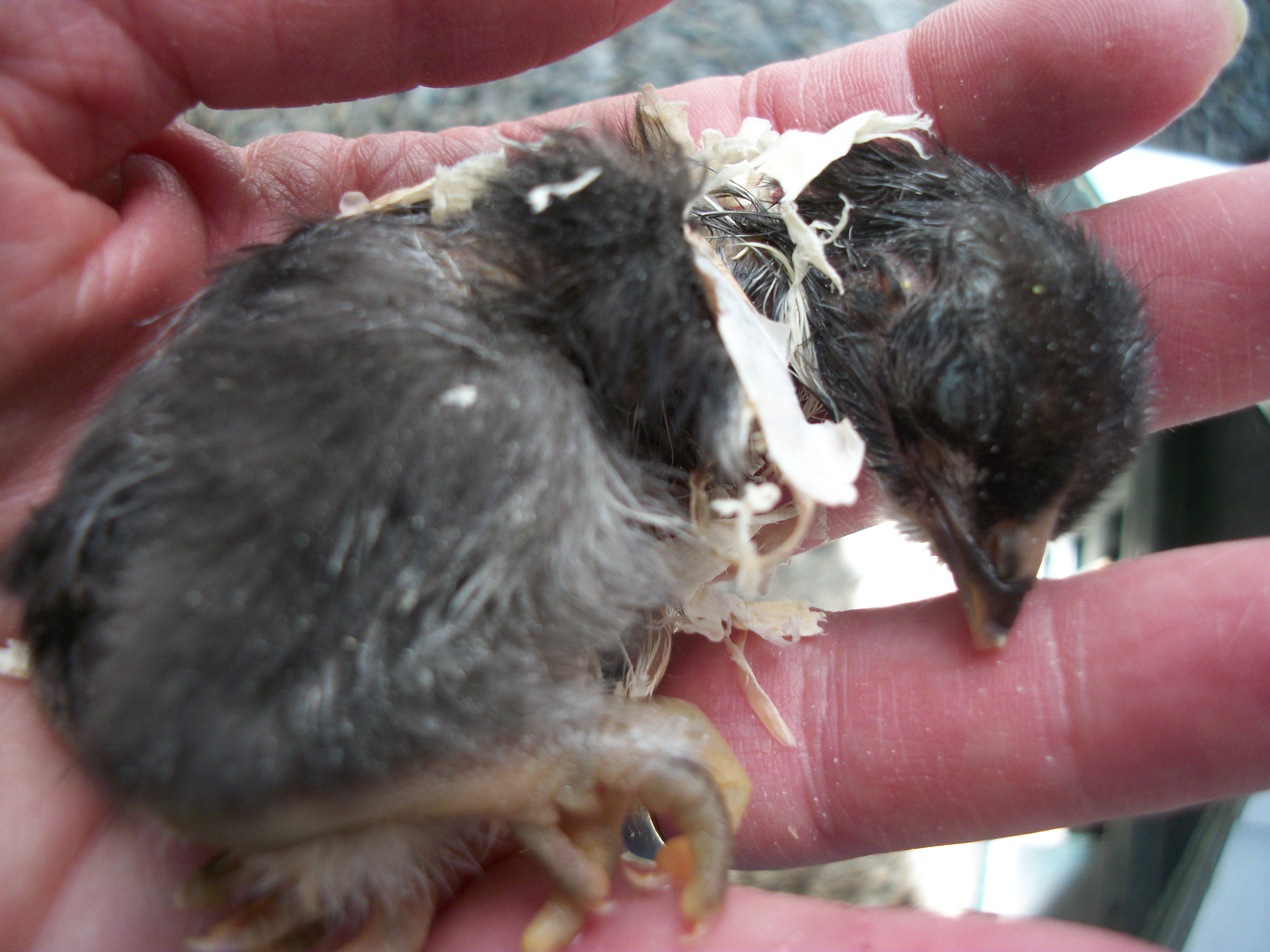
Here she is–she’s a silvery grey color–with yellow legs–with bits of shell clinging to her feathers:
The camera got some good shots inside the dog house without using a flash, which I didn’t want to do. Here’s Sally with two of her chicks hatched and the last egg, the fourth egg, hatching. One chick is in front of the water bottle and the other is just beyond her tucked beneath Sally. The grey chick is trying to get beneath Sally’s feathers :

Here’s another good shot of the chicks and the hatching egg:

Here’s the proud papa with, perhaps, a mother of one of the two CBM babies–chickie Annie that I raised two summers ago:

Mercy! What an adventure! Life happens. It just happens.



 Louisa Enright's Blog