Turkey Tracks: January 25, 2011
Sunday Cooking:
French Onion Soup Dinner
We have some friends here in Maine who LOVE French Onion Soup. Jack and Barbara Moore own the schooner Surprise, which takes people out of our Camden harbor for day sails during the summer. They went to Tufts with John, and we did not know they lived here when we first began to get serious about moving to Camden. We attempted to rent a cottage from them in January 2004 for the summer of 2004, and John realized who they were. We all met at Boyton McKay for lunch (Phil had cooked vegetarian French Onion Soup), and the three old friends reconnected. (Boynton McKay has the best pancakes in America–seriously, it does.)
A week or so ago, Jack and Barbara invited us to dinner at the newly renovated cottage we once rented–it will now be their home–and it is beautiful–and I promised to make them French Onion soup. Traditional French Onion Soup begins with a sturdy beef stock, but many French soups just use vegetables and water (leek and potato soup, for instance), though Julia Child always has a variant for a good bone broth stock. In the winter, especially, bone broths are more prevalent because people are eating hearty meats for warmth. And, if you know me at all, you know I’m a passionate advocate for good bone broths. They are nutrient dense and provide minerals we do not easily get elsewhere. Besides, they allow the use of all parts of an animal. Nothing gets wasted and it’s healthy to boot. How can you go wrong? Also, onions are storage vegetables, so we have a lot of them in the winter. What a French Onion soup is, in the end, is a way to use what is prevalent in the winter season, and use ingredients in the most delightful way.
However, Barbara is mostly a vegetarian, so I promised her I’d make a vegetarian French Onion Soup. And we invited them for Monday night, so I started by making a really good vegetable stock on Sunday afternoon: 2 celery stalks (you don’t want too much celery), some celeriac I had from Hope’s Edge which is mild, 2 big onions, 3 spring onions greens and all, chard stalks, a small turnip, a parsnip, a few potatoes hanging around the potato basket, 4 carrots, three or four garlic cloves smashed, some of the parsley I froze, some dried lemon thyme, a bay leaf, and some good unrefined sea salt (which is full of minerals like magnesium and good for you, unlike the fake salt in the grocery store which I never buy). I would have used 2 leeks and 1 onion if I had had leeks. Once assembled and brought to a boil, lower the heat, and simmer for about an hour. You will have gotten all you need from the vegetables by then. Let the stock cool and strain it through a colendar. In this household, the dogs get the carrots the next morning mixed into their raw meat, and the chickens get some carrots, the chard stalks, the turnip, parsnip, and a few of the spent potatoes. If you can’t part with the vegetables, pull off a bit of the stock and puree the vegetables in it, reheat, pour in some heavy REAL cream or put a few tablespoons of butter on top, and you have another lovely soup. If you don’t have animals, you could compost the spent vegetables. If you don’t have a composter, put them outside under a shrub. They don’t have any fat in them, so they won’t attract vermin, and you won’t be adding, mindlessly, to the waste stream. The shrub will thank you.
Anyway, here’s what the broth looked like on the stove. Isn’t it pretty?

Roughly speaking, here’s what you need for the soup ingredients:
2 quarts of stock minimum–I probably use 2 1/2 quarts–and at least 1/2 cup dry white wine (red isn’t bad if you’re using a beef stock)
8 or 9 medium to large onions cut pole to pole and sliced into 1/4-inch slices (I use more than Julia who calls for 5 cups I think)
1 tsp. salt, a pinch of sugar, 3 Tablespoons of butter, and 2 Tablespoons of other fat (olive oil, coconut oil, tallow, lard)
Grated swiss cheese–good swiss which is sweet, not bitter, is usually European in origin. And, if you like, the following enrichments: 3 Tablespoons of Cognac, egg yolks ( 1 to 4)
Really good French Bread Baguette
While the stock was cooking, I sliced up the onions, put them into a HEAVY pan with the butter, oil/fat, and salt, and on medium heat, began caramelize them. When they have all melted down, add the bit of sugar which will help caramelize the onions. Hang around the kitchen and stir them up every couple of minutes. Keep the heat from being too hot. You don’t want to burn them.
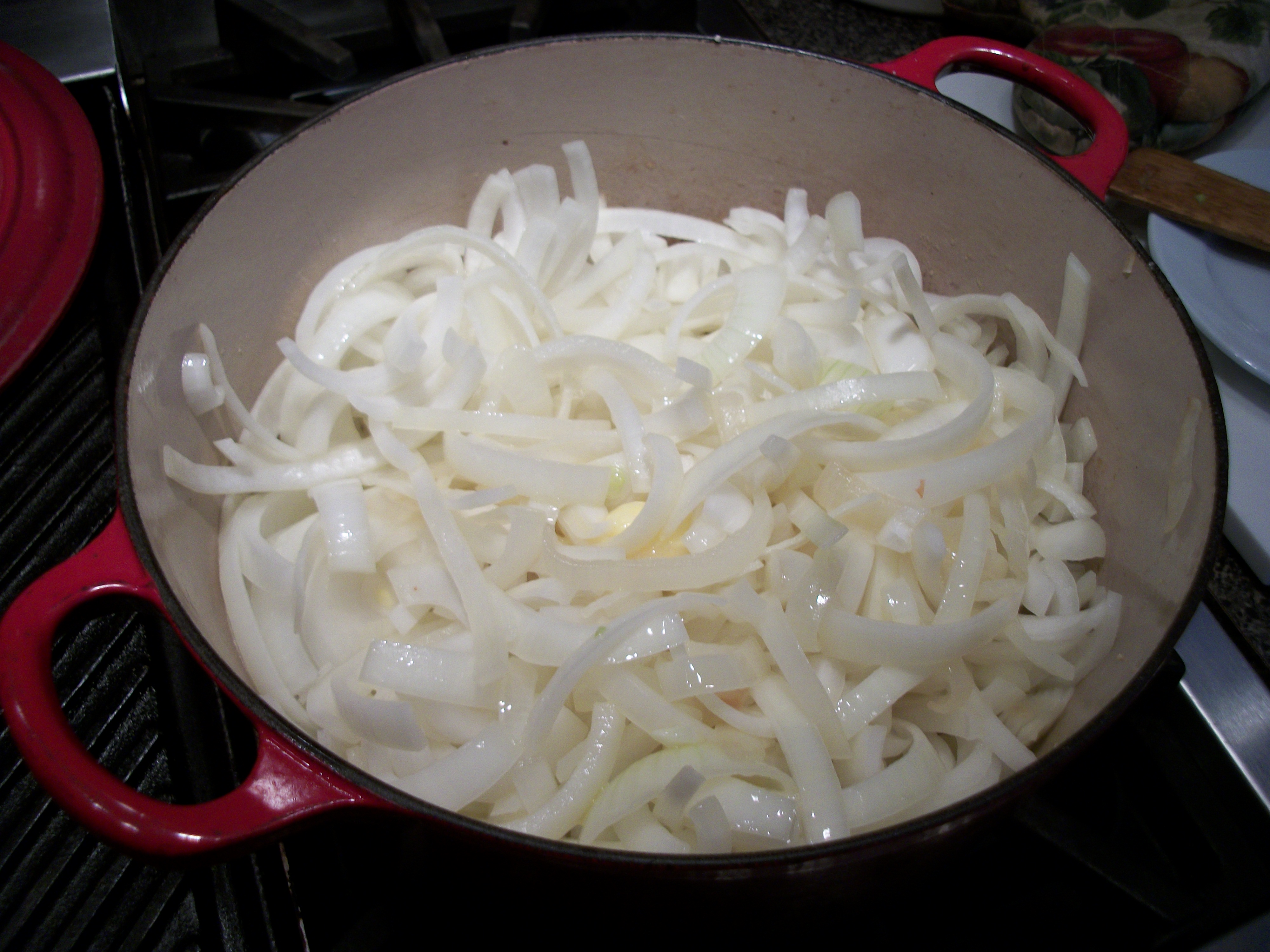
Here are the onions getting close to being done:
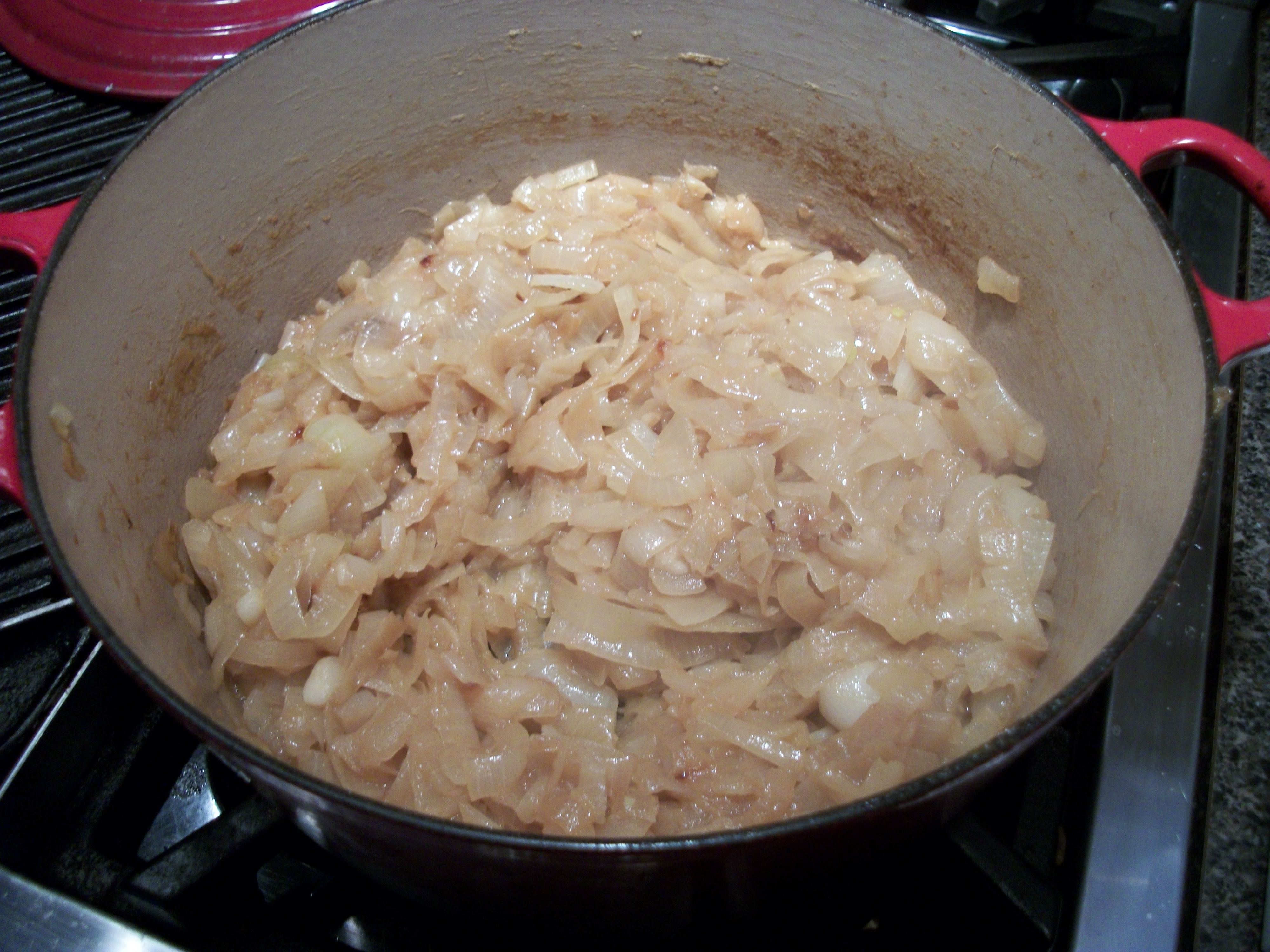
The onions are now a soft golden color. You can get onions to caramelize to a much deeper color, but the taste changes as the process continues. Since I was using a vegetable stock, I didn’t want the onions to be as strong as I would for a beef stock. This picture is showing the onions to be a bit light, but they were actually a lovely golden color. When you think your onions are dark enough, stir in about 1/4 cup of flour and cook, stirring constantly, for about 3 minutes. Add your stock and stir up all the bits in the bottom of the pan.
At this point, I let the mixture cool and refrigerated it. All I needed to do on Monday was to heat the soup gently, let it simmer for about 30 to 40 minutes, and taste it for salt when it got warm. My soup was very sweet. Onions are sweet, but remember I had also used carrots and a parsnip in the broth. Chard stalks are sweetish too.
Here’s the soup on Monday cooking gently for 40 minutes:

I thought it needed some zip, so just before serving, I added a good 3 Tablespoons of cognac. (A plain brandy would work too.) And, I enriched it with 4 egg yolks, which made it silky smooth and gave it some lovely body, not to mention protein the body can use easily.
To add egg yolks, drizzle a ladle of soup into the eggs while you whisk them. For safety, as I had used 4 eggs, I added a second ladle slowly while whisking. (This is called tempering the eggs.) Then, with the soup OFF THE HEAT, stir the eggs into the soup and stir the soup until it thickens–just a minute or so.
I put grated swiss cheese (a GOOD swiss) into the bottom of each deep bowl and ladled soup over it. My gratinee soup bowls are small, and we wanted big bowls of soup for dinner–not a smaller size for a first course. And, as we had really fresh baguettes, we just quartered them and put a hunk at each person’s plate. I can get lovely raw butter, so we had that for the bread too. (We didn’t want to toast sliced bread and put it into our soup this time and put the cheese over it and put everything into the oven to melt the cheese.)
While the stock made and the onions caramelized, I made a three-layer cake–a recipe I had put away to try years ago. It’s a caramel cake, but not a southern style. Instead, the batter and the icing are flavored with mocha syrup, Bailey’s cream liquor, a coffee liquor, and vanilla. I didn’t have a mocha syrup, so I put the other ingredients in a pan and threw in about a tablespoon of chocolate bits and a tablespoon of some caramel syrup I had and let it all sit on the oven shelf to warm and melt the chocolate. The cake is spectacular and lovely, so that innovation was fine. Here it is, though the camera distorts the bottoms of things (making them look smaller) if you don’t have it level with the photographed object:

Here it is cut:

It is yummo! I got it from “Better Homes and Gardens” Dec. 2005, “Secret to a Great Cake: Cream Caramel Cake,” page 220. The only downer is that the icing has EIGHT CUPS of confectioner’s sugar in it. That’s more sugar than I eat in two years!!!!
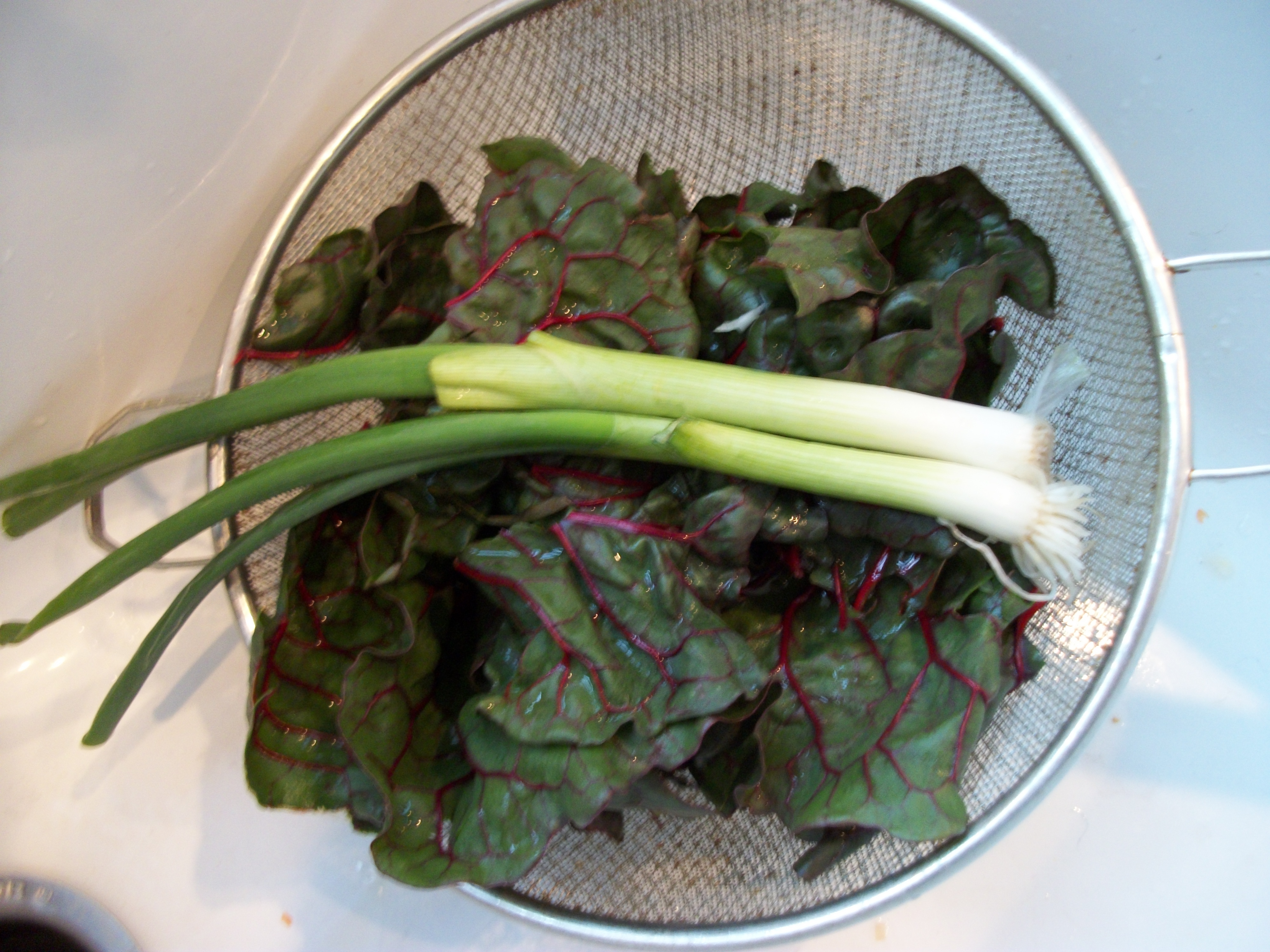
So, you remember those chard stalks I used in the soup stock? Here are the leaves–with some green onions–all ready to be sauteed for dinner on Sunday night. Dinner was roasted sweet potato and a seared sirloin steak and some of my sauerkraut. Aren’t chard leaves pretty? Chard is in the beet family, you know. I usually grow a variety called “rainbow” chard that comes in all sorts of electric colors. It’s quite amazing in the garden. It’s great sauteed with some coconut oil and when it begins to melt down, a splash of fruity vinegar and a drizzle of honey. Sometimes I also add some raisins or some sliced apple, peel and all.
So, on Monday, I only had to make a salad and grate some cheese. Here’s the salad:

I wanted something citrusy. Lettuce greens are not in season now, so this salad is from “away.” It has some water cress, some leaf lettuce, some romaine, a naval orange, some fennel sliced thin on the mandolin cutter, some hearts of palm (I grabbed a CAN thinking I was buying asparagus hearts–bad, bad as can linings leach BPA–I should have NOT used anything else), some green onions, some toasted pine nuts, and a fruity dressing of lemon and olive oil. It was delicious!
So, Bon Appetit! to all and mega thanks to the incomparable Julia!
PS: For a good beef stock, put a selection of bones in a roasting pan, add some celery (2 stalks only), carrots, onion, and garlic (I slice the whole bulb in half after seeing son Bryan do that) and roast until brown at high heat–400 degrees–turning and stirring after about 40 minutes. Usually everything is brown in no more than an hour. Drop the heat if you think things are moving too fast. Put everything into a large stock pot. Put water in the roasting pan and scrape up the goodies and pour all into the stock pot too. Add more onion, carrots, garlic, fresh or dried herbs (thyme, rosemary, bay leaf, parsley) and GOOD SEA SALT THAT IS DAMP AND GREY and cook for at least 5 to 6 hours and up to 12 hours. Strain and discard bones and spent veggies. Freeze extra in Mason quart jars.




 Louisa Enright's Blog