Interesting Information: The Worth of Bananas

Interesting Information:  March 24, 2014

The Worth of Bananas


A friend was here recently, and she was SHOCKED that I rarely eat a banana.

“What about potassium?” she said.

“Well,” I said, “bananas being a good source for potassium is mostly food industry hype and does not take into account the down side of eating bananas.”

“What???”

One medium banana of the type in our stores has 450/mg of potassium–and a whole lot of starchy carbohydrates that aren’t much good for anything.  (Highly colored bananas in other parts of the world carry a better nutrient load than the yellow banana to which we have standardized–an incredible loss of diversity through monocrop cultures run by industry.)  I don’t know about you, but I’d like to lose another 20 pounds, and I can’t do that by eating useless, starchy carbs.

And there are better food sources for potassium:

Flounder (6 ounces) has 996.

Winter squash (1 cup cooked) has 946.

One medium white potato has 844.

Salmon (6 ounces fresh) has 756.

Cod (6 ounces) has 690.

Parsnips (1 cup cooked) has between 573 to 758.

Avocado (1/2 medium) has 602.

Asparagus (1 cup lightly cooked( has 558.

Orange juice freshly squeezed (1 cup) 496 and collard greens (1 cup cooked) 468

Broccoli (1 cup) comes just below banana at 440.

Other sources are chicken, sweet potato, celery, and tuna.

(I left out the dried fruits as they aren’t especially good for you even if they have good doses of potassium.)

Potassium is a mineral that works as an electrolyte that carries “tiny electrical charges throughout the body, and especially ensures the proper functioning of the heart,” according to Rachel Albert, B.A., in “Charging Up With Potassium” in Well Being Journal, Jan/Feb 2013 (35-37).  (I love Rachel Albert’s The Garden of Eating–it has wonderful recipes and a plan for how to manage to always have really good food available in your home by cooking multiple dishes at once and adding to them as you go along in the week.)

Potassium deficiency “may include fatigue, weakness, irritability, loss of muscle strength, muscle cramps or spasms (charley horses), swollen ankles, general edema, and recurring headaches that come at the same tie each day” (35).

Albert writes that “potassium and sodium play a tug of war across the cell walls in your body, with the delicate balance of your body chemistry at stake.  So, when the sodium concentration is high, potassium is literally stolen from your body.  It is leached from your tissues, poured into your blood stream, then dumped into your urine and excreted.  Conversely, when the potassium content outweighs sodium, your body is able to release and let go of excess sodium and water.  Potassium in its natural state acts as a mild diuretic and can counteract hypertension, which is more common among individuals and ethnic groups who consume few potassium-rich goods (37).  In hot weather, Albert notes, we need more potassium as we sweat potassium levels out of our bodies.

The more I read about our bodies, the more I am realizing how delicate the chemical balances can be.  I often have muscle cramps–especially after I eat some chocolate, I’ve noticed.  Or, when I hike.  And I know that my potassium can get too low–from a blood test the last time (March 2013) I had a bad food allergy attack.  The minute I take a potassium tablet, the cramps stop.

BUT, this article is the first time I’ve made an association between potassium and salt.  I eat and LOVE a LOT of salt–sea salt.  So maybe I’ll cut back a bit.  Salt is not the demon it has been made out to be for years–I’ve written about that on this blog–but I often put even more salt on foods before tasting them.  So…time for a bit of a change.  Perhaps I’ve been throwing off this potassium/salt balance in my body.
 

Turkey Tracks: Do Yourself a Favor: Cook and Eat Dark Leafy Greens

Turkey Tracks:  June 19, 2010

Do Yourself a Favor:

Cook and Eat Dark Leafy Greens

Dark Leafy Greens are chock full of nutrients.  I’m talking Lambs Quarters, Bok Choy, Collards, Turnip Greens, Mustard Greens, Chicory, Dandelion, Kale, Parsley, Dock, Endive, and Watercress.  (Lamb Quarters and Dock are wild greens:     for dock, see http://eatingmymoccasinsnow.blogspot.com/2009/04/dock-rumex-crispus.html; for lambs quarters see http://www.google.com/search?hl=en&rlz=&=&q=lamb+quarters,+image&um=1&ie=UTF-8&tbm=isch&source=og&sa=N&tab=wi&biw=1362&bih=669.

I’m leaving out spinach, chard, and beet greens because they have high levels of oxalic acid that can cause a number of unpleasant side effects:  kidney stones and the reduction of the body’s absorption of calcium and iron among them.  Though I love spinach and chard, I eat these greens sparingly and, pretty much, only in season.

I try to cook several batches of dark leafy greens in a week, and I cook enough of them at one time to have leftovers.  Cold greens are delicious drizzled with a vinaigrette or a tahini or peanut dressing.  But, my favorite leftover use is to use the greens inside an omelet–with added cheese.  An omelet of goat cheese and cooked greens is great for breakfast, lunch, or dinner.  And, the combination of greens, egg, and cheese is…delicious!

According to Rachel Albert-Matesz and Don Matesz, in their cookbook and guide, THE GARDEN OF EATING, kale has 250 percent more vitamin C than an orange, 4, 450 percent more Vitamin A, and more potassium, iron, phosphorus, calcium, and protein (308).  Rachel A-M has a terrific web site, too:     http://www.thehealthycookingcoach.com/.   I highly recommend the cookbook.  I’ve yet to cook something bad from it, and it has significantly expanded my ability to  cook greens and to create satisfying meals without using grains.  Her web site has the cheapest prices–it’s under $30.

These dark leafy greens need to be cooked.  They don’t lose substantial nutrients, and cooking reduces some of the bitter compounds that can hinder digestion and absorption of nutrients.  Think of cooking them for at least 10 minutes.  This aspect of dark leafly greens makes me hesitate about juicing them, too.

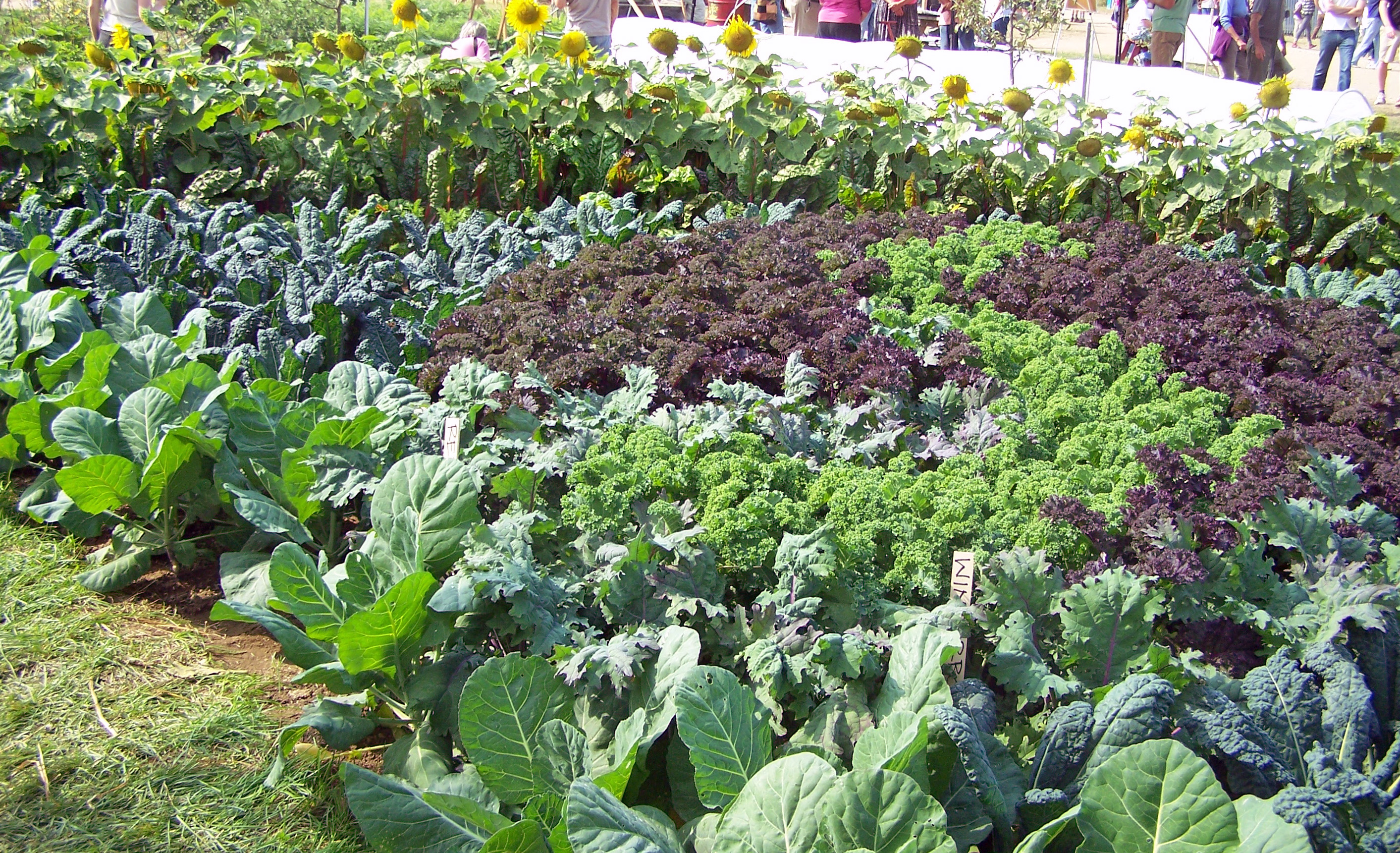
My favorite greens are kale and collards.  Kale comes in various, beautiful forms, and each tastes slightly different.  You might recall a picture I took of some kale forms at the Maine Organic Farmers’ and Growers (MOFGA) fair last year.  Collards are in the foreground.

There are two principal ways to cook greens:  boil whole leaves/stems or pan saute and steam greens in a large, covered frying pan or pot.  I use both methods.  I boil when I want to prep greens ahead.  I particularly like kale boiled, chopped, and, later, sauteed in butter.  In both cases, you need to strip or cut (collards) the leaf from the fibrous stem.  Kale stems are more tender than collards.  Rachel A-M cooks kale stems and chops them when tender and adds them back to the leaves.  I’ll confess, usually I give the stems, which always have a few remaining bits of leaves, to the chickens as they take true delight in them.

For boiling, bring water to boil, drop in the whole leaves, and cook until tender–at the most from 5 to 10 minutes.  Drain, immerse in cold ice water to preserve color, and chop.  If you layer the leaves, then roll them, you can slice off strips.  Turn the strips and cut off bite-sized pieces.  Refrigerate for up to three days.

To pan saute, your imagination is the limit of fun combinations for additions.  Start by stripping leaves from stems.  Roll leaves and slice and cut, again, to make squares.  Sometimes, though, I just roughly chop greens.  Here’s a picture of two bunches of  leafy green kale.  When cooked, there will be enough for four servings.  John and I eat one serving each hot and then we have an asset in the kitchen:  cooked greens to be used in other ways, like an omelet.  Or, eaten cold.  The point I’m making is that greens COOK DOWN rather a lot, so buy enough.

Kale is tenderer than collards.  And, collards, in particular, benefit from the addition of meat broth for liquid, or an extra chicken/turkey wing in the pan.  When I make broth, I always pull off several small 1-cup Mason jars to use when cooking greens.

The basic method is to start by pan frying a chopped onion in good oil/fat.  I use unrefined coconut oil, or duck fat, or saved bacon grease, depending upon what kind of flavors I want.  Adding bits of flavoring meat, like pancetta or bacon, is nice at this stage.  Add some chopped garlic just before you get ready to add the greens.

But, before that, consider what kind of SPICES you’d like to have running around the pan.  Perhaps some combination of spices–cumin, cinnamon, coriander, turmeric, for instance.  Curry powder?  Put those kinds of spices into the pan and let them fry in the fat for a moment or two–with the garlic if you’re using it.  Mustard is a nice addition.  Any of the hot pepper spices, like paprika or red pepper.  And nutmeg is lovely with greens.  Thyme or sage is nice.  Gingeroot is lovely.

You could throw in some sliced apples in the fall.  Or, a handful of dried fruit in the winter.  (Think of drizzling in some honey or maple syrup at the end if you go in this direction–with a bit of fruity vinegar to spark the tastes.)

A handful of cleaned seaweed (dulse, for instance) gives some heft and adds iodine, which I think about since I don’t eat grocery store salt.

Adding other vegetables is also nice:  carrots, mushrooms, cauliflower, daikon radish, celery, bell pepper strips.

USE WHAT YOU HAVE IN THE KITCHEN.

When your veggies and spices are sweated out/mixed in, throw in the greens.  If they have enough water from washing, you can begin to turn them with tongs until they wilt down.  If you don’t have enough liquid, add water/bone broth (about a cup) to the pan–mopre for collards–wilt down the leaves, and cover and cook for 5-10 minutes.  Collards will require longer cooking.  Remove the lid and cook down any remaining liquid at high heat before serving.

ENJOY!