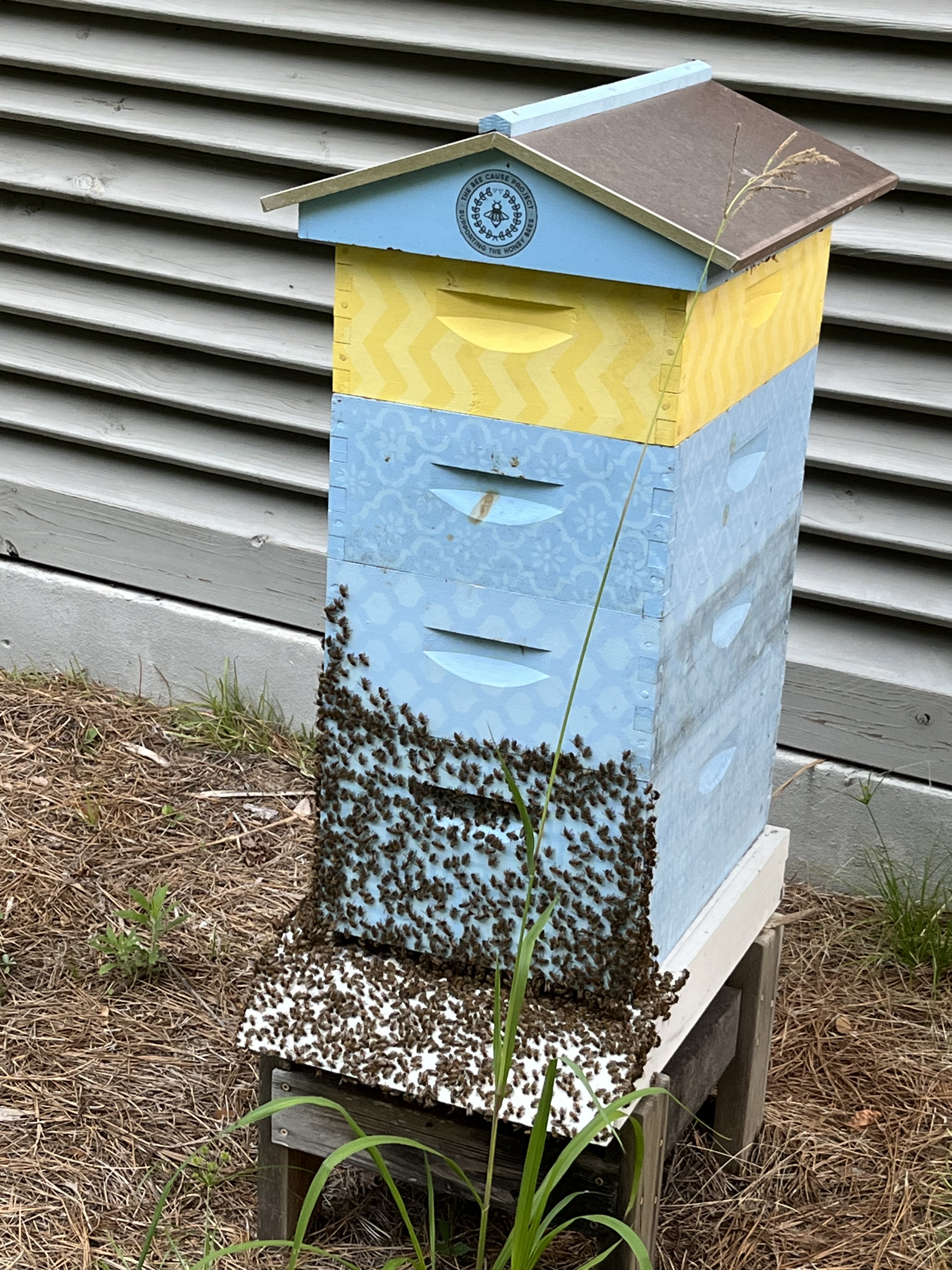
Daughter-in-Law Tami showed me this video of the hive in her back yard recently. And I saw the hive for myself last Sunday.
I’m really interested because I’m going to get some of the honey from this hive in the near future, yes, but also because beekeeping is a very big practice in my family and in this area.
Tami told me that some of the bees are outside the box for a variety of reasons: it’s hot and humid here now with temps in the mid to high 90s, the bees might be contemplating a swarm from the hive, and/or it is crowded inside the hive as there are now a lot of bees. The presence of bees outside the hive is called “bearding.”
Tami also said that it is very normal for bees in a hive that is this healthy to create a swarm and that beekeepers should let them carry out that intention if the bees want to swarm. Reducing the size of the hive by some bees swarming gives the remaining bees a chance to rest. It also gives them time to clear out the mites that can and do infest a hive. Mites, Tami, said are the number one danger to a bee hive. Mites set up and live in the empty little wax hexagon cells the bees have just created to store their honey.
There are FIVE “supers” (the narrow upper drawers) on this hive, which means that there are a lot of bees involved and that they have had to work hard to try to fill up each drawer as it is installed. She will harvest three drawers in the near future, especially if the bees swarm, as that will leave less real estate at mid-summer for the bees to try to fill with honey. The bees will need two supers of honey for the winter–more than that means they have to keep a lot of the hive warm all winter, which is also hard on the bees who need to rest in the winter.
Here’s the hive earlier in the year with three supers installed. The bottom thicker box is the brood box where the queen lives. (I think that’s right.)
Here’s a very bad picture of Tami. She is the co-founder and director of The Bee Cause, an organization that strives to preserve bees and to educate people about bees. The Bee Cause now also tries to educate people about the natural world and how humans interact and are impacted by the natural world–which includes the destruction of natural habitats. Bees, for instance, alongside other pollinators, pollinate most of the plant crops that humans rely on for food. If bees and other pollinators are killed by human practices, the end result will be a huge loss of the foods that humans need.

Here’s some recent honey from a beekeeper who works closely with Tami. This honey is the honey that I keep on hand all the time.

Honey is also a wonderful medicinal–both to eat and to use for wounds. But that is a tale for another day. And honey does not really go bad and can remain viable for thousands of years.
Honey and some maple syrup are my only sweetners.
And now you can understand that I am trying to do my part by planting plants that bloom and, therefore, nurture pollinators. And, also, why I am trying to create a healthy habitat around my house, as with the use of pine straw bedding that provides a home for many creatures and hand-weeding my new sodded grass until it gains enough purchase to thrive on its own–which it now has.
Finally, perhaps you can understand also why I am very sad at the amount of chemical use taking place in my new neighborhood and in this region–herbicides for the grass and “weeds” and insecticides for “the bugs.” Note that spraying Round-Up (glysophate) for weed control is very dangerous for people. We know that now. The data is very clear now. And indescriminate spraying for mosquitoes kills ALL the insects, bees included.
I am not against judicious use of chemicals when needed around a house. Chemicals that kill termites, for instance, can be put around the foundations or into traps set near a house’s foundation. And inside baiting for roaches is confined to specific spots. In Maine, we had to solve an infestation of carpenter ants and…ick…bedbugs brought in on our luggage. Both solutions were chemical.
The natural world has a power of its own, you know. And we violate it at our own peril. We are, perhaps, a self-solving problem for the natural world.

 Louisa Enright's Blog
I love reading about bees. My husband was a beekeeper for many years. At one time, we had a lot of hives and harvested and sold honey at a local farmers market. Our last name is Boyd and we were known as “The Boyds and the Bees”. We started losing hives and finally gave up. I’ve often thought we should try again with a couple hives. We’ll see …….
One of the problems today is that bees are not very healthy–having been “improved” by scientists, etc. That’s a longer story, of course.
I have to apply medicinal-grade honey to
<
div>Ron’s leg wounds. Never did th