Interesting Information: New Harvard Study on Red Meat and Cancer = Junk Science

Interesting Information:  March 17, 2012

New Harvard Study on Red Meat and Cancer = Junk Science

I was quilting and listening to NPR news the other day when I heard a story about there being a “new” study that linked red meat and cancer.

Information about the type of study came late in the story, and I’d be willing to bet that what most people heard was “Harvard” and “red meat causes cancer.”

Before emoting on this blog, I poked around a bit and found out more information.  Here’s the press release from Harvard:

http://www.hsph.harvard.edu/news/press-releases/2012-releases/red-meat-cardiovascular-cancer-mortality.html

And, here’s a story from Business Week:

http://www.businessweek.com/news/2012-03-12/a-hot-dog-a-day-raises-risk-of-dying-harvard-study-finds

***

Now, before you panic about your grass-fed red meat consumption, let’s do a bit of thinking together…

First of all, the study uses QUESTIONNAIRES to determine what people are eating.  This kind of methodology is famously inaccurate and, thus, unscientific.  You can poll 121,342 people, as this study did, and it’s still unscientific because it is always already inaccurate.  People lie for their own reasons or don’t remember exactly.

Second, CORRELATION IS NOT CAUSATION.  One famous example of this kind of thinking–leaping from a perceived association to hard fact–would be the very wrong connection between high cholesterol counts and heart attacks.  Do you know how many people have been seriously maimed by taking statins?  I don’t know, but I’ve written a Tipping Points essay on how they waste muscles in the body.  Since Big Pharma and our docs have made a fortune making statins and/or dispensing them, you can bet a LOT of people have been harmed.

Third, the so-called “killer” red meats here are PROCESSED red meats (hot dogs), bacon (not a red meat and made with nitrates), and FAST FOOD hamburgers (notoriously poor quality hamburger, which is probably full of pink slime).  This study is NOT covering high quality red meats, like grass-fed beef, which is free of disease and which is chock full of high-density nutrients.  The distinctions between types of red meat are NOT made in the study’s announcement.  Rather, all red meat is just lumped together and damned.

So, you can bet that if folks are eating a lot of hot dogs and fast food hamburgers, they are also drinking SODAS (full of sugar) and ordering FRENCH FRIES.  How many people eating a fast food hot dog or hamburger are going to order water with a slice of lemon???  Or, NOT order some french fries?

By the way, it’s not all that hard to find good quality–as in nitrate free–bacon and hot dogs.  And to find hot dogs not padded with soy.  And grass-fed beef is getting real traction in the market now.  Yes, it costs more.  It takes longer to bring the cow to market.  So, savor this beef  fully and cook with ALL the beef parts, not just the hamburger and the steaks.

Here’s a quote from the “Business Week” article, by Betsy Booren, the director of scientific affiars for the American Meat Institute Foundation:

All of these studies struggle to disentangle other lifestyle and dietary habits from meat and processed meat and admit that they can’t do it well enough to use their conclusions to accurately recommend people change their dietary habits….What the total evidence has shown, and what common sense suggests, is that a balanced diet and a healthy body weight are the keys to good health.

Fourth, don’t be fooled by slippery math.  I’m beginning to think of this kind of math exercise as “medical math.”  The study’s writers claim that their analysis showed that people who ate red meat–excuse me, who ate processed hot dogs, bacon, fast-food hamburgers, sodas, and french fries–had an increased risk of 16 percent risk of getting cancer.  Well, the study included 121,342 people, and 9464 people died from cancer.  That’s 8 % of the total.

Here’s more math.  That 16% is part of an unnamed total risk of cancer.  If that total risk is 8%, then you have to take 16% of the 8%, which increases the 8% by 1.28%, which makes the total 9.28%.  That’s a whole lot less that 16%.

Fifth, the study recommends eating more plant-based foods and other forms of protein.  Yet, plants are NOT nutrient dense.  And, they add in a lot of fiber and a lot of sugar (fruits, grains!) which we don’t handle well.  In short, we can’t digest cellulose.  We do not have the enzymes to process cellulose, and too much of it puts a lot of stress on our bodies.  As I’ve discussed in many of my essays now–see the essays on Gary Taubes’ WHY WE GET FAT, for instance–we can get every single nutrient we need, including all 8 essential fatty acids, from meat.  We could stop eating all carbohydrates and thrive.  That’s not junk science; that’s real science with MANY quantifiable test results behind it.

Are there micronutrients in vegetables and fruits that support health?  Probably.  Go slow with fruits, however.  They have a lot of sugar.  So, that’s why I really like the Paleo diet, as it mixes high-quality meat with veggies and fruits.  The Paleo diet drops grains, legumes (a poor source of protein and a problem to digest), and dairy.  I have access to high-quality raw dairy, and I do include it.  Do take a look at the Dr. Terry Wahls video posted earlier on this blog.

The suggested protein alternatives each have problems.  Fish is full of mercury in, increasingly, levels that are not healthy.  We’ve cut our fish consumption down considerably.  It’s now a real treat.  Commercial chicken, besides being utterly tasteless, is full of arsenic and has been fed a lot of GMO soy and corn.  We avoid commercial poultry and buy organic if we’re forced to buy commercial chicken.  We’re lucky here in Maine to have access to pastured chickens for meat.  But, if you find your local farmers and ask, you can probably find some free-range meat chickens.  As for nuts–give me a break.  Nuts are NOT protein dense.

Sixth, here’s another scientific fact for you:  only red meat contains sufficient quantities of vitamin B12 in forms your body can use.  If you lack B12, or no longer can process it from your foods, you’ll get dementia.

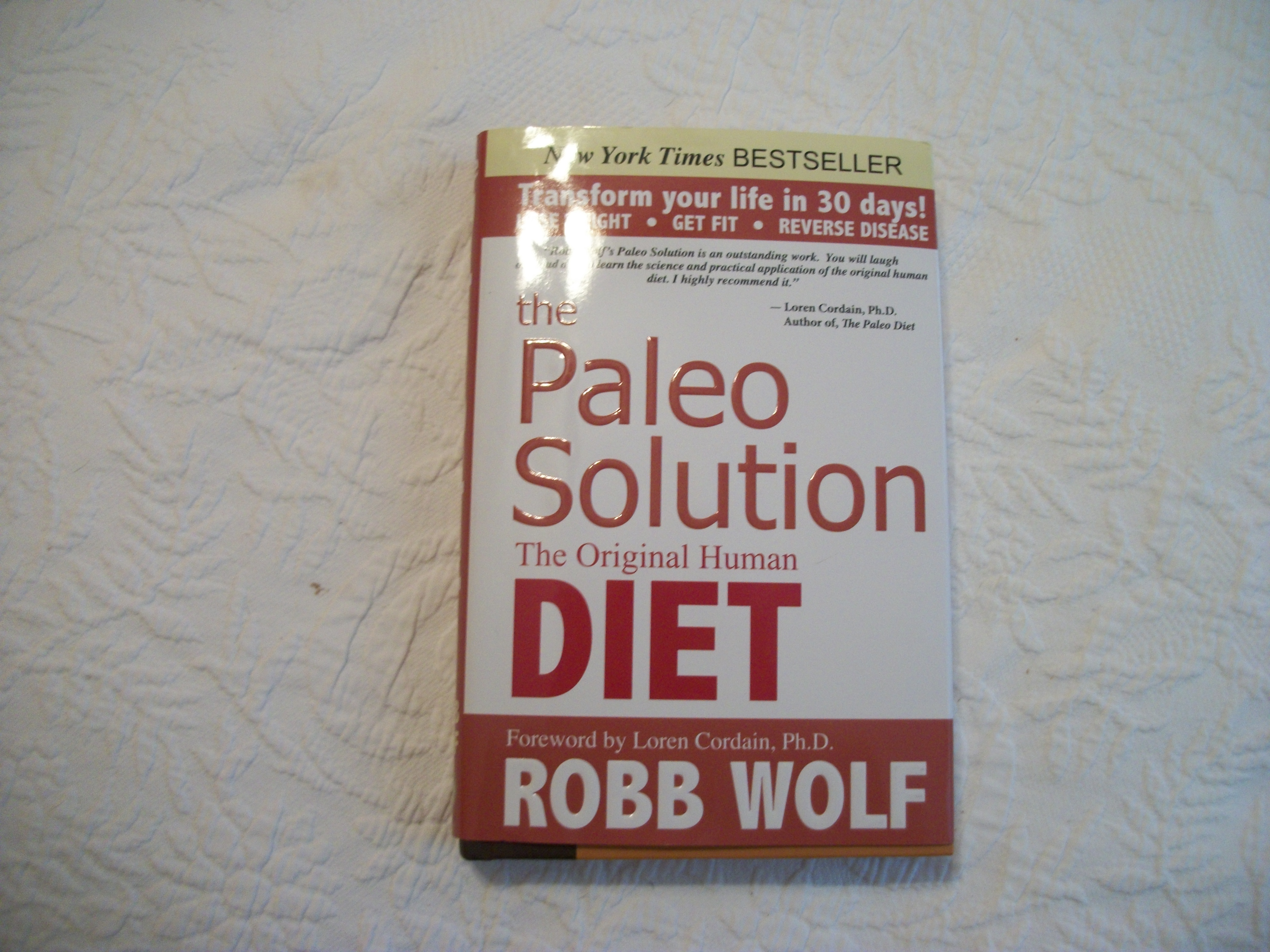
So, I agree with Rob Wolf, THE PALEO SOLUTION, about this kind of “science.”  It’s junk.  It’s a waste of time, money, and energy.  It has no core principles at its heart.  It’s why people are so confused about what to eat.

Shame on you, Frank Wu!!!

Damn junk food for the problem it is, yes.  But don’t participate in the correlation in place of causation problem.  And don’t lump grass-fed beef into this study and say so clearly.  Grass-fed red meat is totally different from commercial pink-slimed meat produced in CAFO lots.  Don’t confuse people like this.

And, shame on NPR for even reporting on this story.  It amounts to advertising “facts” that anything but.
Turkey Tracks: Giovanna’s Red Shawl

Turkey Tracks:  March 17, 2012

Giovanna’s Red Shawl

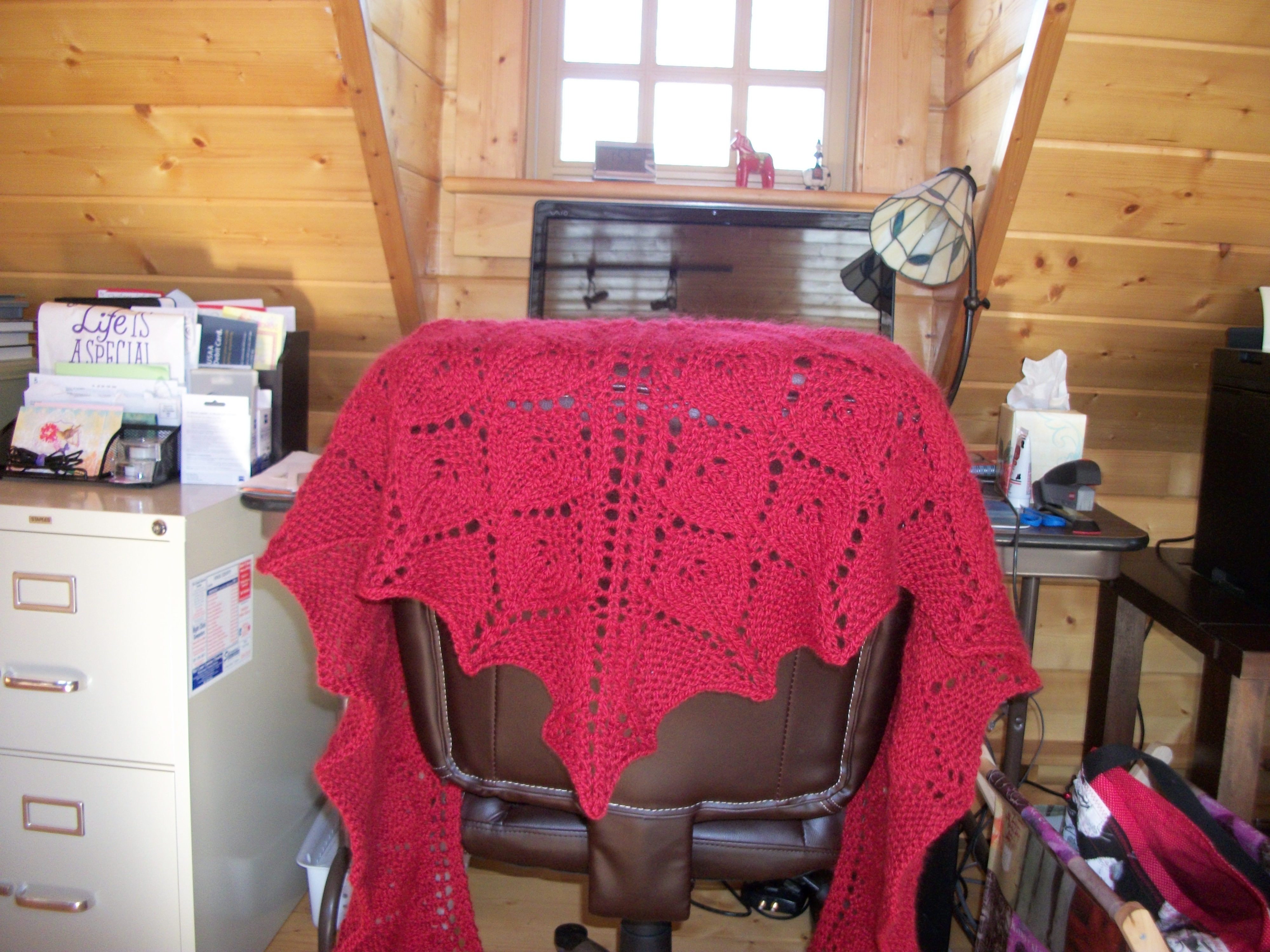
A few weeks back, Giovanna McCarthy invited me to her workroom to wind my skeins of Romney Ridge yarn into balls.   Look what was hanging over her computer chair.

I didn’t get a good picture of it until she brought it to our last Coastal Quilters’ meeting.

Here’s a close-up of the work of some of the work of this spectacular knitter.

You can see a little in these pictures that what’s very nice about this shawl, other than the beautiful red color and the gorgeous pattern, is the large “u-shaped” neckline.  This shawl just “cozies” up to your body.

Beautiful!!!!

xxxx

Interesting Information: Apple Ipod Touch Replaces Sirius/XM Satellite Radio

Interesting Information:  March 11, 2012

Apple Ipod Touch Replaces Sirius/XM Satellite Radio

I am a talk radio junkie.

And, when we moved to Maine eight years ago, I discovered that the local NPR channel did not carry Diane Rhem.  AND, that the local NPR channel carried CLASSICAL MUSIC all morning.

Mercy!  What was I going to do!

The solution at that time was getting a subscription to Sirius/XM Satellite Radio, which had multiple NPR channels and all kinds of other political and news channels.  I found that I rarely listened to anything but NPR, however, so the hundreds of channels were pretty much wasted on me, especially as I did not like the music on the Sirius/XM’s music channels either.

After hooking up the Sirius radio and stringing the receiver through my underground quilt room window, I spent many hours trying to find the sweet spot where I could get uninterrupted reception.  That actually took months as it was totally counterintuitive that the spot would be at the back of the house which, itself, backs up to a steep hill and forest.

After only a few years, the speakers in the portable radio blew out.  But, I soldiered on.  Buying a new radio was around $200.  And, the yearly bill for Sirius/XM runs about $170, once you add in their tacked on “music royalty” fee.

Then, last month, Sirius/XM DROPPED one NPR channel and stopped all the A-level programs, like Diane Rehm, on the other.  What remained was so NOT what I wanted to hear.

I was furious!

I realized Sirius/XM was probably in serious financial trouble.

What was I going to do?

Giovanna McCarthy came to the rescue.  Get an “internet” radio.  Better yet, she wrote after doing some research on my behalf, get an IPod Touch, and you can put your music on that as well.

Let’s back up to the music thing.  Back in the 1980s, I made a whole lot of tapes with music that I dearly love.  Tapes, folks, not CDs.  These tapes are now brittle, worn, have bad sound, and so forth.  But, not long ago–while peeling all the garlic actually–I popped in one of these tapes, turned it all the way up, and sang my way through a tedious job.

I realized I wanted my music back.  And I knew that I’d be able to hear fine with ear phones.  (I have VERY serious hearing aids and VERY serious hearing loss–as does my middle sister.  We think it may have been drugs taken as children or some chemical contamination on various Air Force bases.)

The Ipod Touch, with it’s Cloud feature and it’s Itunes, would let me get the music back and store it reasonable.

AND, it downloads CDs you already own, too!

I ordered it.  And, ordered a portable speaker with a docking station for the quilt room.

I had a frustrating few days as I tried to climb over the technical hurdles.  After all, I’m several generations behind all this new technology.  But, I have the system up and running, and I’m listening to Diane Rehm and all of NPR, and so much more.  I can even listen whenever I want–not just on the broadcasting schedule!  It even carries Facebook and my email.  I’m sure I have only “touched” the surface of what all it will do.

I’m slowly finding, on Itunes, my lost music.  Most of it, anyway.  So far I’ve only replaced one tape.  There are some old songs that have not made it into CD form that are now lost to me except on Utube:  Lacy J. Dalton’s “China Doll,” “Golden Memories,” and “Ain’t Nobody Who Could Do It Like My Daddy Could”; Tom T. Hall’s “Over the Rainbow,” and David Frizzel and Shelly West’s “Two Sides.”  Lost, in this age of archiving everything…

But, this morning, I downloaded and stored three of my favorite CDs–which I never listen to since the player is upstairs and I am, often, downstairs in the quilt room.

A whole new world has opened up!

Oh happy day!

Books, Documentaries, Reviews: My Read Piles, March 2012

Books, Documentaries, Reviews:  March 2012

My Read Piles, March 2012

Here’s what’s in my read pile, NONFICTION:

Here’s my FICTION read pile:

THE SWEET LIFE IN PARIS has what appears to be some good recipes.  But, of course, it’s all about sugar and white flour.  There are, however, a few recipes that use buckwheat flour.  Buckwheat, strictly speaking is not a grain.  It’s a kind of fruit.  I have a mix from our CSA, Cheryl Wixson’s Kitchen, that is a chocolate cake made with buckwheat.  I will try that…

I enjoyed the cultural discussions of how different the French are from Americans.  My Cultural Studies studies demonstrated quite clearly that “we are NOT all alike under the sun.”  In fact, different population groups are radically different in many ways.  So, it was fun to read about these cultural difference.

I’m reading LET THE GREAT WORLD SPIN now.  It’s beautifully written.  I’m about half way through, but am only reading a few pages at night as I’ve been going to bed late, and I’m tired.  My daytime reading is mostly nonfiction–so I can keep up with the essays and “interesting information” for this blog.

XXX

Interesting Information: Dr. Terry Wahls

Interesting Information:  March 11, 2012

Dr. Terry Wahls

I pulled out this paragraph from Tipping Points 41:  Part I, The Paleo Diet.

I wanted to highlight how Dr. Terry Wahls has used the Paleo diet to stop the degenerative nature of her MS and to heal her body.

The video embedded in this paragraph is a “must see.”  It’s about 19 minutes.  Please take the time to watch it.

Dr. Terry Wahls, MINDING MY MITOCHONDRIA:  HOW I OVERCAME SECONDARY PROGRESSIVE MULTIPLE SCLEROSIS (MS) AND GOT OUT OF MY WHEELCHAIR, is a clinical professor of medicine at the University of Iowa’s Carver College of Medicine.  In 2003 she was diagnosed with secondary progressive multiple sclerosis (MS) and soon became wheel-chair bound.  When mainstream medicine could not slow her disease, she started to research how nutrition could help the mitochondria in her brain.  Within eight months of starting a hunter-gatherer diet, she could walk again with a cane.  Today, she rides her bike, rides horses, and lectures worldwide on what she has learned.  Take a look at her short, informative lecture at a November 2011 TED (The Technology Entertainment and Design) conference, http://www.youtube.com/watch?v=KLjgBLwH3Wc

Mainely Tipping Points 41: Part I, The Paleo Diet

Mainely Tipping Points 41

The Paleo Diet, Part I


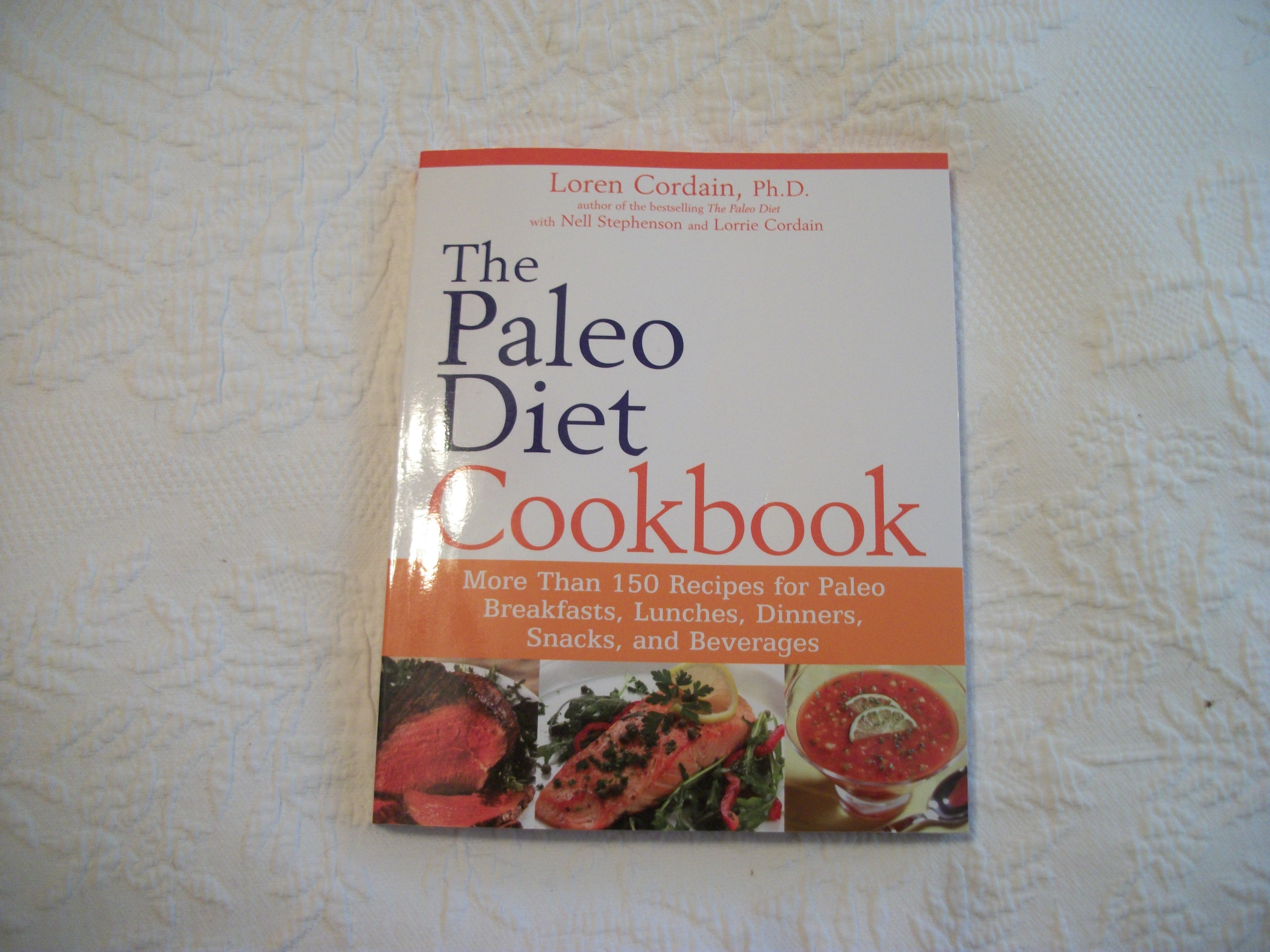
Loren Cordain, THE PALEO DIET COOKBOOK, is a professor in the Health and Exercise Science Department at Colorado State University.   Cordain focuses on the evolutionary and anthropological basis for diet, health, and well being in modern humans.  Cordain is generally acknowledged to be the world’s leading expert on the Paleolithic diet.  He has analyzed 229 hunter-gatherer societies and published more than 100 peer-reviewed publications. 

 Robb Wolf, THE PALEO SOLUTION:  THE ORIGINAL HUMAN DIET, is Cordain’s student.  Wolf is a former research biochemist who now co-owns the NorCal Strength & Conditioning gym, ranked by Men’s Health as one of the top 30 gyms in America.  Wolf explains why grains are so hard for humans to digest and how they foster a “leaky gut” condition which, in turn, leads to an array of chronic diseases, including neurological diseases like Multiple Sclerosis and Parkinson’s.


 Dr. Terry Wahls, MINDING MY MITOCHONDRIA:  HOW I OVERCAME SECONDARY PROGRESSIVE MULTIPLE SCLEROSIS (MS) AND GOT OUT OF MY WHEELCHAIR, is a clinical professor of medicine at the University of Iowa’s Carver College of Medicine.  In 2003 she was diagnosed with secondary progressive multiple sclerosis (MS) and soon became wheel-chair bound.  When mainstream medicine could not slow her disease, she started to research how nutrition could help the mitochondria in her brain.  Within eight months of starting a hunter-gatherer diet, she could walk again with a cane.  Today, she rides her bike, rides horses, and lectures worldwide on what she has learned.  Take a look at her short, informative lecture at a November 2011 TED (The Technology Entertainment and Design) conference, http://www.youtube.com/watch?v=KLjgBLwH3Wc

Those promoting the Paleo Diet argue that humans are genetically wired to eat meat, foraged vegetables, fruits, nuts, and seeds.  Paleo peoples, they argue, did not eat grains, legumes, or dairy. 

“Hunter-gathers, pastoralists, and agriculturalists have been extensively studied since the mid-1800’s,” notes Wolf.  Archeological evidence, he explains, demonstrates clearly that Paleo people were superbly healthy.  Their bones, explains Wolf, “looked like those of high-level athletes” (148).

Paleo peoples “were as tall or taller than modern Americans and Europeans, which is a sign they ate a very nutritious diet.  They were virtually free of cavities and bone malformations that are common with malnutrition.  Despite a lack of medical care, they had remarkably low infant mortality rates, yet had better than 10 percent of their population live into their sixties” (39).  (Remember Paleo peoples lived in very dangerous times.)  The Paleo peoples were “virtually free of degenerative disease such as cancer, diabetes, and cardiovascular disease.  They also showed virtually no near-sightedness or acne” (39). 

With the shift to agriculture, humans “lost an average of six inches in height” (93).  These early Neolithic farmers had about seven cavities on average per person.  Infant mortality rates increased:  “the most significant difference was between the ages of two and four when malnutrition is particularly damaging to children.”  These farmers had bone malformations typical of infectious diseases and did not live as long.  Deficiencies in iron, calcium, and protein were common (40-41).   

Wolf notes that if the timeline of human history is compared to a 100-yard football field, the first 99.5 yards comprises all of human history except for the last 5,000 years.  In the last 10,000 years most humans transitioned from a hunter-gatherer lifestyle to the settled agricultural lifestyle of the last 5,000 years.  Television, the Internet, and refined vegetable oils, notes Wolf, only take up the “last few inches” of this timeline (38-39).  Surely the last quarter-inch would include today’s fake, franken foods.

In essence, explains Wolf, humans “moved from a nutrient-dense, protein-rich diet that was varied and changed with location and seasons to a diet dependent upon a few starchy crops.  These starchy crops provide a fraction of the vitamins and minerals found in fruits, vegetables, and lean meats.  These ‘new foods’ create a host of other health problems ranging from cancer to autoimmunity to infertility” (41). 

Our health researchers, Wolf argues, lack a scientific framework from which to study and assess information on what we should eat, so their answers “change in response to politics, lobbying, and the media.”  I would add two other factors:  individual economic self-interest (paycheck scientists and those who personally benefit from promoting certain diets) and the presence of a personal belief system not grounded in science, such as “salt is bad.”  As a result, Wolf argues, “our `health maintenance system’ [is] more parasitic than symbiotic….After all, it’s hard as hell to make money off healthy people….” (34).  Now, writes Wolf, with regard to our health, “common” is being mistaken for “normal” (11). 

With some small exceptions, the following diets are closely related to the Paleo Diet:  Dr. Natasha Campbell-McBride’s GAPS (Gut and Psychology Syndrome) diet;  Gary Taubes’ WHY WE GET FAT, which advocates the diet used by the Lifestyle Medicine Clinic at the Duke University Medical Clinic; Konstantin Monastyrsky’s FIBER MENANCE, which promotes a low-fiber diet; and Dr. Joseph Mercola’s NO GRAIN DIET.  (Except for Mercola’s NO-GRAIN DIET, these books have been discussed in earlier Tipping Points essays.) 

The above diets agree that grains are a problem.  Where diversity emerges is over whether or not to eat legumes and dairy and, if so, which legumes and what kinds of dairy. 

The Weston A. Price Foundation (WAPF), which I really like because they are practicing good science, recommends raw/real dairy.  WAPF allows, cautions about, or discards legumes based on how hard it is to mitigate their anti-nutrient chemical packages.  Thus, soy is not recommended.  And whole grains are allowed if they are properly soaked or sprouted to mitigate their anti-nutrient chemical properties. 

For myself, I avoid grains, especially refined grains.  I pretty much avoid legumes, too, mostly because it’s clear my body does not like them and because they are an inferior protein source.  Dairy I love, especially fermented dairy like yogurt, kefir, and piima.  There are many peoples still present today who thrive on real milk.  The Laplanders (reindeer), the Masai (cows), and the grasslanders from inner Mongolia (sheep) spring immediately to my mind.  Granted, some of this milk is consumed in a fermented form, but we’re still talking healthy people who consume dairy products.

Whenever we attempt to adopt food ways from other eras or other regions, we inevitably bring our own belief systems into the mix.  Cordain is no different.  His emphasis on lean, grass-fed meat betrays the anti-saturated fat campaign that has permeated our culture since the 1970s.  Of course early people used animal fat; it was the only fat they had unless they lived near coconut trees or the sea.  Eskimos lived mostly on fat and were supremely healthy.  And, pemmican was made from a 1:1 ratio of fat and meat, with some dried fruit pounded in.  (Somewhere I read that some pemmican was found in a grave that was thousands of years old and that it was still good—which speaks to the power of saturated fats as a preservative.)  

Cordain’s anti-salt stance also betrays the presence of belief system, not science.  Healthy salt is essential for humans and for preserving food, as was discussed in Tipping Points 40. 

Cordain recommends using dried egg whites in smoothies as a protein source.  But, the scientists at the WAPF argue that powdered protein powders of all kinds have broken chemical structures and are dangerous.  Also, egg whites contain enzyme inhibitors that interfere with protein digestion.  We need the egg yolk to digest the egg white, and for the body to obtain optimal levels of nutrition, the egg white needs to be cooked. 

Cordain gets into trouble with his “non Paleo” diet list.  He allows olive, coconut, walnut, macadamia, and flaxseed oils.  Yet, most nut/seed oils are highly refined and dangerous.  One needs to buy unrefined oils, and finding unrefined olive and coconut oils is fairly easy.  I did find some unrefined grapeseed oil in Portland recently; that’s a rare commodity.  

Cordain uses lemons and limes to season salad greens, but vinegar is not allowed.  Yet, wine is.  Vinegar and wine are the same thing essentially. 

Diet sodas, which are toxic chemical brews, are allowed.  Mercy!

Still, in general, I do believe the essence of the Paleo diet—grass-fed, free-range meats; wild fish; wild seafood; vegetables; fruits; nuts; and seeds—to be healthy.  Medically, this way of eating can heal and support the body. 

Just ask Dr. Terry Wahls. 

Interesting Information: CSA Time

Interesting Information:  March 8, 2012

CSA Time

 Two of my nieces are well into finding and eating local foods.

Here’s a recent message from niece Lauren Howser Black about buying into a local CSA, or Community Shared Agriculture:

We are pretty sure we’re going to join our friend’s CSA this summer. They are Mennonite and farm a pretty big piece of land. We met them through our local farmer’s market where they sell wonderful, organic produce. It runs from June-October and we can get a box each week. I really like the idea of trying to eat what’s currently in season, as I have never done that before. They grow everything from greens, varieties of herbs, peas, beans, squash, tomatoes, melons, raspberries, root vegetables, etc. I also love the idea of supporting local farmer’s. When I pick up our basket this summer from them at the farmer’s market, I can also purchase local eggs, cheese, and meats. Our goal is to find ways to cook and enjoy whatever we get in our weekly basket, even if we’ve never had it before. We’re excited to try this out. 

Lauren’s sister Nancy Howser Gardner is also doing some sort of CSA.  She put a picture of a gorgeous basket of food on Facebook the other day.

Our CSA is Hope’s Edge, which starts up here in Maine in mid-June.  We’ve belonged for about 7 years now, and I can’t imagine summer without going out to the farm each week and collecting our beautiful, healthy, organic, fresh food.  Hope’s Edge has never failed us, no matter the weather conditions.  Farmer Tom is a member of our greater family!

A Community Shared Agriculture program asks you to give them a set amount of money yearly.  We give Farmer Tom a little of our half-share costs in the fall, so he can buy seeds, supplies, and so forth.  We give him the rest in the early spring.  And we get a bounteous amount of food in return.  The only risk is if the weather or some other growing condition affects some of the crops, you don’t get that piece of the harvest for that year.  It’s always worked out for us.

This year we’re also doing a local cheese CSA, which will be picked up at Hope’s Edge on our pick-up day–Appleton Creamery.

And, we’re continuing with Cheryl Wixson’s CSA, which contains ready-to-use organic products that are so fun to have in the kitchen.  You can see blog entries on Wixson’s kitchen elsewhere here.

My wish for you today is that you find and support a local CSA or a local farmer’s market this year. 

Interesting Information: Maine’s Olympia Snowe Retires and Rush Limbaugh Verbally Strikes A Young Woman

Interesting Information:  March 4, 2012

Maine’s Olympia Snowe Retires

and

Rush Limbaugh Verbally Strikes A Young Woman

Olympia Snowe is a grand person, smart and caring of her constituents.

Her voice of reason will be missed.  In Maine.  In America.

She is leaving the Senate because she feels she can no longer be effective in the polarized world of American politics.

***

Rush Limbaugh went on a rant that attacked a young woman with an opinion different from his.  He called her a slut, a whore, and a prostitute.  On air.  To a national audience.  He asked that she make tapes when she had sex and show them to the world.

***

 How did we get to such a place in America where one party’s desire to unseat a President trumps all the other business of the country?  Where a man who has been married four times, who illegally took drugs, and who sells hatred daily can call a beautiful, educated young woman such vile names in public?

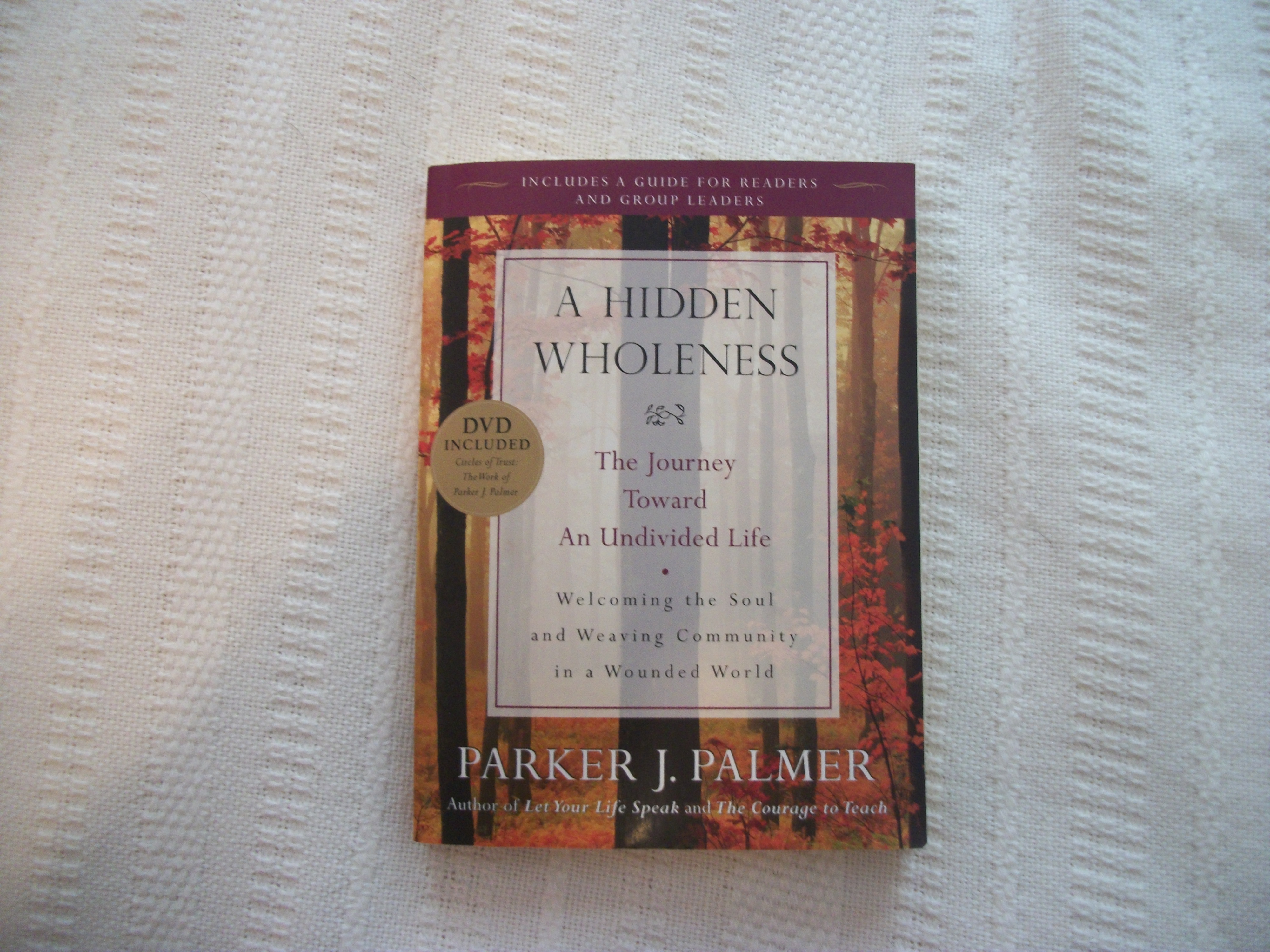
Parker J. Palmer surfaces one answer in A HIDDEN WHOLENESS:

Palmer, a Quaker, suffered from life-threatening depression.  Eventually, he figured out our modern culture cleaves us into two pieces–so that the essence of our self is separated from how we live our lives.  Here’s his discussion of his problem–which is one answer to what is happening in America today (37-39):

We can reclaim our lives only by choosing to live divided no more.  It is a choice so daunting–or so it seems in the midst of depression–that we are unlikely to make it until our pain becomes unbearable, the pain that comes from denying or defying true self.

 Secularism denies true self by regarding us as raw material.  Moralism–the pious partner in this odd couple–achieves the same end by translating “self” into “selfishness” and insisting that we banish the word from our vocabulary.  The whole problem with our society, the moralists claim, is that too many people are out for themselves at the expense of everyone else.  This New Age emphasis on self-fulfillment, this constant “cult of me,” is the root cause of the fragmentation of community that we see all around us.  Or so the moralists argue.

Deep caring about each other’s fate does seem to be on the decline, but I do not believe that New Age narcissism is much to blame.  The external causes of our moral indifference are a fragmented mass society that leaves us isolated and afraid, an economic system that puts the rights of capital before the rights of people, and a political process that makes citizens into ciphers.

These are the forces that allow, even encourage, unbridled competition, social irresponsibility, and the survival of the financially fittest.  The executives who brought down major corporations by taking indecent sums off the top while wage earners of modest means lost their retirement accounts were clearly more influenced by capitalist amorality than by some New Age guru.

But before I go too far in assigning blame, let me name the real problem with the moralists’ complaint:  there is scant evidence for their claim that the ‘cult of me” reigns supreme in our land.  I have traveled this country extensively and have met many people.  Rarely have I met people with the overweening sense of self the moralists say we have, people who put themselves first as if they possessed the divine right of kings.

Instead, I have met too many people who suffer from an empty self.  They have a bottomless pit where their identity should be–an inner void they try to fill with competitive success, consumerism, sexism, racism, or anything that might give them the illusion of being better than others.  we embrace attitudes and practices such as these not  because  we regard ourselves as superior but because we have no sense of self at all.  Putting others down becomes a path to identity, a path we would not need to walk if we knew who we were.

The moralists seem to believe that we are in a vicious circle where rising individualism and the self-centeredness inherent in it cause the decline of community–and the decline of community, in turn, gives rise to more individualism and self-centeredness.  The reality is quite different, I think:  as community is torn apart by various political and economic forces, more and more people suffer from the empty self syndrome.

A strong community helps people develop a sense of true self, for only in community can the self exercise and fulfill its nature:  giving and taking, listening and speaking, being and doing.  But when the community unravels and we lose touch with one another, the self atrophies and we lose touch with ourselves as well.  Lacking opportunities to be ourselves in a web of relationships, our sense of self disappears, leading to behaviors that further fragment our relationships and spread the epidemic of inner emptiness.

As I view our society through the lens of my journey with depression–an extreme form of the empty self syndrome, an experience of self-annihilation just short of death–I am convinced that the moralists have got it wrong:  it is never “selfish” to name, claim, and nurture true self.

There are selfish acts, to be sure.  But those acts arise from an empty self, as we try to fill our emptiness in ways that harm others–or in ways that harm us and bring grief to those who care about us.  When we are rooted in true self, we can act in ways that are life-giving for us and all whose lives we touch.  Whatever we do to care for true self is, in the long run, a gift to the world.

Olympia Snowe knows herself.  She stands on and acts out of her values.  It really scares me that she feels that things in Washington are so far gone that she can be of no more use.

Rush Limbaugh is a moral abyss.  He creates and sells the hatred of a host of “others.”  He laughs all the way to the bank.  Every day.

There can be no community within Limbaugh’s kind of worldview, for there can be no place for difference.  Is this the kind of America we all want to live within?

Not me.  Not ever.

Turkey Tracks: Beet Salad

Turkey Tracks:  March 4, 2012

Beet Salad

This picture of a beet salad has been waiting to be discussed since the Christmas holidays when Mike, Tami, and the kiddos were here.

It was too good to just move on and ignore it, so here it is.

It all started when we ha some roasted beets…

Just wash some beets, put them into a covered pan, put the pan into the oven at 350 degrees for about an hour.  Less for small beets; more for larger ones.  A knife will slide right in when they are done.  I also put about a 1/2 cup of water into the pan just to prevent the oozing beet juices from burning.  Let the beets cool.  The skins will slip off easily if you rub the beets with a paper towel.  If the beets are still too warm to handle, stick a fork in each beet, hold it up, and rub the paper towel of the surface while protecting your fingers from the heat.

Lay out a bed of spinach and put the chopped beets (bite sized) over.  We had some of our dried cherry tomatoes, so those went on.  Diced, fresh are also nice.  We had some leftover cooked string beans, so they went on.  Sliced onion.  Red onion would be even nicer, but I’d never make a special trip to the store for one ingredient as I tend to cook with what I have on hand.  Blue cheese crumbled over all.  And the dressing is a very mustardy, sharp, garlicky vinaigrette–lovely with the sweet beets and onion.  Salt and cracked black pepper.

There wasn’t a piece left at the end of the meal.

The picture does not really do this salad justice.  It’s fabulous for a dinner party.

PS:  The tablecloth is a hand-crocheted piece with butterflies in the pattern that I bought at our Coastal Quilters fall auction for, I think, $30!!!!  It has lived on the table since and washes and dries easily.   Thank you, thank you to whomever put this piece into the auction.  It is loved and cherished now.

Turkey Tracks: Blue Fox Trot Quilt

Turkey Tracks:  March 4, 2012

Blue Fox Trot Quilt

I’ve finished another scrappy quilt in what I’m now thinking about as “The Scrappy Project.”

To remind, I have BAGS of pre-cut pieces of fabric since for over 10 years, whenever I finish a quilt, I cut up the leftover pieces–too small to go back into the stash–into useable pieces–a rectangle, various squares, and any strip that’s at least 1 1/2 inches.

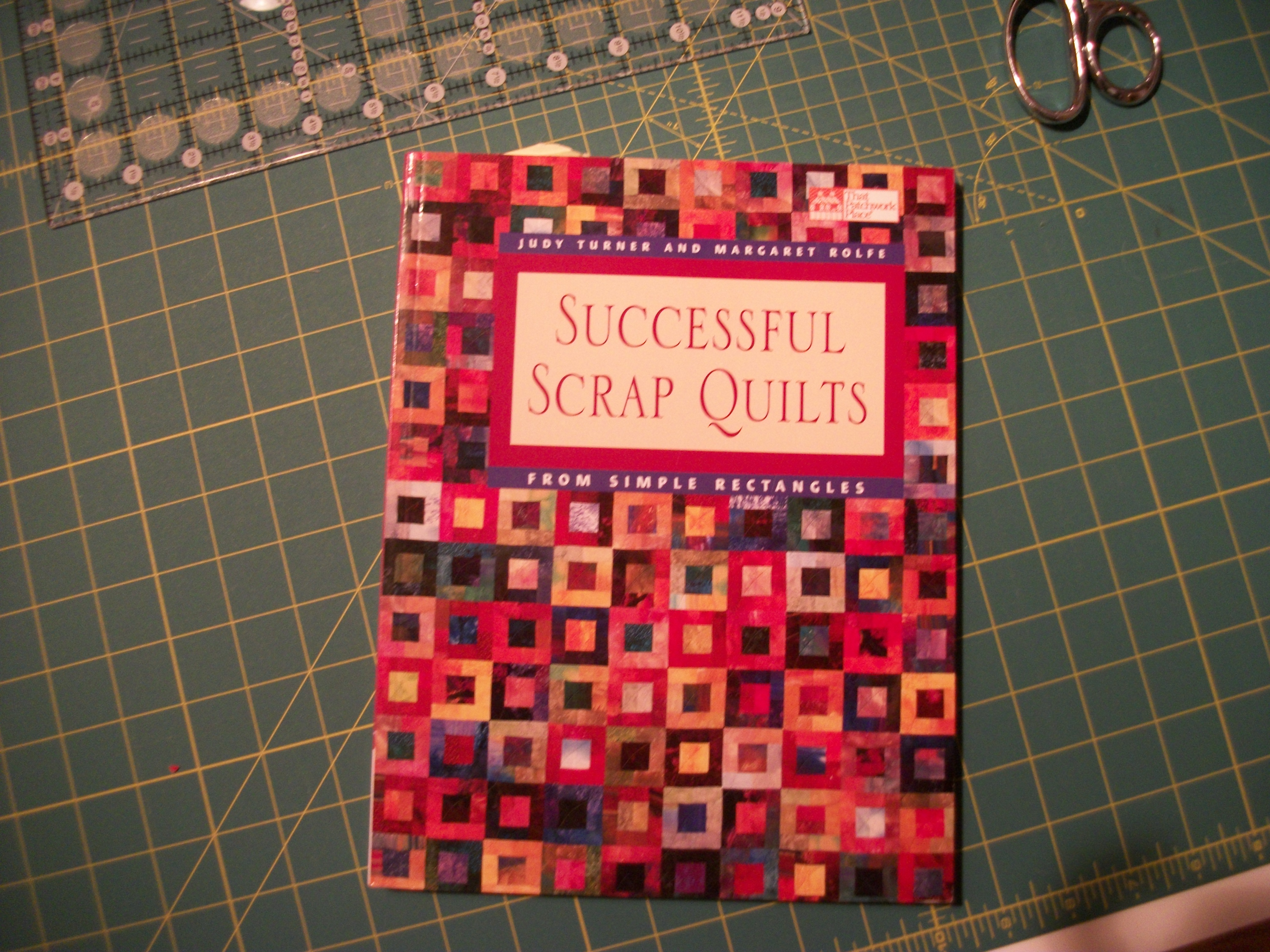
This quilt is made from the 2 by 3 1/2-inch rectangles and was inspired by this book:

First I separated out all the blue rectangles from the HUGE piles of rectangles and further separated into lights, darks, and brights.  Then, I made a trial block.  I pretty much knew this idea would work because about 9 years ago, I made a green version from leftovers of a green rail quilt.  Green Fling hangs in the stairwell of our home in Camden, Maine:

Here’s a few trial blocks going on the design wall–I had to figure out whether or not to turn either the light or dark blocks sideways or not.  I did turn them eventually as I thought it gave more movement.  Somehow, if the blocks are all upright, the quilt is too linear.  Also, turning either the lights or darks means you don’t have seam abutment problems.  Here all the blocks are going one way.  Too…linear…

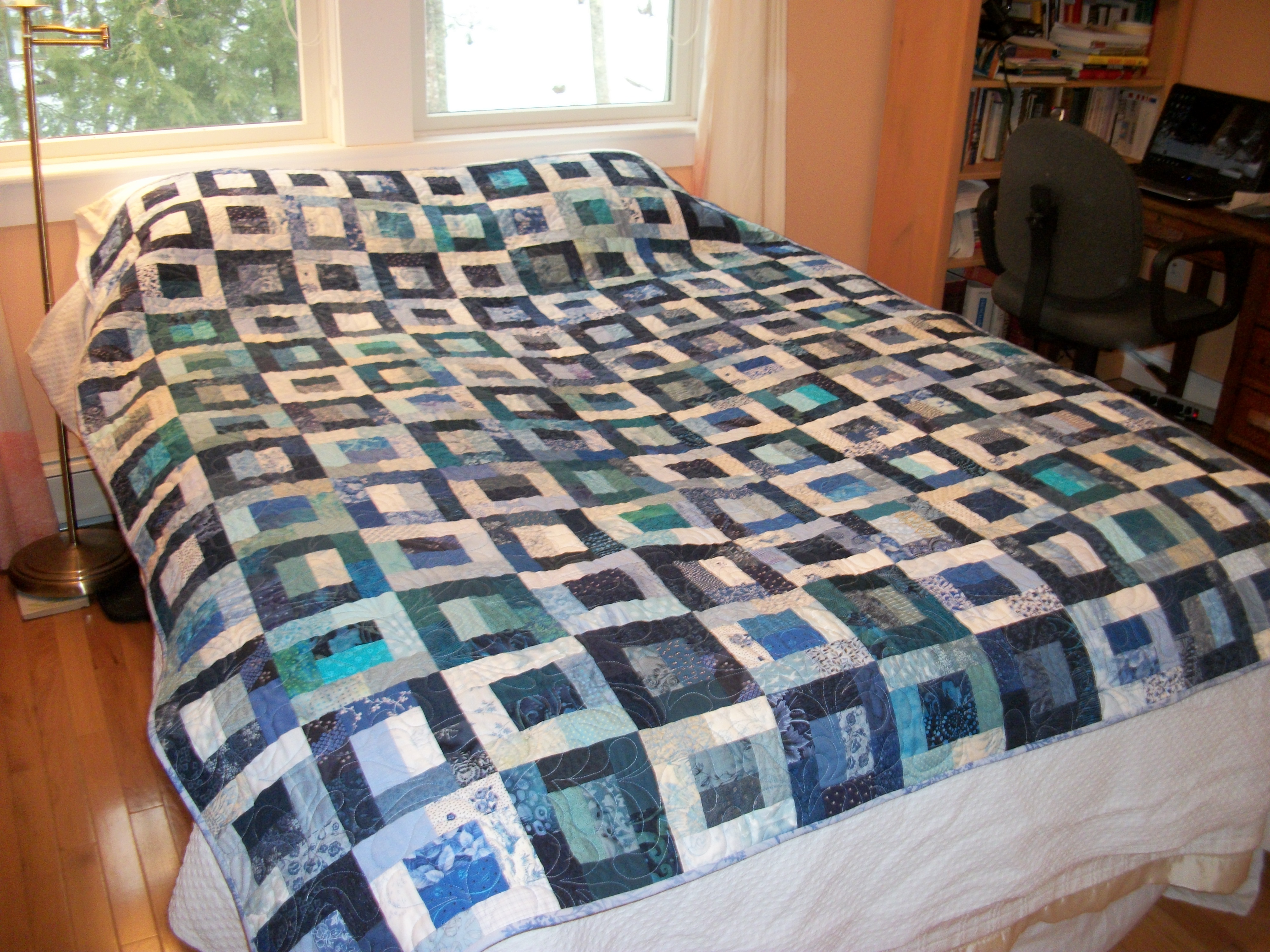
Here’s the finished quilt.  See how better it is with one set of blocks turned.

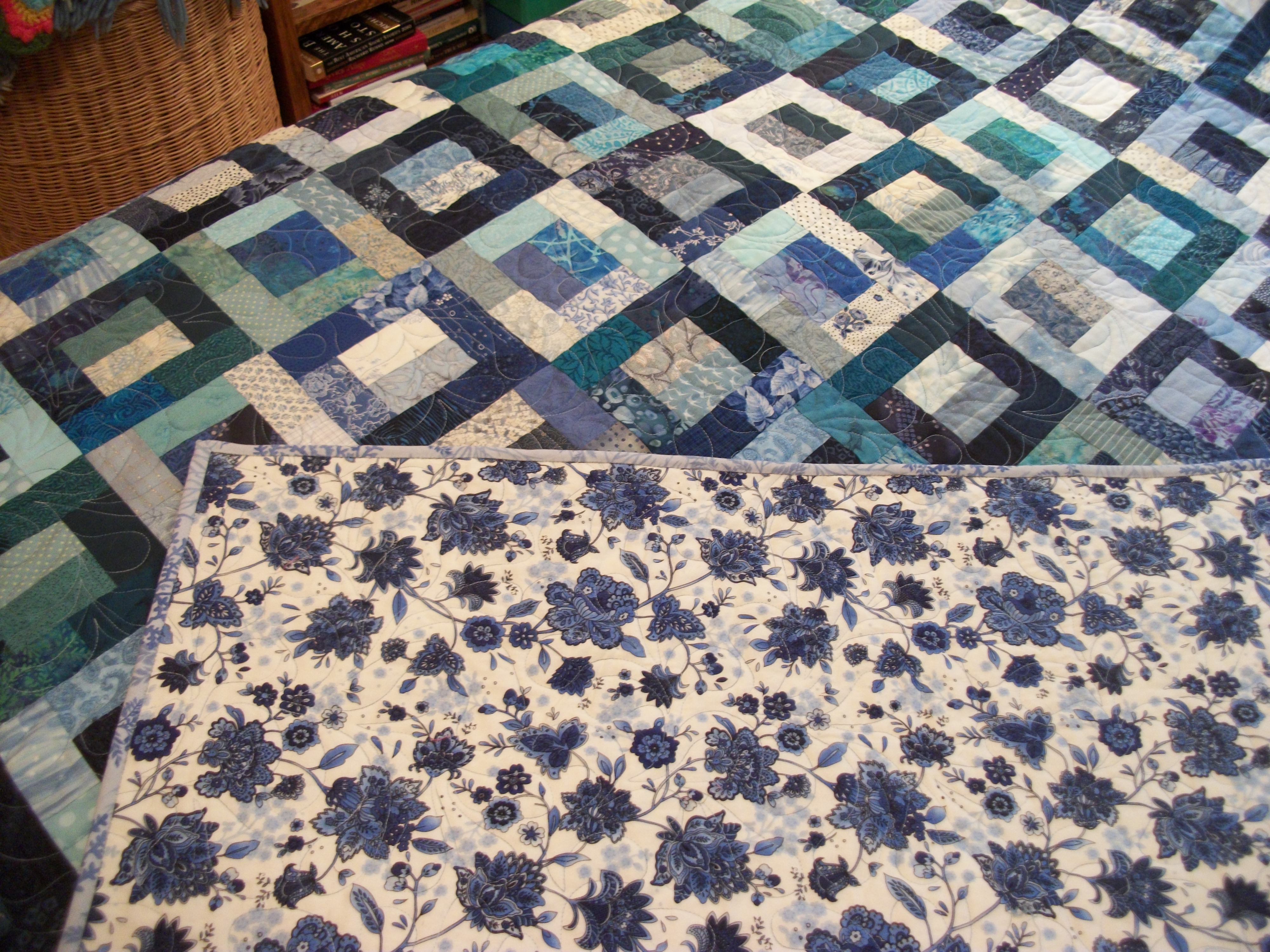
Here’s the backing and binding–both of which are perfect for this quilt.

Here’s a close-up of some of the blocks so you can see the quilting and the play of the blocks:

Blue Fox Trot–slow, slow, quick step.  There are two fox trots in each block and enough blocks to dance around the room.