Turkey Tracks: Using Dried Zucchini Slices

Turkey Tracks:  February 2, 2012

Using Dried Zucchini Slices

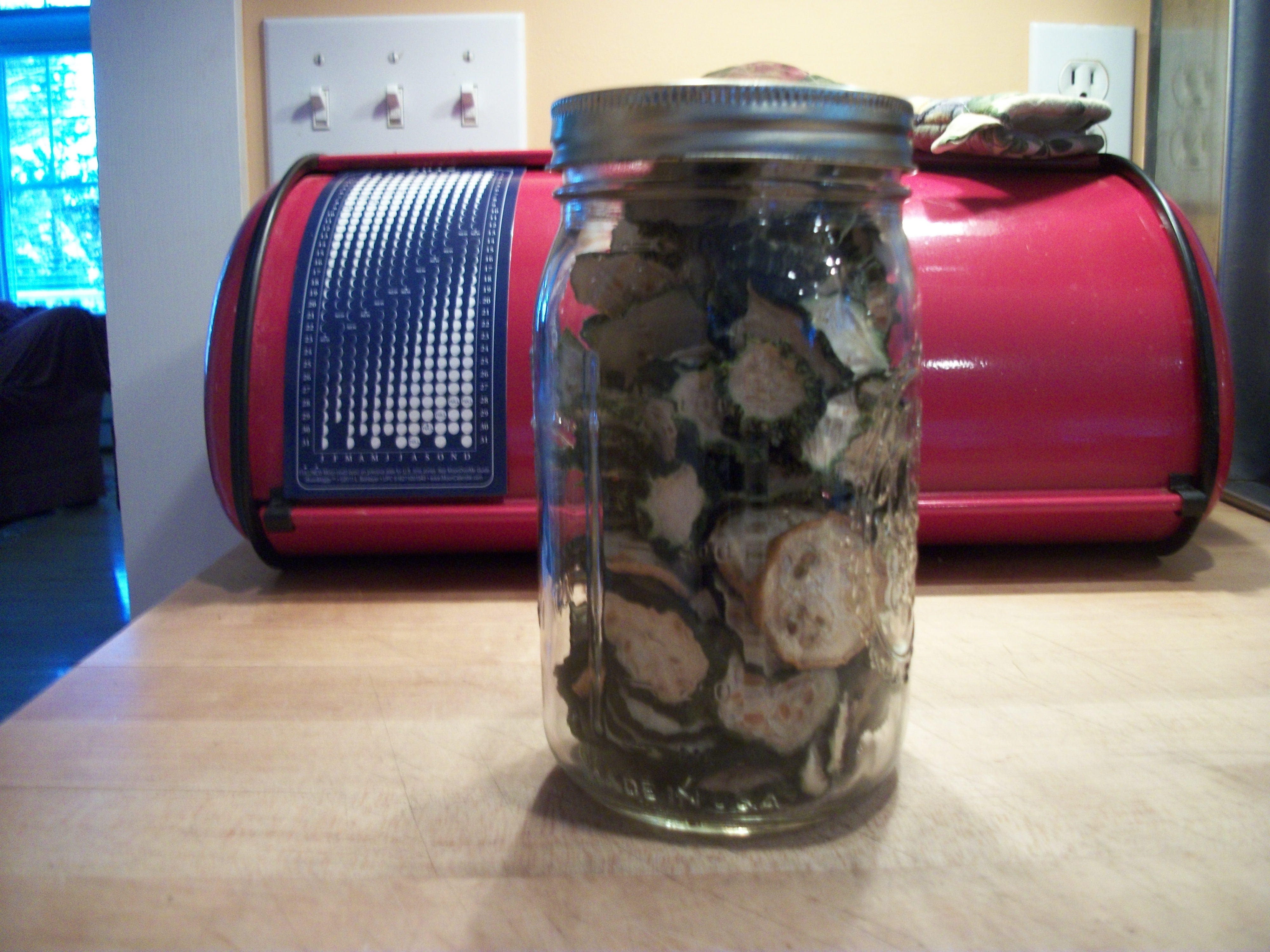
The zucchini slices I dried last summer have been a great success this winter.  Here’s a pic–with the 2012 Moon Maggy in the background I see.

To recap, when the glut of zukes comes in, I’ve tried to shred them and freeze them for winter soups or to put into the dog food.  But, the frozen shredded zukes develop this metallic taste.  And, the bits are positively slimy.  So, this past summer I tried slicing and drying them–having had great success drying halved small tomatoes.

One can just eat the zuke chips or use them in dips.  But, what we’re finding is that they are terrific thrown into soup in about the last five minutes to reconstitute.  They hold their shape and texture, are a delicious addition, and hold up to reheating soup.

Success!

We’re down to our last handful of tomatoes.  I dried a TON of them last summer before the late blight hit.  MORE next summer.

Mainely Tipping Points 39: SENOMYX’S PATENTED CHEMICAL FLAVOR ENHANCERS

Mainely Tipping Points 39

Feb. 1, 2012


SENOMYX’S PATENTED CHEMICAL FLAVOR ENHANCERS


Lee Burdett is a food and health blogger:  http://blog.wellfedfamily.net.  Her Summer 2011 WISE TRADITIONS article, “Senomyx:  The Brave New World of Flavor BioEngineering,” follows Sally Fallon Morell’s article “The Salt of the Earth,” discussed in Tipping Points 38.  Both writers are concerned with the substitution of chemicals for real food, and both articles can be found online at the Weston A. Price Foundation (WAPF) web site, which is linked on the right sidebar of this blog.  Morell and the WAPF are really worried about what a chemical substitution for real salt might do to the health of the general population.     

Senomyx, writes Burdett, is a ten-year old publicly traded high-tech research and development company based in San Diego.  Senomyx’s work is “closely related to the pharmaceutical industry….”  Indeed, “the majority of their corporate executives came from Pfizer, Novartis and Merck.”  And “their advisory board is populated by neurobiologists, neuropharmacologists and one Nobel prize-winning chemist.”  Synomyx “achieved an 85 percent increase in profits from 2009 to 2010.”

Why is any of this information important?  Because, explains Burdett, Synomyx is a “new player in the big food processing game.”  Synomyx has developed patented flavor enhancers by using what they call their “proprietary taste receptor-based assay systems.”  These systems allow Senomyx to test “an enormous volume of chemicals” and to determine if a particular chemical concoction is “effective or tasty.”  Once found, Synomyx patents the concoction. 

Synomyx has five flavors in various stages of completion, writes Burdett:  Savory Flavors, Sweet Taste, Salt Taste, Cooling Flavors, and Bitter Blockers.  Senomyx has already patented some savory flavor ingredients  and  some sweet flavor ingredients, including a sucralose enhancer.  The savory flavor ingredients were tested against monosodium glutamate (MSG) and inosine monophosphate (IMP)—which is “an expensive MSG enhancer.”  The sweet flavors were tested against various carbohydrate-based sugars and against artificial sweeteners.   Synomyx is working on  cooling flavors; bitter blockers, which will be used as additives in soy foods as they are “too bitter for most people to eat;” and on salty flavors. 

Synomyx, writes Burdett, has given the name SNMX-29 to “the protein they believe is the primary human salt taste receptor.  Now, they will use their “enormous flavor enhancing library to pinpoint which one stimulates SNMX-29 precisely the way sodium chloride does.”  And, “once this is achieved all that is left is for some company to buy the rights to insert that perfect salt enhancer into a food, replacing the need for much of the sodium currently used.”

Synomyx’s chemical flavors, writes Burdett, “stimulate your taste buds without them actually tasting anything.  This subterfuge fools your brain into thinking you have tasted an intensely sweet or savory (unami) flavor.  Much like MSG, these flavor enhancers operate on the neurological level to produce these reactions.  They bypass normal tasting processes and, because of their ability to react directly with the brain’s receptors, send signals directly to the location in your brain where specific flavors are registered.” 

Synomyx’s chemical flavors have not been tested for safety, explains Burdett, because very small amounts are used.  Thus, these chemicals “have not undergone the FDA’s usual safety approval process for food additives.”  But, science is discovering more and more that small amounts of chemicals are dangerous and that eating small amounts multiple times in a day does add up.    

In addition, the Flavor and Extract Manufacturers Association (FEMA)—which is an industry-funded organization—granted Senomyx’s MSG-enhancer Generally Recognized as Safe (GRAS) status in “less than eighteen months.”  So, this chemical has been patented and is “already in products on the market.”  Two sweet flavors and two Bitter Blockers have been given GRAS status by FEMA.  As these chemical flavors “are not actually ingredients but rather `enhancers,’ they are not required to be listed in a package’s ingredients except as `artificial flavors.’“  If you are buying packaged foods, likely you’re already eating them.     

The Ajinomoto Group (which mostly operates in China), Cadbury/Kraft, Campbell’s Soup, Firmenich (a Swiss perfume and flavoring company), Solae (soy-based foods), Nestlé, and PepsiCo—all of which have many trade names—are using Senomyx’s flavor enhancers.  For instance, writes Burdett, PepsiCo (which includes the Frito-Lay, Tropicana, Quaker, and Gatorade brands) “recently signed a four-year contract with Senomyx that included a thirty-million dollar up front payment from Pepsi to Senomyx to use their sweet enhancers.”

Burdett notes these sweet chemical flavors can replace 75 percent of sucralose and 50 percent of table sugar.  And, she notes that Synomyx CEO Kent Snyder has cited the need for Synomyx’s salt enhancement program “because salt reduction is such a high priority for food companies and the medical community `due to the association of high salt intake with cardiovascular disease.’ “ 

Yet, we know from Sally Fallon Morell’s article, “The Salt of the Earth,” that salt is “vital to health” and “there is no substitute for salt.”  We know that adequate sodium chloride “must be obtained from salt.”  We know that a 2010 government-funded study published in the “Journal of the American Medical Association” found that “even modest reductions in salt intake are associated with an increased risk of cardiovascular disease and death” and that “lower sodium is associated with higher mortality.”

As with all of these food issues, there is a history.  The salt wars, writes Morell, “began in 1972 when the National High Blood Pressure Education Program, a coalition of thirty-six medical organizations and six federal agencies essentially declared that salt was an unnecessary evil.”  Industry was, of course, involved in this erroneous view.  Morell cites the example of Kristin McNutt, who had been hired by the MSG Foundation .  (Decreasing salt increases consumption of artificial flavorings, like MSG.)  McNutt testified before the McGovern Committee hearings that resulted in the demonization of saturated fats and the promotion of highly processed, dangerous vegetable oils.  McNutt said the following in a lecture before the Society for Nutrition Education in the early 1980s:  “ `It’s just like what we did before the McGovern Committee hearings.  In order to get media attention, we said that salt causes high blood pressure.  We knew it wasn’t true but we had to get their attention.” 

Now, low-salt is part of an elaborate belief system supported by misguided groups like the Center for Science in the Public Interest (CSPI) and many of our government organizations, like the FDA and the USDA, whose 2010 guidelines lower salt intake, writes Morell, to below the “absolute requirement for salt.”  Industry, including the medical industry, will be the only beneficiary of these unscientific decisions.  And, the food industry stands to make even more money if it does not have to pay for actual sugar and salt.

Chemical flavors are pharmaceuticals and as such should be safety tested.  Certainly they should be properly listed on food labels.  Why aren’t they?  Michael Pollan in IN DEFENSE OF FOOD explains that in 1973, the FDA “simply repealed the 1938 rule concerning imitation foods.”  This action opened the regulatory door to all manner of faked food ingredients.  “All it would take now,” writes Pollan, “was a push from the McGovern’s Dietary Goals for hundreds of `traditional foods that everyone know’ to begin their long retreat from the supermarket shelves and for our eating to become more `scientific’ “(34-36). 

So, don’t be afraid of consuming real, Celtic-type salt.  Avoid packaged, processed foods, especially those with a long list of ingredients you can’t pronounce.  Cook, eat, and enjoy meals made from organic, locally grown, nutrient dense foods.  Buy a copy of NOURISHING TRADITIONS if you need help.  An hour making a soup or stew or roasting a chicken yields several nights of meals.  In addition to protecting and nourishing your health, your food will be delicious and fully satisfying.


Turkey Tracks: “Two Bits” quilt

Turkey Tracks:  January 29, 2012

“Two Bits” Quilt

As I’ve been writing since early January, for over 10 years, when I finish a quilt I make myself cut up any leftover fabric pieces that are too small to fold and put into my stash.  I start with the largest square–up to 5 inches–and work down.  The smallest square I cut is two inches.  And, at the start of January, I had two and a-half bags of two-inch squares.

I had been seeing large blocks made from these small squares for some time–say a block of 25 (or 5 rows by 5 rows).   But, what color setting fabric to use?  I didn’t want to use a cream or white muslin.  That would be pretty, but too tame for me.  Then I saw a quilt in the December 2011 “American Patchwork and Quilting” by Miriam Kujac that used a soft black setting fabric and used, even, grey borders.  The small patches glowed with the soft black to set them off.  This quilt was a reproduction of an antique quilt that used a type of grey/black fabric called “Mourning” that was made from the 1800s on.  Kujac named her quilt “Mourning Glory” after that antique fabric.

Also, I liked the alternating rows of two different sized blocks Kujac used.

Here’s “Two Bits” at its beginning.  You can see some–but by no means all–of the other sacks of cut fabric.  There’s a huge bucket full of them off the end of my ironing board!  And, there are MANY more of the two-inch squares.  I think what’s in the pic is the contents of one bag.

Here’s the finished quilt.  The picture does not begin to do justice to this fabulous quilt!

I had a large piece of red (cranberries) fabric in my stash that was perfect for the backing:

I used a soft grey thread to quilt “Two Bits,” and a pantograph of feathers that were full of curves–to offset the straight lines of the quilt blocks.

Finally, here’s a picture of the grey borders and binding–all from my stash:

One of the fun–and sweet–things about using these squares is that I was–and am again now looking at these pictures–of all the other quilts I have worked on.  I deliberately placed blocks with faces–and there were a lot of faces of all sorts–directionally–so that they were all going the same way.  For those of you who have one of my quilts, look closely as you’re liable to see some fabric  you recognize.

“Two Bits” is now living at my sister’s house–Jamie  Philpott Howser–in Atlanta, Georgia.  She likes it too.

The leftover two-inch squares are mostly warm colors.   Hmmmmm.   Maybe a rich russet brown setting fabric???

Turkey Tracks: Delvino’s in Belfast

Turkey Tracks:  January 26, 2012

Delvino’s

Belfast, Maine

I didn’t know there was a new Italian restaurant in Belfast, Maine.  Neither did my book club whom I told late yesterday afternoon.  My lunch partner yesterday, the legendary long-arm quilter in our area, Joan Herrick, introduced me.  Delvino’s has been open for a year now.  Who knew?

Delvino’s is at 52 Main in Belfast.  For locals, it’s on lower Main, on the right as you go downhill to the water, near the inn, the kitchen store, and Coyote Moon.   The telephone number is 338-4565.  It’s open as follows:

Sunday 11-8:30 p.m.

Monday to Thursday 11:30-8:30 p.m.

Friday/Saturday 11:30-9 p.m.

Joan and I had a lovely lunch, complete with dessert and coffee.  All the food is fresh, homemade, and is quite good.  We shared bruchetta (I don’t think this is spelled right, but I’m in a hurry this morning) that came with lovely toasted baguette slices.  I had spinach and ham-stuffed ravioli with a roasted garlic cream sauce; Joan had gnocchi (ditto) in a cream pesto sauce.  Salad and nice bread came with the meal.  I had a flourless chocolate cake with raspberry sauce that was as rich as fudge.  And Joan had tiramisu that was as light as can be.  The coffee was great, and they even found me some honey with which to sweeten it.  The waitress was terrific, and we felt quite welcomed and spoiled.

The menu read really well–there were lots of non-pasta choices and a daily soup selection.

I highly recommend it.  I meant to take a picture, but it was—brrrr–cold with the wind off the water, and we rushed to the car afterwards.

Turkey Tracks: Ice Houses and An Eagle

Turkey Tracks:  January 26, 2012

Ice Houses and An Eagle

In deep winter, ice houses start appearing on our ponds.  Here’s Hosmer Pond, over by the Snow Bowl.  There are more ice houses on it than I remember in recent years.  What’s special about this picture, though, is the large lump to the right of the ice house in the middle of this picture.  It’s an eagle, who was eating something, probably some discarded bait.

We couldn’t quite believe it when we first passed.  My brain was saying “no, it’s some sort of big gull.”  I was driving, so I turned around and doubled back.  John got out of the car with his phone camera, and maybe he got better pictures.  I realized that I had my small camera in my purse (what good is a camera if it’s never with you?), so I held it out to him.  But, our presence began to spook the eagle, and it flew.  John tried to get those pics, but they didn’t come out.  The eagle’s white tail and huge wing span were spectacular up so close.

This snow has melted with our recent warm temps (50 degrees yesterday), so the whole pond is as shiny and smooth as glass–which the ice skaters love.

xxx

Turkey Tracks: Blue Hubbard Squash

Turkey Tracks:  January 23, 2012

Blue Hubbard Squash

I bought a Blue Hubbard squash in the late fall to roast for the winter.

Blue Hubbards are HUGE.  And they are legendary for being really, really delicious.

I tried to grow them last year, but it just wasn’t a good squash year in my garden.  I’ve already ordered the seeds to try again next year.

I put the squash next to other items in the kitchen so you could tell how big it it.  John had to take it to the garage and slice it into two parts with a saw.  The seeds are also supposed to be terrific, and I love to roast squash and pumpkin seeds, but I didn’t this time around.  Too much going on with everyone here for Christmas.  A missed opportunity I now regret.

Here it is cut in half.  It has beautifully orange flesh.

I put each half cut side down in a large pan coated lightly with coconut oil or olive oil and roasted about an hour.  You can tell from the smell when they are done.  And, you can check for sure by piercing with a sharp knife.

I scooped out the flesh and froze it in serving sizes for us.  And, of course we ate it that night.  I put it in a pot, heated it, mashed it, and added some cream, some butter, some maple syrup, some salt, and some cinnamon and nutmeg.  Delicious!

Add some eggs, and you’d have a great pie filling.

xxx

Books, Documentaries, Reviews: FRIDAY NIGHT LIGHTS

Books, Documentaries, Reviews:  January 23, 2012

FRIDAY NIGHT LIGHTS

John and I love stories.  In the evenings, we watch movies or television series.  We love nothing better than getting hold of a long television series which we can watch night after night.  We don’t have to wait to see what happens next because we can always sit up later to watch and see.  And there are no ads.  And I can knit or sew quietly to my heart’s content.

We just finished FRIDAY NIGHT LIGHTS–which ran for 5 years.  There are 76, wonderful episodes.  We both loved the series.

Now, neither John nor I follow sports, and this series is about high-school football in West Texas.  Only, it’s also about problems that people struggle with every day:  politics, race, parenting, acquiring and keeping good jobs, and so forth.  The characters are wonderful–not a stereotypical one in the bunch.  The stories compelling, and we are still grieving that it’s really over, that we’ve watched them all.

Warning:  watch the first episode, and you’ll be hooked.

Mainely Tipping Points 38: Please Pass the Salt

Mainely Tipping Points 38:  January 23, 2012

PLEASE PASS THE SALT

If you were to make me choose between sugar and salt, I’d choose salt every time.  I’m almost always the first one at the table to say “please pass the salt.”

I like to think I inherited my salt-loving tendency from my maternal grandmother—Louise Phillips Bryan of Reynolds, Georgia.  So, when the salt wars began in the 1970s—that time when many of the false, unscientific notions about food and body chemistry took root–I didn’t pay a bit of attention.  Grandmother lived to be ninety and ate mostly local, nutrient-dense food.  She ate fried bacon nearly every morning alongside her three (small) buttered pancakes, with, if she had it, homemade blackberry jam.  If not, she had locally made cane syrup, whose molasses-like pungency can curl your toes.   

I think Grandmother would have lived much longer if she hadn’t taken—apparently largely unsupervised– an early form of an estrogen replacement supplement.   Like many women of that time, she was told that post-menopausal estrogen would help keep her facial skin supple.  She died of uterine cancer.     

So, given all the ongoing warnings about the dangers of salt, imagine my delight at discovering in just the past few years that there is a real salt that’s full of good-for-you minerals.  It’s that reasonably priced grey, wet “Celtic” salt that can be found in our local coops (cooperative membership stores) and, sometimes, in expensive, small jars in mainstream grocery stores.  (The pricy, pink Himalayan salts are also ok, but are mined, so some of the nutrients are long-gone.  Nothing beats the barely processed, grey Celtic-type salt for overall health benefits.)   

The first versions of this Celtic-type salt came from the coast of Brittany, in France; thus, the “Celtic” name association.  According to Sally Fallon Morell and Mary Enig, PhD, in NOURISHING TRADITIONS, this real salt contains about 82 percent sodium chloride; 14 percent macro-minerals, “particularly magnesium”; and “nearly 80 trace minerals,” including “organic iodine from the minute bits of plant life that are preserved in the moist Celtic sea salt” (48-49). 

This Celtic-type salt is also made in Maine, up near Machias, by the Maine Sea Salt Company.   Owner Stephen C. Cook evaporates salt water in solar houses without added heat.  He advertises that he never heats this water to speed up the process and never uses drying agents.  He makes both the grey Celtic salt and a whiter, drier salt which might be more processed in that the water might be heated before going into the solar house.  One warning:  real salt attracts moisture, so store it in a covered container or a salt pig. 

I’m finding that this Celtic-type salt is really salty—a little goes a long way.  And, as my taste buds have welcomed real salt, I’m also finding that “pouring” fake salt with added iodine is not very—well–salty.     

White sea salt has usually been highly processed with both heat and chemicals, which kills its nutrients, including the natural iodine salts.  White sea salt is probably better than “pouring” salt because it isn’t a fake salt and it does not contain additives.  But, be sure to check the label.  It is, however, a dead food.    

“Pouring” salt is a fake salt.  Morell and Enig explain that potassium iodide is added in amounts “that can be toxic”–in order “to replace the natural iodine salts removed during processing.”  Additives, including dangerous aluminum compounds, are added to enable the “pouring.”  Dextrose is added to “stabilize the volatile iodide compound,” which turns the mixture purple, so a bleaching agent is used to turn the “salt” white again (48-49). 

Morell and Enig write that the iodine in iodized salt is an inorganic version that can cause thyroid problems if used in excess.  And they note further that certain vegetables, like cabbage and spinach, can block iodine absorption.  In addition to Celtic-type salt, we also get iodine from “sea weeds, fish broth, butter, pineapple, artichokes, asparagus and dark green vegetables.”  Morell and Enig also caution that one needs “sufficient levels of vitamin A, supplied by animal fats” to properly utilize ingested iodine.  Among the signs of iodine deficiency are muscle cramps and cold hands and feet (44).  

Salt is a powerful preservative.  It’s also a powerful enzyme activator.  Morell and Enig write that Dr. Edward Howell, the noted enzyme researcher whose work I’ve referenced in earlier essays, observed that those whose diets are composed almost entirely of raw foods, like the Eskimos, do not need much salt; but those who subsist on a diet composed largely of cooked foods, like the Chinese, require greater amounts of salt to activate enzymes in the intestines” (48). 

Howell’s observation resonates with the growing body of knowledge that links much of our health to how well our gut is functioning.  Anyway, Howell’s observation probably explains why I feel the need to salt the cooked foods I eat and don’t put much salt on salad.  Probably, we each have already found our own salt balances and sensitivities—unless we have been needlessly terrified about salt consumption. 

Morell and Enig note that early research showed a correlation between salt and high-blood pressure.  But, correlation is not causation.  And, indeed, subsequent research, including a “large study conducted in 1983 [Robert A. Holden et al] and published in the July 15, 1983, Journal of the American Medical Association, found that dietary salt did not have any significant effect on blood pressure in the majority of people.  In some cases, salt restriction actually raised blood pressure.”

Since 1983, many studies have demonstrated not only that there are no benefits to a low-sodium diet, but that, as Morell notes in “The Salt of the Earth,” in the Summer 2011 “Wise Traditions,” which is available online,  “lower sodium is associated with higher mortality.”  Major studies vindicating salt are listed in a sidebar article (“More Studies Vindicating Salt”).   Morell cites a 2010 “government-funded study published in the Journal of the American Medical Association” which found that “even modest reductions in salt intake are associated with an increased risk of cardiovascular disease and death.”  

The Weston A. Price Foundation folks are very worried about our government’s unscientific low-sodium position.  In “The Salt of the Earth,” Fallon writes that salt is “vital to health” and that there is no viable substitute.  The human body’s “interior is salty, and without salt the myriad chemical reactions that support enzyme function, energy production, hormone production, protein transport and many other biochemical processes simply can’t work.”

Anecdotally, I can tell you that one of our family members fell prey to the low-sodium demonization of salt.  She landed up in the hospital in a lock-down ward because she could not distinguish reality from her hallucinations and bad dreams and was utterly terrified.  With restored salt levels, she reclaimed her sanity in short order.     

Fallon explains that though our bodies require “salt concentrations in the blood to be kept constant,” Western people today “consume about half the amount of salt that they consumed traditionally.”  Real salt, writes Fallon, “provides two elements that are essential for life and for good health:  sodium and chloride ions.”  Neither can be manufactured by the body, so must be obtained from food.  Sodium is present in a variety of foods, but chloride ions can only be obtained from salt

So, why do our government’s 2010 food guidelines lower salt from 6 grams to 3.5 grams—which is less than the one teaspoon of our absolute daily salt requirement?  And why are food companies not objecting, since they rely on salt for flavor?  Perhaps it’s because a fake chemical salt is being readied to enter the market. 
Books, Documentaries, Reviews: Semper Fi: Always Faithful

January 23, 2012

Somehow I seem to have not shared with you the amazing weekend in late September/early October we spent at the Camden International Film Festivalk or CIFF, as we know it locally.  We’ve attended almost since it began–maybe missing the first year.  Every year it gets better and better, and it’s been fun watching many of the films we’ve seen go on to national prominence.  CIFF’s national and internationational reputation is growing, growing, so that helps with the quality of the films submitted.

Many of the films have the power to blow holes in the watcher’s head.  This year we saw a number of those.  Among them was SEMPER FI:  ALWAYS FAITHFUL–the story of one of the largest water contamination disasters in U.S. history.  The location, the Marine base Camp Lejeune, where the Marines, for DECADES, covered up the fact that the drinking water was lethal.  The tip of the iceberg here is that this kind of pollution is likely to be found at many military bases and is, also, being covered up.  The hook of the film is that Marine (myth?) is that the Marines are one big family where family members are loved and protected.

Here’s a recent Washington Post story about the film.

http://www.washingtonpost.com/national/health-science/documentary-reveals-how-contaminated-water-at-the-nations-largest-marine-base-damaged-lives/2012/01/10/gIQAfpy4GQ_story.html?wpisrc=nl_headlines

And, here are some other titles to watch for or be aware of:

HELL AND BACK AGAIN–the CIFF opening night film about a 25-year old career soldier whose wounds in Afghanistan mandate his return to a civilian life and to a life where his physical well-being is compromised forever–something young soldiers, who are willing to die during service, somehow, never see coming.

DOWNEAST–this story of the struggtle to replace a closed canning factory way up “downeast” with a lobster-packing business–which replaces 128 lost jobs with new work–garnered a standing ovation from the audience–especially when the audience realized the new owner and his family were present in the audience.  Entrepreneur Antonio Bussone runs headlong into entrenched local politics–to include those on the local boards who also work with lobsters and who do not want his business to come to fruition.  The film is an excellent look at the complexity of local change, of what happens when businesses close locally and move elsewhere–in this case to Canada.

A “SECRET CINEMA” early screening of an unnamed film about a social movement in South Africa protesting evictions from squatter homes near major cities.

Another “SECRET CINEMA” early screening about “the unregulated international machine that produces–though ambition, emotion, greed, hope, disillusionment–beauty.  Set in Russia and Japan (Russian girls are chosen to go to Japan to work as fashion models), the film details the terrible exploitation that occurs to under-age Russian girls.  In many ways, the practices detailed in the film play into the sex trade.

UNFINISHED SPACES–a film set in Cuba about architects chosen in the early 1960s to design and build Cuba’s National Art Schools.  The amazing buildings were halted before they were fully completed–for political reasons–and are now being completed.

BETTER THIS WORLD–a chilling film about two young men from Midland, Texas, who attend the 2008 Republican convention with the goal of protesting.  But, they have been drawn into these actions by a man hired as an undercover government informant.  They are arrested by a zealous prosecutor on terrorism charges, though they did nothing violent.  (They made molatov cocktails, but abandoned them.)  One is turned against the other through threats of prison time and promises of plea bargains.  It’s a terrible story that every American should know.

A program of short films started each day, and for the first time we attended and enjoyed them.