Tipping Points 5: I Believe

(You may want to read my essays in order.)

Tipping Points 5

April 9, 2010

I Believe

The movie Food, Inc. came to Rockland, Maine, this past July (2009), and I missed it.  My husband heard an interview with Michael Pollan, who is in the movie.  Pollan discussed how commercial potato fields are sprayed with a chemical fungicide so toxic that workers do not go into the fields afterwards for a full five days.  I confirmed Pollan’s statement and discovered he also says that once grown, the potatoes have to sit for up to six months before the toxins they contain dissipate. 

In August, while chatting with two other people in a windjammer galley, I said that I was looking forward to seeing Food, Inc. when the DVD is released.  A nearby crew member, a high school student, said, “I saw the preview, and I thought it was trying to scare me.”

Setting aside my sudden memory of a recent preview I had seen of a summer blockbuster which involved robots killing everything in sight and a soundtrack that blew me out of my seat, I asked the young man if he had seen the whole movie.  “No,” he said, and followed with what was a heartfelt and emotionally delivered statement:  “I know that the food in the supermarket is ok.  I know that my food is safe and is good for me.”

Belief systems are notoriously powerful.  People will shed blood and, even, life for them.  Belief systems are laden with “facts” that are easy to disprove, but which the heart embraces.  The mystery to me is what this young man’s heart was embracing.  What lay beneath the belief that the great majority of our national food system is producing food that is safe and nourishing when it is demonstrably neither? 

Another reaction I experience often is anger.  One young mother did not like hearing about food issues because “they make me feel like a bad mother.”  What emerged next was “I do not know what to do.”  And, she’s right.  With all the industry-produced junk science claims circulating, how does anyone know what or whom to believe?  Plus, it is time consuming to do the research necessary to figure out who is attached to industry claims and who is not.   

The current, awesome cultural power of our modern food industry represents a development span of over 150 years.  This industry has acquired massive political clout–our government supports and promotes cheap, dangerous, and fake foods and oversees an irresponsible regulatory system.  This industry has successfully managed the legal system; has driven out or co-opted competitors, like organic foods or real milk; has bought scientists who create and promote junk science; has gained control of unregulated media advertising; and has placed this fake, tainted food in one-stop, convenient outlets.  Together with the drug industry, the food industry has manipulated the academic and medical industries so that they create, promote, and teach their junk science and promote their products.

But, if one takes seriously that the safety of our food system has been co-opted by unregulated industry acting rationally in its own interests, one has to begin making personal changes if one wants to be healthy.  Our personal changes can create a new paradigm, one that supports belief with facts that can be investigated and substantiated.

Change always involves first changing the stories we tell ourselves.  There is, thus, a role for emotional belief when it supports the ethic that human and societal health have to trump industry profit.  Have hope, for there are at least three powerful philosophical concepts emerging:  the Precautionary Principle, the rights of all to “the commons,” and the rights of all against toxic trespass. 

The Precautionary Principle states that no chemical can be used unless it has been thoroughly demonstrated not to be harmful for human life.  This concept animates recent regulatory and legal changes in Europe and Canada.  The EU’s Regulation, Evaluation, Authorization, and Restriction of Chemicals Act (REACH) went into effect in June 2007.  Though considerably mitigated in the political process, especially by efforts of the US State Department under Colin Powell, which acted as agents for the US chemical industry, REACH represents a big crack in the dike. 

In Canada, activists trying to ban ChemLawn chemicals used the Precautionary Principle as a legal strategy rather than pitting their experts against ChemLawn’s experts.  ChemLawn lost.  This story is told in the film A Chemical Reaction, shown this fall at the Camden (Maine) International Film Festival (CIFF).  Portland’s Paul Tukey (Safe Lawns) became ill after applying lawn chemicals, primarily 2, 4-D–a synthetic chemical in the phenoxy class (which includes Agent Orange) and which has a strong association with the rise of non-Hodgkin’s lymphoma.  Also, Tukey’s son was born with severe ADHD which doctors think was caused by Tukey’s exposure to lawn chemicals as they affect reproduction.  After losing this particular case in Canada, ChemLawn changed its Canadian name to GreenLawn and its American name to TruGreen. 

“The Commons” concept is taken from the lost use of peasant-farmed common land in Europe in the 1400-1500s.  Today, “the commons” concept supports the ability of local areas to stop industrial dumping of Class A sewage sludge into a local environment.  Or, the extraction of local water for bottled water sales.  Or, in the case of our Port Clyde, Maine, fisherman, as detailed in the local movie recently shown at CIFF, The Fish Are For The People, the unsustainable harvesting of too many fish from our local waters by nonlocal industrial boats.  Certainly, clean air and water can be seen as “the commons.”

Toxic Trespass covers both the spread of unwanted chemicals and of Genetically Modified (GM) seeds.  In 1997, Canadian farmer Percy Schmeiser noticed that Monsanto’s Roundup Ready GM seeds had taken root at the edges of his fields next to public roads.  He collected his own seed, as usual, but by 1998, 95 percent of his 1030 acres were contaminated with Monsanto’s GM canola.  Monsanto tried to charge Schmeiser $400,000 for this seed, but he refused to pay or to settle since settlement included a legal “gag” provision.  Under patent law, Schmeiser lost his trial, his appeal, and, later, in the Supreme Court. 

Schmeiser quit planting.  The work of his life, the development of his own seed, was destroyed.  The movie The Future of Food (2004) suggested the idea that Schmeiser’s situation involved a trespass concept.  Monsanto seeds either blew into Schmeiser’s fields from truck beds or spread there on their own.  In 2005, Schmeiser found more Roundup Ready Canola in his fields.  He had the fields cleaned ($660) and sent the bill to Monsanto, but they refused to pay.  Schmeiser sued, and this time, Monsanto lost.    

To date, no one is holding chemical applicators responsible for chemical drift into the soil, water, or air in any meaningful way.  But, the idea of toxic trespass linked to the Precautionary Principle and our right to a clean “commons” holds promise for those willing to insist on a different, safer world.

Turkey Tracks: Book Club, Lane Cake

April 9, 2010

Book Club, Lane Cake

Yesterday our Book Club met to discuss A. S. Byatt’s THE CHILDREN’S BOOK–a dense, amazing, informative, complicated, wonderful novel.  In may ways, this novel is as much history as it is fiction.  Set in Britain, Germany, and France, but primarily in Britain, in the years before World War I erupts, the novel explores so many themes we got dizzy trying to identify all of them.  Certainly class conflict, art, artisans, theater, puppets, philosophical and political groups, gender issues, connections to nature and the loss thereof, the power of national groups when war looms, the power of geography to form culture, the production of fairy tales in this era by many authors, and on and on. 

Byatt sees this period as a Silver Age that degenerates into a Lead Age with the war and its aftermath.  The Golden Age preceding the Silver Age has already passed.  It’s clear that she sees that the fermentation of politics and culture change drastically with the war.  All the energy, especially the energy of young people across Europe, pours into nationalism.  The result is that cultural changes that could have taken place in lieu of war don’t.  It’s not so much that the slate is wiped clean, but that all the energy for change is dissipated for those who survive the war. 

In this way, the characters in the novel are not unlike the puppet theaters Byatt reproduces throughout the novel.  We perform inside scripts created by forces that drive us, and while mankind created those forces, we have lost touch with how they do drive us.   Plus, we have lost touch with nature, which is a primary ingredient of the Golden Age.  Thus, the descent into an Age of Lead begins.  And, I think, Byatt is saying that, by extension, that is how we have arrived where we are now, where more than ever before, the hidden scripts of economics drives us, where we are detached from nature, and where we are at a crossroads where life will change drastically in some direction. 

The Lane Cake

My grandmother used to bake two cakes around the winter holidays:  a Lane Cake and a Japanese Fruit Cake.  The Lane Cake was always my favorite.  It was a minimum of three layers, filled with a raisin, coconut, pecan, wine or whiskey filling, and iced with a cooked white icing. 

I’ve never been a good cake baker.   Maybe I avoided them since they are exacting, and I’m more of a handful of this and a pinch of that kind of cook.  And, since my 30’s, I’ve struggled with weight issues, so baking didn’t seem a good idea.   Anyway, baking some of Julia Child’s cakes this winter made me see they are full of eggs and butter and not a lot of sugar.  Making those cakes gave me a bit of courage.  So, I thought to try the Lane Cake recipe of my grandmother’s, especially since I have all the fresh eggs now from the chickens.  I figured I could bake it for the Book Club meeting since it is way too special to have for everyday use.

You must start it three days ahead, as it needs to season with the filling.  It called for “pastry” flour, which I had my doubts about.  I think that term might not have translated across time and space.  But, against my better judgment, I used it anyway.  The layers rose amazingly tall.  It may be ok, I thought.  The filling was tedious, but easy, and tasted divine.  I filled the cake and left it to sit for three days.  On the day of the book club, I iced it, and that went fine as well.

But, the cake layers were not light and wonderful, but heavy and coarse.  So, next time, I’ll use cake flour.  I’m sure it will be quite wonderful then. 

I researched the recipe, which is very old.  Here’s some history from a web site on food history:  http://www.foodtimeline.org/foodcakes.html#lane

            “The Lane cake, one of Alabama’s more famous culinary specialties, was created by Emma Rylander Lane of Clayton, Barbour County. It is a type of white sponge cake made with egg whites and consists of four layers that are filled with a mixture of the egg yolks, butter, sugar, raisins, and whiskey. The cake is frosted with a boiled, fluffy white confection of water, sugar, and whipped egg whites. The cake is typically served in the South at birthdays, wedding anniversaries, and other special occasions. The recipe was first printed in Lane’s cookbook Some Good Things to Eat, which she self-published in 1898. According to chef and culinary scholar Neil Ravenna, Lane first brought her cake recipe to public attention at a county fair in Columbus, Georgia, when she entered her cake in a baking competition there and took first prize. She originally named the cake the Prize cake, but an acquaintance convinced her to lend her own name to the dessert.”

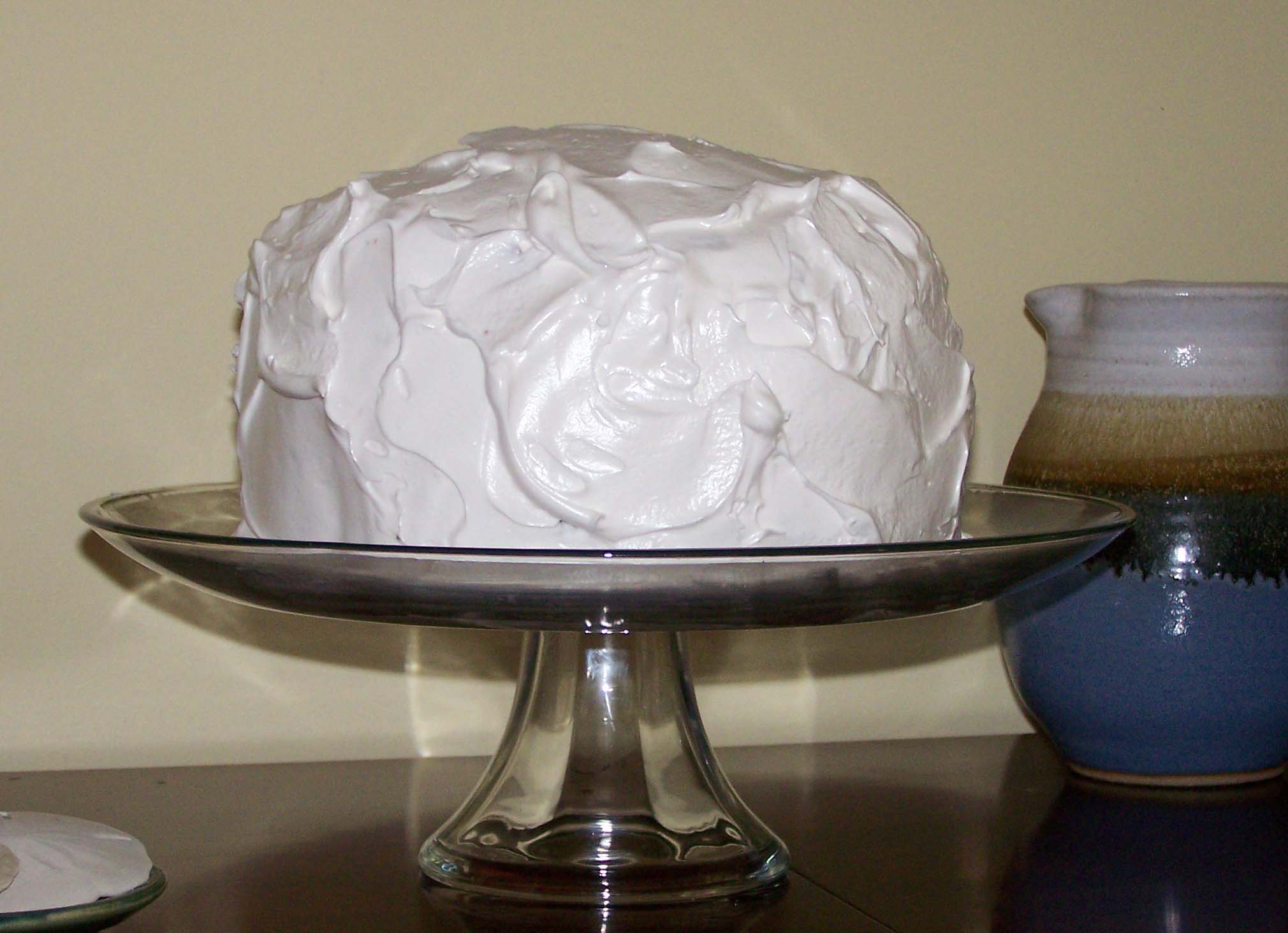
Here is my cake:

And, here is a recipe I think will work:

Cake:

Preheat oven to 375

8 egg whites, stiffly beaten; 1 cup of butter (two sticks); 2 cups sugar; 1 cup sweet milk; 3 1/2 cups CAKE FLOUR; 2 teaspoons baking powder; pinch of salt for egg whites; 1 teaspoon vanilla.

Sift flour and baking powder 4 or 5 times.  The more the flour is sifted, the lighter the cake.  Cream butter and sugar together until foamy.  (Sift sugar for a lighter cake.)  Add flour and milk alternately to butter/sugar mixture.  Begin and end with adding flour.  Add vanilla.  Fold in stiffly beaten egg whites.  Bake in four 8-inch cake pans that have been greased with butter and floured.  Or, three larger cake pans.  Bake at 375 for 30 to 35 minutes.  Keep a sharp eye, as doneness depends upon the size of the pans.  Allow cake to sit in pans for a few minutes, then turn them out onto wire racks to THOROUGHLY COOL.

Filling:

8 egg yolks; 2 cups sugar; 1/2 cup butter (1 stick); 1 cup raisins chopped; 1 cup fresh coconut or good quality freeze dried; 1 cup chopped pecans (soak these first in salted water and dry in the oven or a dehydrator to remove the phytates); pinch salt, 1 cup brandy or 3/4 cup wine or 1/2 cup whiskey; 1 teaspoon vanilla.  (I added grated lemon peel and that was nice–1 or 2 tsps.)

Beat egg yolks until lemon colored.  Add sugar, salt, and continue beating until mixture is light.  Melt butter in top of a double boiler and add egg-sugar mixture; stir constantly until thickens (up to 20 minutes).  Add other ingredients.  Let cool, spread between cake layers.  Let cake sit for up to 3 days before icing.

White Icing:

4 egg whites, 1 1/2 cups sugar, 1/4 cup water, 1 tsp. cream of tartar, pinch of salt, 1 tsp. vanilla.

Put everything BUT the vanilla into a double boiler and cook for about 5 minutes, beating with a hand electric mixer.  Remove from heat when mixture forms good peaks and is shiny.  Add vanilla.  Continue beating until spreading consistency is good. 

Make it for a special event and ENJOY!!!!


Tipping Points 4: The Emperor Has No Clothes

(You may want to read my essays in order.)

Tipping Points 4

April 7, 2010

The Emperor Has No Clothes

 Will Allen was the keynote speaker at the MOFGA (Maine Organic Farmers and Growers Association) Common Ground Fair in September 2009.  I would have gone to hear him rain or shine.  His 2008 book THE WAR ON BUGS is a history of agricultural and home-use chemicals in the United States.  Allen tells this ugly story to spotlight the Emperor’s nakedness:  our society does not have a mechanism to protect people from the excesses of the market.  Corporations, acting rationally in their own best interests, are making irrational decisions that adversely affect everyone.   

The historical process Allen describes is present in the development of most American industries, but if we look at just the agricultural and home-use chemical industry, we can see clearly how irrationality has replaced rationality, how we are all, including those making decisions within this industry, being massively poisoned.  Allen exposes how the modern web of players—corporate industry, scientists in academia, media, politicians, and the government organizations whose charters are to protect citizens—cooperate to relentlessly and, so far, successfully push the products of this industry. 

Allen tells how the loss of nourishing soil fertility begins in Europe alongside the birth of the capitalistic paradigm.  The landgrab enclosure movement of 1400-1500 halts the use of the common lands; forces large numbers of peasants to relocate to cities, which makes their labor available for industry; and allows, for a few individuals at the top of the society, the acquisition of both land and cheap labor.  The stage–designed by those with the cultural power to change the laws and to control the policing mechanisms–is set now for agricultural profit taking and the accumulation of capital.  Productivity, however, declines (3-4). 

This process of careless large-scale monocrop farming is duplicated in America, except for a small group of mostly small, northern, self-sufficient yeoman farmers (3-15).  Rich men exhausted land fertility and moved to new land–which was, often, given to land companies for free or for a few cents an acre by the government in charge (21-22).  For instance, in 1749 a land grant from King George II helped organize The Ohio Company.  By 1792, after the Revolution, this land company controlled 6,700,000 acres of land along the Ohio River, making George Washington, one of this land company’s leaders, one of the richest men in America (6).        

By the early 1800s, soil fertility on large-scale farms was devastated (13).  But, the first chemical quick fix was discovered.  Peruvian bird guano, mined by slaves and prisoners, was imported in the late 1820s–until supplies were exhausted in the late 1850s (25-26).  Next, fertilizer merchants created, manufactured, and sold, with relentless, repetitive advertising campaigns, attempted copies of the natural guano (30-31). 

So, writes Allen, the stage is now set for the seemingly benign and cheap chemical fix for ruined land, for pest control on monocrops, and for the promise of the reduction of labor costs.  But, the actual price was and is the continued degradation of the land and of the food since, while these farmers produced cheaper food, this food was of poorer quality and contained poisons (139). 

Also, the developing commercial fertilizer industry allowed the continued acquisition of land by large-scale commercial farms since the process whereby small farmers who could not compete lost their land accelerated (46).  Additionally, large-scale farmers had political power.  They could and did control access to the developing transportation systems bringing food to markets that were becoming increasingly centralized in cities (66-67). 

The next set of fertilizers, continues Allen, are the waste products of industry:  sodium nitrate from salt mining; arsenic and lead pesticides from iron and copper smelting, fabric dyeing, and paint manufacturing; cyanide gas from ammonium-cyanide production; natural gas and hydrogen used to make nitrogen for fertilizers, from gasoline or coke manufacturing; and fluorine from uranium mining.  So, as time passed, our food, more and more, was grown with industrial wastes (xxv-xxvi). 

But, what Allen is able to show by looking so closely at the history of this industry is the pattern that evolves for American industry formation.  What evolves alongside the markets for these waste products—and which still exists–is a top-down imposition of junk science.  Industry endows academic “research” departments and laboratories to support the use of industrial waste products.  Academia ignores actual data from the field that does not support the new message.  Industry organizes relentless advertising campaigns and heavily invests in the media, like farm journals, which promote the claims of the junk science that sells the waste product.  Industry controls politically the government mechanisms that should be protecting citizens.  And, anyone who protests or offers actual scientific proof that the junk science is flawed is ridiculed and/or run out of the arena (35-39, 68-73, 77-79, 82-91).          

This industry knows exactly how dangerous these chemicals are to human health because most of these chemicals (fluorines, carbonates, organophosphates, bromines, pyrethrum powder, and rotenone) were extensively tested during the war years.  The U.S. Army, the Office of Management and Budget (OMB), the USDA, and the “dominant chemical companies on the American side” tested thousands of old and new chemicals for their toxic potential during the war years” (131).  And, the Nazis and the cartel of companies known as I. G. Farben “experimented with all the known chemicals on concentration-camp victims throughout World War II” (129).  Yet the legal process to ban chemicals in America is limited to fights to ban a single chemical, rather than classes of chemicals, and this industry wages all out war to prevent any chemical, no matter how dangerous, from being banned 235).    

The ugly truth is that these chemicals either do not get regulated or, when regulated, are not policed adequately.  Arsenic, a heavy metal that is acutely toxic, is still in agricultural use today and will have a continued presence in agricultural soils for up to 100 years (124).  Arsenic causes cancer, lung and stomach damage, and serious debilitation to people or animals exposed to application drift (233). 

Methyl bromide has been scheduled for banning for ten years, but politically powerful large-scale strawberry, grape, and fruit farmers in California and Florida successfully obtained special-exemption uses in 2007 and 2008.  This chemical has already caused serious environmental degradation from aquifer to ozone.  In humans it causes “mutations, tumors, and monstrous birth defects” and is “incredibly lethal in very small doses so that pest resistance does not develop” (233-234, 244).   

Many banned chemicals, like DDT, suspended in 1972, creep back into patented chemical formulas (Kelthane) as part of the secret “inerts” ingredients.  This company was not fined by the government (175). 

Bigger and bigger farms—which grow through the logic of unregulated capitalism–means more and more chemicals are dumped into the environment and onto our food.  Surely we can recognize, thanks to Allen’s work, that the Emperor is naked, that there is a terrible flaw in our society.  Surely we can understand the history Allen charts between these abusive, needless practices and the growth of our own illnesses and deaths.  Surely the tipping point of change must be nearing where we all support our regional networks of small farmers who produce such glorious, healthy, life-sustaining food.  

Turkey Tracks: Duck Eggs

April 7, 2010

Duck Eggs

One of the seasonal pleasures in Maine is the appearance of duck eggs in our local markets in the spring.  My friend Rose has a spectacular black Muscovy male duck.    Rose and her husband Peter made a little retention pond for their ducks by diverting some of a local stream, gave them a dog-house sized house, and fenced in the area. 

Two years ago a sudden fall freeze froze the pond during the night.  The ducks were not locked into their house since they could escape predators by going into the pond.  A predator killed the female, and the male fought all night long.   When Rose and Peter found him the next morning, his wing was injured, and he was, understandably, very upset. 

He spent that winter in the chicken house, which was not at all to his liking.  Peter took pity on him from time to time and filled a basin with water so he could bathe.   But, in the spring, one of Rose’s many friends found a white female for him, and they raised a lot of babies that year.  I want to say 12 to 14.  I’ll have to ask Rose to jog my memory, but I was getting eggs from Rose one day just after the female duck first brought her babies out into the world. 

This spring, there are two females, and Rose has generously shared some of their eggs with John and me.  A duck egg is larger than a chicken egg, and it has a very tough shell to crack.   The insides are much thicker than a chicken egg, much more viscous.

Rose says duck eggs make the most heavenly pasta.  I used our eggs for cheese omelets, which are large and very fluffy.  These days I hardly ever go shopping for special recipes.  Rather, I take what I have and make something out of it.

Duck Egg Omelets

For each omelet, crack open one duck egg and scramble it with a fork.

Add some whole raw milk, real salt (celtic sea salt or local grey colored damp salt), pepper, and whatever herbs or leftover greens you might have on hand.  I was growing some onion sets in a Mason jar on my kitchen window sill (thanks to Colin Beaven’s web site–No Impact Man–http://noimpactman.typepad.com), so I snipped some of those into the egg mixture.  (It was too early to have herbs outside my kitchen door.)

Melt some good butter (made from raw cream if you can get it) into an omelet pan, and when it has stopped foaming, pour in the egg mixture.  Lower heat.  Lift the edges and let the raw egg run under the mixture.  When the omelet is mostly set, add a handful of grated, raw milk cheddar cheese and fold the omelet in half.  Let it sit in the pan on low heat until the cheese melts.

Enjoy!!

Tipping Points 3: When Did This Happen?

(You may want to read my essays in order.)

Tipping Points 3

April 3, 2010

When Did This Happen?

 I began reading food labels after passing out at my neighbors’ dinner table from a food reaction.  For  two decades I had been shopping the outside aisles of the supermarket where whole foods supposedly lived.  But, I had not questioned the sanctity of dairy products beyond ice cream—which often now included more than the five basic ingredients many food writers recommend as the watershed between real and fake foods.  Whip cream, I thought, for the cobbler I was planning. 

 The text on the front of the package of the All Purpose Whipping Cream read “super fresh” and “ultra-pasteurized, ” which meant raw milk had been preheated to just below 200 degrees Fahrenheit and then thermally processed to a temperature at or above 280 degrees Fahrenheit for at least two seconds.  Ultrapasteurization, which is suddenly more common, cooks milk.  This product lasts longer on the shelves–six months in an unrefrigerated aseptic (airtight, sterilized) container and up to 50 days in a refrigerated plastic milk container. 

The ingredient label read exactly as follows:  “cream, carrageenan (helps hold the whipped cream peaks), mono and diglycerides (made with vegetable oil, helps put air into the cream as it is whipping), and polysorbate 80 (made from corn oil, helps create stiff peaks).”  Wow, I thought, whipping raw heavy cream makes glorious peaks that last for days.  And, they’re not only killing the nutrients in the cream by cooking them, they’re cutting back on the cream and substituting seaweed and cheap highly processed vegetable oils.   

According to Dr. Mary Enig, a biochemist who is an internationally recognized authority on fats (Know Your Fats), the intensive processing of these vegetable oils breaks down their chemical structures into parts that act like razor blades in human veins and tissues.  These broken structures are the free radicals that cause heart disease.  

Enig is a scientist who since the 1970s has tried to tell the public how dangerous trans fats are, how untrue the lipid hypothesis used to demonize the animal fats people have eaten for centuries is, and how unhealthy the vegetable oils used to substitute for animal fats are.  When Enig tried to expose the scientific flaws in the lipid hypothesis, her work was successfully suppressed, and she never again got any funding.  She is associated with The Weston A. Price Foundation.  And, together with Sally Fallon, she wrote Nourishing Traditions and Eat Fat, Lose Fat (about healing diets).  Her lecture, The Oiling of America, delivered by Sally Fallon, is available on DVD.        

 Googling the ingredients on the AP cream carton shows that carrageenan is a gel-like thickening and stabilizing agent made from seaweed.  Polysorbate 80 is a surfactant (aids the blending of two liquids, like fats and water) and an emulsifier (helps the surfactant to blend).  Mayonnaise, for instance, is an oil-in-water emulsion made possible with the lecithin emulsifier in egg yolks.  Polysorbate 80 substitutes for egg yolks.  And, mono- and diglycerides are fats made, usually, from highly-processed soybean, cottonseed, sunflower, or palm oil.  They, too, act as emulsifiers.  And, they keep most baked products from getting stale.  In other processed foods, such as ice cream, margarine, instant potatoes, and chewing gum, they serve as stabilizers and give body and improved consistency. 

 Dr. Enig writes mono- and diglycerides are not just made from oils–they are the waste by-products of oil industry processing.  They are modern, cheap substitutes for lard and butter and, apparently, for egg yolks.  And, while they can be trans fats and do have some caloric value, industry is not required to list either condition on a label (WAPF web site).  

So, AP ultrapasteurized whipping cream is not a “super fresh” food—an oxymoron of stunning proportions.  It is a fake food.   

When did this happen?

Ann Vileisis, in Kitchen Literacy, describes how food additives have long been a problem in America.  As more people relocated to cities in the early 1900s, the food industry turned to preservatives to cut spoilage and reduce costs.  They used solutions of formaldehyde, salicylic acid, borax, and boracic acid, all of which “mask the natural signs of decomposition that had traditionally signified danger to cooks and eaters.”  The Pure Food and Drug Act, which required labels listing ingredients, was passed in 1906 after some of the largest manufacturers recognized that under the act, which would supercede state and local regulations, they could develop national markets that could and did squeeze out local and regional markets (126-134). 

Almost immediately, the distinction between man-made ingredients and “natural” ingredients became a political football.  Eventually, the act allowed the use of “artificial colorings, flavorings, and preservatives as ordinary parts of the American diet.”  The average shoppers of that era could not evaluate easily the additives on labels, so they came to rely on the government to protect them.  And, they use brand names as a marker of quality (126-134).

 But, The Pure Food and Drug Act did not prohibit the “inclusion of toxic ingredients in medicines,” and in 1937, a company used the untested drug sulfanilamide to treat streptococcal infections.  Sulfanilamide killed “more than a hundred people, mostly children,” which led to the 1938 Food, Drug, and Cosmetic Act, which required drug manufacturers to test toxicity and report findings to the FDA before a drug could be sold.  The act did not include provisions for toxicity testing for pesticides or food additives (177-178).  But,  Michael Pollan writes in In Defense of Food, and this is very important, it did require that the word “imitation” be listed with regard to “any food product that was, well, an imitation” (34-36). 

World War II shortages jumpstarted the creation of processed foods, which grew from about 1,000 products prewar to 4,000 or 5,000 new products postwar.  By 1950, one in four women worked outside the home, so there was both a loss of time and energy to cook and more money to buy processed food products (Vileisis 187).

The key shift to fake foods occurred in 1973 when industry succeeded in overturning the imitation label requirement.  Pollan writes that the change was not made by Congress, but by the FDA, which simply repealed the imitation labeling requirement within the depths of “a set of new, seemingly consumer-friendly rules about nutrient labeling.” The document stated that “as long as an imitation product was not `nutritionally inferior’ to the natural food it sought to impersonate,” it “could be marketed without using the dreaded `I’ word.”  The “regulatory door,” writes Pollen, “was thrown open to all manner of faked low-fat products:  Fats in things like sour cream and yogurt could now be replaced with hydrogenated oils or guar gum or carrageenan, bacon bits could be replaced with soy protein, the cream in `whipped cream’ and `coffee creamer’ could be replaced with corn starch, and the yolks of liquefied eggs could be replaced with, well, whatever the food scientists could dream up, because the sky was now the limit” (34-36). 

This process of nutritional equivalency—an equivalency decided by industry in collusion with the government, birthed the fake foods that now fill our supermarkets.  And, in turn, this process created a huge experiment that utilizes human subjects eating fake foods.  Look around you:  the experiment is not going well.

What we can do is eat the nutrient dense, whole, organic, local foods available in local markets, farmers’ markets, and our Community Shared Agriculture (CSAs) programs.  Support these markets, support local farmers, support eating foods in their natural seasons, and healthy food will return.  These foods may cost more, but you can make different decisions about what is really important in your life and give up something else in order to buy good food that nourishes your body.  Cheap foods are, in the end, enormously costly in so many ways, not the least of which is your own health and well being.              


Turkey Tracks: Lost Chickens

Turkey Tracks:  April 3, 2010

Lost Chickens

John lost the chickens last night.

I went outside at dusk to batten down the hatches on their coop so no predator could get to them in the night and found John circling the garage.

“The chickens are missing,” he said.

I chuckled because I had done precisely the same thing two nights before.

“Look inside,” I said.  They’ve put themselves to bed.”

And, there they were, up in the attic of the coop and curled into the nesting boxes.  You have to look really hard to see the black hens on the roost in the dark.  The wheatens are easier to spot.  Or so you’d think.  I somehow managed to leave one outside the coop, but inside the cage one night last week.  She must have been under the coop.  I found her the next morning roosting on the inside ramp to the coop.  The wheatens don’t take on the bulky French babes, and one of the wheatens is always odd woman out.

I have to count feet on the French babes to take a roll call.  Nappy is easy to spot.  On cold nights, he and Sally sleep together.  As I peer at them through the lid over the nesting boxes, he purrs to me.

“Good night,” Nappy, I say, and rub his neck for a minute.

Then, together, John and I lock them in.

Tipping Points 2: Winning the Cancer War

Tipping Points 2

April 2, 2010


Winning the Cancer War

In June 2001, my niece and godchild Catherine, at twenty-seven years of age, died.  An aggressive form of non-Hodgkins lymphoma took her down in thirteen months.  She left behind her eighteen-month old daughter; a not-yet-thirty-year-old husband; and an extended family and a network of friends who all had tried, as she had, to move heaven and earth to preserve her life. 

Catherine’s death created a black hole in the fabric of the lives of those who loved her.  And, her death was most likely a casualty of the careless, heedless pollution of the land, water, and air on the rural Eastern Shore of Virginia where she lived.  There, the commercial chicken industry grows, slaughters, and dumps waste onto the fields and into the Chesapeake Bay.  There, large commercial agriculture grows vegetables for nearby urban markets, using, of course, the full array of agricultural chemicals.   

Catherine’s cancer and death is a metaphor for what is wrong in our society.  It was not until my early forties in the 1980s that I started noticing how many people around me were dying of cancer.  How many Americans, I now wonder, have to experience the kind of horrible death Catherine endured before we wake up, stop calling cancer “normal,” and insist that the poisonous practices causing cancer be stopped? 

But, when will this BIG tipping point arrive?

Catherine’s death produced a fork in the road for me.  I could continue to live life as usual.  Or, I could realize that life is precious and sometimes much shorter than we expect, and I could answer a deep longing to return to a quieter,  rural life lived closer to the earth, to its seasons, to nature.  That’s how I got to Maine. 

And, once in Maine, some time after I passed out at her dinner table from a food reaction, my neighbor recommended I read Dr. Sandra Steingraber’s book, LIVING DOWNSTREAM.  Steingraber is a scientist (biology) and an heir to Rachael Carson, who died of lymphoma.  Steingraber’s life choices have been made from the “watchful waiting” platform of one who had bladder cancer in her twenties.  She studies, and now shares, what she has learned about cancer and the connections between cancer and environmental degradation.

Steingraber demonstrates that we have no comprehensive national cancer registry.  The National Cancer Institute (NCI) “does not attempt to record all cases of cancer in the country, but instead samples about 14 percent of the populace” (37).  This sampling comes from five states and five specific metropolitan areas and has only been in place since 1973.  Other factors further complicate this sampling:  different states collect data differently, some are years behind in analysis, and the data cannot account for people who move around the country.  Some states, like Vermont, not in the NCI registry, have only had cancer registries since 1992 (41-42). 

Regardless of this vexed statistical terrain, Steingraber says it is possible to determine that “the incidence of cancer in the United States rose 49.3 percent between 1950 and 1991,” that “40 percent of us…will contract the disease sometime within our lifespans,” and that lymphoma is one of the cancers that has “escalated over the past twenty years” (41-42).  Indeed, the cancer that killed Catherine, non-Hodgkin’s lymphoma, is one of three cancers “ascending most swiftly in the United States,” tripling since 1950 (47, 51).  Lymphomas are “consistently associated” with the phenoxy pesticides and herbicides which are used widely on crops, lawns, gardens, timber stands, and golf courses (52).  And, lymphomas occur in higher rates in agricultural areas (52, 64-65).  

My mother died in July 2009 from the same type of cancer that killed Catherine.  She lived in rural Georgia across the road from a young peach orchard posted with scull-and-crossbones poison signs and still reeking of chemicals many weeks after spraying occurred.  Even walking down the road next to the orchard drenched our clothes with the chemical odor.  Steingraber explains that when a chemical is sprayed, “less than 0.1 percent” stays on the target; the rest, or 99.9 percent, drifts “into the general environment (179).”  So, it is logical that lymphoma cancer rates are growing.

Now, in Georgia, where once there were dozens of peach farms in every little town, only about five companies control the commercial production of peaches—which means the connection between peach growers and those who live with their poisonous practices is broken.  This kind of distance is occurring all across the terrain of food as consumers, too, are distanced from the production of their food, which allows heinous practices to occur, from the spraying of poisonous chemicals, to the torture of animals, to the production of fake foods.      

Steingraber traces the history of the shift from a carbohydrate-based economy to a petrochemical-based economy after World War II when the chemical industry needed a new use for stockpiled war-produced chemicals.   After 1945, “between 45,000 and 100,000 chemicals” came into common use and only “1.5 to 3 percent” or “1,200 to 1,500 chemicals” have ever been “tested for carcinogenicity” (99).  These petroleum-derived synthetic chemicals “easily interact” with our bodies and, thus, interfere with our life processes.  Many are soluble in fat and collect in animal tissues high in fat, like human brains, breasts, bone marrows, and livers, all of which are sites where cancer is increasing.  Additionally, many of these synthetic chemicals are often not biodegradable, so they do not decay as does organic matter.  But, they are not static:  many shed, or, “off-gas,” the “smaller, more reactive molecules from which they are made,” producing new chemicals that remain largely uninvestigated, let alone monitored or regulated.  Further, when burned, many of these substances can create new reactive chemicals, like dioxin, which is poisonous (91-100).          

In totality, American industries and we, ourselves, are, every day, putting tons of chemicals into our environment without considering the implications for humans or for the earth itself.  In the early 1990s, in Steingraber’s home state of Illinois alone, “54 million pounds of synthetic pesticides” went onto agricultural fields annually and in 1992, Illinois industries “released more than 100 million pounds of toxic chemicals into the environment” (5-6).  We are, Steingraber argues, “running an uncontrolled experiment using human subjects” (270)—an experiment that has had deadly consequences since the World Health Organization has concluded that “at least 80 percent of all cancer is attributable to environmental influences” (60).  Thus, cancer cells, Steingraber argues, are “made, not born” (241).    

So, cancer is NOT caused by having bad genes or not getting enough exercise.  Cancer is being caused by the cocktail we have created, which includes at least the following ingredients:  environmental poisons; fake, highly processed foods; the overuse and mixing of dangerous prescription drugs; and the stress of modern life. 

Cancer is a creature of corporatism, of unregulated industries which are not held accountable for the harm they do.  Cancer is the blowback from a society that puts profit ahead of people and individuals ahead of community.  Cancer itself is an extremely profitable industry.  Cancer is a metaphor we can and must change.

We can start by strengthening ties in our own community.  Begin buying local products from those who follow sustainable practices.     


Turkey Tracks: Our First Flock

Turkey Tracks: April 2, 2010

Our First Flock

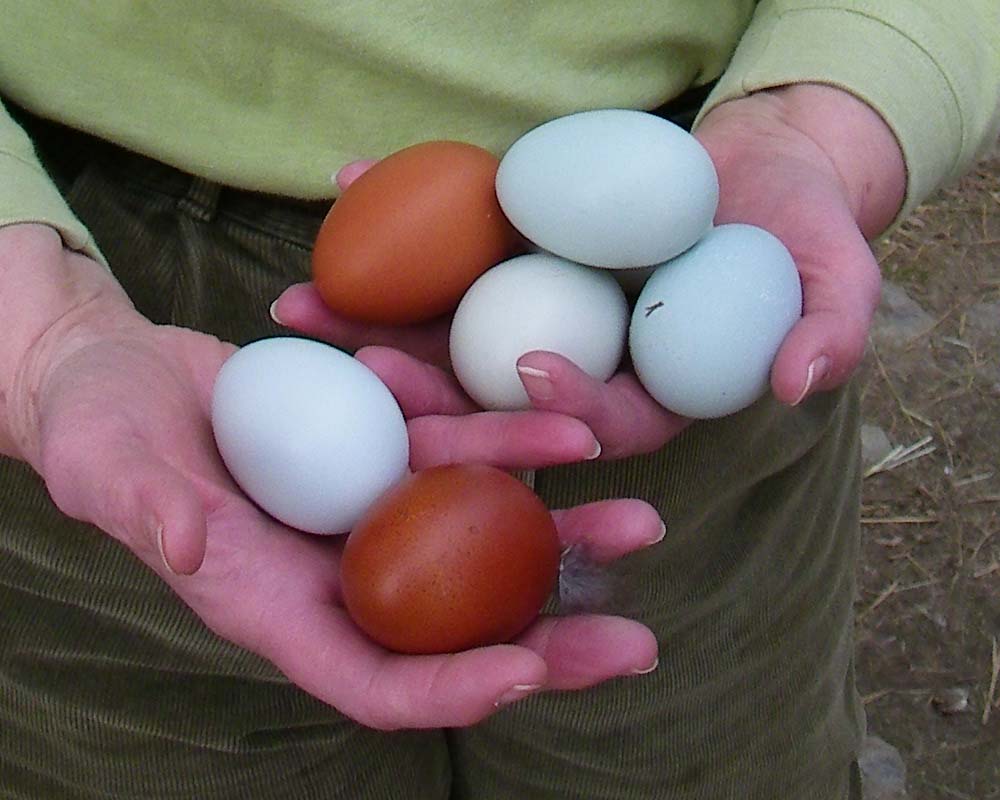
We got six chickens in March–a rooster and five hens.  We hadn’t planned on the rooster, but he wanted to come, and we’re so glad he did.  The roo, Napoleon, or Nappy, and three of the hens, are Copper Black Marans.  This breed is rare in America, but very common in Europe.  We lucked into getting them because they are not breeding quality.  This breed lays the most beautiful dark, chocolate brown eggs.  We could care less that Nappy has a white tail feather, or that not all the beautiful black hens have feathered feet.  The other two hens are Ameraucana Wheatens, and they are beautiful.  They are like quicksilver in the yard–quick, light, happy.  And, they lay blue eggs.

Here are our chicks getting used to their new home.

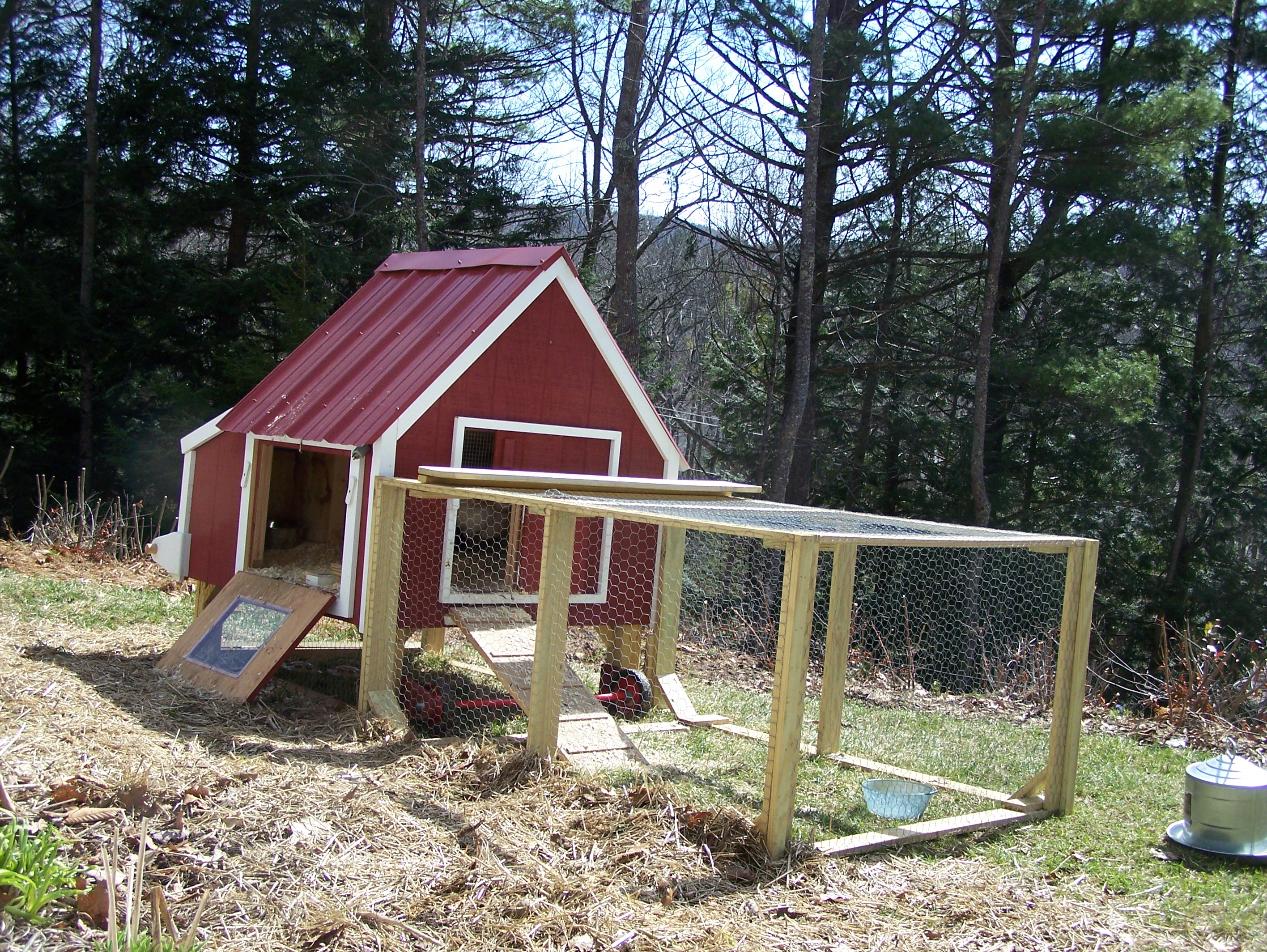
And, here is a picture of our chicken coop, which we purchased at the Maine Organic Farmers and Growers (MOFGA) fair last September from a young couple near Augusta, www.rootscoopsandmore.com.

One of the Ameraucanas, Sally, loves Nappy.

She follows him everywhere and sleeps next to him at night.  The coop roost only holds four birds, and the French babes and the other Ameraucana, Martha, apparantly have dibs on it.

Nappy leads the girls around the yard on walkabouts.  There is much discussion along the way.  They are delighted with the number of worms in my vegetable garden beds!

Tipping Points 1: Passing Out in My Plate

Tipping Points 1

April 1, 2010

Passing Out In My Plate

In May 2006, I passed out at our neighbors’ dinner table from an allergic reaction to something I had eaten.  The attack strengthened so quickly that I never knew until much later, when we could all joke a little, that my face fell into my dinner plate.  Or, that I lost all muscle control.  Or, that my husband and our neighbors were really scared as they tried to tell a dispatcher which rural driveway the responding rescue squads should take.  Or, that our neighbors’ son drew pictures of his yard filled with trucks and emergency crews during the following weeks.   

Afterwards, for some days, I felt very tired and very groggy.  And, scared.  Why had these attacks started?  What exactly had produced this strong reaction?  What if I had more attacks, and like fatal bee stings, the next one killed me? 

Earlier that spring, I had already had four or five mild attacks where blood rushed to my face and hands, where my vision blurred slightly, where I felt ill, and where I knew something was really wrong.  In April, there had been a much stronger attack in a favorite local restaurant, an attack which had allowed me to begin to associate hot chili peppers and/or pork with the reaction, though these were foods I had eaten with impunity all my life.

But that day in May, I had not eaten any peppers.  I had eaten a sandwich at a local fast-food place, and, I remembered later, that I had not felt well and that one of the earlier mild attacks had also been associated with this place.  Since I had eaten sandwiches from this chain all across America, I wondered if I had brushed up against some sort of local, recent pesticide application.  Perhaps, too, the sulfites in the red wine we brought to our neighbor’s dinner—a deep Chilean red–played a role in pushing me over the edge of what had been a simmering attack.  The rest of the dinner were foods I eat all the time:  wild salmon and, from the farmers’ market, salad, a green vegetable, and freshly baked local bread.  At that time, it seemed unlikely that these often-eaten foods had become ingredients in what I had begun to think of as a mysterious cocktail that had the power to knock me out in seconds. 

You can see how all these uncertainties could be unsettling, how looking for the combining culprits is like hunting for a needle in a haystack.  I carried an Epi-pen everywhere and, after reading all the warnings on the label, worried that my husband might actually use it on me if I passed out.  The potential effects of the pen seemed more dangerous than one of the bad attacks, from which I have, so far, slowly recovered on my own.  I stopped drinking red wine—or any alcohol–since alcohol can intensify a reaction.  And I started being really, really aware of my environment and my body’s reactions to everything. 

The food attacks, thus, became a tipping point for me.  They and my reactions to them started me on a journey of discoveries that have led to differing life choices.  A sign at the local Yoga Barn reminds me more forcibly of what is at stake:  “Take Care of Your Body, or Where Will You Live?”   In this sense, this tipping point, has been a gift. 

I am convinced now that my body is like one of those canaries used in mines to warn of odorless, deadly gasses.  Or, I am like the frog floating in warming water.  My body is telling all of us that those like me—and there are many–are signaling some kind of fundamental overload.  For me, the foods I’ve eaten all of my life have suddenly become poisonous and eating has become a bit like gambling with a roulette wheel.  Yet, foods alone may not be the total cause.       

What I’ve learned is that corporations have changed our food radically since the mid 1970s and that too much of our food is causing wild allergic reactions and chronic disease in people.  What I’ve learned is that we humans are, literally, poisoning our environment and, by extension, ourselves.  What I’ve learned is that corporations have been remarkably successful in either creating junk science that facilitates the selling of their products or hiding science that points to problems.  What I’ve learned is that our government has a 150 year history of protecting and facilitating corporations, not its citizens.  What I’ve learned is that few people have the time to do the kind of research I have been doing, and that I want to share this knowledge.   

The good news I can offer is that we do have opportunities for making a different set of choices, for living a different kind of life.  The hope to be found is that once we understand fully the modern terrain upon which we exist—a terrain I did not understand in 2006–we will begin making these different choices.  We can join others around the country who have already become agents of change in a culture that is now unsustainable for too many of us.  The promise is a fuller, richer, healthier life.