Turkey Tracks: Birthday Quilt

Turkey Tracks:  July 16, 2010

Birthday Quilt

I love my birthday.  It’s March 17th, and I look forward to it every year. 

This year, the grandchildren sent me a special present:  a paper quilt.

I loved it on sight.

And, I propped it on the wall in our craft/laundry room area, but didn’t get it hung until just before they came.

Here’s what it looks like:


You can see their names at the top.  I love the colors.  And, I think it’s the coolest quilt ever.

Mainely Tipping Points 13: The Failure of the Low-Fat, High-Carbohydrate American Diet

(Oops!  Read TP 12 first; it’s part of a series in the essays) 

Tipping Points 13

The Failure of the Low-Fat, High-Carbohydrate American Diet


 When Luise Light and her team of experts attempted to scientifically formulate the 1980 USDA Food Guide, they accepted two current dietary ideas as truth:  fat should be no more than 30 percent of the diet, and since the end of World War II, and especially in the 1960s, Americans had been experiencing “rising rates of heart disease, high blood pressure, stroke, and diabetes” (13, Luise Light, WHAT TO EAT:  THE TEN THINGS YOU REALLY NEED TO KNOW TO EAT WELL AND BE HEALTHY).

Current historians show us that the low-fat premise that has governed the American diet for the past fifty years sprang from belief, not science, and became part of American cultural and economic practices when the stars aligned around a constellation that included the political power of a congressional committee, media acceptance of its recommendations, and the firmly-held beliefs of a handful of people.

Science writer Gary Taubes, in his myth-exploding article “The Soft Science of Dietary Fat,” published in “Science” magazine in March 2001, questioned the idea that there ever was an epidemic of heart disease after World War II (http://www.nasw.org/awards/2001/The%20soft%20science.pdf).  When Taubes interviewed Harry Rosenberg, Director of the National Center for Health Statistics (NCHS), Rosenberg said a heart disease epidemic never existed.  First, in 1949 the International Classification of Diseases (ICD) added arteriosclerotic heart disease as a new category under the general category of heart diseases.  Between 1948-1949, the new category appeared to raise coronary disease death rates about 20 percent for males and 35 percent for females. 

Again, In 1965, the ICD added a category for coronary heart disease, which added more deaths to the statistical data as physicians began using the new categories.  Furthermore, Rosenberg explained, by the 1950s, Americans were healthier, so more were living to be 50-year-olds who would go on to die of chronic diseases like heart disease, which physicians were now listing on death certificates under the new categories.  Taubes reports that Rosenberg said that, in actuality, risk rates of dying from a heart attack remained unchanged.

Taubes also discussed the fact that between 1989 and 1992, three independent research groups (Harvard Medical School; The University of California, San Francisco, funded by the U.S. Surgeon General’s Office; and McGill University, Montreal) used computer models to work out added life expectancy for a person eating a low-fat diet that controlled saturated fats.  All three models agreed, but their conclusions have been ignored by media. 

The Harvard study showed that if a person’s total fat consumption was less than 30 percent of their daily total calories and if their saturated fat consumption was 10 percent of that 30 percent, a healthy nonsmoker might add from 3 days to 3 months of life.  The latter two studies showed net increase of life expectancy would be from three to four months.  Taubes noted that the U.S. Surgeon General’s office tried to prevent the University of California study from being published in “The Journal of the American Medical Association (JAMA), but JAMA published it in June 1991.

The Lipid Hypothesis is the “scientific” paradigm calling for a low-fat diet.  The Lipid Hypothesis is the premise that ingested fat, especially saturated fat, raises blood cholesterol levels, and high cholesterol levels cause chronic heart disease (CHD).  Yet, many, many scientists now have argued that these cause-and-effect links have never been proven and, in fact, cannot be proven.  More recently than Taubes, Michael Pollan, in IN DEFENSE OF FOOD (2008), traces this history and current thinking on dietary fats in a section entitled “The Melting of the Lipid Hypothesis” (40-50). 

So how did the Lipid Hypothesis and the low-fat paradigm get installed with scant scientific data to support it?  Biochemist Ancel Keys is a key player.  In the mid 1950s, Keys (University of Minnesota) claimed that his epidemiological Seven Countries Study showed a correlation between the consumption of dietary fat and heart disease.  But, an epidemiological study cannot control or eliminate variables, and correlation is not proved causation.  Furthermore, many now, among them Taubes and Uffe Ravnskov, claim that Keys eliminated countries whose statistics did not fit his hypotheses, like France, Holland, Switzerland, Norway, Denmark, Sweden, and West Germany, where national populations ate 30 to 40 percent of their calories as fat and whose death rates from CHD were half that of the United States.  Nevertheless, in 1961, the American Heart Association began advocating low-fat diets for men with high cholesterol levels.

Also in the 1950s, Nathan Pritkin, was diagnosed with heart disease.  Though he had no college degree and no scientific training, Pritkin created and published a low-fat, aerobic exercise regime that sold millions of copies.  Pritkin also suffered from leukemia, and it began causing complications and pain in the early 1980s.  Pritkin committed suicide in 1985.        

In 1977, the Congressional Select Committee on Nutrition and Human Needs, chaired by Senator George McGovern, promoted the low-fat hypothesis—despite objections by scientists expert in the field.  Taubes determines that “a handful of McGovern staffers…almost single-handedly changed nutritional policy in this country” by initiating “the process of turning the dietary fat hypothesis into dogma” (4).

In 1976, Taubes reports, after two days of testimony, this committee turned “the task of researching and writing the first `Dietary Goals for the United States’” over to Nick Mottern, a labor reporter with “no experience writing about science, nutrition, or health” (5).  Mottern relied on Harvard School of Public Health nutritionist Mark Hegsted’s low-fat beliefs.  Hegsted, unlike E. H. Ahrens, whose laboratory at the Rockefeller University in New York City was doing seminal research on fat and cholesterol metabolism, saw no risks associated with such a major change to the American diet.  Ahrens, as early as 1969, was concerned that eating less fat or changing the proportions of saturated to unsaturated fats could have profound and harmful effects on the body (3-6).  Nevertheless, the Select Committee published Mottern’s dietary guidelines. 

Next, Taube relates, Carol Tucker Foreman, a political appointee at USDA who later forms a public relations and lobbying firm whose clients have included Phillip Morris, Monsanto (bovine growth hormone), and Procter and Gamble (fake fat Olestra), hired Hegsted to produce “Using the Dietary Guidelines for Americans,” which supported the McGovern Committee Report.  Foreman hired Hegsted despite the fact that Philip Handler, National Academy of Sciences (NAS) President and an expert on metabolism, had told her that Mottern’s Dietary Goals were “`nonsense’ “ (6).

When NAS released its own dietary guidelines a few months later (watch your weight and everything else will be all right), the media criticized the NAS for having industry connections.  Hegsted later returned to Harvard where his research was funded by Frito-Lay.

So, a consensus was achieved, oneTaube says is “continuously reinforced by physicians, nutritionists, journalists, health organizations, and consumer advocacy groups such as the Center for Science in the Public Interest” (1).  And, science was “left to catch up” (7).

 Only, science never has.  And, what has emerged is that all calories are not equal and substituting carbohydrates for fat has caused weight gain and diabetes.  And, according to lipid biochemist Mary Enig, substituting highly-processed fats for time-honored, traditional fats is causing chronic heart disease.   

Pollan notes that in a 2001 review of the relevant research and report by “prominent nutrition scientists” at the Harvard School of Public Health, “just about every strut supporting the theory that dietary fat causes heart disease” was removed, except for consuming trans fats and consuming fats that alter ratios of omega 3 to omega 6 fatty acids (41-42).  Pollan notes the Harvard scientists stated the following in their report’s second paragraph:  “`It is now increasingly recognized that the low-fat campaign has been based on little scientific evidence and may have caused unintended health consequences’ “ (43).    

Pollan assesses that the low-fat ideology of nutritionism has been nutrition’s “supreme test and, as now is coming clear, its most abject failure” (41).

Turkey Tracks: Mid-July

Turkey Tracks:  July 16, 2010

I’m not sure where the past month has gone.  We are in full summer in Camden, Maine, so we are outdoors a lot.  And, the grandchildren came in early July (almost 7, 5 1/2, almost 4 and almost 3), so we are preoccupied with spending time with them.  They arrived just as our first strawberry patch ever was closing down, and they picked out the rest over the next few days.

Our strawberries are “Sparkles.”  John had some years back announced that he didn’t like strawberries and wasn’t eating any more.  Home grown, heritage strawberries turned him around, and he couldn’t get enough of them.  These berries bear no resemblance to commercial strawberries that are the size of golf balls and are sour and which are coated with up to 8 or 9 heinous chemical mixtures.  Sparkles fill your mouth with the taste of warm sunshine and sweetness.  I was able to freeze a fair amount of them, and we have been making ice cream with them.  If you have a food processor, it’s dead easy.

Food Processor Ice Cream:

Put several cups of real heavy cream (if you can’t get it, don’t waste your time or waistline eating the pasteurized stuff as it has no vitamins or enzymes in it, only empty calories) or plain yogurt or keifer (hopefully made from real milk) into the bowl of a food processor.  Add something sweet to taste–honey or maple syrup.  If you use stevia, make sure you aren’t using one with rice maltodextrin as that stuff is bad for you and nasty tasting–it’s a fake chemical food.  Add at least 1 Tablespoon of Arrowroot (buy it in bulk; it’s way cheaper)–it’s what makes the mixture smooth.  Turn on the processor, pour in at least 3-4 cups FROZEN fruit, and voila!  Lovely, soft ice cream.  If you have leftovers, add a Tablespoon of some liquor to keep it soft.  We never have leftovers…

Raspberries are coming in now, and mine are going to produce enough for all of us to eat and share.  We’ll probably go to a local organic farm to pick raspberries to freeze for winter.  There’s a pie I want to try as well, from one of Ruth Reichl’s memoirs.  (If you have not read the three memoirs and love food and cooking, you may want to read them:  Tender At The Bone, Comfort Me With Apples,  and Garlic and Sapphires.)  

Blueberries are around the corner.  I’ve ordered 15 pounds of organic berries to freeze for winter smoothies and cobblers.  Commercial blueberries, even the heralded small “wild” berries of Maine, which are by far the tastiest, are sprayed with an array of chemicals–some of which get into the local water and kill the fish and amphibians.  Some kill birds, bees, butterflies, etc.  If they kill those living things, they can kill you!  Or, make you really sick.  In fact, blueberries made the Environmental Working Group’s list of foods to avoid this year at position No. 5.

Here’s what the garden looks like now, with Bowen (almost 7) in front:

The plant on the right with yellow blooms is Beedy Parker Kale.  That’s garlic on the left, with celery and radish in front.  The potatoes are coming up well to the right of Bowen’s shoulder.  We’ve picked peas until we’re tired of them.  Beans are coming on strong.   That’s a yellow squash up front.  And, we’ve got broccoli to cut in the middle of the garden.

Here’s the dreaded zucchini, with lush tomatoes in front of the day lilies and raspberries fringing the yard:


 We have 14 winter squash and pumpkin hills in the meadow and Brussel Sprouts, cabbage, and more broccoli along the driveway. 

The chicken report is a bit different.  Our broody hen has given up trying to sit on eggs, though I suspect one of the Wheatens is starting to get the urge.  Here’s a picture of the chicks Rose Thomas incubated in June:

These chicks are Americana/Wheaten and Maran.  None of the Marans made it. 

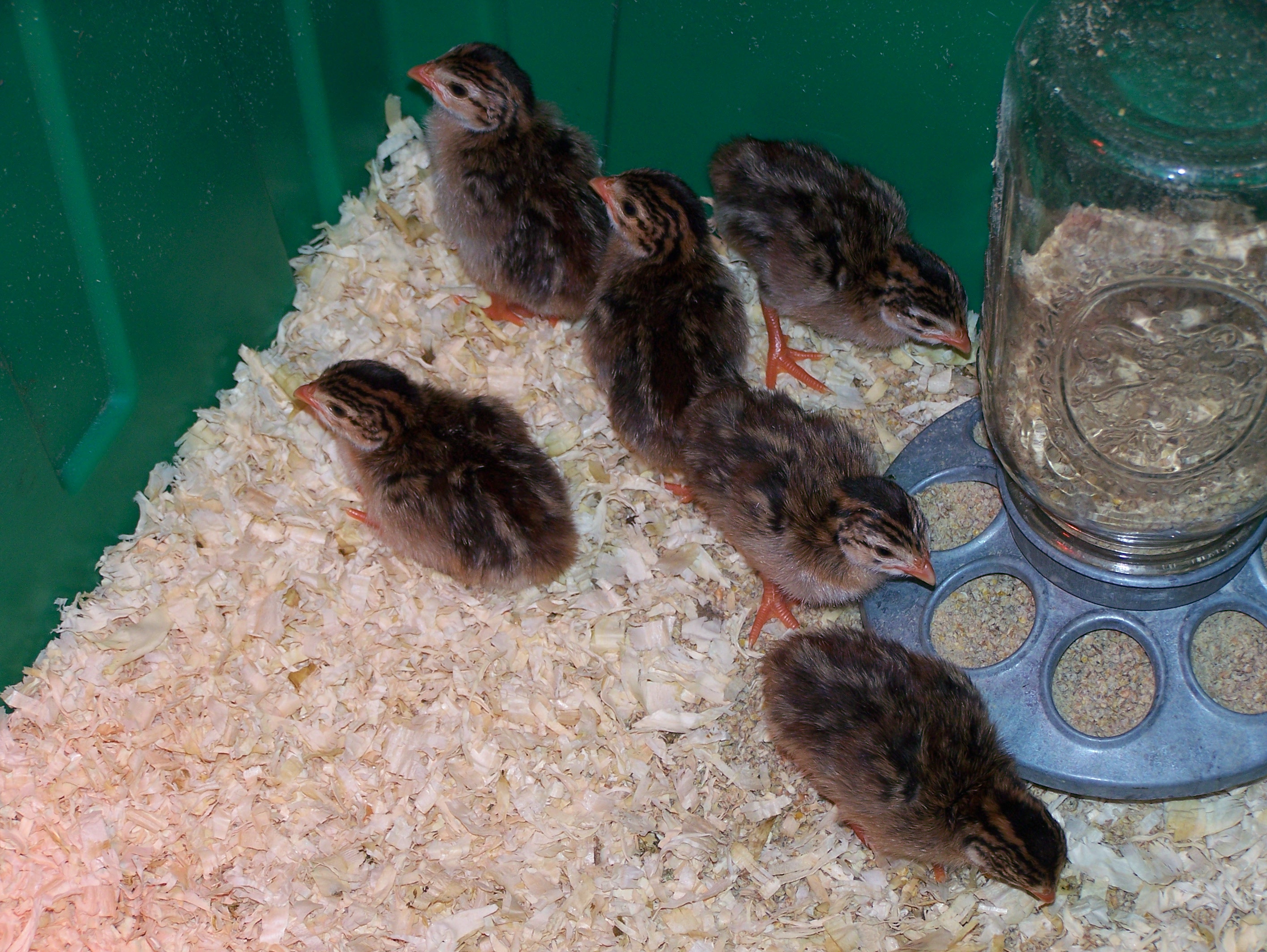
Here’s a picture of the six Guinea hens she also incubated:

Guinea hens take 26 days to hatch.  Chickens take 21.  So, Rose was quite proud of these babies.  She also had a hen sitting on eggs in the middle of the chicken pasture.  That hen will stay there 26 days, with the male close by.  Guineas lay eggs communally, but only one hen will sit the eggs.  I wonder if something like that goes on with chickens as our broody hen gathered all the eggs underneath herself out of our two boxes, and the other hens seemed to be cooperating. 

I started over 20 eggs timed to hatch July 14th.  One caught me by surprise on the 12th and tried to hatch in the egg turner with the humidity too low.  It didn’t make it out of the shell.  One hatched.  The rest are dormant.  We will open them later today to see what the story is.  Were they unfertilized?  Did something go wrong? 

The Marans are proving hard to hatch…  But, the one chick we have, named Orphan Annie, seems to be thriving.  Rose thinks her Maran, who recently hatched a brood, might take her.  But, she is rapidly becoming a pet…

So, everything is growing well:  veggies, fruits, chickens, and grandchildren.

Turkey Tracks: A Quiet Sunday in June

Turkey Tracks:  June 14, 2010

A Quiet Sunday in June

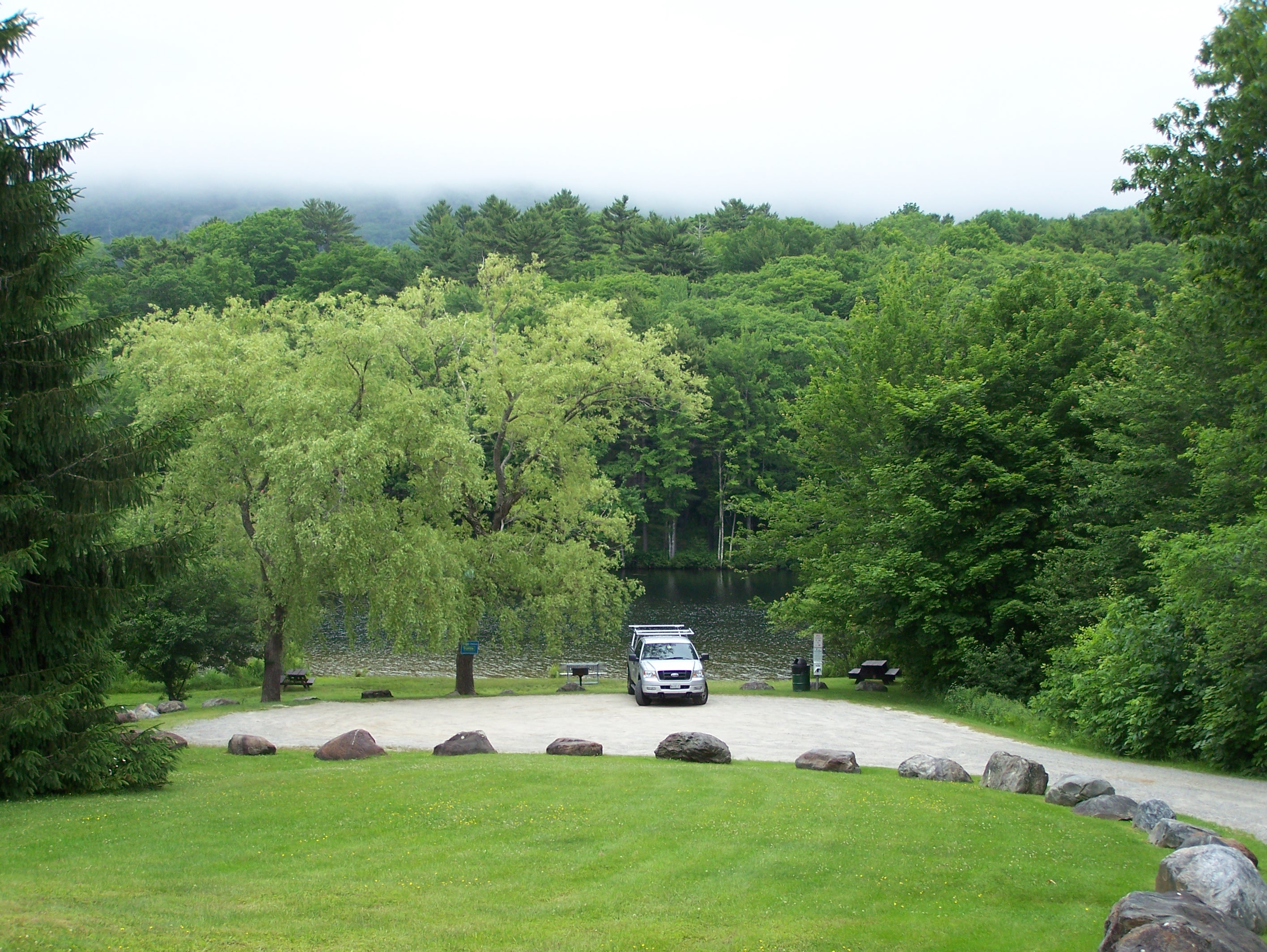
Yesterday was filled with small pleasures.  It was a soft day.  The clouds sat right down on the mountain tops, and the fog bank drifted in and out over the land.  We went for a little ride in the car to poke around and pick up a few things, like ice cream cones in town.  Here is Shirttail Point, our swimming hole on the river.  Note the clouds on the mountain beyond:


The truck belongs to three people in a canoe who came up just after I took the picture.

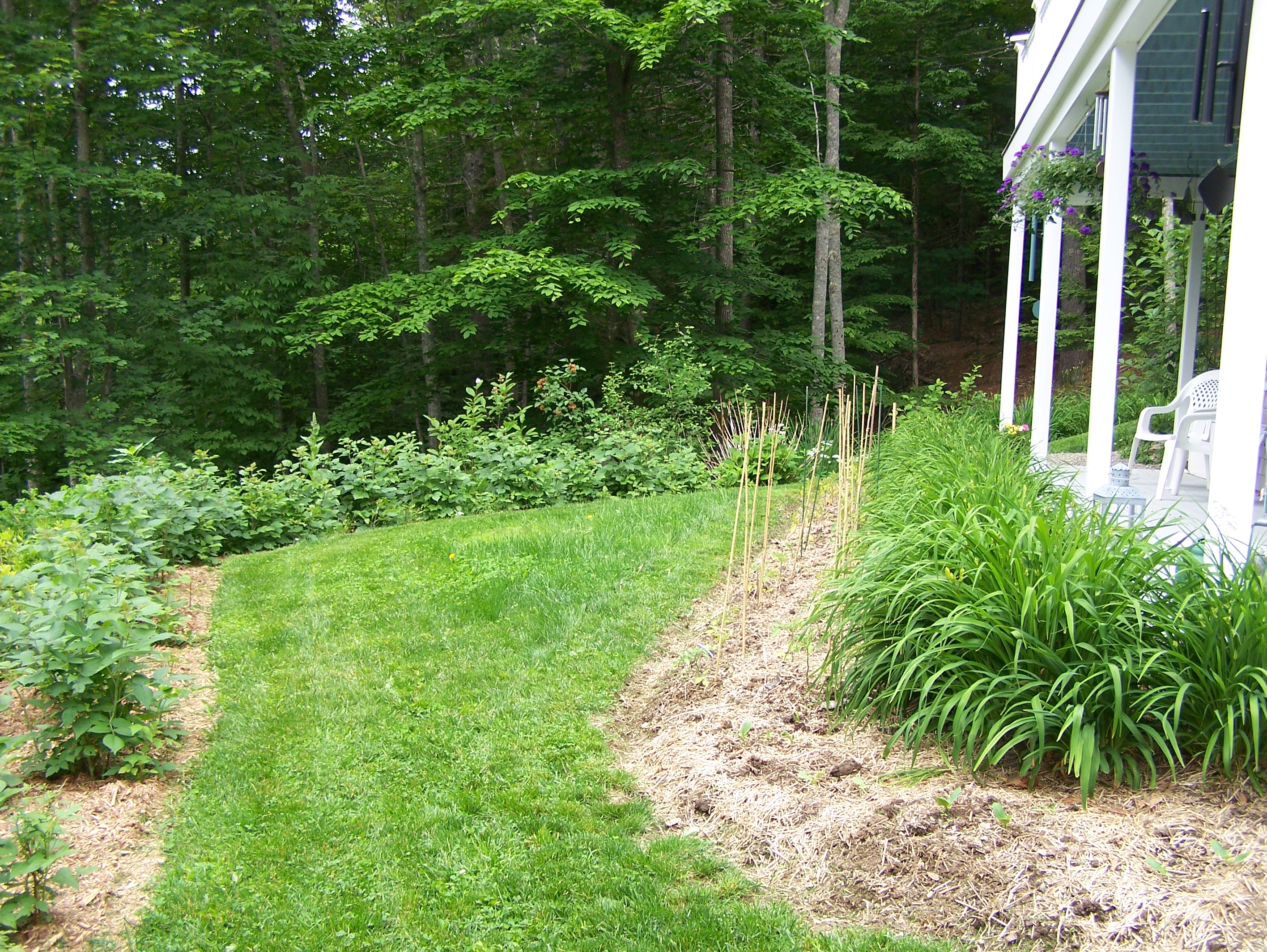
The garden is doing well.  Here is a picture of what it looks like now, with the chicken fence down:

The pea trellis is filling up.  The garlic (on the right) looks good.  In the distance, you see flowering kale.

Here is a picture of the tomato bed, which currently houses 20 plants, and along the curve, our raspberry plants.

Our strawberries are also starting to show color.  We planted them last year, but knocked off their blooms for the first year so the plants would establish themselves. 

This year, the red poppies finally bloomed.  I initially planted them in a spot that quickly grew too shady and had to move them.  This is their third year, but their first to bloom.  The blue flowers are, I think, Cantebury bells.  My shadow, Miss Reynolds Georgia, who is 8 this year, gets in the picture.

Penelope, Penobscot Bay (PenBay), Penny cannot stand to be left out:

I put alyssum into the steps every year.  And, Lady’s Mantle (the light green) grows like a weed in Maine.

One of our errands was to pick up some trout worms, meant for fishing, for the chickens.  Twenty-four (24!!!!) worms sell for $3 at Megunticook Market.  I justify this outrageous expense because of the pleasure it brings and because I can no longer drink wine, unfortunately.  I also tell myself that one of our fabulous local products, an ice cream sandwich called a Dolcelino, sells for $3.50.  I’m not sure I’m forgoing those in order to buy some worms though…  Here are the chickens eating the worms.

Nappy, the rooster, calls the hens to come, come, come eat this thing she has brought.  He stands over the treat and bobs his head up and down, trilling the call.  The hens come running, running.  (One of the Marans is broody, so she stays in the coop; one of the Wheatens was laying an egg and missed the treat.)  The Marans try to run off the Wheaten, so she only gets a few unless I throw some to her especially.  Today I just threw the whole lot into the pen.  I don’t think Nappy ever gets any of the worms.  He gives them all to the hens while he guards them.  I’ve tried to offer him some just for him, put to the side, but he just calls the hens for those.   

This morning, for the first time in a month, the broody hen (May May) came out of the coop with the others.  I’ve been having to lift her out and to put her in front of food before she will eat.  She goes into a kind of zone where her feet don’t work, so you have to pick her up and down until she, gradually, walks to the food. 

They don’t seem to mind being penned, but they are much quieter and less active.  They miss their walks.

Interesting Information: Cancer Rates, Delmarva Peninsula

Interesting Information:  June 14, 2010

Cancer Rates, Delmarva Peninsula

The Maine Organic Farmers’ and Growers Association quarterly journal came last week some time.  The journal always list up-to-date information about toxins.  This issue had a piece of information that I’ve searched for, off and on, for some time–cancer rates on the Eastern Shore.   

The area where my niece Catherine died, called the Eastern Shore, is part of a larger geographical structure called the Delmarva Peninsula–for the states of Delaware, Maryland, and Virginia which make it up.  The Delmarva peninsula is known for chicken production (growing and slaughtering) and for truck gardening.  The produce goes to neighboring urban areas, among them DC and Baltimore. 

Catherine lived just downwind from a chicken processing plant.  Neighboring fields were covered routinely with chicken manure.  These plants pumped bloody water into the bay.  Indeed, pfiesteria piscicida was discovered in the Chesapeake Bay very near her home south of Onancock.  Pfiesteria piscicida kills, massively kills, fish.  And, it has been associated with both the handling of pig and chicken manure in large, industrial practices, as a quick google search demonstrates.  See http://en.wikipedia.org/wiki/Pfiesteria_piscicida  and http://www.grist.org/article/last/

Anyway, here is the article from the June-August 2010 MOFGA journal, pages 9 and 10.  I’ve just retyped it exactly as it appears:

“Sheila Pell reports in Emagazine that some 70 percent of U.S. broiler chickens, as well as turkeys and swine, are given the arsenic-based growth promoting feed additive roxarsone.  While some of that organic arsenic remains in chicken meat, most is excreted and breaks down into inorganic arsenic, a strong promoter of many cancers.  In Prairie Grove, Arkansas, which is surrounded by large poultry factory farms, and where manure from those farms is used extensively as fertilizer on area fields, incidences of rare cancers are high.  A decade ago, the town’s 2,500 residents learned that 17 children there suffered from cancers including brain and testicular cancer and leukemia.  Likewise, the  Peninsula, another area with factory poultry farms, has one of the highest cancer rates in the United States.  Manure that isn’t used as fertilizer is added to cattle feed.  The National Chicken Council claims that roxarsone, an antibiotic, contributes to “animal health and welfare, food  and environmental sustainability.”  (“Arsenic and Old Studies–Pressure Is On to Ban a Hazardous but Profitable Feed Additive,” by Sheila Pell, Emagazine, March-April 2010; http://www.emagazine.com/view/?5064). 

High cancer rates on the Delmarva peninsula…  It’s nice to see it confirmed…

When Catherine was dying, and we all started at looking at why she might have gotten such an aggressive cancer–it killed her in a year despite every medical intervention tried, including a stem-cell transplant at Duke–we wondered about all the cancer in young people where she lived.  We wondered about the water.  We wondered about the truck gardening.  We really wondered about the chicken industry.

The Eastern Shore in perfectly suited for large industry, in that while there are some wealthy people who have vacation homes, most of the area is poor.  The chicken and produce industries provide jobs–though many of them, I suspect from looking at who was working in the fields, are going to illegal immigrants.  Anyway, no one locally will fight what is happening to the environment–even though many families have been struck with the nightmare of cancer.

Arsenic has never been banned in the United States, and it is still used agriculturally. 


Turkey Tracks: Visit to Pete and Rose’s Farm

Turkey Tracks: June 10, 2010

Visit to Pete and Rose’s Farm:  a Dolce Vita

The eggs Rose has been incubating started hatching last night.  Rose called me right away.  John and I left first thing this morning to go see them.

Here are the first 6:

The little black one is a Maran/Wheaten Americauna cross.

Many of the eggs in the incubator have big pecking holes in them and the chicks inside make them rock back and forth as they move around in their efforts to get out of the shell.   We stayed for along time watching two in particular that we thought might hatch while we were there.  But, no luck.  Rose will call later today to tell me how many more have hatched.

Rose has about 6 guinea hen eggs in the incubator.  They are much smaller than even our Americauna’s eggs.  And, they take about six days longer to hatch, whereas the regular hens take 21 days.  Rose’s guinea hen is sitting on a pile of eggs in a stand of tall grasses in the middle of the large chicken enclosure.  Merlin, the husband, stays with her and says sweet things to her all the while.  She will not leave the eggs, rain or shine, until they hatch.  Guinea fowl easily fly into the tops of trees, so it’s interesting that they nest on the ground, which is a very vulnerable place to be for a chicken with eggs.  Here is a picture of Rose’s Merlin–named so because he is an escape artist.  Rose got the female not long ago, actually.  Merlin is much smaller than William, Rose’s Americauna Rooster, but William is scared to death of Merlin.

Our meat chickens are 9 weeks old now, and you can see they are getting close to harvest weight.  We are planning on June 27th, probably.  Everyone who got part of the order of over 170 chicks will gather to help each other process the birds.

I will be curious to see if their livers will be good.  The livers of commercially raised chickens are not healthy at all.  That’s why you don’t see them in the stores anymore.  We will also keep the chicken feet, which are fabulous additions to the chicken broth we make from every chicken we roast.  In Italy, one always gets all the chicken parts, including the feet, when buying a chicken at any market.

Rose  recently got some adorable rabbits.  They are true pets, though she uses their feces to make a tea that she uses on her plants.  She calls these rabbits “floppy ear rabbits.”

Jenna, who is part of a program that places young people who are interested in farming with farmers, told Rose yesterday that this pair of rabbits will be having babies in the near future…  Rose and the friend who gave her these rabbits thought they were two females.  Oh well…

Lupines are blooming everywhere now.   The lupines are one of the prettiest wildflowers in Maine.  They are everywhere–all along the sides of the roads, in the ditches, in fields.  I like them best when they have pink and white mixed into the blue.  There was a stand of them back of Rose’s house.

It’s the best I can do today, which is a soft, rainy day.

Turkey Tracks: Baby Chickens

June 9, 2010

Baby Chickens

Rose called today.  The eggs we’ve been incubating at her house are hatching!!  We have three out already.  We expected them tomorrow.   These are Marans, Wheaten Americaunas, Maran-Wheaten crosses (which will lay an olive colored egg), some guineas, and I’m not sure what else.  Rose said one of the crosses is black!!

I’m going to see them first thing tomorrow!

Life happens!!

Tipping Points 11: The Chemical Madness Maze

Tipping Points 11

The Chemical Madness Maze


Three events in the past few weeks are swirling around in my mind. 

First, blueberries made the “dirty dozen” produce list.  At position 5, blueberries join apples (4) and potatoes (11)—all major crops for Maine farmers.  Being on the “dirty dozen” list is not good for business. 

Second, The President’s Cancer Panel (PCP) released its 2008-2009 report entitled “Reducing Environmental Cancer Risk:  What We Can Do Now.”  Consumers, especially parents, are urged by the Cancer Panel to “buy food that has not been sprayed or grown with chemical fertilizers,” a message that is increasing in frequency and volume these days. 

Nicholas D. Kristof called the President’s Cancer Panel “the Mount Everest of the medical mainstream.”  And, former President George W. Bush appointed the Cancer Panel’s current members:  an oncologist and professor of surgery at Howard University and an immunologist at the M. D. Anderson Cancer Center in Houston.  The Cancer Panel’s report is available on-line:  http://pcp.cancer.gov .  I urge you, especially if you are a parent or are involved in chemical applications, to read it. 

Third, Maine’s Pesticide Control Board (PCB) has scheduled a series of public meetings (May 14, June 24 and 25, and July 23) to discuss the public’s right-to-know about chemical spraying.  Existing law concerning the pesticide registry, where people could register to be notified of spraying, was seriously weakened last year. 

The seven members of the PCB are appointed by the Governor and approved by the Legislature.  Because the constitution of this board obviously was designed for political and perceived economic reasons, board members are expected to defend their particular turfs, which includes chemical farming and forestry and chemical spraying businesses. 

The Cancer Panel report states that our regulatory system for chemicals is deeply broken; that we are putting ourselves and, more importantly, our children at great risk; and that we must adopt precautionary measures rather than using reactionary measures (waiting until sufficient maiming and killing has occurred) with regard to the more than 80,000 improperly tested chemicals we are allowing to be dispersed with impunity. 

 In 2009, the Cancer Panel report discloses, 1.5  million people were diagnosed with cancer and 562,000 people died of cancer.   Today, some 41 percent of Americans will be diagnosed with cancer in their life times.  From 1975–2006, cancer incidence in U.S. children under 20 years of age has increased. 

The Cancer Panel directly connects cancer and environmental toxins:  “a growing body of research documents myriad established and suspected environmental factors linked to genetic, immune, and endocrine dysfunction that can lead to cancer and other diseases.”  The Cancer Panel is “particularly concerned to find that the true burden of environmentally induced cancer has been grossly underestimated” and that human “exposure to potential environmental carcinogens is widespread.” 

The Cancer Panel sums up current problems with our regulatory systems.  Included among the problems are “undue industry influence,” “weak laws and regulations,” and “inadequate funding and insufficient staffing.”  What results is “agency dysfunction and a lack of will to identify and remove hazards.”

For instance, the Cancer Panel determines that the Toxic Substances Control Act of 1976 (TSCA) “may be the most egregious example of ineffective regulation of environmental contaminants.”  TSCA “grandfathered in approximately 62,000 chemicals; today, more than 80,000 chemicals are in use, and 1,000–2,000 new chemicals are created and introduced into the environment each year.”   Yet, writes the Panel, “TSCA does not include a true proof-of-safety provision”—which means “neither industry nor government confirm the safety of existing or new chemicals prior to their sale and use.”

TSCA allows chemical companies, reveals the Cancer Panel, to avoid discovering worrisome product information, which must be reported, by simply not conducting toxicity tests.  And, as the “EPA can only require testing if it can verify that the chemical poses a health risk to the public,” the “EPA has required testing of less than 1 percent of the chemicals in commerce and has issued regulations to control only five existing chemicals.”  Additionally, “chemical manufacturers have successfully claimed that much of the requested submissions are confidential, proprietary information.”  So, “it is almost impossible for scientists and environmentalists to challenge the release of new chemicals.”  

In addition, the Cancer Panel notes that the U.S. “does not use most of the international measures, standards, or classification structures for environmental toxins that have broad acceptance in most other countries,” which makes meaningful comparisons difficult.  Further, U.S. standards are “less stringent than international equivalents.” 

In the chapter on agricultural chemicals, the Cancer Panel reports that “the entire U.S. population is exposed on a daily basis to numerous agricultural chemicals, some of which also are used in residential and commercial landscaping.  Many of these chemicals have known or suspected carcinogenic or endocrine-disrupting properties.”  For instance,” pesticides (insecticides, herbicides, and fungicides)” approved for use by the EPA “contain nearly 900 active ingredients, many of which are toxic.  Many of the solvents, fillers, and other chemicals listed as inert ingredients on pesticide labels also are toxic, but are not required to be tested for their potential to cause chronic diseases such as cancer.”

The Cancer Panel states that agricultural chemicals do not stay put.  Sprayed chemicals migrate on the air and into the water, creating toxic trespass into other peoples’ lives.  Indeed, Dr. Sandra Steingraber, who is quoted in the report, writes in her book LIVING DOWNSTREAM, that “in general, less that 0.1 percent of pesticides applied for pest control actually reach their target pests, leaving 99.9 percent to move into the general environment.” 

Farmers, their families, their workers, and chemical sprayers (including crop dusters) bear the highest health risks, according to the Cancer Panel.   Farm children, especially those living near pesticide use, have consistently elevated leukemia rates.  Exposure to the nearly 1,400 EPA-registered pesticides “has been linked to brain/central nervous system (CNS), breast, colon, lung, ovarian (female spouses), pancreatic, kidney, testicular, and stomach cancers, as well as Hodgkin and non-Hodgkin lymphoma, multiple myeloma, and soft tissue sarcoma.”  

It is very clear that we cannot continue using untested chemicals.  It is very clear that we are massively harming our children.  It is very clear that we must develop a political will for change and that we must devise ways to help the people caught in the chemical madness maze to escape it without undue financial penalty.       

Therefore, it follows that we must all understand that the problem at hand is not how to organize a chemical spraying registry.  It follows that we must all understand that the problem for individual PCB members is no longer how to protect present chemical practices.  The problem that we must all now face is how to stop the use of untested, toxic, dangerous chemicals. 

Statements to the PCB can be sent to the Director, Henry Jennings, henry.jennings@maine.gov.        

Write the PCB members and tell them that you recognize that they now have an incredibly difficult task.  Tell them that they must understand now that their primary responsibility must be to protect us and to protect themselves and their loved ones.  Tell them that this duty must supercede all other considerations.

Turkey Tracks: Finished and Ongoing Projects

June 9, 2010

Finished and Ongoing Projects

The garden is all planted now.  We have more tomato plants than I’ve ever planted.  We planted 14 winter squash and pumpkin mounds down in the meadow, and all seedlings there are up and have been thinned.  The potatoes are poking up through the dirt in the upper garden.  The strawberries are full of berries.  Ditto, the raspberries.  The beans are up.  I’ve planted extra Brussels sprouts, cabbage, broccoli, and kale.  And, we’ve gotten some much-needed rain.  Everything is very green and lush.  I have only to plant some more flower seeds.  And, weeding.  There is always weeding to do. 

Inside, during the rain, I finished two other projects.  Here is Blue Moon December 2010, which is now hanging outside my quilt room.  Roxanne’s lovely art piece moved up to my writing room.

The camera didn’t pick up the moonlight beading that shimmers across the water in the upper pond and along the water, center front to right.  Not many beads, just a hint of silvery light.  This moon was quite spectacular, and I wanted to do something with it from the moment I saw it while going to a local Christmas party. 

And, here is a knitting bag, long enough for knitting needles.


The lining is the polka dot, and the inside pockets, a toile:

This was a very fun project.  Prudy Netzorg had the idea to do it, and we took a class at Quilt Divas together.  Thanks Prudy.

I have Talula’s paper doll quilt all cut out.  Those fabrics came in a kit, and they sent 1 yard of the doll fabric.  It’s impossible to get a variety of dolls without a bit more fabric, so I’ve sent for that.  Meanwhile, I’m working on what I can.  Hopefully, both Wilhelmina (whose quilt is finished) and Talula will both have quilts when they come in July.

I’m knitting an afghan at night.  It’s a lovely shade of soft spring green.  Maryann is knitting one in yellow.  We have size 13 circular needles, and the project was billed as a weekend project.  HA!!  No way, Jose.  And, I’ve already had to undo about 10 inches as joining this very soft yarn in the middle distorted the pattern. 

And, my carry around knitting is a pair of socks for Corinne in a bamboo and nylon blend that should work in Charleston, SC.  Mothers to be need to be pampered!!!!

Turkey Tracks: Napolean, The Quilt Room Mascot

June 9, 2010

Napolean, The Quilt Room Mascot

Carol Boyer visited Coastal Quilters, and did a workshop on Friday, May 14th before our Saturday meeting.   Carol is one of the most creative people I have ever met, and spending time with her is so freeing.  Carol taught art in the public schools, and she is willing and able to try anything to see how it might work.  She is an inventive quilter, but she also makes dolls.  Our workshop was to make a “funky chicken.”  And, she had prepared a hen pattern for us to use.  I had it in my head that I wanted to do a rooster.  No problem.  With a few snips and inserts into the pattern, the hen got a longer neck, bigger comb, and so forth.  A rooster tail?  No problem.  Go home and get some wire…  Here’s what came home with me.

 And, here are his feet, with his awesome toenails:

The real Nappy boy and all his hens are penned now.  He doesn’t seem to mind.  Neither do the Maran hens.  The Wheatens are completely affronted.  And, they escape forthwith is there is any garden weeding going on.  They aren’t too hard to catch as they do get worried when they are separated from Nappy for too long.  It’s fairly easy to pen them against the fence somewhere.

Here is Nappy with some funky chickens:

Here are some of the dolls Carol brought for her trunk show on Saturday:

Thank you Carol for a lovely time!