Tipping Points 10: Meat Chickens

Tipping Points 10

June 9, 2010


Meat Chickens

 I am helping raise fifty pastured meat chickens with Pete and Rose Thomas of the Vegetable Shed on Route 173 in Lincolnville.  I am mostly a bystander at this stage.  I paid for our twenty chicks when they arrived, am paying for half of the feed as Pete and Rose are doing all the work, paid for half of some of the start-up equipment, and go admire how healthy and beautiful the chickens are about once a week.  I will help slaughter them later this month.

We got twenty pastured chickens in a Community Shared Agriculture arrangement last fall, and we would have done so again.  But, as Pete and Rose helped us acquire and manage our layers, it emerged that they wanted to raise some Silver Cross meat chickens.  They agreed to let us be partners, and we’re all learning a lot as we go along.

After watching the movie JULIE AND JULIA, where Julie Powell cooks all 536 recipes in Volume One of Julia Child’s “Mastering the Art of French Cooking” (1961) in one year and blogs about the experience, I pulled out my Volume One—nearly 50 years old now and one of the cookbooks I brought with me when we culled books and moved to Maine.  I made the master leek and potato soup recipe.  Delicious!  Next, as I’ve never been a strong baker, I challenged myself with the cake section.  I was amazed at how many eggs and how little flour and sugar the French one-layer cakes contained.  And, real butter cream icing is velvet on the tongue; has an intense, satisfying flavor; and is smooth all the way down.  Yummo!

Then, I discovered the DVD set of eighteen of the early Julia Child television shows, made throughout the 1960s.  One of these shows is “How To Roast A Chicken.”  Julia lines up six chickens to compare their sizes and purposes:  a broiler, a fryer, a roaster, a capon (castrated rooster), a stewing fowl, and an “old lady” hen fit only for soup.  The broiler Julia shows weighs 1 ½ to 2 ½ pounds and is 2 to 3 months old.  The roasting chicken is 4 to 7 pounds and is 5 ½ to 9 months old.

Nowadays, we are raising 4 to 5-pound Cornish Cross chickens in six or seven weeks.

And, they are tasteless.  In her memoir MY LIFE IN FRANCE, Julia sums up the problem she encounters in 1955 when she begins to experiment with chicken cookery:  “The American poultry industry had made it possible to grow a fine-looking fryer in record time and sell it at a reasonable price, but no one mentioned that the result usually tasted like the stuffing inside of a teddy bear” (213).

According to the National Sustainable Agriculture Information Service (NCAT), beginning in the 1950s, industry worked to develop a chicken that was meatier, was broad-breasted, grew rapidly, converted feed efficiently, had limited feathering which minimized plucking, and which had “other traits considered desirable for rearing very large numbers of birds in confinement.”  Uniformity dictates this model.  If all the birds are the same size, processing equipment can be designed for maximum technical efficiency (http://attra.ncat.org/attra-pub/poultry_genetics.html).

In April 2009, Harvey Ussery, in “Backyard Poultry Magazine,” noted that the development of the Cornish Cross has “pushed muscle tissue growth to extremes, at the expense of balanced growth of all other systems—resulting in failed tendons and crippled legs, compromised immune systems, heart failure, and other problems.”  This chicken is given antibiotics and arsenic to “force still faster growth.”  And, since they are raised in “filthy, high-stress conditions,” antibiotics are required from “day one to slaughter” (“Sunday Dinner Chicken:  Alternatives to the Cornish Cross,” Apr/May 2009, “Backyard Poultry Magazine,” www.themodernhomestead.us/article/Cornish+Cross+Alternatives.html.).

Ussery vowed never again to “coddle such a compromised bird” when he lost twenty-two in two hours during a temperature spike.  The distressed birds, wrote Ussery, were at slaughter weight.  And, they “sat…in the shade of their pasture shelter, panting desperately, and died—rather than walk six feet for a drink of water outside the shelter.”  Meanwhile, his group of “young New Hampshires, the same age as the Cornish Cross to the day, [were] scooting about the pasture like little waterbugs, crossing their entire electronetted area when they needed a drink of water.”

Steve Hode of the Northeast Sustainable Agriculture Working Group, who raises chickens in Windsor, Maine, says the flesh of the Cornish Cross chickens is so soft that it dissolves in your mouth without much chewing.  Further, Hode noted, the bones of these chickens, because they grow so fast, never develop the density that makes for mineral-rich bone broths.

The efficient feed conversion factor means that meat chickens are fed, as are industrial layers, 90 percent corn and 10 percent soy.  Feeds, even organic feeds, contain the synthetic protein methionine and an array of chemicals and waste-product oils.  Changing to 70 percent corn and 30 percent soy solves the protein problem, but affects production costs as less carbohydrate (corn) means a longer growth time, more money for additional feed, and more manure (“There’s a synthetic in my organic chicken,” Rodale Institute, 1 April 2005, http://newfarm.rodaleinstitute.org/columns/org_news/2005/0405/methionine.shtml).  A 70/30 mixture does not solve the problem of making omnivore chickens vegetarians, which affects the omega 3 to 6 ratio of the meat.

According to the Lion’s Grip web site, what chickens prefer to eat is much more diverse.  Too see this list is to understand how blighted a diet of 90 percent corn, 10 percent soy, and a bunch of chemicals is.  Chickens need ample grass and living plants, especially clover; subterranean flora and fauna; insects; and protein that raises the omega 3 content of flesh and eggs so that it is equal to the omega 6 content, like fish, meat, milk worms, and nuts.  A grain supplement should only be given free choice and should be based on a mixture of five or more grains.  Legumes should be offered with grain to balance grain proteins.  Salt should come from free-choice kelp, and calcium from oyster shells or grass-fed bone.  Oils, like the highly processed, already rancid waste products from industry, should never be added to chicken feed   (www.lionsgrip.com/chickensidealfeed.html).

We are feeding our chickens commercial organic feed, as we have not yet worked out how else to feed a large flock of organic chickens outside what the so-called free market has standardized.  We do not like giving the chickens soy, synthetic chemicals, and waste products from industry.  But we have not yet located local grain mixtures and protein sources that are economically feasible and not too time consuming to organize.

Four major transnational companies supply 80 to 90 percent of the chicks to the worldwide commercial meat chicken industry, some in the form of hatching eggs sold to independent hatcheries.  Alternatives to the Cornish Crosses are limited, but some of these companies are now offering a slower growing Cornish Cross, like our Silver Crosses, which are slaughtered closer to their sexual maturity.  And, and at least one of these companies, Hubbard, a French company, is offering a chicken sold under the Red Label system in France that is most commonly known here as a Freedom Ranger.  This chicken, apparently, takes twelve weeks to grow, forages pasture well, and is loaded with flavor.

Our Silver Cross chickens come from Henry Noll in Pennsylvania.   While still a Cornish Cross, they are slower growing and will take at least 9 weeks to grow to 5 pounds.  Crossed with a Barred Rock, they are a beautiful silver grey with barred feathers and red combs.  Pete and Rose, who ate one last fall, say they definitely taste better than the flavor-challenged standard Cornish Cross.

Our chickens are very lively and have huge yellow feet and legs.  You can tell which ones are roosters now, and they are, suddenly, looking quite heavy.  However, all of them eat like piranhas.  It’s eerie to watch them eat.  And they are eating us out of house and home.  They will eat the grass and clover in their large, movable pen only if grain is withheld.

So, for fall and the future, we are looking to the Freedom Ranger chicken.  Ussery describes the meat as being “incomparably better.”  And NCAT says the “meat is flavorful and firm, but not tough.”  Freedom Rangers are also good layers.

Do not ask us to sell our meat chickens to you.  We cannot.  The food Nazis at the Quality Assurance and Regulation Division of the Maine Department of Agriculture, in the name of food safety and without any evidence of problems, will likely be successful in revoking the 1,000-bird poultry exemption for small farmers.  Now, any farmer who wants to sell even one chicken must build his/her own, very expensive processing facility, which would only be used a few weeks a  year.  Additionally, equipment may not be shared between farmers.

Here’s exactly how government helps the big and uniform get bigger and more uniform.  Here’s how small, local, and diverse gets driven out of the market.  Here’s how tasteless chickens are created.

Turkey Tracks: Coastal Quilters 2010 Challenge Quilt

June 9, 2010

Coastal Quilters 2010 Challenge Quilt

I finished the Coastal Quilter’s 2010 challenge.  Here is the challenge fabric:

We were to create a 9 by 12 quilt using this fabric in some way.  The orientation was landscape, so the 12″ side would be on top.  We chose this size in case anyone wanted to donate their quilt to Ami Simms Alzeimer’s Quilt Project.   You can see these quilts at http://www.alzquilts.org.    Ami, whose mother died of Alzeimers, has raised almost half a million dollars that she donates directly to research by selling these donated quilts in on-line auctions and at major quilt shows.

Here’s my challenge quilt:

From the beginning, I saw a rooster tail in the fabric.  John printed a picture of Napolean for me in black and white on 8 1/2 by 11-inch paper.  I cut out the shapes, fused them to fabric, recreated the rooster, and quilted it.  As various people came and went and commented, the piece evolved.   Linda McKinney said I needed a white line of stitching between the sky and the land.  Prudy Netzorg said I needed a moon.  (I later changed the moon thread to white.)  The buttons came from buttons collected by my Great Aunt Margaret Phillips, who lived through the depression in Reynolds, Georgia.  She taught in the primary grades in the Reynolds school and walked everywhere as she had no car.  I inherited her button jar sometime over the years, and I use those buttons all the time.  I have added to it, and friend Gina Caceci added her mother’s buttons to it when she passed away.     

All our challenge quilts will hang together at the Pine Tree Quilt Guild show in late July.  I’ll take pictures so you can see what other people did with this fabric.  Each and every quilt is amazingly creative, as you’ll eventually see.

Turkey Tracks: Chicken Fenced Garden

May 17, 2010

Chicken Fenced Garden

We spent the day in the garden.  This time of year, vegetable gardens can look pretty bleak.  But, things are going on nevertheless.  The garlic is doing well.  Beedy Parker’s kale is up and running.  The asparagras–oh my!  It’s second year, and we decided not to cut any.  It’s all come back and seems to be spreading well.

In the upper garden, the strawberries have big fat blooms on them.  And, the raspberries are looking bushy in the front.  They have a lot of sprouts coming up as well.

I’ve planted carrots, beets, and three kinds of peas.  It’s the first time for peas for me.  The radish are up.  The lettuce is looking good.  The onion sets are in.  But, the garden is waiting for all those big, lush plants that look so exciting:  beans, tomatoes, cukes, squash of all kinds, cabbage, broccoli, leeks, potatoes, Brussel sprouts.

We bought annual flower plants today and potted until we ran out of potting dirt and compost.  We hung three hanging plants in the usual places.  The hummers are back; they will be delighted to see a hanging plant near their feeders.  No sight of the Baltimore Orioles yet, but it’s time for them.

Here’s what the garden looks like now.  You can see the new pea trellis behind the dreadful chicken fence that really works.

It’s very dry, however.  We are watering daily in May in Maine!!!  Very bizarre.

Turkey Tracks: Two Quilts

May 17, 2010

Two Quilts

John and I both volunteer at The Community School in Camden, Maine.  The C-School is a private alternative high school. 

This year, I worked with two students, both girls.  I have accompanied them through many academic endeavors, watched them grow and grow up, and celebrated with them their awesome success.  Both will graduate May 28th. 

Along the way, the three of us decided they would, or could, make quilts.  Ok.  I decided, and they went along with me.  They are both cool that way.  And, I was honored that they trusted me saying they could make a quilt, especially since neither of them had ever sewn, used a rotary cutter (VERY sharp, can cut off fingers), done fabric math, and so on.

Well!  After 5 months of working almost every Friday afternoon, their quilts are done.  And, on the spur of a moment, I took them to our April quilt meeting.  One of our quilters works for the Center for Maine Contemporary Art.  Later, she got in touch with me and suggested the girls and the C-School hang the quilts in the annual student show beginning May 1.

We finished their bindings, I put on hanging sleeves, John and I worked out hanging rods, and both of us worked on signage.  John did most of the signage and all of the hanging. 

Here are the quilts:


 I am so proud of both girls.  I wish for them all the best in this world.   I will miss them so much.  But, I know that they will always have these quilts and that the quilts will remind them what they can accomplish in life.   


Turkey Tracks: Kathy Daniels Comes to Coastal Quilters

May 17, 2010

Kathy Daniels Comes to Coastal Quilters

Mercy!  Where does time fly to?

Our April 10 meeting of Coastal Quilters featured Kathy Daniels, who is an amazing quilter.  Best of all, she may be moving to Camden in the near future.  Kathy did a trunk show for us which included her quilt journey.  She started with traditional quilts, but quickly moved into art quilts.

I loved most of her quilts.  They are so inventive.  But here is one I particularly liked.

Kathy is on the left and Sarah Ann Smith, a nationally known quilter, is on the right.  Kathy and Sarah are friends and members in Frayed Edges, their art quilt group. 

Kathy’s blog is  http://studiointhewoods.blogspot.com/.  Take a look.  It’s really fun.  And, colorful.  Lots going on here.

Sarah’s blog is http://sarahannsmith.com.   Visit it to see her beautiful quilts.  Her galley is on the right of her opening page.  Also, she just published her first book:  Thread Work Unraveled.  AND, it has been given a second printing.  GO SARAH!  Be sure to visit her blog.  If you’re a quilter, you can learn a lot.  If you’re not, you’ll still be intrigued.

So, here’s another of Kathy’s quilts that I liked a lot.  It’s a tribute to a beloved dog who died.


Finally, here’s another one I liked.

 Kathy!  Thanks so much for coming to Coastal Quilters!

Turkey Tracks: Book Club, Dewey

May 17, 2010

Book Club:  Dewey, the Library Cat

I love my book club.  We are six members, and each year, we each propose a list of 5 books.  The members choose two books from each members’ list, for a total of 12 books.  So, that’s our year of reading.  What I love, in addition to the members themselves, is that I frequently read books I would not have chosen for myself.  My life has been richer for those experiences, even when I don’t like a chosen book, it is interesting to hear if others did and why. 

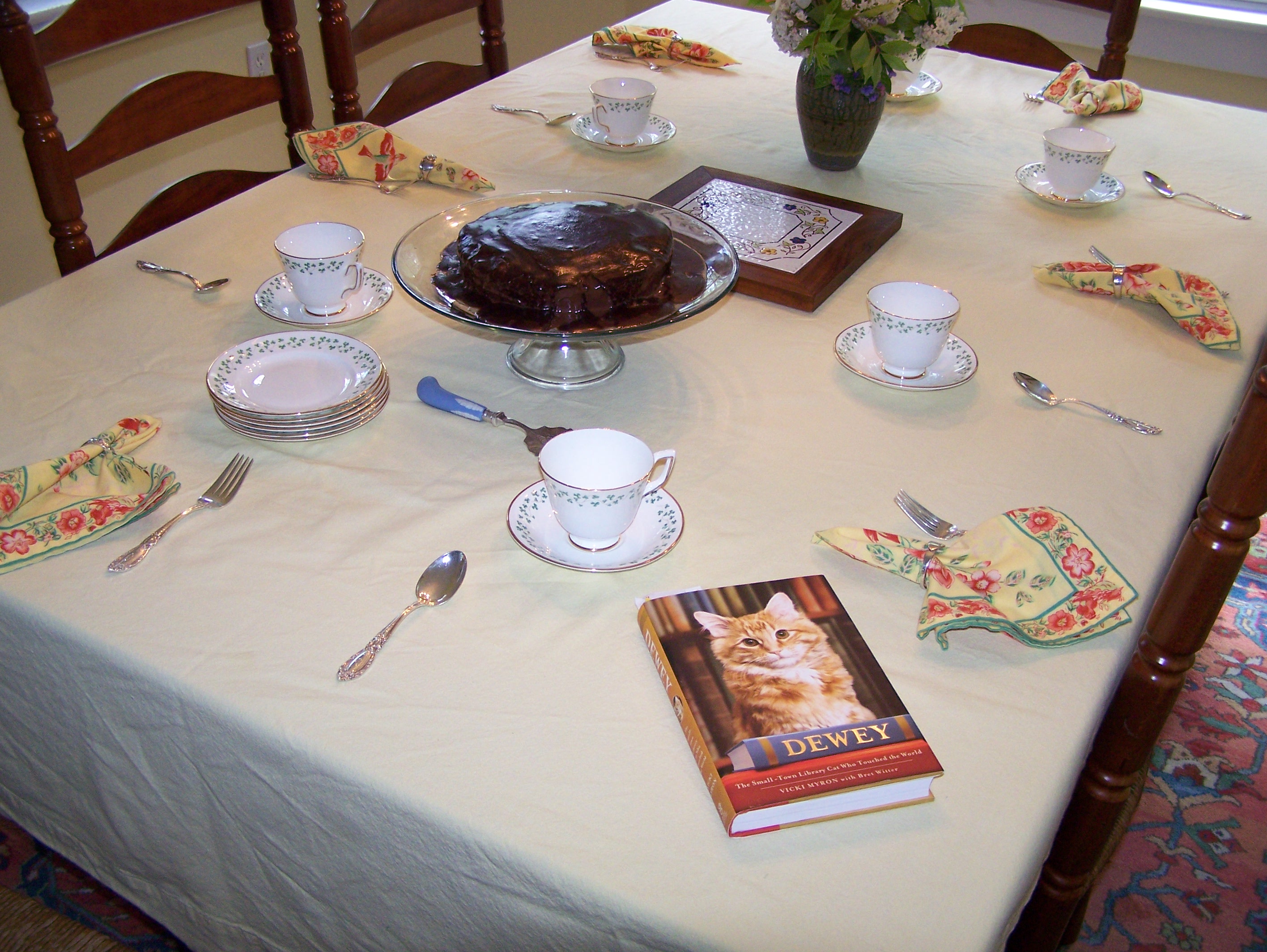
I hosted in May.  It was a beautiful spring day.  I pulled out my yellow tablecloth, the matching tulip and bird napkins, and got out the Royal Tara shamrock tea set AND TEAPOT that John’s mother, Norah, gave me.  I made one of Julia Child’s lovely cakes–the chocolate and almond Queen of Sheba cake.  I put a chocolate ganache icing on it, then drizzled a dark chocolate butter cream over that.  Yummo!

I was able to pick some flowers from the garden.  It’s the first bouquet I’ve been able to organize from our spring garden.  I did pick some of the daffodils in the meadow for a friend’s birthday, but they are naturalizing so well that I just leave them alone.  It is enough to see their jaunty heads bouncing on the wind or turned up to the sun.  I was able to cage a few daffs from the upper gardens. 

The viburnum will only last one day as their woody stems won’t take in water.  But, they brought in the most heavenly sweetness with them.  The blue blossoms are from a pulmonaria (lungwort), and it is doing very well in the yard.  If you don’t know, the tiny blue blossoms turn pink with age.

As you might have noticed from the picture, our book this month was Dewey–a tale of a library cat.  I even heard the author interviewed on Diane Rehm a few years back.  None of us liked this book.  We thought it confused between the narrative of Dewey (a short narrative) and the narrative of the author’s own life.  Some of us wanted more on one or the other, which was interesting.  I was unable to finish it.  I ran out of time because I just couldn’t get into it.    

So, on to the next:  Barbara Kingsolver’s The Lacuna. 


Tipping Points 9: Chicken Feed

Tipping Points 9

May 17, 2010

Chicken Feed

 We got six chickens in mid-March.  We had planned for four hens, but we bought five hens and a rooster!  We named them almost immediately as each one has a distinct personality.  A chicken can live as long as twelve years.  Hens are born with a finite number of eggs.  Once the eggs are gone, decisions must be made about the difference between pets and stew-pot candidates.

For me, getting chickens has been a long-held dream.  For John, raised in urban Boston, getting chickens has been a huge leap into an unknown terrain of increased responsibility, pressure on our limited yard space, and the Maine winter.  Nevertheless, John found our chicken coop at the Maine Organic Farmers and Growers Association’s Common Ground Fair last September.

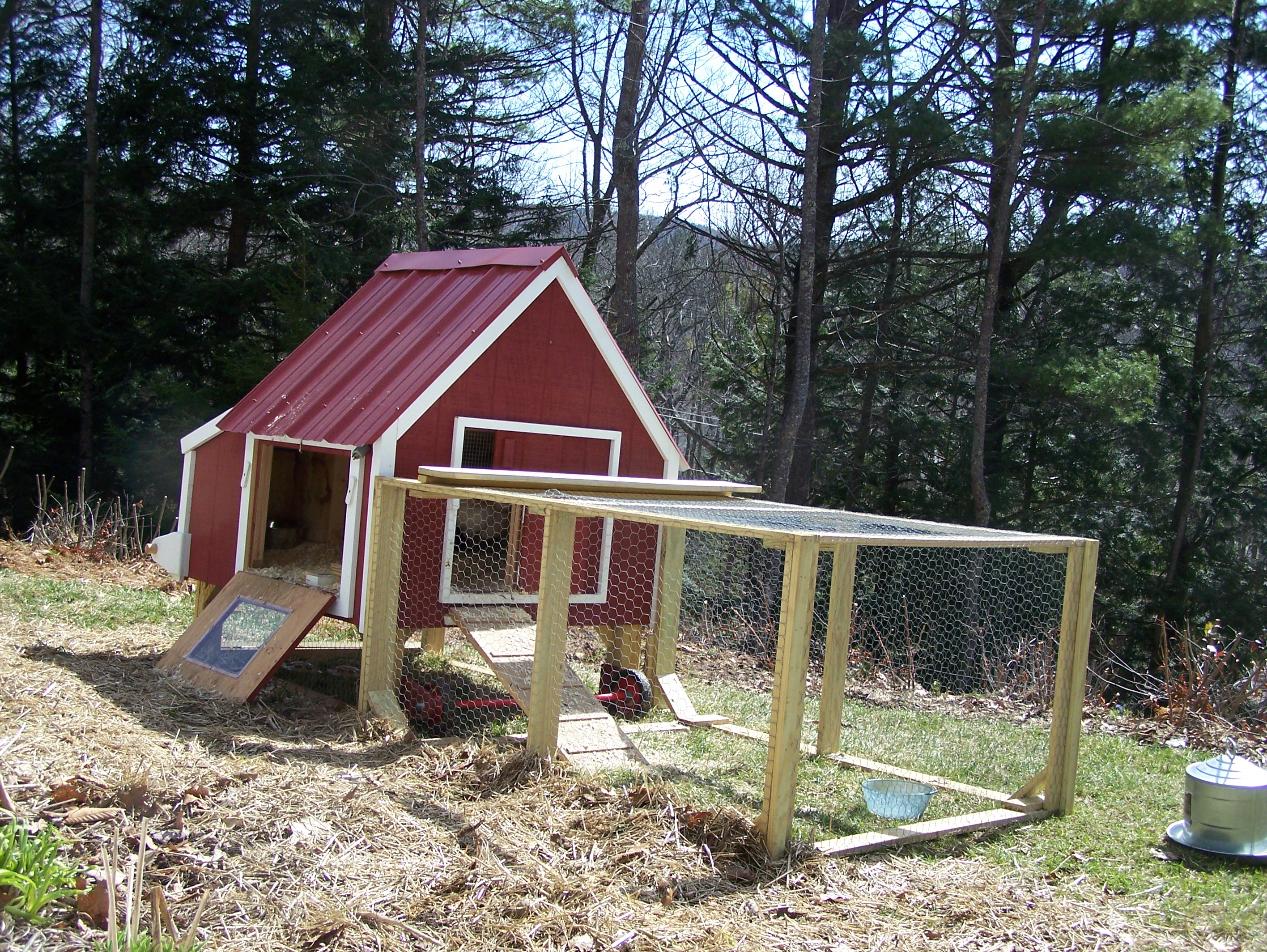
Designed and made by Stephen Gingras of Augusta, Maine, our coop is made for four chickens.  Upon seeing it, we knew we could never make something so perfect.  Our coop has an internal roost; three egg boxes, one of which we use for food; an inside power switch so we can use a light bulb for heat on cold nights; a free-range opening under the egg boxes which our tall rooster finds undignified; a let-down door with a window for easy coop cleaning; a tin roof; a detachable cage; and wheels.

You can see more views of our coop at www.rootscoopsandmore.com.  Gingras coops are kits, but Stephen and Lori delivered ours assembled and helped us drag it up a steep incline.

I didn’t need to obtain chickens for good eggs.  In the Camden, Maine, area we are blessed with many small flocks of healthy, free-range chickens whose eggs can be found at local markets.  My personal favorites are the eggs Rose and Peter Thomas produce and sell at their Vegetable Shed, which is on 173 in Lincolnville.  I visit this farm frequently, so I know these chickens free range, eat organic food, and have yolks that are a deep gold to pumpkin orange.

We traveled to see our children in November, and winter, which is hard on chickens, was closing in when we got home.  Getting chickens would be a spring project.

I am reminded how egg-spoiled I have become when I travel.  Commercial eggs, organic or not, have yolks that are the same color nearly as the white.  They taste bitter, and when hard-boiled are rubbery and altogether disgusting.  It’s sad that most people these days do not realize how delicious a good egg is or that a good egg takes good chicken feed.  Indeed, I doubt eggs from commercial layers, even if fertilized, could make a chick.

So, the problem I researched all winter was what to feed the chickens.  All the commercial feeds, including the organic feeds, are 90 percent corn; 10 percent soy; and have about 20 chemicals, meal waste products from other industrial processes, and soybean oil that my research warns goes rancid and can be both highly processed and trans fat laden.  The corn/soy ratio does not contain enough protein, so organic rules allow the addition of a synthetic essential amino acid, methionine.  The organic brand our chickens were eating is all mashed up so it is predigestable, which means a chicken will eat more of it.  Industrial theory is a stuffed chicken lays more eggs.  This feed looks like bran cereal, and our chickens eat it last when it is mixed with our feed.

Organic rules stopped the addition of unspeakable animal by-products into chicken feeds, but rather than choosing a healthy protein source or a better grain/legume ratio, the organic industry chose cheapness.  Corn and soy are cheap.  Corn fattens, and while soy, which must be cooked, provides protein, it has a dangerous antinutrient package that American industry has never been able to fully detoxify.  If soy antinutrients slowly poison animals, what are they doing to humans eating chicken eggs and flesh?

Also, all commercial chicken feed is throwing off the omega 3 and 6 ratios in both eggs and meat.  Human diets should have a ratio of 1:1, or not more than 1:3 (omega 6).  The American diet today is giving most Americans an omega 3 to 6 ratio of 1:20-25.  This boosted omega 6 imbalance is not healthy and is likely part of why so many people have chronic illnesses.

Further, chickens are omnivores, not vegetarians.  They will eat grains and legumes, which are low in omega 3, only after choosing greens, insects, meat, fish, and milk products.  Grain/legume mixtures should be supplements only, offered for free choice, and should include at least five different whole grains.

Bolstered by reading G. F. Heuser’s FEEDING POULTRY, published in 1955 at the advent of the commercial chicken industry when people still had small flocks, and by my own research (see, for instance, www.lionsgrip.com/chickensidealfeed.html), I determined a feeding program.  The chickens would free range for greens and insects, and I would supplement with meat; fish; milk products like yogurt, milk, whey, and buttermilk from making butter; some leftovers from the kitchen; and a grain, legume (no soy), and seed mixture that I found from Greener Pastures Farm, www.greenerpasturesfarm.com.  I don’t always mix everything listed, but I do include the major grains and the two legumes.  I wish our Maine farmers would offer an organic, whole-grain, no-soy legume mixture.

Rose and I began hunting pullets, which are coming into laying, in early March.  Since I only wanted four hens, Rose offered to give me four of a larger order.  Most commercially raised pullets have been debeaked, which prevents chickens crowded close together from pecking each other.  When I see these maimed creatures, I feel like I’m going to burst into tears and vomit.   I wanted also to avoid shipping day-old baby chicks.  Surely, I believed, someone local has some pullets.

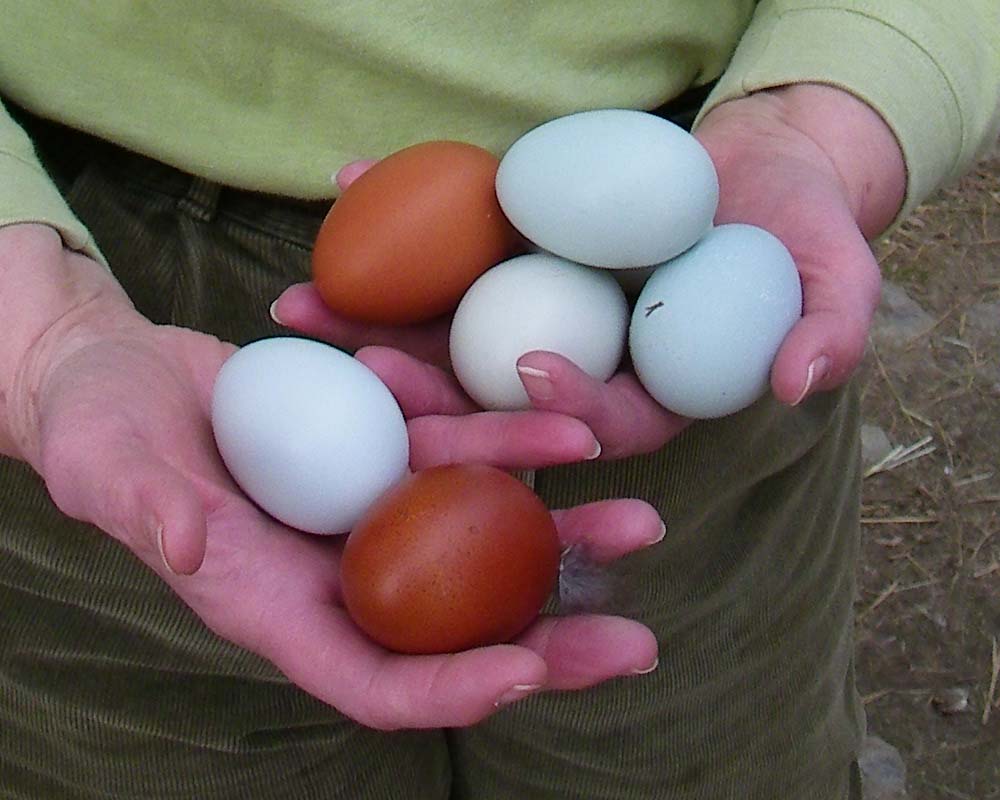
And, someone in Vassalboro, Maine, about 40 minutes away, did.  There were some year-old Copper Black Marans that were not breeding quality and some excess Wheaten Ameraucanas.  The Marans, a solid, docile, friendly breed, are common in France, but in America are rare.  Chefs highly prize the deep chocolate brown Maran egg.  The Wheatens, which streak about the yard like flashes of wily quicksilver, lay a blue egg.

I have the Maran rooster, Rose has the Ameraucana rooster, and we each have a selection of both breeds that is weighted toward our rooster.  We’ve gotten an incubator and plan to hatch eggs to replenish our flocks and to offer local baby chicks next spring.  Rose now has gorgeous egg colors ranging from deep chocolate brown, to light brown, to rose, to blue, to white.

In addition to being fascinated with chickens, I wanted to create a holistic garden circle where I could add composted animal manure to our vegetable beds which, in turn, would help feed the animals.  The chickens don’t produce as much fecal matter as I had expected.  It’s easy to collect droppings around the yard for the dedicated composter which will compost for a year.  I only need to change out coop bedding once a month as I remove fecal matter daily .

Our chickens are scratching only bare soil surface.  And, while they walk sometimes on emerging plants, they are light enough and not numerous enough to do damage.  Though they pruned some new leaves on the raspberries, so far they have not destroyed one single plant.  They do make dirt baths in bare soil, so we got some wood ash from friend Margaret Rauenhorst and made a dedicated space.  Dirt baths are important deterrents for chicken pests.

I also wanted to use the chickens for pest patrol.  Our chickens steadily work our beds, so I am expecting fewer pests this year.  For the moment, I may also have fewer worms since I am a sucker for the company and conversation that starts if I weed with a trowel.  Worms are generally at a deeper level, so if I weed, all six come to supervise and to eat whatever worms they can get.

When our asparagras started emerging  and it was time to plant peas, we got some flexible plastic fencing for the big vegetable garden.  Next, we enclosed temporarily the strawberry patch.  I know we will have to pen our chickens in early June when it’s time to plant potatoes, seedlings, and seeds in non-fenced beds.  But we hate to pen them as it limits their “chickeness.”

We’ll have to pen the rooster when the grandchildren are here in July.  Napolean is as tall as our two little girls, and he is unpredictably protective of the hens, as our irrepressible rat terrier, No No Penny, will testify.  She is scared to death of him.  He does not seem to think the calmer rat terrier, Reynolds, is a problem.  But, when I forget and wear my red rain clogs, he decides I am a threat.  Otherwise, he is a sweet boy and lets me pick him up and hold him, which I do frequently.

In April, our five hens laid 110 eggs, or an average of 3.6 eggs a day.  On many days now, we are blessed with five eggs.  The yolks are a deep, rich, golden orange, and all six chickens seem healthy and happy.   

Turkey Tracks: Nancy’s Dirt Bath

Turkey Tracks:  May 7, 2010

Nancy’s Dirt Bath

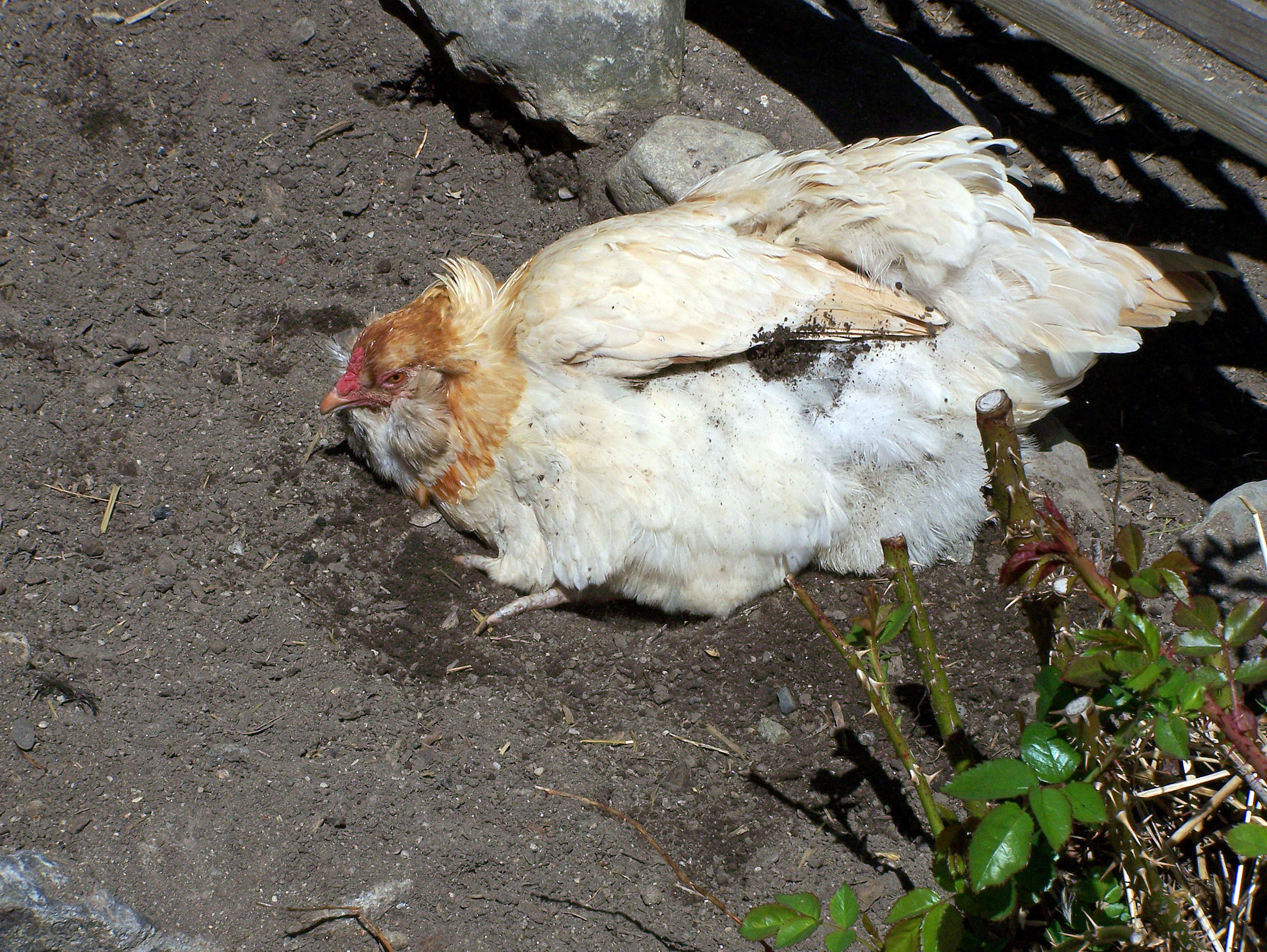
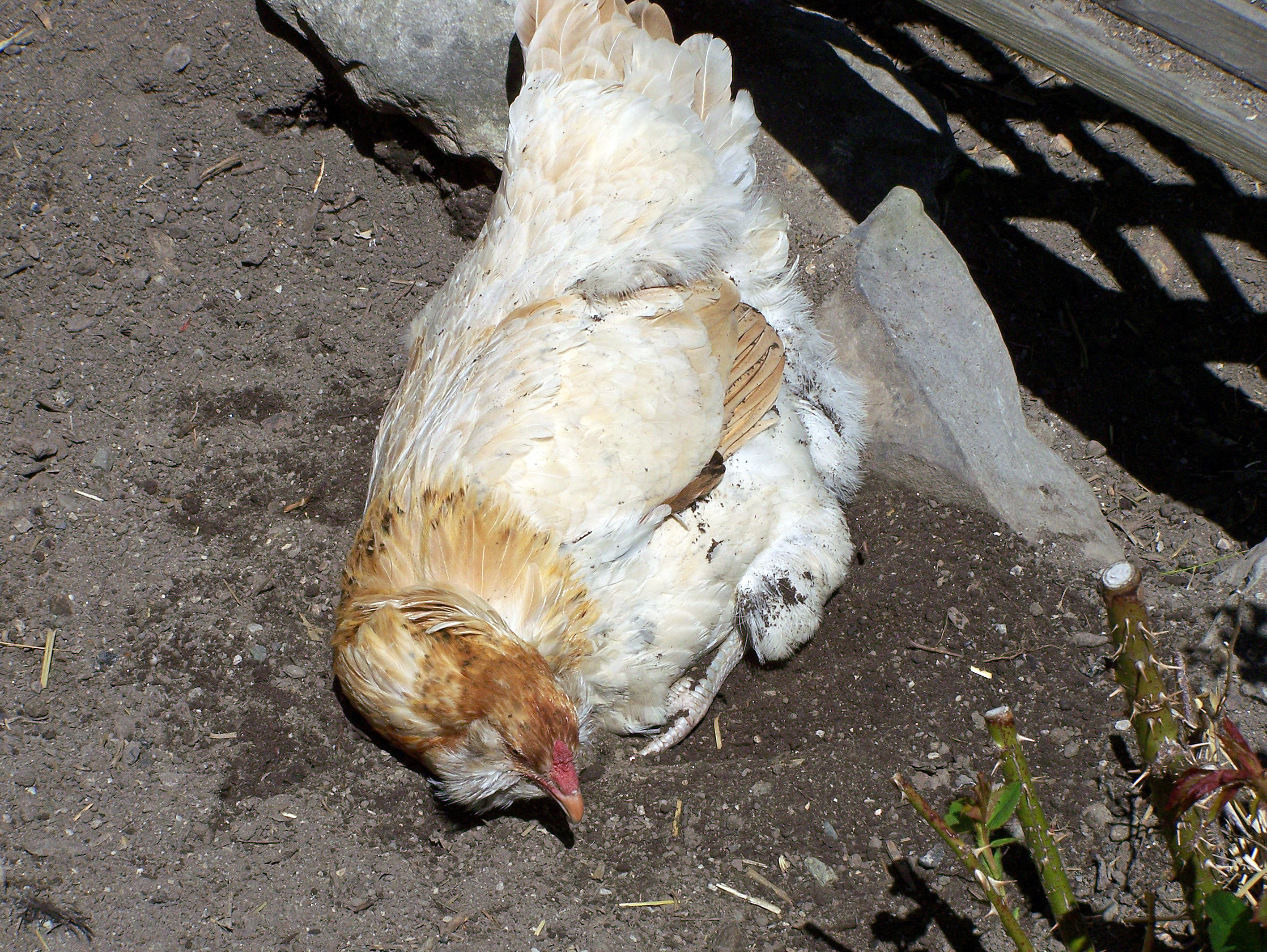
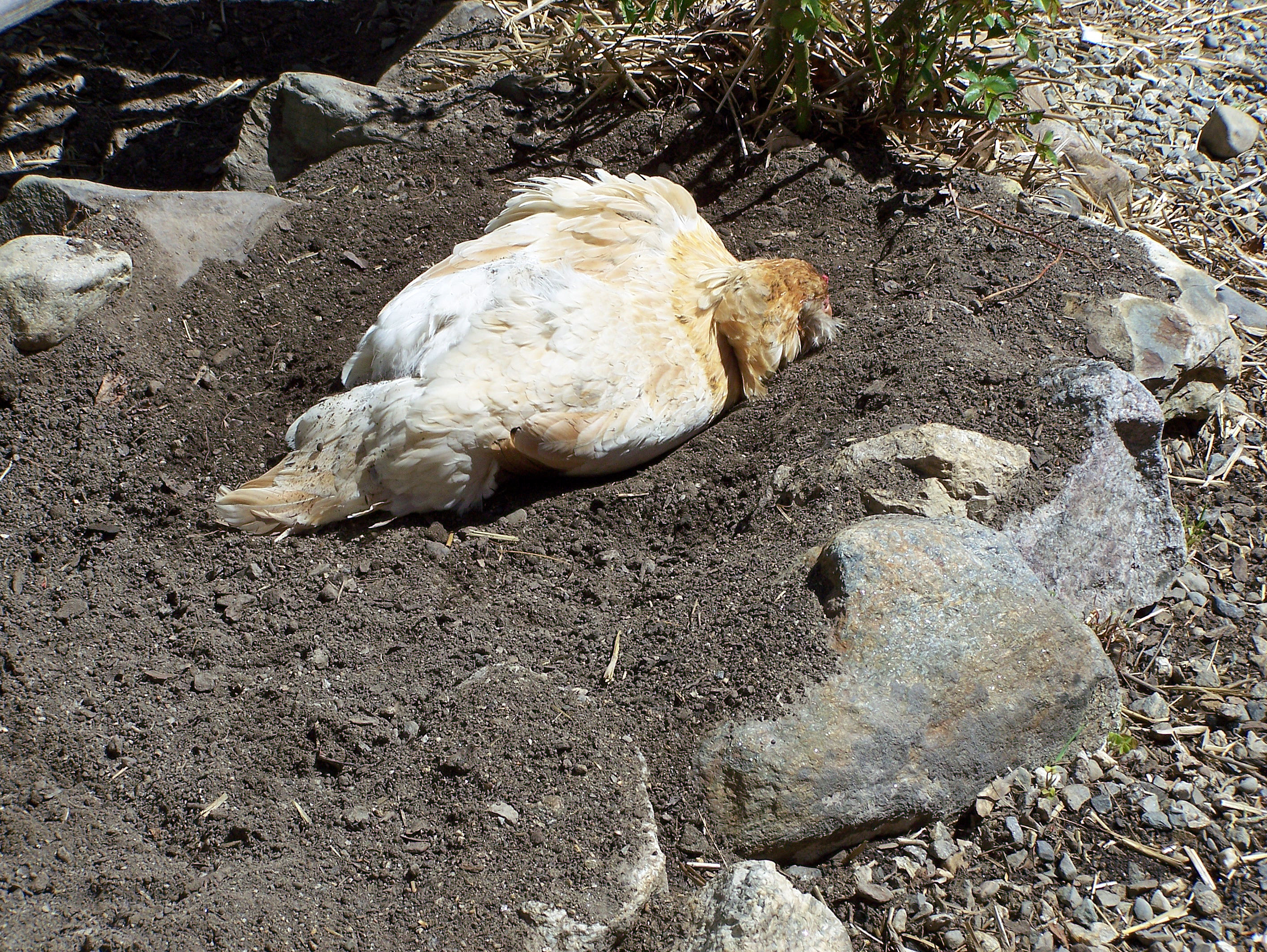
Nancy is an Ameraucana Wheaten chicken.  She is one of two Wheaten hens we have.  The other one is named Sally.    Nancy was Martha Washington.  But, she isn’t a Martha.  She’s a Nancy.  And, Sally was Sally Ross until we recalled that the flagmaker was not Sally Ross, but Betsy.  We already have three chickens with “B” names.  We don’t need another one.  Anyway, Sally is a Sally.  The Wheatens lay medium-sized blue eggs that are as smooth and shiny as polished rocks.  These girls needed American names because their flockmates are French Copper Black Marans.

Both of the Wheatens love dirt baths and take several every sunny day.  It’s something to watch.  Here’s something of a sequence though this dirt bath thing goes on for a long time:

Then, there’s always the moment when the Wheatens go so into the moment that they look like they’ve died, which can really give you a start if you’ve not seen them do it.  Oh my God, you think.   Something’s killed one of the chickens!!!


Turkey Tracks: Sunrise on Mount Desert, From Isle Au Haut

Turkey Tracks:  May 6, 2010

Sunrise on Mount Desert, From Isle Au Haut

I’ve been working on two small art quilts that will hang in our newly painted bedroom.  I’ve finished this one:  Mount Desert From Isle Au Haut. 


Mount Desert is Acadia National Park near Bar Harbor, Maine, and it is one of the most beautiful places on this earth.  The highest mountain is Cadillac Mountain.   Mount Desert is pronounced “dessert,” like a sweet.  The first time I heard this pronouncement I thought the person saying it was making a mistake.   Instead, I just didn’t know–which is not unusual.  I have always read so much that I know many words by sight, but have, often, not actually heard them pronounced.  They exist in my brain in an alternate universe.   

Isle Au Haut, or High Island, is where Linda Greenlaw lobsters.  You remember her, right?  She was the woman long-boat captain in THE PERFECT STORM.  She still lobsters I think.  But she also writes books.  Her mother is a famous cook on Isle Au Haut and in the region.  Linda and her mother wrote a cookbook together. 

John and I visited Isle Au Haut for our son Bryan’s 40th birthday celebration–a visit planned by his wife, Corinne.  One goes to the island on the mail boat, and we went out in a storm, which was quite exciting.  The only cars on the island are old ones, so everyone bikes and hikes around and, occasionally, get rides from local people with cars.  Berries grow wild, and the air smells so sweet.  It’s a magic place.  We stayed at the Inn at Isle Au Haut, and the view in the quilt is from the inn’s dock.      

The companion piece pictures the Blue Moon we had in December 2009.  The moon is rising over the Camden Hills and Megunticook Lake.  It is almost done.  But, with the early spring, I’ve been out in the yard a lot and have not quilted very much.   

Turkey Tracks: Seedlings

Turkey Tracks:  May 6, 2010

Seedlings

We are having the warmest spring.  I feel like plants are about a month early this year.  We put up our first pea trellis this year, and I planted peas in the garden in mid-April.  The peas are all up now.  So, I planted the second batch a few days ago.  I can only stay in the garden for a little while on cloudy days as the black flies are horrendous right now. 

It has been horribly dry too.  We’ve already had to water the garden and the strawberries.  For one day I thought we had lost the strawberries.  I just had not realized how dry it was.  And, it is not normal to have to water in Maine in April and early May.   

I planted seedlings inside about a month ago.  They are all up now, and seem to be growing well.  We enclosed the little porch upstairs.  It faces southeast and has no overhang, which is perfect for the seedlings .  Here’s what they looked like about 10 days ago. 

Outside the picture frame are about 70 sprouted leeks.  I’ve never planted leeks, so I’m quite excited about those too.  The seedlings are several kinds of tomatoes, cabbage, broccoli, and Brussels sprouts.