Books, Documentaries, Reviews: My Read Pile September 2011

Books, Documentaries, Reviews:  September 2011

My Read Pile–September 2011

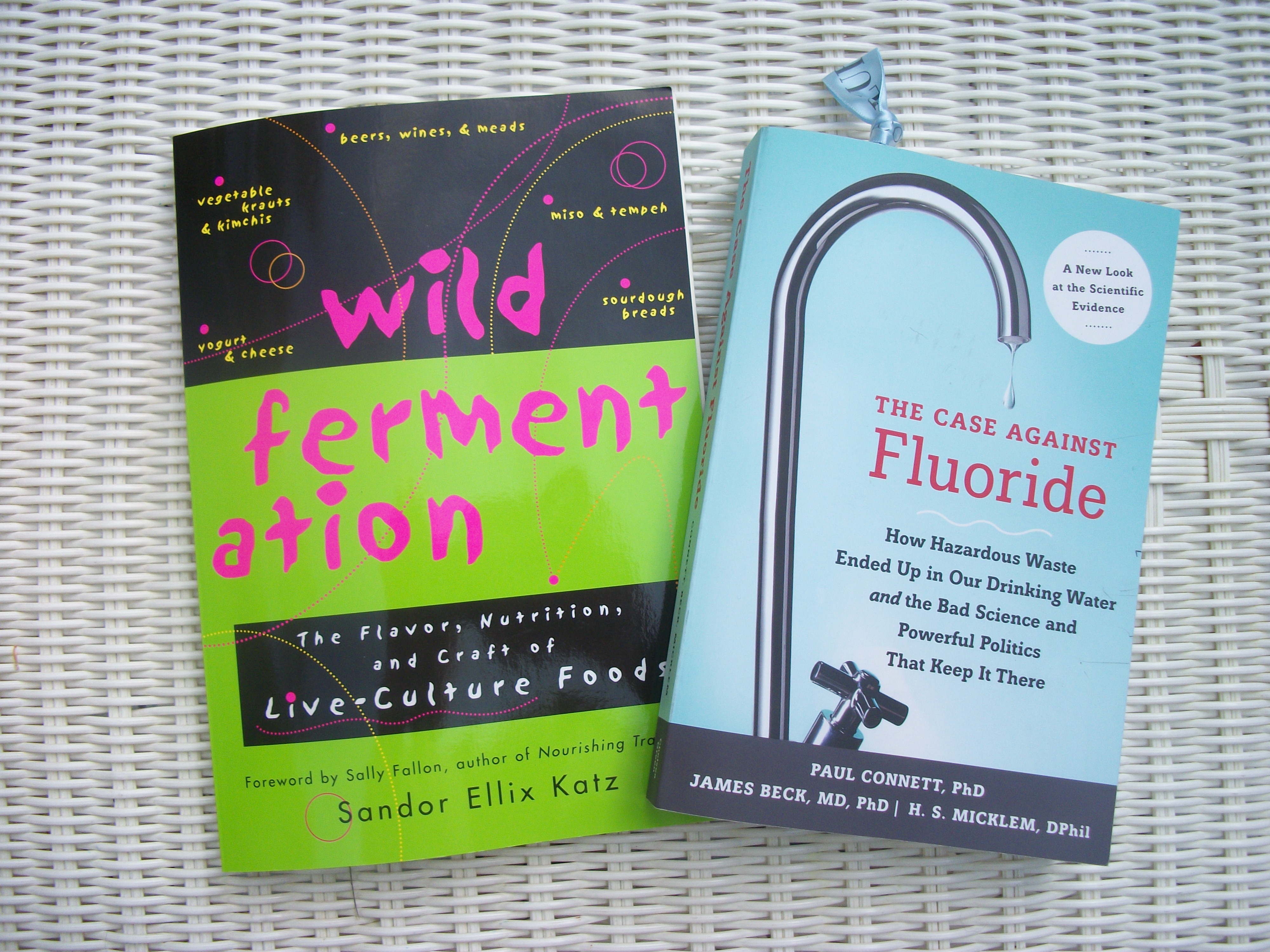
Just finished Sandor Ellix Katz’s WILD FERMENTATION.  LOVED IT!  I can’t think why I have not gotten it sooner.  I’ll be writing the next Mainely Tipping Points on it.  I sat down and read it straight through, and in hours had a cheese ball dripping whey and had a quart jar of kale fermenting.

THE CASE AGAINST FLUORIDE has been written by 3 MAJOR scientists who know what they’re talking about.  The EPA recently lowered the amount of fluoride allowed in municipal water systems.  And, most people get way too much fluoride already in tooth paste–especially children who SWALLOW it.  (Try telling a two-year old not to swallow tasty toothpaste!)  So, more on fluoride later, but meanwhile know that it is very dangerous, that it’s a waste product of industry, and that you should filter it out of your water.  Better still, read about it and try to get it out of your local system.  The time is right!
TOOTH PASTE RECIPE

By the way, the best recipe for toothpaste is just to mix baking soda with good sea salt–equal proportions.  But it in a jar and dip your wet toothbrush into it.  If you want some flavor, get some essential oil of peppermint and use one drop on the wet toothbrush.  Or, some essential lime oil, sweet orange, or one of the oils that are ok to put into your mouth if you rinse them out.  Peppermint essential oil has some nice anti-fungal properties, among other good effects.
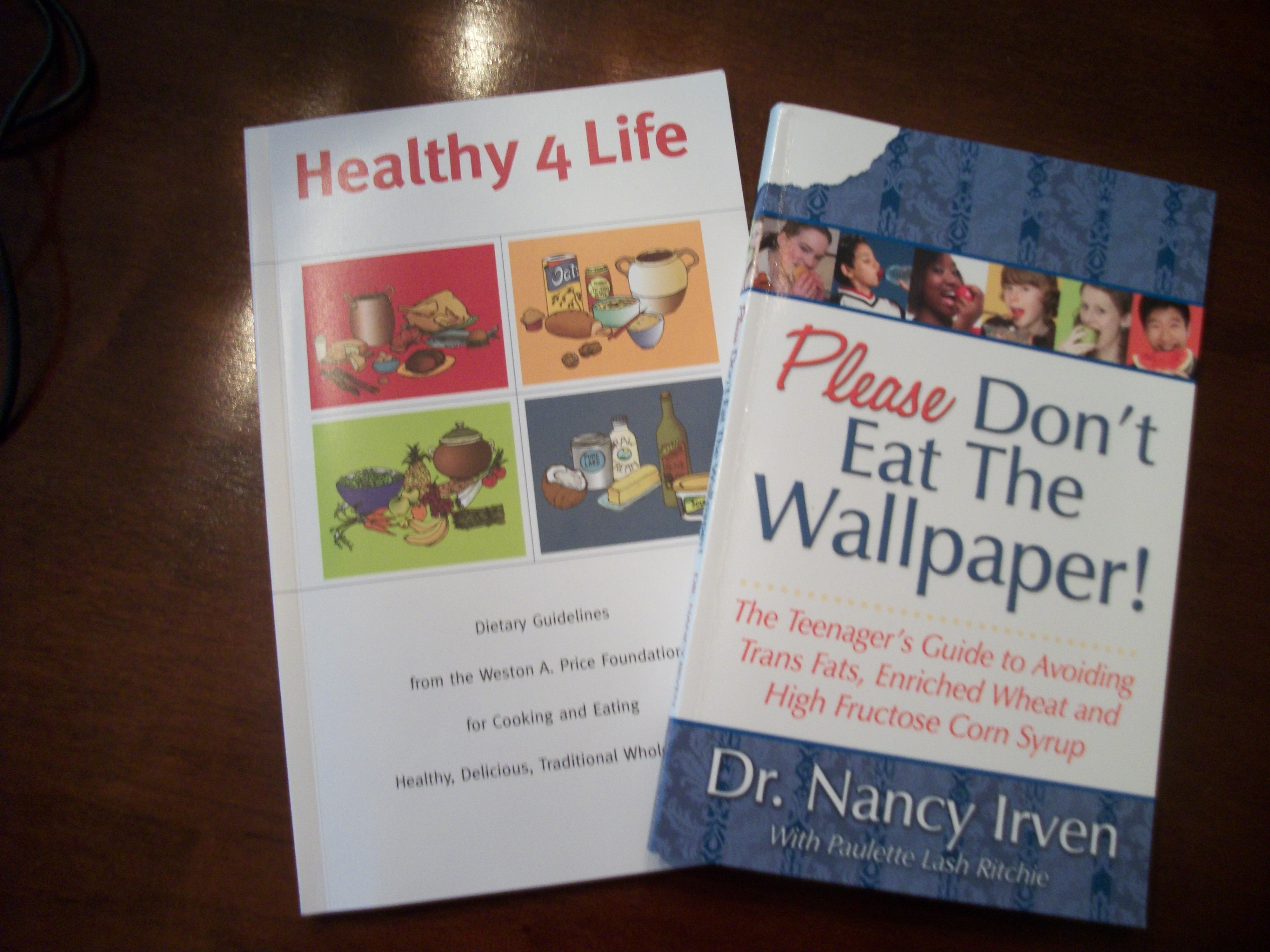
Interesting Information: Healthy 4 Life and Please Don’t Eat the Wallpaper.

When someone asks me how to start changing their food consumption habits, I usually recommend NOURISHING TRADITIONS, Sally Fallon Morrell and Dr. Mary Enig, both of the Weston A. Price Foundation–which also has a really good web site.

But, this past year, the WAPF came out with a very short little book–their answer to the travesty of the USDA’S food guide, whose formation is driven by the market–not science–and which is guaranteed to make you sick.  I really like this little book.  It’s an excellent and easy guide to changing your life.  NOURISHING TRADITIONS is an amazing book and is chock full of information, so that would be the next place to go in your journey.

WAPF will send you HEALTHY 4 LIFE for about $12.   They also have a great shopping guide and lots of informative pamphlets on soy (really bad), raw milk, and so forth.

In addition, Dr. Nancy Irven, after working with high school students, published PLEASE DON’T EAT THE WALLPAPER, available at amazon.com at least for about $14 as I recall.  Irven’s goal is to get students to own their own health and diet by first understanding why high fructose corn syrup, white flour, and trans fats are really bad sugar, glue, and plastic.  Get those three out of the diet, she explains, and the other bad additives, etc., drop out with them.  Irven has a light touch and funny sense of humor, and the high school program she’s been working with on diet has been highly successful.

In short, there’s so much really bad information out there that teenagers, who are often adrift on their own in terms of food anyway, don’t know what to eat.  Since this same condition is true for many Americans, Irven’s little book is useful for all ages.

Turkey Tracks/Books: My Current Read Pile

Turkey Tracks/Books:  June 26, 2011

My Current Read Pile

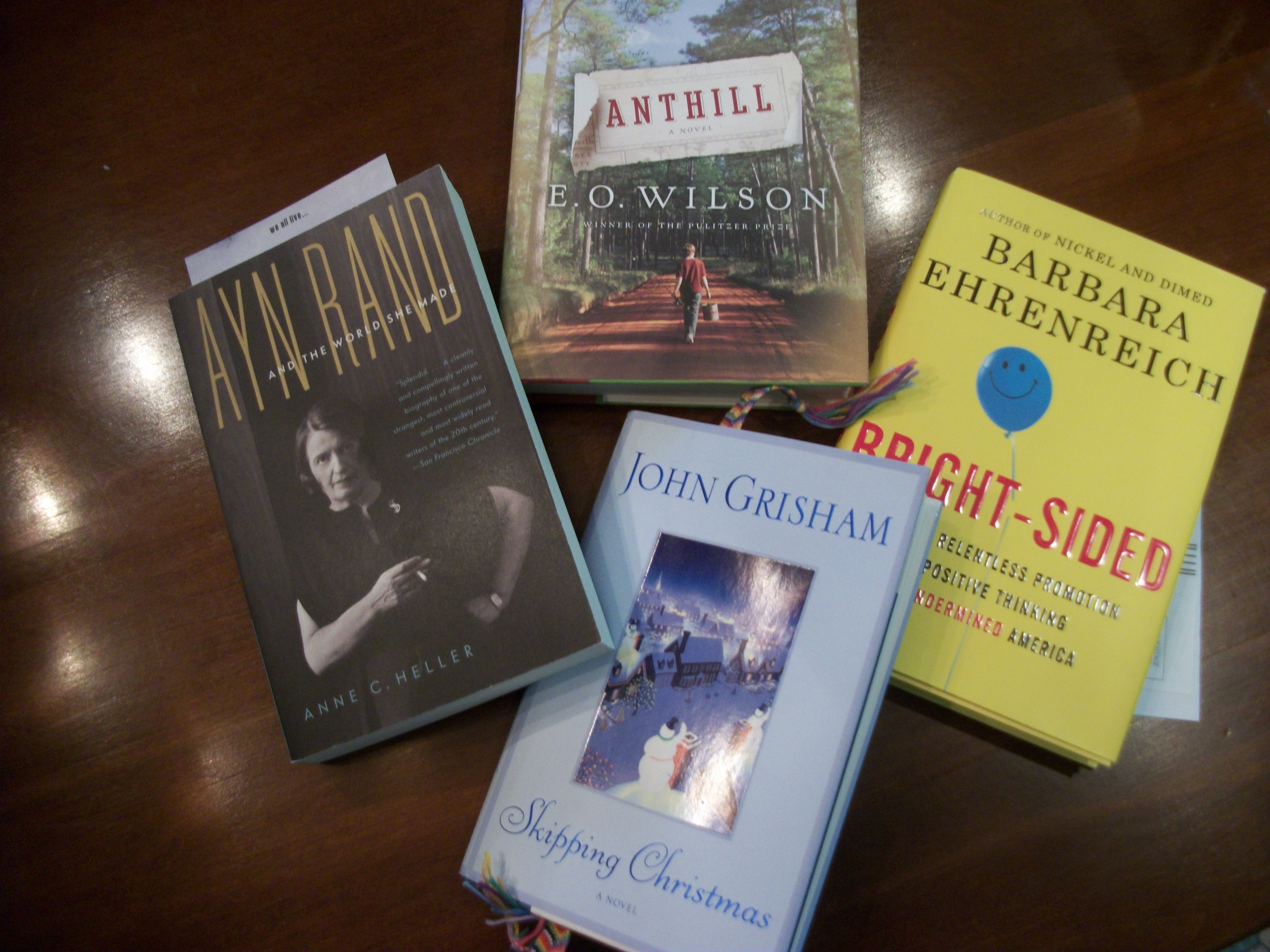
Here’s a picture of my current read pile:

I have, for what is, I’m sure, a brief moment, caught up with my magazines and journals.

Despite the title, John Grisham’s SKIPPING CHRISTMAS might not wind up advocating that stance at all.  So, I look forward to finding out what happens.  This book was a gift from a friend after I wrote a piece about my dislike of–and refusal to participate in–the commercial nature of Christmas.

The biography of Ayn Rand interests me because I’d like to see if she “walked her talk.”  Her economic and social theories have had a powerful impact in this country.  For instance, Congressman Paul Ryan’s budget was derived from Rand’s “objectivism” philosophy.  Her “super man” heroes come too uncomfortably close to the theories that guided Nazism maleness for me.  But, it will be good to refresh my knowledge of her theories.  I read her novels too many years ago–actually when I was in high school.

E. O. Wilson’s book on ants won the Pulitzer one year.  He’s an emeritus scientist at Harvard, and a naturalist to the core.  He’s also a southerner, and he captures a number of southern mindsets in the characters in this book.  The sections on ants are not just about ants; they’re about over population and an unimpeded use of available resources–to the point where nature can no longer support an out-of-synch ant population.  This section is a warning to humans, actually.  As a novel, the book doesn’t quite work–because it isn’t sure what it should be.  But as something else–the inner thoughts of a major scientist, it’s well worthwhile.

Barbara Ehrenreich’s BRIGHT-SIDED was recommended by a Camden friend who knows I think the unbridled optimism of Americans–especially with regard to medical problems like cancer–is a problem that helps us to ignore what we must do to begin to heal our environment, ourselves, our country, and our world.  As long as we can say “the problem is that you aren’t trying hard enough,” we cannot begin to understand what is actually wrong, how we’ve been poisoned, and so forth.

Book Club Reading List 2011-2010

Our book club gathered last week to pick our next slate of books.  There are six members, and we each present a list of 5 books we have chosen for the book club’s consideration.  The members then each vote on two of our books, votes are counted, and the high counts join the list.  After all the books are chosen, we assign books to particular months.  We try to match shorter books with months where we are busier, for instance.  And similar books get separated across the months, as are the two urban garden books on this slate of books.

Because we are all very different people, we bring different books to the table for consideration.  I wind up reading books I would not choose on my own, and that’s usually a really good thing for me.   It’s also interesting to see who does or does not like a book–interesting discussions reveal aspects of a book we might not have considered on our own.

Book Club Reading List 2011-2010

2011

July:  THE RED THREAD, Nicholas Jose–two pairs of lovers across the centuries, set in Shanghai

August:  MY EMPIRE OF DIRT, Manny Howard–800 square-foot backyard “farm” in Brooklyn changes Howard’s life when he decides to try to eat out of it for one month.

September:  CUTTING FOR STONE, Abraham Verghese–Twin brothers (Indian/British) share a love for medicine.  Novel moves back and forth from Ethiopia and New York.

October:  TO KILL A MOCKINGBIRD, Harper Lee–now classic tale of racism.

November:  THE HARE WITH THE AMBER EYES, Edmund de Waal–family memoir revolving around the inheritance of a collection of ornamental Japanese carvings known as netsuke.

December:  MAJOR PETTIGREW’S LAST STAND, Helen Semonsen–in a small English village, Pettigrew values the quiet life and honor, duty, decorum, but begins a friendship with Jasmina Ali, a Pakistani shopkeeper, which results in culture clashes and a funny, barbed, and winsome book.

2012

January:  THE SWEET LIFE IN PARIS, David Lebovitz–cookbook author and Chez Panisse pastry chef Lebovitz gathers some of his best stories about Paris in this hilarious book.

February:  FARM CITY, Novella Carpenter–in a ghetto in Oakland, CA, Carpenter begins farming a vacant lot next to her apartment.  As she grows bolder, she brings in bees and animals:  chickens, rabbits, and pigs.

March:  THE WHITE WOMAN ON THE GREEN BICYCLE, Monique Roffey–Trinidad, an unforgettable love story that is brimming with passion and politics.

April:  SILK, Allesandro Baricco–powerful and erotic tale that reveals how one man’s desire threatens to ruin his life.

May:  LET THE GREAT WORLD SPIN, Colum McCann–portrait of NYCity, 1974 ; winner, National Book Award, reviewed as “an emotional tour de force.”

June:  LYRICS ALLEY, Leila Aboulela–Egypt and Sudan, a warm, well-crafted story that foregrounds romantic love and the search for spirituality and meaning.

Turkey Tracks: In Progress: Noro Iro Sweater

Turkey Tracks:  February 12, 2011

In Progress:  Noro Iro Sweater

Well, here’s my Noro Iro sweater in progress.  You may recall that I’m using a pattern from Jane Ellison’s book, KNITTING NORO.

I have run into gauge problems.  The pattern calls for a 7mm needle, which falls somewhere between our 6mm (10 1/2) and 8mm (11) American needles–which means the sweater will fit ok but is going to take more yarn!!!   Fortunately Helen at Heavenly Socks in Belfast, Maine, has two extra skeins since she so generously ordered the yarn for me, which meant she had to order 12 skeins and hope to sell the other 4 since I was only supposed to need 8.  She’s great that way!

 What you see here is the back.  The bottom is knitted in a textured pattern for about 11 inches.  Then you switch to stockinette.  Both showcase the yarn nicely.  I wish I had put that wide dark band fully at the bottom.  I do like the scalloped bottom edge.

Here’s the pattern I’m trying to do.  Notice how matched the yarn is on the sleeves and front body.

I have no idea how my sweater is going to come out because I can already see that the back will be different.  The back is twice as wide as either of the front pieces, right?  So, the yarn color on the front is knitting out twice as thick before changing to a new color.  In other words, the only way you could try to match color would be to do a lot of cutting of yarn.  And, I don’t think that’s the purpose of this yarn anyway.

Oh well!  It will be what it will be!

It’s feeling a little fussy to me though.  Like one of those garments that are wearing you rather than you wearing them!

Turkey Tracks: Jane Smiley’s PRIVATE LIFE

Turkey Tracks:  January 9, 2011

Jane Smiley’s PRIVATE LIFE

 I finished reading Jane Smiley’s new novel PRIVATE LIFE (May 2010) last night.

I highly recommend it.

It’s the work of a mature author writing at the top of her form.  It’s engaging at all levels:  character development, plot, mystery, profound engagement with issues and ideas. 

It’s a bit of an epic, since it chronicles the main character’s life from teenage years to mid-sixties–beginning in the late 1880.  Margaret is well on the road to spinsterhood in a small Missouri town 300 miles from St Louis, when a marriage is arranged with a locally famous, seemingly brilliant but socially awkward man from a prominent family who might become a nationally famous scientist.  They move to coastal California near San Francisco and live on an island with a naval base, and her decades-long discovery of who her husband is–and who she is–actually begins.  (No, he is not a serial killer–this is a serious study of character and the changing conditions for women and the culture in general through this period.)  The Japanese have a settlement just inland from the island, and the Margaret brushes up against a particular Japanese family for many years.  She is devastated when they are swept up and put into internment camps when WWII breaks out–an occurrence that brackets the novel’s opening and closing pages.

I wish I could go back and read it new once again.

Turkey Tracks: Glee!

Turkey Tracks:  January 6, 2011

Glee!

Season 1 of the television show GLEE is available on DVD.

It’s just plain fun to watch it.

So, if you’re looking for some light-hearted viewing, take a look.  Each show features really great music, often accompanied by intricate dance segments and great costumes.  It’s like watching a fairly elaborate staged musical, over and over. 

There is a thin plot progression and some character development , so I’d recommend you watch the episodes in order.  Out-of-control, stereotypical, campy characters are part of the fun.  Often there is some greater message of how to have a more inclusive society or what’s “the right thing to do.” 

The background vocals feature the Tufts glee club, which is what interested John in the first place.

Season 2 releases later this month.

Turkey Tracks: Three Knitting Projects

Turkey Tracks:  December 30, 2010

Three Knitting Projects

I have three knitting projects going on at the moment.

First, I bought this book at the Border’s in Portland when we spent the night before flying to Charleston at Thanksgiving.  I LOVE Noro yarn.   The colors are brilliant, vivid, and so much fun.  I’ve made two scarf Noro projects.  And, two matching hats.  But I’ve never worked with the bulky weight–Iro.   KNITTING NORO has a bulky cardigan that I really liked, and Helen at Heavenly Socks in Belfast helped me find an Iro I liked.  She ordered it for me forthwith AND gave me a 20 percent discount on it as part of her holiday discount special.


Amazon.com: Knitting Noro: The Magic of Knitting with Hand-Dyed Yarns 9780307586551: Jane Ellison: Books

Here is the yarn I chose.  You can see I’ve wound 5 of the skeins.  I left three so you could see how pretty they look, too:

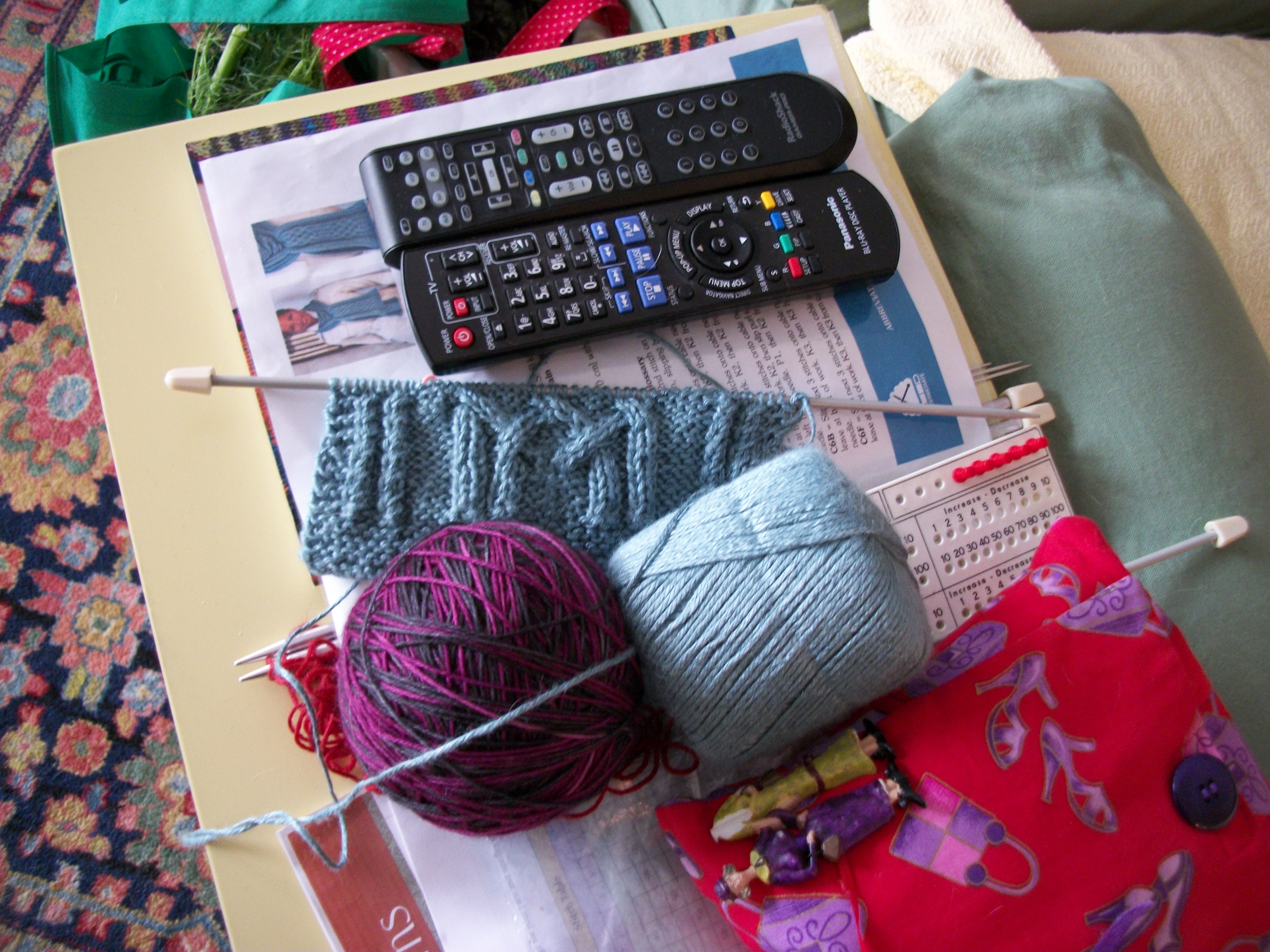
I can hardly wait to start this sweater.  But, but, I have two other projects ahead of this one.  A silk/bamboo scarf–so I can master cables and an intricate pattern.  (I’ve already taken it out twice, but I’m getting the hang of it now.  And, some sock yarn (magenta and dark grey) that I’m going to use to try socks that start at the toe AND that use a 5-stitch pattern.

In addition, I’m working on 3 quilts in various stages of development and just sent one off in the mail today.  But more on that later.

Turkey Tracks: The Elegance of the Hedgehog

Turkey Tracks:  November 8, 2010

The Elegance of the Hedgehog

Muriel Barbery is a French professor of philosophy.  Her novel The Elegance of the Hedgehog has been enormously popular in her native France, England, and in America. 

I do not see why.

I believe the novel’s success to be partly due to a lack of critical reviews.  The reviews on-line are all laudatory.  So is the novel’s popularity due to some popular idea that this is a philosophical novel that produces cultural capital if one has read it because it does discuss various philosophical ideas along the way?   But, for me, Barbery’s philosophical stance in the novel is incoherent.  And, Barbery shocks the reader by killing her protagonist just when the three central characters have come together in an interesting way.  It’s as if Barbery does not know what to do with them once she’s set their stage.  And, I found it very difficult to capture the large cast in my head as I read.  I kept having to page back to see “who is that again?”

But, let’s look at how Barbery handles philosophy.  She, as is customary, divides the subject into two major camps:  idealism and materialism.  Idealism comes from the mind of the individual interacting with the world, as in Descartes “I think, therefore I am.”  And, phenomenology, a subset of idealism and the subject of a debunking discourse in the novel– is the belief that the real world in inaccessible  because all that exists is perception formed in the mind.   Materialism, on the other hand, believes that there are bones, dates, and observable constructs in the world.  Marx, for instance, is from the materialistic camp.  But, Barbery dismisses Marx on the first page of the novel.  Not all of materialism, but Marx, who writes of capital and its impact on class–a major subject in the novel as the main protagonist is a concierge in a fancy apartment filled with rich people. 

With idealism dismissed and Marx dismissed, what remains?  For Barbery it’s a particular material moment of viewing Beauty.   ART, thus, gives us the power to erase desire because we can look at beauty/art without wanting the objects portrayed in the art.  Further, the still life, or the objects within art, hold beauty in a timeless moment.  Barbery describes other such timeless beautiful moments of beauty in the novel.  So, all of materialism is reduced to beauty held in a moment seen only by the observant–like the petal of a flower falling that one of the protagonists sees. 

But, but, but–isn’t beauty in the eye of the beholder.  And, aren’t notions of beauty formed by one’s culture and by the context within which one lives?  History shows shifting notions of beauty.  Yet, a key scene that sketches out Barbery’s philosophy is when the concierge visits the apartment of a wealthy Japanese man and sees a western still life from several hundred years ago.  Together the two people–one Asian and one French–salivate over this very Western picture.  Would the Japanese man really have this notion of beauty?  Would the concierge really enjoy esoteric Japanese movies that display Japanese notions of beauty?  This is the great bourgeoise move that makes all people alike under the sun.  By drawing a notion of universal beauty that can be seen by all, Barbery erases the very real differences that exist between cultures, between ages.  What has followed that idea around the world has been a violence carried out by those with the power to do so.  The different are made to want the same things as the conqueror when their culture was/is very different. 

Aha, but maybe that’s where the popularity lies.  It’s the same old Western story told yet another way, isn’t it?  And, isn’t the viewing of ART actually a moment of idealism, not materialism.  Isn’t that moment mediated by the mind and the cultural knowledge of the mind?  So, what’s really going on here is an entrapment within the idealistic circuit which maintains the status quo of… class reality, for instance.

Yes, that’s it.

Turkey Tracks: Book Club, Dewey

May 17, 2010

Book Club:  Dewey, the Library Cat

I love my book club.  We are six members, and each year, we each propose a list of 5 books.  The members choose two books from each members’ list, for a total of 12 books.  So, that’s our year of reading.  What I love, in addition to the members themselves, is that I frequently read books I would not have chosen for myself.  My life has been richer for those experiences, even when I don’t like a chosen book, it is interesting to hear if others did and why. 

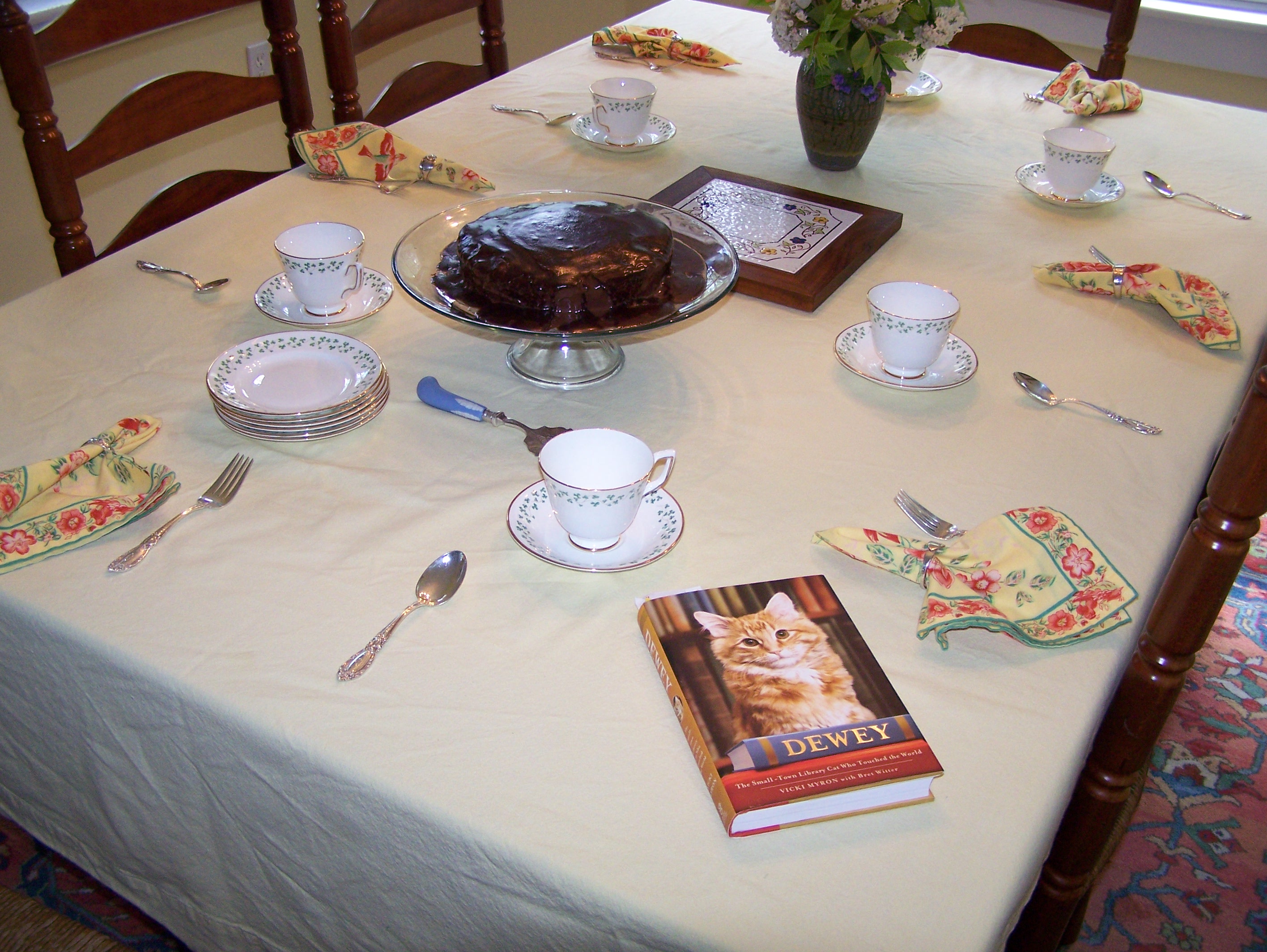
I hosted in May.  It was a beautiful spring day.  I pulled out my yellow tablecloth, the matching tulip and bird napkins, and got out the Royal Tara shamrock tea set AND TEAPOT that John’s mother, Norah, gave me.  I made one of Julia Child’s lovely cakes–the chocolate and almond Queen of Sheba cake.  I put a chocolate ganache icing on it, then drizzled a dark chocolate butter cream over that.  Yummo!

I was able to pick some flowers from the garden.  It’s the first bouquet I’ve been able to organize from our spring garden.  I did pick some of the daffodils in the meadow for a friend’s birthday, but they are naturalizing so well that I just leave them alone.  It is enough to see their jaunty heads bouncing on the wind or turned up to the sun.  I was able to cage a few daffs from the upper gardens. 

The viburnum will only last one day as their woody stems won’t take in water.  But, they brought in the most heavenly sweetness with them.  The blue blossoms are from a pulmonaria (lungwort), and it is doing very well in the yard.  If you don’t know, the tiny blue blossoms turn pink with age.

As you might have noticed from the picture, our book this month was Dewey–a tale of a library cat.  I even heard the author interviewed on Diane Rehm a few years back.  None of us liked this book.  We thought it confused between the narrative of Dewey (a short narrative) and the narrative of the author’s own life.  Some of us wanted more on one or the other, which was interesting.  I was unable to finish it.  I ran out of time because I just couldn’t get into it.    

So, on to the next:  Barbara Kingsolver’s The Lacuna.