Interesting Information: Modern Wheat Raises Blood Sugar

Interesting Information:  May 2, 2012

Modern Wheat Raises Blood Sugar

I’m researching grains for Part II of the three-part series of the Mainely Tipping Points essays on the Paleo Diet.  Part III will be on legumes.  Part I is on the blog, TP 41.  Click on Mainely Tipping Points essays on the right sidebar of the blog.

“Well Being Journal” (May/June 2012) published a letter from Mark Pasley, who heard an on-line interview with William Davis, M.D., who just published WHEAT BELLY.  (I’ve ordered this book.)  Pasley writes that “what got my attention was Davis’s assertion that modern wheat (which differs greatly from our wheat of just 50 years ago) raises blood sugar as much as table sugar.  So every time we eat wheat, our blood sugar spikes and then drops a couple hours later, when we (no surprise) crave more wheat.  This creates a cycle of constant hunger and snacking, as well as a potential predisposition for type 2 diabetes.  In addition, the way the wheat is metabolized tends to create visceral fat around the organs in the belly.”

Pasley writes, also, the following–which I find really interesting:  “Apparently, the changes made to wheat by agribusiness and the food industry over the years have created a grain–never tested on humans–that causes health problems for many people.”

Pasley decided to go wheat-free for one month after hearing the interview.  Here’s what he wrote:  “Since then, I have experienced dramatic improvements in mood, energy, and digestion by simply eliminating wheat, and my belly has indeed gotten smaller.  I don’t own a scale, but the last time I went to the gym, their scale said I was 7 pounds lighter.”

I have no idea what kind of research William Davis is using, and I’m looking forward to reading his book.  But I will say that I am increasingly finding good information (in that it is well researched by people with good credentials and being published in major mainstream journals) that wheat, and especially wheat gluten,  is a big problem for many more people than anyone previously thought.  Also, wheat is being put into all kinds of body-care products–where it can be easily absorbed by the skin–especially if it’s in a shampoo or conditioner being used in a hot shower.

Interesting Information: Using Roundup to Ripen Wheat

Interesting Information:  April 30, 2012

Using Roundup to Ripen Wheat

Keith Lewis is a wheat farmer.

The May/June 2012 WELL BEING JOURNAL carried the following quote from Keith Lewis, which apparently appeared in a new book by William Davis, M.D., WHEAT BELLY.

“I have been a wheat farmer for 50  years and one wheat production practice that is very common is applying the herbicide Roundup (glyphosate) just prior to harvest.  Roundup is licensed for pre-harvest weed control.  Monsanto, the manufacturer of Roundup, claims that application to plants at over 30% kernel moisture results in Roundup uptake by the plant into the kernels.  Farmers like this practice because Roundup kills the wheat plant, allowing an earlier harvest.

A wheat field often ripens unevenly, thus applying Roundup pre-harvest evens up the greener parts of the field with the more mature.  The result is that on the less mature areas, Roundup is trans-located into the kernels….This practice is not licensed.  Farmers mistakenly call it `dessication.’

Consumers eating products made from wheat flour are undoubtedly consuming minute amounts of Roundup.  An interesting aside:  malt barley, which is made into beer, is not acceptable in the market place if it has been sprayed with pre-harvest Roundup.  Lentils and peas are not accepted in the marketplace if they are sprayed with pre-harvest Roundup, but it’s ok on wheat?  This farming practice concerns me and it should further concern consumers of wheat products.”

Roundup, or glyphosate, now has enough of a track record to warrant serious consideration of withdrawing it from the market–if only our regulatory agencies had laws with more teeth and weren’t so staffed by “foxes in the hen-house” folks.

And, we are learning that very small amounts of toxic chemicals can have a BIG impact.  You have only to take seriously the autism rates posted on this blog last week to see that.

So, it’s a fact that if you eat commercial wheat, you’re going to be eating–or feeding your children–a certain amount of a very toxic chemical.

Eat organic!

Of course, you know I’ve ordered WHEAT BELLY to read…

Interesting Information: Some Thoughts On Fast Food Hamburgers Not Spoiling

Interesting Information:  April 27, 2012

Some Thoughts On Fast Food Hamburgers Not Spoiling

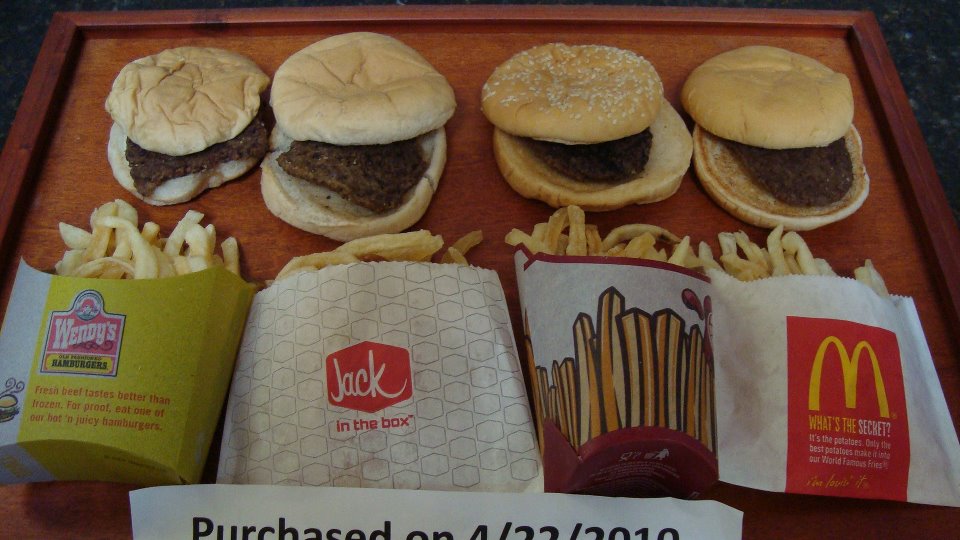
Recap:  Willow Rheault Kreibich posted a piece on FB that featured a picture of various fast food hamburgers and french fries, on a tray, that had not spoiled in two years.

I posted the picture on this blog and commented to the effect of “do you really want to eat this food.”

“Burgerman” replied to my blog–with some interesting and welcome cautions about this story.

Willow received the following piece from “skeptical teacher”:  http://skepticalteacher.wordpress.com/2010/11/14/the-myth-of-the-non-decomposing-mcdonalds-hamburger/

Apparently, the issue is the amount of moisture involved in the molding process.  And, be aware that mold is the issue raised–not outright spoilage.

The counter argument goes that food needs moisture to mold.  Without moisture, such as might be found inside a plastic storage bag, mold does not occur.

Ok, I can buy that.

But, then I remembered the hotdog buns that got lost in my cupboard for about four months.  They were in a plastic bag.  When I opened the bag, they were like new–soft and spongy and looking quite edible.  I was shocked.  I can tell you that any organic, local bread I bring into the kitchen in a plastic bag spoils in a few days.  It grows truly radical mold, especially in the summer.  If I left a slice of this bread out, it would dry out and not spoil.  That’s true.  But those hot dog buns–which are probably akin to fast food hamburger buns–didn’t spoil inside a bag that would have trapped any moisture in them and caused mold.

Potatoes have a lot of moisture in them.  And, frying would trap that moisture inside.  I can see that some of the thin ones might dry out if left on the counter, but what about the fatter ones?  The fries in the picture look kind of like they just came out of the fryer.  What’s up with that?  What comes to mind for me is that commercial potatoes are sprayed with really strong chemicals–so strong that they often have to sit in piles outside until the worst of the chemicals dissipate–a process which can take up to six months, according to Michael Pollan.  These potatoes will not grow sprouts from their “eyes” if exposed to light.  Are the chemicals retarding mold and spoilage as well?  I want to know a lot more about why these French fries are not going bad.

As for the hamburger patties, I can see that if the meat is thin enough, it might dry out before molding.  Burgerman reminded me that we dry foods all the time, including meat.  But, we don’t dry meat on a counter.  We dry it under the sun, with the aid of air currents.  Or, in a dehydrator.  In other words, we use heat and air circulation to wick away moisture and to kill any pathogens that cause spoilage.  In addition, most commercial hamburgers are cooked well-done–so many of the pathogens are killed–as are the nutrients, by the way, which is why I eat meat that isn’t well done.  The grass-fed hamburgers I cook are medium rare or, even, for me, at least, rare.  There’s a TON of moisture in them.  They would spoil and mold if left on the counter.

Mold is one issue.  But what about other spoilage?   Would you eat one of these two-year old hamburgers and French fries that have, famously, not grown mold?

For the past 46 years, I have cooked multiple meals every day–unless I’m on an infrequent vacation somewhere–in which case I usually long for my own food.  I feed two dogs and eight chickens real food.  No dry dog food or commercial chicken feed is served here.  So, at night I am always throwing leftovers into bowls for the animals for the next morning.  Real food starts to turn into something smelly I wouldn’t eat in a matter of a few hours.

So, yes, I can agree that if you let well-done hamburgers and dead-bread buns sit out, they won’t MOLD unless there is sufficient moisture.  Maybe, though, they will SPOIL.

But, that fact begs the question of whether or not this kind of food is actually nourishing in any way.  It’s still dead food:  dead buns, dead overcooked meat that is likely adulterated with soy, and something truly weird about the nonspoiling French fries that are cooked in rancid, dangerous highly-processed vegetable oils–often made from soy and cottonseed.  (When did cotton become a food?)  The processing in these oils breaks their chemical structures down so that they are like little sharp razor blades in your veins.  They’re the real cause of heart disease according to Sally Fallon Morrell and Mary Enig of the Weston A. Price Foundation–as demonstrated in the video, “The Oiling of America.”

So, I’m still saying, “would you feed this food to your kids?”  Or, eat it yourself?

Interesting Information: The CDC Announces Horrifying New Autism Rates

Interesting Information:  April 24, 2012

The CDC Announces Horrifying New Autism Rates

The CDC has announced the following information:

1 in 88 children are now diagnosed with an autism spectrum disorder (ASD);

1 in 54 boys; and

1 in 252 girls– which means BOYS ARE FIVE TIMES MORE LIKELY TO HAVE AN ASD.

This number represents a 78 PERCENT INCREASE in the past five years and a 23 percent increase in the LAST TWO YEARS.

Utah had the highest prevalence of autism:  1 in 47,  8-year olds.

New Jersey had 1 in 49.

Dr. Mercola, in “The Silent Time Bomb Now Affecting 1 in 54 Boys in the US,” asks “What’s really going on here?”  (See http://articles.mercola.com for more information.)

And, Mercola adds the following:

“Personally, I don’t see how anyone can look at a 78 percent increase of any health problem in a mere five years without snapping to attention.  Prior to the CDC’s announcement, the Canary Party, a citizens’ action group on autism, rightfully predicted that the CDC would down play the seriousness of these latest statistics.

On its new autism webpage, the CDC state they suspect some of the increase `is due to greater awareness and better identification’ among some of the children.

But even taking that possibility into consideration, the statistics are truly shocking.  How can one in 88American children have some form of autistic disorder?  In a normal, healthy environment, that just shouldn’t happen.  And the fact that it IS happening demands our immediate attention.  Something is going very wrong, very fast…”

That SOMETHING WRONG is toxic overload, according to Dr. Mercola.  I agree.

Here’s some contributing areas  Mercola identifies:

Environmental areas, of course.  But, which ones?

Likely, there are multiple factors.  Among them are the overuse and inappropriate use of vaccines–which may function as “the straw that broke the camel’s back.”

And, our overuse of toxic chemicals–which are being put into our food, our air, our water, our clothing, our furniture, and on and on and on.   Key among these are mercury, toxic adjuvants in vaccines, phthalates, BPA, and so forth.

Electromagnetic fields need much more investigation.  Women who sleep in strong electromagnetic fields during pregnancy might give birth to babies that exhibit neurological abnormalities.  Computers, smart meters, cell phones, those baby-monitoring systems, microwaves, all throw electromagnetic waves.  I would not put those baby-monitoring systems into a baby’s room knowing what I now know, and I remind young parents that babies have survived just fine for all the thousands of years before the last 10, when these systems became “must haves” for child safety.

Vitamin D deficiency in pregnant women might be a factor.

And, Dr. Natasha Campbell-McBride is arguing that children born to parents with abnormal gut flora develop devestating gut and brain toxicity that leads to autism–all of which can be cured with diet.  If you are working with an autistic child, please, please read McBride’s book, GUT AND PSYCHOLOGY SYNDROME.  I wrote about the GAPS diet in my Mainely Tipping Points Essays on this blog, essay No. 31, “I Feel It In My Gut.”

WHAT TO DO?

Read Mercola’s article for more guidance, but, basically, do everything you can to lower toxic overload.  Buy organic foods; get rid of personal body care products and household cleaning products loaded with chemicals; and read up on vaccine dangers and only get the ones, if any, that seem the most necessary to you.

Clean up your diet.  Get rid of the junk food.  If it comes in a box, don’t eat it.  If it comes in a can, make sure it’s BPA free.  Limit carbohydrates, especially grains and legumes.  And, if you eat them, make sure you prepare them properly–more on this subject in upcoming Mainely Tipping Points essays.

SUPPORT THE IMMEDIATE INSTALLATION OF THE PRECAUTIONARY PRINCIPAL.  All untested chemicals in circulation must now be tested–and tested by scientists who do not have financial interests in the outcome.  Nothing can be allowed into circulation that causes human harm.

We have to develop the POLITICAL WILL to make these changes–and that starts with understanding that we cannot continue down this road without dire, dire consequences.

One in 54 boys.  That’s at least one boy you know, for sure.

Interesting Information: This “Food” is TWO YEARS OLD

Interesting Information:  April 23, 2010

This “Food” is TWO YEARS OLD

Willow Rheault Kreibich posted this picture on FB recently.

The picture is taken from the FB wall photos of the LiveWell Wellness Centers–so you can go and have a look for yourself.

This food was purchased on April 22, 2010, so it is now TWO YEARS OLD.

Do you really want to feed this “food” to yourself or to your children????

Can we in any way call this food that even bugs won’t touch “nourishing”?

I copied and pasted below the picture what the folks at LiveWell wrote beneath their wall photo

Our fast “food” display is now 2 years old.  The word food is questionable, since the bread-like and meat-like substances have not molded or spoiled in any way.  Bugs won’t even bother with it.  Please think twice about giving this to your kids.  You have a choice, but they don’t.  We truly are what we eat.

Interesting Information: Study Links Pesticide To Bee Deaths

Interesting Information:  April 23, 2012

Study Links Pesticide to Bee Deaths

David Abel, in “The Boston Globe,” reported on a recent Harvard Public Health study that made a one-to-one link between bee colony collapse disorder and a chemical in the neonicotinoid family, imidacloprid (April 6, 2012, B1).

Before 2006, Abel notes, “the typical bee colony collapse was between 25 and 30 percent”–a figure which has “doubled since then.”  Imidacloprid was first reviewed by EPA in 2008.

One strategy chemical companies use to prevent chemicals from being banned is to claim a study is faulty, that more study is needed.  Bayer, the German chemical company who sells the most imidacloprid, immediately claimed the study flawed in that too much of the chemical was used in the study.  But, Alex Lu, associate professor of environmental exposure biology at the Harvard School of Public Health, said “it took only low levels to cause hive collapse, less than is typically used in crops or in areas where bees forage.”  Most importantly, this study clearly linked bee death and colony collapse to imidacloprid.  In other words, there is no question that there is a one to one link here and that the result is bee death.

Imidacloprid is used increasingly in crops such as corn and soybeans.  In Maine, it’s used on “wild” blueberry barrens.  Bees are exposed to imidacloprid both through nectar from the sprayed plants AND through the high-fructose corn syrup with which they are fed.  Charles Benbook, chief scientist of the Organic Center in Boulder, Colorado, and former executive director of the National Academy of Sciences on Agriculture, warned that what’s happening to bees doesn’t just stop with bees:  “People, especially children, consume a lot of high-fructose corn syrup.  The presence of any pesticides in high fructose corn syrup should be a concern for the general public.”

Neonicotinoids act on an insect’s central nervous system.  What do you think it will do to human nervous systems?  Especially when we are learning more and more each day that very small amounts of these chemicals can do a ton of damage.

The Harvard study showed that after 23 weeks of exposure to low levels of imidacloprid, 15 of the 16 treated hives were dead.  Those exposed to higher levels died first.

EPA officials, after the release of this Harvard study, have moved up in their registration schedule so that they will begin a review of imidacloprid by the end of this year.

Parts of France and Italy banned imidacloprid in 2009, and colony collapse disorder there has been substantially reduced.

Bees are our canaries in the coal mines.

Do not eat corn unless it is clearly organic.  Do not eat soybeans, period.  (I’ll write more on that later.)  In addition, both corn and soybeans are likely GMO’d, which is a whole other set of problems for human health.

Interesting Information: Carmina Burana

Interesting Information:  April 20, 2012

Carmina Burana

One of the many joys of living in mid-coast Maine is that a very rich array of arts are available to us each week of the year.  This area is known for its artists, musicians, writers, and so forth.  We live in an intellectual mecca in many ways.

Last weekend, we attended one of the many concerts that the Bay Chamber organization brings to us each year.  This event featured Carl Orff’s “Carmina Burana,” performed by our own Down East Singers and three soloists (NPR’s Suzanne Nance, Daniel C. Stein, and Andrew Garland), each of whom had gorgeous voices.

If you think you don’t know Orff’s “Carmina Burana,” you do.  The opening song, “O Fortuna,” has been featured in literally hundreds of movies.  Take a look:

http://en.wikipedia.org/wiki/Carl_Orff’s_O_Fortuna_in_popular_culture

And, here’s one utube version of the many listed versions of ” O Fortuna”:

http://www.youtube.com/watch?v=p9eEwsGPf3s

What I didn’t know until last Saturday, was that the WHOLE “Carmina Burana” is a collection of very old  secular songs originally written in medieval Latin, Old French, and Middle-High German.  Anthony Antolini, conductor of the Down East Singers, told us that “Carmina” is from the Latin word “carmen,” which means secular songs.  The first song, “O Fortuna,” is about Fortune, the Empress of the World, and often features a wheel of life that turns–something you can see in the utube selection above.  These early songs were “spicy” and were sung by goliards, or street persons living by their wits.

Mercy!  It’s always so fun to learn something new.

Interesting Information: Canola Oil and Toxic Erucic Acid

Interesting Information:  April 19, 2012

Canola Oil and Toxic Erucic Acid

Canola oil is the “go to” oil for almost everyone now.  Because it does not have a strong taste–as it’s highly processed–it gets put into salad dressings, baked goods, and cooked with in all kinds of ways.

Loren Cordain, the modern “father” of the Paleo diet research, has withdrawn his support of canola oil, which he allowed in the 2002 original version of his THE PALEO COOKBOOK.

Here’s the excerpt explaining why (22-23):

Since the publication of the first edition of THE PALEO DIET in 2002, I have reversed my position on canola oil and can no longer endorse its consumption.  Canola oil comes from the seeds of the rape plant (Brassica rapa or Brassica campestris), which is a relative of the broccoli, cabbage, Brussels sprouts, and kale family.  Undoubtedly, humans have eaten cabbage and its relatives since before historical times, and I still strongly support the consumption of these health-promoting vegetables.  Nevertheless, the concentrated oil from Brassica is another story.

In its original form, rape plants produced a seed oil that contained elevated levels (20-50 percent) of erucic acid (a monounsaturated fatty acid labeled 22:1n9).  Erucic acid is toxic and causes tissue damage in many organs of laboratory animals.  In the early 1970s, Canadian plant breeders developed a strain of rape plant that yielded a seed with less than 2 percent erucic acid (thus the name canola oil).

The erucic acid content of commercially available canola oil averages 0.6 percent.  Despite its low erucic acid content, a number of experiments in the 1970s showed that even at low concentrations (2.0 and 0.88 percent), canola oil fed to rats could still elicit minor heart scarring that was considered pathological.  A series of recent rat studies of low-erucic canola oil conducted by Dr. Ohara and colleagues at the Hatano Research Institute in Japan reported kidney injuries, increases in blood sodium levels, and abnormal changes in the hormone aldosterone, which regulates blood pressure.

Other harmful effects of canola oil consumption in animals (at 10 percent of their total calories) included decreased litter sizes, behavioral changes, and liver damage.  A number of recent human studies of canola and rapeseed oil by Dr. Poiikonen and colleagues at the University of Tempere in Finland showed it to be a potent allergen in adults and children that causes allergic cross-reactions from other environmental allergens.  Based on these brand-new findings in both humans and animals, I prefer to err on the safe side and can no longer recommend canola oil in the modern-day Paleo Diet.

Cordain goes on to say that olive oil has “less than positive omega 6 to omega 3 ratios–11 to 7.  So, excessive consumption without enough long-chain omega 3 fatty acids (EPA and DHA) will “derail an otherwise healthy diet.”

The Weston A. Price Foundation (WAPF) has long warned that all of the highly-processed vegetable oils cause heart disease.

I use high-quality (centrifuge extracted) coconut oil to saute or bake.  Or, tallow or lard if I can get it.   If I’ve got chicken fat on top of my broth, I use that to sweat out vegetables for a soup using the broth.  I reserve high-quality olive oil for salad dressings.  I use rendered duck fat to pan fry potatoes for a special treat–and they are beyond delicious!  It’s pretty safe to say that I rarely, rarely deep-fry anything.  I think the last time was some doughnuts, but I’ve since learned more about fats.

I’m not above eating the very occasional homemade doughnut when breakfasting out, however.  The are delicious.  And, addictive.

Interesting Information: The Maine CDC Joins the Salt War

Interesting Information:  April 15, 2012

The Maine CDC Joins the Salt War

Recently, the Maine CDC ran a warning in our local paper, The Camden Herald, about the dangers of salt consumption.  Its conclusions were based on a 2010 study out of Stanford.

At best, this Stanford study can only be called junk science.  As such, it—and our government’s support of it–will only confuse people about how to eat.

First, the study uses data from the Framingham heart study.  Framingham relies on what people said they were eating–which is famously always already vexed.  Stanford singles out salt consumption.  But, what about everything else folks were eating that might cause heart disease?  Therefore, this Stanford study can only show correlation, not causation with regard to salt consumption.  Acting from correlation is famously not scientific.

Second, the 2010 Stanford study’s results are based on a computer model that predicts causation.  But, computer models only work if they are using correct data.  This data can only be based on faulty information since people are only remembering what they think they have eaten.

Third, there are many, many studies showing that salt consumption is not related to blood pressure.  Or, heart disease.  You can read an essay I wrote on the salt wars on this blog:  Mainely Tipping P0ints 38.  You can view a video refuting this government anti-salt campaign, “The Salt Guru:  Fight Feds for Salt Freedom,” http://www.youtube.com/watch?v=re_V0pazMfc&feature=youtu.be.   And you can view the Weston A. Price’s press release on their main web page, http://www.globenewswire.com/newsroom/news.html?d=243574.  .

Salt is crucial for human health, so why is our government starting another salt war?  One reason might be industry production costs, especially when industry is using a lot of salt to mask the quality of inferior, fake foods.

We need to insist that our government be more careful about warning people about what is dangerous to eat.  We need to insist that our government does not facilitate or participate in faulty belief systems.  We need to insist that our government promotes solid science.  Otherwise, our government is working for industry and not for us.

Eat good salt, though, not the fake kind.  Buy unprocessed sea salt.