Turkey Tracks: How to Sew On a Button

Turkey Tracks:  February 15, 2011

How to Sew On a Button

A friend told me recently that s/he wanted to learn to sew on a button. 

We meant to sit down so I could demonstrate.  There are a few tricks.

But, the internet is a wonderful thing for this kind of information.  Here’s a terrific video showing exactly how to sew on a button, including the bit of information I would have included about creating a thread shank between the button and the material about equal to the thickness of the material that the button will be handling. 

I would also note that sometimes, if I don’t want to see a knot on the inside of my jacket or sweater or whatever, I will start sewing my button on from the front side, so the knot is hidden.  I also, like the demo here, return to the front side to clip off my thread, but, first, I do a quick knot into the thread shank to doubly secure the thread.

http://www.videojug.com/film/how-to-sew-on-a-button

Turkey Tracks: Chicken Feed Recipe

Turkey Tracks:  February 9, 2011

Chicken Feed Recipe

Our chickens are very tired of being “cooped up” in their coop and attached cage, both of which are now banked high with snow and which are, therefore, dark.  You will recall that the chicks were venturing out in the snow paths we made, lured by me and sunflower seeds, until a bird (an owl?) killed May May at dusk one day.

The cage, actually, has about 2 feet of snow on its top as well–which probably provides quite a bit of insulation, especially since I layered tarps over it before the first snow fall.  Inside the coop, we have a red 60 watt translucent light, which gives them a bit more heat.  (The temps up here were in the teens last night.)  I plug in the light in the morning when I feed the chicks so they have some light in their coop during the day.  I turn if off about 8 p.m.  They don’t really like the light on all night, so I only leave it on all night when the temps fall into the single digits.  They get quite cross when they go all night with the light on.

Chickens are very social, so I try to visit them several times a day after they have finished laying.  They don’t like to be disturbed when they are laying.  I open the roof, and they come to see me.  Several will fly up to perch on the opened roof edge and like to be petted and rubbed.  All of them talk to you.  I throw a handful of sunflower seeds into the cage, which is now many inches deep with coop bedding that falls out when the cage door gets opened in the morning.  They scratch around looking for the seeds, and it gives them something to do.  They are VERY bored.  (The dogs are too.)  The other day I sacrificed some of my compost worms and took a full bowl out to the coop.  Mercy me!  Those chickens were so excited.

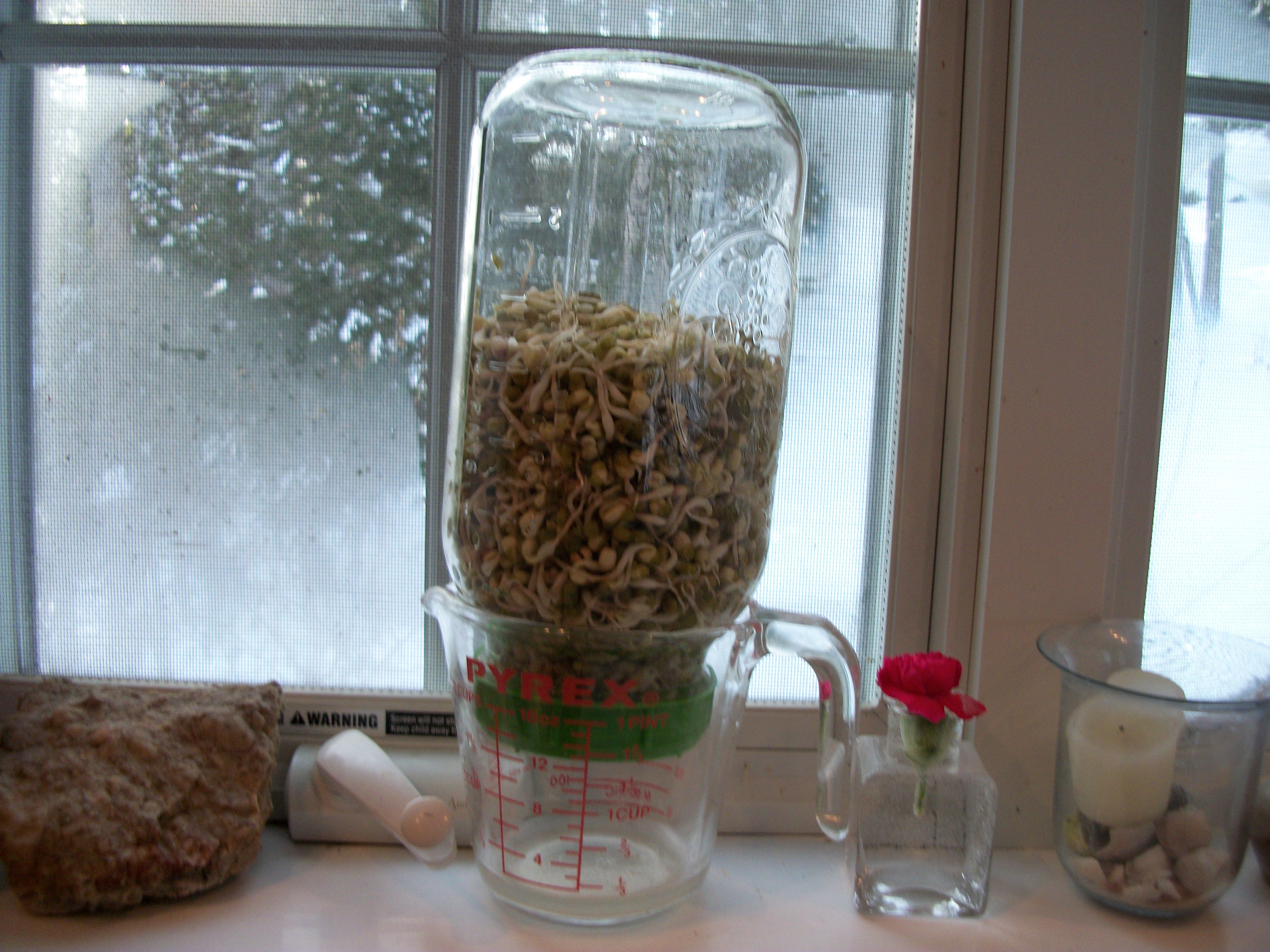
Chickens love greens, and now all the grass is covered with snow.  I give them as many greens as I can–leftover lettuce, cooked greens, the stems from cleaning greens, and so forth.  I’ve even been known to BUY them some lettuce.  But, what the really love are sprouts, so I’ve been sprouting mung beans for them–something I do this time of year anyway to get fresh greens into our diets.  If I leave the sprouts growing longer, they start to grow leaves, and the chicks really like those.  Here are some sprouting in the kitchen window:

 That rock in in the window is a piece of the old, old Bryan mill stone from the mill out on what was once the farm in Reynolds, Georgia.  My Uncle Buddy gave it to me long years ago now.   The mill was gone by the time I was a child, but he remembered it.

I also give the chickens a big bowl of milk, some hamburger, a bit of bread to soak up the milk, kitchen leftovers they like, and whatever greens I can muster up first thing in the morning.  They love cooked oatmeal, like a warm mash, on a cold morning.  Ditto ground corn cooked in a bit of milk.  This food is their second choice, after greens.

I don’t feed my chickens commercial organic feed, which is full of industrial by-products, like spent, rancid oils, SOY, and  synthetic protein, needed because the corn/soy ratio doesn’t supply enough protein.    Chickens fed commercial feed, even organic feed, produce egg yolks with soy isoflavones, which are phytoestrogens that act like hormones and which affect human reproductive and nervous systems.

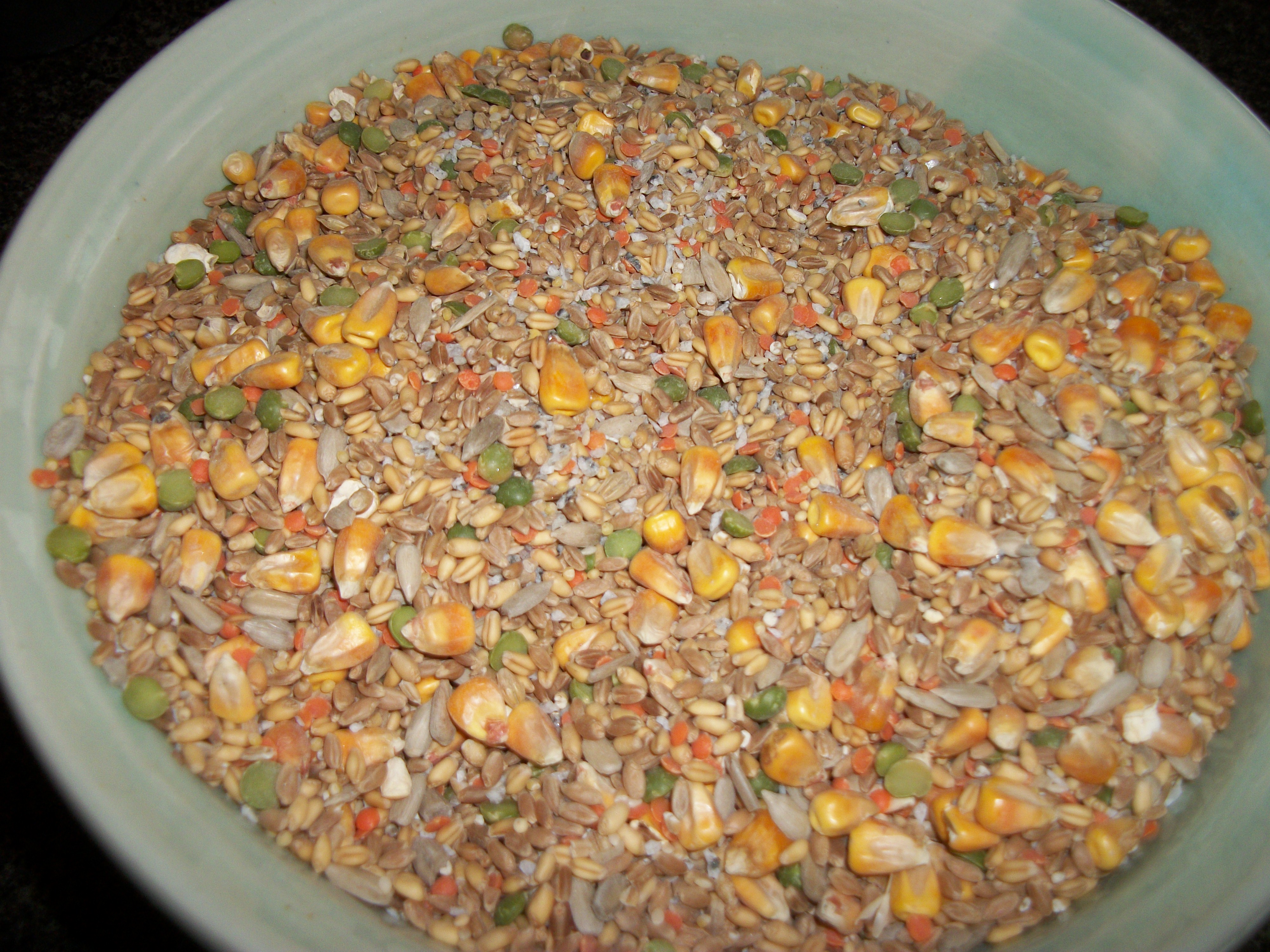
Here’s what the mixture I make for them looks like–and I’m darn lucky to have access to all of these organic grains.  Looks good enough to grind and cook, right?  I could, if I didn’t put grit into the mixture.  See the tiny rocks–grit–mixed it?  That’s what chickens use to help digest their food inside their crop, or gizzard.   Anyway, I keep all the grains, seeds, and beans separate out in the garage, so I can use them if I like.
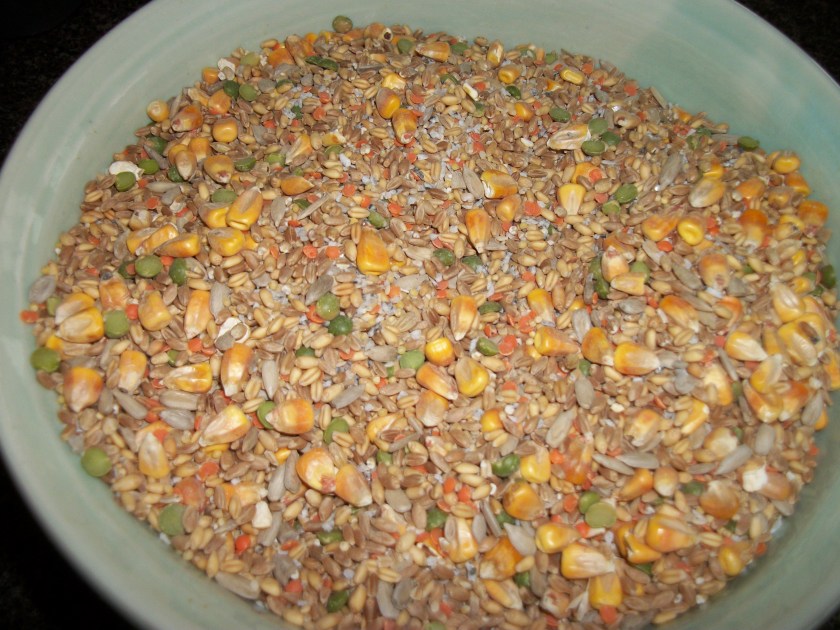
I got the master recipe from a farm out west somewhere, called Greener Pastures (www.greenerpasturesfarm.com/ChickenFeed Recipe.html).  Thanks so much for sharing, Greener Pastures!

This recipe uses wheat, which has a fair amount of protein, as the base grain and peas and lentils for proteins.  Everything is organic.  So, here’s what I’m mixing up:

3 parts hard red winter wheat

3 parts soft spring wheat

1 part whole corn (I up this in the winter to almost 3 parts to help the chicks gain and hold fat, and in the summer I throw out a bit of whole corn for scratch feed.)

1 part steel-cut oats

1 part hulled barley

1 part hulled sunflower seeds

1 part green split peas

1 part lentils

Any other seeds/grain I think they’ll like for a change:  millet, sesame seeds, etc.

About two cups of grit per mixture.
Interesting Information: 2010 in review

The stats helper monkeys at WordPress.com mulled over how this blog did in 2010, and here’s a high level summary of its overall blog health:

Healthy blog!

The Blog-Health-o-Meter™ reads This blog is doing awesome!.

Crunchy numbers

Featured image

A Boeing 747-400 passenger jet can hold 416 passengers. This blog was viewed about 1,500 times in 2010. That’s about 4 full 747s.

In 2010, there were 83 new posts, not bad for the first year! There were 214 pictures uploaded, taking up a total of 387mb. That’s about 4 pictures per week.

The busiest day of the year was April 10th with 32 views. The most popular post that day was Tipping Points 2: Winning the Cancer War.

Where did they come from?

The top referring sites in 2010 were mail.yahoo.com, healthfitnesstherapy.com, slashingtongue.com, en.wordpress.com, and digg.com.

Some visitors came searching, mostly for louisa enright blog, socks, louisa enright, oreo cows, and cow markings.

Attractions in 2010

These are the posts and pages that got the most views in 2010.

1

Tipping Points 2: Winning the Cancer War April 2010

2

Tipping Points 9: Chicken Feed May 2010

3

Turkey Tracks: Hand Projects: Socks and a Rug October 2010
1 comment

4

About April 2010

5

Interesting Information: Cancer Rates, Delmarva Peninsula June 2010

Interesting Information: Cancer Rates, Delmarva Peninsula

Interesting Information:  June 14, 2010

Cancer Rates, Delmarva Peninsula

The Maine Organic Farmers’ and Growers Association quarterly journal came last week some time.  The journal always list up-to-date information about toxins.  This issue had a piece of information that I’ve searched for, off and on, for some time–cancer rates on the Eastern Shore.   

The area where my niece Catherine died, called the Eastern Shore, is part of a larger geographical structure called the Delmarva Peninsula–for the states of Delaware, Maryland, and Virginia which make it up.  The Delmarva peninsula is known for chicken production (growing and slaughtering) and for truck gardening.  The produce goes to neighboring urban areas, among them DC and Baltimore. 

Catherine lived just downwind from a chicken processing plant.  Neighboring fields were covered routinely with chicken manure.  These plants pumped bloody water into the bay.  Indeed, pfiesteria piscicida was discovered in the Chesapeake Bay very near her home south of Onancock.  Pfiesteria piscicida kills, massively kills, fish.  And, it has been associated with both the handling of pig and chicken manure in large, industrial practices, as a quick google search demonstrates.  See http://en.wikipedia.org/wiki/Pfiesteria_piscicida  and http://www.grist.org/article/last/

Anyway, here is the article from the June-August 2010 MOFGA journal, pages 9 and 10.  I’ve just retyped it exactly as it appears:

“Sheila Pell reports in Emagazine that some 70 percent of U.S. broiler chickens, as well as turkeys and swine, are given the arsenic-based growth promoting feed additive roxarsone.  While some of that organic arsenic remains in chicken meat, most is excreted and breaks down into inorganic arsenic, a strong promoter of many cancers.  In Prairie Grove, Arkansas, which is surrounded by large poultry factory farms, and where manure from those farms is used extensively as fertilizer on area fields, incidences of rare cancers are high.  A decade ago, the town’s 2,500 residents learned that 17 children there suffered from cancers including brain and testicular cancer and leukemia.  Likewise, the  Peninsula, another area with factory poultry farms, has one of the highest cancer rates in the United States.  Manure that isn’t used as fertilizer is added to cattle feed.  The National Chicken Council claims that roxarsone, an antibiotic, contributes to “animal health and welfare, food  and environmental sustainability.”  (“Arsenic and Old Studies–Pressure Is On to Ban a Hazardous but Profitable Feed Additive,” by Sheila Pell, Emagazine, March-April 2010; http://www.emagazine.com/view/?5064). 

High cancer rates on the Delmarva peninsula…  It’s nice to see it confirmed…

When Catherine was dying, and we all started at looking at why she might have gotten such an aggressive cancer–it killed her in a year despite every medical intervention tried, including a stem-cell transplant at Duke–we wondered about all the cancer in young people where she lived.  We wondered about the water.  We wondered about the truck gardening.  We really wondered about the chicken industry.

The Eastern Shore in perfectly suited for large industry, in that while there are some wealthy people who have vacation homes, most of the area is poor.  The chicken and produce industries provide jobs–though many of them, I suspect from looking at who was working in the fields, are going to illegal immigrants.  Anyway, no one locally will fight what is happening to the environment–even though many families have been struck with the nightmare of cancer.

Arsenic has never been banned in the United States, and it is still used agriculturally.