Interesting Information: An Unlikely Crusader For Food Safety

Robyn O’Brien, a former Wall Street analyst, watched in horror while her youngest child (of 4 children) experienced a food allergy attack one morning- -while eating a breakfast of waffles, eggs, and tube yogurt.  The experience set O’Brien off on a journey to understand why and what she could do about it in order to protect her family.

The video is 18 FAST minutes (because it’s so interesting and informative)–and ends with the suggestion that we can all begin to make small, incremental steps toward insuring that our food supply is once again made safe.

http://www.karmatube.org/videos.php?id=2343

O’Brien also has a web site that seeks to help and to inform:  http://allergykidsfoundation.org.

PS:  O’Brien surfaces the information that the United States has higher cancer rates than anywhere else on the planet–due mostly to our use of untested chemicals in and on our foods.

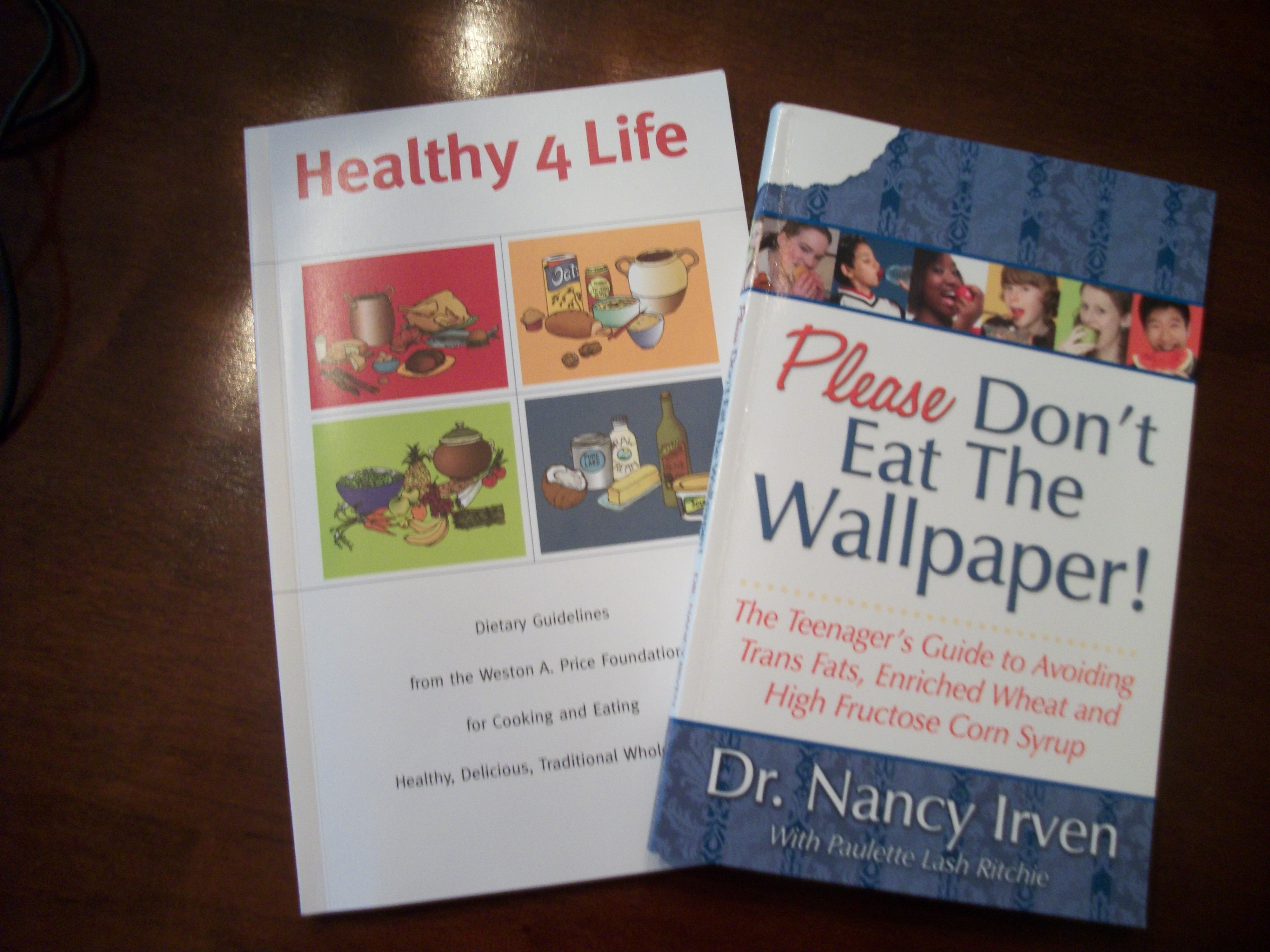
Interesting Information: Healthy 4 Life and Please Don’t Eat the Wallpaper.

When someone asks me how to start changing their food consumption habits, I usually recommend NOURISHING TRADITIONS, Sally Fallon Morrell and Dr. Mary Enig, both of the Weston A. Price Foundation–which also has a really good web site.

But, this past year, the WAPF came out with a very short little book–their answer to the travesty of the USDA’S food guide, whose formation is driven by the market–not science–and which is guaranteed to make you sick.  I really like this little book.  It’s an excellent and easy guide to changing your life.  NOURISHING TRADITIONS is an amazing book and is chock full of information, so that would be the next place to go in your journey.

WAPF will send you HEALTHY 4 LIFE for about $12.   They also have a great shopping guide and lots of informative pamphlets on soy (really bad), raw milk, and so forth.

In addition, Dr. Nancy Irven, after working with high school students, published PLEASE DON’T EAT THE WALLPAPER, available at amazon.com at least for about $14 as I recall.  Irven’s goal is to get students to own their own health and diet by first understanding why high fructose corn syrup, white flour, and trans fats are really bad sugar, glue, and plastic.  Get those three out of the diet, she explains, and the other bad additives, etc., drop out with them.  Irven has a light touch and funny sense of humor, and the high school program she’s been working with on diet has been highly successful.

In short, there’s so much really bad information out there that teenagers, who are often adrift on their own in terms of food anyway, don’t know what to eat.  Since this same condition is true for many Americans, Irven’s little book is useful for all ages.

Interesting Information: “Why Go Organic” video

This little video, done by a child after an experiment, speaks to why you do not want to eat commercial potatoes in any form.

Do take a look?

http://www.geekmom.com/2011/06/a-sweet-potato-experiment-why-go-organic/


Here’s a site discussing the video and chlorpropham, the chemical at issue.  According to PAN (Pesticide Action Network), it is toxic to bees and retards growth in animals–and can kill them.

http://www.care2.com/greenliving/girl-discovers-the-importance-of-eating-organic-video.html


Interesting Information: GMO Foods Have Not Been Tested Properly

Interesting Information:  July 9, 2011

GMO Foods Have Not Been Tested Properly

Philip Bereano, PhD, is a professor emeritus at the University of Washington and an engaged activist concerning genetically modified (GM) foods.  I saw this quote from him in the July/August 2011 issue of Well Being Journal and tracked down the whole interview, which is on Dr. Joseph Mercola’s web site:  http://articles.mercola.com/sites/articles/archive/2011/04/02/dr-philip-bereano-on-gmos.aspx.

Bereano said the following:

The problem with calling genetically engineered organisms safe is that there are no valid risk assessments being done on them. There is no research, really, being done into the health or environmental effects of a genetically engineered organism. Certainly no work that is published in the open peer-reviewed literature, or  that isn’t proprietary. Corporations promoting these things claim that they have done research, but you can’t get any information on it because it’s all claimed to be proprietary.

The whole interview is worth a scan because Bereano is arguing that what is coming clear is that there is a deliberate corporate strategy being carried out with government help to corner the markets on seeds and to drive organic farmers out of the market by the simple process of contamination.

Don’t scream “conspiracy theory” because while there may be some conspiracy going on here, what’s really occuring is the normal working of the logic of unfettered capitalism–which seeks to control all markets, to drive out all competitors, and to colonize any part of the economy so that it functions as a profit center.

Bereano addressed the claims that GMO foods can “feed the world” and that they are cheaper and shows that neither claim is true.

In May 2009, the American Academy of Environmental Medicine called for a ban on the use of GMO foods:  http://www.aaemonline.org/gmopressrelease.html.  Members are seeing increasing levels of serious health problems they believe to be connected to GMO foods.

What’s really disturbing is that GM foods don’t have to be labeled–which is another argument for buying local from people you trust.  Be especially careful with corn–especially corn chips.  Be sure to choose organic corn chips.   And do take  a moment to read about this issue so that you understand what is at stake for you and your beloveds.

Interesting Information: Vanilla Ice Cream

Interesting Information:  July 9, 2011

Vanilla Ice Cream

COOKS ILLUSTRATED, May/June 2010, investigated vanilla ice cream.  Nationwide, there are nearly 40 brands of vanilla ice creamCI chose the eight top-selling brands and taste-tested those.  The winner was Ben & Jerry’s Vanilla.  Next came Haagen-Dazs, Wells blue Bunny, Breyers, Friendly’s, Blue Bell, and Turkey Hill.  Edy’s Grand Vanilla was not recommended.

The criteria included what kind of vanilla was used (natural or synthetic); the tricky business of using stabilizers like carob gum, guar gum, tara gum, and carrageenan (the winner uses two); how much air is pumped into the ice cream to expand volume; and what kind of sweetener is used.

Edy’s, for instance, is a big package with lots of air, while Ben & Jerry’s is a small package with lots of ice cream.  Between the two, Ben & Jerry’s is a POUND heavier than Edy’s, even in the smaller package.

And ice creams using corn syrup tasted “`unnaturally sweet,’ ”  no matter the sugar levels.

Testers discovered that “keeping it simple” produced the best vanilla ice cream:  cream, milk, sugar, eggs, real vanilla, and a minimum of emulsifiers made the best ice cream.

Homemade Vanilla Ice Cream

You can keep it even simpler:  get a pint of some real/raw heavy cream, add 2 or 3 egg yolks (keep the whites for macaroons or meringues) , some real vanilla extract, a tablespoon of healthy arrowroot for creaminess, some maple syrup or honey for sweetness, put it into one of those quart ice cream makers you keep frozen in the freezer, and you have delicious and healthy ice cream in about 20 minutes!

You can also make food processor ice cream out of cream or yogurt and frozen fruit.  That recipe is on the blog in July 2010.

Interesting Information: Greek Yogurt

Interesting Information:  July 9, 2011

Greek Yogurt

A friend gives me her COOKS ILLUSTRATED magazines when she finishes them.  The May/June issue had an article on Greek yogurt I found interesting.

I knew that Greek yogurt was just yogurt with a lot of the whey drained out of it.  Anyone can make it, and the leftover whey is an amazing substance that is full of enzymes that help digestion.   A tablespoon of whey in a bit of water before a meal can really help digestion and can begin restoring probiotics in the gut.  You can also freeze it and use the ice cubes in smoothies, put it in soups, and so forth.  And, of course, there is a whole foodway of lacto-fermented foods made with whey that are chock full of enzymes.  Sauerkraut is an example, and there is a recipe for it in the recipe section of this blog.

I always thought that whey had a lot of protein, so I was skeptical about draining off the whey.  However, COOKS ILLUSTRATED says that whey does not have that high a protein content, so what’s being lost by draining some off to make a thicker yogurt is “only” the enzyme and mineral content of the whey.  (What remains is high in protein.)  If one uses the whey in other ways, no substantial harm is done–unless you are buying the yogurt and are never getting the whey.  (I’m guessing the whey is used to make that dried whey protein powder which, like all dried liquids, has been harmed by the drying process.)  Anyway, do note that you are now dealing with a whole product that has been splintered into parts–which is not a good thing to do as the whole contains all that you need to digest and use the product most effectively.

The market has “caught on” to Greek yogurt and is busily trying to make a buck on it.  So, buyer beware.  Read the labels to see what’s been added to what should just be yogurt with the whey drained off.  Many manufacturers are getting the creamy thickness of Greek yogurt (as they are with regular yogurt) by using thickeners like pectin, gelatin, seaweed, and milk protein concentrate.  These yogurts (Yoplait and The Greek Gods are examples) also have considerably higher levels of carbohydrates than other brands, and we are learning, together I hope, that carbohydrates are the root cause of many chronic diseases in America.

Unfortunately, COOKS ILLUSTRATED bought into the belief system that fat is not good, so they tested nonfat yogurts.  (One needs fat to digest protein.)  CI liked Olympus Nonfat Greek Yogurt the best.  It is imported from Greece.  they recommend Voskos, Brown Cow, Dannon, Oikos, and Fage.  Chobani was recommended with reservations.  And Athenos, Yoplait, and The Greek Gods were not recommended at all.

For me, the best bet is to make your own yogurt from whole real/raw milk.  If you want to make Greek yogurt or, even, some yogurt cheese, drain off some or all of the whey.  But, be sure to use the whey in some other ways in your diet.

If you must buy yogurt, which would be made with pasteurized milk, seek out a whole milk, cream-line one with no additives.  There are still a few left out there.

Interesting Information: EWG’s Dirty Dozen

Interesting Information:  July 8, 2010

The Environmental Working Group’s

Dirty Dozen List

The EWG’s guide to Pesticides in Produce now lists the following produce, in order of toxicity:  apples, celery, strawberries, peaches, spinach, nectarines (imported), grapes (imported), sweet bell peppers, potatoes, blueberries (domestic), lettuce, and kale/collard greens.  See www.ewg.org/foodnews/summary.

The EWG also warns that the commodity corn crop used for animal feed and biofuels is “almost all produced with genetically modified (GMO) seeds, as is some sweet corn sold for human consumption.”  The sweet corn IS NOT LABELED as GMO in U.S. stores, thanks to our lax and corrupt government oversight agencies.

Both the EWG and NUTRITION ACTION newsletter make the case–as the EWG puts it–that “the health benefits of a diet rich in fruits and vegetables outweigh the risks of pesticide exposure.”

I DISAGREE strongly.

First, the 2009 President’s Cancer Panel report–easily available for you to read online–is very clear that the use of toxic chemicals on our food and in our environment is the cause of much of the cancer epidemic we are experiencing.  I, for one, am really tired of losing so many beloveds to cancer.  When I was a young woman, cancers and heart disease were rare.

Second, more and more data is coming out now that our heavy use of carbs is causing hormonal disorders that are, in turn, causing obesity, diabetes, and metabolic syndrome.  So, a diet rich in produce is likely not be a good thing at all.

Third, our digestive tract does not handle lots of cellulose well.  We do not have the multiple stomachs, digestive chemicals, and so forth to handle so many fruits and vegetables–especially many of the raw ones.  Our digestive tract is set up to eat the animals that do process cellulose well.

(I’ve written about these issues in my Tipping Points essays here on this blog–and will continue to do so.)

I really wish EWG and organizations like it would step up to the plate and start taking a stand that incorporates good science–which would include the information that shows how seriously toxic the chemicals we use on our FOODs are.   Their unscientific repetition of the low-fat, high-carb, calorie in/out belief system is doing a lot of harm, which I suspect is not what they want to accomplish.

Finally, what you can do is to try to find local sources of organic foods.  It’s going to be a bit like “build it and they will come.”  Ask your local farmers to raise this food for you.  Go to farmers’ markets to find them.  Go out into the country and find them.  Plant a garden and raise some of your own food–even it’s only one tomato plant in a bucket.  And, try to eat foods in their seasons and to put them up in some way (canning, freezing) if you want to continue to enjoy them.  You can’t possibly know what’s been done to food raised outside of this country–even if it’s labeled “organic.”  (Take a look at the documentary OUR DAILY BREAD, for instance.)

What you can do is to stop giving your beloveds food that has poison on it and in it.  What you can do is to stop telling yourself that someone else is going to protect you and your beloveds–someone like the government.  It hasn’t.  It won’t.  What you can do is to face squarely the fact that these chemicals are killers and that they will kill you and your beloveds.  The cancer statistics are ample proof of that truth.  These chemicals are especially destructive to your babies, to your children, to teenagers–because they are still growing so fast.  No amount of these chemicals is safe.

Nothing is going to change until we all band together and say “No, we’re not doing it any more.  Give us good food, raised locally and organically, so that it has all the nutrients it should.”

Believe me, whatever money you think you’re saving by buying cheap food can get eaten up in a heartbeat with a cancer patient.  Few people understand the massive resources it takes to manage a cancer patient…

Assess what you can give up in your life to be able to find and pay for good food.  In the end, the time and money will be worth it.

Turkey Tracks: Do Yourself a Favor: Cook and Eat Dark Leafy Greens

Turkey Tracks:  June 19, 2010

Do Yourself a Favor:

Cook and Eat Dark Leafy Greens

Dark Leafy Greens are chock full of nutrients.  I’m talking Lambs Quarters, Bok Choy, Collards, Turnip Greens, Mustard Greens, Chicory, Dandelion, Kale, Parsley, Dock, Endive, and Watercress.  (Lamb Quarters and Dock are wild greens:     for dock, see http://eatingmymoccasinsnow.blogspot.com/2009/04/dock-rumex-crispus.html; for lambs quarters see http://www.google.com/search?hl=en&rlz=&=&q=lamb+quarters,+image&um=1&ie=UTF-8&tbm=isch&source=og&sa=N&tab=wi&biw=1362&bih=669.

I’m leaving out spinach, chard, and beet greens because they have high levels of oxalic acid that can cause a number of unpleasant side effects:  kidney stones and the reduction of the body’s absorption of calcium and iron among them.  Though I love spinach and chard, I eat these greens sparingly and, pretty much, only in season.

I try to cook several batches of dark leafy greens in a week, and I cook enough of them at one time to have leftovers.  Cold greens are delicious drizzled with a vinaigrette or a tahini or peanut dressing.  But, my favorite leftover use is to use the greens inside an omelet–with added cheese.  An omelet of goat cheese and cooked greens is great for breakfast, lunch, or dinner.  And, the combination of greens, egg, and cheese is…delicious!

According to Rachel Albert-Matesz and Don Matesz, in their cookbook and guide, THE GARDEN OF EATING, kale has 250 percent more vitamin C than an orange, 4, 450 percent more Vitamin A, and more potassium, iron, phosphorus, calcium, and protein (308).  Rachel A-M has a terrific web site, too:     http://www.thehealthycookingcoach.com/.   I highly recommend the cookbook.  I’ve yet to cook something bad from it, and it has significantly expanded my ability to  cook greens and to create satisfying meals without using grains.  Her web site has the cheapest prices–it’s under $30.

These dark leafy greens need to be cooked.  They don’t lose substantial nutrients, and cooking reduces some of the bitter compounds that can hinder digestion and absorption of nutrients.  Think of cooking them for at least 10 minutes.  This aspect of dark leafly greens makes me hesitate about juicing them, too.

My favorite greens are kale and collards.  Kale comes in various, beautiful forms, and each tastes slightly different.  You might recall a picture I took of some kale forms at the Maine Organic Farmers’ and Growers (MOFGA) fair last year.  Collards are in the foreground.

There are two principal ways to cook greens:  boil whole leaves/stems or pan saute and steam greens in a large, covered frying pan or pot.  I use both methods.  I boil when I want to prep greens ahead.  I particularly like kale boiled, chopped, and, later, sauteed in butter.  In both cases, you need to strip or cut (collards) the leaf from the fibrous stem.  Kale stems are more tender than collards.  Rachel A-M cooks kale stems and chops them when tender and adds them back to the leaves.  I’ll confess, usually I give the stems, which always have a few remaining bits of leaves, to the chickens as they take true delight in them.

For boiling, bring water to boil, drop in the whole leaves, and cook until tender–at the most from 5 to 10 minutes.  Drain, immerse in cold ice water to preserve color, and chop.  If you layer the leaves, then roll them, you can slice off strips.  Turn the strips and cut off bite-sized pieces.  Refrigerate for up to three days.

To pan saute, your imagination is the limit of fun combinations for additions.  Start by stripping leaves from stems.  Roll leaves and slice and cut, again, to make squares.  Sometimes, though, I just roughly chop greens.  Here’s a picture of two bunches of  leafy green kale.  When cooked, there will be enough for four servings.  John and I eat one serving each hot and then we have an asset in the kitchen:  cooked greens to be used in other ways, like an omelet.  Or, eaten cold.  The point I’m making is that greens COOK DOWN rather a lot, so buy enough.

Kale is tenderer than collards.  And, collards, in particular, benefit from the addition of meat broth for liquid, or an extra chicken/turkey wing in the pan.  When I make broth, I always pull off several small 1-cup Mason jars to use when cooking greens.

The basic method is to start by pan frying a chopped onion in good oil/fat.  I use unrefined coconut oil, or duck fat, or saved bacon grease, depending upon what kind of flavors I want.  Adding bits of flavoring meat, like pancetta or bacon, is nice at this stage.  Add some chopped garlic just before you get ready to add the greens.

But, before that, consider what kind of SPICES you’d like to have running around the pan.  Perhaps some combination of spices–cumin, cinnamon, coriander, turmeric, for instance.  Curry powder?  Put those kinds of spices into the pan and let them fry in the fat for a moment or two–with the garlic if you’re using it.  Mustard is a nice addition.  Any of the hot pepper spices, like paprika or red pepper.  And nutmeg is lovely with greens.  Thyme or sage is nice.  Gingeroot is lovely.

You could throw in some sliced apples in the fall.  Or, a handful of dried fruit in the winter.  (Think of drizzling in some honey or maple syrup at the end if you go in this direction–with a bit of fruity vinegar to spark the tastes.)

A handful of cleaned seaweed (dulse, for instance) gives some heft and adds iodine, which I think about since I don’t eat grocery store salt.

Adding other vegetables is also nice:  carrots, mushrooms, cauliflower, daikon radish, celery, bell pepper strips.

USE WHAT YOU HAVE IN THE KITCHEN.

When your veggies and spices are sweated out/mixed in, throw in the greens.  If they have enough water from washing, you can begin to turn them with tongs until they wilt down.  If you don’t have enough liquid, add water/bone broth (about a cup) to the pan–mopre for collards–wilt down the leaves, and cover and cook for 5-10 minutes.  Collards will require longer cooking.  Remove the lid and cook down any remaining liquid at high heat before serving.

ENJOY!

Interesting Information: Homogenization of Milk and Cheese

Interesting Information:  June 13, 2011

Homogenization of Milk and Cheese

Steve Bemis is a retired corporate attorney who farms hay in Michigan for local farmers.  He is also a founding Board member of the Weston A. Price Foundation’s Farm-to-Consumer Legal Defense Fund–which works to insure greater access to local foods, especially raw milk.  In the Spring 2011 WAPF journal WISE TRADITIONS, Bemis poses an interesting theory about the real need for homogenization and pasteurization of milk (http://www.realmilk.com/cheese-is-serious.html).  The real reason, poses Bemis, might be the dairy industry’s incredibly profitable cheese business.

Let’s back up for a moment.  In my lifetime, one’s milk was delivered to the door in glass bottles.  One judged the milk by the cream line at the top of the bottle–clearly visible for all to see.  But, the dairy industry wanted that cream to make other products.  Ice cream, yes, but also cheese.

So, industry begin figuring out ways to get that cream.   How they did it was to, first, convince women that milk had to be pasteurized as real milk was unsafe–a claim never proven scientifically.  Second, they instituted, over time, a process of fractionalizing milk into parts and reconstituting some of the parts back into milk–minus all the cream.  (Whole milk might not have the whole amount of cream that came from the cow.)   Says Bemis:  “Milk, milkfat, skim milk powder and other fractions of milk are processed into cheese, butter, ice cream, yogurt, kefir, and other industrial component which are ubiquitous in processed and ultra-processed foods.”  Third, they successfully got the federal government to police this new terrain.  This is how industry works:  maximize profits any way possible, including gaming the information.

Processed, fractionalized milk was then homogenized, so no one could ever see the cream line again.  And, the glass bottles disappeared.  But, here’s where Bemis gets really interesting.  Once milk is homogenized, it “will go rancid within a matter of hours.”  Thus, the milk has to be pasteurized to keep it from going rancid.   “Hence,” writes Bemis, “once the dairy industry took the homogenizing step to follow the dollars, it had to pasteurize.”  Bemis continues:  “And the industry will have to stick with the gospel of pasteurizing, since their current economic structure requires it.”

Hmmmm….  Pasteurization came AFTER homogenization.  Pasteurization was NEVER about food safety.  It was about maximizing profits, fooling customers, and extending shelf life.

So, if you can’t get the whole, raw, living, healthy REAL milk, try to find a dairy that produces a cream line, even if the milk is pasteurized.  Homogenized milk is really, really processed.

Bemis then turns his attention to the cheese issue.  He asks an important question:  “Is contamination of raw milk a huge red herring keeping our eyes off a far more important reason for pasteurizing milk?”  Cheese is a keystone product for the dairy industry.  Cheese is a billion dollar business.  Cheese is probably why both the USDA and the FDA have launched even more intense, fear-based attacks against raw milk and against artisan cheese makers.

The good news, writes Bemis, is that “raw milk consumption continues to surge; FDA’s interstate ban is under legal attack, and FDA’s dogma is regularly being shown to be inconsistent, illogical and unscientific–an embarrassing and ever-deepening quandary in which the agency finds itself due to its steadfast refusal even to hold a dialogue on the subject.”

As for the USDA, one part of it promotes cheese consumption while another part (the new food guide) says its unhealthy.  How’s that for mixed agendas?  It’s time to locate any kind of government recommendations on how to eat somewhere other than the USDA and to put science back into the process.

Interesting Information: Culturing Dairy Uses Up Its Sugars

Interesting Information:  April 20, 2010

Culturing Dairy Uses Up Its Sugars

Sugar is bad news for human health.

A little sugar does hurt–especially the highly-processed, white, refined sugars.  And, on average, we aren’t eating a “little sugar” daily.  A lot of sugar is hidden in our foods. 

Jen Allbritton, in “Zapping Sugar Cravings:  Hair-Raising Stats on this `White Plague’ and How to Reduce Your Need for Sweets,” in WISE TRADITIONS, Winter 2010, 53-59–the journal of the Weston A. Price Foundation, notes that “our ancestors likely indulged in around one tablespoon (60 calories) of honey per day (when available), which is stunningly low compared to today’s average sugar intake of one cup (774 calories) per day!”   And, I’d add that our ancestors didn’t eat fruit out of season, unless they dried it, and the fruit they ate had not yet been bred to be big and very sweet.  Also, the honey they ate was unheated, raw honey.

I’m a lover of whole, real/raw  milk, and we can buy it in local markets and our coops here in Maine.  Between the chickens, the dogs, and John and me, we go through about 2 gallons a week and 2 pints of heavy cream.  I don’t worry about the fat or protein in the milk, but it also contains sugars.  So, I was very interested to read in Allbritton’s article that culturing milk (yogurt, kefir, pima, etc.) uses up most, if not all, of these milk sugars.  Yeah!!!  We’ll now move toward eating even more of the yogurt I make and keep on hand and drinking less of the milk form.  (Look in the recipe section of this blog to see how easy it is to make your own yogurt–and it’s light years better than anything you buy., most of which as added junk like pectin, seaweed, and dangerous dried milk).  This morning we had big bowls of fresh yogurt topped with a mixture of “crispy” nuts, seeds, dried fruits, bits of chocolate!, and dried coconut.  (See the blog recipes for how to make crispy nuts.)  It’s 1:37, and I’m still not hungry.  Tomorrow or the next day,  I’ll make us yogurt smoothies with added raw egg yolks, unrefined coconut oil (it doesn’t stick to your body), and some of the fruit I froze last summer.     

By the way, Allbritton has a nice chart with the sugar content in some common products.  You know that labels split up the sugars by using separate names for them, right?  If industry didn’t play this kind of game, they’d have to show that sugar is often the first ingredient in a product.  So, note that 6 ounces of 99% fat-free flavored Yoplait yogurt contains 8 teaspoons of sugar !!!  Isn’t that the yogurt that’s advertised on tv as a weight-loss tool?  I don’t think so.  All that sugar is going to have you hunting for more food in short order, especially since there’s no fat to satisfy and sustain hunger.  You’ll end up eating MORE and feeling guilty.  And, if you eat more sugar, it becomes a vicious cycle. 

Much of that 1-cup daily average is not immediately detectable simply because it comes in bits and pieces added into our foods, which is why home-cooking whole, nutrient-dense foods is a good thing.  (Remember that the 1-cup average means that many folks are eating way more than 1 cup of sugar a day.)  And, Allbritton is just dealing with processed sugars, she isn’t dealing with the further sugar load of the increased use of grains, starchy vegetables, and so forth. 

Allbritton points to the work of Nancy Appleton, PhD, who wrote SUICIDE BY SUGAR.  She has a blog:  www.nancyappleton.com where you can find details of how lethal sugar consumption is.  For starters, it both si connected with cancer development and feeds cancer cells.  It disturbs the balance in your body in countless, disease-causing ways.  It causes obesity.  It also contributes to destructive, aggressive, restless behavior.  It is addictive and can, Allbritton writes, “rival cocaine in its addictive strength” (55).   

We mostly confine daily sugar ingestion to honey, which we both love.  I do, occasionally, make a really good cake with loads of butter and our fresh eggs and, hopefully, limited amounts of sugar and white flour.  They are a real treat, but not something either of us craves these days. 

Here’s the link to Allbritton’s article:  http://www.westonaprice.org/childrens-health/2108-zapping-sugar-cravings?qh=YToxNjp7aTowO3M6NzoiemFwcGluZyI7aToxO3M6NDoiemFwcyI7aToyO3M6MzoiemFwIjtpOjM7czo1OiJzdWdhciI7aTo0O3M6ODoic3VnYXJpbmciO2k6NTtzOjY6InN1Z2FycyI7aTo2O3M6Nzoic3VnYXJlZCI7aTo3O3M6Nzoic3VnYXIncyI7aTo4O3M6ODoiY3JhdmluZ3MiO2k6OTtzOjc6ImNyYXZpbmciO2k6MTA7czo1OiJjcmF2ZSI7aToxMTtzOjY6ImNyYXZlZCI7aToxMjtzOjY6ImNyYXZlcyI7aToxMztzOjEzOiJ6YXBwaW5nIHN1Z2FyIjtpOjE0O3M6MjI6InphcHBpbmcgc3VnYXIgY3JhdmluZ3MiO2k6MTU7czoxNDoic3VnYXIgY3JhdmluZ3MiO30%3D