My Georgia grandmother once told me that the Brown Thrasher was her favorite bird. We were sitting in the back yard, which was all covered in pine straw, and each of us occupied a chair in the permanent ring of chairs where family and visitors often sat–especially mid-morning when it was maybe time for a cold coca-cola drunk from the little bottles that held that liquid back in the day.
I think now that my grandmother’s favorite color was brown, and that her eyes were such a lovely dark brown. And, I think that the Brown Thrasher is a big brown bird with an amazing vocabulary of sounds.
I saw TWO of them today as I walked–widely separated by distance. Each flew into the underbrush as soon as I came near, which is how they are described in the first link below, which also has sounds.
Bryan and Corinne gifted me with a camellia for my birthday this year, and yesterday Corinne and two granddaughters took me to buy it at a local nursery not far from me: Hidden Ponds Nursery in Awendaw.
We found a beautiful red camellia, and another one (pink) jumped into my cart, along with a pink canna lily.
There ARE hidden ponds on this property. And I so enjoyed seeing the koi begging for food.
There is also a large collection of other animals–a beautiful black duck roaming free, hens in a very cute coop, rabbits, goats, a BIG rooster in a separate pen, and…DONKEYS.
At the donkey pen, a very kind woman had come to visit with the two donkeys (a mother about 8 years old and her daughter)–which is something this very kind person said she does frequently–and she passed us carrots, apple slices, and peppermint treats made for horses–all of which the donkeys happily took from our hands.
This woman also had a beautiful dog–half Springer Spaniel and half poodle–who was enjoying chasing a ball people threw for him. But, sadly, I didn’t get a picture.
Anyway, in a few minutes I’m putting on old clothes and going out to plant the canna lily. Bryan will come sometime in coming days to help me with the camellias as they are large for me to plant.
Hmmm…
Maybe I will move an azalea that is not thriving to where the rest of those azaleas were moved–and I will put the pink camellia in that spot. It gets morning sun and afternoon shade. Perfect!
Former Virginia neighbor Gina sent me an interesting opinion article “defending” daytime reading–as it is apparently often seen today as being lazy or unproductive since it distracts from “more important” activities. Thus, daytime reading is seen to be a forbidden treat. Or, I suppose, an act of rebellion.
Turns out there are now “silent reading” parties where one can go to read while listening to especially chosen music. And there are Zoom reading parties online. There are small charges for these events of course. And…many of these seem, LOL, to be at night.
I read. Every day. In the daylight. My mother used to say that I would read the back of the cereal boxes at breakfast if I didn’t have anything else to read at hand. Not that she would have allowed me to read at the breakfast table –or any other meal table–anyway.
In the mornings now I read online those whom I follow to keep abreast of what’s going on in the culture. So, that may seem more like work–but it is also a deep passion for me as my background is Cultural Studies.
At my noon “dinner,” and after I’ve done whatever chores or errands I need to do, I read from whatever book of fiction I have on hand. My nearby library has a kiosk that is always filled with books one can buy for $1–books chosen around changing and timely themes. I like to get a few of those at a time–ones that look interesting for one reason or another–as then I don’t have to worry about returning them by a “times up” deadline. I usually “play them forward” or return them to the library, and I’ve found some authors I like this way and often go on to read or listen to (audio books) other books by those authors. I especially like to read a bit longer while I enjoy my dessert fruit and espresso. Having my dinner on the porch just combines all of these pleasures.
When I get well into a book, I will often take time on the couch later in the day to read further or finish a book. That is a joy. I don’t feel guilty. But I am retired–I do realize that fact. Nevertheless, I have aways read a lot–every day.
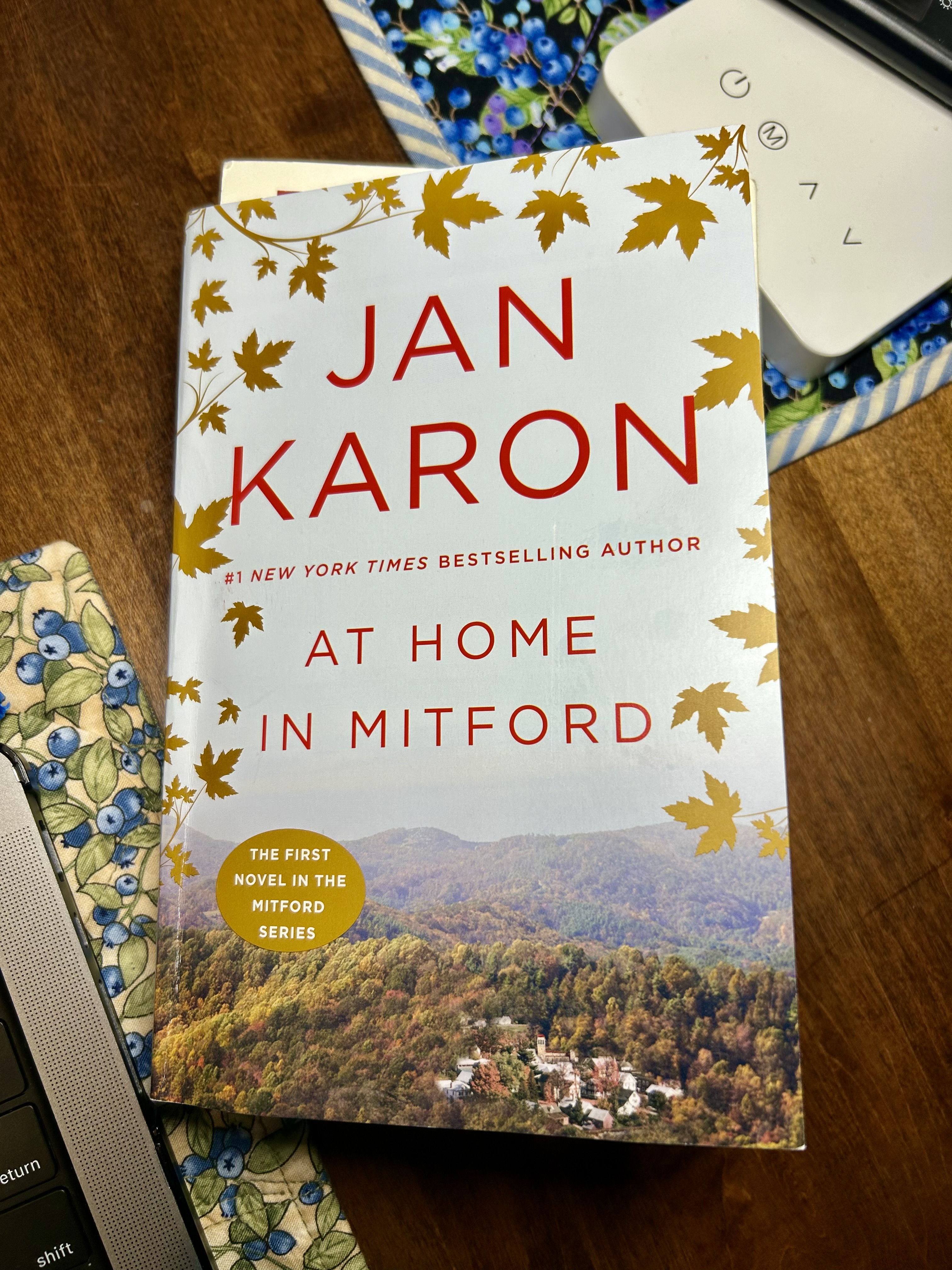
I picked up a book by Jan Karon from the library kiosk a bit ago and very much enjoyed it–an Episcopalian minister’s life in a small East Coast mountain town who goes to a coastal parish for a 6-month interim appointment before retirement (with wife and pets). This book, A New Song, turned out to be a kind of “quiet” book and is midway in a series of about 14 books. I enjoyed the humor, the values on display, and the plot. So I got hold of the first book in the series, which I have just started. I’ll see…what develops.
Gina wrote in her note that her book club is now reading The Last Castle (Denise Kieran) which is a history of the Biltmore estate in Asheville, NC. Next up in this book club is The Women (Kristin Hannah). Book clubs are great for reading good books–for the most part.
Today is VERY stormy with gale winds off and on and flash flood warnings from the national weather system. So, I will stay put, and I’m sure there will be fiction reading. And, sewing later in the day.
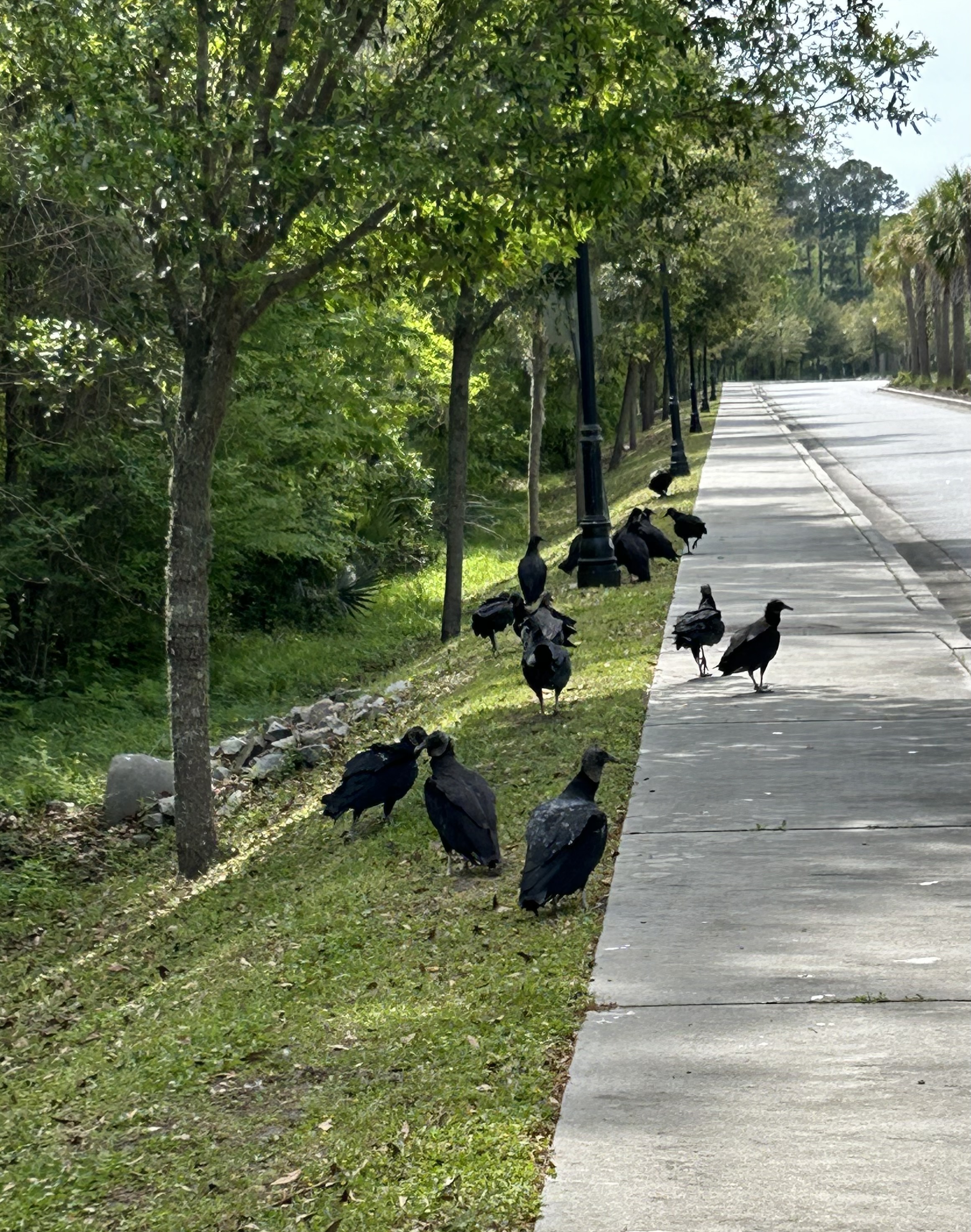
A few days back when walking with a neighbor, we saw that there was a large gathering of black birds along the sidewalk–about 20-25 I’d say. At first I thought the birds were cormorants as some were holding out their wings like cormorants do to dry their wings. But as we got closer, we could see that they were black buzzards, which are very, very common here, and I knew there must be a carcass down the side of the hill.
Yes, there was a dead deer–a young male with its horns trying to emerge. It was probably hit by a car and got as far as the edge of the woods below the road.
But why were some of the birds spreading their wings? Turns out it is a strategy to regulate their body heat–though sometimes it can also be to dry wet wings.
Some of the birds flew as we got closer. I blew up this pic so you could see better.
The birds were still there the next day when I walked–and were much less nervous about people walking by them.
Most, but not all, of them did fly as I got closer.
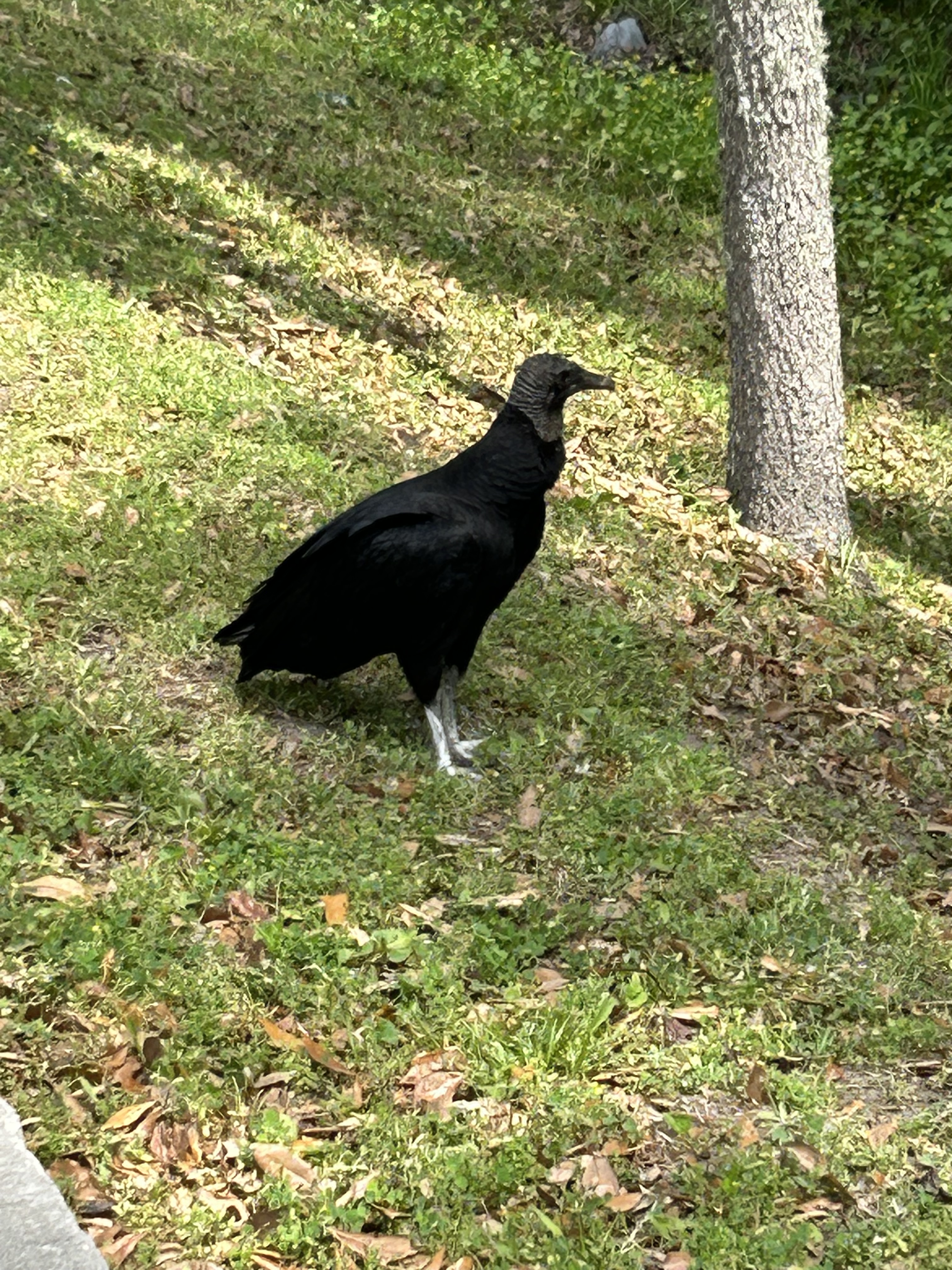
On the way back, the birds didn’t really retreat from me very much. This one let me get quite close. These are big birds with a big wing span. Underneath the wings the feathers are ash grey or white. And note the white feet.
These birds were actually doing a good job of cleaning up this poor dead animal. In another day or two, there will be nothing but bones.
And that is how nature works.
But it was interesting to think about the deer and the buzzards a bit on Easter weekend, if you know what I mean. The dead deer was providing life for a LOT of buzzards (25 or so). The deer was, in essence, a bonanza for the buzzards.
Now some days later, someone from the town or county pulled the carcass into the woods, and there is nothing left to see but bones.
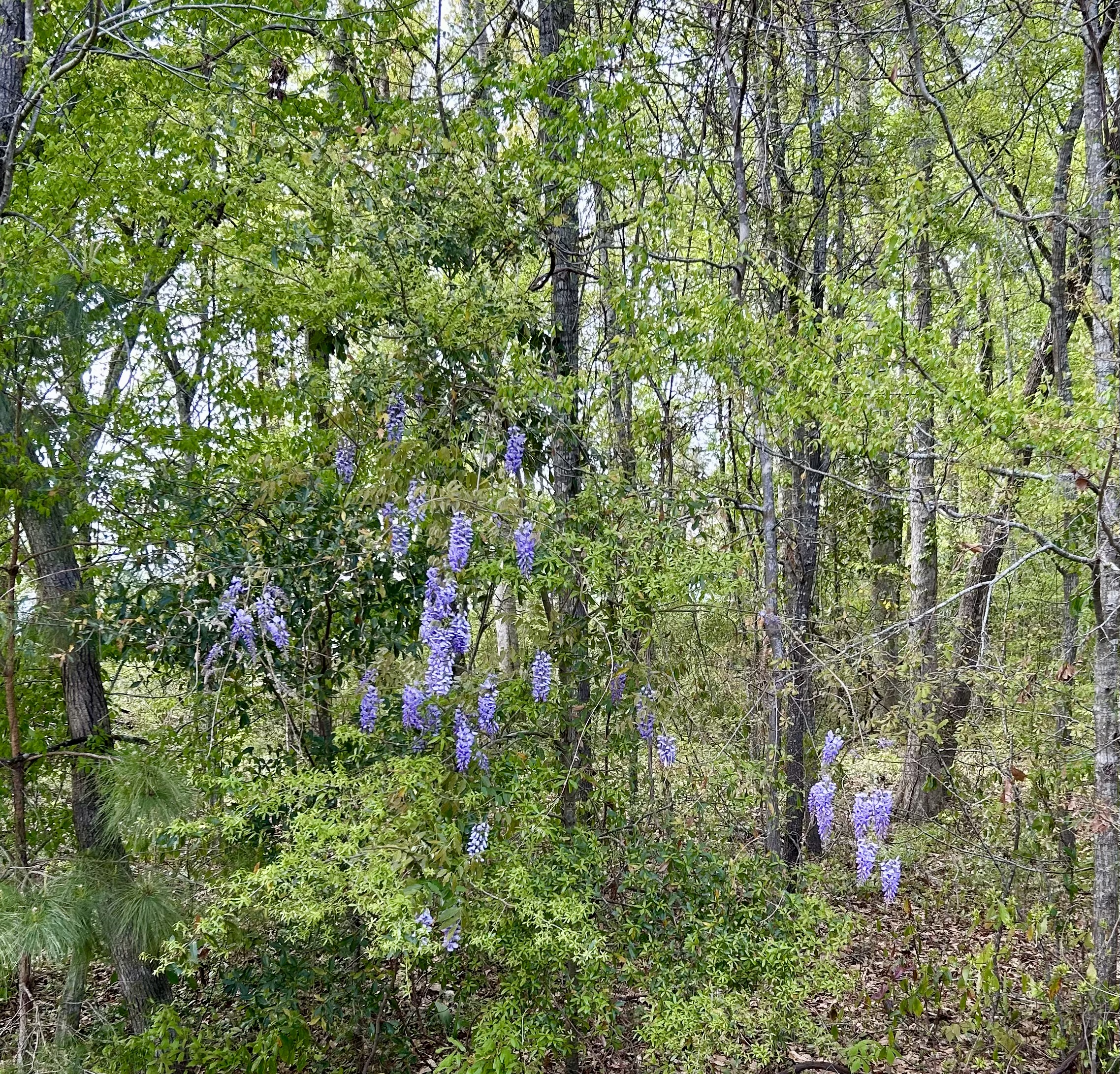
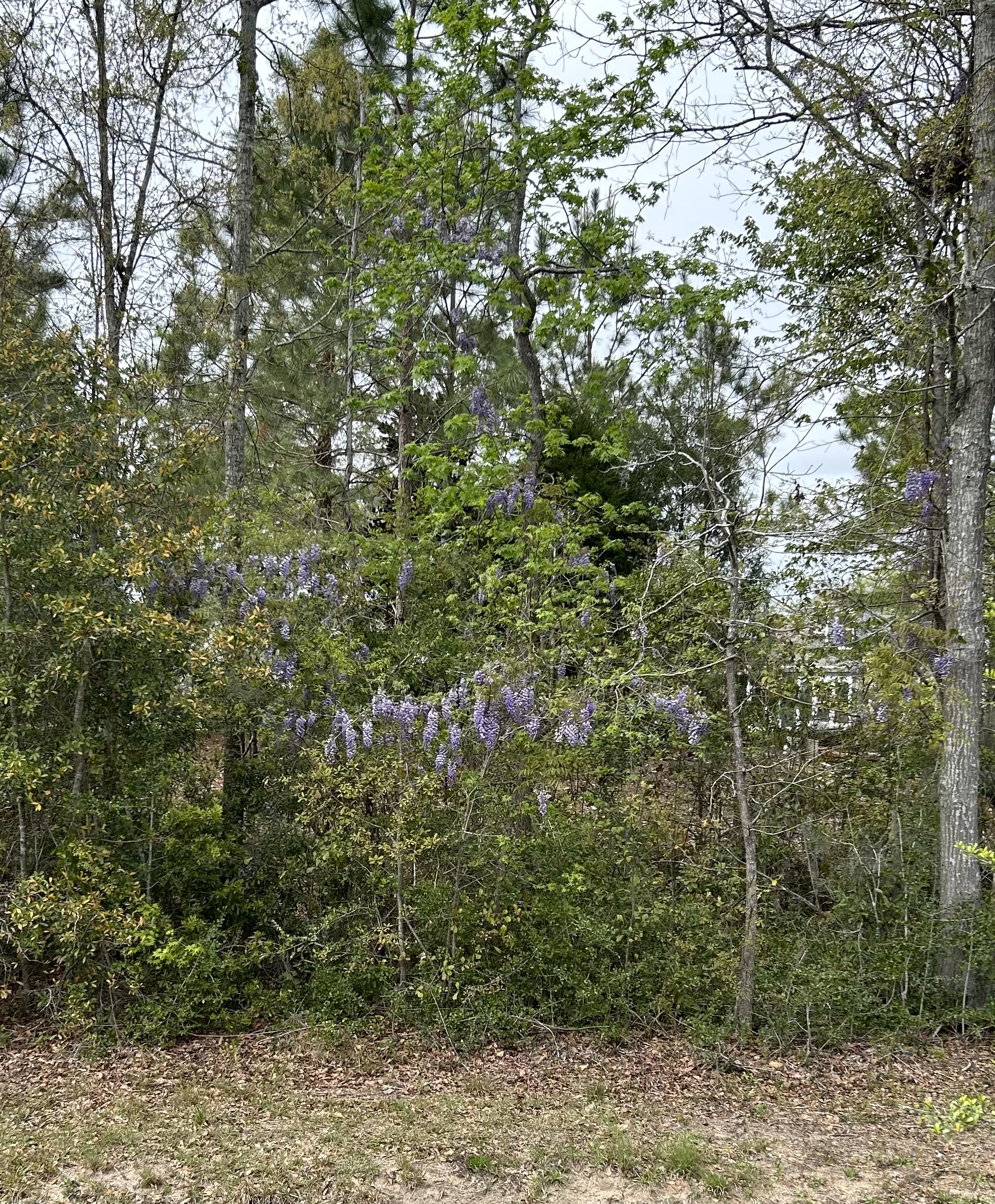
Wisteria is so beautiful in the spring. It can and does escape confinement in formal plantings (where it makes a nice shrub or vine on some part of a house or trellis)–and when it does escape, it decorates the woods in the spring.
Here it is along the walk I take every day. This particular vine is just one among three or four that are running through the woods and are blooming now.
Here’s more of the wisteria in the woods.
There are at least three types of vines here that can get loose in the woods that I know about. One is the Yellow Jasmine, which is the South Carolina state flower. While beautiful and so cheerful in the spring, every part of this vine is poisonous and can cause skin irritation if touched.
Here’s some information on Carolina Jasmine from Clemson University.
The other vine is Kudzu, which in my mind is like “the little shop of horrors” plants. It can take over whole woods and totally cover whole swaths of trees.
Here’s some information and pictures on Kudzu–from an article entitled “Kudzu: The Invasive Vine that Ate the South.”
Cobblestone Quilters Guild is the regional in my area here in South Carolina–I live within the greater Charleston County. Right now I belong to Cobblestone, to one of its “splinter” groups named Patchwork Gals, and the Charleston Modern Quilt Guild (which is separate from Cobblestone and is tied to the Modern Quilt Guild).
Cobblestone has a quilt show every two years, and this was the year. About 200 quilts were displayed, and the show was very sweet. I so enjoyed it. Some of the quilts shown were made by members of the Charleston Modern Quilt Guild.
I took some pictures–but only those that particularly called to me. There is no rhyme or reason really to these pictures I took–it really was just whatever moved me at the moment.
Here is “Fractured Color Wheel” by Cathy Beemer, who is a member of the modern quilt group and whose two quilts I have shown you recently. One hung at Houston recently (2023?), and the other hung at QuiltCon 2024 in Raleigh, NC, in February.
I took this picture for my Maine friend Lynn V, who has made several animal quilts for her grandchildren. This one is “Zoo Family Portrait” by Jennifer McFadden.
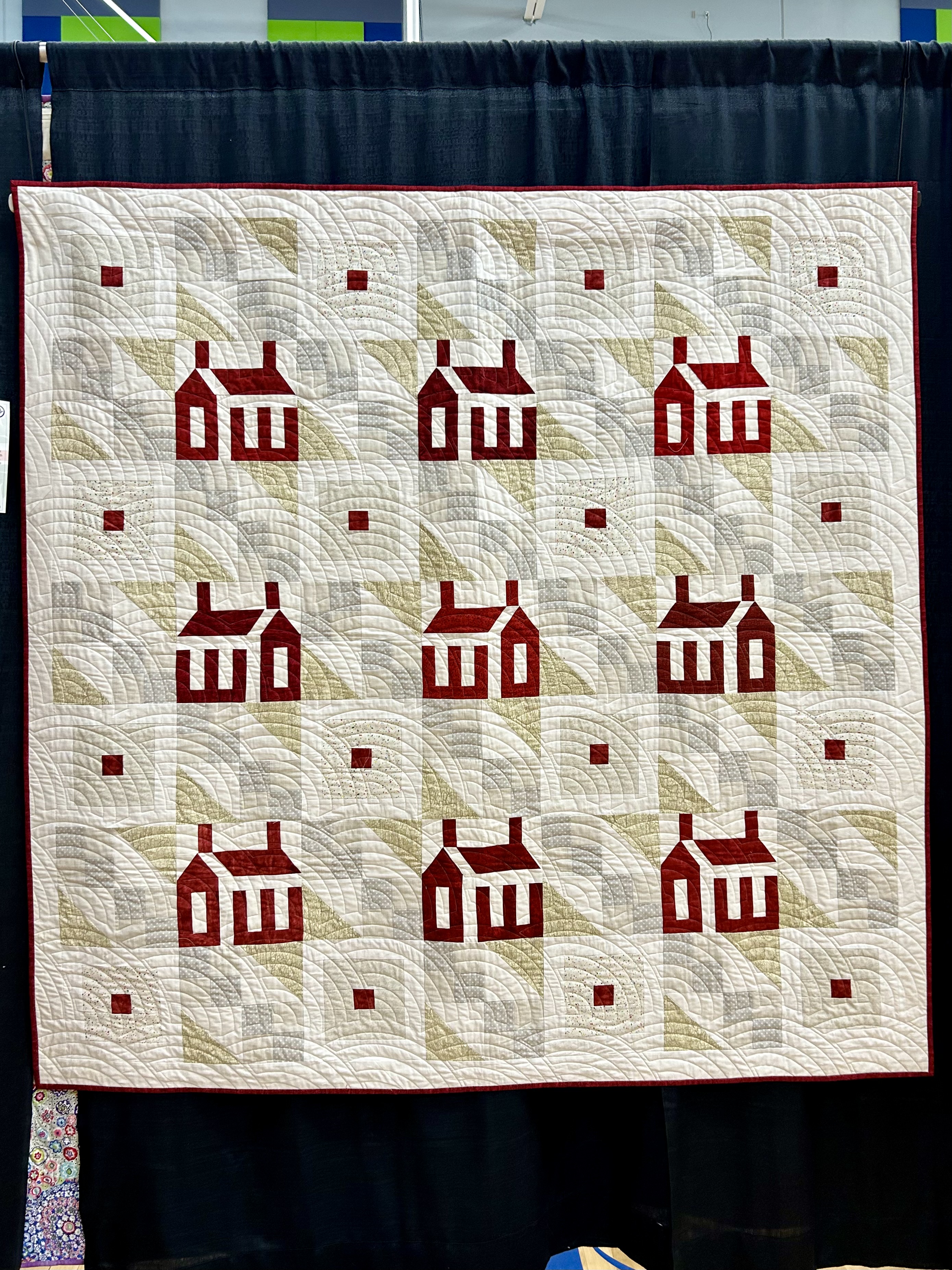
I’ve never met a house quilt I didn’t like. And I really, really loved this one, with its neutral background and quiet strips of diagonal grey blocks (look closely) and it’s Bishop Fan quilting and its red binding. It’s “I Live in a Red House” by Katy Sheehy.
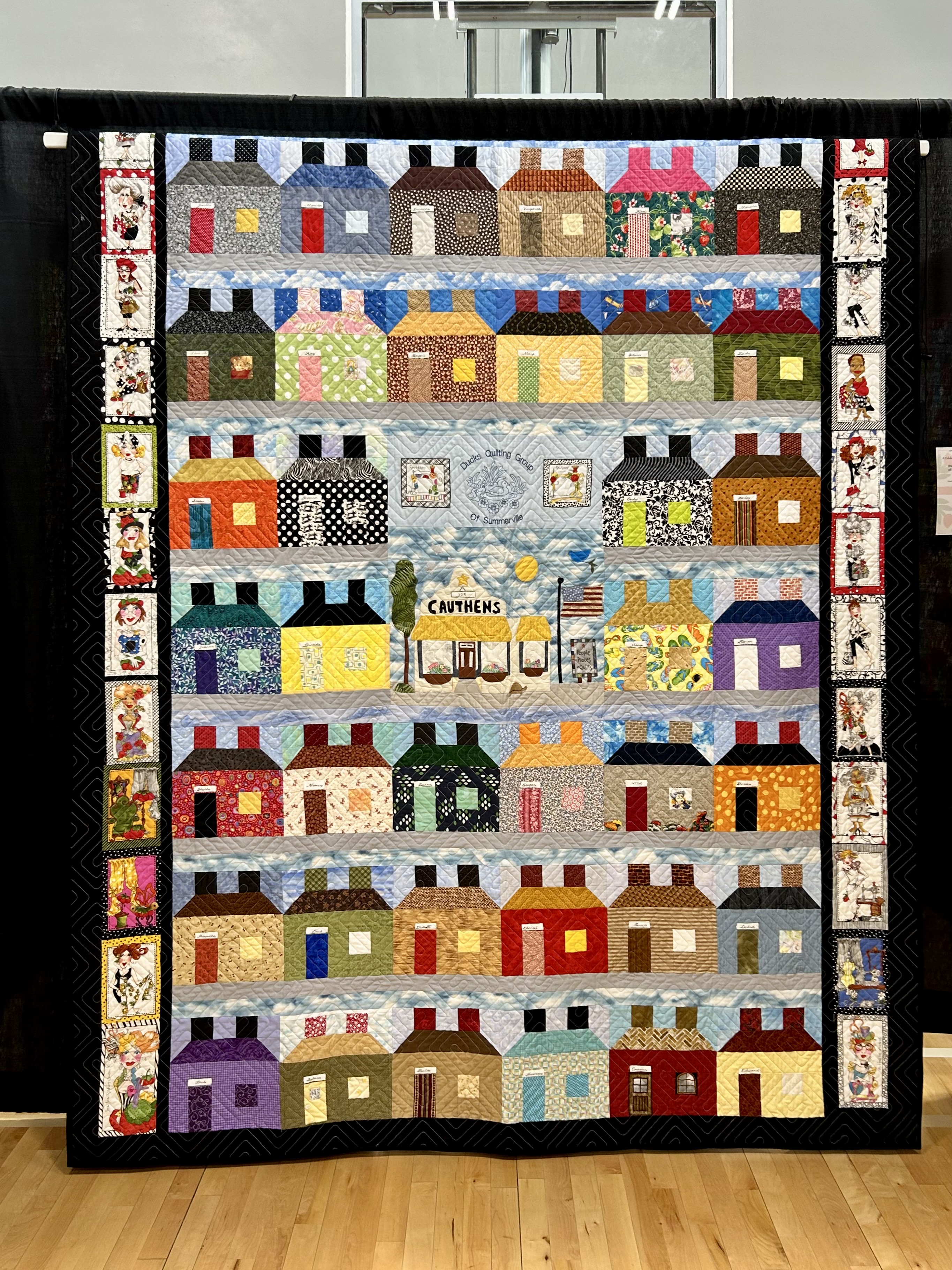
ANOTHER house quilt that I liked. It’s “Duck’s Quilting Group of Summerville at PPQ” (which is the People, Places, and Quilts quilt store in Summerville, SC).
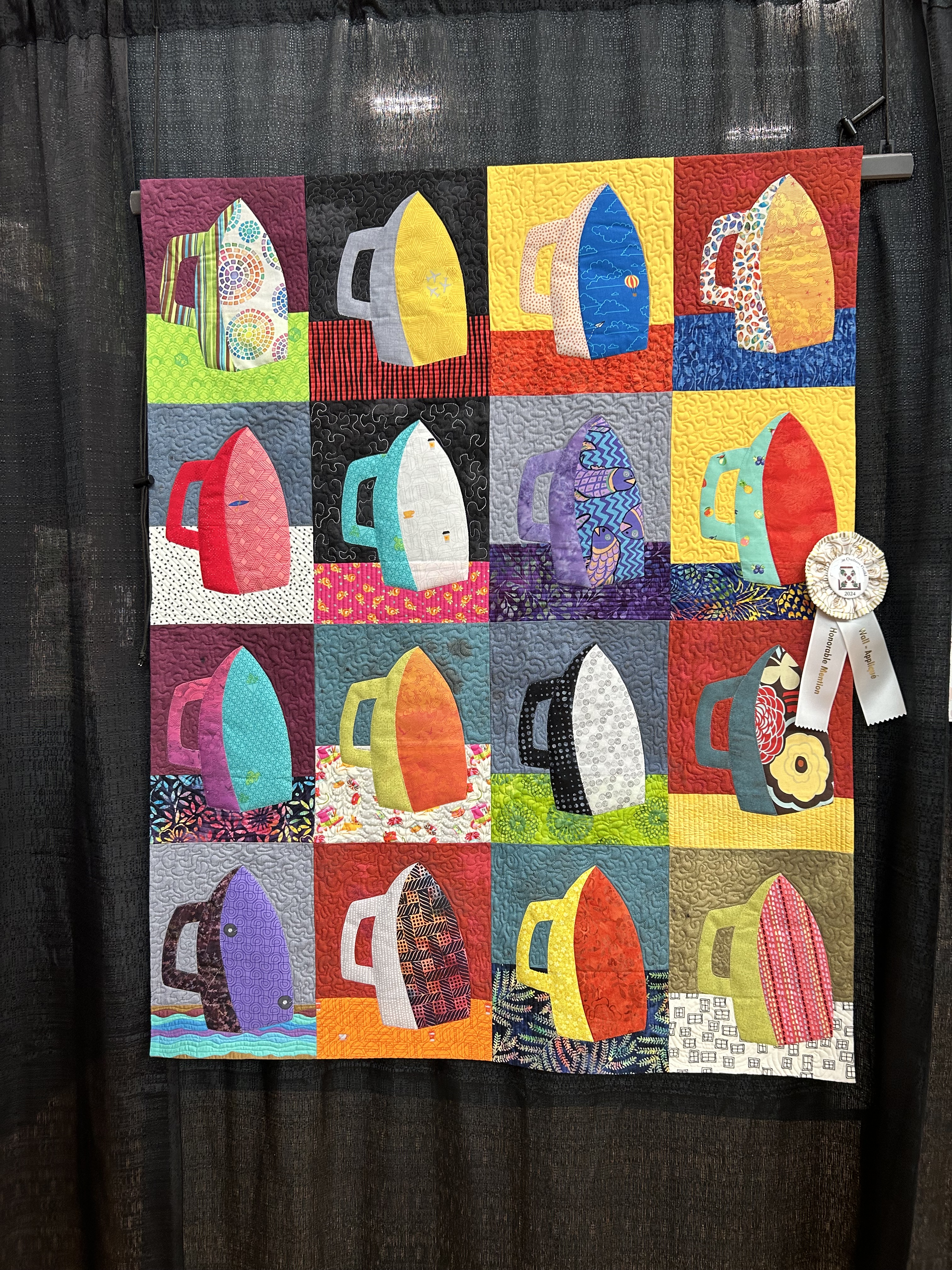
How colorful and fun is this quilt? How could we NOT use irons in quilting. This quilt is “Irony,” by the modern group member Susan Brandt. I love the name too.
This “eyes” are the result of a challenge. And how fun is that? I love this idea.
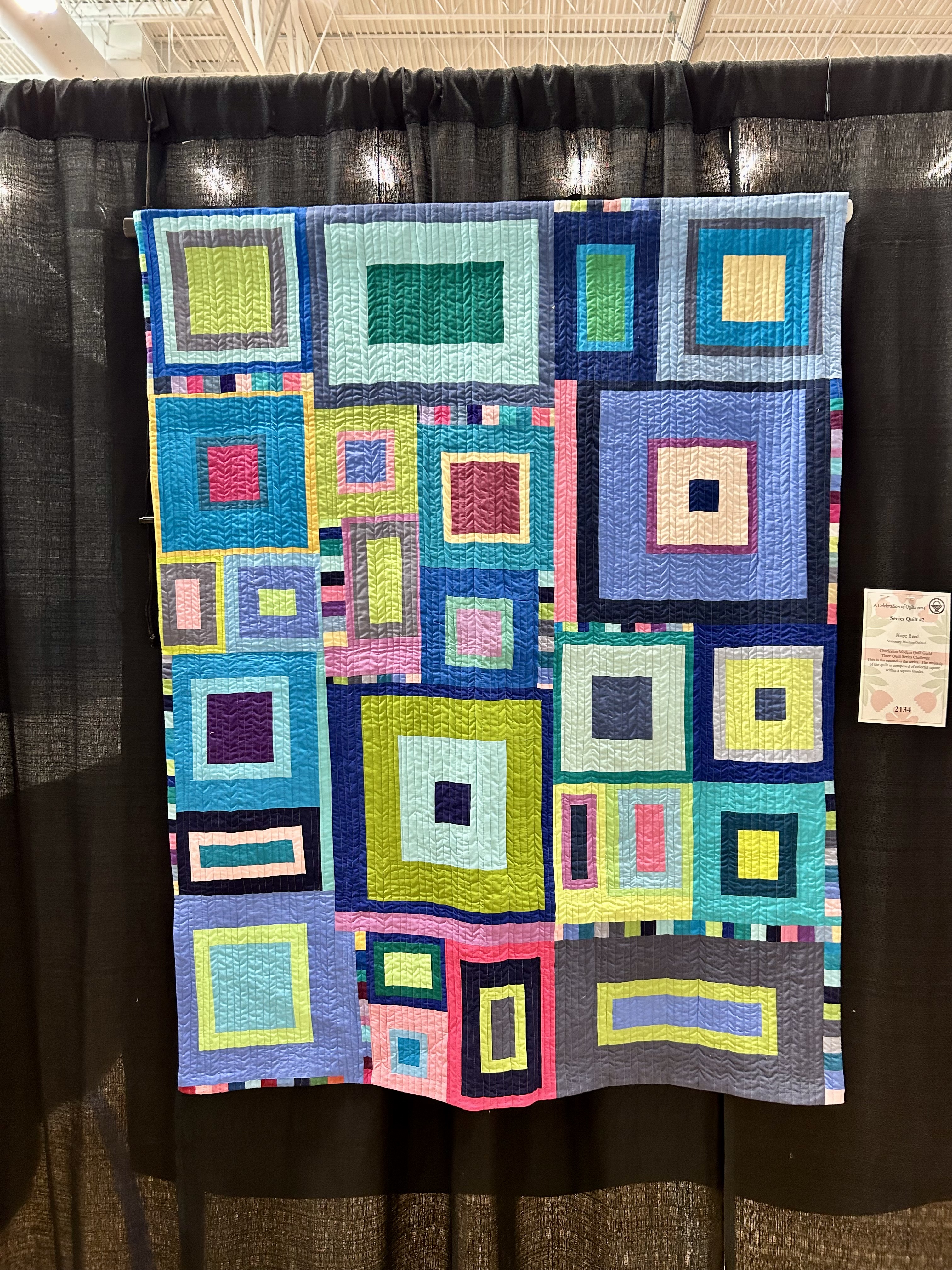
I’ve been intrigued by “house top” backs for a while now. And look at the use of lines of small scraps in the quilt and in the binding. This quilt is part of the series challenge some in the modern group did. This one is by Hope Reed and is the number 2 quilt in her series of three.
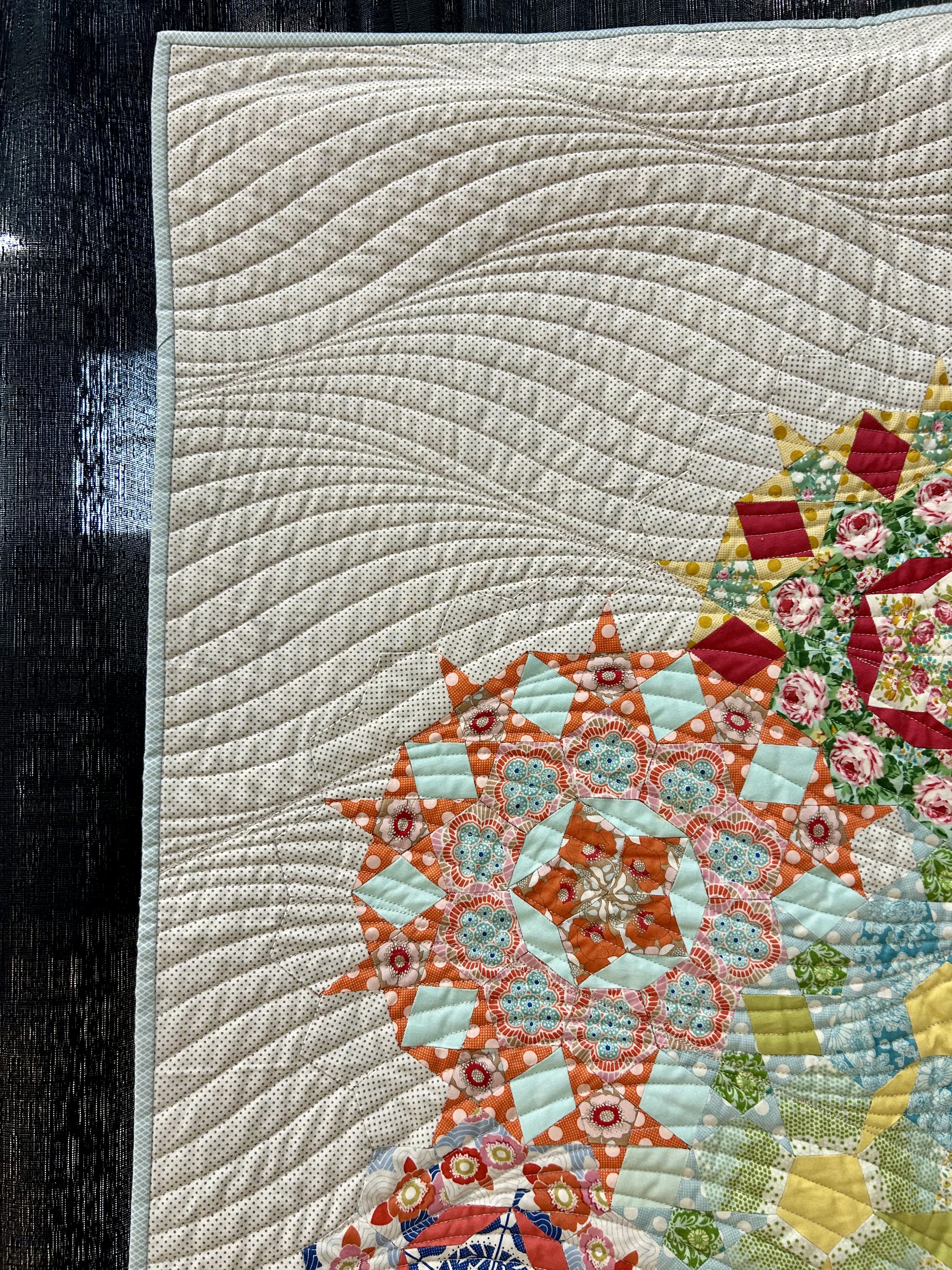
I loved this quilting–there is so much energy and movement. I didn’t take a picture of this quilt’s name, who made it, or who quilted it. Bad!!
Here is another quilt by Cathy Beemer. Cathy writes that this quilt is the first in her SECOND series of three quilts. This one, for me, is a real inspiration as I’ve been drawn to these small crosses for some time. A leader ender project with solid strips? Probably that will happen.
And that’s it, folks.
I can’t wait for the next show, and I’ll do more to help next time, now that I have a better “lay of the quilty land” in my new adventure.
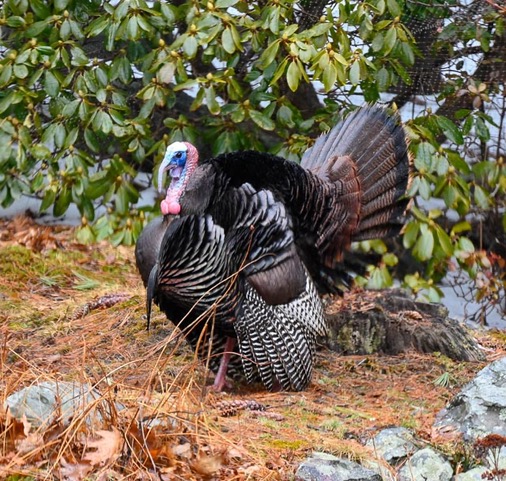
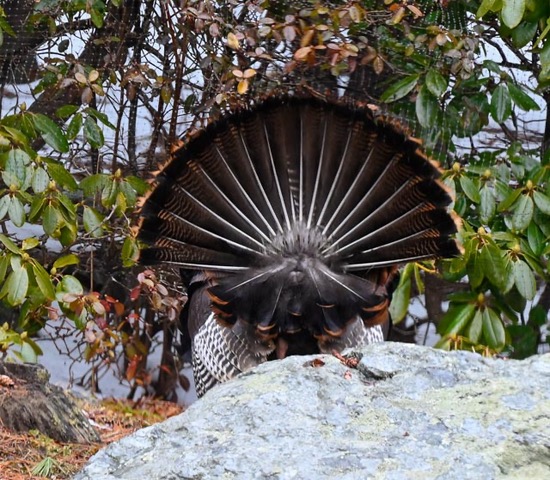
My Camden friend Marsha Smith sent me these pictures, and they bring back fond memories. A large gaggle (sometimes also called a rafter) of turkeys spent the winter in the woods that surrounded my house on two sides. They often roosted in the tall pines, and it was so fun to watch them get themselves up that high–as they are heavy birds. They would go up the hill in back of the house before launching to give themselves the advantage of more height with relation to the tops of the pines. Those flights always reminded me of the big C-135 transport planes taking off from the runway near one of the homes my family occupied on Offutt Air Force Base in Nebraska.
Anyway, the turkeys were so fun to watch, especially when the males started to display their feathers in the spring. Note that their heads turn blue as part of this effort.
I remember the summer when I was 9 or 10, when we lived on Barksdale Air Force Base in Shreveport, Louisiana. That summer, my mother packed us up and took us to her home in rural Georgia as she deemed we would be safer there as polio struck mostly children and mostly in the summer heat.
As an adult, I’ve always been curious about what caused “polio” to erupt in that time frame which included that summer in my life, especially after reading that polio, the virus, had never spread so widely before that time. And I know two people of my age who had polio as children and suffered horribly then and have had permanent problems with their legs and feet their whole lives.
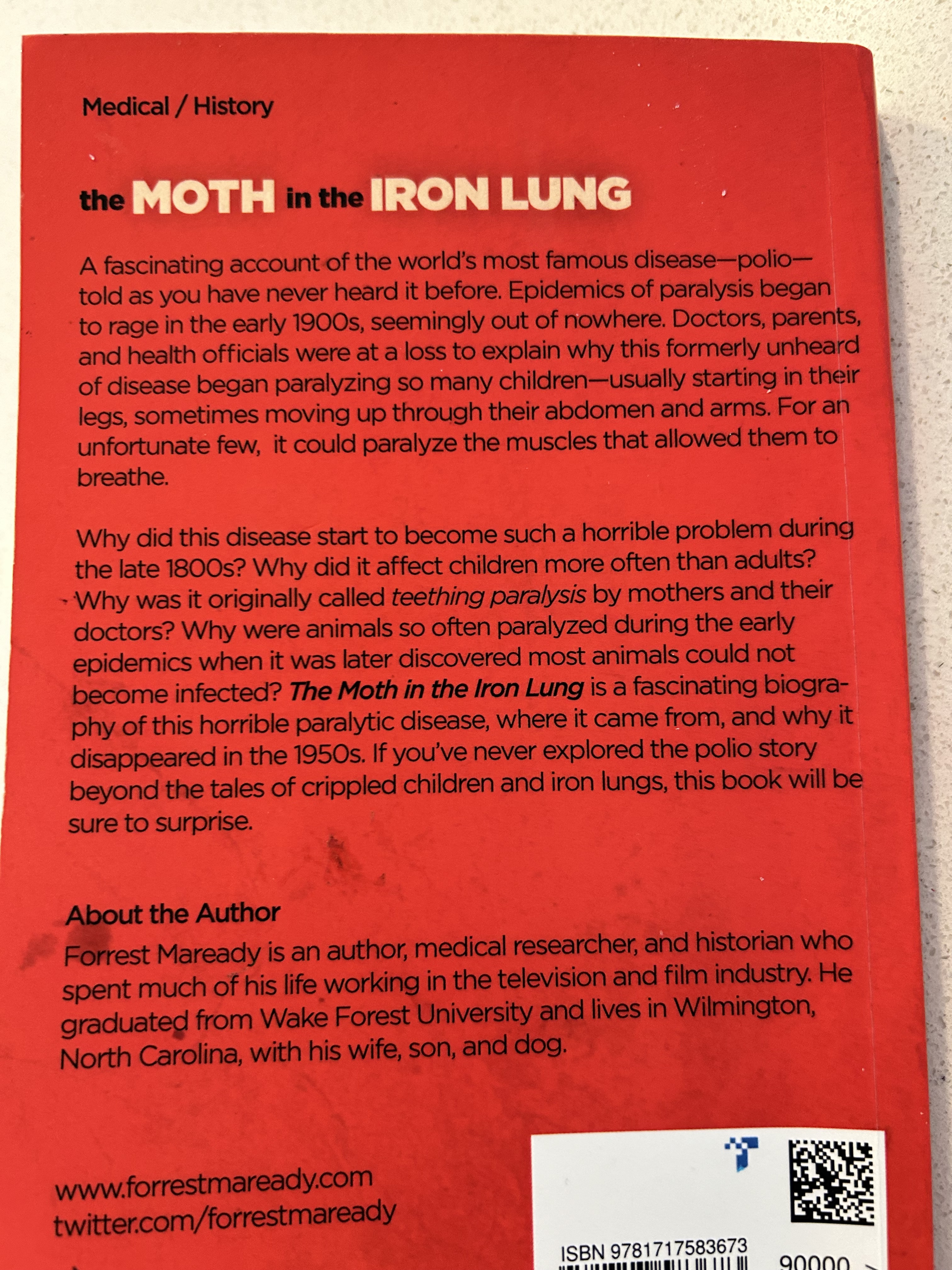
When I saw someone I follow online recommend this book by Forest Maready, I thought, ok, I’ll take a look and ordered it. Reading it was like following the plot of a murder mystery, and I was fascinated.
The back cover:
Maready starts with chronicling the first-recognized cases of “infantile paralysis” in the early 1800s in Europe and America. The paralysis always struck children about the time they were “teething” their first molar teeth. Horrifically, remedies involved deadly mixtures of mercury and arsenic. It is now known that mercury causes paralysis, so these remedies only made these children worse. But, why did only children get “polio” in the first place?
In 1856, Etienne Trouvelot arrived in Boston from France, bringing with him moth eggs as he raised silkworms and wanted to improve the line of silkworms he had. One type of the moth eggs he had were those of the Gypsy moth–which he dropped by accident in the yard of his American home. They hatched, and the saga of the utter destruction the gypsy moth created over time on the East Coast is now well known. By the spring of 1889 in Boston the Gypsy moths were devouring plants, starting with oak trees, and moving to food crops and fruit trees and anything they could eat. The moths were everywhere–on plants, on houses, even underfoot on the streets. Each spring, the moths spread outward in their search for food.
“Polio” means “grey.” And “myelitis” means lesions on the spinal cord. We know now that neurons inside the spinal cord come in two categories: grey matter in the center of the cord and white matter on the outside.”Poliomyelitis” means lesions in the grey matter of the spinal cord–which could only be seen in these early medical times during an autopsy. Further, lesions in the front half of the grey matter of the spinal cord cause muscle paralysis in the lower extremities, but if also in the back half, cause a loss of sensitivity/feeling. If the problem remained in the lower spine, paralysis was the problem. If the inflammation traveled up the spine, breathing problems start–and that produced the need for the iron lung that comes along eventually.
Meanwhile, people tried an arsenic poison called Paris Green to kill the Gypsy moths and other destructive insects, like the potato beetle which was impacting food production by 1874. Paris Green was sprayed directly on insects–and on food plants. Arsenic can and does cause lesions on the spinal cord. But Paris Green didn’t work well, so a mixture of lead arsenate was used on all plants, including garden vegetable plants. Later, investigators found residue from these poisons on foods, and industry hired “scientists” to do “studies” that said these poisons were not harmful.
Polio cases increased, and the term “epidemic” started being used. The first “polio epidemic” was in Rutland, Vermont, in 1894. But not all those who got this “polio” or who died from it, had the typical “polio” paralysis or other typical polio symptoms.
We now also know that many other things can cause a poliomyelitis paralysis condition. The polio virus is an enterovirus; it thrives in the gut. The coxsackievirus, echovirus, other enteroviruses (intestinal), and bacterial (like streptococcus) infections can causes poliomyelitis and its ensuing paralysis. But an infection has to get inside the nervous system to do its damage. And the question remains, how does that happen? Maready discusses some possible ways.
So why did children of teething age become sick first? One answer is that when little, their gut is next to their lower spine. As they grow, that proximity changes. But no one knows for sure.
As history advances, man invents better and better ways to spray poisons on insects and plants. After World War II, even planes are used to spray crops. And poisons, like DDT, come into the market. But this environmental situation and growing knowledge of other causes for “poliomyelitis” is ignored by “modern” medicine, which tries to find a vaccine that can prevent the polio virus itself. Meanwhile, poliomyelitis infections make the jump from rural areas to urban areas alongside the spraying campaigns and the better supply lines for fresh foods into urban areas.
My opinion: this whole story is a fascinating history. The end result is that there really is not much of a consensus on what actually happened back in the day. But true polio today from the actual virus is rare–unless it is caused by a live “polio virus” vaccine used outside of the US, which banned those vaccines for use here as they do shed and cause polio.
Plus, the famous iconic photo of dozens of iron lungs in a hospital environment was staged. There were never more than 1,157 iron lungs in operation in the United States in the 1950s. And an irony for me, also, is that when my mother took us to rural Georgia that summer, she may well have put us into more danger. I remember watching small “dustcropper” planes spray poisons over crops. But, we lived in town, and the family farm was outside the town.
Still, this journey we are on to manage crops and insects with poisons that are dangerous to mammal lives, continues unabated today. We are all living with a roulette wheel in terms of health outcomes. And “medicine” and public health are still ignoring environmental poisons while looking for vaccines for individual diseases.
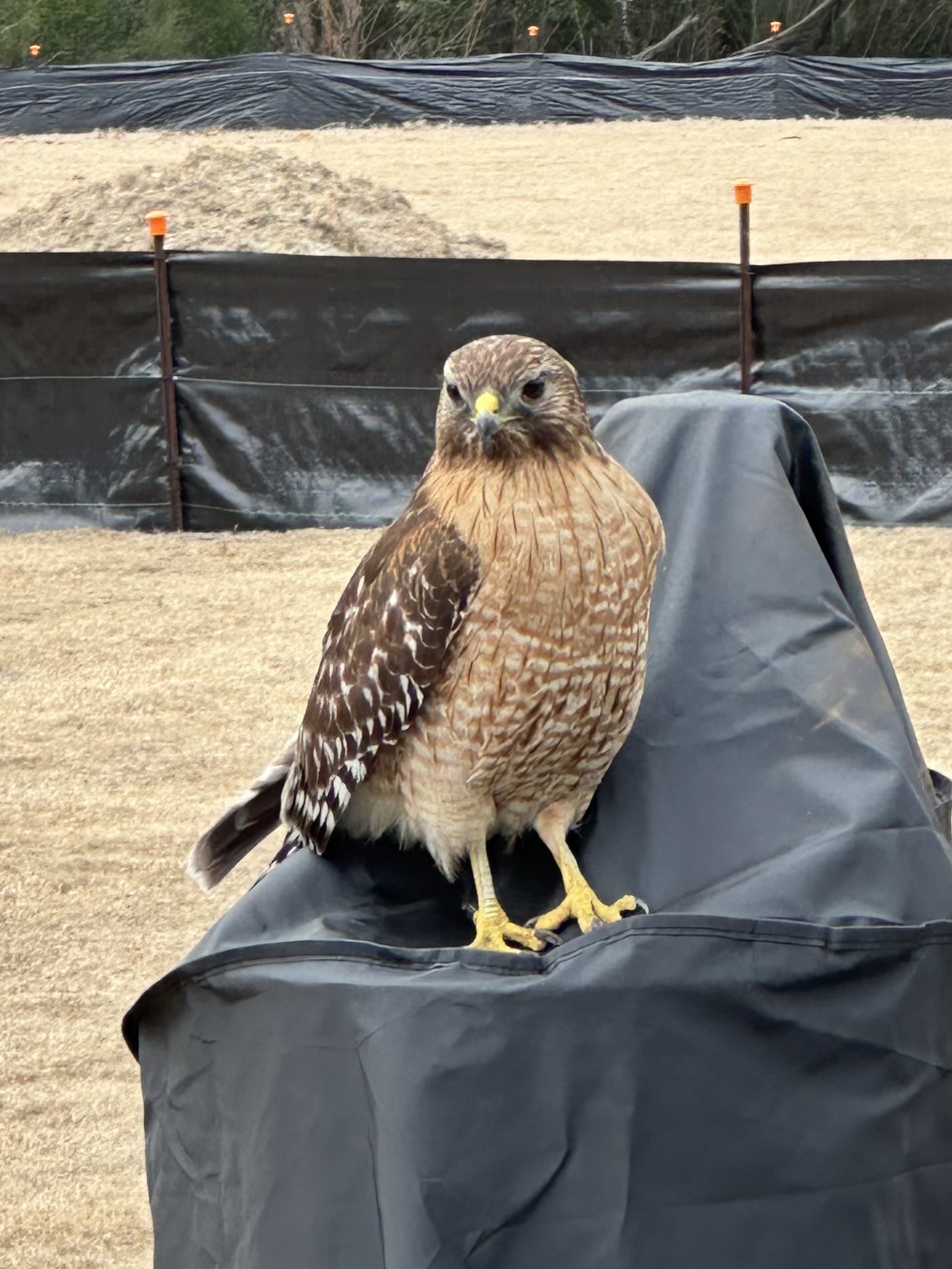
DIL Corinne took a picture of this beautiful hawk recently. There was a pair, but one flew off before she could get a picture. I think it might be a red-shouldered hawk, but I could be wrong. Corinne thinks it is a broad-winged hawk. There is a link below if you want to explore further. Two hawks seen together could also be a parent and an offspring? Who knows?
When I walk, I pass two water retention ponds, and they team with birds. I have often seen a pair of hawks here too, and on my last walk, one circled above me and cried as it…hunted? The call is distinctive–a shrill kind of “whee.”
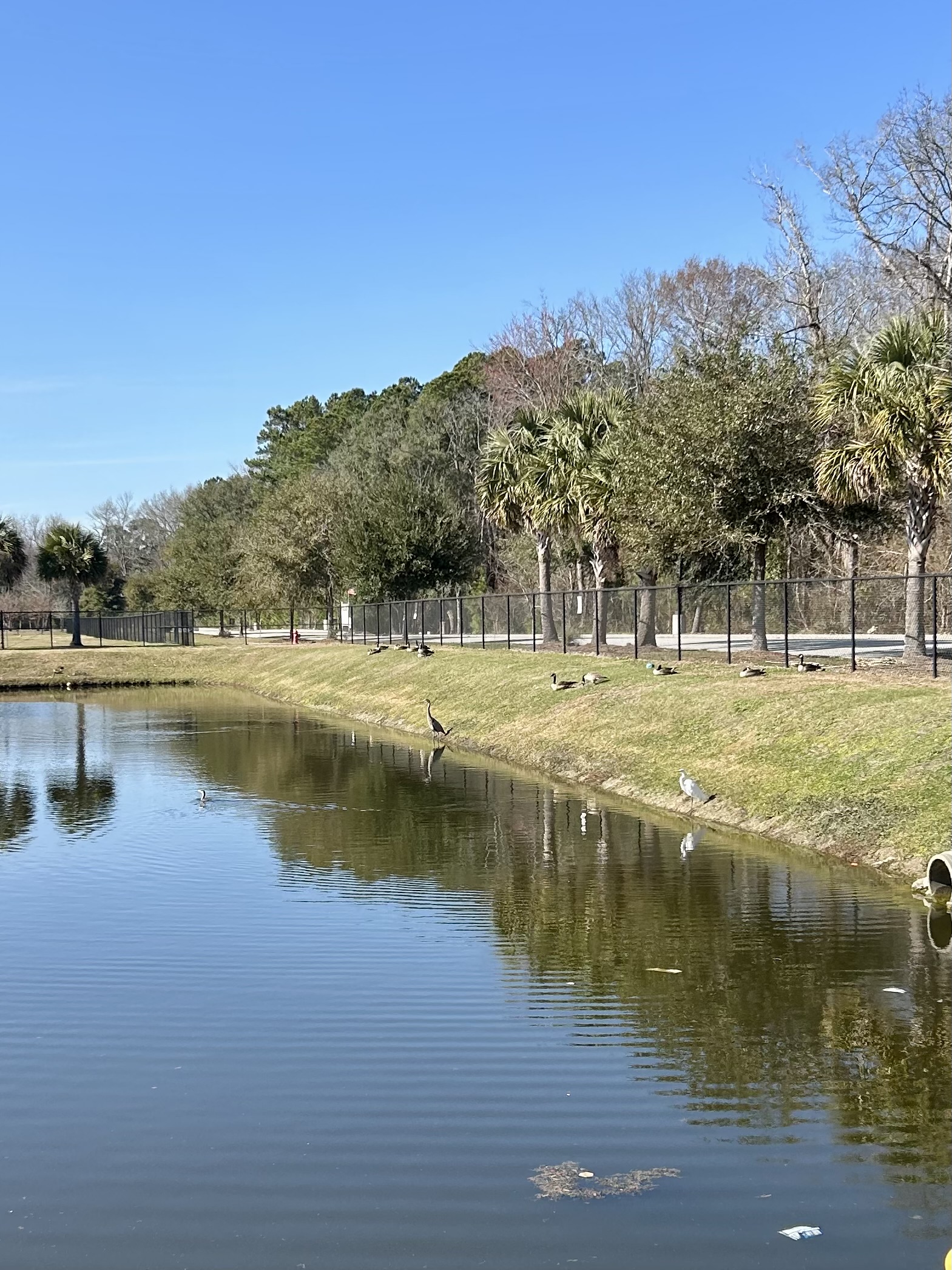
This pond is on school property, is fenced, and is full of Canadian geese. But along the side you can see a big heron ( a Great Blue?) and a Snowy Egret. In the water, a cormorant swims. Often, outside the fence, a flock of White Ibis, with their distinctive long curved beaks, gather to fleece the grass for bugs.
The woods to the right are both firm and wet lands–and are the buffer between these two schools and my neighborhood. A buffer for now anyway–this land could get developed.
I’ve begun to wonder if, when the geese mate and raise babies, how they will “walk their broods to water,” given the fence.
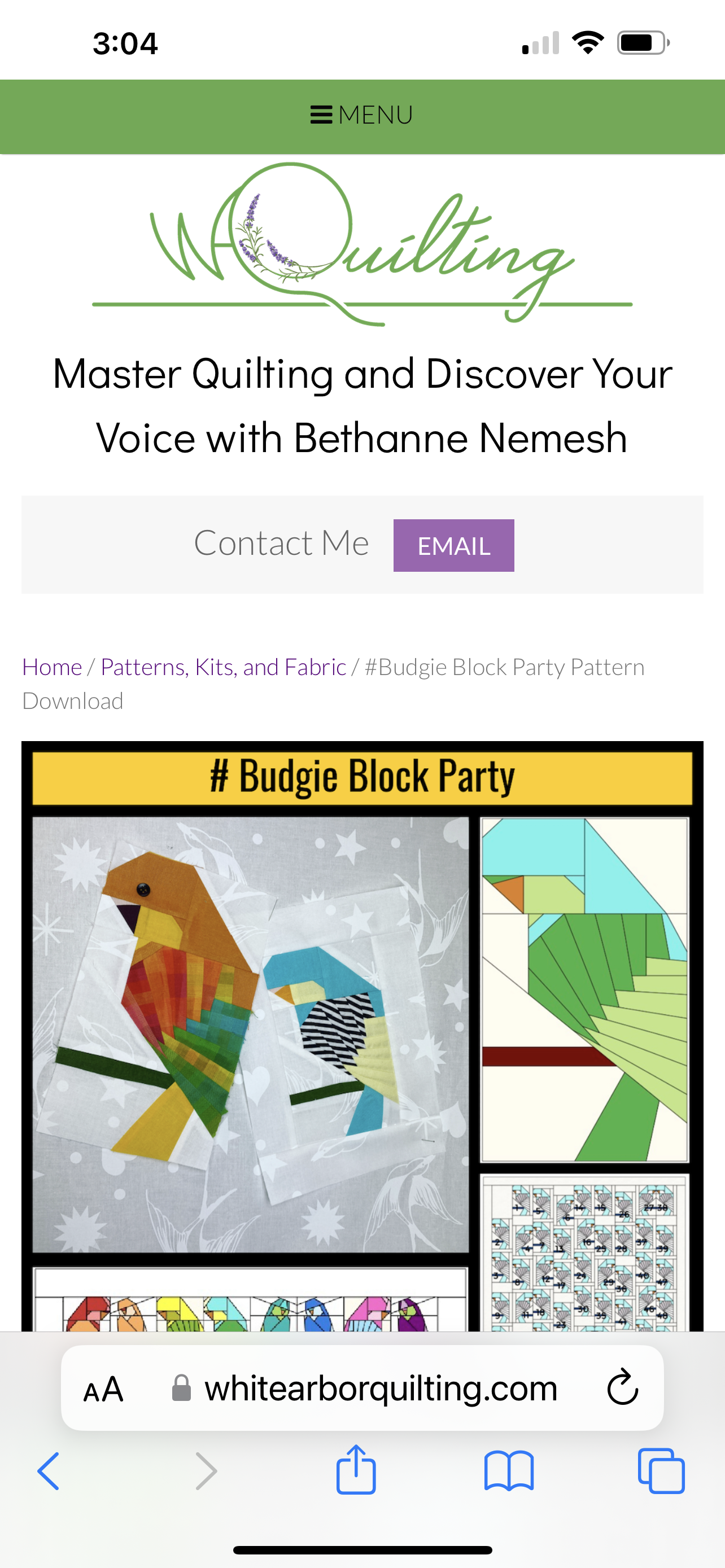
Budgies, as created by a pattern by Bethanne Nemesh and shared on one of the Aurifil thread posts–see link below. These posts are always inspiring and fun to see. I like seeing them each week.
And you all know I love that “Love” fabric and use it a lot–Carrie Bloomston, “Newsprint.” These budgies are made by @ladydisews, or Diana Z on Instagram.
Screenshot
m
I am admiring from a distance as I already have enough projects going and planned.








 Louisa Enright's Blog