It Is Sunday Again

And it is HOT and dry here. We really need rain again. So, my watering duties have increased. But the new Crape Myrtle tree seems to be doing ok. I’m hoping the daily water when needed will help this new tree develop a good root system and will get it through the summer heat.

Lately, these little rain/tree frogs are in my garden–and around other neighbors’ houses. They are so cute, so vividly green. There is a darker brown version too. I haven’t tried to catch one to see if s/he has suckers on the feet, but it sure looks like they do. The downside: they have huge poops that they leave on the sides of our houses when they seek shelter away from the vegetation.

I googled and now believe these little frogs are American Green Tree Frogs, so yes, there are suckers on their feet. If you want to read more, here is a link. Yes, they can also have a darker brown color.

https://en.wikipedia.org/wiki/American_green_tree_frog

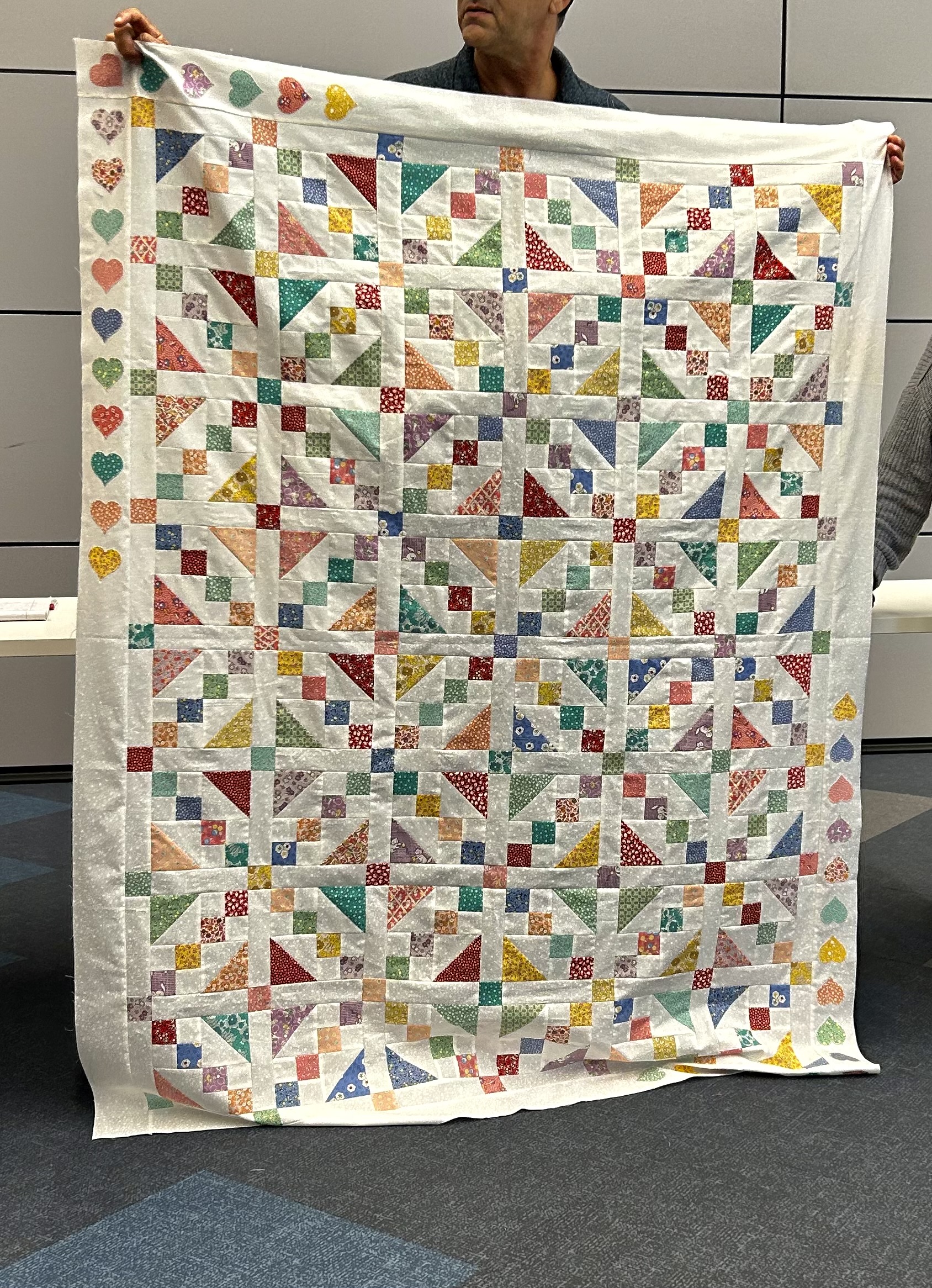
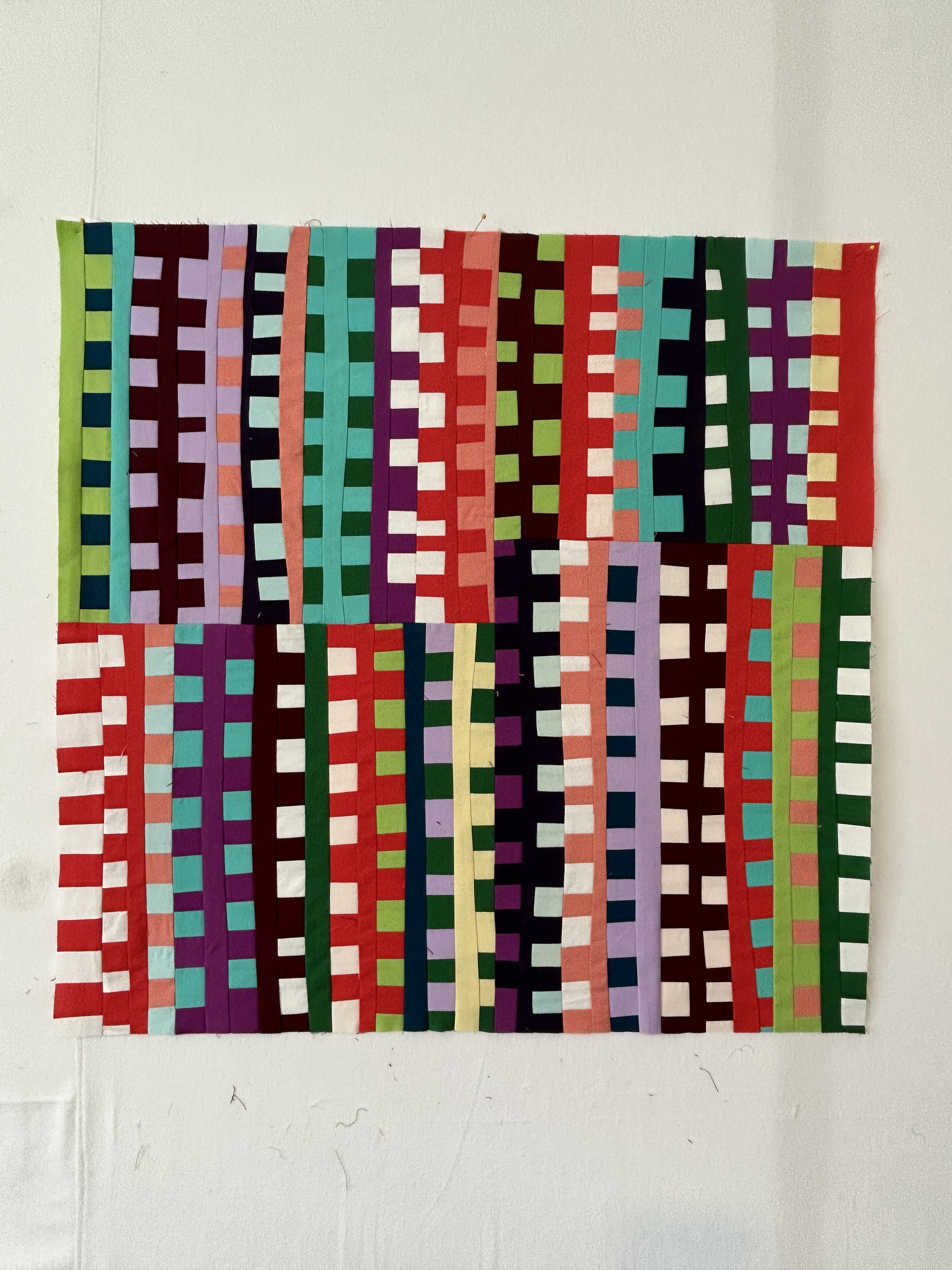
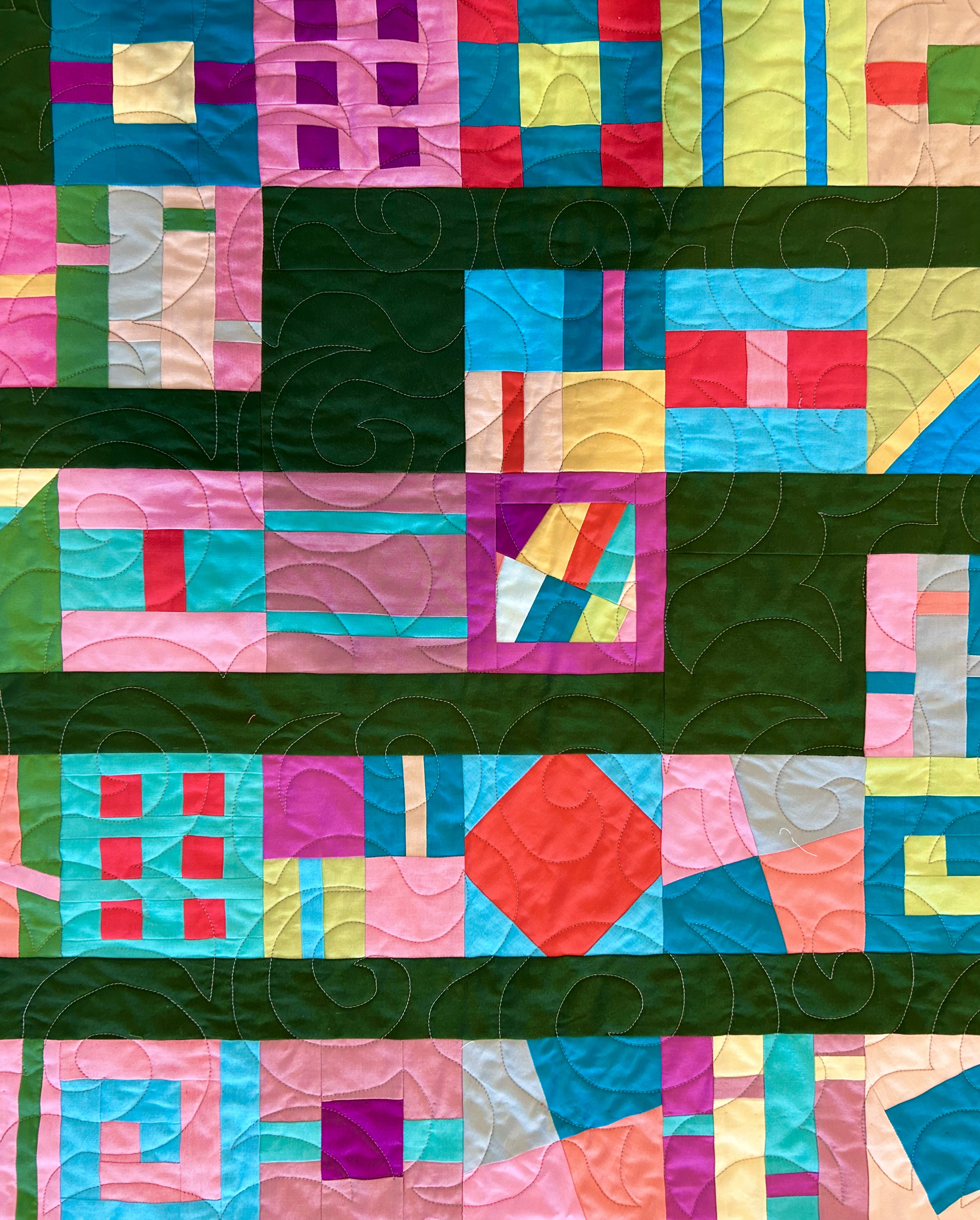
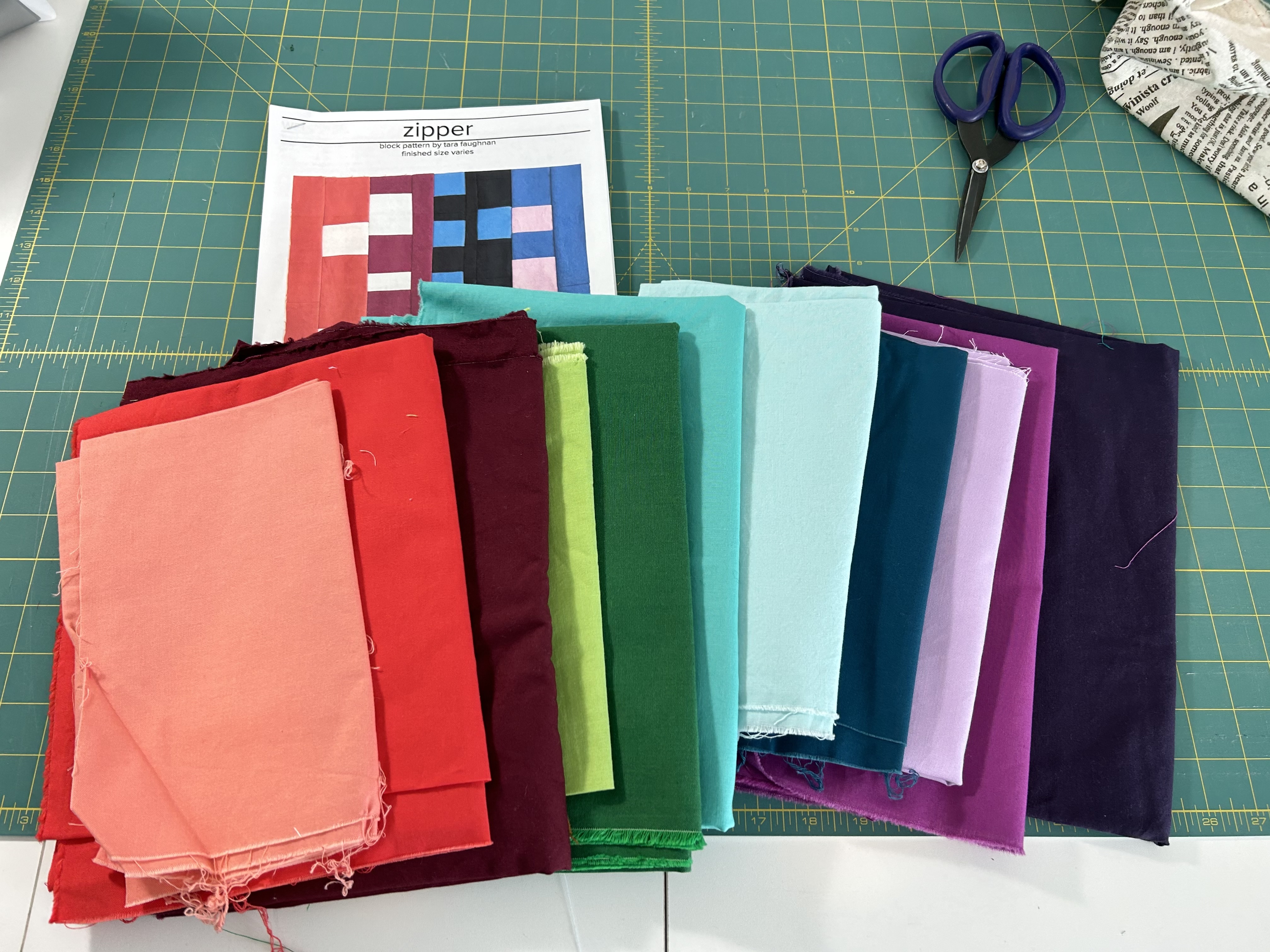
I finished all the blocks for the big red quilt yesterday, with 18 extras which can be used for a smaller lap quilt. I have some extra fabric as well, so I could have 20 blocks down the road. I’ll cut the violet sashings today–Kona Thistle. The blocks are 10-inches finished, and the sashings will finish at 1 1/2 inches, so this quilt will be 90 1/2 finished. I’m still thinking about wide-back backings–the reds seem an overkill and too traditional. Also, one has to think about thread quilting color when choosing a backing, and I don’t want to quilt with red thread. I’m now wondering about something in the gold tones. Or a darker grey. Or, one of the newsprint backings. I’m going to bind with the Kona Thistle so I have to think about that too,

I have not had a working oven since August 1st. Ugh! The control board on my Kitchen aid froze somehow, and I was unable to turn it off. I had to turn it off with its breaker, in the garage, which also turns off the microwave. This oven is a gas/electric oven. The Whirlpool repair man has been here twice now, and we have the oven on, but locked, which allows me to use the top taps. (Yeah, I can make espresso coffee again.) But on the last visit the oven techie discovered that both bottom sides have damage that one wouldn’t notice until the oven is pulled out. The damage impacts the bottom warming drawer which doesn’t slide in and out properly–and maybe is a factor in the control board, which definitely needs replacing. There will be paperwork from Whirlpool soon.

I’ve put in a warranty ticket with the builder for a replacement oven. It’s clear that it was damaged when it was installed.

This past week, to cope, I bought an Air Fryer to join my grill and my Instant Pot. So, there is now a new learning curve–and most of you know I kind of like learning curves. I have been tempted by friends loving their air fryers for several years now.

When not in use, this appliance can fit in this spot in my kitchen, which was vacant except for Alexis, which I never really use. I like clean counters that don’t have a lot of appliances on them, and the storage in this house allows me to store appliances I’m not using every day. But this one is getting used every day.

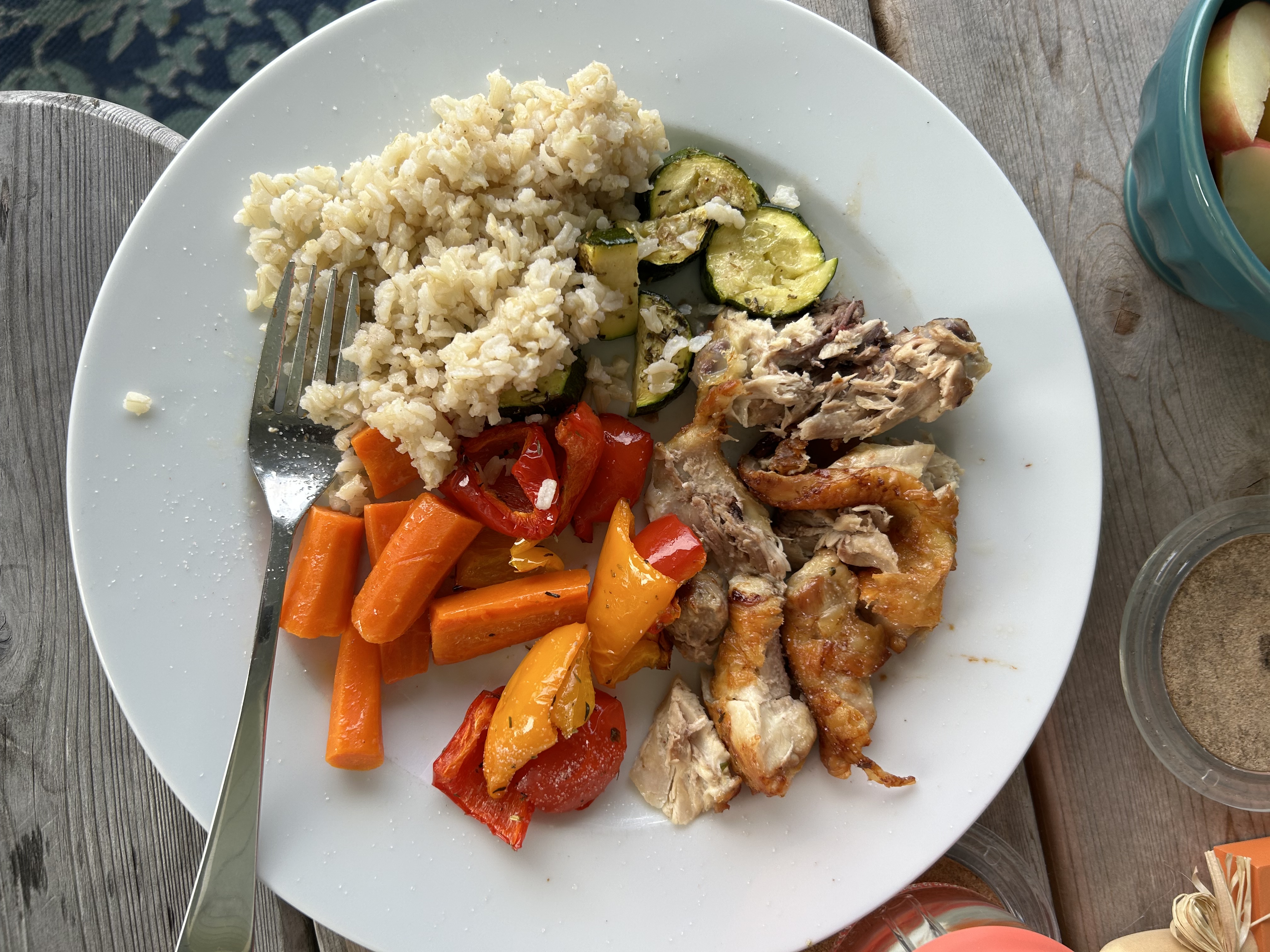
I cooked this first meal in 25 minutes right after I unpacked it and read all the instructions. The corn was delicious, and the chicken drum sticks were moist and browned. I cooked the asparagus in the microwave in 3 minutes. (I am not a fan of microwaves, but necessity now makes its use needed.) I cooked 4 ears of corn and took the kernels off the other two ears for use in salads.

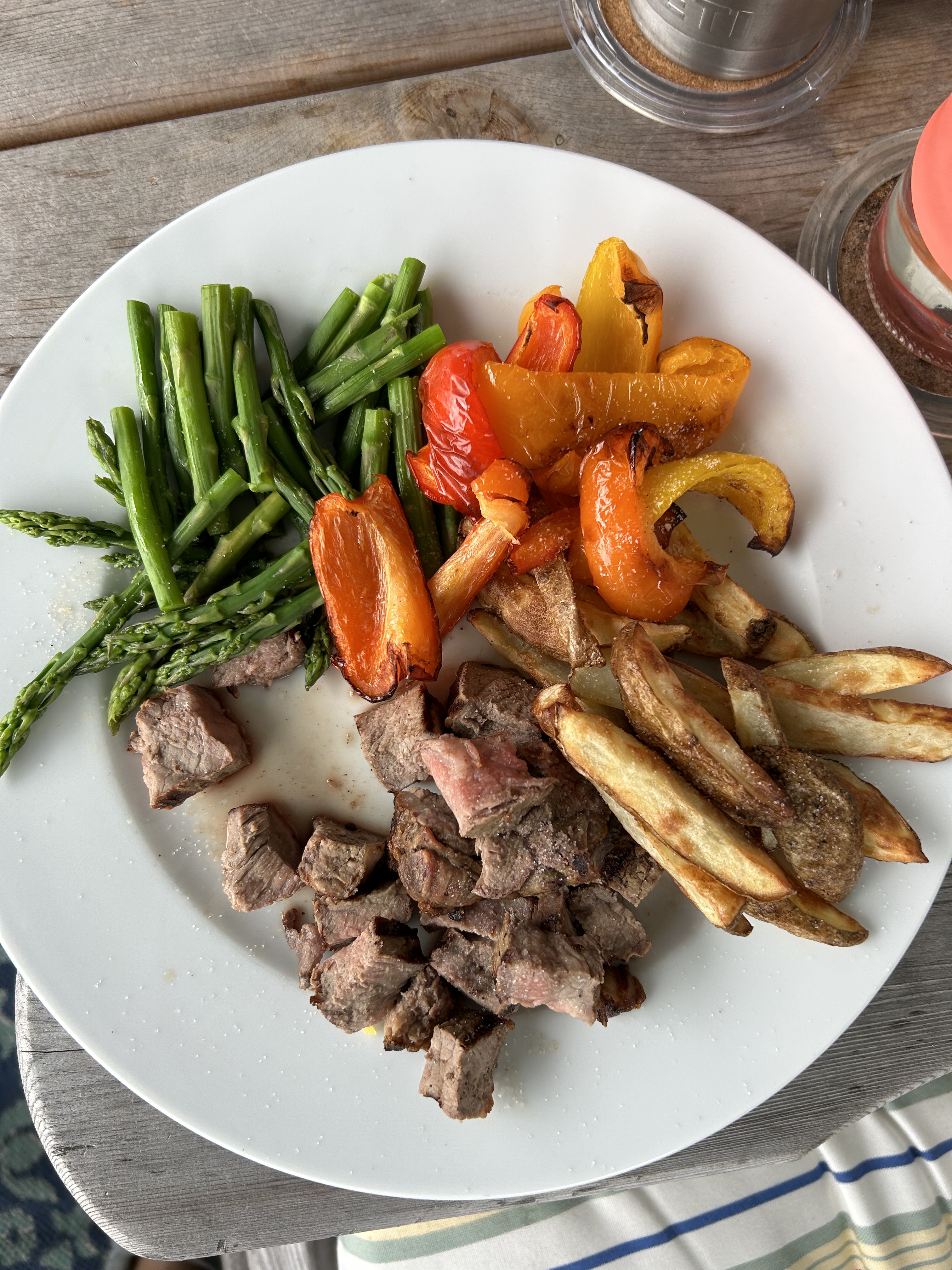
I can’t wait to try some handcut French fries with duck fat as the fat, rather than the bad veggie oils on the frozen fries in the grocery store.

Prior to the Air Fryer’s arrival, I used my Instant Pot to cook a whole chicken. I added more liquid so I would have some good broth–and with some of the meat, the broth, some frozen veggies, and some cooked veggies in my refrigerator, I made a whole pot of soup.

The soup was nourishing and made for two days of easy meals. The extra meat I used to vary the soup with some fresh salads.

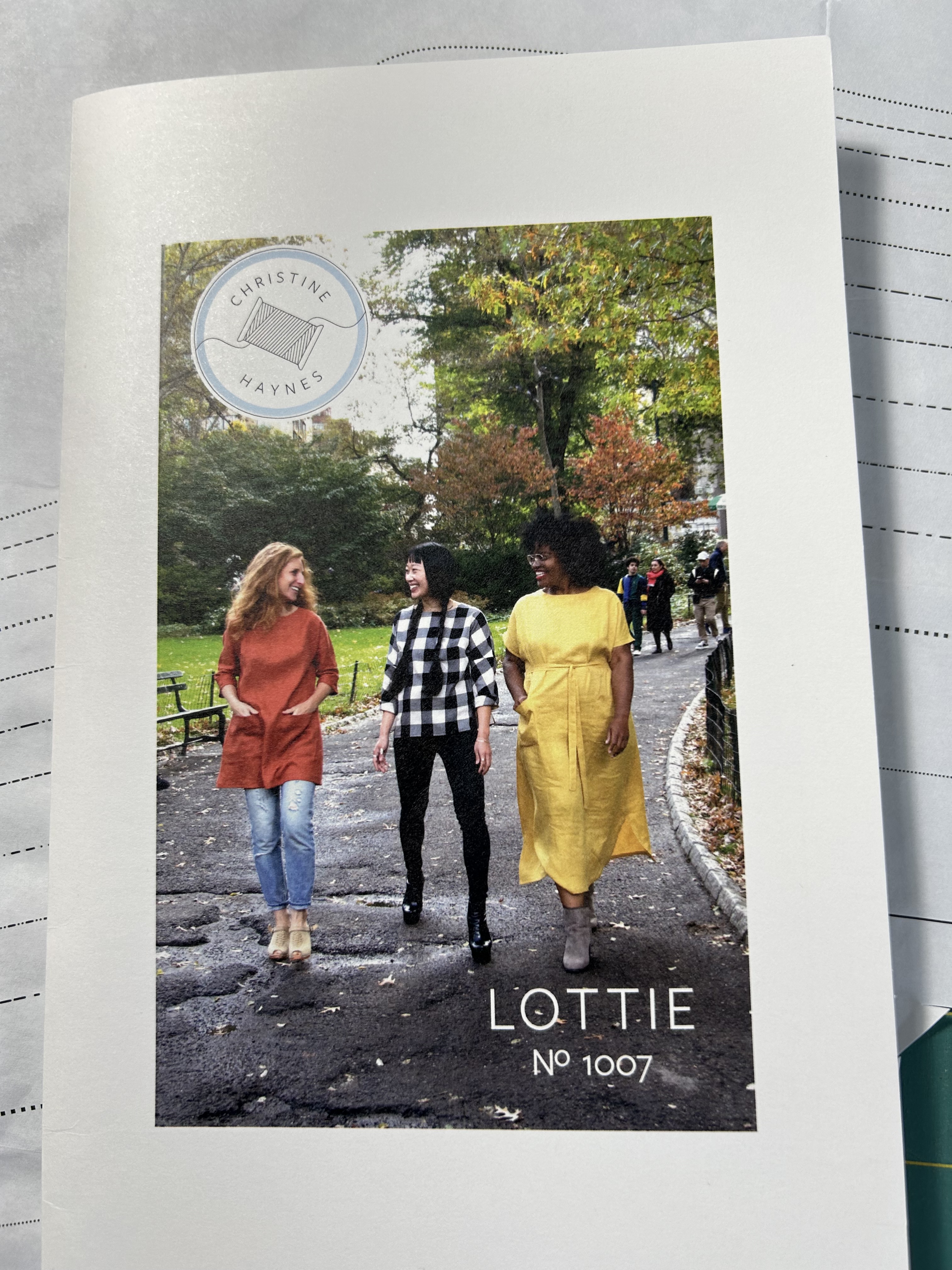
I am making progress on hand-quilting Traverse, which I’m very much enjoying. I got in a lot of sewing time on it this past week while waiting downstairs for the electric and Whirlpool techies to show up. (Upstairs I can’t hear the doorbell.) I sewed and listened to my favorite music one day and an ongoing book another day.

My stitches are getting better with Tara Faughnan’s quilting method, and the back of the quilt is starting to look interesting. I like my strategy of keeping thread colors quiet on the front since I don’t want to take away or hide the patterns or colors in each row. So far I have most of the right colors for the colors in the quilt.

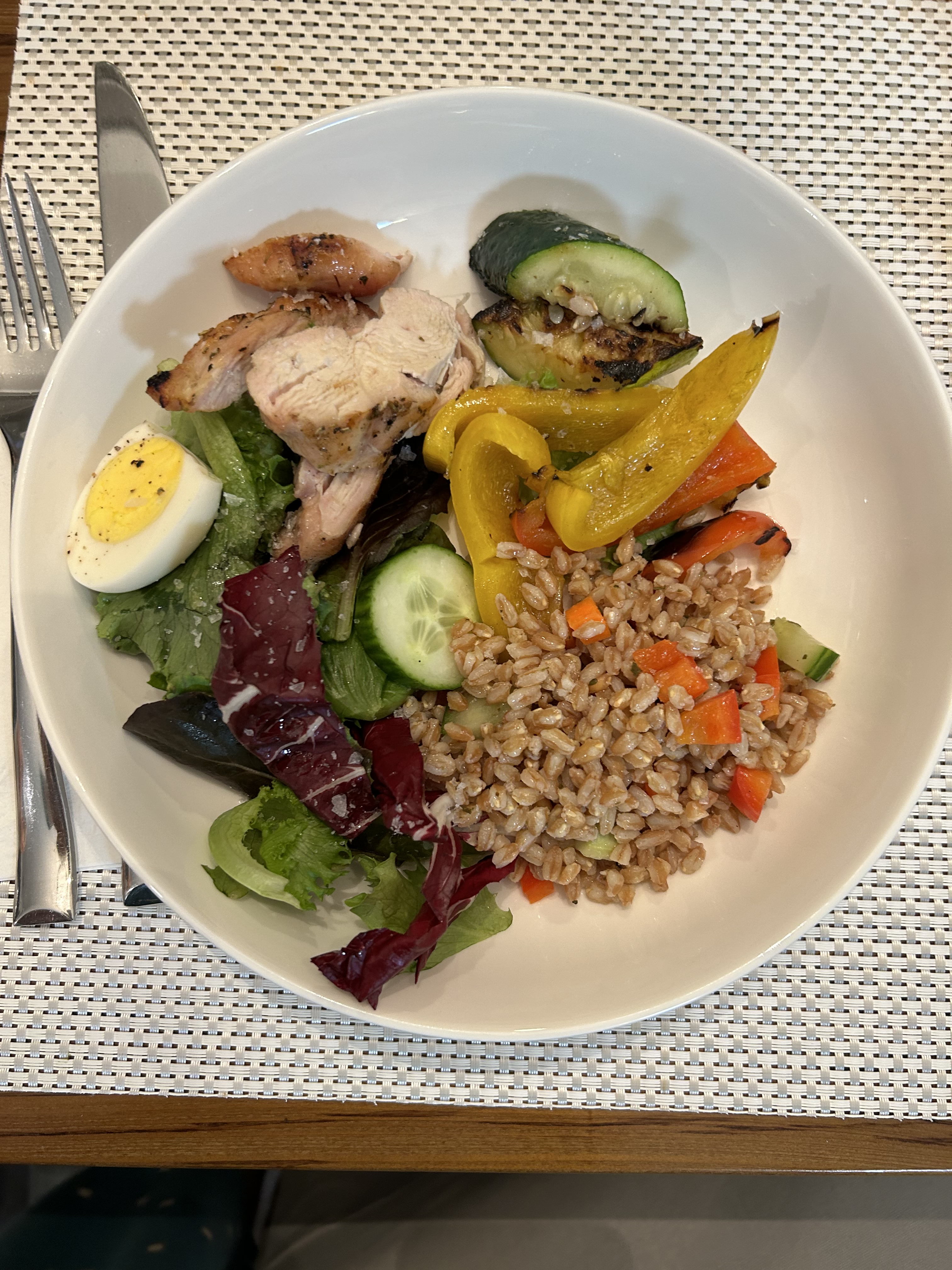
I’m happy. And now, hungry. It is time to organize my dinner and make my supper salad. I’m going to try roasting some cauliflower and carrot in the Ninja Air Fryer.

The Salt Marsh

Between the Mt. Pleasant, in Charleston County in South Carolina, and the string of outer barrier islands, lies a wide salt marsh.

Beaches and sand dune systems form on the side of a barrier island facing the ocean; the side facing the shore often contains marshes, tidal flats, and maritime forests.

The salt marsh here is beautiful, and here is a link to some pictures of salt marshes. I wanted to stop on the connector highway to take a picture for you, but I don’t feel safe to stop on the side of the busy connector, never mind getting out of the car.

https://stock.adobe.com/search?k=south%20carolina%20salt%20marsh

When I arrived here last December, the salt marsh was dormant. The grasses had died back and were brown. Now they are a lush and tall verdant green.

The areas between the islands and the mainland are “tidal flat” wetlands. They can be mostly mud if near where a river comes into the sea. They are “swamps” if trees and big shrubs are involved. And they are salt marshes if they open, grassy, and lined with ribbons of canals.

These salt marshes are the ecological guardians of the coast. Their grassy and sinuous channels fill and drain with saltwater as the tides ebb and flow, providing food, shelter, and nursery grounds for birds, fish, and other wildlife, ranging from dolphins and otters to snails and turtles. 

Healthy salt marshes cleanse the water by filtering runoff, and help other ecosystems, including oyster reefs and seagrass beds, thrive. Conserving salt marsh helps people, too. Marshes can reduce erosion, stabilize shorelines, protect against storm surge, and support species that are crucial to recreational and commercial fishing, hunting, birding, and other activities.

The above information is in the link below, if you want to read more.

https://www.pewtrusts.org/en/research-and-analysis/articles/2021/03/01/11-facts-about-salt-marshes-and-why-we-need-to-protect-them#:~:text=Marshes%20can%20reduce%20erosion%2C%20stabilize,%2C%20birding%2C%20and%20other%20activities.

Then and Now: My House

Recently I looked at pictures of my new house–just while searching for another picture. Here’s my home back in November when I put a contingency contract on it and was waiting for my Maine home to sell.

Here it is in late December when I closed on this new home and was waiting for my furniture to come from Maine. The lawn is sodded, but the Centipede grass was dormant. It will do that again this winter.

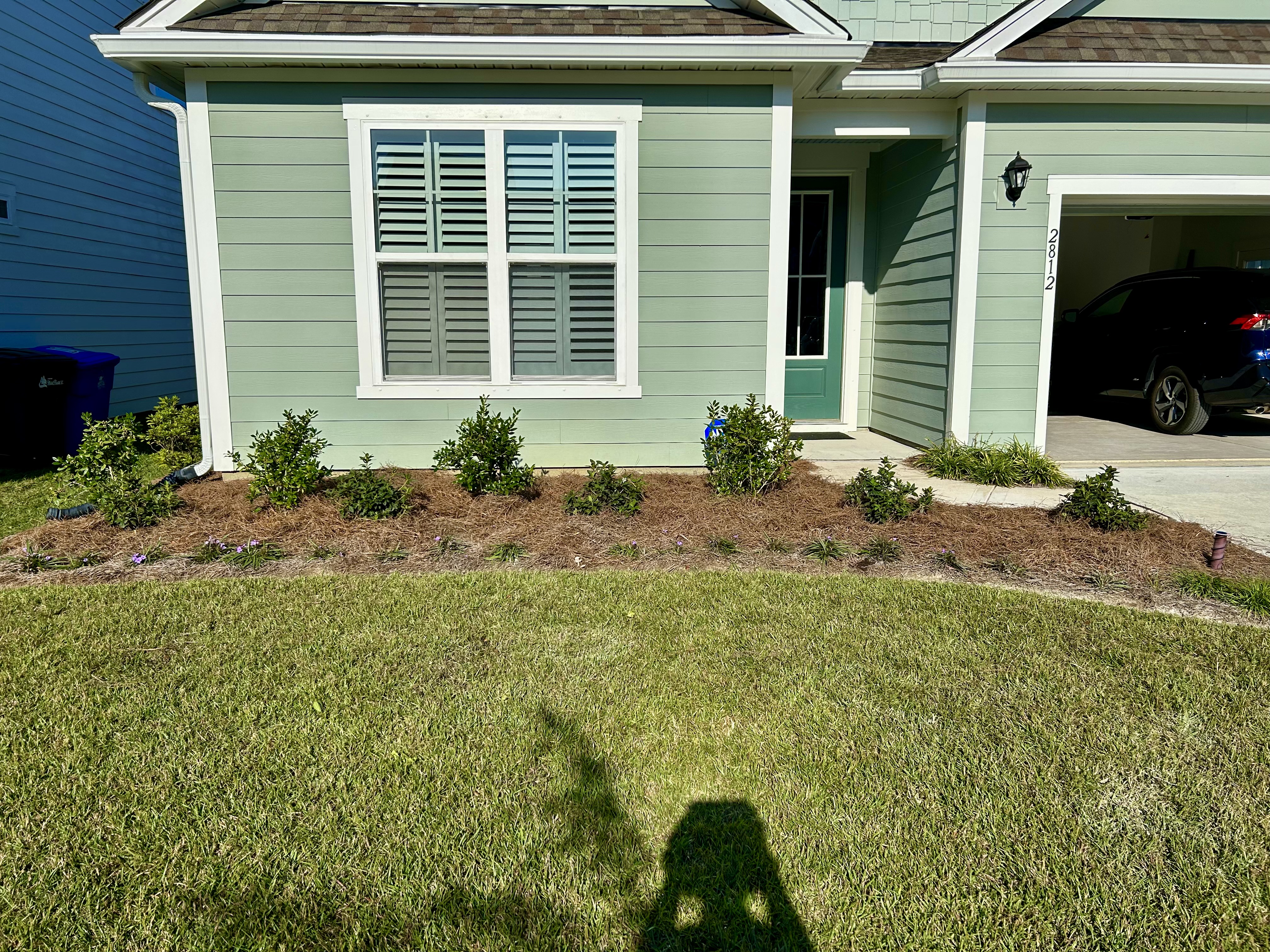
I took this picture the other day–with the new Crape Myrtle in place of the Willow Oak planted by the developer. Look at the size of the azaleas and hollies out front now. They are thriving. I’ve worked so hard on the grass with hand weeding and fertilizing and watering–and it shows. It’s now like a deep carpet in most places.

And you can’t see them from the street yet, but the 20 little Dwarf Mexican Petunias are thriving, growing, and starting to bloom. This morning three more had flowers that had opened.

They are all the pretty violet/blue I wanted.

It is a bit cooler here these past few days. And we’ve had good rain, but I’m going out to water the new Crape Myrtle now as it does not have a developed root system yet.

Sharp Knives

In Maine, I used a man called a “grinder” to sharpen knives and scissors to perfection. The knives I took once a year or so and then sharpened with one of those metal sharpening rods (a “honing rod”) as needed.

But here I have not needed yet to track down a person or place that sharpens knives. And, honestly, back in Maine or Virginia, dropping knives off at a store where they are sent out somewhere wasn’t ideal. I’ll call one of the local quilt shops here to find out who sharpens their scissors. That’s how I found the Maine grinder.

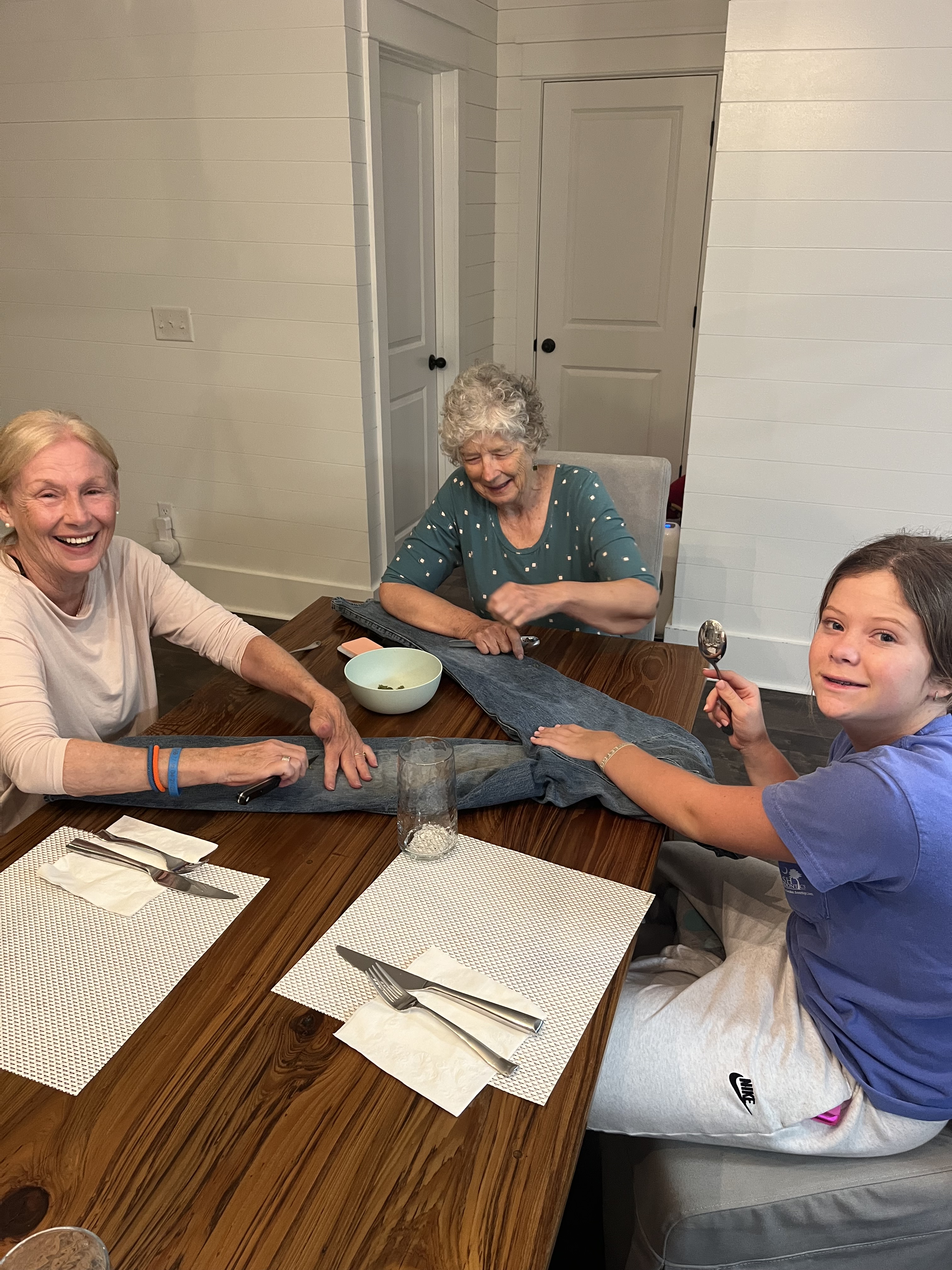
But, a Maine friend told me she had purchased an electric sharpener recently. I used to have one of those, and in time it wore out. I didn’t know they wore out but they do. My friend told me the one she bought. Like me, she cooks a lot and loves having sharp knives.

When I read the comments online at Amazon about the one she got, people loved it, but a few comments educated me about the angles these kinds of sharpeners use. Different sharpeners use different sharpening angles–often from the same manufacturer as people “in the know” do prefer one or the other. Who knew?

I settled on this one–as apparently its angle made a sharper knife edge. It will also sharpen serrated knives. And, it was a bit cheaper too. And note that there are VERY precise and exact instructions for sharpening knives. VERY. You don’t just run knife through the left two sides–often one only needs the far right slide–like with serrated knives.

Oh boy! My knives are SHARP! I even tried my steak knives–which were a wedding present back in 1966, so they are 57 years old now and have never been sharpened. They had serrated edges at the point for about an inch that were mostly worn away–so I just sharpened them as usual. (Their blades could use a polish session.)

Oh my heavens!! They are so sharp now–and a pleasure to use. I would have never taken these all to a grinder to sharpen. It never occurred to me.

This one I sharpened too–the sharpener sharpens the points on a serrated knife.

The grinder in Maine was not horribly expensive, and he also sharpened scissors. But the cost of doing all my knives and scissors did mount up over time. This new sharpener is cost effective from that standpoint.

So, now, I’ll figure out the scissors. As you all might know now, LOL, I sew and cut a lot. Some of my sewing scissors have a partially serrated blade which must NOT be sharpened.

Also, as you might know, all people who do sharpening work are NOT equal. You have to find a good one. That’s why I’ll call the quilt shops.

And I will, sooner rather than later so I’m ready when the need arises.

Hello Traverse!

Sorry to be absent these past days. A niece I have not seen in 10 years visited.

Hello Traverse!

I’ve started hand-quilting her as the last work on the quilt from hell (“Happy”) is done and it is ready to be basted on the longarm to prep it for hand quilting.

I treated myself to an online class with Tara Faughnan about her method of hand quilting–she pretty much hand quilts most of her quilts. And like me, she uses thicker threads and bigger stitches. But, her stitches are so much better than mine–back and front.

I’m starting with the orange stripe in the middle of the quilt. I want the hand quilting to be present for texture, but I do not want to overwhelm the quilt so that I take away its charm. So, I’m sticking to keeping thread color as close as I can to the fabrics that are being quilted.

Already my stitches are so much better. I’m practicing new skills, so my fingers have to relearn what they used to do. And I have a sore finger from feeling for the needle. So, soon, I hope, it will be “hello callus.” That’s a size 6 Embroidery needle made by Tulip. Right now it seems perfect. I have some smaller sizes (which have bigger numbers, LOL), but the Artisan shot cotton in this quilt is heavier than a lot of fabrics, so the bigger needle feels better.

And my back stitches look SO MUCH better now.

I’m using a mixture of threads that are all 12-weight cotton. Over the years I’ve collected a lot of these threads (Sulky, Wonderfil, and others), so I have a great selection of colors. The Wonderfil is thicker than the Sulky.

For these heavier threads, I think Tara Faughnan is right about using Thread Magic as a conditioner. It is heavier and stands up better. For thinner threads, like the 50-wts and smaller, which I would use for binding, I do like the Sew Fine better. It just seems to tangle less with the thinner threads.

Here’s my new thimble–note the raised top. And I mark for the most part with a Hera marker.

I did purchase Tara’s Wonderfil 12-wt, 3-ply, “Spaghetti” thread collection from her shop. These colors are ones she uses a lot, and they are in the quilt.

Here’s a recent picture. I’ve almost completed two rows. I’ll do the yellow row next so I can better practice the running stitch.

So, I’m off and running with this anticipated project!

Palm Trees Bloom

Who knew?

The Sable Palm is a palmetto, but I mistook that in an earlier post and called a regular low shrub that is also a palmetto and called a palmetto the South Carolina state tree. The Sable Palm is the real state tree and is on the South Carolina flag.

Here’s a link to that flag if you want to see what it looks like.

And here’s what the blooms look like. They have been “blooming” for several weeks now.

Here’s a close-up.

Fruit does form after these blooms–a tiny pea-size darkly colored edible fruit–but it is mostly seed and skin.

Local people say that when the blooms die back, they are a mess to clean up. That is probably also true for the palm fronds when they die as the tree grows upwards and forms new palms.

The dried upwardly facing pieces on the trunk are the remnants of old palmetto fronds that died. This area of the palm is called the “boot.”

And that’s all I know about the South Carolina state tree for the moment.

The Bee Cause

DIL Tami Enright shared this informative interview on South Carolina ETV the other day.

I think some of you might enjoy it.

Tami is a co-founder of The Bee Cause and its Director. The Bee Cause now has hives in all 50 states and in some international countries.

In this video, Tami not explains the history of The Bee Cause but what we can each do in our lives to help create a habitat for bees. Small acts can make a difference.

No bees, no food.

Quilty Progress Late July 2023

I finished the half-square triangle quilt made mostly with solid scraps–at least it started that way. But soon I did have to cut some fabric from my stash of bigger pieces as I got picky about balancing colors around the quilt. And don’t laugh, but I did order a few colors I felt I needed when some ran out. The colors in this quilt are way more vibrant than I am able to capture on my phone and in a room where it is tricky to get light where I need it for pictures.

The blocks are 9 inches finished, so it will measure out about 82 inches square. I am thinking of naming it “Inspired by Tara Faughnan,” since that is the truth and since I adore her quilts. She just released a lovely pattern made with solid half-square triangles–but without internal sashing. However, I was drawn to my idea below by a quilt that hangs behind her on some pictures and videos.

I am totally in love with the secondary patterns that form, depending upon how one places these half-square units. Dynamic designs are totally possible–and that’s without getting to color choices beyond just light/dark units. I had such a good time with this one. It tantalizes the eyes.

I will likely put it on the longarm pretty soon as I have a backing for it that I like a lot. I have no idea about a binding. Maybe the dark midnight purple of the internal sashing, a Kona color I love, but whose name escapes me for the moment.

Then, YEAH!!!: here is the FINISHED QUILT TOP FROM HELL. The dark border just makes this quilt–in part I think because it draws out the internal dark shapes that repeat.

Here’s a close-up–the quilt is about 73 inches square when finished. And it has not been pressed since I took out the paper templates (except for the border). I’ll press the border really well and then remove the final paper templates. Then I’ll press it again and likely baste it for hand quilting on the longarm–maybe before “Inspired” gets quilted as basting on a longarm does not take up much time.

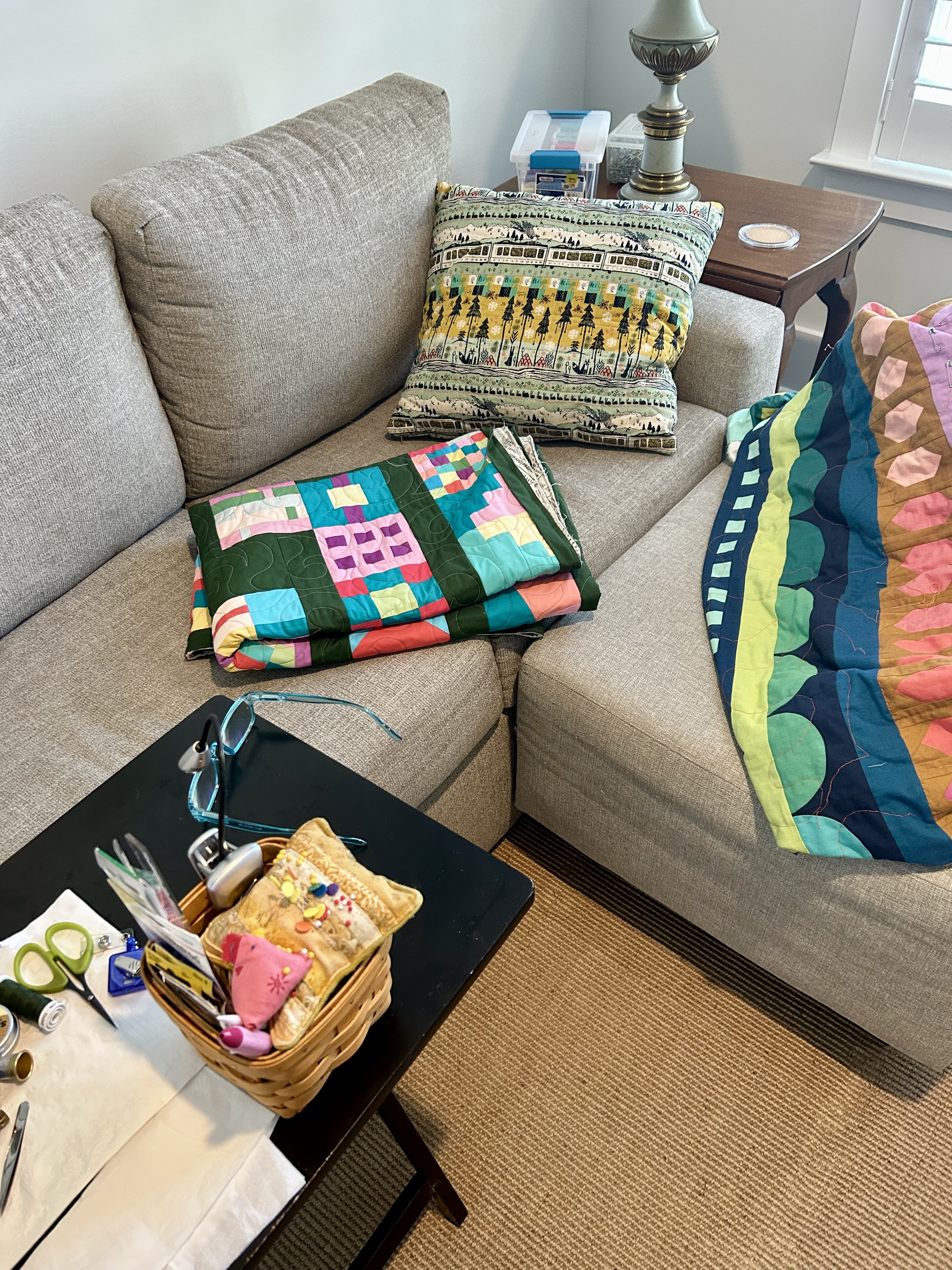
I started this quilt in June 2018 and there are, literally, a hundred thousand or more tiny stitches in it. The prepping of all the templates also took many, many hours. Five years, and she isn’t totally finished yet. But, soon… And she needs a happy name–maybe even “Happy”–as in “I’m happy this one is finally over.” I’ll put on a hanging sleeve before I bind her. And she is the last of the handmade quilts for my seven grandchildren. Now there are seven of these handmade quilts.

Big Red (that will NOT be its name) is now on the design wall. It’s hard to get the color red to show well in my pictures. This quilt made from Kaffe Fasset prints bought in a kit many, many years ago. The reds are vibrant and not at all muddy. The lavender (Kona Thistle) will be the 1-inch sashing and the binding. The 8-wide 10-inch blocks will go right to the edge, so using the same-color sashing fabric for binding will pull everything together. Right now it would finish at 87 wide, but I might go at least one more row long so it wouldn’t be square. I’m not planning to use corner stones between the rows, but you never know what will happen. And of course I’ll move blocks around like crazy as I add them.

I’m so excited about putting the Modern Quilt Society’s “Summer Camp” mystery quilt blocks on the design wall–so I’ll likely do that as soon as this red top is all together. That mystery quilt reveal for the public will be September 1st, which will arrive pretty fast, given that I have so many projects happening.

I brought Traverse downstairs yesterday, and I’ll start hand-quilting it as soon as I have the paper templates out of “Happy”–which may happen tonight.

I’m so looking forward to trying out new hand-quilting skills gleaned from Tara Faughnan’s online hand-quilting class. I have a thinner backing (Cotton Couture), a thinner batting (Dream Cotton Request), a new thimble with a ridged top, some new needles, some of those little finger guard circles for the finger under the quilt that has to meet the needle point, some new thread conditioner, some new thread, and a whole lot of excitement.

A Crape Myrtle

I’ve been worried about this tree in my front yard–a willow oak planted by the developer.

These trees are hardy here, yes. But they will get HUGE and will dwarf the house, the front yard, the street and the neighborhood. Plus the roots that develop get huge and thick and can spread far and wide–disrupting…the street, the driveway, the house foundation (?), and so on. I am hearing some real horror stories.

So, I contacted Estaben Hernandez (EstebanHernandez Luxury Painting). Estaben is also a carpenter, and his brother has a landscape business. These two guys are a part of a network of young men who are hard and willing workers. Estaben made taking out the willow oak and replacing it with a gorgeous Crape Myrtle an easy event. And I am so grateful. He and his guys chose a beautiful tree for me. (I wanted a watermelon pink color.) And the willow oak went to one of the guy’s brother’s house, where there was ample room for it.

I made a trip to Loews and got new pine straw for these two beds and put it down myself. The pine straw is light to move and easy to put down.

Now, all I have to do is pay attention to how much water this new tree is getting. And I already do that with the grass and the beds I have planted. (The roses are blooming like crazy again and are so cheerful. The flowers are smaller, but that’s due to the heat.)

I find myself following the afternoon thunderstorm possibilities–especially in the strong heat we have had recently. (It was 102 on my back porch one afternoon last week.) You would think this storm would have provided some good rain. Well, it did for some west of me. For sure. We didn’t get one drop out of these scary clouds.

But we did get a good rain a day Saturday evening. So I’m good on the watering for one more day. I usually water early evening, so the plants can take all the water in without the sun drying everything out too fast. The night temps are in the 80s, so leaves don’t stay wet long. Plus, the extreme heat would fry a plant’s leaves that were wet if I watered during the day. Early morning watering might be ok, but is not as ideal as early evening watering.

Today it is a bit cooler. High 80s and into the 90s mid to late afternoon. It is late July in the tropics–and August is coming. My house is cool–I run a dehumidifier upstairs in the afternoons–and floor fans on low to keep the air moving–and that helps a lot. High humidity makes everything feel hotter.

Poaching Eggs in Water…Is Easy

And they result is that the eggs are so tender and velvety–so much better than the old poaching pans with which I grew up.

You need a regular, pot of water that you bring to a SIMMER ONLY. More than simmer makes the egg white come away from the egg. There should be no bubbles on the surface of the water. Some use a wide flat pan, especially with more than two eggs. The water has to be deep enough, so a wide flat pan might need a cover, with the heat turned off. (See the video below.)

And you need a utensil with holes to pick up the egg when it’s ready to your satisfaction. A flat spatula works well too.

Break your egg into a glass or a ramekin. Ramekins are shallower than this glass, but I just grabbed what was near. Use only one egg per glass/ramekin and don’t cook more than 4 at a time. You can reuse the same simmering water if you want more eggs.

Many add a teaspoon of WHITE vinegar to the water as it helps the whites stay put. I often don’t, but after looking at the video below, I’ll try the vinegar addition again.

Slide the egg gently, gently into the water. The video below uses a cover and a timer to cook the egg to soft boil–and turns off the heat. I just watch the egg so I can tell when it is done to the consistency I like. I can also spoon water over the top GENTLY if the top needs more heat. This pot is smaller; I would use a bigger pot for more eggs.

When done (either decided by eye or a covered pan with the heat turned off and a timer as in the video below), remove each egg gently. I like soft eggs with golden yolks that will run out on my salad. But harder boiled are lovely too.

I needed some protein for this supper salad, so the poached eggs were perfect. And, delicious.

A bit of practice makes perfect.

And this video is excellent to get you started.