Turkey Tracks: May May Chicken Is Gone

Turkey Tracks:  February 1, 2011

May May Chicken Is Gone

Yesterday, May May Chicken was killed at dusk and partially eaten by a large bird.

Here’s a picture of her from last spring around the time we first got our chickens in March.  The grass is just greening up.  At that time, the Marans were about 18 months old.  And, maybe even a bit more.  She had a fancier name that I can’t for the life of me remember.  She became May May over the summer.
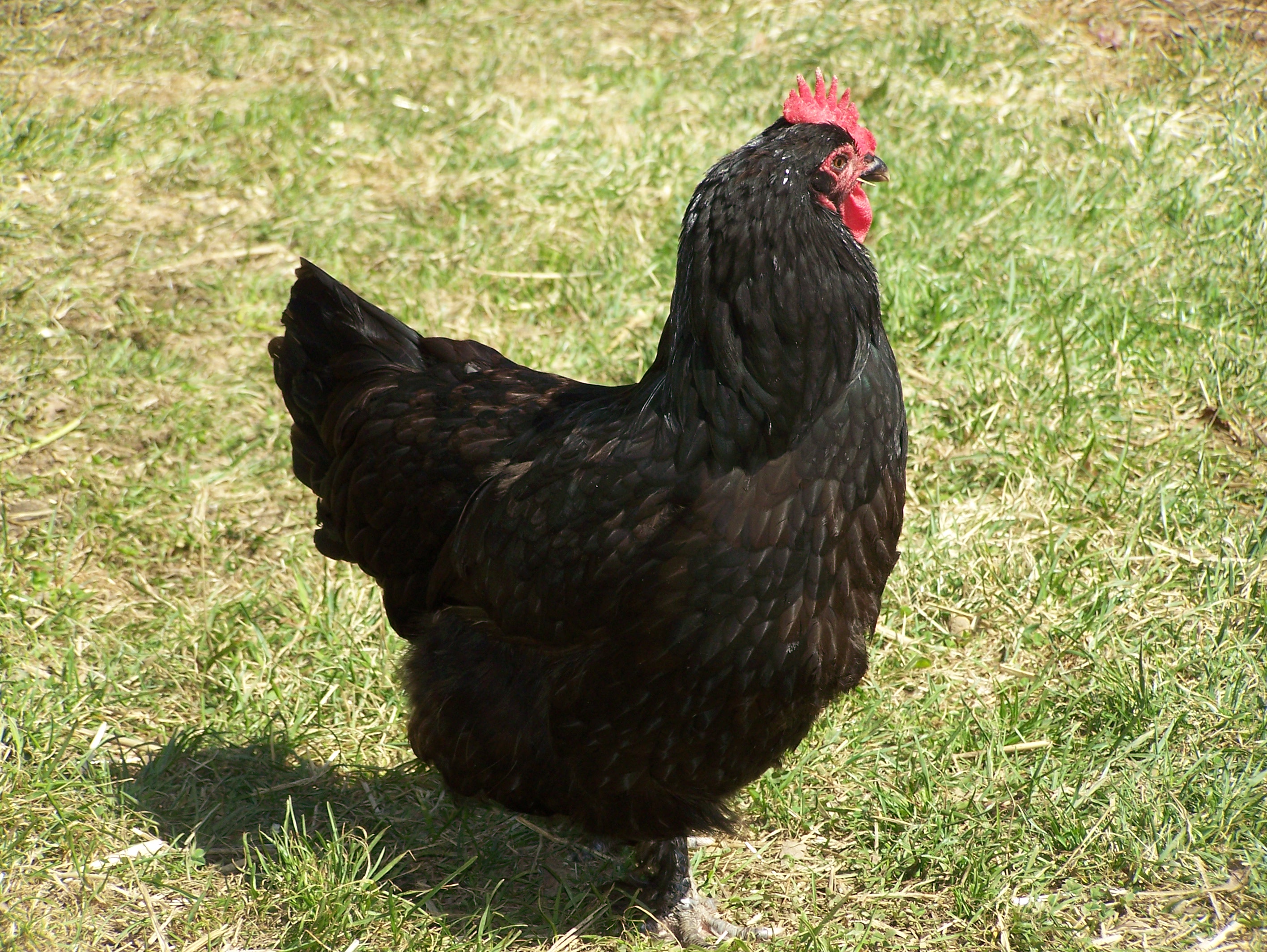
Yesterday afternoon I was happily engrossed in making Karen Johnson’s purse, and I did not hear a thing.  Neither did John, whose office windows, though closed with blinds to keep out the cold, are no more than 10 feet away.

Anyway, I went out at deep dusk or a bit later–the chickens have been slow to roost as they’ve been enjoying being outside.  Mostly, they’ve been hanging out under the porch, right next to one of John’s office windows.   They have scratched out the rocks and pulled out the black weed cloth and have been trying to take dirt baths.  One night this week I had to climb up the slope back of the birdfood storage bench, pick up two of the Maran hens, and put them into the coop.  Had they had been scared to cross the snow to their coop?  So,  while May May was being killed, I was both occupied with my project and giving the hens plenty of time to go into the coop.

I went out the kitchen door, flashlight in hand, and around the snow path to the coop.  (We have more than 2 feet of snow on the ground and have dug paths to get around the house.)  When I lifted the roof lid to make sure the chickens were all inside, I only saw three Maran hens.  The other hens and the rooster were uncharacteristically subdued I realized later.  I started down the path to where the chickens had spent the day and begin to see black feathers.  At first, it didn’t register.  Then, I saw her body, a dark heap atop the snow.  Crimson, bright blood soaked the little hollow where she lay.   Her neck had obviously been broken, and part of her breast had been torn away so that her flesh was exposed.  I stepped into the bank, went up to my knee in the snow as my boot sought firm ground, and picked her up.  She was surprisingly heavy.  Oh, I thought, I am feeding them right.

For some reason, I put her back down and went to tell John.  I knew he would want to know, would want to see for himself.  He pulled on boots and coat and came immediately.   Together we took in the information left for us to witness.  There were no signs of an epic struggle.  We hoped that meant she had died instantly.  There was a small patch of scratch marks in the snow.  Hers?  Made by her feet as she died?  Either an animal or a bird who walked on the snow would have left prints.  No, it was a bird that got her and then sat on her body to eat her, which is why the soft snow was so hollowed out underneath her.  She was too heavy for the bird to lift.  So, the bird ate until disturbed in some way.  Perhaps, by the dogs who had gone out several times while I had been sewing.  At one point, Reynolds came to see me, as if to tell me something.  But I had ignored her, intent on my project.

I picked up May May’s body again and was again surprised at how heavy she was.  I took her to the garage and put her into a trash can.  What else could I do with her?  Leaving her lying in the snow to at least feed something in this winter of heavy snow was unthinkable.  We do not want to tempt  foxes, weasels (the dreaded weasels), coyotes, or racoons into the chicken area.   Nor did we want to tempt our dogs. In the end, her flesh was wasted, trashed, but for a few mouthfuls.

It’s such a strange thing to contemplate death.  In the early afternoon, I had stroked May May while she sat on the nest in the corner of the coop where the hens have been laying.  She had been sitting on two brown eggs, one of which may have been hers.  She had stayed when I reached beneath her and took out the eggs.  She had allowed me to stroke her back a time or two more before I closed the roof lid.  Perhaps one of the eggs I collected before locking in the remaining chickens for the night had been hers, laid after I had left her.  May May had been warm, alive, interested.  And now, there was the lump of her body.  The life had gone; her spirit had departed.  But, to where?

John’s protective mode went into full gear.  He wanted to “get the sucker,” and he got up early to peer out of the windows to see if he could spot the bird, who might return to try to eat from its prey once more.  He thought he saw an eagle in our trees.  He said the bird had a huge wing span, bigger than a hawk’s.  I do not know if an owl is large enough to take down a hen of May May’s size.  Probably.  And I do think she was killed at dusk because she wasn’t really cold when I picked her up.  Anyway, May May’s death is a reminder that nature is not kind, that nature is rapacious and filled with creatures who must eat to live, including man himself.

I am feeling more than a little guilty today because the chickens did not really want to come out in the snow.  They knew it was dangerous.  They knew they were prime targets against the white snow.  That’s why they had hunkered down under the porch.  They knew they could be killed out on the snow paths.  And, May May was.  But, they came out in the first place because I told them it was ok, because they had followed me down the path as I scattered a bit of seed for them, seed they could not resist.  I am shamed that I listened to anyone say how dumb chickens are because they won’t go out into the snow unless you make them.  What hubris!  What a mistake.  What a lack of understanding about chickens and predators.  Chickens almost always stay beneath plants and trees and porches and buildings.  In the winter, they are so at risk.

Here’s a picture of our original six chickens, taken in the fall before Chickie Annie joined then.  May May is the middle black hen.  She was the “head” hen, and she was fiesty and full of life and altogether wonderful.  We will all miss her and the very large brown eggs she laid.

Turkey Tracks: Wynken, Blynken, and Nod quilt

Turkey Tracks:  January 31, 2011

Wynken, Blynken, and Nod Quilt

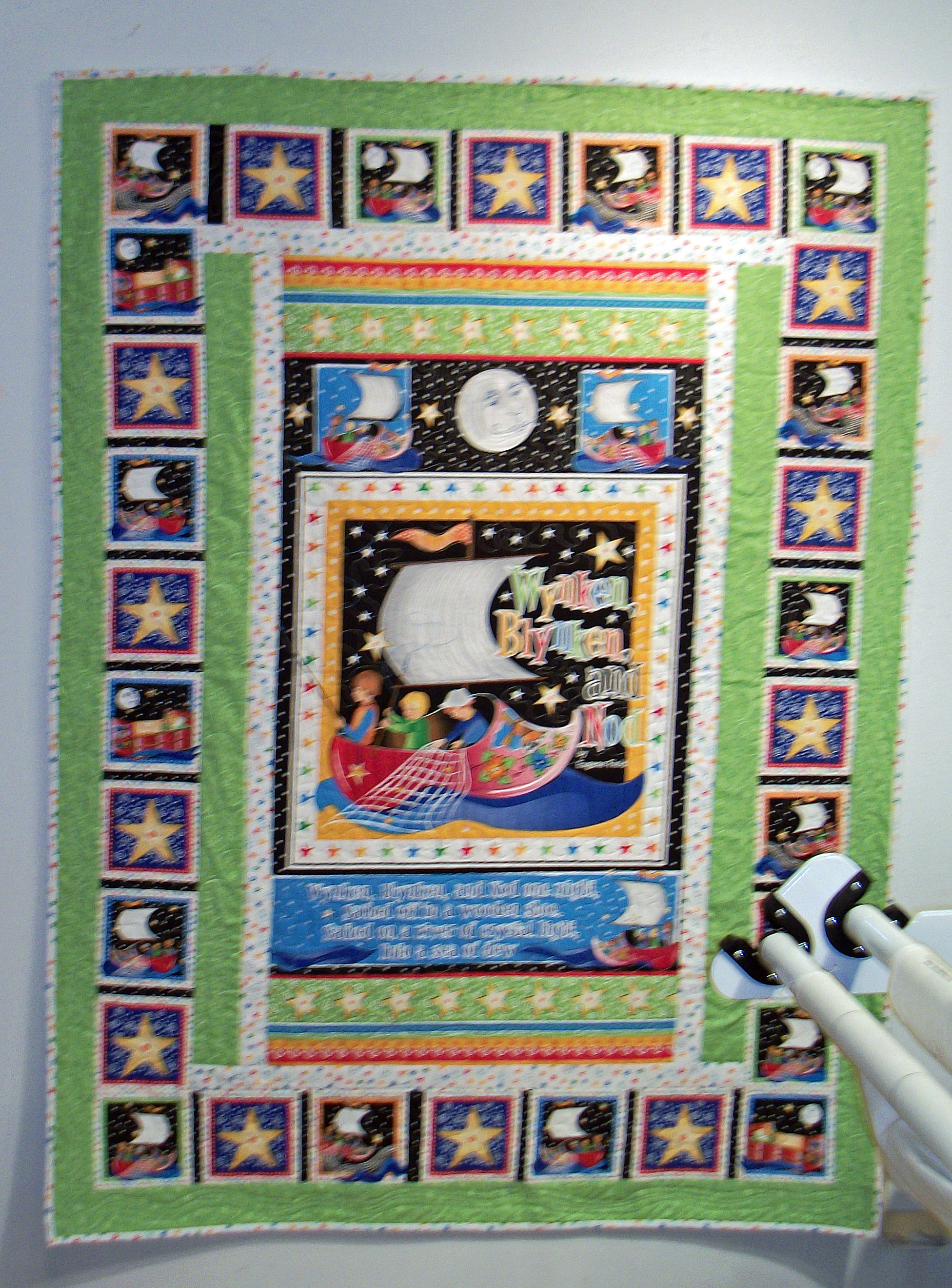
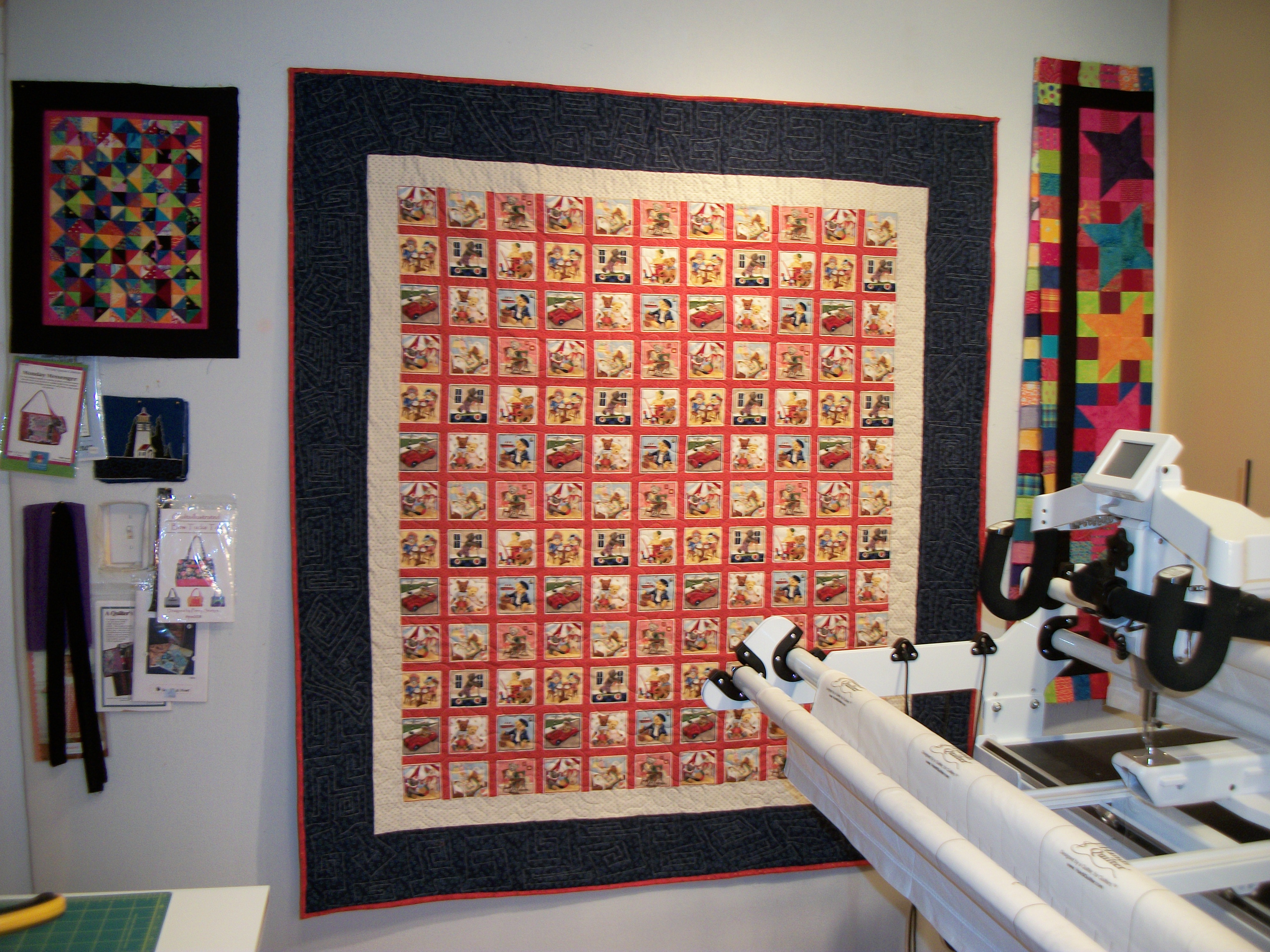
Here’s a very bad picture of the “Wynken, Blynken, and Nod” quilt sent to my great nephew Judah Benjamin Gardner about a week ago.  Judah was born a week before our Ailey. 

This picture is fuzzy and, also, distorted a the bottom.  I’m learning that if I don’t hold my little camera level with the center of something, the bottom gets narrowed.  Oh well.  You can still see it’s a very cute quilt. 


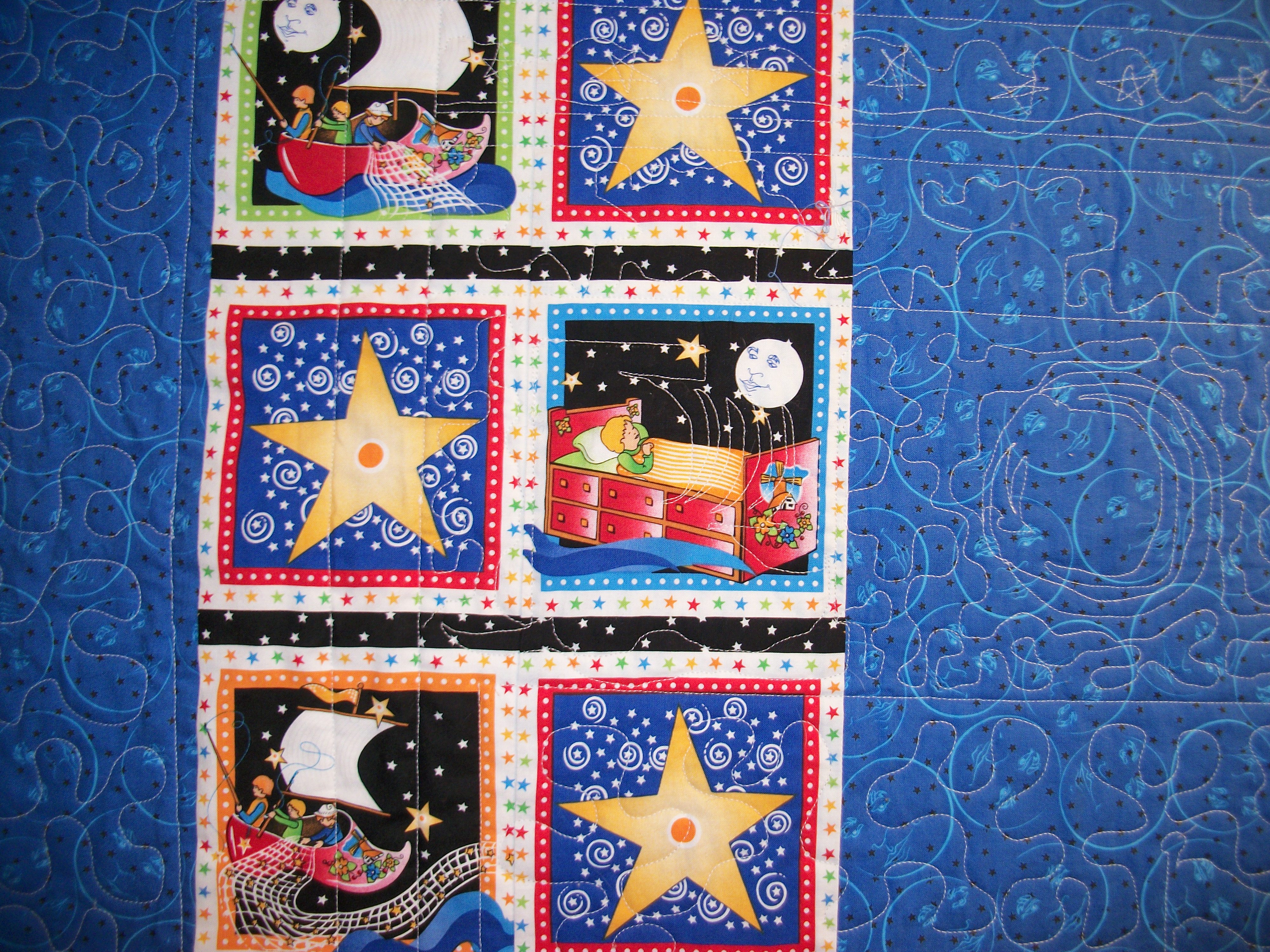
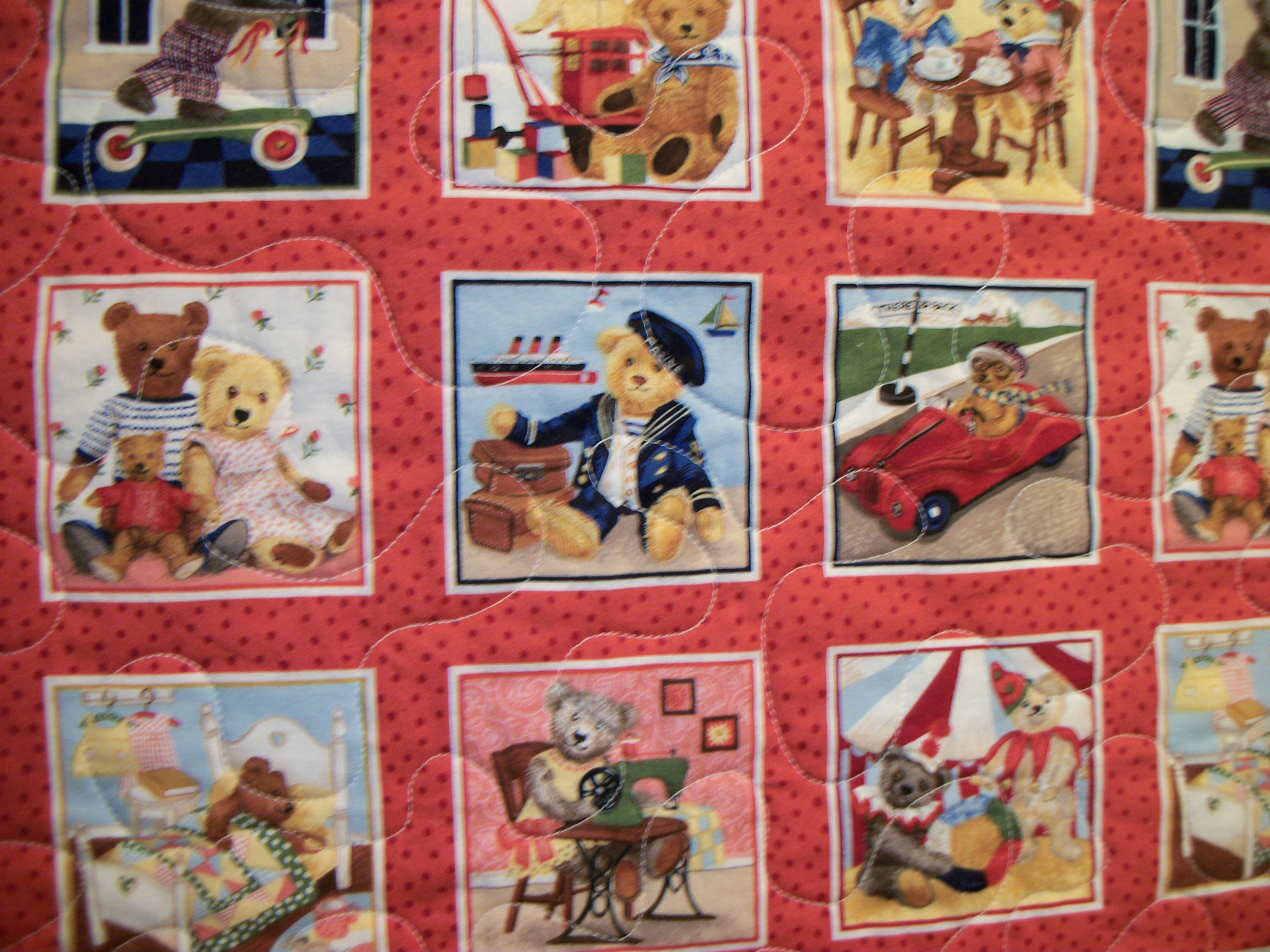
Here’s a close-up of the center panel:


 And here’s a sense of what the back looks like.  I had to piece the back as the quilt turned out larger than I had expected. 


Children’s quilt fabrics are really fun these days!

This quilt is meant to be used and used and washed and used.

Turkey Tracks: Sunday Cooking–French Onion Soup Dinner

Turkey Tracks:  January 25, 2011

Sunday Cooking: 

French Onion Soup Dinner


We have some friends here in Maine who LOVE French Onion Soup.   Jack and Barbara Moore own the schooner Surprise, which takes people out of our Camden harbor for day sails during the summer.  They went to Tufts with John, and we did not know they lived here when we first began to get serious about moving to Camden.   We attempted to rent a cottage from them in January 2004 for the summer of 2004, and John realized who they were.  We all met at Boyton McKay for lunch (Phil had cooked vegetarian French Onion Soup), and the three old friends reconnected.   (Boynton McKay has the best pancakes in America–seriously, it does.) 

A week or so ago, Jack and Barbara invited us to dinner at the newly renovated cottage we once rented–it will now be their home–and it is beautiful–and I promised to make them French Onion soup.   Traditional French Onion Soup begins with a sturdy beef stock, but many French soups just use vegetables and water (leek and potato soup, for instance), though Julia Child always has a variant for a good bone broth stock.  In the winter, especially, bone broths are more prevalent because people are eating hearty meats for warmth.   And, if you know me at all, you  know I’m a passionate advocate for good bone broths.  They are nutrient dense and provide minerals we do not easily get elsewhere.  Besides, they allow the use of all parts of an animal.  Nothing gets wasted and it’s healthy to boot.  How can you go wrong?  Also, onions are storage vegetables, so we have a lot of them in the winter.  What a French Onion soup is, in the end, is a way to use what is prevalent in the winter season, and use ingredients in the most delightful way.

However, Barbara is mostly a vegetarian, so I promised her I’d make a vegetarian French Onion Soup.  And we invited them for Monday night, so I started by making a really good vegetable stock on Sunday afternoon:  2 celery stalks (you don’t want too much celery), some celeriac  I had from Hope’s Edge which is mild, 2 big onions, 3 spring onions greens and all, chard stalks, a small turnip, a parsnip, a few potatoes hanging around the potato basket, 4 carrots, three or four garlic cloves smashed, some of the parsley I froze, some dried lemon thyme, a bay leaf, and some good unrefined sea salt (which is full of minerals like magnesium and good for you,  unlike the fake salt in the grocery store which I never buy).  I would have used 2 leeks and 1 onion if I had had leeks.  Once assembled and brought to a boil, lower the heat, and simmer for about an hour.  You will have gotten all you need from the vegetables by then.  Let the stock cool and strain it through a colendar.   In this household, the dogs get the carrots the next morning mixed into their raw meat, and the chickens get some carrots, the chard stalks, the turnip, parsnip, and a few of the spent potatoes.   If  you can’t part with the vegetables,  pull off a bit of the stock and puree the vegetables in it, reheat,  pour in some heavy REAL cream or put a few tablespoons of butter on top, and you have another lovely soup.  If you don’t have animals, you could compost the spent vegetables.  If you don’t have a composter, put them outside under a shrub.   They don’t have any fat in them, so they won’t attract vermin, and you won’t be adding, mindlessly, to the waste stream.  The shrub will thank you. 

Anyway, here’s what the broth looked like on the stove.  Isn’t it pretty?


Roughly speaking, here’s what you need for the soup  ingredients:

2 quarts of stock minimum–I probably use 2 1/2 quarts–and at least  1/2 cup dry white wine (red isn’t bad if you’re using a beef stock)

8 or 9 medium to large onions cut pole to pole and sliced into 1/4-inch slices  (I use more than Julia who calls for 5 cups I think)

1 tsp. salt, a pinch of sugar, 3 Tablespoons of butter, and 2 Tablespoons of other fat (olive oil, coconut oil, tallow, lard)

Grated swiss cheese–good swiss which is sweet, not bitter, is usually European in origin.  And, if you like, the following enrichments:  3 Tablespoons of Cognac, egg yolks ( 1 to 4)

Really good French Bread Baguette

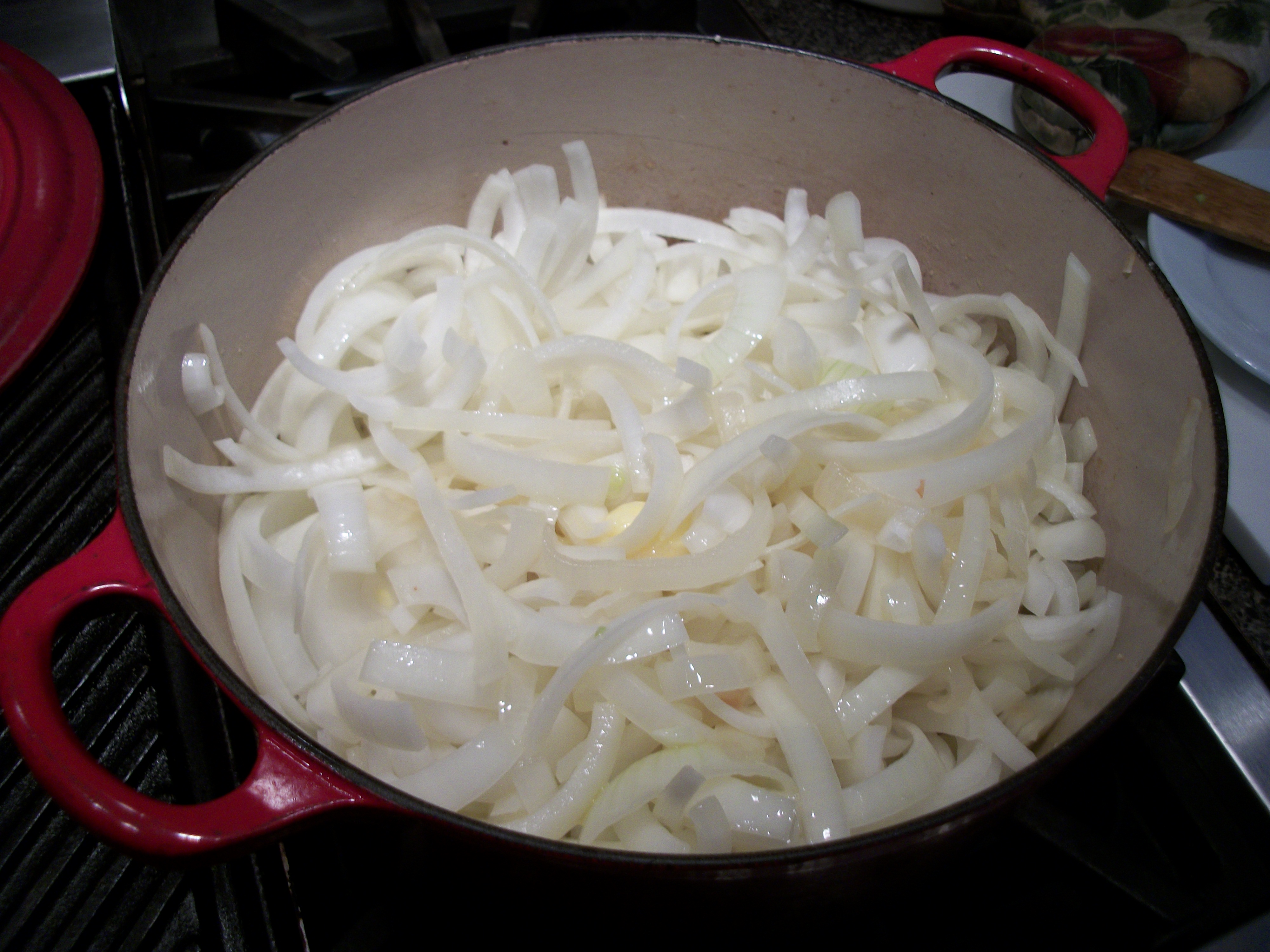
While the stock was cooking, I sliced up the onions, put them into a HEAVY pan with the butter, oil/fat, and salt, and on medium heat, began caramelize them.  When they have all melted down, add the bit of sugar which will help caramelize the onions.  Hang around the kitchen and stir them up every couple of minutes.  Keep the heat from being too hot.  You don’t want to burn them. 

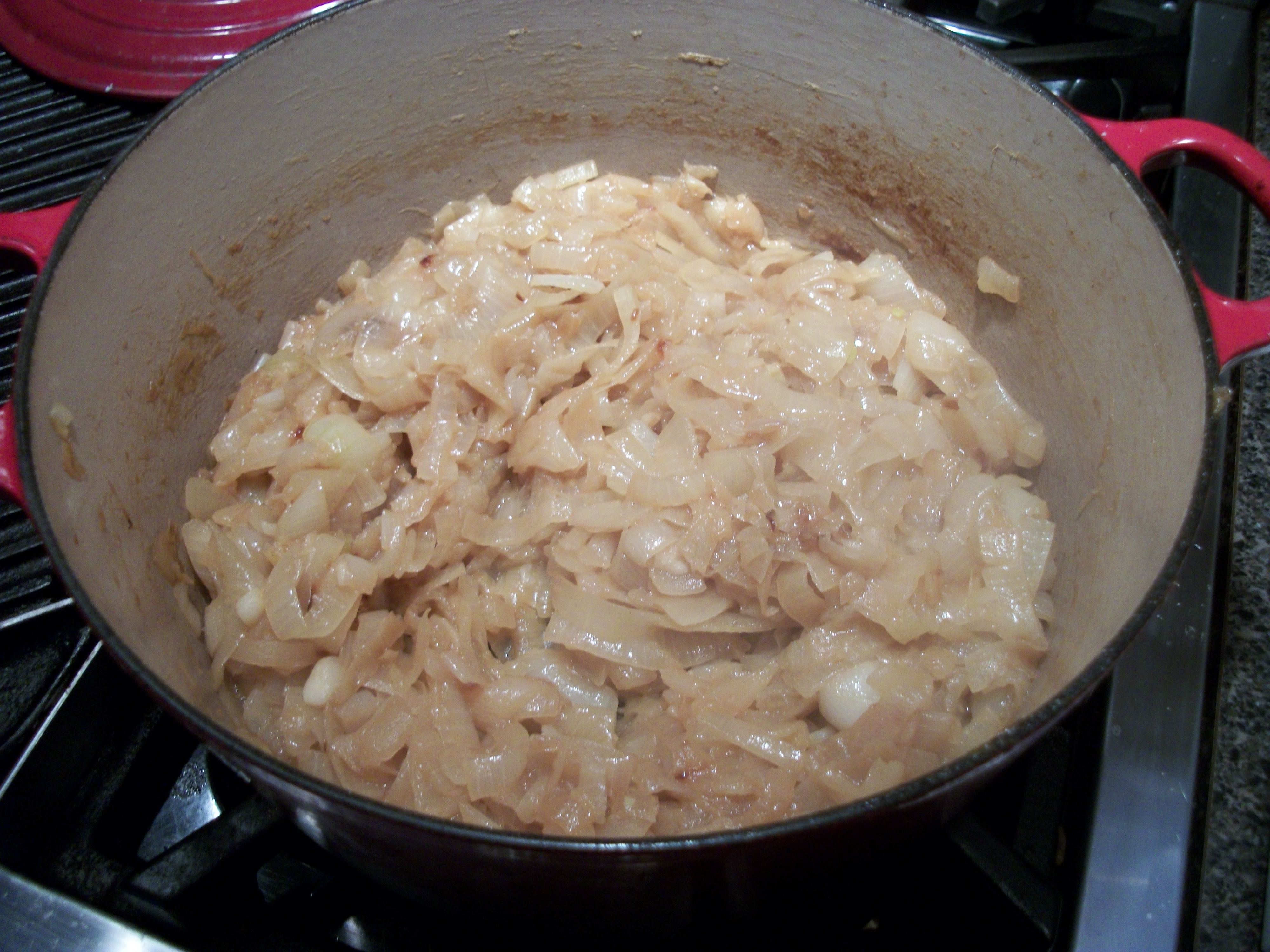
Here are the onions getting close to being done:

The onions are now a soft golden color.  You can get onions to caramelize to a much deeper color, but the taste changes as the process continues.  Since I was using a vegetable stock, I didn’t want the onions to be as strong as I would for a beef stock.  This picture is showing the onions to be a bit light, but they were actually a lovely golden color.  When you think your onions are dark enough, stir in about 1/4 cup of flour and cook, stirring constantly, for about 3 minutes.  Add your stock and stir up all the bits in the bottom of the pan.

At this point, I let the mixture cool and refrigerated it.   All I needed to do on Monday was to heat the soup gently, let it simmer for about 30 to 40 minutes, and taste it for salt when it got warm.  My soup was very sweet.  Onions are sweet, but remember I had also used carrots and a parsnip in the broth.  Chard stalks are sweetish too.  

Here’s the soup on Monday cooking gently for 40 minutes: 

I thought it needed some zip, so just before serving, I added a good 3 Tablespoons of cognac.  (A plain brandy would work too.)  And, I enriched it with 4 egg yolks, which made it silky smooth and gave it some lovely body, not to mention protein the body can use easily. 

To add egg yolks, drizzle a ladle of soup into the eggs while you whisk them.  For safety,  as I had used 4 eggs, I added a second ladle slowly while whisking.  (This is called tempering the eggs.)  Then, with the soup OFF THE HEAT, stir the eggs into the soup and stir the soup until it thickens–just a minute or so.

I put grated swiss cheese (a GOOD swiss) into the bottom of each deep bowl and ladled soup over it.  My gratinee soup bowls are small, and we wanted big bowls of soup for dinner–not a smaller size for a first course.  And, as we had really fresh baguettes, we just quartered them and put a hunk at each person’s plate.  I can get lovely raw butter, so we had that for the bread too.  (We didn’t want to toast sliced bread and put it into our soup this time and put the cheese over it and put everything into the oven to melt the cheese.)

While the stock made and the onions caramelized, I made a three-layer cake–a recipe I had put away to try years ago.  It’s a caramel cake, but not a southern style.  Instead, the batter and the icing are flavored with mocha syrup, Bailey’s cream liquor, a coffee liquor, and vanilla.  I didn’t have a mocha syrup, so I put the other ingredients in a pan and threw in about a tablespoon of chocolate bits and a tablespoon of some caramel syrup I had and let it all sit on the oven shelf to warm and melt the chocolate.  The cake is spectacular and lovely, so that innovation was fine.  Here it is, though the camera distorts the bottoms of things (making them look smaller) if you don’t have it level with the photographed object:

Here it is cut:


It is yummo!  I got it from “Better Homes and Gardens” Dec. 2005, “Secret to a Great Cake:  Cream Caramel Cake,” page 220.  The only downer is that the icing has EIGHT CUPS of confectioner’s sugar in it.  That’s more sugar than I eat in two years!!!! 

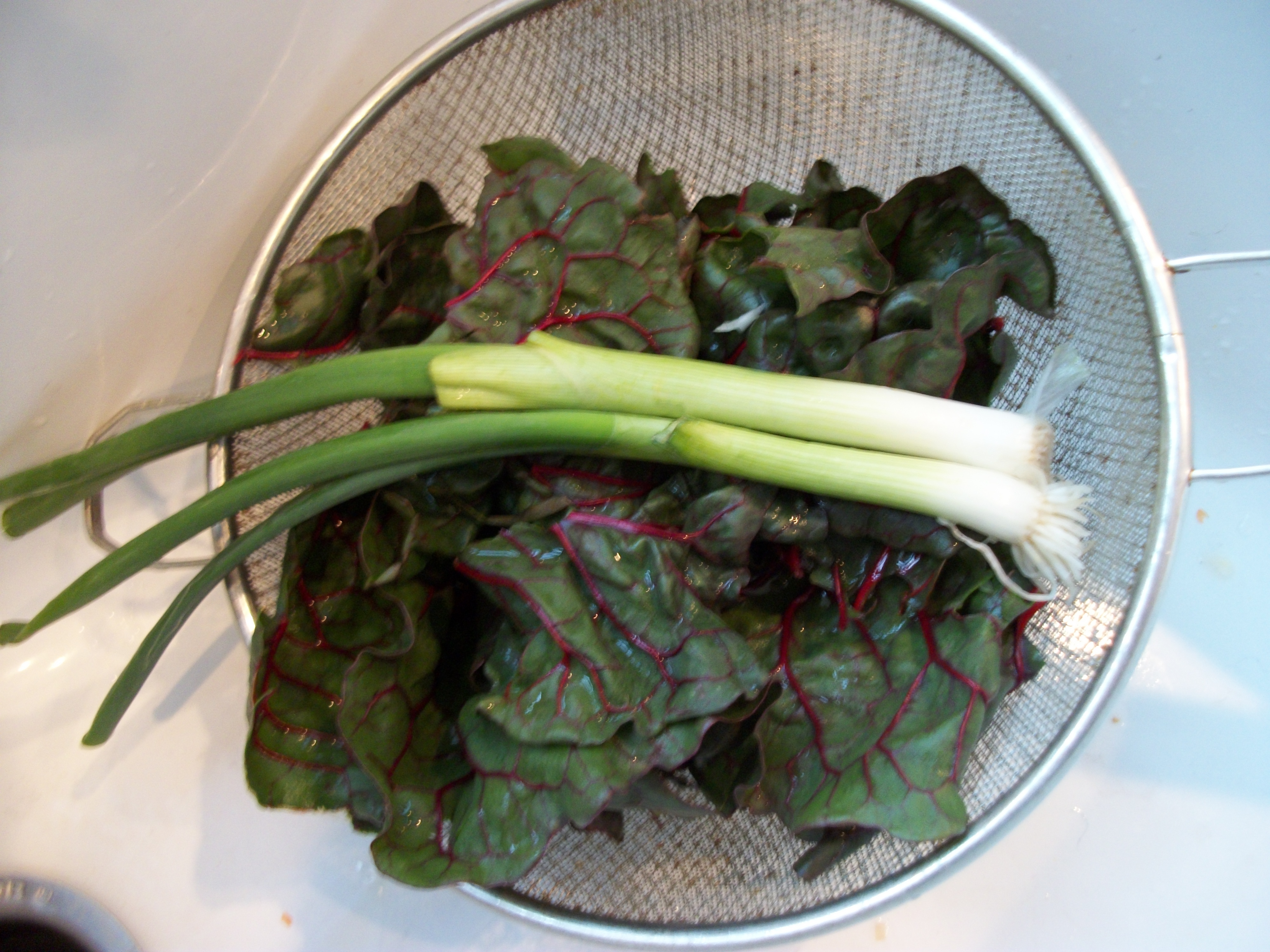
So, you remember those chard stalks I used in the soup stock?  Here are the leaves–with some green onions–all ready to be sauteed for dinner on Sunday night.  Dinner was roasted sweet potato and a seared sirloin steak and some of my sauerkraut.  Aren’t chard leaves pretty?  Chard is in the beet family, you know.  I usually grow a variety called “rainbow” chard that comes in all sorts of electric colors.  It’s quite amazing in the garden.  It’s great sauteed with some coconut oil and when it begins to melt down, a splash of fruity vinegar and a drizzle of honey.  Sometimes I also add some raisins or some sliced apple, peel and all. 

So, on Monday, I only had to make a salad and grate some cheese.  Here’s the salad:

I wanted something citrusy.  Lettuce greens are not in season now, so this salad is from “away.”  It has some water cress, some leaf lettuce, some romaine, a naval orange, some fennel sliced thin on the mandolin cutter, some hearts of palm (I grabbed a CAN thinking I was buying asparagus hearts–bad, bad as can linings leach BPA–I should have NOT used anything else), some green onions, some toasted pine nuts, and a fruity dressing of lemon and olive oil.  It was delicious!

So, Bon Appetit! to all and mega thanks to the incomparable Julia!

PS:  For a good beef stock, put a selection of bones in a roasting pan, add some celery (2 stalks only), carrots, onion, and garlic (I slice the whole bulb in half after seeing son Bryan do that) and roast until brown at high heat–400 degrees–turning and stirring after about 40 minutes.  Usually everything is brown in no more than an hour.   Drop the heat if you think things are moving too fast.  Put everything into a large stock pot.  Put water in the roasting pan and scrape up the goodies and pour all into the stock pot too.  Add more onion, carrots, garlic, fresh or dried herbs (thyme, rosemary, bay leaf, parsley) and GOOD SEA SALT THAT IS DAMP AND GREY and cook for at least 5 to 6 hours and up to 12 hours.  Strain and discard bones and spent veggies.   Freeze extra in Mason quart jars.

Turkey Tracks: Green Hive Honey Farm

Turkey Tracks:  January 24, 2011

Green Hive Honey Farm

“Raw Honey From A Thousand Flowers”

 Isn’t this the prettiest jar of honey you ever saw?

From the moment I saw it I fell in love!


For the past five years or so, I’ve made a right hand turn onto Wiley Road from Barnstown Road and, in doing so, passed a house where the most amazing flower garden begin to appear.  Last year some time, a friend told me that the occupants of this house, Clay and Mary King, had put in hives and were going to sell honey.  I’m always looking for local, NONHEATED honey, and that’s what the King’s have.  They have hives located in other places besides their yard, each site carefully chosen to support bees.  Last year, the honey bottles were plain.  This year, when Clay brought us a case of honey, here’s the jar that emerged from the box.  I’ll never be able to throw away a single one of these bottles.  That’s for sure.

For those of you who are local and who are reading my blog, this honey is amazing!  You can reach Clay and Mary at greenhivenoney@gmail.com.  Or, 207-542-3399.  The web site is www.greenhivehoney.com.  Clay and Mary, by the way, have a therapeutic massage practice.

For those of you who are not local, I urge you to find a local source of unheated raw honey.  It’s full of things that are good for you that come from your own region, and you’d be supporting someone who is trying to make a difference. 

Raw honey, combined with raw butter, has been used traditionally as a healing compound and for immune support.  I try to eat some every day.   

Strangely, in the way that things come together all at once some times, Paul Tukey of Safe Lawns sent out a posting listed on his blog this week that shares the fact that the lead researcher for the USDA has definitely connected the use of the class of insectsicides called neonicotinoids, which are synthetic nicotines, with the colony collapse of bees–and at, writes Tukey, “doses so low they cannot even be detected by normal scientific procedures.”   Apparently, Jeffrey Pettis (the lead USDA researcher), has known for two years about the neonicotinoids, but said that official publication of his findings has been stalled.  What a surprise!  This story is as old as industry use of chemicals.  Some names of these synthetic nicotines are imidacloprid and clothiandin.  Pettis, writes Tukey, broke his story to a documentary filmmaker rather than to a government source.  That’s interesting…   That’s one way to get around the “stalling.”

Neonicotinoids act on the central nervous system of insects and are thought to have a lower toxicity to mammals because they block a specific neural pathway that is, according to Wikipedia, “more abundant in insects than warm-blooded animals.”   More abundant…  My first thought is that, as with BPA, they don’t really know how dangerous to us these chemicals are.  And, no one is looking since we operate within the notion that harm has to be proved before our government even begins to look–which translates into having enough dead or harmed bodies.   Imidacloprid is systemic.  It amazes me that people can watch chemicals drop bugs and not connect the dots that those same chemicals can have an impact on their systems as well.  Again and again, the history of chemical use demonstrates that “they don’t know.”  Or, if they do and it’s dangerous, they hide it.  So, I have no confidence in our government’s ability to protect us any more.     

Imidacloprid is widely used as an insecticide worldwide–except in France and Germany where folks seem to have started questioning impact.  Imidacloprid is used, says Wikipedia, against “soil, seed, timber, and animal pests” and is used as “foliar treatments for crops including:  cereals, cotton, grain, legumes, potatoes, pome fruits, rice, turf and vegetables.”  That’s a LOT of poison.

Feral honey bee populations in America, writes Wikipedia about pollinator decline, have declined by 90 percent.   And, two-thirds of managed honey bee colonies have disappeared.  Two thirds.  The economic and human hardship potential for disaster if this scenario continues is enormous.  About one-third of human nutrition depends on bee pollination.  Think about it.  We’re talking about the majority of fruits, nuts, vegetables, and crops we feed to animals, like alfalfa and clover. 

Most bees right now are moved around the country to service crops, which stresses them.  Often, they only have access to one crop, like, say, almonds, which also stresses them since they need more variety.  Often, they’re fed in winter with high fructose corn syrup because we’ve taken all their honey.  No wonder, often, they die.

So, my hat’s off to Clay and Mary.  The honey is beautiful, the bottle’s beautiful, the label’s beautiful, and I will support you.      

Turkey Tracks: Cutting the Waste Stream and Detoxing the Kitchen

Turkey Tracks:  January 19, 2012

Cutting the Waste Stream and Detoxing the Kitchen

When we first moved to Maine, I was clueless about how many paper products we were using.  And, how much of each.  I could go through a whole roll of paper towels while cleaning the kitchen by the time I mopped up the stove, hood, sink, counters, and cabinets.   And, I didn’t think twice about it either.

Our first hint that Mainers don’t use paper like I had done for forever came when we were invited to a potluck.  I made a really nice dish, and off we went.  Only, when we arrived, we discovered that everyone was supposed to bring their own plate, utensils, and drinking cup.  Wow.  It was a revelation.  Fortunately, another couple lent us one of their sets of everything and each couple ate from one plate.   Our journey toward stopping the paper habit started that night.

Except for paper napkins, I’ve not bought any household paper eating supplies in about 6 years.  And, paper napkins get used very little since we use cloth napkins–which we wash when they get dirty, not after every meal.  (I grew up with this practice, actually, in my grandmother’s home.)  Mostly, paper napkins get used to blow our noses since they are sturdier than kleenex!  And that’s going to stop because I lucked into a box of handkerchiefs a while back, and I, at least, have been carrying one of those in a pocket.   But, they are delicate for the most part.  I wonder if sturdy cloth handkerchiefs are on the market anywhere? 

Last fall I bought a stack of white wash cloths at our local Penny’s–about a dozen for $10.  (Along with some GREAT cotton sheets at 1/2 the price of other places.)  I put them in a bowl on the kitchen counter, and I grab one when I need to clean anything in the kitchen, wipe my hands, wipe…anything.  They get thrown in the washer with the cloth kitchen towels, and all get bleached when they really need it–though the sun does a great job in the summer.  And, of course, I have lots of rags from old t-shirts, towels, and the like. 

Next, I need to figure out how to store clean rags in the bathroom instead of using paper towels to wipe out a sink, polish a mirror, or swish out the toilet (with gloves on, of course).  Now that I’ve focused on the problem, it shouldn’t be hard to solve.

When our quilt group meets, we each bring our own coffee/tea cup.  That’s worked well for many years now.  We hardly ever have to buy disposable cups anymore.  Plates and napkins, though, we do still buy.  And, plastic forks and spoons.   Hmmmmm.  This might be worth discussing at the group.   The Lion’s Club where we meet has plates, utensils, etc., but we’d have to wash them afterwards…  That’s the big problem, isn’t it?  We don’t want to expend energy in that way…   We’ve noticed that people from away who visit use napkins like plates, without giving a thought to the trade-off:  wash a plate or trash more trees. 

It’s always a shock when someone from an urban area comes because our trash fills up quickly with all the disposable coffee cups they…”trash.”  Maine has a good bottle law.  It could be better if they upped the tax a bit more.  Studies have shown that the higher the tax, the better the return, which means less goes into the environment.  Anyway, we take our trash to our local dump and pay $1 for the big yellow bags we use.  There are great recycling bins for paper, cardboard, cans, and bottles.  Obviously, the less trash we put into those yellow bags, the less we pay.  We compost all our plant wastes, and the chickens and dogs eat all the kitchen “slop.”    

Packaging creates a huge amount of trash.  In Britain, I read not long ago, shoppers were stripping their produce out of all the packaging and leaving it for the store to manage.  I don’t know how that came out.  I do know many of us in Maine are using our own bags when we shop, and I’ve stopped putting a lot of produce into plastic bags to carry them home.  Lettuce, maybe.  Apples, no.  I shop mostly at a co-op anyway, and they don’t supply shopping bags or pack your groceries for you.   And, they ask you to pay for any bags you use when gathering food.  But, when I do go to a local supermarket, which is not very often, I’ve stopped going blindly along with all the plastic packaging.  I haven’t quite had the nerve to strip off packaging from organic produce I might buy in a supermarket, but that day is coming soon.  Mostly I try to buy local, organic food, and that’s not often in the supermarket anyway.

I stopped buying and using aluminum foil a few years back.  It’s toxic.  It’s metal, so it doesn’t break down in a land fill.  It was a little disconcerting at first because I had all these food habits that made me reach for the foil to cover a pan or wrap something to heat or transport.  But, I’ve learned to cope.  A bit of wax or parchment paper laid over a hot dish, covered with a thick towel transports food really well.  And, I’ve figured out how to use other lids or pans to cover an open dish in the oven. 

I haven’t yet stopped buying plastic wrap.  But, that’s next.  And, for heaven’s sake, don’t heat plastic wrap in a microwave and give that food to anyone!  (Actually, we took the microwave to the garage three years ago, and we haven’t missed it.  The microwave issue is a whole thing on its own, but every holistic or energy person I know does not use one.)  I already use plates to cover most bowls I put in the refrigerator.  That works fine.  The plate even makes a hard place where you can set another dish. 

I got rid of all plastic storage containers years ago.  I do have some glass containers with glass lids, but they are hard to find.  I have some glass or metal containers with plastic lids, but I wash those lids by hand.  I use Mason Jars a lot.  And,  glass food jars get washed and saved. 

So, I’m down to ziplock bags.  And I still use those.  I wash and reuse them, so I feel a bit better.  But, in the end, I don’t want plastic touching my food any more.  I’ve just read too much about how little we know about what’s going on inside a plastic anything.  And, what we do know is scary.  And, I do know that manufacturing plastic is toxic in so many ways.   Plus, it’s all made from oil, which is a limited resource.  Plastic just isn’t something I want to have in my life or to support.  So, I’ll start thinking about exactly how I use plastic bags and trying to figure out how not to. 

 I have discovered that you can hold lettuce or other salad ingredients really well wrapped in a kitchen towel.  I put cut tomatoes cut side down on a plate on the counter.  I don’t like tomatoes refrigerated anyway.  Ditto for an onion.  Both get eaten or used quickly anyway.   


Turkey Tracks: Making Yogurt is Easy and CHEAP

Turkey Tracks:  January 13, 2011

Making Yogurt Is Easy and Cheap

Yesterday morning  when I tasted the yogurt that had been “making” overnight in the oven, I was, again, reminded at how absolutely delicious it is when it is just fresh, when it has not yet been chilled.  This batch had thickened up to a custard consistency, and it was like velvet on the tongue.  John and I each had a big bowl of it drizzled with nonheated local honey and sprinkled with some dried fruits and “crispy” nuts.

CRISPY NUTS:  Crispy nuts have been soaked in salted water over night and dried in a dehydrator or an oven on very, very low heat until “crispy.”  One does this process to remove the phytates present in the nuts and seeds.  Phytates can inhibit the full absorption of nutrients in a serious way.  Plants are way more chemically powerful than people realize.  Put the nuts into a large bowl, fill it with water, and add about 2 tablespoons of salt.  Let them soak from 12 to 24 hours.  They will swell up.  Drain them and dry them.  I prefer to dry my nuts in a dehydrator as it’s easier than my oven.  I never burn the nuts, which are expensive, in the dehydrator.  I got a cheap one for about $30.  But, it’s plastic, and since I use it all the time and since I’m learning that plastic off gasses around heat, I’m saving for a good metal dehydrator.   You can read all about phytates in Sally Fallon and Dr. Mary Enig’s NOURISHING TRADITIONS, which is a book that, among many other things, attempts to recover lost food preparation practices.

Anyway, here’s how you make yogurt so that you don’t even have to dirty a pan.

Milk–I use a half-gallon at a time.  And, of course, I’m using “real” milk.  Try to find milk that is NOT ultrapasteurized as it might not culture.  Ultrapasteurized milk is cooked milk; it’s a dead product.  You can read all about it in my essays.

2 packets of “yogamet”–which is a dried cultured yogurt product.  It comes in a box.  Inside are individual packets.  Look for it in the cooler section of a natural foods store or Whole Foods.  Trader Joe’s might have it.  After your first batch of yogurt, save about about 1/4 cup of yogurt for your next batch.  Yogurt you’ve cultured yourself begins to make the thicker, custardy yogurt that is so delicious–though all the yogurt you make will taste really good.  One packet will culture one quart of milk.

Find a big bowl–non metal–that will hold your milk.

Turn on the oven to 200 degrees, and when it reaches that temperature, turn it off, put your bowl inside and cover it with a plate.   (No plastic or foil please.)  Close the door and go to bed.  In the morning you will have yogurt.  On very cold days, sometimes mine is still too runny.  I put it in a warm place (like under a cabinet light or on the stove or back in the stove with the oven light turned on) and give it more time to jell.  You’ll know if it’s still too runny.  It will not spoil if you leave it out until it jells, and it will jell eventually, as it’s cultured.

****

Greek yogurt is just yogurt with some of the whey–a clear liquid–drained out.  You can make yogurt cheese by draining off all the whey.  Whey is full of protein, though, so when you drain off the whey, you are leaving the milk solids and fat behind, and they need protein to process properly in your body.  So, don’t eat too much Greek Yogurt.

I often drain some of my yogurt to get some whey.  I use it to culture sauerkraut (see that recipe elsewhere on this blog); put some in homemade mayo to culture it so that it lasts for weeks in the refrigerator; use a few tablespoons when soaking dried beans, grains, or flour; and so forth.  Whey is an amazing preservative and a detoxifying agent.   You can drain yogurt by putting a paper towel, a napkin, or some cheesecloth in a colander, putting in some yogurt, and placing the collander over a deep bowl to catch the whey.  I put a plate over the colandar.  Whey keeps for weeks and weeks in the refrigerator.  And yogurt cheese is great drizzled with honey and served with dried fruit (dates!) for a dessert.  Or, drizzled with olive oil and herbs for a spread.

Most prepared yogurt in stores is not only expensive, it is full of additives and sugar.  It is “jelled” with pectin, for instance.  And, the smooth taste comes from seaweed additives.  It won’t even drip out whey.

Wait until you taste your own yogurt.  You’ll understand what has been lost.  And, now, found.

Turkey Tracks: Pomegranate Ploy, Clementine Bliss, and Bioregion Efforts

Turkey Tracks:  January 11, 2011

Pomegranate Ploy, Clementine Bliss, and Bioregion Efforts

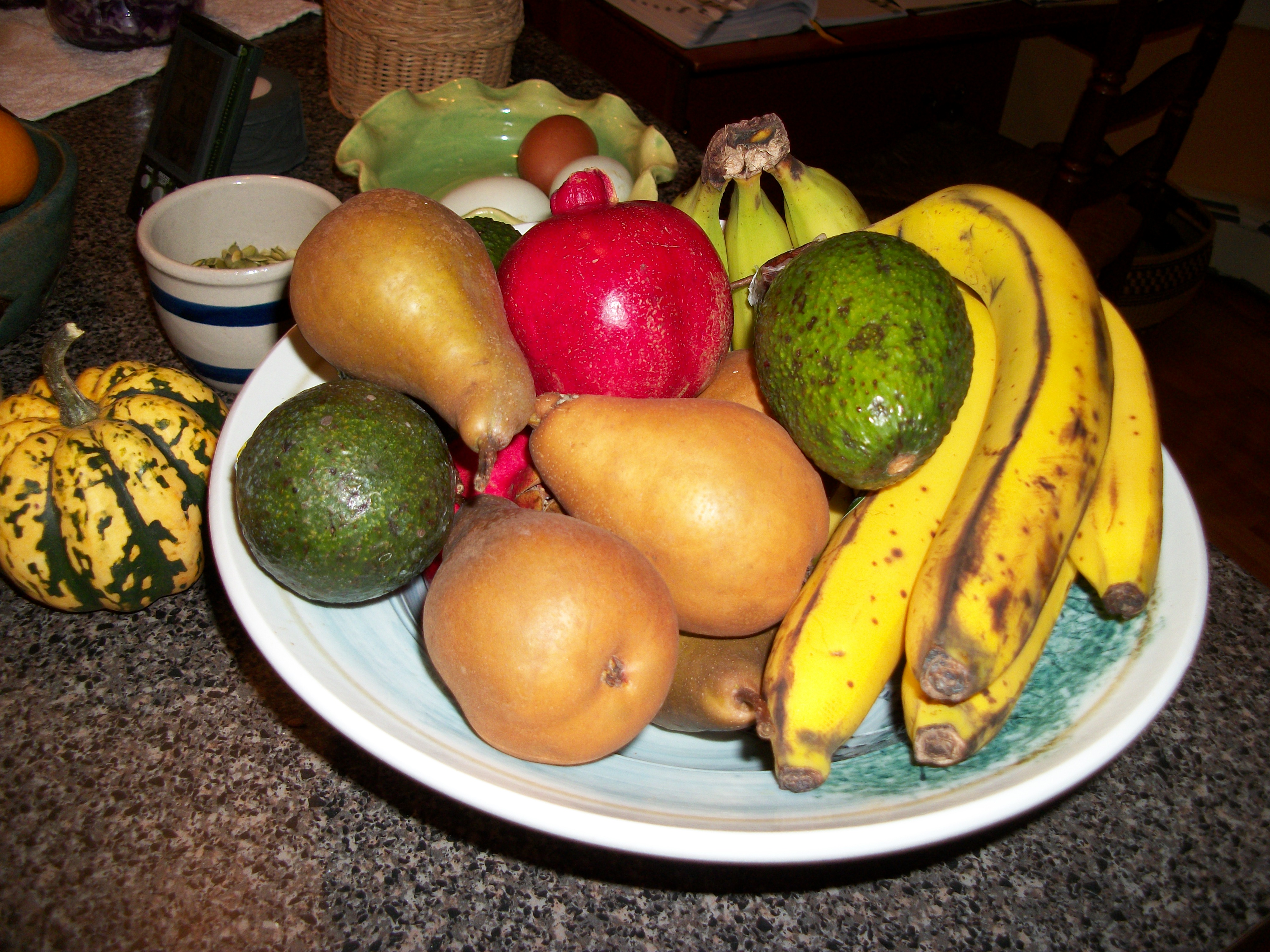
That big red fruit in the middle is a pomegranate.  It’s actually a berry with seeds.  It’s full of vitamins, minerals, and fiber.  The seeds are delicious.  About the only thing wrong with it is that the only place it can grow in the United States is California–which means I’m eating food out of my bioregion, shipped here from many miles away.   Actually, pomegranates are from a really hot-weather plant that grows in the tropics and in, I think, places like the Middle East and India.  Nevertheless, I buy one or two a year for the sheer pleasure of eating the seeds.  They pop in the mouth, releasing a juice that I love.

For years, I didn’t know how best to clean them.  It’s really easy when you know how.  Just cut them in half–top to bottom–and put the halves in a large bowl or pot filled with cool water.  Push the leathery back of the fruit into the center where the seeds are, while pulling at the sides.  The seeds will begin to pop out, and the rind and white fibrous bits inside will float to the top where you can skim them off.  When you’ve got all the seeds free and the debris scooped off, strain the seeds.  I often put them on a towel to soak up excess water.   They refrigerate well for some days, if they last that long.  Children love this whole process.    


Another fruit that is NOT in my bioregion is the clementine.  And, I love them to distraction.  They begin to appear in our market in mid-fall.  And I cannot seem to resist buying them.  They come in little wooden boxes that are a composter’s nightmare.  What a waste of wood and effort.  Here’s a  bowl of them on the kitchen counter:

And  here’s what happens to them in short order as both John and I eat them as if they were cheeries:


What else falls into the “out of my bioregion” conundrum?  Avocados.  Almonds.  Bananas.  (Enjoy those because industry reduced bananas down to one variety which now has a disease that will wipe them all out in a predicted number of years.  I forget exactly why–it has something to do with establishing root stock since the plant maybe does not grow via seeds–but there isn’t much of a viable solution to the problem.  Here’s a real important lesson about monoculture agriculture.)   Coconuts.  Dates.  Olive oil.  Lemons.  The pears in the fruit bowl came from Washington state.  As do a lot of the apples in the local, non-supermarket stores where I shop.  That’s a shame because Maine has really good apples.     

Mercy!

I am trying to improve how I can stick closer to my bioregion in the winter.  I freeze local fruit, and my freezers are full of it.  It’s so yummy in yogurt smoothies.  I freeze raw apple cider when I have room.  More and more of our farmers are raising winter greens in hoop houses now.  Even my cold frame is full of them.  Instead of olive and coconut oils, I can make better use of animal fats (chicken and duck fat, lard, tallow, and BUTTER!!!).  I put up fermented cabbage (sauerkraut) which makes a little raw-food salad on the plate for us.

Here’s what a recent dinner plate looked like:


The green beans and lemon came from away, of course.  I could have used my own frozen green beans, but we usually put them into soups.  The sauerkraut is from the jars I showed you in an earlier blog.  The butter on the beans, squash, and very-lean grass-fed sirloin steak is local and made from real cream (not pasteurized).  Our bodies need fat to process lean meat.  If you don’t supply the fat, your body will have to pull its own enzymes to process the lean meat, which robs the body of needed nutrients.  The squash was locally grown and was delicious.

So, I’ve gotten this meal at least half-way into my bioregion.  It’s a start.

What I absolutely refuse to buy is any produce coming from outside the United States.  Right now there are all sorts of fruits and vegetables in our markets from far-flung places like Israel and the Phillipines.  That carbon footprint is way to deep for me.  And, I’m highly suspicious about the quality of that food anyway.  That kind of food makes the Florida and West Coast food seem a little more appealing.  

But, in the end, I want to support our local farmers.  I want to create an interdependence in my own community as much as I can, because I do believe that the days are numbered when we can afford (in many more ways than just our pocketbooks) a food system that ships food all over the country and the world. 

Now I understand why my mother talked about the joy of getting an orange or some almonds in her Christmas stocking.       

Turkey Tracks: Jane Smiley’s PRIVATE LIFE

Turkey Tracks:  January 9, 2011

Jane Smiley’s PRIVATE LIFE

 I finished reading Jane Smiley’s new novel PRIVATE LIFE (May 2010) last night.

I highly recommend it.

It’s the work of a mature author writing at the top of her form.  It’s engaging at all levels:  character development, plot, mystery, profound engagement with issues and ideas. 

It’s a bit of an epic, since it chronicles the main character’s life from teenage years to mid-sixties–beginning in the late 1880.  Margaret is well on the road to spinsterhood in a small Missouri town 300 miles from St Louis, when a marriage is arranged with a locally famous, seemingly brilliant but socially awkward man from a prominent family who might become a nationally famous scientist.  They move to coastal California near San Francisco and live on an island with a naval base, and her decades-long discovery of who her husband is–and who she is–actually begins.  (No, he is not a serial killer–this is a serious study of character and the changing conditions for women and the culture in general through this period.)  The Japanese have a settlement just inland from the island, and the Margaret brushes up against a particular Japanese family for many years.  She is devastated when they are swept up and put into internment camps when WWII breaks out–an occurrence that brackets the novel’s opening and closing pages.

I wish I could go back and read it new once again.

Turkey Tracks: Taking the Sail Out of It

Turkey Tracks:  January 9, 2011

Taking the Sail Out of It


We have this huge white pine directly back of our house.  This picture does not do its height  or the steepness of the hill justice.


Here it is, looming over the back of the house.  As Tom Jackson, our resident expert said, ” it’sthe biggest boy in the woods so there’s nothing to stop it.”  Note the “sail” at the top of the pine–all the green lollipop growth at the very top. 


You can see the growth pattern of the pine–which is very typical of Maine woods, which are in many places, like around our house, new woods filling in where the land was clear-cut.  The first growth from cleared woods is all quick-growing trees for the most part:  ash, birch, beech, “prollies” (poplars), and white pine.  We do have some hardwood oak and sugar maples and a few old-growth conifers, like hemlocks.  The white pines grow very quickly, and as they are surrounded by quick-growing trees, they all develop “sail” tops and lose the green on their mid to bottom branches.  Thus, this white pine was scary because white pines have shallow roots, topple over easily in high winds or rain-soaked ground.  This situation is worsened by its location on a steep hill slanting toward our house.  

This tree gives me nightmares.  It’s big enough to cleave the house if it came down our direction.

So, the tree experts came, and their solution was to take out most of the “sail.”  They also trimmed up the dead branches.  They say it’s healthy all the way to the top, and with the sail trimmed out, unlikely to fall on the house.

You can see how big the tree is in this picture:


I hope they’re right!

Turkey Tracks: Liam Whittle’s “Teddy Bear Tales” Quilt

Turkey Tracks:  January 9, 2011

Liam Whittle’s “Teddy Bear Tales” Quilt


 I fell in love with this quilt panel when I saw it a few years ago.  Maybe it’s because I’ve always loved Teddy Bears.  It told me it wanted to be sent to Liam Whittle, who is just the right age for teddy bears sleeping on his bed.  I made this quilt to be tough, washed, dragged around, and loved to pieces. 

This is the first quilt I’ve quilted on the long-arm.  It came out pretty well.  I just kept to the basics, but the machine is so much fun to work!

Here’s a detail of the front panel.  I hope Liam and his parents and his sister will make up stories that explain the pictures.

Here’s the backing fabric.  Is it perfect or what?  I really love the childrens’ quilt fabrics available now.

Enjoy, Liam.  Many hugs and kisses and love!  Your Great Aunt Louisa