Turkey Tracks: Do Yourself a Favor: Cook and Eat Dark Leafy Greens

Turkey Tracks:  June 19, 2010

Do Yourself a Favor:

Cook and Eat Dark Leafy Greens

Dark Leafy Greens are chock full of nutrients.  I’m talking Lambs Quarters, Bok Choy, Collards, Turnip Greens, Mustard Greens, Chicory, Dandelion, Kale, Parsley, Dock, Endive, and Watercress.  (Lamb Quarters and Dock are wild greens:     for dock, see http://eatingmymoccasinsnow.blogspot.com/2009/04/dock-rumex-crispus.html; for lambs quarters see http://www.google.com/search?hl=en&rlz=&=&q=lamb+quarters,+image&um=1&ie=UTF-8&tbm=isch&source=og&sa=N&tab=wi&biw=1362&bih=669.

I’m leaving out spinach, chard, and beet greens because they have high levels of oxalic acid that can cause a number of unpleasant side effects:  kidney stones and the reduction of the body’s absorption of calcium and iron among them.  Though I love spinach and chard, I eat these greens sparingly and, pretty much, only in season.

I try to cook several batches of dark leafy greens in a week, and I cook enough of them at one time to have leftovers.  Cold greens are delicious drizzled with a vinaigrette or a tahini or peanut dressing.  But, my favorite leftover use is to use the greens inside an omelet–with added cheese.  An omelet of goat cheese and cooked greens is great for breakfast, lunch, or dinner.  And, the combination of greens, egg, and cheese is…delicious!

According to Rachel Albert-Matesz and Don Matesz, in their cookbook and guide, THE GARDEN OF EATING, kale has 250 percent more vitamin C than an orange, 4, 450 percent more Vitamin A, and more potassium, iron, phosphorus, calcium, and protein (308).  Rachel A-M has a terrific web site, too:     http://www.thehealthycookingcoach.com/.   I highly recommend the cookbook.  I’ve yet to cook something bad from it, and it has significantly expanded my ability to  cook greens and to create satisfying meals without using grains.  Her web site has the cheapest prices–it’s under $30.

These dark leafy greens need to be cooked.  They don’t lose substantial nutrients, and cooking reduces some of the bitter compounds that can hinder digestion and absorption of nutrients.  Think of cooking them for at least 10 minutes.  This aspect of dark leafly greens makes me hesitate about juicing them, too.

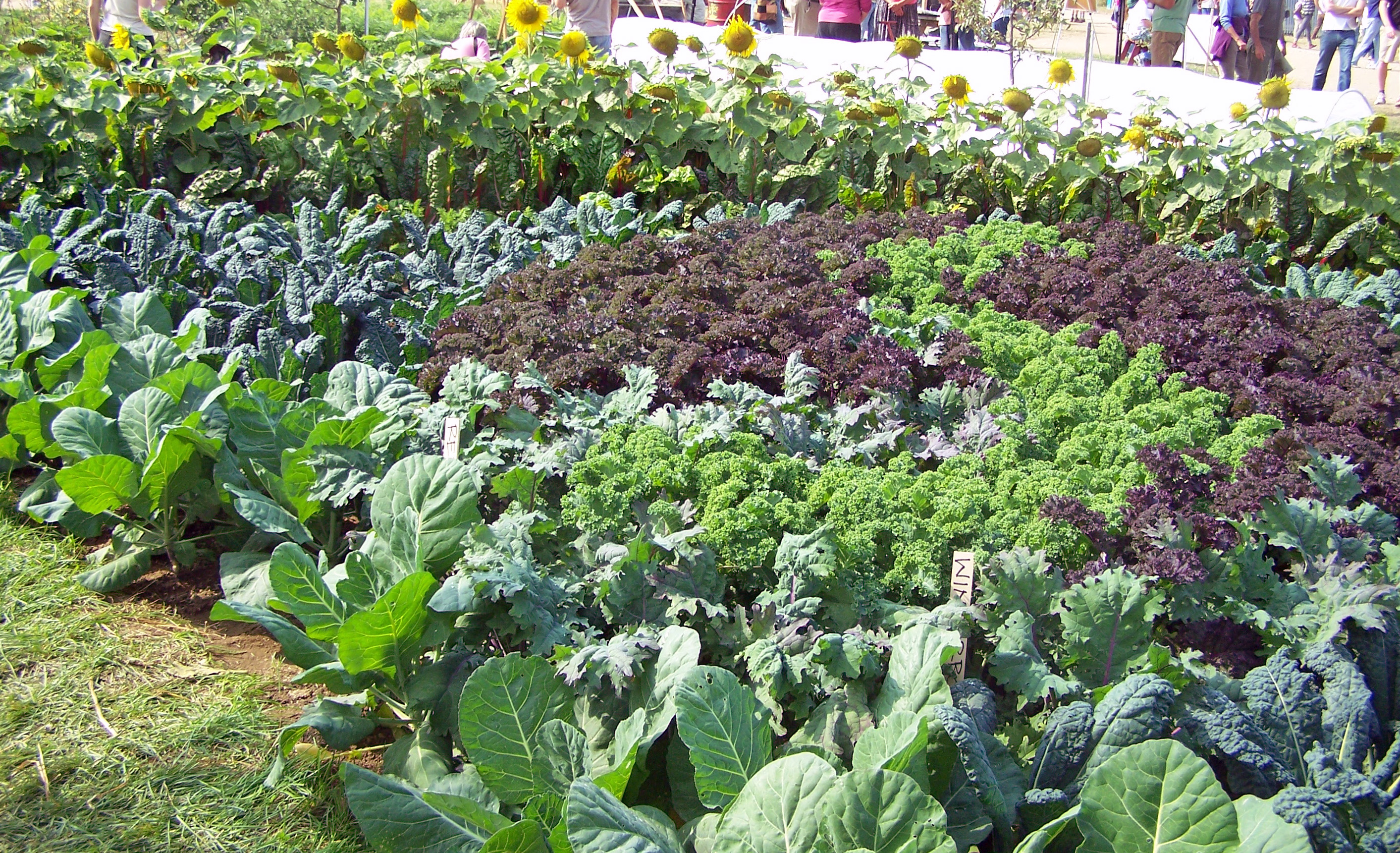
My favorite greens are kale and collards.  Kale comes in various, beautiful forms, and each tastes slightly different.  You might recall a picture I took of some kale forms at the Maine Organic Farmers’ and Growers (MOFGA) fair last year.  Collards are in the foreground.
There are two principal ways to cook greens:  boil whole leaves/stems or pan saute and steam greens in a large, covered frying pan or pot.  I use both methods.  I boil when I want to prep greens ahead.  I particularly like kale boiled, chopped, and, later, sauteed in butter.  In both cases, you need to strip or cut (collards) the leaf from the fibrous stem.  Kale stems are more tender than collards.  Rachel A-M cooks kale stems and chops them when tender and adds them back to the leaves.  I’ll confess, usually I give the stems, which always have a few remaining bits of leaves, to the chickens as they take true delight in them.

For boiling, bring water to boil, drop in the whole leaves, and cook until tender–at the most from 5 to 10 minutes.  Drain, immerse in cold ice water to preserve color, and chop.  If you layer the leaves, then roll them, you can slice off strips.  Turn the strips and cut off bite-sized pieces.  Refrigerate for up to three days.

To pan saute, your imagination is the limit of fun combinations for additions.  Start by stripping leaves from stems.  Roll leaves and slice and cut, again, to make squares.  Sometimes, though, I just roughly chop greens.  Here’s a picture of two bunches of  leafy green kale.  When cooked, there will be enough for four servings.  John and I eat one serving each hot and then we have an asset in the kitchen:  cooked greens to be used in other ways, like an omelet.  Or, eaten cold.  The point I’m making is that greens COOK DOWN rather a lot, so buy enough.

Kale is tenderer than collards.  And, collards, in particular, benefit from the addition of meat broth for liquid, or an extra chicken/turkey wing in the pan.  When I make broth, I always pull off several small 1-cup Mason jars to use when cooking greens.

The basic method is to start by pan frying a chopped onion in good oil/fat.  I use unrefined coconut oil, or duck fat, or saved bacon grease, depending upon what kind of flavors I want.  Adding bits of flavoring meat, like pancetta or bacon, is nice at this stage.  Add some chopped garlic just before you get ready to add the greens.

But, before that, consider what kind of SPICES you’d like to have running around the pan.  Perhaps some combination of spices–cumin, cinnamon, coriander, turmeric, for instance.  Curry powder?  Put those kinds of spices into the pan and let them fry in the fat for a moment or two–with the garlic if you’re using it.  Mustard is a nice addition.  Any of the hot pepper spices, like paprika or red pepper.  And nutmeg is lovely with greens.  Thyme or sage is nice.  Gingeroot is lovely.

You could throw in some sliced apples in the fall.  Or, a handful of dried fruit in the winter.  (Think of drizzling in some honey or maple syrup at the end if you go in this direction–with a bit of fruity vinegar to spark the tastes.)

A handful of cleaned seaweed (dulse, for instance) gives some heft and adds iodine, which I think about since I don’t eat grocery store salt.

Adding other vegetables is also nice:  carrots, mushrooms, cauliflower, daikon radish, celery, bell pepper strips.

USE WHAT YOU HAVE IN THE KITCHEN.

When your veggies and spices are sweated out/mixed in, throw in the greens.  If they have enough water from washing, you can begin to turn them with tongs until they wilt down.  If you don’t have enough liquid, add water/bone broth (about a cup) to the pan–mopre for collards–wilt down the leaves, and cover and cook for 5-10 minutes.  Collards will require longer cooking.  Remove the lid and cook down any remaining liquid at high heat before serving.

ENJOY!

Turkey Tracks: Sardines For Dinner

Turkey Tracks:  June 15, 2011

Sardines For Dinner

Here’s what we had for dinner last night:

There are lots of good reasons to eat sardines.  They’re a little fish and are low on the food chain, so they don’t carry the heavy metal levels (mercury!) bigger fish carry.  They’re full of calcium!  They’re delicious!  They’re quick!  (Be sure to buy some that are NOT in soy sauce.  The ones in flavored sauces, like tomato and mustard, are usually full of stuff you don’t want.)  We had some fresh ones in Italy once–just caught and pan fried.  They were beyond delicious!

Surrounding the sardines, what you see is local carrot, local feta, local sweet radishes just coming in now, shaved spring onion from the garden, local hydroponic tomato (cut up and sprinkle tomato with salt to release the flavor), and local lettuce from our neighbors Susan and Chris Richmond of Golden Brook Farm.  The rest of the ingredients are not local:  dried lemon thyme, olive oil, lemon, balsamic vinegar, olives, stuffed grape leaves from a can, avocado, and a cuke.   At least the produce came from California–I don’t buy food from outside our borders.

The chocolate is fair trade.  One of the best of these is Equal Exchange’s dark chocolate with sea salt and toffee bits.

And, of course, REAL MILK, which is fabulous with the chocolate!

PS:  Canned sardines and grape leaves are one of the few things I eat out of a can as most cans are lined with a mixture that releases BPA–a heinous chemical that can seriously harm humans.

Turkey Tracks: Skunk Recipe!

Turkey Tracks:  May 30, 2011

Skunk Recipe!

We don’t usually have skunks around the house.

No No Penny does not allow them under any circumstances.

If we do get a whiff of skunk, it’s always been in the spring.  That’s when I thank my lucky stars neither of our girls has taken on a skunk and when I check to see if I have skunk-bath ingredients on hand.  It’s a pretty simple mixture, and Mainers swear it is better than tomato juice:  1 quart of hydrogen peroxide, 1 cup of baking soda, and 1 Tablespoon of dishwashing detergent.  Wash until the odor goes away.

So, the other night Miss Reynolds Georgia, aka The Beauty Queen, NEEDED to go out in the middle of the night.  She signals this need by crawling out from the covers, sitting on the end of the bed, and harumping in a low throaty growl–like dripping water–until you get up and put her out.  Which I did finally.  She takes her sweet time, too, and strolls about the yard smelling things in the moonlight.  I know she does because she’s so white that she stands out like a neon light.

Once back in bed, I began to realize that skunk odor was flooding through the windows at my head, though the bedroom is on the second floor.  It was so strong that I seriously wondered if Rey Rey had been skunked and in my sleepiness, I had not picked it up.  I hauled her our from beneath the covers to smell her.  No, she was good.

It was so strong that I worried I would smell like it the next day since my understanding is that “skunk” is an oil that disperses into the air.  Or, the room would.  For days!  Gradually it faded, and I fell back to sleep.

Tomorrow:  hydrogen peroxide.   Ours is a year out of date now.

And, thanks, girls, for being too smart to get skunked!

The girls are 8 and 9 years old now, and it’s hard to believe.  Here’s a pic taken last summer in June:

No  No Penny, on the left, is a Katrina rescue–when she was about 2 years old.  She is the kind of Rat Dog I grew up with–a savvy and relentless hunger, a huge protector of her people and her property, a sunny and funny personality.  She’s a bit heavier this year because she crawls under or into the chicken house–though she is terrified of the rooster–and eats whatever meat and milk they have not finished yet.

Rey Rey is on the right and has a lot of Chihuahua in her line–something breeders are doing to perfectly good rat dogs.  She is my faithful shadow throughout the day and night–except when the black flies are biting.

Both are smarter than you can believe and have huge vocabularies.    Except for Penny’s early life, they’ve never had any dry dog food.

Turkey Tracks: Juicing

Turkey Tracks:  May 27, 2011

Juicing

My niece, Lauren Howser Black, is starting to experiment with juicing–which she shared on Facebook.

I am trying to figure out juicing myself and am slowly coming to some conclusions.

First, all food is made up of three ingredients:  protein, fat, and carbohydrates.  Protein and fat are the building blocks of the body.  They are absolutely necessary for ideal  human health.  Carbohydrates are, apparently, not, since one can get every single nutrient, vitamin, enzyme, etc., one needs from meat alone.  (This information comes most recently from Gary Taubes in WHY WE GET FAT–which I covered in Tipping Points Essays 29 and 30.)

We eat carbs to give ourselves energy.  And, they taste really good for the most part as most are yummy fruits and vegetables.  But, the plant kingdom has been vastly misunderstood for some time.  Plants are chemically based, and they can pack a powerful punch.  For instance, all the major drugs that really work come from plants.  And, plants have chemicals that are absolutely addictive for humans.  Sugar and grains are an example.

Second, humans do not handle cellulose well at all.  Unlike cows, we don’t have four stomachs full of bacteria specifically meant to break down cellulose, in the form of grass.  Our system is much closer to dogs.  We have a single stomach, longer intestines, and bacteria specializing in processing meat and fats.  When we overload them with cellulose, we set up gut conditions that make us sick since all that bulk in the gut, according to Dr. Natasha Campbell-McBride, who wrote GUT AND PSYCHOLOGY SYNDROME, starts preventing the absorption of the good nutrients we need.

Third, humans really do not handle sugars well at all.  Sugars of all kinds throw off the delicate balance of our digestive system–which, in turn, causes the host of chronic diseases associated with people who have settled in one place and are growing, particularly, grains.  You’ll recognize some on the following list:  arthritis, diabetes, hypertension, heart disease, stroke, depression, schizophrenia, and cancer.   Autoimmune and inflammatory conditions abound.  These all appear alongside developmental degradation, like crooked teeth and bad eyesight.  Hunter-gatherers and nomad herders, on the other hand, have been and are (yes there are still some in the world) disease free.  [This kind of assessment is widely discussed.  Here, I’m using Lierre Keith’s recounting of this history in THE VEGETARIAN MYTH (139+).  She is, in turn, drawing on the work of Dr. Loren Cordain, who has worked extensively with archeological evidence of what earlier people ate and how it affected their bodies.]

Given this information, one might avoid all carbs.  I think that would be hard, and most hunter-gatherers and nomadic herders foraged for greens, tubers, seasonal fruits (which were much less sweet than our fruit today), and the like.  Plus, we are surrounded with eye-catching produce all year around.   AND, one has to consider, also, that juicing has long had a place in healing circles.  Maybe it works to detoxify the body–short term–but long-term health requires nutrient dense foods.  Vegetables are not nutrient dense.  Period.

Dr. Natasha Campbell-McBride absolutely holds a place for juicing in the GAPS diet.  (I wrote about GAPS in Tipping Points 31.)  But, she is dealing with a population of sick people (autism, in particular) who have significant gut issues.  (There is a growing recognition that autism almost always has a particular profile of an impaired digestive system AND that autistic people crave carbohydrates and have very limited diets.)  I know I have a gut issue–it was the root cause of my food allergy issues.  I suspect most Americans today do, given all the grains, other carbs, processed food, and chemicals they’re eating.

Dr. Max Gerson was one of the pioneers of healing the body through, among other practices, juicing.  But, he also used infusions of raw liver as well.

Dr. Joseph Mercola, who has an interesting web page and who wrote THE NO-GRAIN DIET, juices–but mostly green vegetables.

So, how to think about this issue?

It’s pretty clear that fruit juices are really high in sugar and offer a terrible jolt to the system.  Fructose sugars are particularly difficult for the body to handle and cause elevated insulin levels.  No one should ever drink commercial fruit juices.  If one is struggling with obesity, too much fructose can and does lead straight down a road that has stops at diabetes, metabolic syndrome, and so on.  But, what about vegetable juices?

I have a Vita-Mix, which pulverizes whatever goes in, so I have to think about all the added cellulose as well.  I’ve decided I need to strain whatever I am going to mix up.

Let’s start with a seemingly balanced approach.  Campbell-McBride says juicing is a great way to get nutrients without all the cellulose.  She advocates about a 50-50 ration of fruits to vegetables.  The sweet in the fruits make the good of the vegetables drinkable–especially for picky eaters.  And, the GAPS work shows that some fruits help heal the gut.  She  recommends two cups of juice a day total.  Here are some of her suggestions:

Pineapple, carrot, and a little bit of beetroot (5%  total) in the morning prepares the digestive system for the coming meals.

Carrot, apple, celery, and beetroot cleanses the liver.

Green juices from leafy veggies (spinach, lettuce, parsley, dill, carrot, and beet tops) with some tomatoe and lemon chelate heavy metals and provide magnesium and iron.

Here’s a list of vegetables she uses:  carrot, beetroot (5% of mixture only), celery, cabbage, lettuce, greens (spinach, parsley, dill, basil, fresh nettle leaves, beet tops, carrot tops, white and red cabbage)

And, her list of fruits comes from the GAPS approved fruits.  She also really likes black elderberry as an immune builder.

The Green Approach.  Dr. Mercola does not permit fruit juice because of the elevated levels of sugar.  I’m not sure I see the difference between eating an apple and juicing it, however, especially since I have this new sensibility about all the cellulose in the apple itself.  Anyway, his juicing is confined to green vegetables.  He avoids carrots, beets, and squashes.

Here’s his beginner green drink:  2 stalks of celery, 1 cucumber, 2 stalks of fennel.

He recommends starting with 1 or 2 ounces and adding to that until you are drinking 12 ounces at a time.

He recommends mixing mild greens (lettuces, but not iceberg; endive, escarole, spinach, cabbage) with stronger veggies (kale, collard, dandelion greens, mustard greens), and adding herbs, eggs (1 to 4), and some flavorings (1 Tablespoon coconut that is whole fresh grated or unsweetened dry from a health food store, 1 Tablespoon fresh cranberries, 1/2 lemon, 1 inch ginger root).

Hmmmm.   I’d have to work up to liking these green mixtures.  But, it’s something about which to think.  I would caution that spinach and chard have high levels of oxalates which can give you kidney stones if eaten in excess.   Also, I really like the cookbook THE GARDEN OF EATING, Rachel Albert-Matesz and Don Matesz.  She has a few juiced drinks as well, but has a Vita-Mix and one eats everything.

CAUTION:  YOU MUST USE ORGANIC PRODUCE!  If you want to be healthy, you cannot consider eating anything that is full of poisons.  Juicing for health when you’re using a tainted food defeats your whole purpose.  The Environmental Working Group now has a web site listing what poisons are on our foods:  http://www.whatsonmyfood.org/

I juiced a mixture of fruits and veggies today, and we drank it for lunch.  I used too many fruits.  It was sweet and good, but I had a headache an hour later.  I think for the moment I’m going to stick with my homemade yogurt, egg, coconut oil, fruit smoothies for the moment, with more limited fruit included.  And, a tonic of raw eggs, lemon juice, and honey.  Maybe I’ll play around with Mercolas more green suggestions.  But, we eat so many fresh, locally grown greens and bone-broth soups, that maybe I don’t need the juicing thing.   I am worried about too much fruit and weight loss, which I need to do.  Hey!  I just read that cinnamon is MAGIC for getting tired, insulin-resistant cells to give up fat.  Will add it to my smoothie in the morning.  I do like Campbell-McBride’s suggestions–just have to curb the urge to put in more fruit.

Turkey Tracks: Yogurt and Lovey’s Gorp

Turkey Tracks:  May 23, 2011

Yogurt and Lovey’s Gorp

 Well, here’s something delicious!

It’s one of our favorite breakfasts…

I make homemade yogurt about every 10 days–a half gallon at a time.   The recipe for how to make yogurt is on this blog.  Click on recipes on the right-side of the screen, and you’ll find it.  I make it in the early evening, so it “makes” overnight.   This batch was made from yogurt that sat in the regrigerator while we went to Charleston, SC, for, all said and done with delayed flights home, 15 days or so.  The starter was pungent, but it made the densest custard I’ve ever seen.  And the flavor was superb.

There are few things in this world as delicious as raw-milk yogurt while it is still at room temperature.  We scoop out a bowl full–making sure to get some of the cream.  Cut up some fresh fruit–bananna this time.  add a handful of my gorp–I keep a batch in a pottery lidded jar on the counter for snacking–and drizzle with, this time, Green Hive Honey Farm UNHEATED honey.

We didn’t get hungry again until mid-afternoon.

Lovey’s Gorp

(That’s me!)

There are no proportions–you just mix up what you like from your “assets”–ingredients you keep on hand.

Here are some ideas:

Dried organic coconut shavings;

 Selections of nuts and seeds you’ve soaked in salted water and dried in an oven or a dehydrator–you soak nuts and seeds to remove their phytates, which can seriously interfere with how your body accesses and processes the nutrients you eat–how to do it is elsewhere on the blog–and above I used pecans, hazelnuts, pumpkin seeds–I don’t use walnuts since they need to be refrigerated;

Selections of organic dried fruits–above are cranberries and blueberries;

Perhaps some chocolate chips…if you’re feeling decadent and are needing a chocolate jolt.

Turkey Tracks: Chicken Feed Recipe

Turkey Tracks:  February 9, 2011

Chicken Feed Recipe

Our chickens are very tired of being “cooped up” in their coop and attached cage, both of which are now banked high with snow and which are, therefore, dark.  You will recall that the chicks were venturing out in the snow paths we made, lured by me and sunflower seeds, until a bird (an owl?) killed May May at dusk one day.

The cage, actually, has about 2 feet of snow on its top as well–which probably provides quite a bit of insulation, especially since I layered tarps over it before the first snow fall.  Inside the coop, we have a red 60 watt translucent light, which gives them a bit more heat.  (The temps up here were in the teens last night.)  I plug in the light in the morning when I feed the chicks so they have some light in their coop during the day.  I turn if off about 8 p.m.  They don’t really like the light on all night, so I only leave it on all night when the temps fall into the single digits.  They get quite cross when they go all night with the light on.

Chickens are very social, so I try to visit them several times a day after they have finished laying.  They don’t like to be disturbed when they are laying.  I open the roof, and they come to see me.  Several will fly up to perch on the opened roof edge and like to be petted and rubbed.  All of them talk to you.  I throw a handful of sunflower seeds into the cage, which is now many inches deep with coop bedding that falls out when the cage door gets opened in the morning.  They scratch around looking for the seeds, and it gives them something to do.  They are VERY bored.  (The dogs are too.)  The other day I sacrificed some of my compost worms and took a full bowl out to the coop.  Mercy me!  Those chickens were so excited.

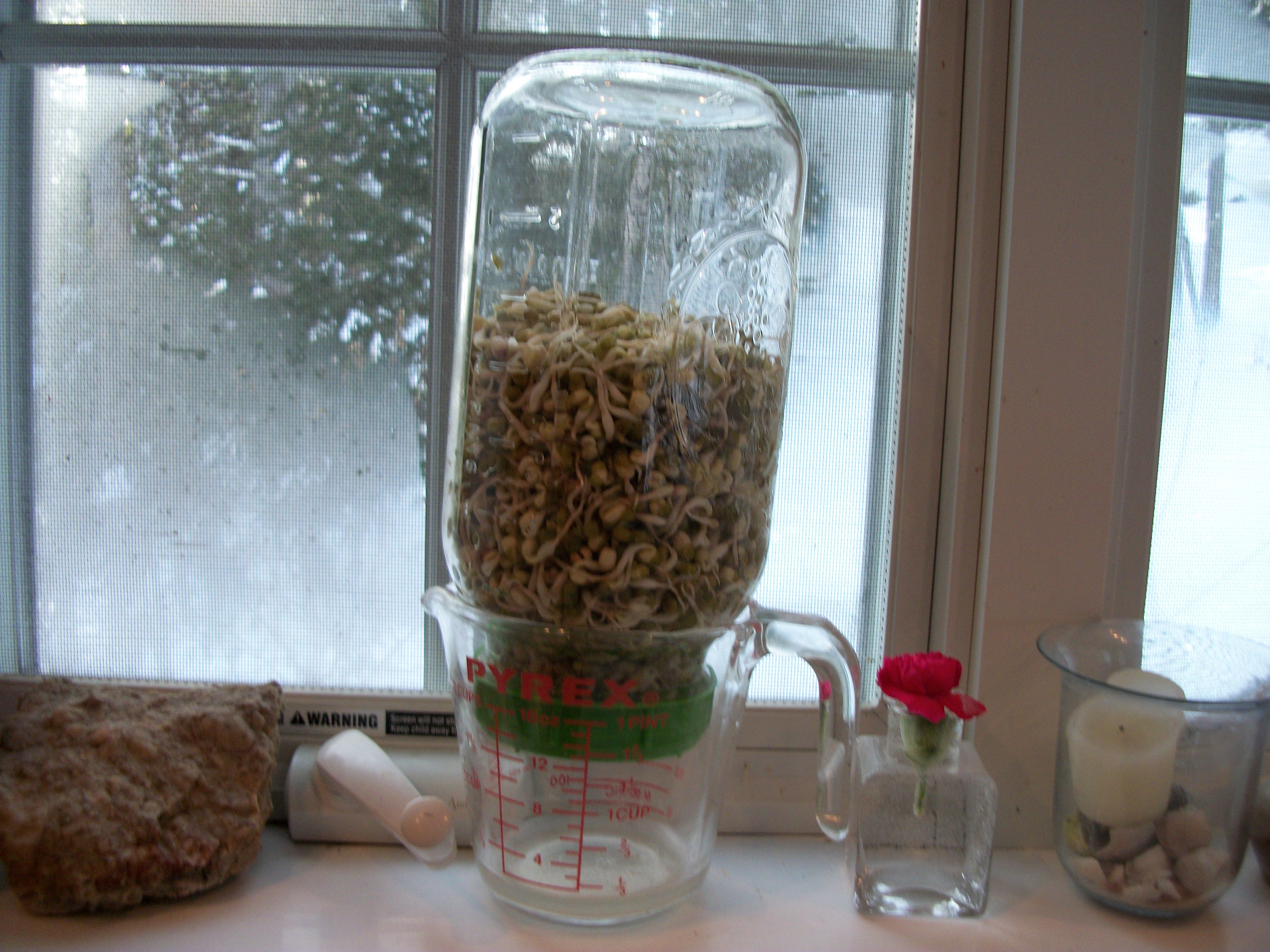
Chickens love greens, and now all the grass is covered with snow.  I give them as many greens as I can–leftover lettuce, cooked greens, the stems from cleaning greens, and so forth.  I’ve even been known to BUY them some lettuce.  But, what the really love are sprouts, so I’ve been sprouting mung beans for them–something I do this time of year anyway to get fresh greens into our diets.  If I leave the sprouts growing longer, they start to grow leaves, and the chicks really like those.  Here are some sprouting in the kitchen window:

 That rock in in the window is a piece of the old, old Bryan mill stone from the mill out on what was once the farm in Reynolds, Georgia.  My Uncle Buddy gave it to me long years ago now.   The mill was gone by the time I was a child, but he remembered it.

I also give the chickens a big bowl of milk, some hamburger, a bit of bread to soak up the milk, kitchen leftovers they like, and whatever greens I can muster up first thing in the morning.  They love cooked oatmeal, like a warm mash, on a cold morning.  Ditto ground corn cooked in a bit of milk.  This food is their second choice, after greens.

I don’t feed my chickens commercial organic feed, which is full of industrial by-products, like spent, rancid oils, SOY, and  synthetic protein, needed because the corn/soy ratio doesn’t supply enough protein.    Chickens fed commercial feed, even organic feed, produce egg yolks with soy isoflavones, which are phytoestrogens that act like hormones and which affect human reproductive and nervous systems.

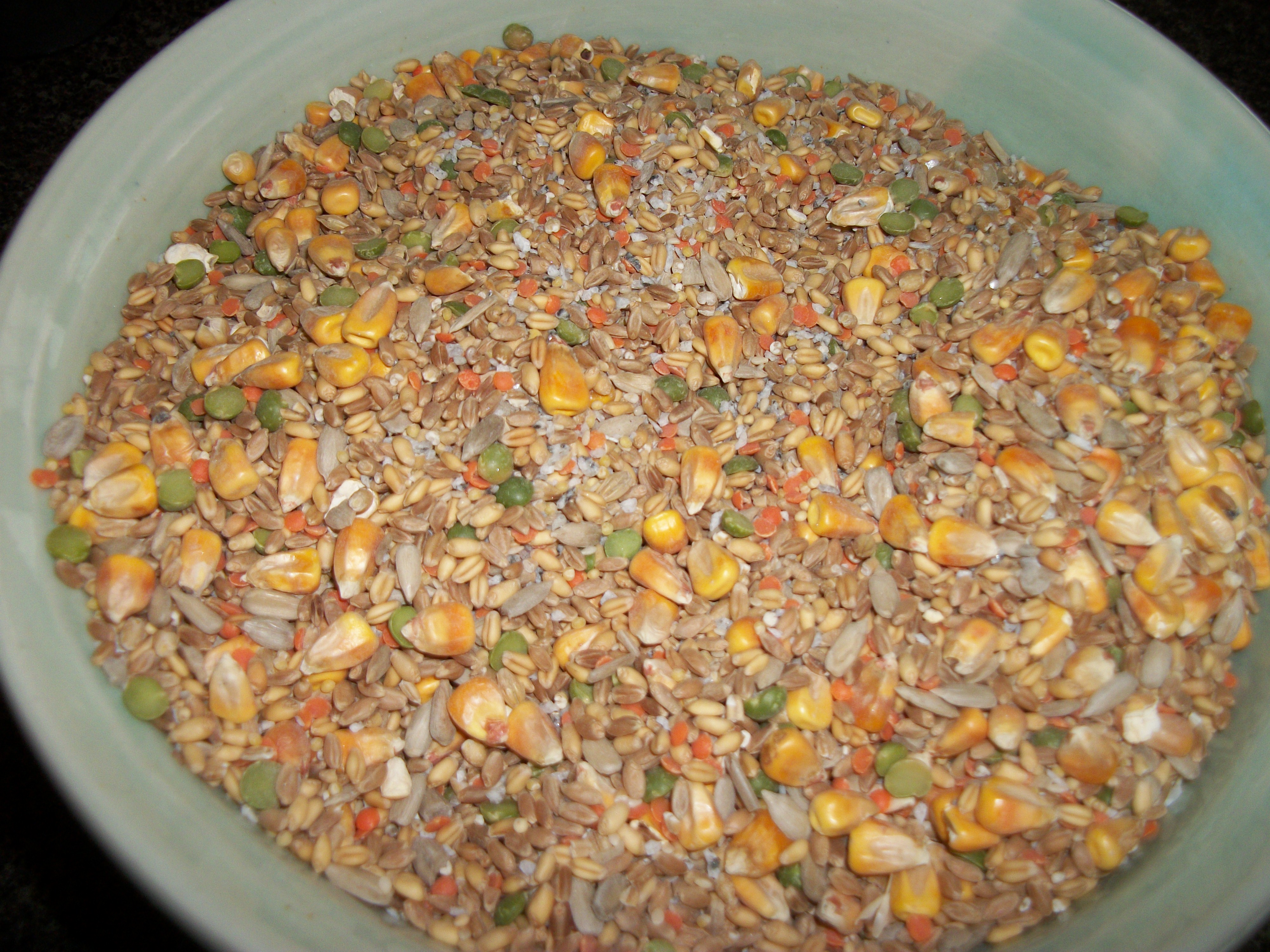
Here’s what the mixture I make for them looks like–and I’m darn lucky to have access to all of these organic grains.  Looks good enough to grind and cook, right?  I could, if I didn’t put grit into the mixture.  See the tiny rocks–grit–mixed it?  That’s what chickens use to help digest their food inside their crop, or gizzard.   Anyway, I keep all the grains, seeds, and beans separate out in the garage, so I can use them if I like.

I got the master recipe from a farm out west somewhere, called Greener Pastures (www.greenerpasturesfarm.com/ChickenFeed Recipe.html).  Thanks so much for sharing, Greener Pastures!

This recipe uses wheat, which has a fair amount of protein, as the base grain and peas and lentils for proteins.  Everything is organic.  So, here’s what I’m mixing up:

3 parts hard red winter wheat

3 parts soft spring wheat

1 part whole corn (I up this in the winter to almost 3 parts to help the chicks gain and hold fat, and in the summer I throw out a bit of whole corn for scratch feed.)

1 part steel-cut oats

1 part hulled barley

1 part hulled sunflower seeds

1 part green split peas

1 part lentils

Any other seeds/grain I think they’ll like for a change:  millet, sesame seeds, etc.

About two cups of grit per mixture.

Turkey Tracks: I Feel Rich: 5 Pounds of Processed Pecans

Turkey Tracks:  February 1, 2011

I Feel Rich:  5 Pounds of Processed Pecans


We’re almost out of the pecans my first cousin Teeny Bryan Epton and her partner brought to us last September.  (Thanks Teeny and Lori!)

With our friends Margaret and Ronald, we order many household items in bulk from Associated Buyers, located in New Hampshire.  AB delivers, also, to all our local coops, or cooperatively owned stores.  I ordered 5 pounds of organic pecans in this last order.  

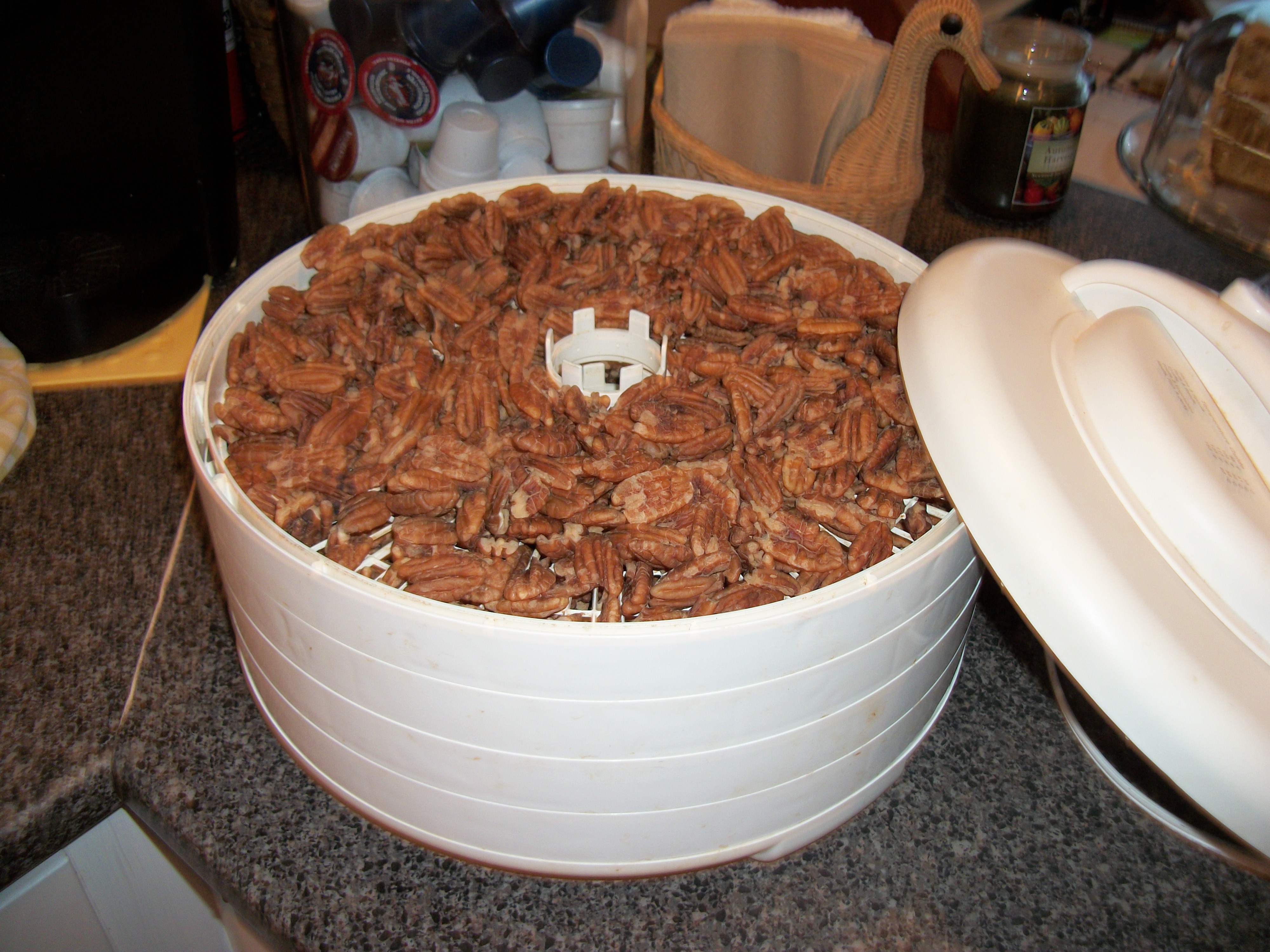
 I soak the nuts over night, dry them gently in the dehydrator, and store them in Mason jars.  Five pounds lasts for months and months.  I keep pumpkin seeds, walnuts, pecans, almonds, and, lately, hazelnuts.  Crispy nuts are delicious! 

ALL nuts, seeds, legumes, and tubers need to be processed in some way to remove the phytates that can prevent your body from absorbing nutrients it needs from many foods.  One prepares most nuts by soaking them in salted water over night and drying then in a dehydrator or an oven on very low heat.  Drying can take, sometimes, well over 24 hours.  I found this information and the recipes in Sally Fallon and Dr. Mary Enig’s treasure trove of a book, NOURISHING TRADITIONS.  Fallon and Enig are part of the Weston A. Price Foundation (www.westonapricefoundation.org).  (Be sure to use .org and NOT .com, which is a scam site.)  I trust the WAPF folks because they have the scientific credentials to understand the chemistry of food and human bodies and because they are not affiliated with industry in any way.

Here are the pecans in the four-tray dehydrator:

And, here they are all jarred up.  The big jar is a half-gallon size with which I’ve recently fallen in love.  Now I’m a rich woman!  I have food assets.

Turkey Tracks: Sunday Cooking–French Onion Soup Dinner

Turkey Tracks:  January 25, 2011

Sunday Cooking: 

French Onion Soup Dinner


We have some friends here in Maine who LOVE French Onion Soup.   Jack and Barbara Moore own the schooner Surprise, which takes people out of our Camden harbor for day sails during the summer.  They went to Tufts with John, and we did not know they lived here when we first began to get serious about moving to Camden.   We attempted to rent a cottage from them in January 2004 for the summer of 2004, and John realized who they were.  We all met at Boyton McKay for lunch (Phil had cooked vegetarian French Onion Soup), and the three old friends reconnected.   (Boynton McKay has the best pancakes in America–seriously, it does.) 

A week or so ago, Jack and Barbara invited us to dinner at the newly renovated cottage we once rented–it will now be their home–and it is beautiful–and I promised to make them French Onion soup.   Traditional French Onion Soup begins with a sturdy beef stock, but many French soups just use vegetables and water (leek and potato soup, for instance), though Julia Child always has a variant for a good bone broth stock.  In the winter, especially, bone broths are more prevalent because people are eating hearty meats for warmth.   And, if you know me at all, you  know I’m a passionate advocate for good bone broths.  They are nutrient dense and provide minerals we do not easily get elsewhere.  Besides, they allow the use of all parts of an animal.  Nothing gets wasted and it’s healthy to boot.  How can you go wrong?  Also, onions are storage vegetables, so we have a lot of them in the winter.  What a French Onion soup is, in the end, is a way to use what is prevalent in the winter season, and use ingredients in the most delightful way.

However, Barbara is mostly a vegetarian, so I promised her I’d make a vegetarian French Onion Soup.  And we invited them for Monday night, so I started by making a really good vegetable stock on Sunday afternoon:  2 celery stalks (you don’t want too much celery), some celeriac  I had from Hope’s Edge which is mild, 2 big onions, 3 spring onions greens and all, chard stalks, a small turnip, a parsnip, a few potatoes hanging around the potato basket, 4 carrots, three or four garlic cloves smashed, some of the parsley I froze, some dried lemon thyme, a bay leaf, and some good unrefined sea salt (which is full of minerals like magnesium and good for you,  unlike the fake salt in the grocery store which I never buy).  I would have used 2 leeks and 1 onion if I had had leeks.  Once assembled and brought to a boil, lower the heat, and simmer for about an hour.  You will have gotten all you need from the vegetables by then.  Let the stock cool and strain it through a colendar.   In this household, the dogs get the carrots the next morning mixed into their raw meat, and the chickens get some carrots, the chard stalks, the turnip, parsnip, and a few of the spent potatoes.   If  you can’t part with the vegetables,  pull off a bit of the stock and puree the vegetables in it, reheat,  pour in some heavy REAL cream or put a few tablespoons of butter on top, and you have another lovely soup.  If you don’t have animals, you could compost the spent vegetables.  If you don’t have a composter, put them outside under a shrub.   They don’t have any fat in them, so they won’t attract vermin, and you won’t be adding, mindlessly, to the waste stream.  The shrub will thank you. 

Anyway, here’s what the broth looked like on the stove.  Isn’t it pretty?


Roughly speaking, here’s what you need for the soup  ingredients:

2 quarts of stock minimum–I probably use 2 1/2 quarts–and at least  1/2 cup dry white wine (red isn’t bad if you’re using a beef stock)

8 or 9 medium to large onions cut pole to pole and sliced into 1/4-inch slices  (I use more than Julia who calls for 5 cups I think)

1 tsp. salt, a pinch of sugar, 3 Tablespoons of butter, and 2 Tablespoons of other fat (olive oil, coconut oil, tallow, lard)

Grated swiss cheese–good swiss which is sweet, not bitter, is usually European in origin.  And, if you like, the following enrichments:  3 Tablespoons of Cognac, egg yolks ( 1 to 4)

Really good French Bread Baguette

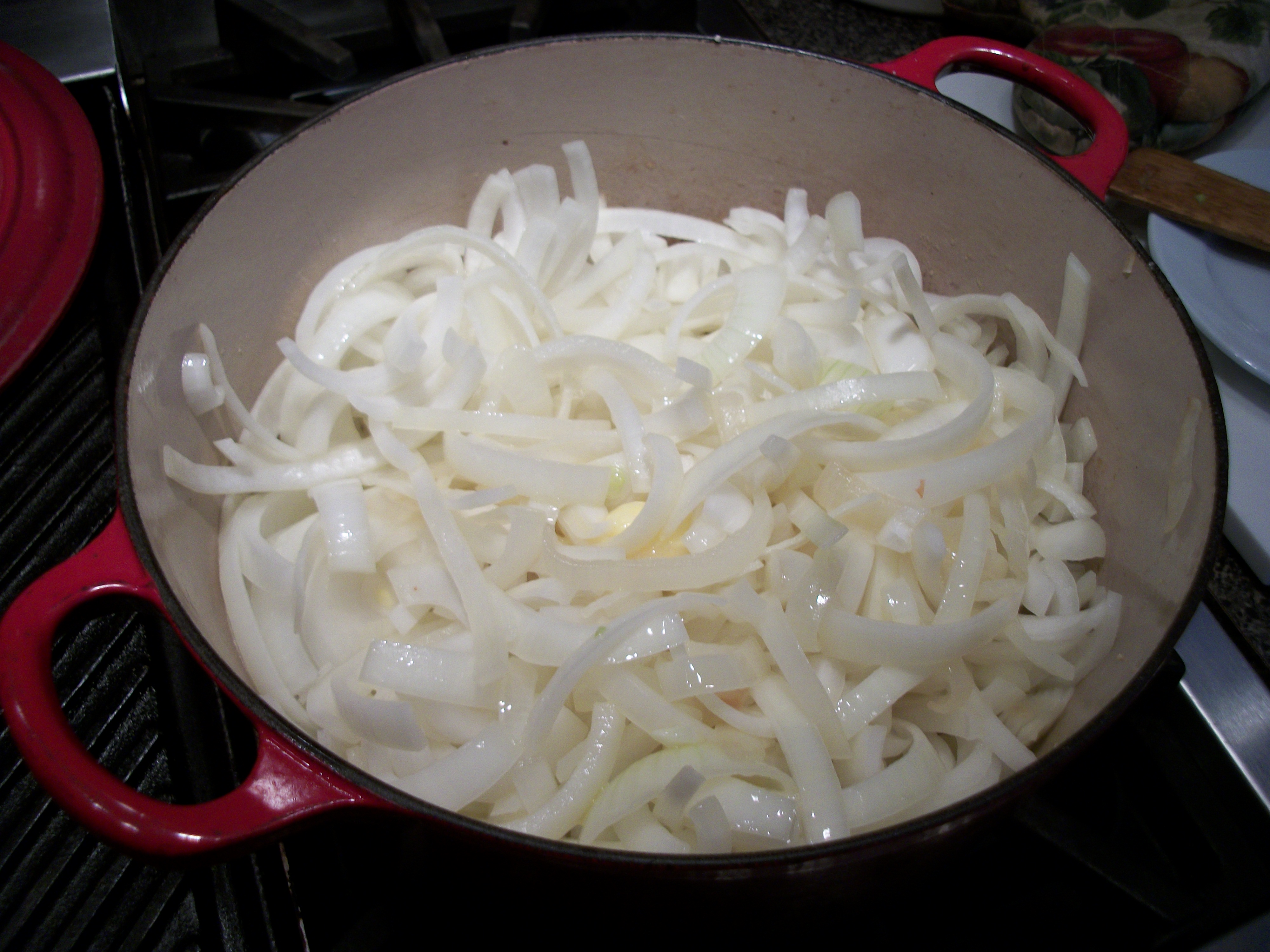
While the stock was cooking, I sliced up the onions, put them into a HEAVY pan with the butter, oil/fat, and salt, and on medium heat, began caramelize them.  When they have all melted down, add the bit of sugar which will help caramelize the onions.  Hang around the kitchen and stir them up every couple of minutes.  Keep the heat from being too hot.  You don’t want to burn them. 

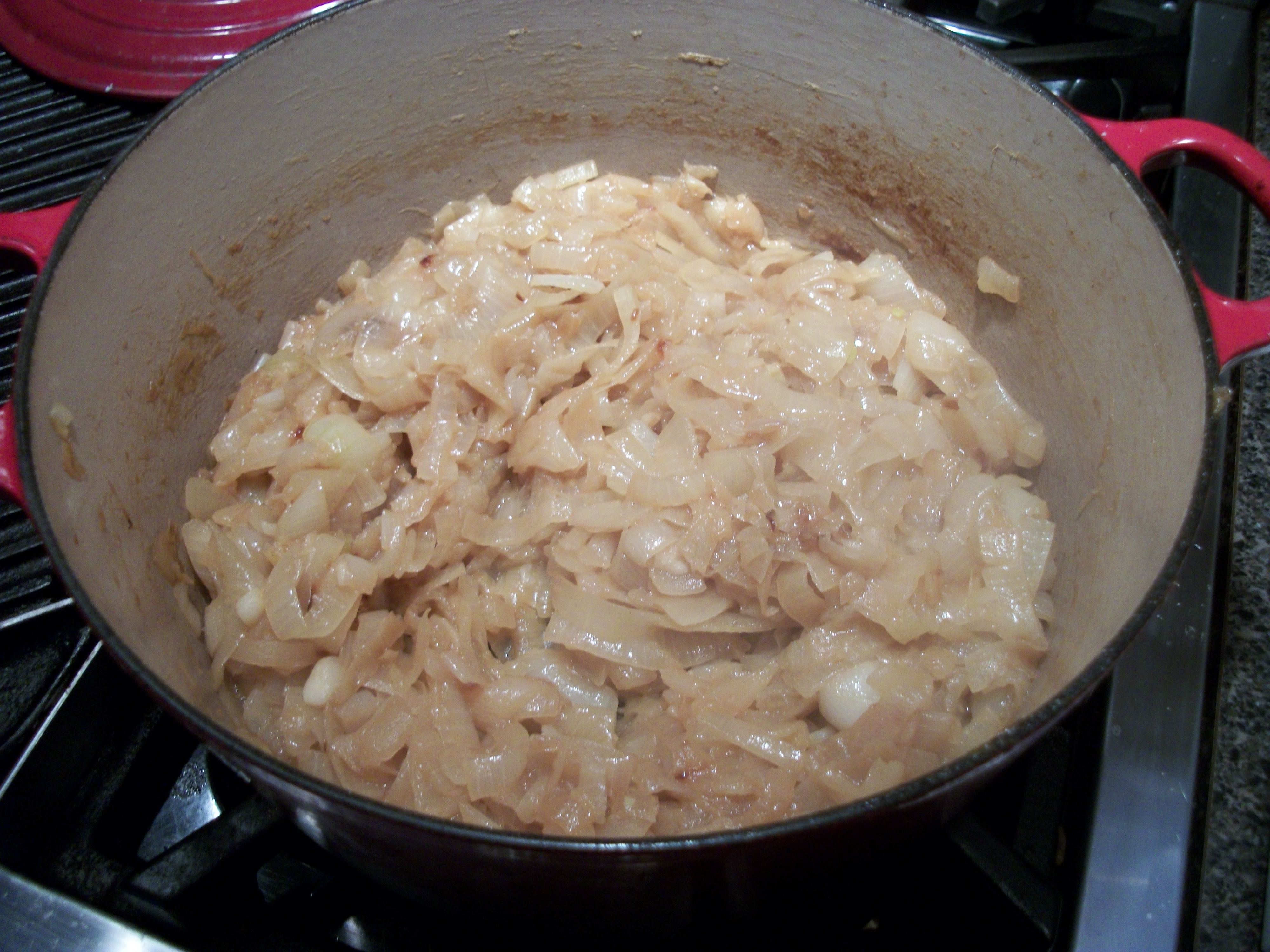
Here are the onions getting close to being done:

The onions are now a soft golden color.  You can get onions to caramelize to a much deeper color, but the taste changes as the process continues.  Since I was using a vegetable stock, I didn’t want the onions to be as strong as I would for a beef stock.  This picture is showing the onions to be a bit light, but they were actually a lovely golden color.  When you think your onions are dark enough, stir in about 1/4 cup of flour and cook, stirring constantly, for about 3 minutes.  Add your stock and stir up all the bits in the bottom of the pan.

At this point, I let the mixture cool and refrigerated it.   All I needed to do on Monday was to heat the soup gently, let it simmer for about 30 to 40 minutes, and taste it for salt when it got warm.  My soup was very sweet.  Onions are sweet, but remember I had also used carrots and a parsnip in the broth.  Chard stalks are sweetish too.  

Here’s the soup on Monday cooking gently for 40 minutes: 

I thought it needed some zip, so just before serving, I added a good 3 Tablespoons of cognac.  (A plain brandy would work too.)  And, I enriched it with 4 egg yolks, which made it silky smooth and gave it some lovely body, not to mention protein the body can use easily. 

To add egg yolks, drizzle a ladle of soup into the eggs while you whisk them.  For safety,  as I had used 4 eggs, I added a second ladle slowly while whisking.  (This is called tempering the eggs.)  Then, with the soup OFF THE HEAT, stir the eggs into the soup and stir the soup until it thickens–just a minute or so.

I put grated swiss cheese (a GOOD swiss) into the bottom of each deep bowl and ladled soup over it.  My gratinee soup bowls are small, and we wanted big bowls of soup for dinner–not a smaller size for a first course.  And, as we had really fresh baguettes, we just quartered them and put a hunk at each person’s plate.  I can get lovely raw butter, so we had that for the bread too.  (We didn’t want to toast sliced bread and put it into our soup this time and put the cheese over it and put everything into the oven to melt the cheese.)

While the stock made and the onions caramelized, I made a three-layer cake–a recipe I had put away to try years ago.  It’s a caramel cake, but not a southern style.  Instead, the batter and the icing are flavored with mocha syrup, Bailey’s cream liquor, a coffee liquor, and vanilla.  I didn’t have a mocha syrup, so I put the other ingredients in a pan and threw in about a tablespoon of chocolate bits and a tablespoon of some caramel syrup I had and let it all sit on the oven shelf to warm and melt the chocolate.  The cake is spectacular and lovely, so that innovation was fine.  Here it is, though the camera distorts the bottoms of things (making them look smaller) if you don’t have it level with the photographed object:

Here it is cut:


It is yummo!  I got it from “Better Homes and Gardens” Dec. 2005, “Secret to a Great Cake:  Cream Caramel Cake,” page 220.  The only downer is that the icing has EIGHT CUPS of confectioner’s sugar in it.  That’s more sugar than I eat in two years!!!! 

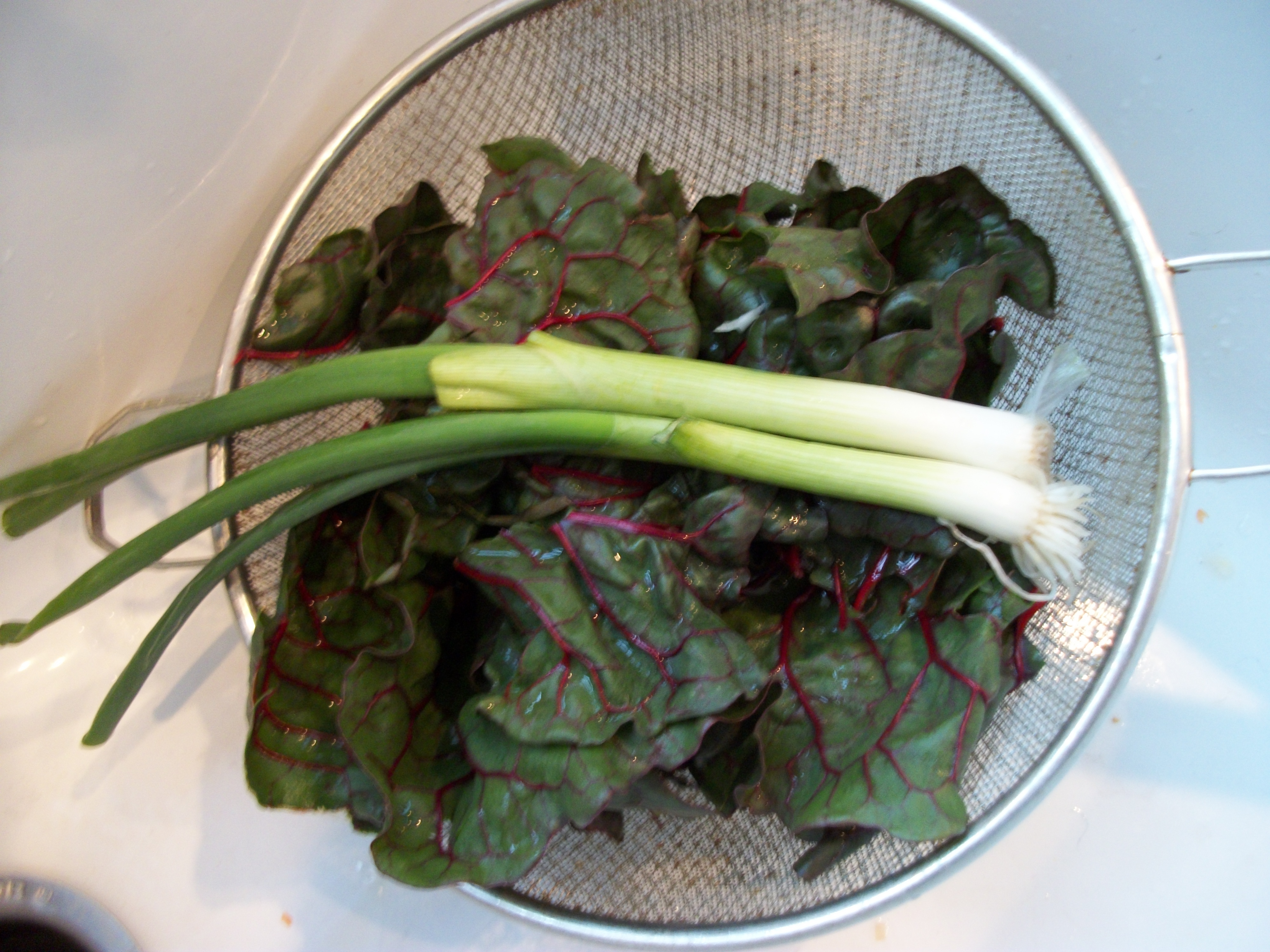
So, you remember those chard stalks I used in the soup stock?  Here are the leaves–with some green onions–all ready to be sauteed for dinner on Sunday night.  Dinner was roasted sweet potato and a seared sirloin steak and some of my sauerkraut.  Aren’t chard leaves pretty?  Chard is in the beet family, you know.  I usually grow a variety called “rainbow” chard that comes in all sorts of electric colors.  It’s quite amazing in the garden.  It’s great sauteed with some coconut oil and when it begins to melt down, a splash of fruity vinegar and a drizzle of honey.  Sometimes I also add some raisins or some sliced apple, peel and all. 

So, on Monday, I only had to make a salad and grate some cheese.  Here’s the salad:

I wanted something citrusy.  Lettuce greens are not in season now, so this salad is from “away.”  It has some water cress, some leaf lettuce, some romaine, a naval orange, some fennel sliced thin on the mandolin cutter, some hearts of palm (I grabbed a CAN thinking I was buying asparagus hearts–bad, bad as can linings leach BPA–I should have NOT used anything else), some green onions, some toasted pine nuts, and a fruity dressing of lemon and olive oil.  It was delicious!

So, Bon Appetit! to all and mega thanks to the incomparable Julia!

PS:  For a good beef stock, put a selection of bones in a roasting pan, add some celery (2 stalks only), carrots, onion, and garlic (I slice the whole bulb in half after seeing son Bryan do that) and roast until brown at high heat–400 degrees–turning and stirring after about 40 minutes.  Usually everything is brown in no more than an hour.   Drop the heat if you think things are moving too fast.  Put everything into a large stock pot.  Put water in the roasting pan and scrape up the goodies and pour all into the stock pot too.  Add more onion, carrots, garlic, fresh or dried herbs (thyme, rosemary, bay leaf, parsley) and GOOD SEA SALT THAT IS DAMP AND GREY and cook for at least 5 to 6 hours and up to 12 hours.  Strain and discard bones and spent veggies.   Freeze extra in Mason quart jars.

Turkey Tracks: Green Hive Honey Farm

Turkey Tracks:  January 24, 2011

Green Hive Honey Farm

“Raw Honey From A Thousand Flowers”

 Isn’t this the prettiest jar of honey you ever saw?

From the moment I saw it I fell in love!


For the past five years or so, I’ve made a right hand turn onto Wiley Road from Barnstown Road and, in doing so, passed a house where the most amazing flower garden begin to appear.  Last year some time, a friend told me that the occupants of this house, Clay and Mary King, had put in hives and were going to sell honey.  I’m always looking for local, NONHEATED honey, and that’s what the King’s have.  They have hives located in other places besides their yard, each site carefully chosen to support bees.  Last year, the honey bottles were plain.  This year, when Clay brought us a case of honey, here’s the jar that emerged from the box.  I’ll never be able to throw away a single one of these bottles.  That’s for sure.

For those of you who are local and who are reading my blog, this honey is amazing!  You can reach Clay and Mary at greenhivenoney@gmail.com.  Or, 207-542-3399.  The web site is www.greenhivehoney.com.  Clay and Mary, by the way, have a therapeutic massage practice.

For those of you who are not local, I urge you to find a local source of unheated raw honey.  It’s full of things that are good for you that come from your own region, and you’d be supporting someone who is trying to make a difference. 

Raw honey, combined with raw butter, has been used traditionally as a healing compound and for immune support.  I try to eat some every day.   

Strangely, in the way that things come together all at once some times, Paul Tukey of Safe Lawns sent out a posting listed on his blog this week that shares the fact that the lead researcher for the USDA has definitely connected the use of the class of insectsicides called neonicotinoids, which are synthetic nicotines, with the colony collapse of bees–and at, writes Tukey, “doses so low they cannot even be detected by normal scientific procedures.”   Apparently, Jeffrey Pettis (the lead USDA researcher), has known for two years about the neonicotinoids, but said that official publication of his findings has been stalled.  What a surprise!  This story is as old as industry use of chemicals.  Some names of these synthetic nicotines are imidacloprid and clothiandin.  Pettis, writes Tukey, broke his story to a documentary filmmaker rather than to a government source.  That’s interesting…   That’s one way to get around the “stalling.”

Neonicotinoids act on the central nervous system of insects and are thought to have a lower toxicity to mammals because they block a specific neural pathway that is, according to Wikipedia, “more abundant in insects than warm-blooded animals.”   More abundant…  My first thought is that, as with BPA, they don’t really know how dangerous to us these chemicals are.  And, no one is looking since we operate within the notion that harm has to be proved before our government even begins to look–which translates into having enough dead or harmed bodies.   Imidacloprid is systemic.  It amazes me that people can watch chemicals drop bugs and not connect the dots that those same chemicals can have an impact on their systems as well.  Again and again, the history of chemical use demonstrates that “they don’t know.”  Or, if they do and it’s dangerous, they hide it.  So, I have no confidence in our government’s ability to protect us any more.     

Imidacloprid is widely used as an insecticide worldwide–except in France and Germany where folks seem to have started questioning impact.  Imidacloprid is used, says Wikipedia, against “soil, seed, timber, and animal pests” and is used as “foliar treatments for crops including:  cereals, cotton, grain, legumes, potatoes, pome fruits, rice, turf and vegetables.”  That’s a LOT of poison.

Feral honey bee populations in America, writes Wikipedia about pollinator decline, have declined by 90 percent.   And, two-thirds of managed honey bee colonies have disappeared.  Two thirds.  The economic and human hardship potential for disaster if this scenario continues is enormous.  About one-third of human nutrition depends on bee pollination.  Think about it.  We’re talking about the majority of fruits, nuts, vegetables, and crops we feed to animals, like alfalfa and clover. 

Most bees right now are moved around the country to service crops, which stresses them.  Often, they only have access to one crop, like, say, almonds, which also stresses them since they need more variety.  Often, they’re fed in winter with high fructose corn syrup because we’ve taken all their honey.  No wonder, often, they die.

So, my hat’s off to Clay and Mary.  The honey is beautiful, the bottle’s beautiful, the label’s beautiful, and I will support you.      

Turkey Tracks: Making Yogurt is Easy and CHEAP

Turkey Tracks:  January 13, 2011

Making Yogurt Is Easy and Cheap

Yesterday morning  when I tasted the yogurt that had been “making” overnight in the oven, I was, again, reminded at how absolutely delicious it is when it is just fresh, when it has not yet been chilled.  This batch had thickened up to a custard consistency, and it was like velvet on the tongue.  John and I each had a big bowl of it drizzled with nonheated local honey and sprinkled with some dried fruits and “crispy” nuts.

CRISPY NUTS:  Crispy nuts have been soaked in salted water over night and dried in a dehydrator or an oven on very, very low heat until “crispy.”  One does this process to remove the phytates present in the nuts and seeds.  Phytates can inhibit the full absorption of nutrients in a serious way.  Plants are way more chemically powerful than people realize.  Put the nuts into a large bowl, fill it with water, and add about 2 tablespoons of salt.  Let them soak from 12 to 24 hours.  They will swell up.  Drain them and dry them.  I prefer to dry my nuts in a dehydrator as it’s easier than my oven.  I never burn the nuts, which are expensive, in the dehydrator.  I got a cheap one for about $30.  But, it’s plastic, and since I use it all the time and since I’m learning that plastic off gasses around heat, I’m saving for a good metal dehydrator.   You can read all about phytates in Sally Fallon and Dr. Mary Enig’s NOURISHING TRADITIONS, which is a book that, among many other things, attempts to recover lost food preparation practices.

Anyway, here’s how you make yogurt so that you don’t even have to dirty a pan.

Milk–I use a half-gallon at a time.  And, of course, I’m using “real” milk.  Try to find milk that is NOT ultrapasteurized as it might not culture.  Ultrapasteurized milk is cooked milk; it’s a dead product.  You can read all about it in my essays.

2 packets of “yogamet”–which is a dried cultured yogurt product.  It comes in a box.  Inside are individual packets.  Look for it in the cooler section of a natural foods store or Whole Foods.  Trader Joe’s might have it.  After your first batch of yogurt, save about about 1/4 cup of yogurt for your next batch.  Yogurt you’ve cultured yourself begins to make the thicker, custardy yogurt that is so delicious–though all the yogurt you make will taste really good.  One packet will culture one quart of milk.

Find a big bowl–non metal–that will hold your milk.

Turn on the oven to 200 degrees, and when it reaches that temperature, turn it off, put your bowl inside and cover it with a plate.   (No plastic or foil please.)  Close the door and go to bed.  In the morning you will have yogurt.  On very cold days, sometimes mine is still too runny.  I put it in a warm place (like under a cabinet light or on the stove or back in the stove with the oven light turned on) and give it more time to jell.  You’ll know if it’s still too runny.  It will not spoil if you leave it out until it jells, and it will jell eventually, as it’s cultured.

****

Greek yogurt is just yogurt with some of the whey–a clear liquid–drained out.  You can make yogurt cheese by draining off all the whey.  Whey is full of protein, though, so when you drain off the whey, you are leaving the milk solids and fat behind, and they need protein to process properly in your body.  So, don’t eat too much Greek Yogurt.

I often drain some of my yogurt to get some whey.  I use it to culture sauerkraut (see that recipe elsewhere on this blog); put some in homemade mayo to culture it so that it lasts for weeks in the refrigerator; use a few tablespoons when soaking dried beans, grains, or flour; and so forth.  Whey is an amazing preservative and a detoxifying agent.   You can drain yogurt by putting a paper towel, a napkin, or some cheesecloth in a colander, putting in some yogurt, and placing the collander over a deep bowl to catch the whey.  I put a plate over the colandar.  Whey keeps for weeks and weeks in the refrigerator.  And yogurt cheese is great drizzled with honey and served with dried fruit (dates!) for a dessert.  Or, drizzled with olive oil and herbs for a spread.

Most prepared yogurt in stores is not only expensive, it is full of additives and sugar.  It is “jelled” with pectin, for instance.  And, the smooth taste comes from seaweed additives.  It won’t even drip out whey.

Wait until you taste your own yogurt.  You’ll understand what has been lost.  And, now, found.