Quilting Information: Long-Arm Practices That Work for Me

January 26, 2015

Long-Arm Practices That Work For Me

Last year in April I took several classes at the Machine Quilters’ Expo in Manchester, New Hampshire.

What I learned there–and also what I’ve learned from the long-arm quilters on Bonnie Hunter’s Facebook Studio for Quilters–has helped me so much.

So, I thought I’d share…

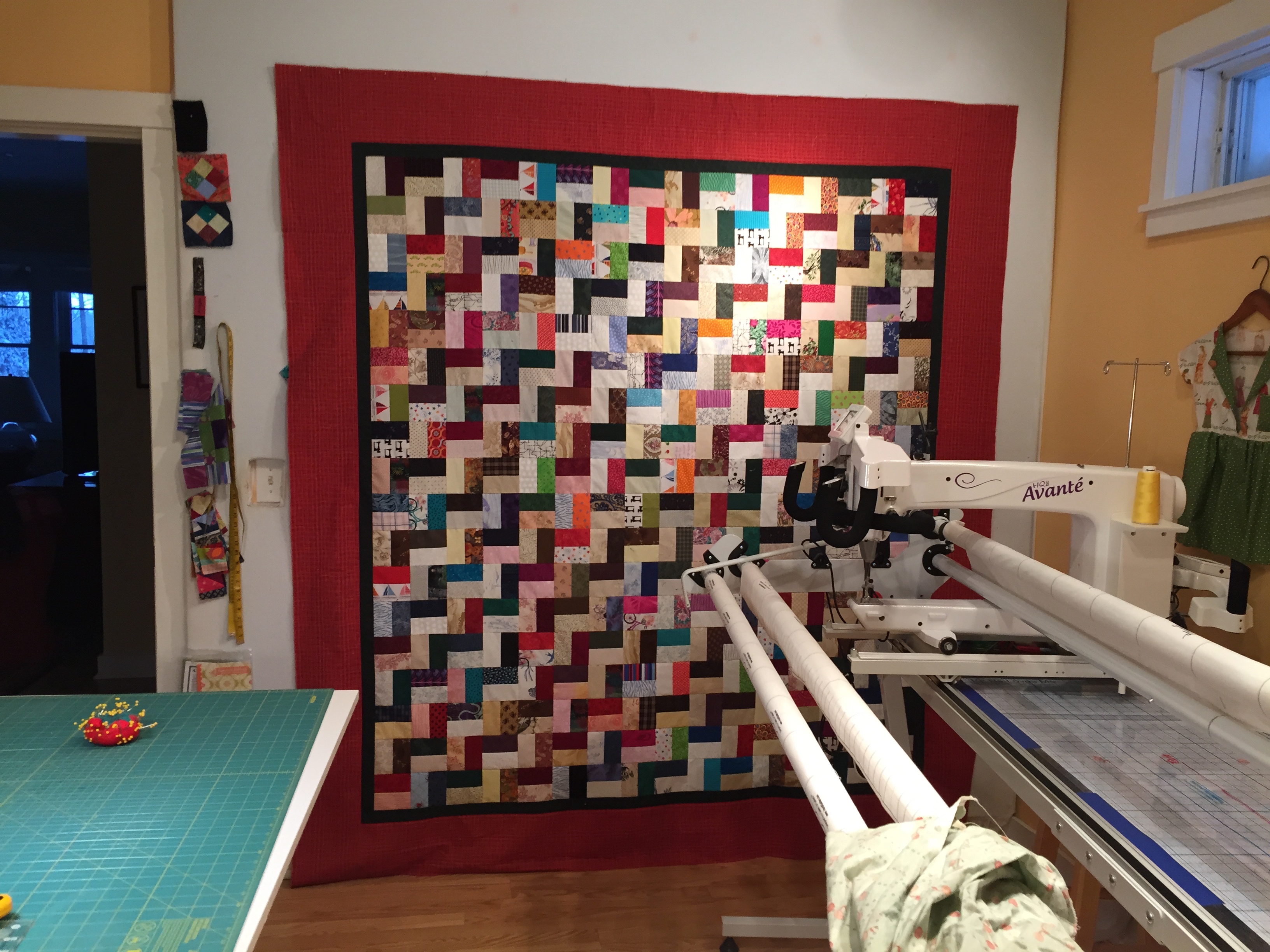
Make sure your bars are level.  Get or borrow a four-foot level and check them.  If they are off, tinker until you have them level.

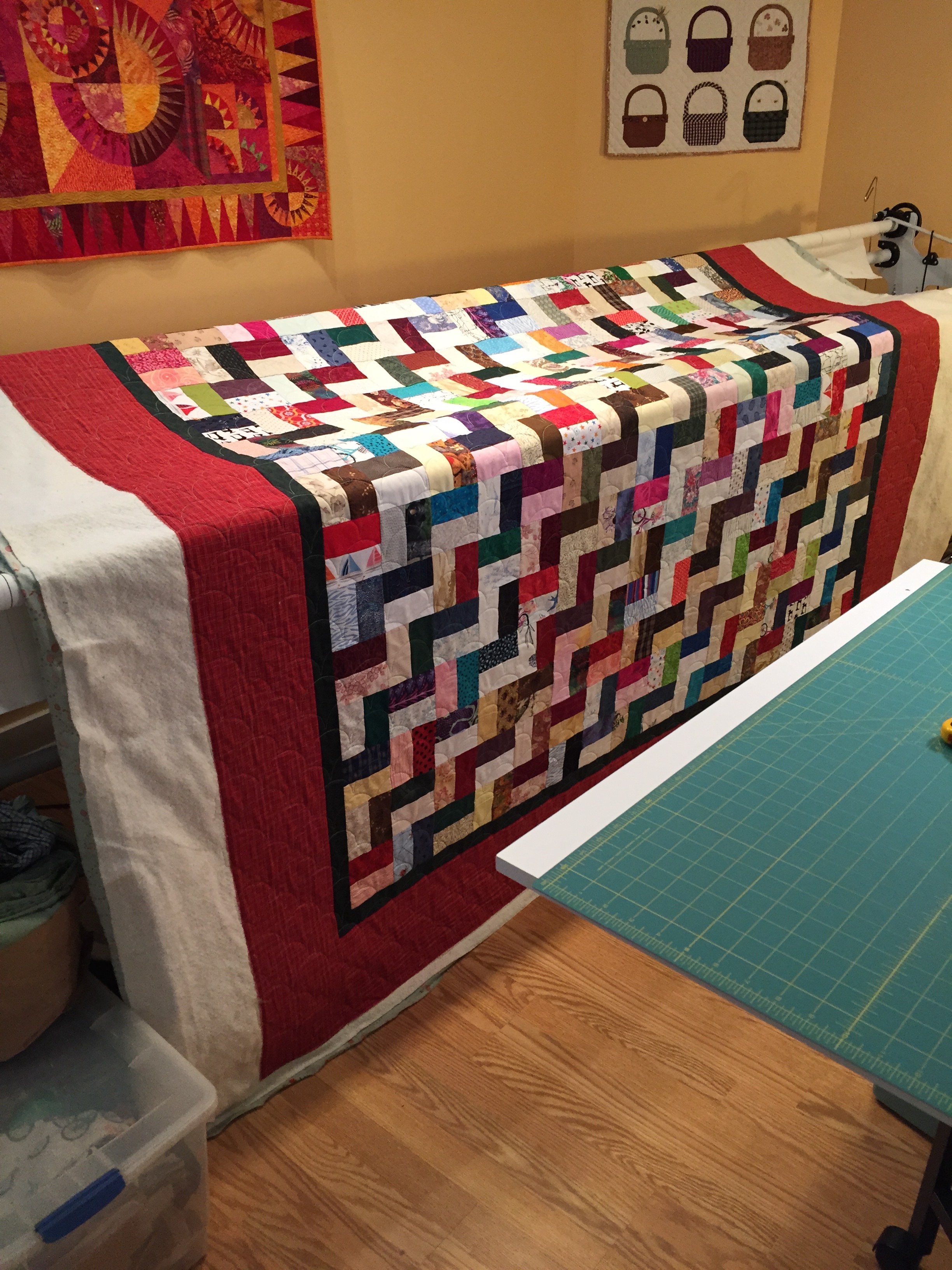
This apparatus below involves suspending a curtain rod over the bars and bringing the side fasteners over it.  AND, see the long rod with the blue ribbons?  Underneath is a plastic piece that the rod snaps into.  This arrangement gives the sides of the quilt a great deal of stability AND prevents you from quilting off of it.  (There are several forms of this kind of stabilizing rod for the edge of the quilt.)

100_3934


Here’s another view:

100_3935


I load my quilt backing in the normal way.

But after being encouraged to do so, I float my top, just like the batting.  See?

IMG_0010

I  sew a plumb line on the batting (using my channel blocker piece), then line up the top of my centered quilt on that line–and sew it down.  THEN I measure both sides of the quilt from the frame on each side and as I move the quilt forward, I make sure that I keep those measurements constant along the length of the quilt.  I sew down the sides every time I roll the quilt forward.  Every time. Especially if I am using a pantograph.

BIG TIP:  If I were to roll the top onto the top bar, I would try to place the quilt (and the backing if needed) LENGTHWISE–which minimizes the bulk of side seams being rolled up over and over on top of each other.

At the end of the quilt, I roll forward to expose the end and sew that down before making the last pass.

I make a lot of scrappy quilts that seem to do best with an overall, even pattern.  So I use, mostly, pantographs–sometimes I free-motion a pattern, but less and less so as I like the patterns in the pantographs.  I place the pantograph UNDER this grid that fits the length of my table–and mark on it with a wet erase marker that can be erased with water.

100_3926


I estimate the amount of thread that one pass will take–and whether or not a whole bobbin will reach through two passes.  On a large quilt, it will not.  So, I estimate the number of passes I will be making and load that many bobbins–from 2/3 to 3/4 full, depending on what I think the pass will need.  The leftover thread gets run off onto bobbins for my domestic machine and/or just used up piecing scrappy quilts I’m making.  There is no thread waste.  (I also use Signature thread, which is sturdy, has a good range of colors, and is way cheaper than that other brand that is so pricy.  I do have to order it online and bought a thread card showing all the colors.)  Here are leftover threads.  More importantly, there are NO thread joins in the quilt body.

100_3929

One of the BIGGEST TIPS I got last year was from Sue Patten (quilter extraordinaire):  “Let the right hand steer if you are right handed.  The left hand doesn’t like to steer!”

I was having some trouble with thread shredding at the needle site, and with the advice of the long-armers, I went up a needle size.  As I do very scrappy quilts, there are a lot of seams, so I try to keep my backings pretty plain–which does not add to the bulk of the quilt sandwich.  The thread shredding involved both the expensive and the less-expensive threads…

100_3932


Before quilting, I put three lines of Sew Rite down the length of my thread cone.  Magic!  No more shredding.

100_3930

If things do start to go wrong, I turn off the machine and walk away.

I think my own personal goal for next year is to try to use more of the speciality rulers I’ve purchased for the long-arm.  Maybe I’ll see if there are some hands-on classes at this year’s MQX show in April…

But, I won’t put any pressure on myself, because, truth to tell, what I like best to do is to piece a top that will be used and loved and washed–so a lot of fancy quilting doesn’t draw me.  I’m not sure that I have the patience for it!!

Books, Documentaries, Reviews: Blog: Big Hips. Open Eyes.

January 26, 2015

Big Hips.  Open Eyes.

I’ve known Tracy Rothchild Lynch just shy of twenty years.

She’s the same age as my sons–and comes out of the matrix of their friends AND out of the network of my friends Terry and Cathy O’Grady and their daughters.

Tracy has always been a thoughtful and talented writer.  Always.

There’s something about the life of a person who must…write.  It’s a chronic condition that just, somehow, never goes away.  The impulse to write, to think and write, just keeps emerging.

With a person like Tracy, whatever emerges is worth every minute spent reading the work.  I always learn something of value from this person who has a deep grounding, a deep perception of life itself, and a lovely sense of humor that seasons the work.

Tracy is trying to write something every day for this year.  Something that involves relationships in some way–those moments that occur every single day in, often, myriad forms–if only yours eyes are open to see them.

Treat yourself to the current entry, but go back, too, and read all of them before the numbers multiply.  Then sign up to “follow” this blog, which is already acquiring some impressive numbers.

GO TRACY!

Big Hips. Open Eyes..

Turkey Tracks: Quilts From Friends

Turkey Tracks:  January 20, 2015

Quilts From Friends


I love having quilts made by my friends all around me.

Every time I see one of those quilts, which is many times each day, I think of that person/those persons.  And I feel all the loving energy that went into that piece of work.

I bought this quilt top at a quilters’ auction in Virginia just before we moved to Maine.  I thought it looked like Maine, and I love baskets.  I quilted it the first winter we were here–2004-2005.

IMG_0077

My Virginia quilt bee–the Toppers, because we made a lot of top for our big group’s auction–sent me to Maine with the Buzz Saw quilt–which I recently showed you:

IMG_0069


It lives in my bedroom.  Underneath it is an afghan made by my SIL Maryann Enright which lives on my bed most of the time.

IMG_0074

Roxanne Wells made this quilt, which hangs in my bedroom.

IMG_0064

The Coastal Quilters made this quilt for John and me when he was so sick.  They said we needed a “quilting hug.”  This picture is on my bed, but this quilt lives in the downstairs bedroom that we set up for him and that he never used.  That room has been repainted and refurbished and is a favorite of many in the family.  I am in and out of that room many times each day as its closet holds a lot of my quilting tools.

Shine On edited

My DIL, Tamara Enright, made this quilt for my birthday a few years back.  It hangs at the entrance to my quilt room:

IMG_0056

Did you know that cardinals are said to come to a house when there is trouble/emotions.  On the day John died, we had five or six at the feeders.  Ordinarily these birds stay in Camden and don’t come out to Howe Hill.  They like flat feeders…

Gail Nicholson made this quilt, which has launched me on a quilt trip to put more quilts into the downstairs sitting/tv room/den?

IMG_0055


Joan Herrick quilted Gail’s quilt.  Joan quilts free-hand on a long arm!

IMG_0059


Betty Johnson makes beautiful little art quilts.  I finally got one of hers at our last auction:

IMG_0062

It lives in the living room:

IMG_0063


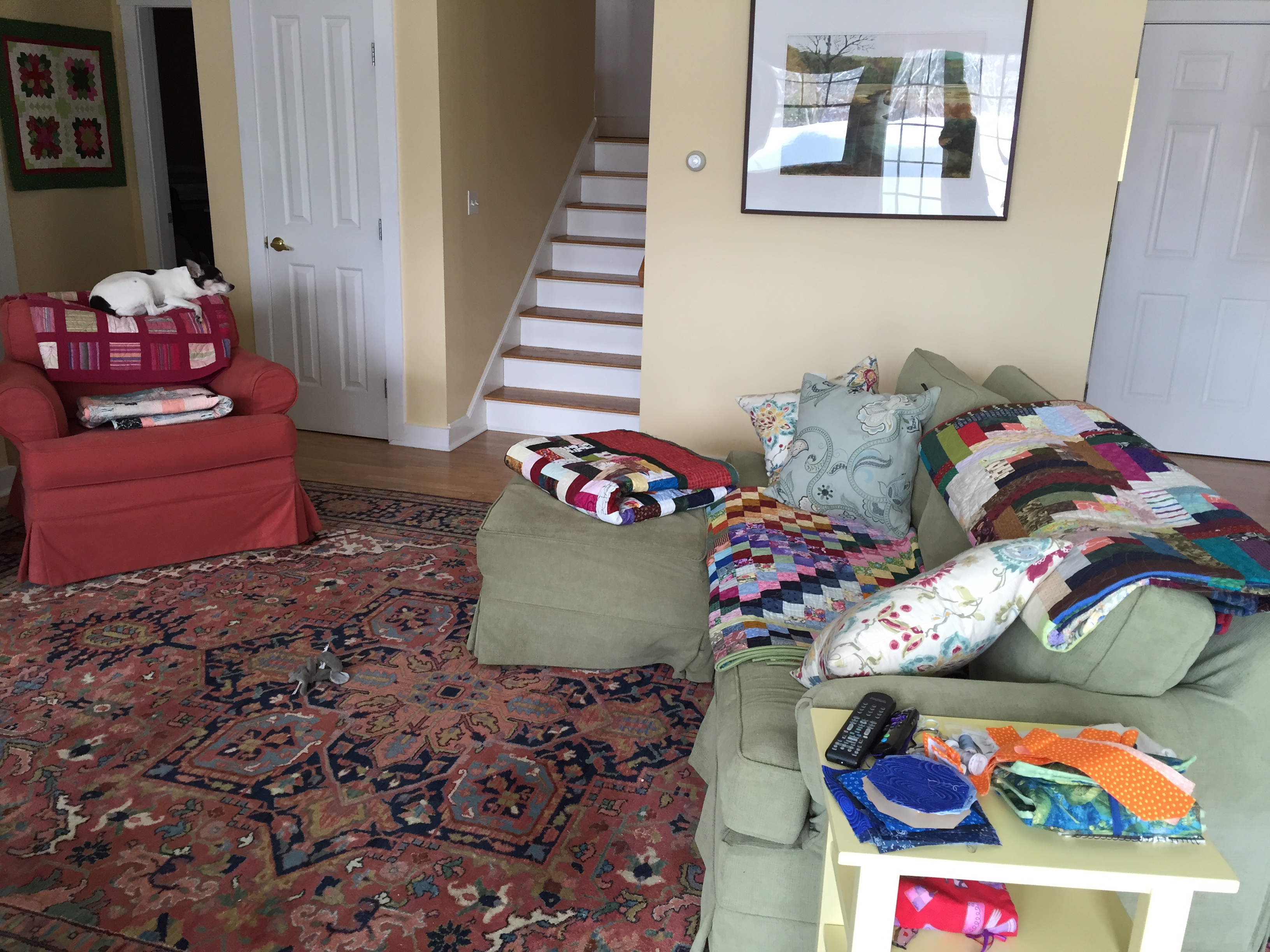
Milly Young made this quilt top, and I bought it at one of our auctions and finished it and fell in love with it along the way.


Millie Young's quilt

Millie Young's quilt 3


I really need to use all these quilts more than I do now.

I have always had a tendency to “save” things for “good.”  But the point of a quilt is to USE THEM.  So, this last one is coming downstairs TODAY to go into my sitting room project.

TODAY!

Interesting Information: Food From China And Far East

Interesting Information:  January 23, 2015

Food From China and Far East

Friend and former neighbor Tutty Fairbanks sent me this impassioned email from a friend of her sister’s.

George, as you can see, is outraged by our global food system–in which, industry has figured out ways to escape regulation.

Unfortunately, I’ve been reading that much of what George is writing is…true.

READ LABELS.  And keep reading them because they can change often.

SHOP AND EAT LOCAL–find a farmer/some farmers you know.

If I am not mistaken–I think I read recently that the laws about displaying “country of origin” on produce have been voted out…

Here’s what George writes about what he has learned:

***
Food for thought…

Smithfield Farms, the largest pork producing farm in the USA was sold in
September to China with the unanimous support of its stockholders!! The hogs
will still be raised here, but slaughtered and packaged for sale there
before being sent back here. 

This includes labels of:
.    Morrell
.    Eckrich
.    Krakus
.    Cudahy
.    Premium Hams
.    Cook’s
.    Gwaltney


The same with many chickens.  They can now be shipped there, but when they
come back all that needs to be labelled is that they  WERE RAISED IN THE
USA .  Not that they were processed in China !!!


Our great FDA at work again.  The chickens will be all processed and most
sold to fast food restaurants for sandwiches, along with schools and
supermarkets.  The China slaughter and processing are not nearly equal to
the requirements here.

*BAD FOOD.*
We recently learned that Starkist Tuna is now owned by Korea , and is in big
conflict with the U.S.concerning quality, safety, and records, which Korea
refuses to produce.

Read several articles on Google about this, and even one that was defending
the eating of tilapia said to avoid the fish that came from China ?


Also, I had just returned home from buying  Albertson’s 4-day special of 4
bags of frozen tilapia for the price of one?  Sure enough, on the top of the
bags, it read “farm raised”, and on the bottom in small print it said,
” China “

read all the way to the end…..

Recently a Food inspector on TV… said he had lived overseas and he had
seen the filthy conditions their foods are raised and processed in. It is
enough to make you throw up.  Some foreign workers have to wear masks as
they work in these places, because the food is so rotten and filthy, it
makes them want to throw up.  Many of their fish on Fish Farms are fed raw
sewage daily.  He said he has seen so much filth throughout their food
growing and processing that he would “never” eat any of it.  They raise this
filth, put some food colouring and some flavourings on it, then they ship it
to the USA & Canada for YOU to consume and feed to YOUR families. They have
no Food & Safety Inspectors.  They ship it to you to buy and poison your
families and friends.

Imported food we eat and the junk we buy:
…    Green Giant frozen vegetables are from China ,
…    and so are most of Europe ‘s Best.

…    Arctic Gardens are OK so is
…    Birdseye.

*Never buy the grocery store garlic unless it is clearly marked from USA or
Canada *, the other stuff is grown in people poop (even worse than chicken
poop). China is the largest producer of garlic in the world; U. S. is next.

*Buy only local honey*, much honey is shipped in huge containers from China
and re-packed here.

Cold-FX is grown and packed in China and is full of fecal bacteria.  Doesn’t
work anyway, big scam.

If the country of origin is not clearly marked beware.

If produce, ask an employee.

Watch out for packages which state “prepared for”, “packed by” or “imported
by”. We don’t understand the lack of mandatory labelling, especially the
produce.

The country of origin should be clearly shown on the item in the store.

Go to the local farmers’ markets in season and keep a wary eye open the rest
of the year.

Please read this very carefully, and read to the very bottom.  It’s
important for all of us.

How is it possible to ship food from China cheaper than having it produced
in the U. S. or Canada ?

FOR EXAMPLE THE “OUR FAMILY” BRAND OF MANDARIN ORANGES SAYS RIGHT ON THE CAN
‘FROM CHINA ‘. – SO, for a FEW MORE CENTS, BUY THE  * LIBERTY *  BRAND.

*GOLD BRAND or THE DOLE IS from CALIFORNIA *.

Beware, Costco sells canned peaches and pears in a plastic jar that come
from China ..

ALL “HIGH LINER” AND MOST OTHER FROZEN FISH PRODUCTS COME FROM CHINA OR
INDONESIA .  THE PACKAGE MAY SAY “PACIFIC SALMON” ON THE FRONT, BUT LOOK FOR
THE SMALL PRINT.  MOST OF THESE PRODUCTS COME FROM FISH FARMS IN THE ORIENT
WHERE THERE ARE NO REGULATIONS ON WHAT IS FED TO THESE FISH.

*Recently The Montreal Gazette had an article* by the Canadian Government on
how Chinese feed the fish: They suspend chicken wire crates over the fish
ponds, and the fish feed on chicken poop.

If you search the internet about what the Chinese feed their fish, you’ll be
alarmed;  eg: growth hormones, expired anti- biotic from humans?  Never buy
any type of fish or shellfish that comes from these countries:
…    Vietnam
…    China
…    Philippines

Check this out personally.

Steinfeld ‘ s Pickles are made in India – just as bad!

Another example is in canned mushrooms.  No-Name brand came from Indonesia .

Also check those little fruit cups.  They used to be made in Canada in the
Niagara region until about 2 years ago. They are now packaged in China .
Most sold in Aldi stores.

While the Chinese export inferior and even toxic products, dangerous toys,
and goods to be sold in North American markets, the media wrings its hands!
Yet, 70% of North Americans believe that the trading privileges afforded to
the Chinese should be suspended.

Well, duh ! Why do you need the government to suspend trading privileges?

SIMPLY DO IT YOURSELF, CANADA and the U. S.

Simply look on the bottom of every product you buy, and if it says ‘Made in
China ‘ or ‘PRC’ (and that now includes Hong Kong ), simply choose another
product, or none at all.  You will be amazed at how dependent you are on
Chinese products, and you will be equally amazed at what you can do without.

YOU’VE BEEN INFORMED
BAD FOOD

 Cheers…..George

<~WRD314.jpg>

This email has been checked for viruses by Avast antivirus software.
www.avast.com


Turkey Tracks: “Knitting Myself to Peace”

Turkey Tracks:  January 21, 2015

“Knitting Myself to Peace”

The thing I love best about quilting, knitting, painting, writing, cooking, gardening, cleaning, etc., is using my hands.

But, hand sewing or knitting or feeding fabric through the sewing machine is deeply peaceful and calming to me.  I miss sewing so much on the days when I can’t carve out some time for it.  I always feel kind of “jangly,” as if, somehow, the sharp edges of the day never got soothed out.  Knitting comes a close second.

Friend Barbara Melchiskey sent me this piece by Sarah Smiley.  And, of course, I understood it and loved it.

I hope you do too.

And that you have something in your daily life that smooths the sharp edges.

Knitting myself to peace — Living — Bangor Daily News — BDN Maine.

Interesting Information AND Quilting Information: Cotton + Steel

Interesting Information:  January 21, 2015

Cotton + Steel

I love stories, and this one is fascinating.

Five “bad ass” women.

Start a business.

RJR Fabrics LOVES THEIR WORK.

And let’s them do whatever they want.

Cotton and Steel — THE BITTER SOUTHERNER.

Even if you don’t sew, this story is really fun.

Enjoy!

Turkey Tracks: Buzz Saw Block

Turkey Tracks:  January 16, 2015

Buzz Saw Block

Mary Sue Bishop and I recently saw a quilt made with a block that we recognized, but we could not come up with the name of it.

My old quilt bee in Virginia made me the sweetest quilt from this block with 1930s fabrics.  See?

IMG_0069


I love the piano key border…

IMG_0072

I came home and searched for the name until I found it.

I knew it was a cross kind of between a log cabin and a pineapple block.

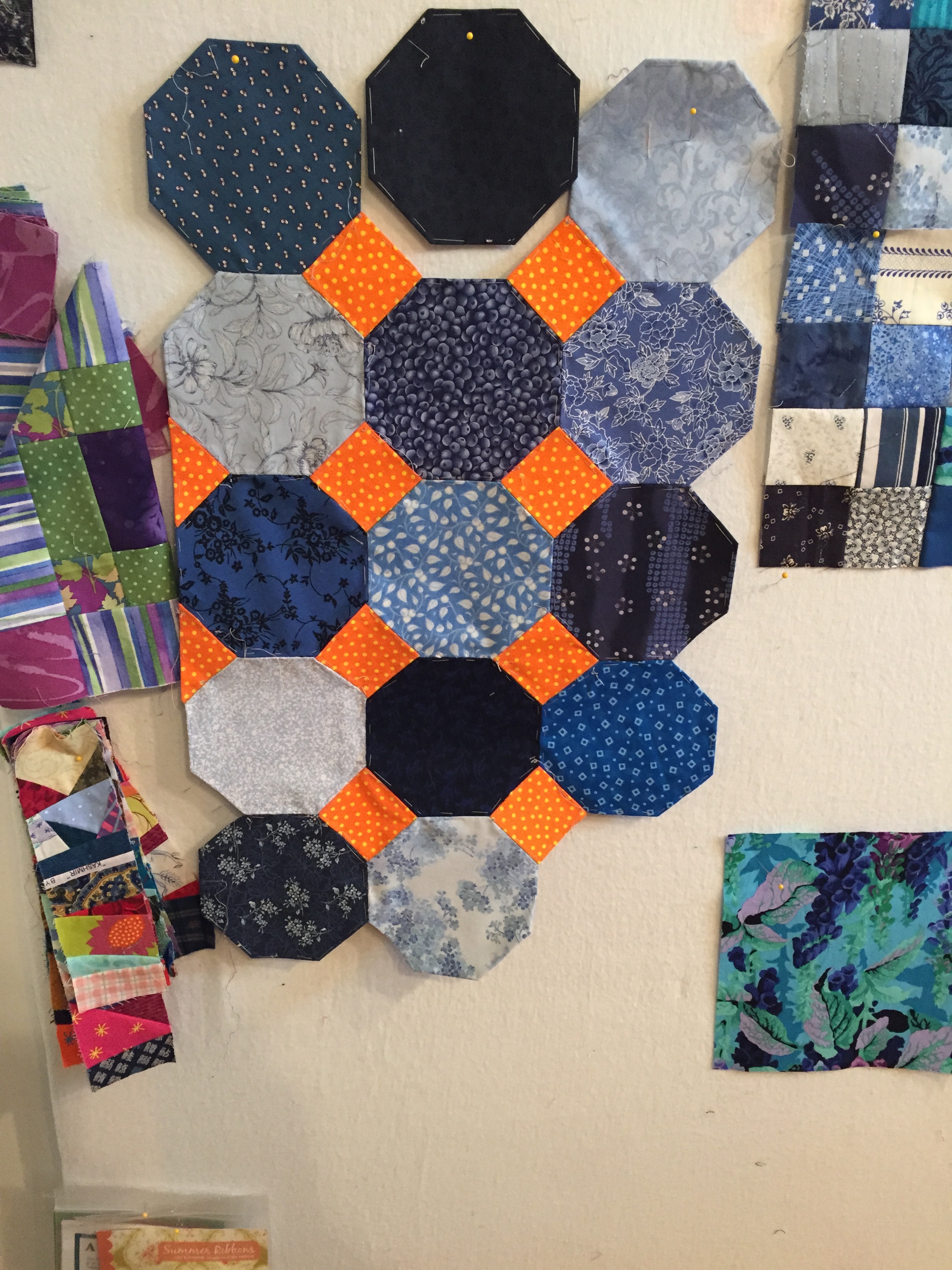
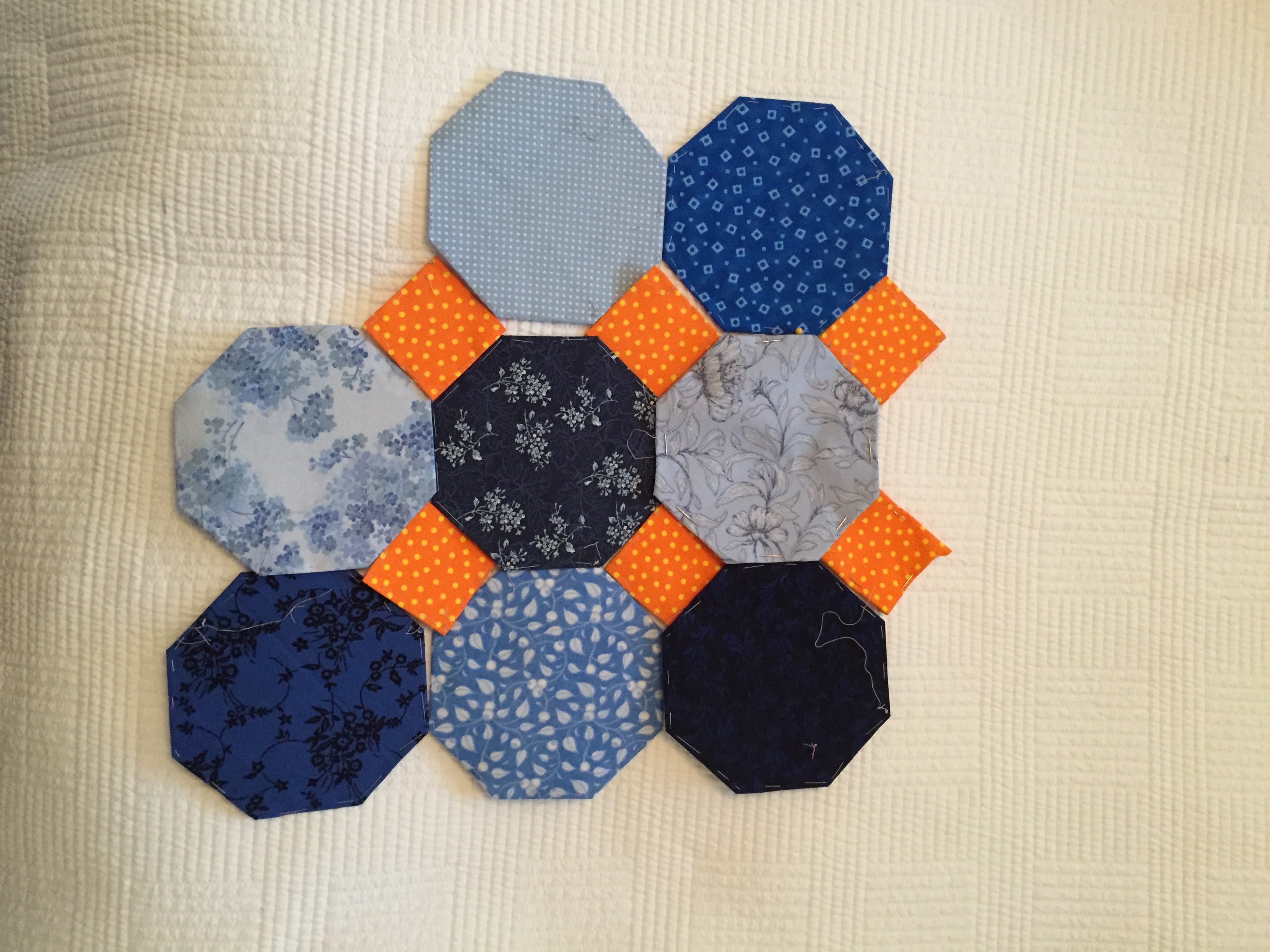
Finally, I turned it over:  it’s a Buzz Saw block.  So I made one:

IMG_0066

This one finishes at 5 1/2 inches–and there are two oranges and two blues, so the whole unit here of four blocks would finish at 10 1/2 inches.

You start with a half-square light/dark triangle that gets cut into four equal strips.  Then one adds a solid strip to the dark-side end.  One must always cut with the same side down–in this case, the dark fabric always went to the bottom.  (If one cuts with the light side down, will that reverse the angle in the middle of each strip???)  (When they passed out spatial relations genes, I didn’t get any.)  Then you realign the strips to form the graduated color, or light, pattern.

Warning:  one tutorial I found started with a 10-inch block, which gets to 9 1/2 inches when you make the half-square triangle.  That’s not so easy to divide into four equal strips.  So….I dropped to an 8 1/2-inch block, which sews in at 8 inches, is easily cut into four equal strips which finish at 7 1/2.

Then to the 6 1/2 square, which finishes to 6, and then, 5 1/2.

The little art quilt we saw had smaller blocks:  we think 4 1/2 which would finish to 3 1/2…

The quilter had used a different setting–one which placed the lights side by side and made them rise and fall…

I wish now I’d taken a picture of it, and I will when I next visit that restaurant:  the River Grill, Damariscotta, Maine.

Meanwhile, I think I could use a fair amount of my stash with this block…

And make a fun quilt.

Turkey Tracks: Megan Brun’s Quilt-In-Progress

Turkey Tracks:  January 16, 2015

Megan Brun’s Quilt-In-Progress

Megan came over this week for a breakfast, and afterwards, we sat and visited and worked on our hand-sewing projects.

I LOVE the quilt Megan is making.

She is making neutral panels with appliquéd circles:

IMG_0540


Here’s a close-up:

IMG_0541

As I understand this project, she will now add some half-as-long-panels with neutral circles.

The quilt is in the “modern” vein.  The panels will be only part of this queen-size quilt.  Megan plans to move out to other shapes, like big rectangles.

Here’s Megan:

IMG_0542

I will show you my hand project soon!  It’s getting borders now…


Turkey Tracks: Winter Flowers

Turkey Tracks:  January 13, 2015

Winter Flowers

It snowed all yesterday.  We didn’t get many inches–only about three–but it was a definite snow day.

IMG_0058

Some of the turkeys hung out beneath the big pines all day.  They were hunkered down, but when I opened the door started to come to me.

IMG_0538


In the kitchen, winter flowers are blooming and bringing lots of cheer:

IMG_0535

IMG_0536

Look at this exotic beauty of an amaryllis:

IMG_0537


More importantly, these blooming bulbs are not drenched with pesticides, as are commercial flowers.

Sad, but true…

Interesting Information: Bill Hyde: “The Real Cost Of Real Food”

Interesting Information:  January 13, 2015

“The Real Cost of Real Food”

When Bill Hyde, PhD, retired from academia, he and his wife bought a seven-acre farm outside of Denver, Colorado.

In the Summer 2014 issue of The Weston A. Price Foundation journal, Wise Traditions,” Hyde walks through what it takes to put one dozen eggs into someone’s hands.  He considers ALL of his expenses–which is something industrial egg providers do not do in order to price their eggs.  For one thing, industrial egg providers do not have to pay for the “soil, air, and water deterioration and pollution that their farm practices create.”  Nor for “remedying the health problems of farm workers and consumers caused by eating and contacting these so-called foods.”  Further, they get breaks through tax policies that favor them, and small real farmers do not.

Hyde’s list of BEFORE PROFIT expenses includes buying and raising the chick (5 or 6 months until they start to lay), shelter and a yard, mobile tractor, feed, utilities , labor, packaging of eggs, transportation, cost of land, and chicken supplies–all of which adds up to $11.52 for a dozen eggs.

Think how we use eggs today.  They’re so cheap and so available all the time (did you know chickens don’t ordinarily lay in the winter months??? or that they are SO NOT vegetarians) that we don’t value them AT ALL.  (Yes, I’m screaming at how we take eggs so for granted.)

But, but, these commercial eggs are OLD when you get them (45 days or more is ok with our government organizations), are made by hens fed inferior food, and made by hens that are terribly mistreated.  (I dare you to watch one of those videos of a commercial layer hen operation.)  That’s why the yolks of a commercial chicken are pale, pale, pale yellow–hardly distinguishable from the white.  A REAL egg yolk is bright pumpkin orange.

Again, as it cannot be said enough, REAL farmers who husband the land and their animals get very, very little support from our nation.  That’s US folks.  Hyde says the following:

Incidentally, I do not believe my situation is unique. In talking to a variety of small farmers, CSAs, and farm co-ops, I have not found one that did not (1) inherit their land, (2) receive grants, (3) use volunteer labor, (4) have a spouse or partner with a real job, or (5) have a day job themselves. While it shows resourcefulness to patch together whatever is necessary to keep a farm operating, my point is that I don’t think it constitutes a viable long-term model for feeding our nation real food.

 And they sure don’t get what the food should cost.

And that’s where a set of statistics is important to understand.  The United States has the lowest food costs in the world…  Today, the average food costs are between 7 and 8 percent of income.  In 1970, average food costs were between 17 and 22%.  As a young married, we were told to allow for 25% on average for food.  Meanwhile in 1970, health costs were from 3 to 7%.  Today they are from 16 to 17%.   Bad food that’s tainted, poisoned, and has no nutrients and fake foods that are artificially flavored and engineered to appeal to your taste buds are making us sick.

So, yes, pay more for real, clean food and pay less in medical costs.  And, taking a longer view, strive to leave a viable world for the next generations.  What we are presently doing is not sustainable.

The Real Cost Of Real Food | Weston A Price.