Turkey Tracks: Beaver Dam

Turkey Tracks:  April 2, 2013

Beaver Dam

I’ve been fascinated with the beaver dam at the foot of Howe Hill, where we live.

Below our house is a wetland that is fed by the stream that runs just beyond the wood line that flanks our house.  Our stream feeds into a stream that runs through culverts under the road intersection below our house where Howe Hill Road meets Molyneaux Road.

Across Molyneaux Road is another wet land that feeds into the larger stream that runs all along Molyneaux Road and gets fed from yet another stream a bit further along that comes down from the higher elevations up Howe Hill.

Anyway, there has been a beaver dam all winter controlling the wetland stream across Molyneaux Road.  Now, though, with the spring melt-off, there is a little waterfall over the dam.

Beaver Dam

I stopped today to take a video so you can hear the rushing sound of the water–a familiar sound these days as water is pouring off all the mountains.

Mainely Tipping Points: Part IV: The American Soy Products

Part IV:  The American Soy Products


As established in Part I, my soy expert is Kaayla T. Daniel, PhD, CCN, the author of THE WHOLE SOY STORY:  THE DARK SIDE OF AMERICA’S FAVORITE HEALTH FOOD (2005).  Daniel’s credentials, experience, and extensive research on soy make her an expert.  Part II explains how soy, which has significantly potent chemicals that can harm human health, got into the human food chain.  Part III discusses the traditional soy products and how they are different from industrialized soy products.  All quotes are from THE WHOLE SOY STORY.  


* * *

The American soy industry could not make much money from “the good old soys”—traditionally made, fermented miso, tempeh, natto, and soy sauce.  Not enough people consumed these soy products.  So, the soy industry tried, first, to produce and sell soy products made from the whole soy bean:  soy nuts and soy nut butter, soy grits, and soy flour.

Roasted soy nuts have to be heavily flavored with sugar, salt, and additives like MSG to be palatable, which is also true for soy nut butter.  With a high oil component, soy grits go rancid easily; harbor the many dangerous, unmediated chemicals found in soy; and taste “beany” (79-84). 

Soy flour proved to be more profitable, but difficult to handle.  Again, the exposed oils turn rancid easily, and the taste is bitter.  Nevertheless, soy flour can replace from one-fourth to one-third of regular flour before affecting taste.  Soy flour is used as an egg and nonfat milk solids substitute.  Soy flour can “moisten the final product, helping retain the illusion of freshness.”  So, soy flour saves “bakers bundles of money.” Note that small amounts of soy flour do not have to be labeled, so most commercial breads contain it (81).      

These whole-bean soy products did not address the burgeoning problem of how to turn the waste products from soy-bean oil manufacture into profit.  So the soy industry developed second-generation products.    

Soy “analogues” attempt to replace existing and familiar dairy and meat products.  Taste is improved, but “combining better taste with a health claim” works even better to offset consumer resistance.  Daniel’s book, however, debunks the soy industry’s claims that industrialized soy products are healthy.      

Soy milk and the analogue products derived from it (soy cheese, puddings, ice creams, yogurts, cottage cheese, and whipped cream), together with the health claims for soy,  prove to be more profitable.  But, the industrial production process for soy milk destroys key nutrients and may produce a toxin, lysinoalanine. 

Taste, however, continues to be a problem.  Soy milk tastes terrible and has a bitter aftertaste.  Thus, even “plain” soy milk is sweetened.  Additionally, the soy industry fortifies soy milk with “calcium, vitamin D and other vitamins and minerals inadequately represented in soybeans” and stabilizes the brew with emulsifiers.  The supplements, though, are “cheap, mass-produced products,” to include Vitamin D2, which “has been linked to hyperactivity, coronary heart disease and allergic reactions.”  Canola oil is added to low-fat soymilks, which are made with soy protein isolate (SPI), to provide creaminess.  And a few years back, titanium oxide, a form of white paint, was an additive used to improve color and texture (65-69).

The soy products made from soy milk are thickened with carrageenan, a water-soluble polymer or gum used as a fat substitute.  Recent studies show that carrageenan “can cause ulcerations and malignancies in the gastrointestinal tract of animals” (69).   

Soy cheeses “can be artificially flavored to resemble American cheese, mozzarella, cheddar, Monterey jack and Parmesan, and they’re increasingly used by fast food operations such as Pizza Hut.”  But, “many brands of soy cheeses contain dangerous partially hydrogenated fats” or trans fats, “with the highest levels in the brands that taste the best.  The main ingredient of Tofutti brand soy cheese, for example, is water, followed by partially hydrogenated soybean oil” (69-70). 

Soy ice creams are mostly water, sugar, oil, soy protein isolate, and, sometimes, tofu.  Tofutti’s first three ingredients are “water, white sugar and corn oil, followed by soy protein isolate (SPI) and sometimes tofu.  Brown sugar and high fructose corn syrup make up most of the rest.”  Soy Dream and Imagine “contain fewer ingredients,” but still “consist mainly of water, some form of sugar, soy and more sugar” (69-71).

Soy protein becomes more “invisible” as industry begins legally inserting it silently into our food, including, at first, such items as “preformed hamburger patties, readymade meat loaves, spaghetti sauces and even some brands of fresh ground beef” (87).  Now, textured soy protein (TSP), soy protein concentrate (SPC), soy protein isolate (SPI), hydrolyzed vegetable/soy protein (HVP/HSP), soy oil, soy margarine, and soy lecithin are put into our foods and into our food animals without any idea of what safe levels of consumption might be, considering that these foods carry elements that are toxic for humans. 

Let’s take a look at these industrial products.  Textured soy protein (TSP) is made when defatted soy flour (the oil has been extracted) is forced through an extruder under conditions of such extreme heat and pressure– that the “structure of the soy protein is changed” (90). 

Soy protein concentrate (SPC) is made from defatted soy flakes (the oil has been extracted) and becomes an industrial component of soy analogues of other foods.  It is best known for use in fake meats, but it “can replace almond paste in marzipan recipes, cream filling in chocolates, and numerous other ingredients” (92).

Soy protein isolate (SPI) is made from defatted soy bean meal (the oil has been extracted).  SPI is “mixed with nearly every food product sold in today’s stores-energy bars, muscle-man powders, breakfast shakes, burgers and hot dogs.”  It is the main ingredient in soy infant formulas.  Consuming SPI increases “requirements for vitamins E, K, D and B12” and a whole host of minerals.  Its production takes place in chemical factories and takes a “complicated, high-tech procedure” that also produces “levels of toxins and carcinogens such as lysinoalanines and nitrosamines” (93).

Soy oil production is “a complicated high-tech process that includes grinding, crushing and extracting, using high temperature, intense pressure and chemical solvents such as hexane.  Free radicals are produced, which causes rancidity, so another “high-temperature refining, deodorizing and light hydrogenation (trans fats) is used (97). 

Soy oil margarine and shortening are made by hydrogenating soy oil, which makes it solid at room temperature and a trans fat.  The compound is dyed yellow for margarine or bleached white for lard. 

Soy lecithin is, literally, “the sludge left after crude soy oil goes through a `degumming’ process.  It is a waste product containing residues of solvents and pesticides.” It is used instead of eggs as an emulsifier to keep water and fat from separating (113-114).   

These industrial forms of soy “carry their baggage of phytates mostly intact, putting formula-fed infants, vegetarians and other high consumers of soybeans at risk for mineral deficiencies” (214).  Unmediated soy can and does cause a host of health problems, as discussed earlier in this series. 

Takeaway message:  if you are going to eat soy, eat the “good old soys” (miso, tempeh, natto, soy sauce) that have been mediated by traditional fermentation and eat those sparingly.  Good luck finding traditionally made soy sauce.  Do not eat the modern industrial soy products.  Like all junk foods, they do not support health.  Know that even with four essays, I have only scratched the surface what is explained in Daniel’s very important book.           

Turkey Tracks: “Coastal Pleasures” Quilt

Turkey Tracks:  March 27, 2013

“Coastal Pleasures” Quilt

There are many of my quilts in my oldest son’s home.

But, none were made especially for Mike.

Bryan, my younger son, has one–“The O’Bryan,” pictured elsewhere on this blog.

Both Tami and Corinne have one.

All the grandchildren have one.  The older four  have two as they got another when they graduated to big beds from cribs.

But, Mike had nary a one.

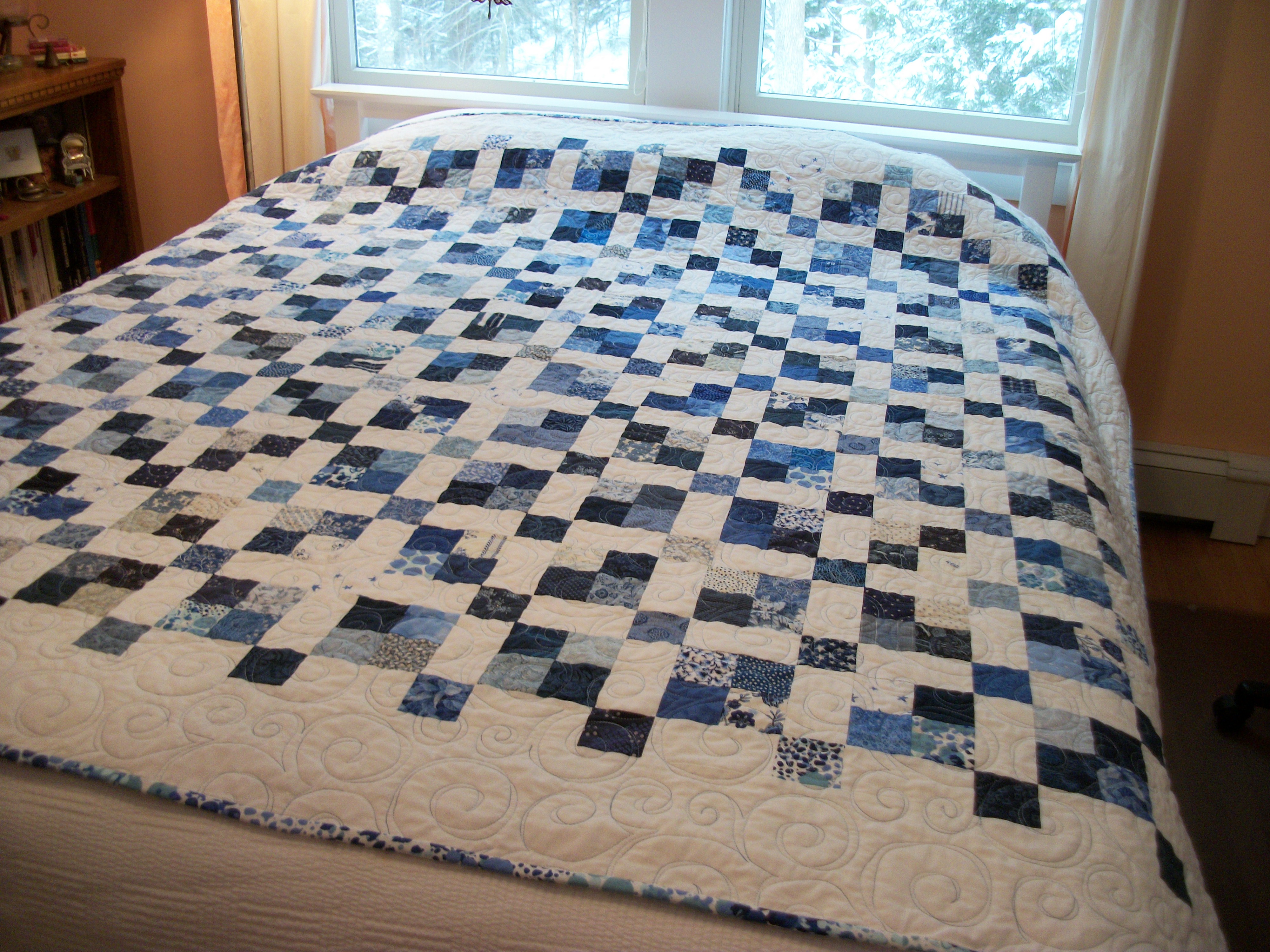
So, I made him “Coastal Pleasures” for his birthday this summer–made from my pre-cut blue squares and a lovely, swirling white on white fabric, “Ramblings” from P&B Textiles.  (Both of my sons and their families live two blocks from each other on Isle of Palms, SC, just north of Charleston, and both are two blocks from the beach.)

Coastal Pleasures

Here is the backing:

Coastal Pleasures back

Here is the backing with the binding and a bit of the front:

Coastal Pleasures back and binding

Here is a close-up of the quilting–a pantograph called Threadz from Urban Elementz, by Patricia E. Ritter (copyright 2012).  I loved the swirling energy of this pattern; it felt like wind moving on water and was very fun to quilt.

Coastal Pleasures top

Here’s a wider view, but still close up.

Coastal Pleasures top 2

Here’s the binding from the front on a white spread:

Coastal Pleasures binding

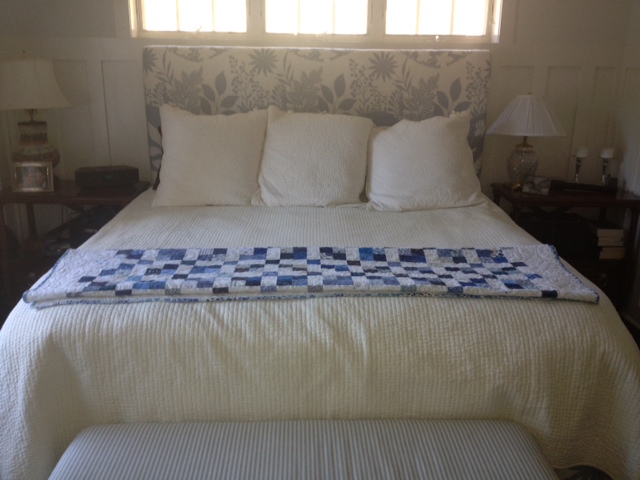
Here’s the quilt at the foot of Mike and Tami’s bed:

Coastal Pleasures on bed

The pattern idea, “Blue Lagoon,” was seen in JELLY ROLL QUILTS by Pam and Nicky Lintott.  I pretty much used the same colors they did—and found a similar quilting pattern.  However, this pattern is pretty basic and could lend itself to many variants.  I’m going to try more blue squares in a low-impact variant.  I found a big floral I’ll use as the white is used in this quilt.  I can hardly wait!!!

Turkey Tracks: Margaret’s Birthday Lantern

Turkey Tracks:  March 27, 2013

Margaret’s Birthday Lantern

Margaret made me a hanging lantern for my birthday.

Here’s a picture of the light itself:

Margaret's light

Here’s a video that’s way too dark, but gives some idea of how the colors change with the addition of a little battery tea light that changes colors.

Margaret makes these lights with three primary ingredients:  a balloon blown up, wood glue diluted by half with water, and tissue paper.  She also used a pipe stem at the top to stabilize the opening.  Her friend Mary makes more tissue paper at the top and folds it inside to stabalize the opening.  Some ribbon makes the hanger.  And a small battery-driven light that changes color makes the colors change.  If hung outside, one could also use a tea light.

She said she paints the balloon with the wood glue mixture, layers on the tissue paper, and…lets it all dry.  She deflates the balloon when the light is dry.

Anyway, I can’t wait to make these lights with the grandchildren this summer.

Or, to show them this one.

Margaret and Mary are making the lights for the wedding this summer of Mary’s son.  They are going to hang the lights in all the trees around the house.

Interesting Information: Chewing Gum Disaster

Interesting Information:  March 27, 2013

Chewing Gum Disaster

I love chewing gum.

Always have.

I probably got that love from my mother.  She used to read in bed at night, and you could always tell how excited the book was by the speed with which she popped the gum in her mouth.

Gum today has some exciting flavors and names, like Wrigley’s “Rain…a tingling spearmint.”  And the packages are colorful and beg to be picked up and chewed.

The other day, though, I noticed that “Rain” had a warning on the cellophane wrapper (NOT on the actual box) that the package contained a chemical called phenylalanine.  Hmmmm.  What is that?

That’s when I looked closer at the label.

Aspartame.  Soy Lecithin.  Sorbitol.  Natural and artificial flavors.

Where was the plain old sugar?

This was not a sugarless gum…

OK.  I’ll just get Juicy Fruit or one of the “normal” older gums.

Aspartame.

Aspartame is in ALL THE GUMS AT THE DRUGSTORE.

I had to go to a health food store to get a plain old gum with plain old sugar.

Aspartame is a neurotoxin.  Dr. Russel Blaylock calls it an excitotoxin and puts it right alongside MSG.  Blaylock claims excitotoxins promote cancer growth and the metastasis of cancer cells.  He cites a life time Italian study that links leukemia and aspartame.  The internet is full of testimonials from people whose health issues had reduced them to wheelchairs and who stopped drinking diet drinks filled with aspartame and who got their health back.  Military pilots are cautioned not to use it before flying planes.

I wrote about the history of aspartame and how it got FDA approval and what it does to humans in Tipping Points 19 and 20.  It’s another shoddy, terrible tale of regulatory agencies bought off by industry and of a total disregard for science or for the health of humans.  Aspartame has NEVER BEEN SHOWN TO BE SAFE.  There is plenty of information showing that IT IS DANGEROUS.

ALL the gum in the stores…

And what about phenylalanine?  In its natural form, it’s an amino acid that shows up in places like breast milk.  It can really harm people who can’t process it.  There have been enough of those folks that the gum is labeled for it.  The pheylalanine is gum has got to be a synthetic chemical brew, so who knows what effect it has on us.  Phenylalanine is reputed to be an analgesic and an antidepressant, so it kills pain and makes you feel happy.  The FDA allows it in foods as an additive and as a NUTRITIONAL SUPPLEMENT, which just shows you how far gone our food system is now.   So, the chewing gum industry is using it because it’s addictive and can kill pain, aren’t they?

And what’s soy lecithin doing in gum???

EVERY SINGLE GUM IN A MAINSTREAM STORE…

Chemical brews, not real food.

Don’t buy it.  Don’t chew it.  Understand what’s gone so terribly wrong with our food system.

Turkey Tracks: RUGS FROM RAGS

Turkey Tracks:  March 27, 2013

RUGS FROM RAGS

For those of you who might like to make the rag rugs shown in earlier posts, you can get directions for the VERY easy looms, clear instructions, and so forth from the book RAGS FROM RUGS, by Country Threads.  It sells for about $10.

Turkey Tracks: I Finished The Rugs!

Turkey Tracks:  March 21, 2013

I Finished The Rugs!

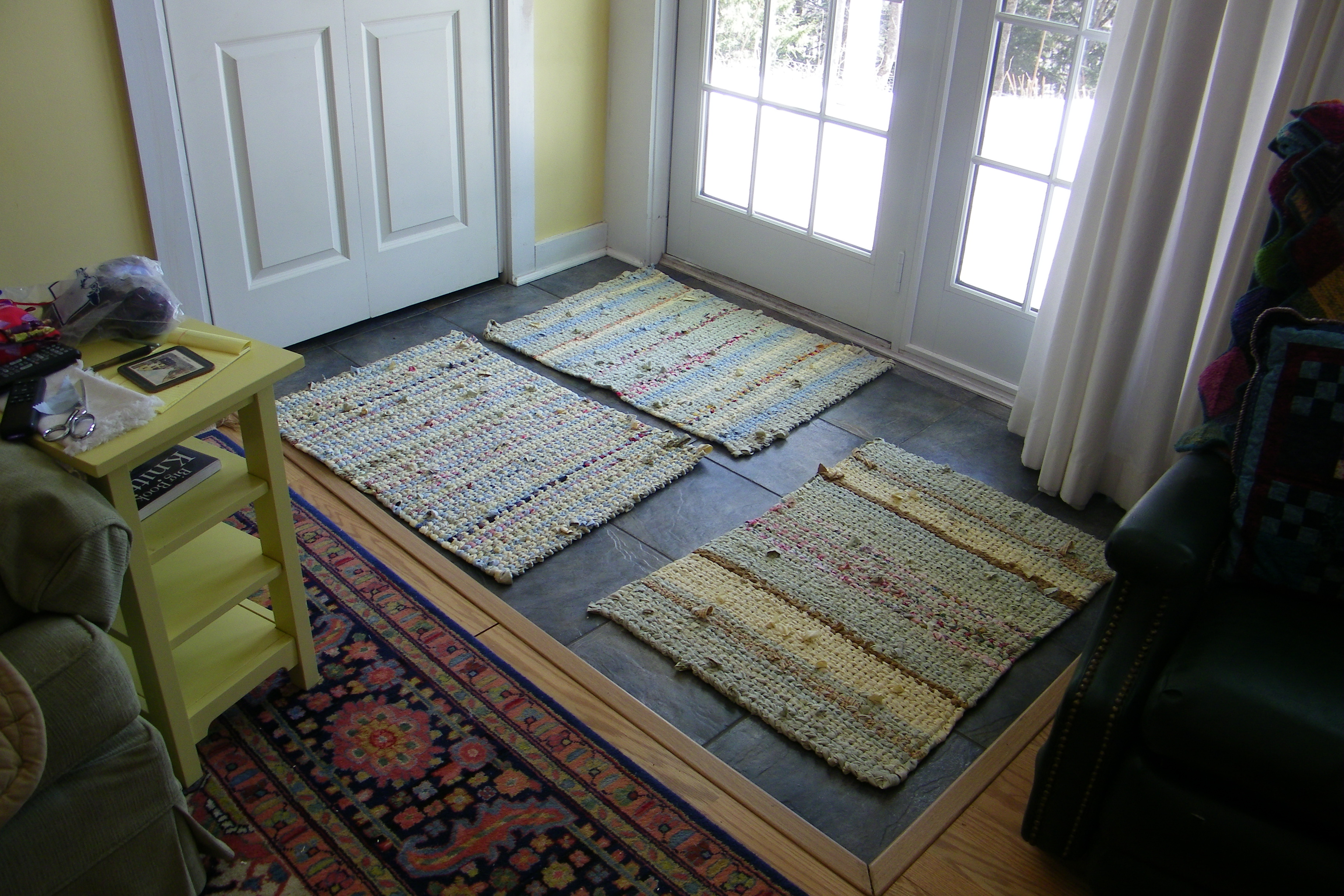
The old sheets I cut into strips with my pinking rotary cutter blade made three rugs.

Here are all three rugs at the front door:

Sheet Rugs

You can begin to see the possibility of sewing the rug sections together to make a larger rug…

And here’s a video so you can see them close-up:

I like the first one I show the best, which is a surprise.  It’s the one without any strips or blocks of color, but with the sheets and the fabrics always just alternated.  It looks so sweet at my back door in the kitchen.  It looks very French country, actually.

I put leftover strips on the loom to hold the side rods in place, so it’s all set up for another project.  I noticed this week in changing sheets that the elastic in one bottom blue sheet is getting very stretched out.  Probably by next winter, I’ll be cutting up more sheet strips.  Blue ones.  These rugs would make nice gifts, especially here in Maine where people take off their boots when they come in your house.

Turkey Tracks: They’re Still Making Fairy Houses

Turkey Tracks:  March 21, 2013

They’re Still Making Fairy Houses

When John and I were in Charleston last spring, we brought the children a book on Maine fairy houses.

We all made fairy houses all over the yard–after collecting flotsam and jetsam from the neighborhood.

Tami sent me this picture last fall, I think.

fairy houses continue

It’s a work of art.

I love the imagination!

Turkey Tracks: The Scarf Came!

Turkey Tracks:  March 21, 2013

The Scarf Came!

With the recent snow, I left our mail in the mailbox for a day.

When I retrieved it yesterday, there was a fat, small envelope that mystified me.

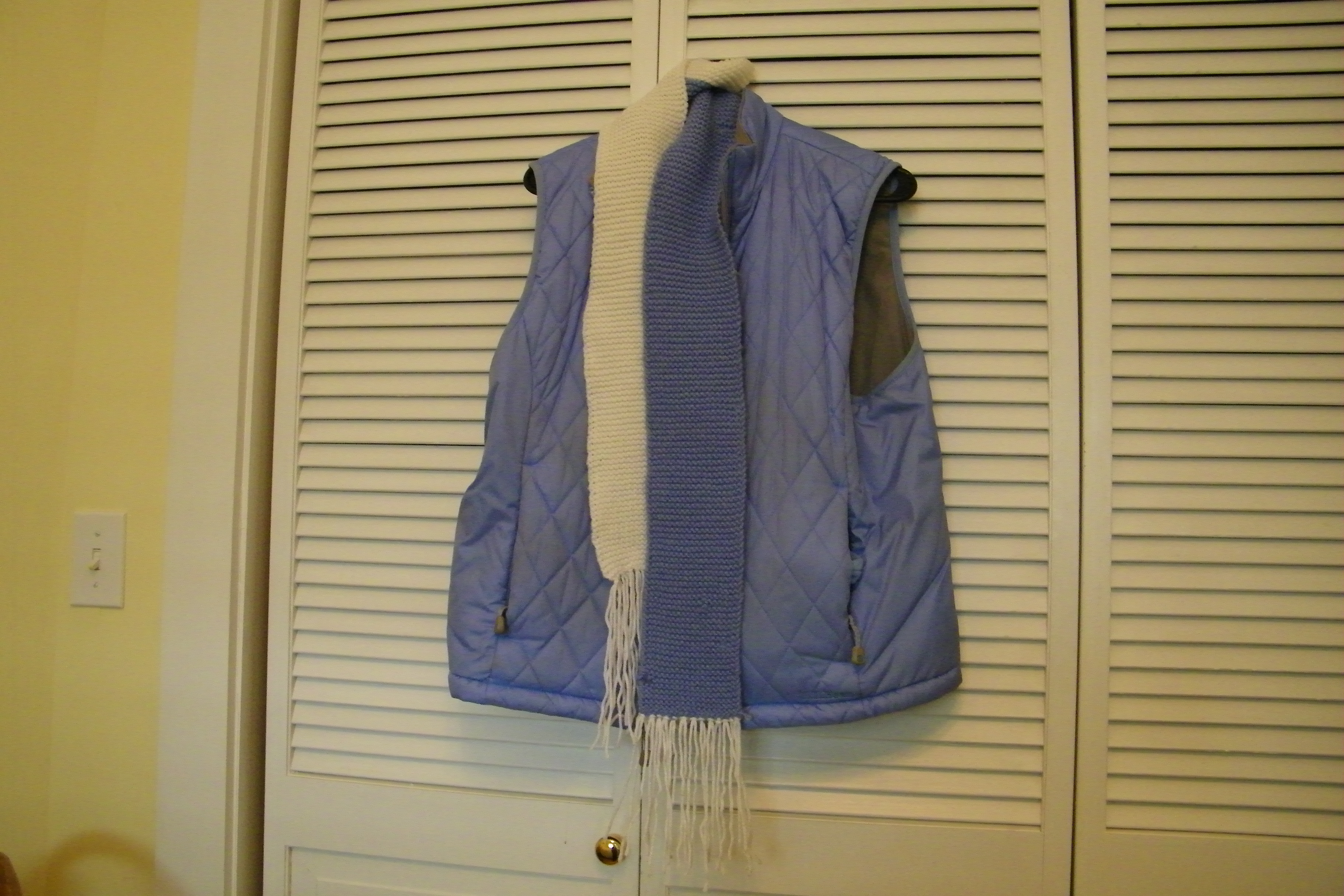
When I opened it, out fell this beautiful blue and white scarf!

My niece Nancy Howser Gardner had mailed me the scarf she had made for me as part of our bargain–red hand-knitted socks for her, a scarf for me.

It’s beautiful, and look what it goes with–my spring vest, which also has mittens and a hat of this same blue:

102_0266

I might even be able to wear all of this regalia soon as we are now into our spring warming trend.  Now, my neck will be toasty warm.

Thanks, Nancy!!!  It’s beautiful, I love it, I love that you made it for me, and I love the colors.  (How did you know?)

Turkey Tracks: Georgia the Goat

Turkey Tracks:  March 18, 2013

Georgia, the Goat

So now that I can put up videos, I have one that I’ve saved for about two years.

Some background:

My friend Tara Derr Webb lives in Charleston, SC, very near my sons.  She grew up with them, and they are all like brothers and sister.  They were thrilled when she and Leighton moved back to the East Coast from the West Coast and abodes abroad and settled near them.

Two years ago, Tara read Kristin Kimball’s THE DIRTY LIFE and started on a journey toward farming.  She visited a farm in the Atlanta, Georgia, area first.  There, a tiny baby goat was born and abandoned by her mother.  The farm family could not expand resources to manage a baby goat, so Tara put her into her car, brought her home, named her Georgia, and raised her with the help of husband Leighton and two nursemaid dogs, Milo, a Great Dane, and Eloise, a charming female of indeterminate age.

Here’s Georgia goat when she’s about 9 months or younger:

Tara and Leighton have gone on to start a farm (Deux Puces, or Two Fleas), a goat herd, vegetable crops, and a soon-to-be restaurant called “The Farmbar” made from a repurposed Spartan Landcraft.  You can read all about it, and them, and see videos of the tiny goat they just adopted on The Farmbar web site, linked on the right-hand sidebar of this blog.