Mainely Tipping Points 44: THE WHOLE SOY STORY

Mainely Tipping Points 44:  December 7, 2012

Part I:  THE WHOLE SOY STORY


Just the other day I stood in front of a store cooler with $40 worth of a premiere brand of bratwurst sausages in my hand.  How delicious they would be for dinner grilled and served alongside applesauce, pan-sautéed cabbage, corn bread, and assorted pickles and mustards.  Almost absentmindedly, I glanced at the ingredients on the label and was startled to see soy protein isolate.  I put the sausages back into the cooler for two reasons:  I don’t think our food should be padded with soy “meat extenders” so industry can make more money, and I don’t think commercial soy is at all safe to eat, especially the highly processed forms like soy protein isolate. 

The person I rely on for soy information is Kaayla T. Daniel, PhD, CCN, the author of THE WHOLE SOY STORY:  THE DARK SIDE OF AMERICA’S FAVORITE HEALTH FOOD (2005).  Daniel is known as the “naughty nutritionist” because with outrageous humor she specializes in debunking food myths, like the myths surrounding commercial soy.  And, Daniel comes with the kinds of credentials and training which allow her to understand the value of what she is researching, like why some studies have good designs and are executed properly and why others are corrupt, in that they have been designed and paid for by industry to make commercial soy appear to be safe and, even, healthy, when it is not. 

If you are totally confused by the alphabet soup that follows many names in the nutrition field, take a look at Daniels article “What Should I Do to Be a Nutritionist?   Making Sense of All Those Confusing Degrees and Credentials,” published in the Weston A. Price Foundation (WAPF) journal, “Wise Traditions,” Fall 2009, http://www.westonaprice.org/health-issues/what-should-i-do-to-be-a-nutritionist.  Daniels walks the reader through what kind of nutritional programs are available and what their strengths and pitfalls are.  She explains what kinds of organizations certify people with dietary and nutritional training, which lets them begin to use the coveted initials behind their names. 

You’ll find, too, that this terrain is a minefield of disingenuous claims.  For instance, , anyone can claim to be a nutritionist, so the alphabet soup tells everyone what kind of training and testing has been involved.   And, Daniels notes that Mary Enig, PhD, MACN, “is fond of saying [that] `Dietitians are trained to dispense processed food.’ (That MACN behind Enig’s name is the coveted Master of the American College of Nutrition, “a prestigious category for those who have made outstanding contributions over an extended period of time to the field of nutrition.”)  

Daniels herself studied under the legendary H. Ira Fritz, PhD, CNS, FACN.  The CNS stands for Certified Nutritional Specialist, and the FACN designates that Fritz is a Fellow of the American College of Nutrition.  The FACNs, explains Daniels, “hold doctoral degrees, [have] expertise as practitioners or educators and [have] a publication track record.”  (Dr. Enig’s MACN is a step above the FACN, which she also holds.) 

Dr. Fritz is now emeritus professor at both Union and Wright State University in Dayton, Ohio, and was, in addition to Daniels, mentor to a number of “superstars” in the field of nutrition.  Daniels herself is a CNN, or Certified Clinical Nutritionist, which is a very respected credential.  And, she is a board member (Vice President) of the WAPF and regularly publishes articles in its journal “Wise Traditions,” where she also has a column on soy issues.  And, she blogs at the WAPF web site and on her own blog, http://liberationwellness.com.    

With the publication of THE WHOLE SOY STORY, Daniels acquired a national reputation.  She appeared on the Dr. Oz show, where that megalomaniac did not allow her to speak more than one sentence.  (Oz ended that segment by passing out stalks of soy to the audience, each fluttering with raw edamame pods.)  She appeared on the Oz show as counter to Dr. Mark Hyman, a pro soy advocate, who did not seem to know that soy milk and tofu are not fermented soy products, which are safer to eat.  Her in-depth response to Hyman in the Fall 2010 “Wise Traditions” is worth reading, in that it discusses in a short article many of the myths and dangers of eating untreated soy:  http://www.westonaprice.org/soy-alert/response-to-dr-mark-hyman.  Daniels has been on ABC’s View From the Bay, NPR’s People’s Pharmacy, and will soon appear on PBS Healing Quest.  She was WAPF’s 2005 recipient of the Integrity in Science Award.

I am taking a lot of time setting up Daniel’s credentials because I hope this activity helps readers understand not only what I am looking for when navigating the maze of whom to believe when it comes to nutrition, but how readers, too, should discern the value of what they are reading.  We can no longer rely on studies from Harvard as being reliable just because they come from Harvard.  One has only to look at the recent study denouncing red meat done to see that Harvard nutrition scientists are perfectly capable of producing terrible, useless studies.  (See my blog, https://louisaenright.wordpress.com/?s=red+meat.).  Daniels has solid credentials, she works with people at the WAPF who also have solid credentials, and for THE WHOLE SOY STORY she looked at the history of soy, at all the major soy studies, at the major soy issues, and at the major soy industry proponents.

We are being besieged at the moment with the idea that we should all eat mostly a plant-based diet.  Vegetables and fruits are touted as being chock full of wonderful ingredients that will make us healthy.  What is being lost in this current moment of insanity is not only that plants are not nutrient dense, but that plants manage their lives chemically and that some of those chemicals are so potent that they can cause quite a bit of harm to humans.  Many of the plants that we eat everyday can, if overdone or eaten without being treated to reduce the chemical load, cause serious trouble.  And, it’s easy to over eat certain foods since they are now available all year round.  Take spinach, for instance. It’s loaded with oxalates, which can cause kidney stones if eaten in excess.  Or, the grains and legumes I wrote about in the  Mainely Tipping Points Essay series on the Paleolithic diet, essays 41, 42, and 43, which are loaded with antinutrients that must be treated to be safe to eat.  For more information in this vein, see Daniels; “Plants Bite Back,” “Wise Traditions,” Spring 2010, http://www.westonaprice.org/food-features/plants-bite-back.  

Soy is a dangerous plant food without a long history of use as a food.  And we are feeding it to animals and fish we eat and whose eggs we eat.  We are dumping soy into processed and packaged foods, including things like canned tuna fish and, unlabeled, in the hamburger in your local grocery store.  We are loading it with sugars and drinking it, to include putting it into baby formula.  We are, in short, wallowing in soy.

Here are some quotes from the flyleaf of THE WHOLE SOY STORY:  “Soy is NOT a health food.  Soy is NOT the answer to world hunger.  Soy is NOT a panacea.  Soy has NOT even been proven safe.”

And, here’s a quote to help start off this series on soy, again from the flyleaf:  “Hundreds of epidemiological, clinical and laboratory studies link soy to malnutrition, digestive problems, thyroid dysfunction, cognitive decline, reproductive disorders, immune system breakdown, even heart disease and cancer.   Most at risk are children given soy formula, vegetarians who eat soy as their main source of protein and adults self-medicating with soy foods and supplements.”   

Next:  how soy got into our food chain.        

Turkey Tracks: Some Favorite Recent Pictures

Turkey Tracks:  November 18, 2012

Some Favorite Recent Pictures

Three of the grandchildren and son Bryan have birthdays in September.

Remember the socks I was making out of leftover yarn?

Birthday socks–worn with very feminine white nightgowns purchased at a local Camden store:

Ailey Enright, the youngest grandchild for the moment, will be two the 25th of November.  She belongs to Bryan and Corinne, and she is intrepid.  No matter how cold the water, in she goes…

Bryan and Bowen (Mike and Tami’s oldest) were learning to surf.  Guess you will likely outdo both…

I love this one, taken on this same cold day.  Cousins–the oldest and the youngest:

Charleston cousins at Halloween:  the children of three families are represented here:  Mike and Tami, Bryan and Corinne, and Joey and Meaghan Kelly’s Meyer is in the red costume:

Talula is going to be a designer/artist of some sort.  She put this costume together herself, but got help with her eyes.  The photo is by Tara Derr Webb, who is clearly a mentor here and who is, herself, a working artist, a budding farmer, an amazing cook, and a gifted photographer.

Morning with Daddy:

Ailey with Uncle Michael:

Here are the Mike and Tami kiddos painting pumpkins with Uncle Joey and cousin Meyer.  Joey is Tami’s brother, and he’s so good with all these children.

First day in a new school.  I made the dress Mina is wearing, on the left, some years back.  Each girl had a matching dress, and I thought they were long outgrown.

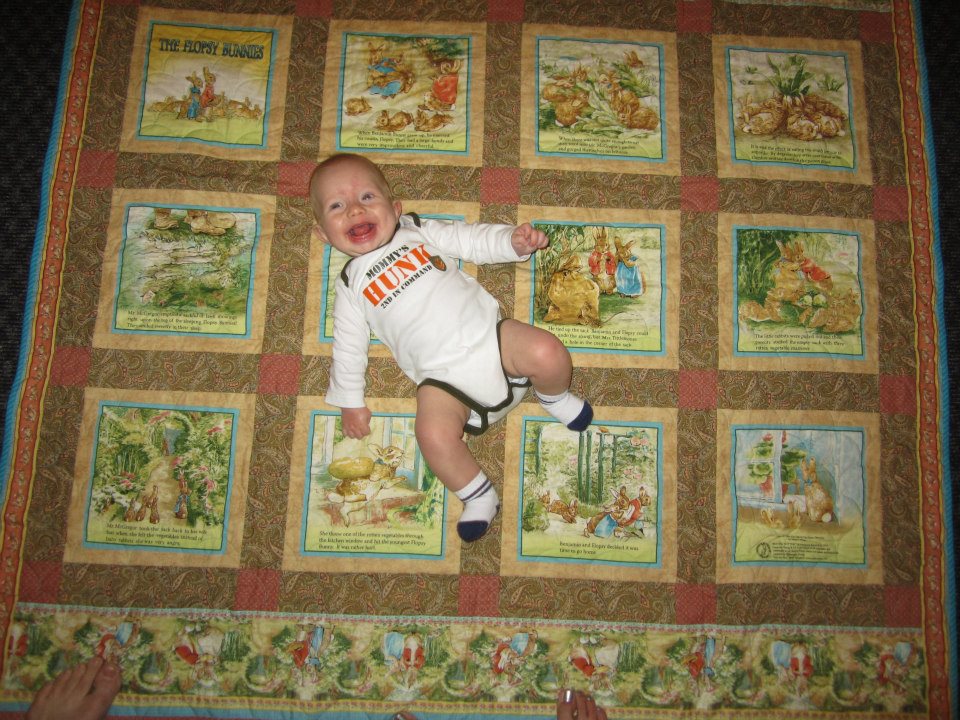
Meyer Kelly on his quilt.  I love nothing better than to see a quilt I’ve made being used and loved:

Ditto, Owen Black on his quilt:

That’s all folks!


Turkey Tracks: Fox With Foot Fetish

Turkey Tracks:  November 18, 2012

Fox With Foot Fetish

We’ve had a few chuckles over this information.

You might remember that we lost two chickens to a fox about six weeks or so ago.  Our whole neighborhood had seen her/him from time to time.  Susan McBride and Chris Richmond, up at Golden Brook Farm, thought for a few days fox had gotten one of their sweet, new barn cats.  And, they breathed a sigh of relief when they took their crop of meat chickens to be slaughtered without any loss along the way.

Things died down, then neighbor Marina Schauffler sent me this post:

In case you’re in need of a little humor, here’s an update on the neighborhood fox thief. Your chickens aren’t the only victims. I have now lost FIVE shoes to our fox friend. I kick off shoes on our back porch and noticed that one (then two, then three) were missing, but thought the boys had knocked them off or moved them. When a hiking boot went missing this morning, I hopped online and found that there are foxes with a foot fetish—who steal shoes for their pups to play with! One in Germany got nicknamed Imelda (after Imelda Marcos) ‘cause she ran off with 120 shoes in one community! I have to laugh (even though it’s going to be costly replacing them!)—I wish I could have seen her hauling off the half-pound hiking boot!

My chickens are loose again.

So far, so good…

Mainely Tipping Points Essay 43: Part III: Paleo Diet: What’s Wrong With Legumes?

Mainely Tipping Points Essay 43:  November 16, 2012

Paleo Diet, Part III:  What’s Wrong With Legumes?


To recap from Parts I and II, Paleo Diet advocates argue that humans are genetically wired to eat meat, foraged vegetables, fruits, nuts, and seeds.  Paleo peoples, they argue, did not eat grains, legumes, or dairy and were superbly healthy.

 But, what’s wrong with beans and peanuts, also known as legumes?

 Rob Wolf, in “The Paleo Solution,” puts it simply:  “dairy and legumes have problems similar to grains:  gut irritating proteins, antinutrients…protease inhibitors, and inflammation.”  Antinutrients, like phytates, bind to metal ions, like magnesium, zinc, iron, calcium, and copper, which make them unavailable for absorption by our bodies.  Protease inhibitors prevent the breakdown of proteins which means your body cannot “effectively digest the protein in your meal” (98-99, 93).  In other words, antinutrients and protease inhibitors cause malabsorption and disease.    


Nora T. Gedgaudas, C.N.S., C.N.T., in “Grains:  Are They Really a Health Food?:  Adverse Effects of Gluten Grains” (“Well Being Journal,” May/June 2012), notes that “legumes typically contain 60 percent starch and only relatively small amounts of incomplete protein, and they also contain potent protease inhibitors, which can damage one’s ability to properly digest and use dietary protein and can also potentially damage the pancreas over time, when one is overly dependent on them as a source of calories.”  (Gedgaudas’ web site is http://www.primalbody-primalmind.com.) 

 William Davis, MD, in “Wheat Belly,” notes that the carbohydrate in legumes contains amylopectin C, which is the least digestible of the amylopectins—which leads to the chant “Beans, beans, they’re good for your heart, the more you eat ‘em, the more you…”.  Yet, the reality of the indigestible matter is not so funny:  “undigested amylopectin makes its way to the colon, whereupon the symbiotic bacteria happily dwelling there feast on the undigested starches and generate gases such as nitrogen and hydrogen, making the sugars unavailable for you to digest” (33).

 Davis goes on to note that amylopectin B is “the form found in bananas and potatoes and, while more digestible than bean amylopectin C, still resists digestion to some degree.  Remember that wheat has amylopectin A, which is the most digestible form of the amlopectins and, thus, can raise blood sugars more than eating a sugar-sweetened soda or a sugary candy bar.  The lesson here is that “not all complex carbohydrates are created equal….”   And Davis cautions that as the carbohydrate load of legumes “can be excessive if consumed in large quantities,” it’s best to limit servings to about a ½ cup size (33, 213). 

 Wolf is less compromising when it comes to combining plant-based foods, like beans and rice, to obtain essential amino acids—which we must eat as we cannot make them on our own.  The eight essential amino acids are “plentiful in animal sources and lacking to various degrees in plant sources.”  Wolf notes that “many agricultural societies found that certain combinations (like beans and rice) can prevent protein malnutrition.”  But, relying on the work of anthropologists who have compared them, Wolf notes that “most vegetarian societies…are less healthy than hunter-gathers and pastoralists.”  That’s because “plant sources of protein, even when combined to provide all the essential amino acids, are far too heavy in carbohydrate, irritate the gut, and steal vitamins and minerals from the body via anti-nutrients.”  Wolfs’ final assessment:  “Beans and rice, nuts and seeds, are what I call “Third World proteins.’  They will keep you alive, they will not allow you to thrive” (208-209).

 Wolf cautions that unless you are lean and healthy, don’t eat fruit.  He adds, further, that “there is no nutrient in fruit that is not available in veggies, and fruit may have too many carbs for you” (214)

 Dr.  Natasha Campbell-McBride expanded on the 1950s Specific Carbohydrate Diet (SCD) of Dr. Sidney Valentine Haas and created the “Gut and Psychology Syndrome” (GAPS) diet.  (That history is in my Mainely Tipping Points Essay 31 on my blog:  https://louisaenright.wordpress.com.)  Haas recognized the connections between diet and disease, especially in the debilitating digestive disorders, and put patients on a diet that eliminated dairy, grains, legumes, and starchy vegetables, like potatoes.  (Dairy is slowly added back after healing has started, beginning with cultured forms, like yogurt.  But, some patients are not able to tolerate dairy permanently.)  Haas’s SCD diet emphasized bone broths, meat stews that included animal fat, vegetables, and some fruits.  The results were, and are, amazing. 

 Dr. Campbell-McBride was one of many now, like Wolf and Davis, who made the further connection that too many starchy carbohydrates foment conditions in the gut that allow out-of-control yeasts to degrade the gut lining—which allows food particles to escape into the blood stream and trigger autoimmune reactions.  Campbell-McBride is one of the first to realize that these out-of-control yeast populations produce toxins that affect the brain and create problematic behavior.  Conditions like autism, for instance, might not really be autism, but effects of inappropriate diet and malfunctioning body systems. 

 Sally Fallon Morell and Mary G. Enig, Ph. D. of The Weston A. Price Foundation (WAPF) hold a place in their 1999 “Nourishing Traditions,” for most legumes—if properly soaked and cooked so that phytic acid and enzyme inhibitors are destroyed and difficult-to-digest complex sugars are made more digestible and if legumes are cooked and eaten with at least small amounts of animal protein and animal fat. 

 Morell and Enig write that soybeans, however, should only be eaten sparingly and only after fermentation into miso, tempeh, and natto because the chemical package in soy is so powerful and so dangerous (495-496).  A  commercial method has never been fully developed that renders soy completely safe.  But, more on soy in Mainely Tipping Points 44 .  (Note that tofu is not a fermented soy food.) 

 Morell and Enig are careful to caution that “vegetable protein alone cannot sustain healthy life because it does not contain enough of all of the amino acids that are essential.”  Indeed, “most all plants lack methionine, one of the essential amino acids” (495-496).  Further, both Morell and Enig have made clear repeatedly in the WAPF journal “Wise Traditions” that the current government support for plant-based diets is dangerous and unscientific.          

 In the end, what Paleo diet advocates are asking is why, in the first place eat foods with such high carbohydrate loads, inferior protein, and so many dangerous chemicals —especially when a diet of meat, vegetables, fruits, nuts, and seeds supplies nutrients in dense, safe, satisfying forms. 

 This Paleo question is especially good to contemplate if one is overweight and experiencing the attendant health issues that accompany that condition and are trying to make changes.  Or, if one has ongoing digestive disorders which really must be addressed. 


Interesting Information: Just Say “NO” to Hand-wash Chemicals

Interesting Information:  November 11, 2012

Just Say “NO” to Hand-Wash Chemicals

I was looking for a fermented beet recipe in Sandor Ellix Katz’s WILD FERMENTATION when I realized I had marked a passage about using antibacterial soaps, most of which contain Triclosan or Triclocarban.  Katz’s book is all about using organisms of fermentation to create living foods.  As such, he argues that these organisms “play a role in protecting us, as organisms among organisms, from disease” (8).

Triclosan has been classified as a pesticide by the EPA since 1969, though it is more often used in products that promote the “body hygiene,” with which we are obsessed.  Here’s the EPA site since googling reveals that there are a number of internet sites trying to deny this classification of triclosan:  http://www.epa.gov/oppsrrd1/REDs/factsheets/triclosan_fs.htm.   One does not really want to think that one is putting a pesticide on one’s skin or in one’s mouth (toothpaste).

The Natural Resources Defense council’s page on the dangers of triclosan is a good place to start understanding how dangerous it is.  Triclosan may cause antibiotic resistance in humans and definitely encourages the growth of “superbugs” and disrupts hormones, particularly in the brain and the reproductive systems:  http://www.nrdc.org/living/chemicalindex/triclosan.asp?gclid=CPyh97ewx7MCFcxAMgod0n4AQg.

I was fairly astonished at the extensive use of triclosan in all kinds of products.  Dr. Ben Kim has assembled an astonishing list of these products: http://drbenkim.com/articles/triclosan-products.htm.  One might expect triclosan in soap, but it’s also in toothpaste and all kinds of cosmetics–and that’s just the beginning.  Do take a look at Kim’s list–it’s in first-aid products, clothing, toys, kitchen equipment…

If the terms “antibacterial” or “antimicrobial” appear on a label, start looking deeper for Triclosan on the main ingredient label.

And, if you’re somewhere where you’ve used a toilet that has one of those hand-wash dispensers that substitute for soap and water–you might want to forgo using it.  What may or may not be on your hands is far less dangerous than the chemical you’re about to use.  Maybe carry “wipes” that are less dangerous?

As I said, Americans are obsessed with germs and body hygiene–which dates back to the divergence between germ-theory proponents and immune-system proponents AND to the market’s ability to make products that seem to quiet our fears about germs and pathogens–a fear the market exploits.  I explored this history in Mainely Tipping Points 8 Essay, with regard to the safety of real milk versus the dead commercial milk, which is on this blog.  (You can get to the essays by clicking on the right sidebar or by searching from the search bottom on the right sidebar ).  And, that’s where Katz and his WILD FERMENTATION come back into play.  It’s worth reading Katz’s take on this whole subject, from which I quote below.  (Note:   Katz cites all his quotes in the text.)

Our culture is terrified of germs and obsessed with hygiene.  The more we glean about disease-causing viruses, bacteria, and other microorganisms, the more we fear exposure to all forms of microscopic life.  Every new sensationalized killer microbe gives us more reason to defend ourselves with vigilance  Nothing illustrates this more vividly than the sudden appearance, everywhere in the United States, of antibacterial soap.  Twenty years ago, mass marketing of antibacterial soap was but a glimmer in some pharmaceutical executive’s eye.  It has quickly become the standard hand-washing hygiene product.  Are fewer people getting sick as a result?  “There’s no evidence that they do any good and there’s reason to suspect that they could contribute to a problem by helping to create antibiotic-resistant bacteria,” says Dr. Myron Genel, chair of the American Medical Association’s Council on Scientific Affairs.  Antibacterial soap is just another exploitative and potentially dangerous product being sold by preying on people’s fears.

The antibacterial compounds in these soaps, most commonly triclosan, kill the more susceptible bacteria but not the heartier ones.  “These resistant microbes may include bacteria…that were unable to gain a foothold previously and are now able to thrive thanks to the destruction of competing microbes,” says Dr. Stuart Levy, director of the Tufts University Center for Adaptation Genetics and Drug Resistance.  Your skin, your orifices, and the surfaces of your home are all covered with microorganisms that help protect you (and themselves) from potentially harmful organisms that you both encounter.  Constantly assaulting the bacteria on, in, and around you with antibacterial compounds weakens one line of defense your body uses against disease organisms.

Microorganisms not only protect us by competing with potentially dangerous organisms, they teach the immune system how to function.  “The immune system organizes itself through experience, just like the brain,” says Dr. Irun R. Cohen of the Weizmann Institute of Science in Israel.  A growing number of researchers are finding evidence to support what is known as “the hygiene hypothesis,” which attributes the dramatic rise in the prevalence of asthma and other allergies to lack of exposure to diverse microorganisms found in soil and untreated water.  “The cleaner we live…the more likely we’ll get asthma and allergies,” states Dr. David Rosenstreich, director of Allergy and Immunology at the Albert Einstein School of Medicine in New York (9).

So, just say “no” to Triclosan as an ingredient in hygiene products and all the other products in which it is found.

And think about all the germ-theory hype a bit more…

Work to build up your immune system…

Books, Documentaries, Reviews: Maybe We Still Have A Democracy

Review of the Election:  November 8, 2012

Maybe We Still Have A Democracy

I had my doubts.

I was really afraid for what could happen.  After all, Hitler got elected in an economic downturn when people wanted more and were scared…  He promised to make the trains run on time…

There was so much money pitted against what’s left of our democracy.  So many lies made in order to win at any cost.  So many ads that lied.  So much fear-mongering.  So much hatred.  So much voter suppression.  So much media that portrayed the sides as equal, when they were anything but equal, especially in terms of money.  Rachael Maddow reported on November 7th that Romney’s side spent two-thirds of the campaign money, versus Obama’s one-third.

The media portrayed the election as a horse race and totally ignored any role to reveal what is true and what isn’t.  The mainstream media didn’t cover the voter suppression story or point to the awful racism, like the ads that lied that Obama had banished work under welfare.  Or, that  the auto bailout didn’t work because Jeep was taking all the jobs to China anyway.  Why should we be surprised?  The media is now big business; their plutocrat owners made a fortune off this election.

And, then, there was the alternative reality created by Fox Commentary, for even they say they don’t do “news.”  In the process truth, science, real polling data, and on and on just got erased, smeared, stamped on, eradicated.  They create a horse race every day between so-called conservatives and liberals, and they laugh all the way to the bank.

I went to bed Tuesday night after 2 a.m. and could hardly sleep.  The people “got” it.  They voted.  Some of them stayed in line for 8 and 9 hours to do so.  And, they shellacked the Romney ticket.  They said “no” to the buying of this election by the 1% who have so much money they can’t even spend it all.

I don’t want to call the Romney organization the GOP, because these folks are not the GOP I’ve always known and, many times, admired.  (I even worked for Ronald Reagan at one point in my life as a political appointee and have long cherished folks who conserve, who care about their community, who build businesses that are ethical and moral, who fear foreign entanglements, and who will fight for their country when it is needed.)  The folks in command of the GOP right now are Far, Far, Far Right Ideologues.  Most of them are wealthy and don’t have a clue what a worker in America faces every day–witness Romney’s 47% and Ryan’s 30%.  Nor have most of them served in the military.  What I realized Wednesday morning is these folks will never win in this country as long as women and workers can vote fairly.

I woke up feeling profoundly grateful for the American people, for their willingness to act on their belief that we are all so much better off when we work together then when we go it alone, for their belief in the need for the kind of government that “has their backs” when something like a storm like Sandy hits, for their refusal to let wealthy men buy this country, for their refusal to believe the lies–and on and on.  They knew Romney couldn’t produce jobs because he does not have that kind of work experience–he only knows how to get rid of good American jobs by eliminating them or sending them to China.

Because of the American people, health care will become a right and pre-existing conditions won’t stop people from getting medical attention.

Because of the American people, women will retain the rights to their bodies and will have equal pay for equal work.  (No more vaginal probes please!)

Because of the American people, workers will retain basic civil rights to organize in the workplace.  If workers don’t operate to balance owners’ excesses, we all suffer.  And if workers aren’t paid fairly for their work, they don’t have enough money to buy owners’ goods.  It’s simple math.

Because of the American people, gay people will gain civil rights across the country faster–to include being able to marry legally.  That law passed in a number of states this election.

Because of the American people, we will all enjoy a more stable economic possibility.  The GOP’s Austrian School of Economics practices (called erronously “free” market principles when it is anything but) blew out our economy.  Doubling down on it would crash the world system AND would create a hell for workers worldwide.  We would have chaos and anarchy in our streets.  Read my earlier blog entry about Crony Capitalism to see, in part, what I mean.

Because of the American people, Obama will be the one to appoint two and maybe three Supreme Court Justices.  The Supreme Court will get turned around from its ideological, pro-corporate stance.  The hollowing out of laws so that they favor corporations and stop people from being heard in our courts can be stopped.  Roe V. Wade will stand.  And, maybe, Citizens United will be stopped.

Because of the American people, something will be done about the difficulty of voting and voter suppression.

Because of the American people, Americans will stand a much-improved chance at getting real, good jobs, especially in the energy sector, in the rebuilding of our roads and bridges, and, maybe, in a return to the land as we turn toward healthy, clean food.

Because of the American people, our soldiers will come home from TWO unfunded wars.  And, when they do, they will be taken care of properly.

Because of the American people, real science will be valued.  Climate change will be recognized.  Rape will be rape.  Fetuses will remain fetuses and not persons until they have brains and can breathe.  Hopefully, toxic chemicals will be banned from the environment.  And GMOs will be labeled.

Because of the American people, FEMA will not be privatized.  Nor, our schools.  Nor any more sectors of our economy that should remain in place for the common good.

Because of the American people, maybe we are done with giving Donald Trump a stage.  And, John Sununu, who is a vicious, racist bigot.

Because of the American people, we will continue to be led by a person who is not perfect, who does not claim to be, but who is steady, careful, reliable, dignified, and who tells the truth.  We will be led by someone with real strength and character–not someone who is a shill for the plutocrats, who thinks he is strong when he mindlessly, ruthlessly, and rudely attacks, and who cannot open his mouth without lying.

Because of the American people, we will continue to have a Democracy, not a Theocracy run by Plutocrats.

I am deeply grateful and have renewed faith that maybe we do still have a democracy, however flawed it is.

Interesting Information: Rachael Maddow Show November 7, 2012

Interesting Information:  November 8, 2012

Rachael Maddow Show November 7, 2012

She’s smart.  Really smart.

She’s nice.  Polite to all.

Her November 7, 2012, show analyzed many of the highlights of the Presidential election.

It’s a must see.  Well done, smart, polite, interesting…

You can download the podcast on itunes.

You can stream it at the MSNBC url:   http://www.msnbc.msn.com/id/26315908/ns/msnbc_tv-rachel_maddow_show


Interesting Information: “Mitt Romney’s Bailout Bonanza”: The Face of Crony Capitalism

Interesting Information:  November 8, 2012

“Mitt Romney’s Bailout Bonanza”:  The Face of Crony Capitalism

Greg Palast’s story in the November 5, 2012, issue of “The Nation” is important because it allows a picture of how crony capitalism works and why it is so exciting that the 99 percent–Americans of all creeds, colors, and genders–voted for Obama in enough numbers for him to win.  They “get” that ultra wealthy people trying to buy an election means even more trouble for the 99 percent.

The full story title is “Mitt Romney’s Bailout Bonanza”:  How Mitt and Ann made millions–and Mitt’s hedge fund donors made billions–from the auto-industry rescue that he condemned.”

Greg Palast is an “economist and financial investigator turned journalist whose series on vulture funds appeared on BBC Television’s Newsnight.”  This work was “supported by the Investigative Fund at the Nation Institute and by the Puffin Foundation.”  Palast’s new book is BILLIONAIRES & BALLOT BANDITS:  HOW TO STEAL AN ELECTION IN 9 EASY STEPS.

You can read the whole piece for yourself at http://www.thenation.com/article/170644/mitt-romneys-bailout-bonanza.  But, here are the highlights.  Be warned:  it’s a nasty story.  But, one that shows how crony capitalists work, how they are parasitic predators.

Mitt and Ann Romney “personally gained at least $15.3 million from the bailout–and a few of Romney’s most important Wall Street donors made more than $4 billion.  Their gains, and the Romneys’, were astronomical–more than 3,000 percent on their investment.”  The Romneys invested “at least $1 million…through Ann Romney’s blind trust (it could be far more, but the Romneys have declined to disclose exactly how much).”

The government bailout sent “directly or indirectly, more than $12.9 billion to Delphi–and to the hedge funds that had gained control over it.”

A key player is the super rich, super conservative “vulture investor” Paul Singer–a long time Romney friend and a long time supporter of Paul Ryan, who voted for the auto bailout.  (Singer was instrumental likely in putting Ryan on the Romney ticket.)  Singer owns one of the hedge funds that gained control of Delphi Automotive–the former General Motors subsidiary “whose auto parts remain essential to GM’s production lines.”  Neither GM or Chrysler can operate without these auto parts.

When the auto industry started running into trouble, it spun off Delphi Automotive, which was loaded with debt.  Delphi went into bankruptcy and Singer and his crony friends–all of them very rich and all of whom have donated millions to the Romney campaign–bought Delphi stock at “20 cents on the dollar of their face value.”  Singer, chair of the “anti-union Manhattan Institute…rid Delphi of every single one of its 25,200 unionized workers” (underline mine).  Singer et al closed all but 4 of the 29 Delphi plants and sent the jobs to China.  Delphi is “now incorporated overseas, leaving the company with 5,000 employees in the United States (versus almost 100,000 abroad).

Delphi retirees lost their health insurance and life insurance and their pensions were “slashed by 40 percent.”  As the hedge funders refused to honor workers’ pensions, the government’s Pension benefit Guaranty Corporation had to take over paying “all of Delphi’s retirement pensions”–which slashed pensions by 40 percent as this organization cannot pay in full.  Retirees found they could not get good jobs to replace this monetary loss.  Romney’s campaign ran ads blaming Obama for the monetary losses to the workers though it was Singer et al who refused to honor Delphi’s obligations to its workers–a practice began in the leverage buyouts of the 1970s–pioneered by men like Mitt Romney.

In June 2009, with “the bailout negotiations in full swing, the hedge funds, under Singer’s lead, used their bonds to buy up a controlling interest in Delphi’s stock….they paid, on average, an equivalent of only 67 cents per share.”

Two years later, in November 2011, “the Singer syndicate took Delphi public at $22 a share, turning an eye-popping profit of more than 3,000 percent.”  This gain of $904 million came from U.S. taxpayer money for the bailout.

Between 2011 and 2012 Delphi’s stock soared 45 percent.  These gains came from Delphi’s more stable situation, yes, but this situation was based on Singer et al’s refusal to honor Delphi’s healthcare and pension obligations AND from the bailout, taxpayer  money.  The various individual crony capitalists in the Singer syndicate have made $390 million (Daniel Loeb), $894 million (two Goldman Sachs alums, $2.6 billion (John Paulson),and $1.2 billion (Singer and his partners).

When President Obama set out to save the failing auto industry, there were at least 25,000 union workers who stood to lose their jobs.  The Delphi hedge fund owners held Delphi hostage, telling the government to “hand over $350 million immediately, `because if you don’t, we’ll shut you down’ “–meaning the whole of the auto industry which needed Delphi’s parts.

At one point in 2009, the government and GM tried to “take back control of Delphi via a joint venture with Platinum Equity,” but the hedge funders refused to sell–seeing that they could make a lot more money by holding the company hostage, sending jobs overseas, cutting retirees pensions and insurance, and so forth.

This year, 2012, Singer et al took the money they had “saved” by not honoring obligations to workers and bought auto plants parts plants in Asia–$972 million–“purchased from Bain Capital.”

Romney’s 2009 tax returns would have shown how much he actually made on this deal.  He refused to release them.

If  Romney had invested as little (for him) as $7.5 million, he would have made $115 million.

Whatever money is involved remains untaxed as Delphi’s incorporation is now in the Isle of Jersey, a “tax haven off the coast of France.”

These men are parasitic predators.

They do not care about workers.

They do not create American jobs.

They did not have any plan for America beyond making it easier for themselves to make these kinds of deals.

There is no such thing as a “free” market.  Just look at all the monopoly formation that is in place.

Good business people build things, honor obligations, and conserve what is important in their communities and their nation.

Turkey Tracks: Delicious!!! Massaged Kale

Turkey Tracks:  October 30, 2012

Massaged Kale

Well, you are in for a real treat.

Don’t hesitate for a moment to make Georgeanne Davis’s “Massaged Kale” recipe–which appeared in one of our local papers, THE FREE PRESS, last week.  She also included a Chocolate Beet Cake and Squash-Filled Potstickers, so I’m including the whole citation so you can read the column “Home & Garden” for yourselves: http://www.freepressonline.com/main.asp?SectionID=50&SubSectionID=72&ArticleID=22592.

Son Bryan is here visiting–actually he’s trapped here due to the strange storm calledSandy, which has cancelled most flights along the East Coast–so we made Massaged Kale–with lamb loin chops and the roasted veggie dish I love to make when it’s time to pick the green tomatoes.  I wrote about this recipe last year and you can find it under the recipe tab on the right sidebar.  Basically you roast cup up green tomatoes, a deep sweet squash like a Buttercup, some fresh potatoes, some onion–all garnished with fresh rosemary, garlic, salt, and olive oil.  The sour tomatoes work beautifully with the sweetness of the squash, and I look forward to this dish each fall.

John, Bryan, and I all loved the Massaged Kale, and John doesn’t even like kale very much.  The tiny bit we had left over was very good the next night as well–and I shared it between the three of us.

Plus, it’s easy to make.  You just wash the kale (I used enough from the garden to fill a big bowl–Davis recommends two bunches of kale) and tear it into bite-sized pieces–leaving out the stalk and tough stems.  Mix up the following and pour it over the leaves.  Then start to rub the leaves–kneading them–with your hands–until they get shiny/glossy and have reduced by half.  This part only takes a very few minutes–maybe 5 or less.

I think sauteed pine nuts sprinkled over the top would be good, too.  Or, toasted walnuts.  This plain base would also be good for sandwiches or further worked into a pesto, as Davis notes.

1/2 cup grated Parmesan cheese

1/3 cup olive oil

1/4 cup lemon juice–I just used the juice of one lemon

3 large garlic cloves, minced–it might be nice to grind them down to a paste with the blade of your knife and a bit of good Sea Salt

1 Tablespoon soy sauce

1 minced anchovy fillet (I keep a tube of anchovy paste on hand and used that so I didn’t have to open a bottle just for one fillet)

Sea salt and pepper–go slow with added salt as the soy sauce and Parmesan cheese are also salty and I almost got my batch too salty…

ENJOY!!!

Interesting Information: Walmart’s Campaign to Fight Hunger

Interesting Information:  October 22, 2012

Walmart’s Campaign to Fight Hunger

A Walmart insert came in our local Camden, Maine, paper last week.

I was horrified by its contents.  And, saddened.

The front page of a four-page sale flyer announced–in big capitals–“ONE IN SIX AMERICANS STRUGGLE WITH HUNGER.”

The background picture (I would try to photo it, but I’m afraid of their copyright laws) shows four children (two African Americans, one with dark hair whose face is turned away, and in the center of the page, a blond white child with big blue eyes) and a “mom” or “teacher” adult.  So, unspoken is that we really have to do something about hungry children, not just hungry Americans.  (The last time I looked, childhood hunger was one in five children–and if Walmart paid better wages, they could help that problem immensely.)

In the foreground are 2 apples, four raspberries, six oranges, and a bunch of about 6 bananas.  Behind them–and filling the rest of the pages–are boxes of horrible, fake, sugary, unhealthy foods:  Honey Nut Cheerios, Kellogg’s Frosted Flakes, Country Crock margarine, Jell-O Oreo Dirt Cup, Knorr Pasta with Chicken, Knoss Rice with Cheddar and Broccoli, a box of Hamburger Helper that promises seven meals, Kellogg’s Special K (really, there’s nothing in that box that’s good for you–see my Mainely Tipping Points essays), and Nature Valley cereal bars.

The other three sheets are more of the same kind of fake foods.  The only fresh foods are the token fruits on the front page–and they aren’t on sale in the flyer.

The logos of General Mills, Unilever, Kraft Foods, and ConAgra Foods are on the cover page.

Meanwhile, the government and the medical community and all the public health folks are running around screaming about the obesity epidemic.  Really, they don’t need to look any farther than this Walmart flyer.  Here’s what is massively wrong and why so many folks are obese.  They’re eating TOO MANY CARBOHYDRATES and fake foods, like the ones “on sale” in this ad.

Don’t for one minute think that Walmart cares about obesity or children.  Or, that Walmart is NOT making a huge profit on a sale like this one.  There is not one philanthropic bone in this corporation’s structure.  And, according to Tracie McMillan in THE AMERICAN WAY OF EATING (more on this book later), Walmart already controls 25 percent of the grocery market in America and is now threatening expansion that will harm inner city markets and urban farming efforts.  Don’t think Walmart will always keep prices low as they get more of a market share either.  They won’t.

So, don’t fall for this kind of appeal.

Don’t be a part of feeding hungry kids or your kids or yourself this kind of unhealthy food.  Find other ways to help feed the hungry and to eat yourself.  There’s plenty of help out there for you to learn how NOT to use these boxed fake foods.

Most of all, don’t shop at Walmart.  Yes, some things may be momentarily cheaper at Walmart, but there are huge costs in all kinds of ways in the Walmart model.  Walmart is part of why we have hungry children in America in the first place.