Books, Documentaries, Reviews: My Read Pile September 2011

Books, Documentaries, Reviews:  September 2011

My Read Pile–September 2011

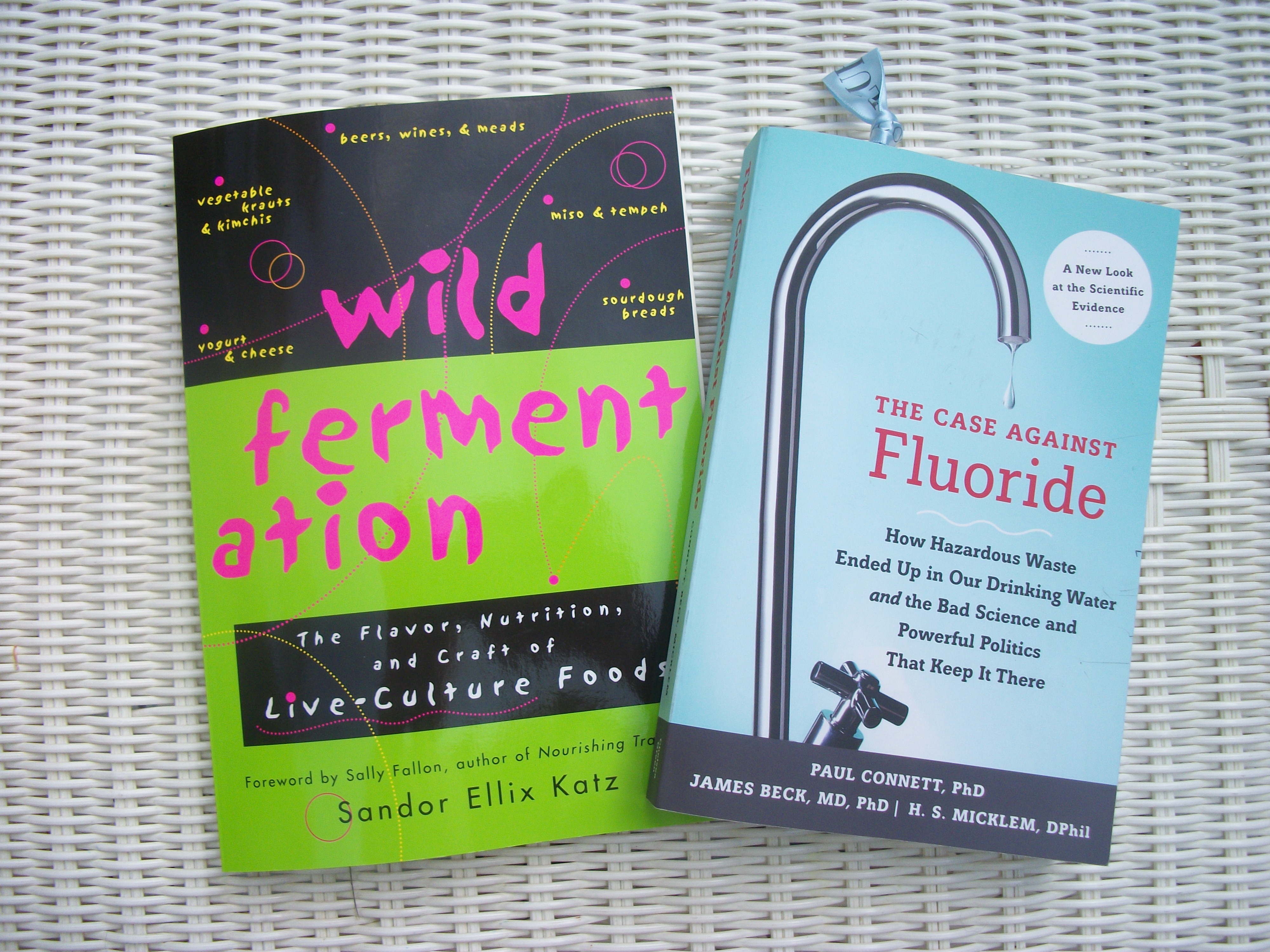
Just finished Sandor Ellix Katz’s WILD FERMENTATION.  LOVED IT!  I can’t think why I have not gotten it sooner.  I’ll be writing the next Mainely Tipping Points on it.  I sat down and read it straight through, and in hours had a cheese ball dripping whey and had a quart jar of kale fermenting.

THE CASE AGAINST FLUORIDE has been written by 3 MAJOR scientists who know what they’re talking about.  The EPA recently lowered the amount of fluoride allowed in municipal water systems.  And, most people get way too much fluoride already in tooth paste–especially children who SWALLOW it.  (Try telling a two-year old not to swallow tasty toothpaste!)  So, more on fluoride later, but meanwhile know that it is very dangerous, that it’s a waste product of industry, and that you should filter it out of your water.  Better still, read about it and try to get it out of your local system.  The time is right!

TOOTH PASTE RECIPE

By the way, the best recipe for toothpaste is just to mix baking soda with good sea salt–equal proportions.  But it in a jar and dip your wet toothbrush into it.  If you want some flavor, get some essential oil of peppermint and use one drop on the wet toothbrush.  Or, some essential lime oil, sweet orange, or one of the oils that are ok to put into your mouth if you rinse them out.  Peppermint essential oil has some nice anti-fungal properties, among other good effects.

Turkey Tracks: New Chickens

Turkey Tracks:  September 2, 2011

New Chickens

Over the summer, I have replenished and expanded, by one, our chicken flock.

First, two of the older Copper Black Maran hens went to Rose’s farm.  She wanted more dark brown eggs, and we have the new CB chickens, so she will keep the best of those roosters and try to place the rest.  Remember, that we got a “straight run” of 15 CBM chicks from Tom Culpepper last May.  Half of all “straight runs” are, statistically, male.  To no one’s surprise, we have 7 CB Maran roosters.  Indeed, half of all just-born farm animals are male.  And, you cannot keep a lot of males.  Rose has a big flock, so she may be able to have two strong roosters.  But, maybe not.  They still have to go into the same chicken house at night.  Anyway, Rose now has breeding stock to reproduce the CBMs next spring, and I have a back-up CBM rooster.

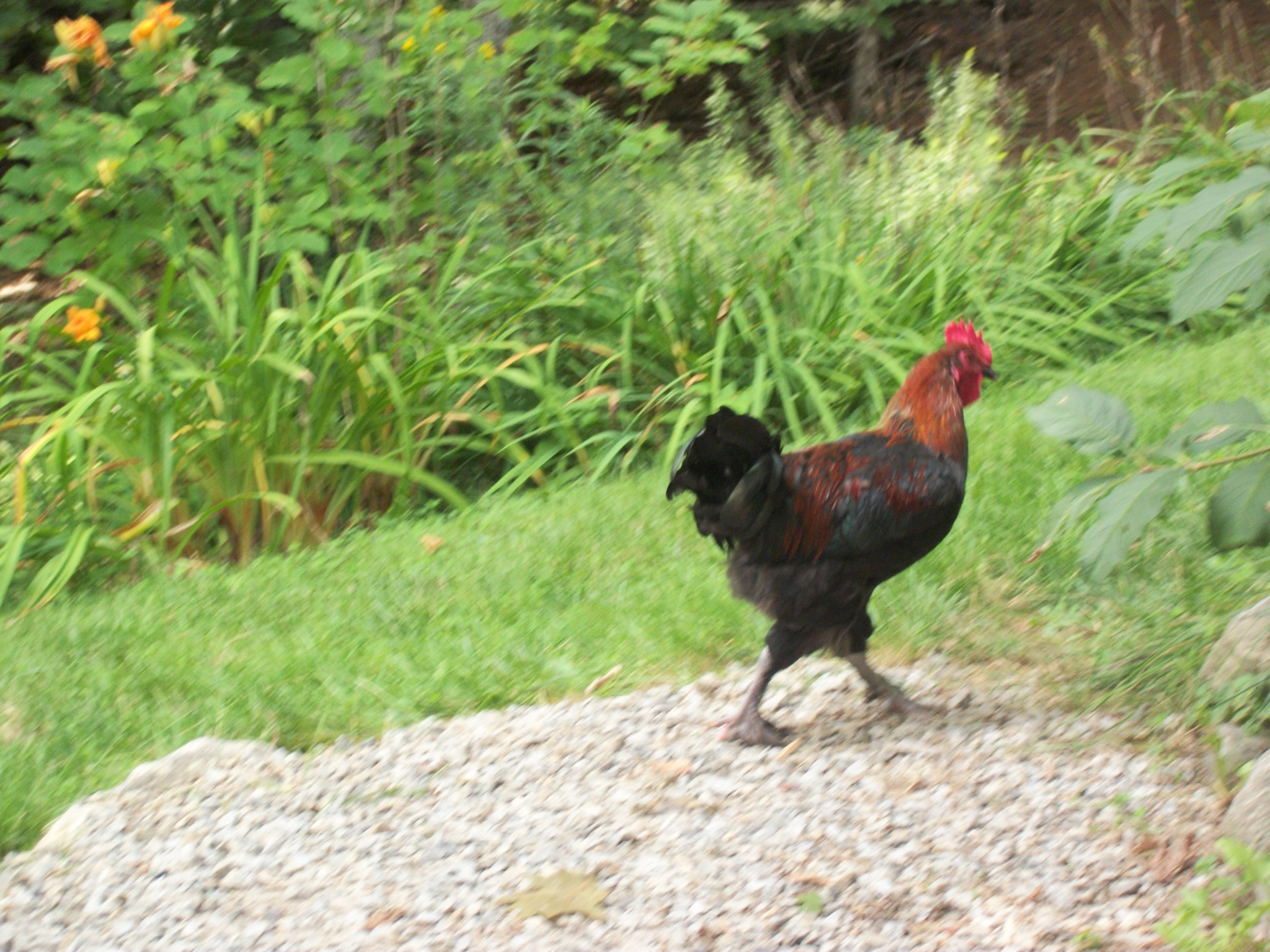
Napoleon, or “Nappy,” has been rehomed to a lovely woman just starting a flock up north of Belfast.  Rose has agreed to part with one of the two older hens so Julia can have a pair and can raise babies.  Nappy was a terrific rooster with the hens–he took such good care of them–but when they were laying or when he was fenced, he was very protective of the coop and the hens.  He was just too aggressive for the grandchildren or for Jessica’s children–when she comes to take care of the house, chickens, and dogs when we go to Charleston or otherwise travel.  As beautiful as he was–and he was GORGEOUS, it wasn’t worth the risk.

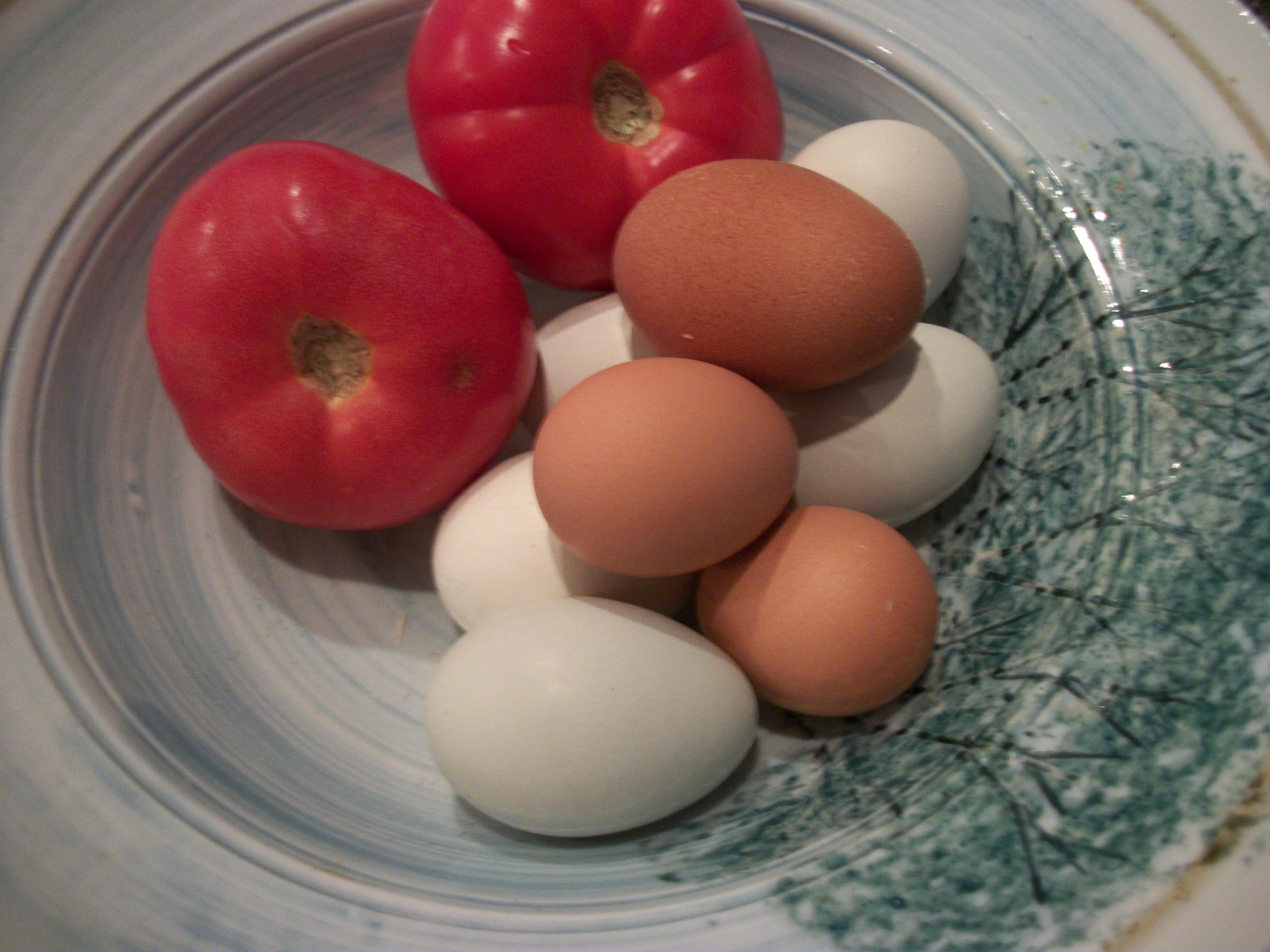
Valentine, otherwise listed here earlier as Chickie Honey Ginger, changed her name when she got a bit bigger.  She’s a sweetheart–a Freedom Ranger meat bird/layer.  She’s HUGE, and, at first, layed a tiny little rosy brown pullet egg when she was only barely four months old.  Here’s a picture.  The larger, darker brown egg is Chickie Annie’s, a CBM who is a year old now.  The cool thing about Valentine’s eggs are that, even as tiny pullet eggs, they are almost always double yolked!

Here’s a picture of Valentine with our 3 “older” hens now–the two wheaten Americaunas, Sally and Nancy, and the CBM chick I raised last summer, Annabelle, or Chickie Annie.

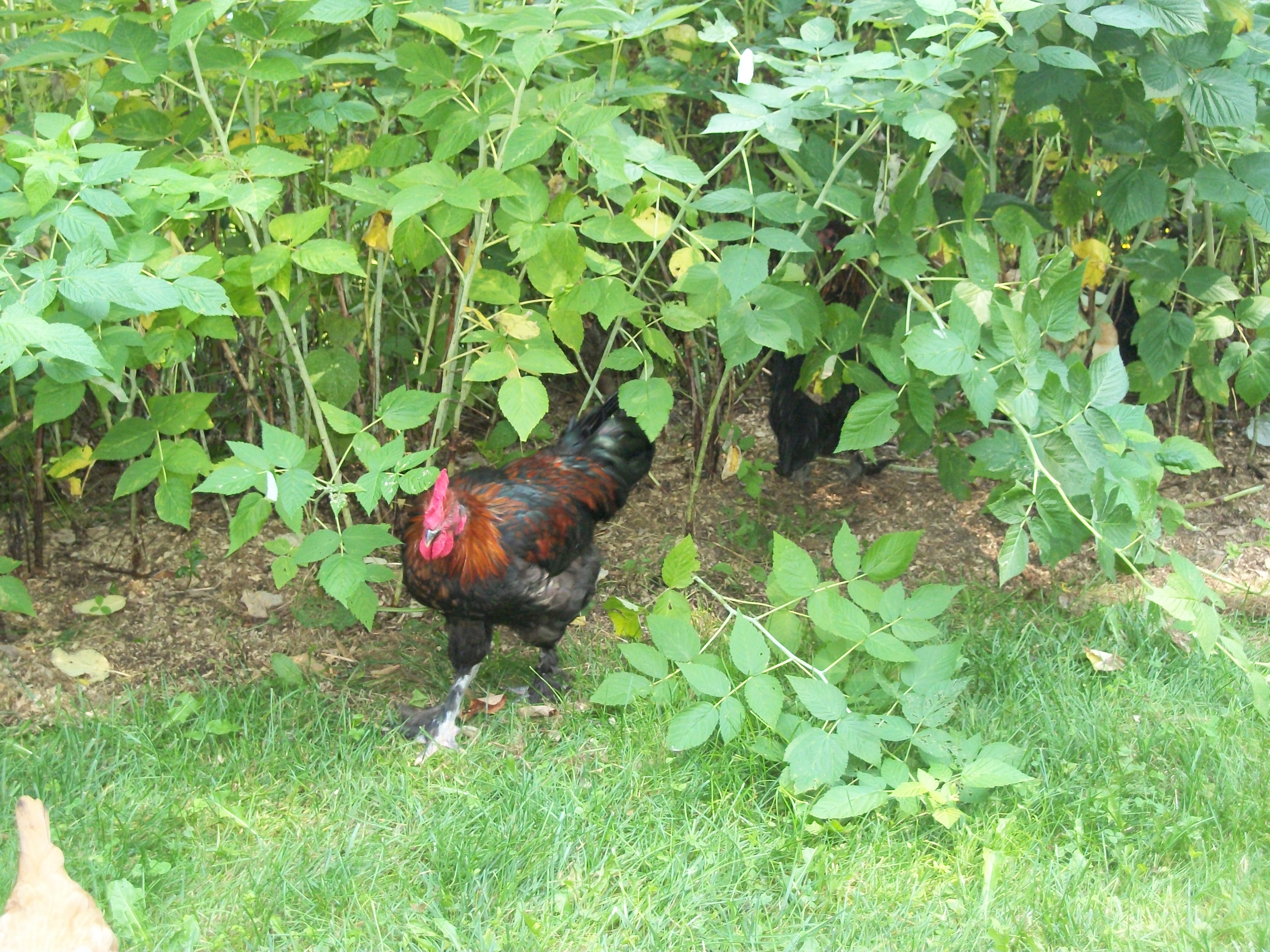
Valentine is only about 10 days older than the CBMaran chicks and the “blue egg” chicks Rose raised this spring.  But, she’s TWICE their size.  She kind of moves between the older hens and the newer three, 2 CBMs and 1 wheaten Americauna from Rose’s rooster William–part of Rose’s “blue egg” chick bunch this spring.  The new girls are scared to death of the old girls and scared of us, though they are gradually settling in now and will come close to us.  I took this picture of them hanging out on the edge of the “chicken briar patch,” the raspberries, about a week ago.

That’s Pearl and Rosie, with our new roo, Pretty Pierre.  Ninja is in the briar patch.  These names come from the grandchildren this summer.

Here’s a picture of Pierre, the best I can do at the moment since he’s new to the group and is only just learning his roo duties.  AND, how to crow.

When Pierre first came, Valentine was very taken with him.  She tried to follow him, and that totally freaked Pierre out.  Remember she’s a very impressive fully grown hen, and he’s just a baby really.  When he got upset, she got even more upset, fluffed up all her feathers, which made her look even bigger, and charged him.  Mercy!  That was his first hour outside the coop cage.  John and I had to get him down out of the tall bushes to put him to bed in the coop that night.

Something happened the next day, as she had a torn comb and was all bloody.  John and I took her inside, washed it off, and put some calendula cream on it.  Here she is with her poor bloody head:

By the second night, she was sleeping next to Pierre in the coop.

So, we go into the fall and winter with 8 chickens–7 hens and a rooster.  The new girls will start laying this month.  We will be rolling in soy-free eggs from healthy chickens.  And, Valentine follows me everywhere when I’m in the yard, earnestly talking to me the whole time.

Chicken love!

Turkey Tracks: Brown Paper Bag Book Project

Turkey Tracks:  August 29, 2011

Brown Paper Bag Book Project

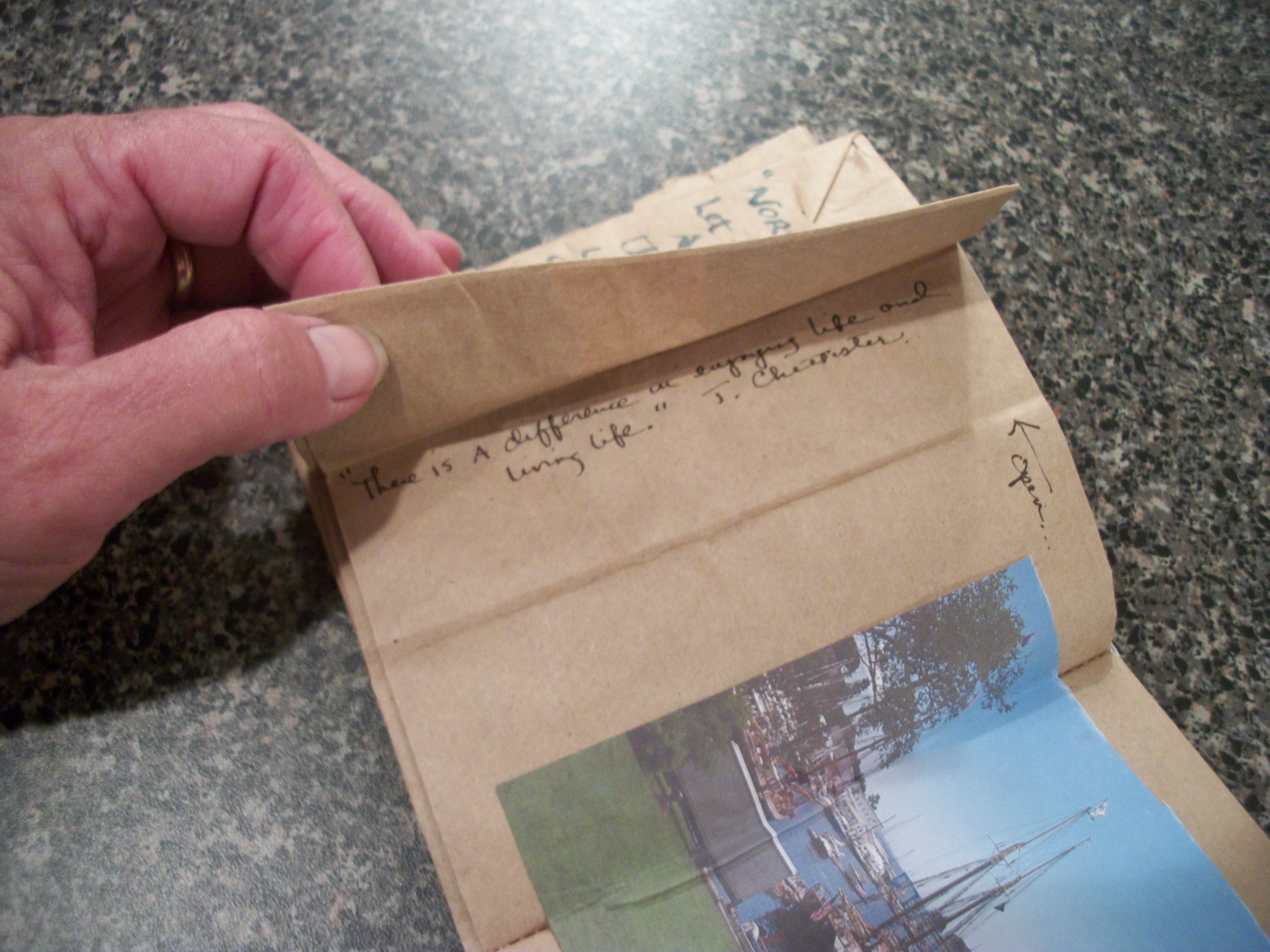
One of our local artists, Robinsunne, came to speak to the Coastal Quilters a few years back–http://robinsunne.com.  She brought a book she had made using brown paper lunch bags.  I loved it on sight and knew that one day I would make one.

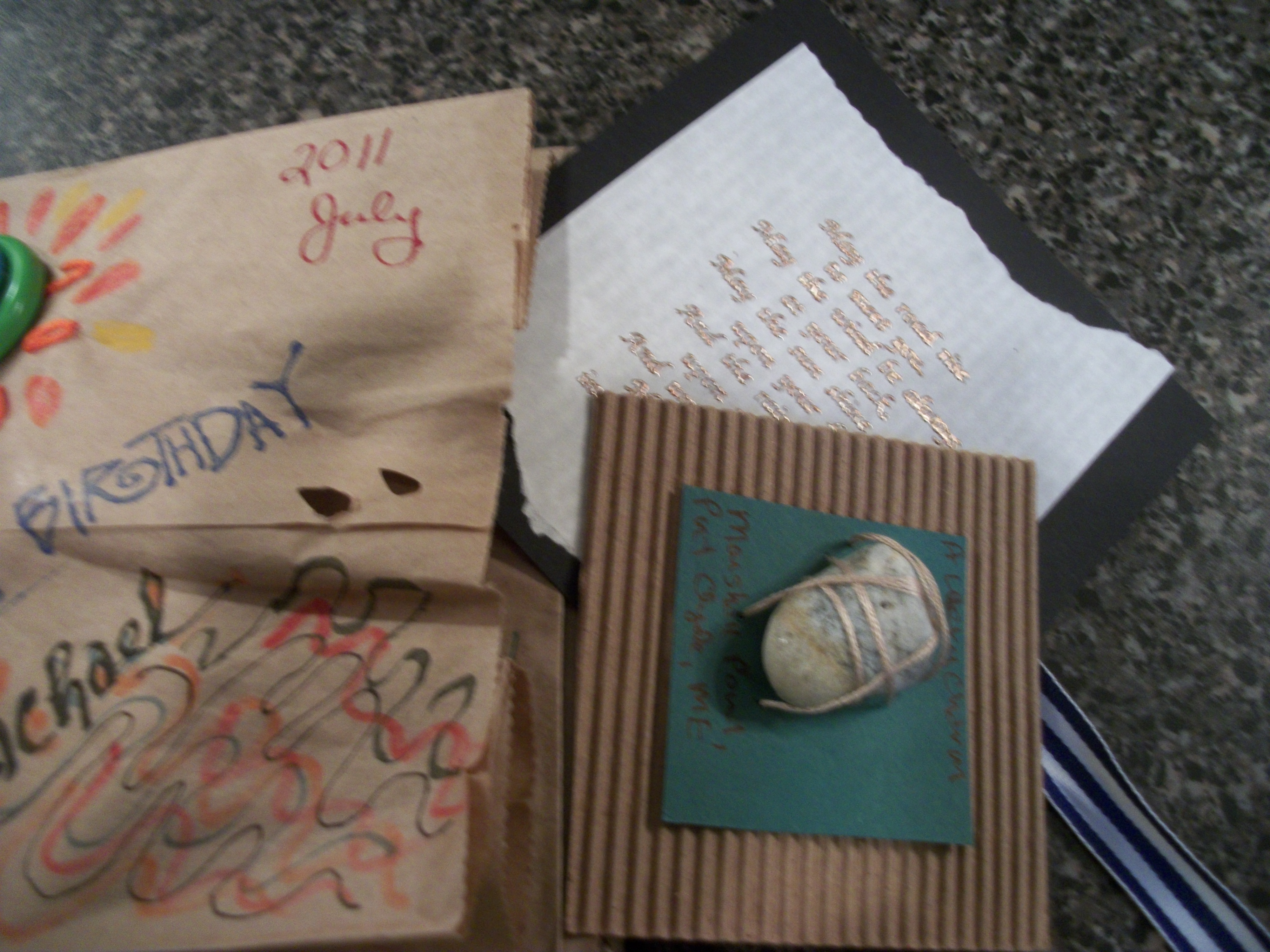
I’ve tried to show the grandchildren how to make one for two years running now, but they don ‘t quite get it yet.  There was nothing left to do but make one myself, which I did as a birthday card for my son Michael.  I found the project to be as much fun as I had imagined.  And, I will make more.  They do take a bit of time.

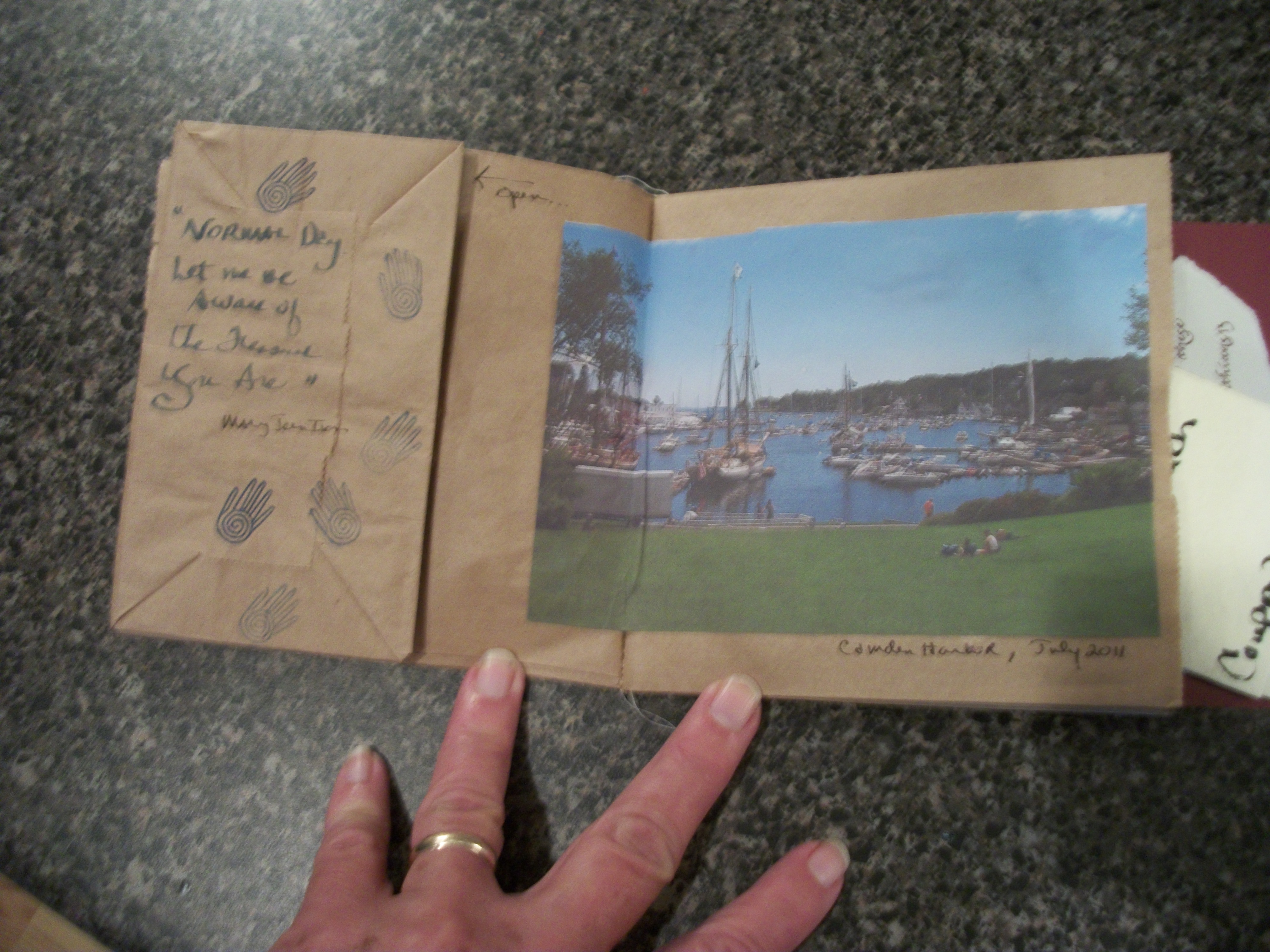
Here’s the outside of the brown paper lunch bag book–the buttons come from a quilt shop in Charleston, SC–People, Places, and Quilts.

First, you take 3 or 4 of the brown paper lunch bags and ALTERNATE having the top and the bottom on the left-hand side.  Put them in a pile, fold them in half, and sew down the middle of the crease.  It’s a good idea to have the OUTSIDE  bag–when you fold inside– with the opening to the left as that becomes your front cover.

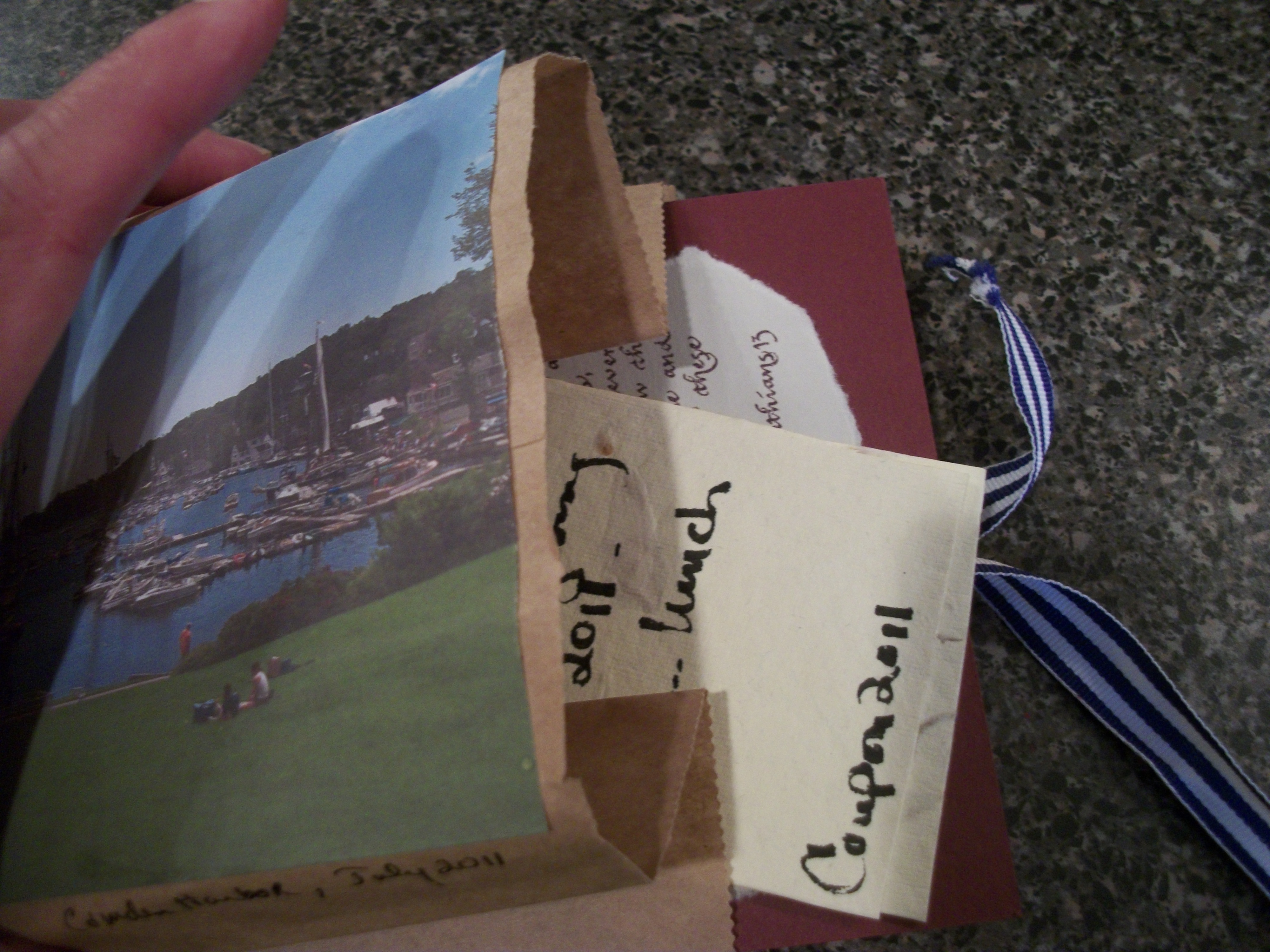
Here’s how to use the open top of the bag:  stuff it with interesting objects, coupons, sayings written down, recipes etc.

Here’s what the bottom part of the bag looks like within the book–a flap is created on the page that can be folded back to reveal a surprise of some sort:

See..

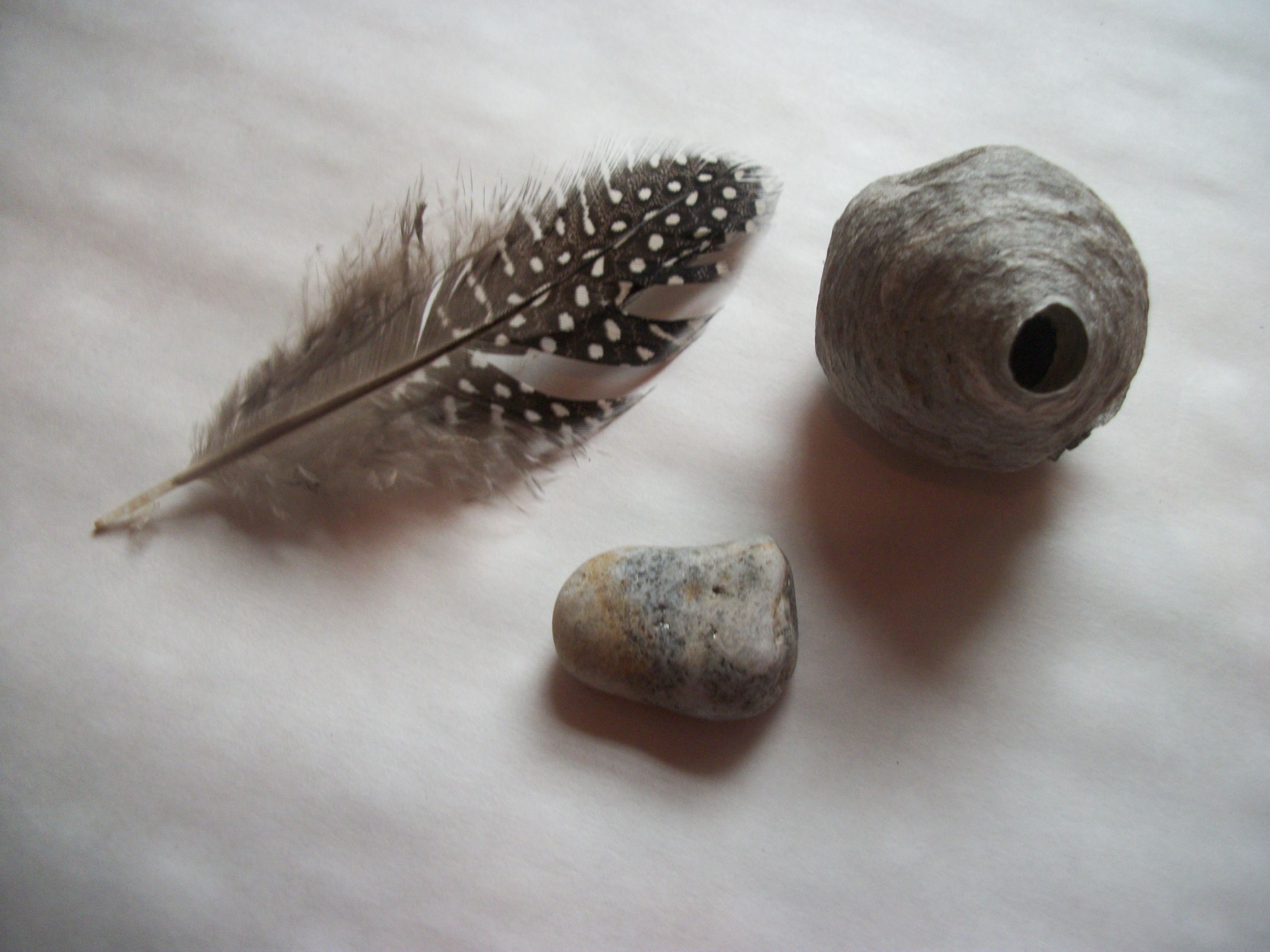
Found objects can be “artfully” presented and tucked into one of the book’s pockets:

Sewing onto the paper–as with the buttons on the front–proved to be more difficult than I’d thought–because of the inner folds of the unfolded bag top.

Stamping is a nice way to decorate the bag.

So, try one yourself!

Interesting Information: The Food Renegade’s Take on Orange Juice

Interesting Information:  August 28, 2011

The Food Renegade’s Take on Orange Juice

I’ve just added THE FOOD RENEGADE’s web site to the links on my blog.

The food renegade , Kristen Michaelis, is a woman after my own heart.   She loves nutrient-dense real foods, is a fan of the Weston A. Price Foundation’s work, and is inspired by Michael Pollan and  the poet/author Wendall Barry.

Kristen cooks SOLE food–Sustainable, Organic, Local, and Ethical food.

We’ve also read many of the same books.

She’s also a nutrition coach and has lots of tutorial videos on her site, like how to make kombucha, butter, buttermilk, and so forth.

Here’s a recent piece she did on what’s in orange juice–you know, the fresh kind that’s supposed to be “just squeezed.”

http://www.foodrenegade.com/?s=orange+juice

Even I was surprised about the chemical flavor packs the industry adds back into what is–and I did already know this info–highly processed juice.  Apparently these flavor packs are geared to specific tastes different groups of people have.  People in Peru, for instance, have a different flavor pack put into their orange juice.

I knew commercial orange juice was bad food–and wrote about it in a recent Tipping Points 30, an essay called “The Very Bad Breakfast”–in the essay section of this blog.  If I thought before that orange was a dangerous product, I now think it’s dangerous and a fake food.

Read about this orange juice and weep for what has been done to our food.

But don’t despair, just stop shopping in your local grocery store!  And if you’re going to drink orange juice, which is, by the way, full of fructose and, after being squeezed, has no fiber, squeeze your own.

Interesting Information: Back to School, PVC-free products

Hey Mothers of Back-to-School Kids,

Here’s a good web site to help you NOT to buy back-to-school products that contain PVC chemicals–from the Center for Health, Environment, and Justice.  These chemicals can contaminate your child’s body and cause life-long health problems.

http://www.chej.org/publications/PVCGuide/PVCfree.pdf?key=48408701

The PVC family of chemicals includes toxic additives that are not safe for your child.  Backpacks, binders, lunchboxes, modeling clay, and clothing can all contain PVC chemicals.  This web site tells you how to identify dangerous products.  It also tells you where these products are made and how the manufacturing of them is hurting local people.

Turkey Tracks and Interesting Information: Late Blight Hits Potatoes

Turkey Tracks and Interesting Information:  August 25, 2011

Late Blight Hits Potatoes

We pulled our potatoes last week.

Late blight was on their leaves, and we didn’t want to risk losing all of them.  Even if the potatoes look ok, they don’t taste right if the late blight gets a real hold on the plants.  Late blight is the same culprit that attacked the Irish potatoes and produced the famous famine.

Late blight also attacks tomato plants.  It shrivels up and yellows the leaves as if their edges have been burned.  The stems are next.  There are some black spots.  And the tomatoes get spots on them.  They rot and taste terrible.

So, to save what we could and to protect the tomatoes, we pulled the potatoes–which meant they would not continue to grow up into September, or about another 4-6 weeks.

We started with 6 varieties:  La Ratte fingerlings, Red Pontiac, Elba, Katahdin, German Butterballs, and a Russet.  Here’s what the harvest looked like.   (Remember we’ve been eating the fingerlings.)

Aren’t they pretty?  Even if still smallish.

Maine has been struggling with late blight for three years now.  It first came to us on tomato plants grown in the south and shipped in here for the big box stores.  So, it’s another legacy of monocrop culture and capitalism that doesn’t control for disease.  The spores of late blight can travel for miles and miles on the air currents–more than 40.  That first year, late blight wiped out the new England tomato harvest.

I’ve read about “organic” spraying strategies, but the sprays seem not to be what I want on my soil or near my body.  Better to forego potatoes and tomatoes if necessary.

C’est la vie!

Turkey Tracks: Vitamin B12 and My Favorite Dinner

Turkey Tracks:  August 25, 2011

Vitamin B12 and My Favorite Dinner

Without a doubt, this dinner is my favorite:  Grilled STEAK, fresh corn on the cob, a big salad, and a piece of dark chocolate with caramel crunch and sea salt.

I am my father’s daughter.

Only, my father took many drugs for allergies and asthma.  Also, he had a sweet tooth, which did not help with his gut flora and fauna.  He probably had an overgrowth of yeasts in this gut.  And, as he aged, he, like many, started having trouble with stomach acid–so he couldn’t digest his food well.  I remember him going around with Tums all the time.  BUT, the problem more often is LOW stomach acid, not the reverse.  (Keep hydrochloric acid–HCL–with pepsin on hand for when you have stomach rumbles and acid reflux.)  And when that happens, the body struggles to process food.  The gut becomes damaged, so one starts experiencing malabsorption, which leads to malnutrition.  My mother used to say “I feed him really well, and he eats, but he’s just getting thinner and thinner.”

Here’s a quote from “Could It Be Vitamin B12?,” by Sally M. Pacholok and Jeffrey J. Stuart, in the Sept/Oct issue of WELL BEING JOURNAL, pages 16-20:

“A far more common cause of B12 deficiency, especially in people over fifty, is a condition called atrophic gastritis, an inflammation and deterioration of the stomach lining.  Atrophic gastritis reduces the secretion of the stomach acid that is needed to separate vitamin B12 from protein–a problem often made worse by proton-pump inhibitors and antacids or other medications.  In addition, older people have smaller numbers of the cells that produce intrinsic factor” (18).  (Intrinsic factor is a protein produced in the stomach that is necessary to process B12.)

My dad started getting vitamin B shots, but the body can’t utilize B12 if other ingredients, like intrinsic factor,  are not also in place.  It’s a really complicated and delicate balance.  A lack of vitamin B12, in particular, causes dementia, which slipped up on my dad gradually.  He died not knowing who we were or who he was.

A really strong source of B12 is red meat.  Liver has especially high levels.  But you can also get some from poultry, fish, eggs, and dairy products.  Bi-valves apparently have high levels of B12 (clams, mussels, oysters).  B12 is  produced in the guts of animals, so you cannot get it from plants.  If you want to read more, here’s an article from the Weston A. Price Foundation web site on B12:    http://www.westonaprice.org/vitamins-and-minerals/vitamin-b12.

So, the corn on my plate came from Hope’s Edge CSA.  It’s such a treat when it comes in every year.  And, doesn’t it look pretty this year?  The lettuce, cukes, broccoli, onions, and beans came from our garden.  (I often put leftover veggies on the next day’s salad.)  Our lettuce, as the summer has been cool, has just lasted and lasted.  The carrots, beets, and tomatoes came from Hope’s Edge.  The salad dressing is homemade–good olive oil, some mustard, some fresh garlic, some fresh herbs, salt, pepper, and red wine vinegar.  The iced drink is Kombucha, a fermented fruity tea drink which is great to sip before eating as it starts activating digestive juices.  The chocolate is Fair Trade.  And the milk is, of course, REAL.

It was a perfect summer meal!

MUSTARD VINAGRETTE

In a small bowl, crush a clove of garlic with a fork.  If you add some salt, you can get a kind of paste while you mash.  Add herbs and pepper.  Add a tablespoon of Dijon-type mustard, add 2-3Tablespoons of red-wine vinegar.  Mix well.  Drizzle in olive oil while stirring with the fork–it will take about 3/4 cup for taste, and it will blend with the other ingredients so that it thickens.  You could add a raw egg for a richer version.  You can also just dump everything into a small jar (1 cup or more) and shake really well.

Interesting Information: The Corporate “Organic” Label is a Rip-Off

Interesting Information:  August 23, 2011

The Corporate “Organic” Label is a Rip-Off

About a week ago, my sister and I had a Facebook interchange about some “organic” yogurt purchased at a local grocery store in order to help her sick grandson–who had been running a high fever.  My sister hoped the probiotics in the yogurt would help build up her grandson’s immune system.

“That’s unlikely if it came from a commercial grocery store,” I said.  “It’s a fake food.”

What I didn’t say is that most of the probiotics listed on a label of commercial yogurt are probably no longer alive.  They get killed during the process of making the fake food.  (Look for a claim of “live” cultures.)  And I didn’t say that anything made from pasteurized milk is not a health food.  Or, that it should be avoided since it’s pretty much wasted calories in your body.   I’ve already said these things to myk sister many times, and she’s been very patient with me and my food ideas over the past few years.  The good news is that she’s talking about buying a cow share and about working with a local, organic farm in her area that sells milk, meat, eggs, and produce.

Pretty much all of the small “organic” companies have now been purchased by BIG CORPORATIONS.  And, in the name of both bigness and profit, they’ve corrupted almost everything that the term “organic” used to mean.

Stonyfield was the yogurt brand in question.  The carton pictures warm and fuzzy images of cows grazing on green fields.  Or, a pretty woman eating yogurt in a background of green fields and a red barn.

But, Stonyfield sold out to Group Danone, which also owns the “organic” brand, Brown Cow.  Group Danone also owns Dannon dairy products.

 Assuming the type of yogurt in question for my grand-nephew is whole milk plain yogurt, and not any of the fat-free or low-fat options–you need fat to process protein–AND assuming it was not one of the whole milk fruit-filled options (like white chocolate raspberry) which are full of sugars so that they are a dessert, not a health food for a sick child, the label shows that in addition to the probiotic cultures, the yogurt contains added pectin (a hidden source of fiber to thicken the yogurt–too much fiber can cause damage to your digestive system) and what has to be synthetic vitamin D3, which never operates in human bodies like the real D3 present in real foods.

What the label does NOT SHOW is that Stonyfield also adds powdered milk to its yogurt to thicken it up.  Powdered milk is highly processed so that the chemical strands are broken up, which creates all kinds of toxins.  (Don’t drink powdered ANYTHING.)

And, I’d want to have an objective third party to witness the pasturing of these Stonyfield cows because most commercial dairies, organic included, supplement with grains and god knows what else.  (One site I read today had a commenter telling how local “organic” cows on a farm on her road were being fed “organic” doughnuts.)  That’s just what happens when BIG BUSINESS exerts profit pressures and when dairy farms are being driven out of business in droves.

Back in 2006, BUSINESS WEEK used Stonyfield to illustrate what a tawdry thing the term “organic” has become in the hands of large corporations:  “The Organic Myth:  pastoral ideals are getting trampled as organic food goes mass market.”  It’s an article well worth reading since nothing has changed for the better since 2006:   http://www.businessweek.com/magazine/content/06_42/b4005001.htm.

The article almost immediately points out that Stonyfield’s organic farm is “long gone.”  Instead, “its main facility is a state-of-the-art industrial plant just off the airport strip in Londonderry, NH, where it handles milk from other farms.”  And, it blows the whistle on Stonyfield’s use of powdered milk and its attempts to have said powdered milk shipped to the US from New Zealand which is 9,000 miles away.

Dr. Joseph Mercola made a video after the article came out, and it’s worth viewing:   http://articles.mercola.com/sites/articles/archive/2006/10/12/you-are-being-ripped-off-by-much-of-the-organic-food-you-are-buying.aspx.   Mercola called it “You Are Being Ripped Off By Much Of The ‘Organic’ Food You Are Buying.”

Obviously, I agree with Dr. Mercola’s assessment.  Real organic food can’t be found in your local grocery store if it comes in a package.  And, that “organic” produce that you can sometimes find is being shipped here from places like Holland, Peru, Israel, Mexico, and China.  Besides the fact that this produce is tired out and lifeless, who knows how it has been grown.  Take a look at the German film OUR DAILY BREAD to see what I mean.  Most of this produce is being grown in hoop houses in peat packs stuffed with synthetic nutrients–all tended by technological equipment and lone, lonely people.  It’s not real food grown in nutrient-dense soil.  It hasn’t been harvested with joy by groups of people who will eat it together.  And you’re being charged premium prices for it.

You have to go out and find local, organic farmers in your own community and work out ways to get their food into your kitchen and into your body.  And, you have to eat seasonally as much as possible.  You can do it; there’s all kinds of help now to locate real farmers and organic food that will sustain your health and the health of those you love.  Start with the lists on the Weston A. Price Foundation and/or the ads in their quarterly journal, WISE TRADITIONS.  And, there’s all kinds of help to learn how to preserve some food from summer for the winter.

The CEO of Stonyfield sent Dr. Mercola a letter that attempts to explain Stonyfield’s “organic practices.”  You can find that letter on the same Mercola site as the video.  It’s really sad to read such a letter from someone who used to have an organic farm.   The denial and greed is shameful.  But that is what happens when corporations and capitalism are not tied to a set of values and ethics that support human rather than short-term profit.

Here’s a partial list of the once organic small businesses that are now “organic”:  Burt’s Bees, Tom’s of Maine, Odwalla, Naked Juice, Horizon Organic Dairy, The Organic Cow of Vermont, After the Fall, R.W. Knukdsen, Kashi, GardenBurger, Bear Naked, Back to Nature, Boca, Cascadian Farms, Health Valley, Arrowhead Mills, Green and Blacks Organic Chocolate, Dagoba Chocolate, Seeds of Change, Muir Glen, Alta Dena, White Wave/Silk, Westbrae, and Westsoy.

Buyer Beware!

Finally, make your own yogurt.  It’s dead easy–unless you’re working with ultra-pasteurized milk, which might not culture.  And, even yogurt made from pasteurized milk is better than the expensive fake stuff.  Heat your oven to 200 degrees.  Pour a half-gallon of whole milk into a large glass bowl.  Mix in two packages of Yogumet starter.  Put a plate over your bowl.  Turn the oven off, and put the bowl into the oven.  Let it sit over night.  In the morning you will have lovely yogurt.  Save about 1/4 cup for your next batch.  Sometimes it can take yogurt a bit longer.  Give it time; it won’t spoil.  Keep it in a warm place until it jells.
Turkey Tracks: Rugosa Rose Hip Jam

Turkey Tracks:  August 22, 2011

Rugosa Rose Hip Jam

I’ve been thinking about Rugosa Rose Hip Jam for the past…5 years or so.

When we moved to Maine, we bought a house on the side of a steep hill.  There’s an astonishing drop off–held in place by a large-boulder rock wall- to a small field below in the front yard, where our drainage field is located.   With visions of very young grandchildren tumbling down this death trap, we planted the slope with rugosa roses and bayberry.  Two years ago, we added another row of plants:  raspberries.

The whole slope is now impenetrable–we called it the chicken briar patch since the chickens love it so much.  They feel safe in there.  The raspberries are THRIVING on their attention, and since we’ve released the chickens from their summer pen, the June bug count has diminished significantly.

The rugosa’s hips began to catch my eye as the years passed.   For several years I thought one should wait until after the first frost as they’d be sweeter.  I read that in several places actually.  One year I collected the hips and dried them for winter nutritional teas–they’re full of vitamin C–but I never made any.  (I love my black tea with wild honey and real heavy cream too much.)  Also, it seemed to me that by the time the first frost came, the hips were all dried out and moldy looking.  Last year I got as far as finding information and recipes.

Did you know that roses are in the apple family?  I didn’t.

Here’s what some of the hips looked like on Sunday:

As you can see, a lot of them are as big as crab apples and are very red and ripe looking.   One simply must do SOMETHING with such luscious looking fruits.  So, I picked the ones that were ripe and refound the recipes.

Prepping the hips is VERY labor intensive.  You cut them in half and scrape out the seeds.  There are TONS of seeds.  I made cups of tea for John and me, and we sat outside and chatted while I prepped the hips.  It was a beautiful afternoon.

Here’s a picture of the prepped hips and the TONS of seeds and the very sharp paring knife with which I did not poke myself, though I came close a few times :

Penny joined us, as she usually does.  Miss Reynolds Georgia won’t give up her watch dog perch upstairs looking out the bedroom window.  She’s also sure it’s very dangerous outside the house–unless one is going to be taken for a ride in the car or if one has to pee:

I  cast the seeds out over the back hill/slope.  Who knows?  We have rugosas sprouting all over the place all the time here.

Rose Hip Jam

The next step is to put about an equal amount of water as one has hips and cook the two together until one has a mushy pulp.  That takes about 20-30 minutes.  I didn’t put enough water at first, and I noticed I was getting a kind of syrupy mixture.  Interesting.

Then, one has to decide what to do with the pulpy mixture.  I tried a food mill, but that didn’t work.  Too much thick pulp, too much loss.  I scraped everything into the Vita Mix, which is a very powerful blender/chopper, added a bit more water, and pulverized it all.  I had about 2 1/2 cups of pulp.

One then adds an equal amount of sugar, and I did (though I usually don’t) as I couldn’t imagine that this pulpy mass would taste nice.  I almost burned the mixture on the sides of the pans until I realized what was happening and scraped the sides down with a spatula.

Then, one cooks the mass until it begins to “jelly” according to directions.   Or, coats the spoon well.  The candy thermometer wasn’t especially helpful since the mass didn’t melt down like a berry jelly or jam does.   The mass began to coat the spoon and jell up on the plate, and it turned a deep pumpkin color that was lovely.  So, I jarred it up.

Here it is cooling:

I don’t know what I expected Rose Hip Jelly/Jam to taste like.  I had imagined a clearer jelly for one thing.  And, maybe a lemony, sharp taste, subdued by the sugar.

Well!  It’s delicious.  It tastes a lot like apple butter, but it’s different too.  There is, after all, a subtle lemony taste in there.  Both texture and color are like that of a roasted pumpkin, but not the taste.  I can definitely see using it as a cake filling, which one of the recipes suggests.  I really like it, actually, and would definitely use it on morning toast, or on oatmeal porridge, or during afternoon tea spread on something tea-like.

So, I’ll keep my eye on the hips that are still ripening and make another batch in weeks to come.