Interesting Information: Greek Yogurt

Interesting Information:  July 9, 2011

Greek Yogurt

A friend gives me her COOKS ILLUSTRATED magazines when she finishes them.  The May/June issue had an article on Greek yogurt I found interesting.

I knew that Greek yogurt was just yogurt with a lot of the whey drained out of it.  Anyone can make it, and the leftover whey is an amazing substance that is full of enzymes that help digestion.   A tablespoon of whey in a bit of water before a meal can really help digestion and can begin restoring probiotics in the gut.  You can also freeze it and use the ice cubes in smoothies, put it in soups, and so forth.  And, of course, there is a whole foodway of lacto-fermented foods made with whey that are chock full of enzymes.  Sauerkraut is an example, and there is a recipe for it in the recipe section of this blog.

I always thought that whey had a lot of protein, so I was skeptical about draining off the whey.  However, COOKS ILLUSTRATED says that whey does not have that high a protein content, so what’s being lost by draining some off to make a thicker yogurt is “only” the enzyme and mineral content of the whey.  (What remains is high in protein.)  If one uses the whey in other ways, no substantial harm is done–unless you are buying the yogurt and are never getting the whey.  (I’m guessing the whey is used to make that dried whey protein powder which, like all dried liquids, has been harmed by the drying process.)  Anyway, do note that you are now dealing with a whole product that has been splintered into parts–which is not a good thing to do as the whole contains all that you need to digest and use the product most effectively.

The market has “caught on” to Greek yogurt and is busily trying to make a buck on it.  So, buyer beware.  Read the labels to see what’s been added to what should just be yogurt with the whey drained off.  Many manufacturers are getting the creamy thickness of Greek yogurt (as they are with regular yogurt) by using thickeners like pectin, gelatin, seaweed, and milk protein concentrate.  These yogurts (Yoplait and The Greek Gods are examples) also have considerably higher levels of carbohydrates than other brands, and we are learning, together I hope, that carbohydrates are the root cause of many chronic diseases in America.

Unfortunately, COOKS ILLUSTRATED bought into the belief system that fat is not good, so they tested nonfat yogurts.  (One needs fat to digest protein.)  CI liked Olympus Nonfat Greek Yogurt the best.  It is imported from Greece.  they recommend Voskos, Brown Cow, Dannon, Oikos, and Fage.  Chobani was recommended with reservations.  And Athenos, Yoplait, and The Greek Gods were not recommended at all.

For me, the best bet is to make your own yogurt from whole real/raw milk.  If you want to make Greek yogurt or, even, some yogurt cheese, drain off some or all of the whey.  But, be sure to use the whey in some other ways in your diet.

If you must buy yogurt, which would be made with pasteurized milk, seek out a whole milk, cream-line one with no additives.  There are still a few left out there.

Turkey Tracks: Camden Inner Harbor, Summer

Turkey Tracks:  July 8, 2011

Camden Inner Harbor, Summer

Sometime last winter, I posted a picture of the Camden Inner Harbor with schooners all wrapped up for winter–taken from this same place.

Here is that same shot in the summer.

 I’m pretty sure the windjammer/schooner in the foreground is the Mary Day.   She would be provisioning to go out again for probably a week.  The equipment next to the water is getting a stage ready for our July 3rd (Sunday night) fireworks and music.  Sunday turned out to be overcast, so the splendid fireworks took place on Tuesday night.  I suspect the music went on as planned, though we wound up doing different things on Sunday.

It’s mid-afternoon, so many of the boats that “sleep” in our harbor are out for the day.  At night, the harbor is jam-packed with boats of all kinds.

The river comes into the harbor on the far right, and there is a lot of activity on that side of the harbor, which is out of this picture’s frame.

On this side, the harbor is surrounded by beautiful green lawns, with the library sitting above them.

Interesting Information: EWG’s Dirty Dozen

Interesting Information:  July 8, 2010

The Environmental Working Group’s

Dirty Dozen List

The EWG’s guide to Pesticides in Produce now lists the following produce, in order of toxicity:  apples, celery, strawberries, peaches, spinach, nectarines (imported), grapes (imported), sweet bell peppers, potatoes, blueberries (domestic), lettuce, and kale/collard greens.  See www.ewg.org/foodnews/summary.

The EWG also warns that the commodity corn crop used for animal feed and biofuels is “almost all produced with genetically modified (GMO) seeds, as is some sweet corn sold for human consumption.”  The sweet corn IS NOT LABELED as GMO in U.S. stores, thanks to our lax and corrupt government oversight agencies.

Both the EWG and NUTRITION ACTION newsletter make the case–as the EWG puts it–that “the health benefits of a diet rich in fruits and vegetables outweigh the risks of pesticide exposure.”

I DISAGREE strongly.

First, the 2009 President’s Cancer Panel report–easily available for you to read online–is very clear that the use of toxic chemicals on our food and in our environment is the cause of much of the cancer epidemic we are experiencing.  I, for one, am really tired of losing so many beloveds to cancer.  When I was a young woman, cancers and heart disease were rare.

Second, more and more data is coming out now that our heavy use of carbs is causing hormonal disorders that are, in turn, causing obesity, diabetes, and metabolic syndrome.  So, a diet rich in produce is likely not be a good thing at all.

Third, our digestive tract does not handle lots of cellulose well.  We do not have the multiple stomachs, digestive chemicals, and so forth to handle so many fruits and vegetables–especially many of the raw ones.  Our digestive tract is set up to eat the animals that do process cellulose well.

(I’ve written about these issues in my Tipping Points essays here on this blog–and will continue to do so.)

I really wish EWG and organizations like it would step up to the plate and start taking a stand that incorporates good science–which would include the information that shows how seriously toxic the chemicals we use on our FOODs are.   Their unscientific repetition of the low-fat, high-carb, calorie in/out belief system is doing a lot of harm, which I suspect is not what they want to accomplish.

Finally, what you can do is to try to find local sources of organic foods.  It’s going to be a bit like “build it and they will come.”  Ask your local farmers to raise this food for you.  Go to farmers’ markets to find them.  Go out into the country and find them.  Plant a garden and raise some of your own food–even it’s only one tomato plant in a bucket.  And, try to eat foods in their seasons and to put them up in some way (canning, freezing) if you want to continue to enjoy them.  You can’t possibly know what’s been done to food raised outside of this country–even if it’s labeled “organic.”  (Take a look at the documentary OUR DAILY BREAD, for instance.)

What you can do is to stop giving your beloveds food that has poison on it and in it.  What you can do is to stop telling yourself that someone else is going to protect you and your beloveds–someone like the government.  It hasn’t.  It won’t.  What you can do is to face squarely the fact that these chemicals are killers and that they will kill you and your beloveds.  The cancer statistics are ample proof of that truth.  These chemicals are especially destructive to your babies, to your children, to teenagers–because they are still growing so fast.  No amount of these chemicals is safe.

Nothing is going to change until we all band together and say “No, we’re not doing it any more.  Give us good food, raised locally and organically, so that it has all the nutrients it should.”

Believe me, whatever money you think you’re saving by buying cheap food can get eaten up in a heartbeat with a cancer patient.  Few people understand the massive resources it takes to manage a cancer patient…

Assess what you can give up in your life to be able to find and pay for good food.  In the end, the time and money will be worth it.

Turkey Tracks: First Strawberries

Turkey Tracks:  Jully 1, 2011

First Strawberries

Our strawberries have been coming in for the past few days–big red and delicious.  John and I have stood in the garden eating the early arrivals, one by one.   Since we’ve had a late spring, the strawberries will go into full production just as Mike, Tami, and the four kiddos arrive–which will be in about an hour now.

Some of the berries pictured below came from our CSA, Hope’s Edge, this morning.  Some are ours.  All are gorgeous.  None taste like what you find in a supermarket which have been shipped in here from across the country.  Supermarket berries are big and red, but there the comparison ends.  They are pulpy sour things that are so acid they make your mouth pucker.   These berries are dead sweet and worth the wait each year!

Too, none of our berries have been sprayed with poisons.

Turkey Tracks/Books: My Current Read Pile

Turkey Tracks/Books:  June 26, 2011

My Current Read Pile

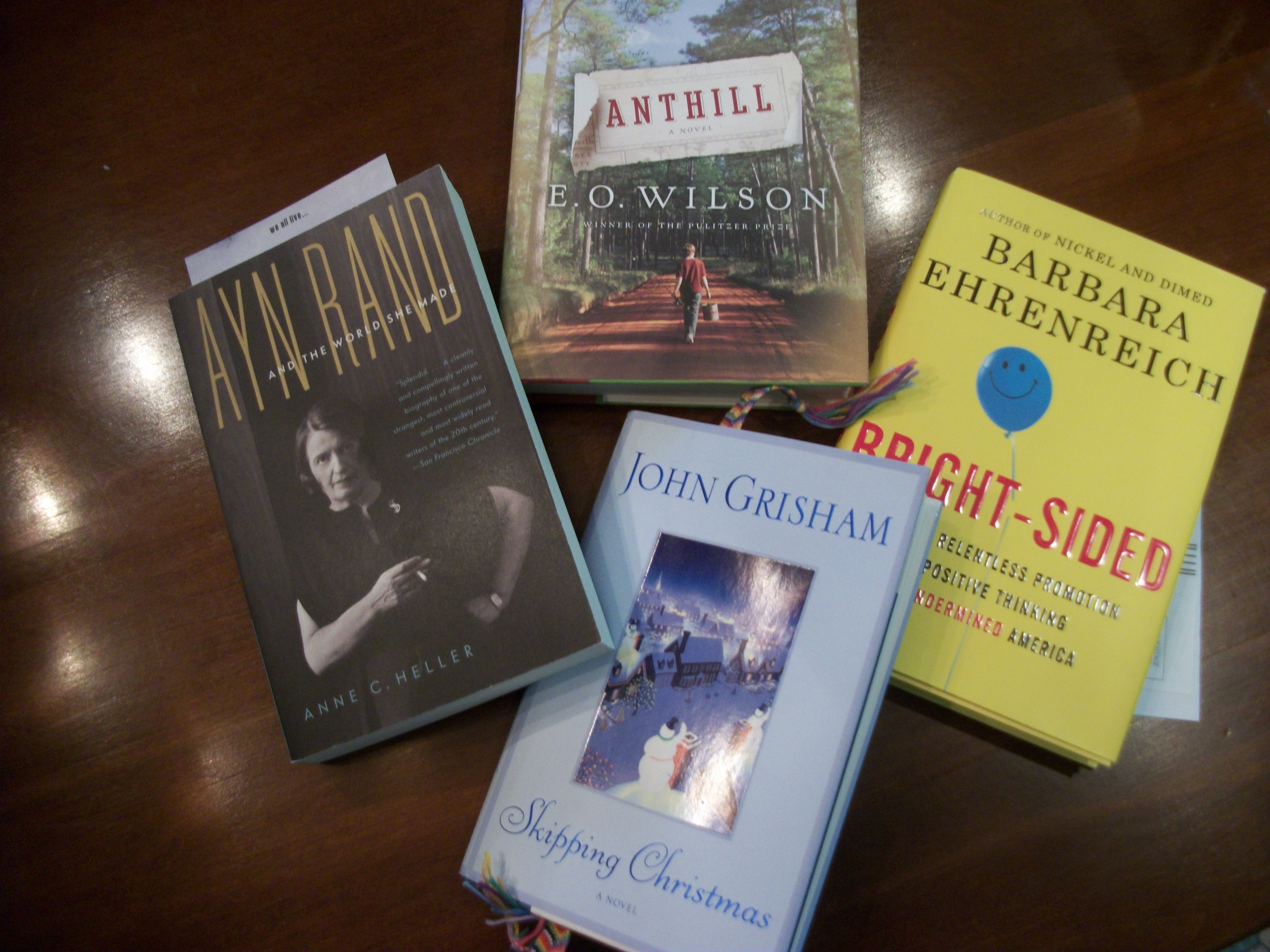
Here’s a picture of my current read pile:

I have, for what is, I’m sure, a brief moment, caught up with my magazines and journals.

Despite the title, John Grisham’s SKIPPING CHRISTMAS might not wind up advocating that stance at all.  So, I look forward to finding out what happens.  This book was a gift from a friend after I wrote a piece about my dislike of–and refusal to participate in–the commercial nature of Christmas.

The biography of Ayn Rand interests me because I’d like to see if she “walked her talk.”  Her economic and social theories have had a powerful impact in this country.  For instance, Congressman Paul Ryan’s budget was derived from Rand’s “objectivism” philosophy.  Her “super man” heroes come too uncomfortably close to the theories that guided Nazism maleness for me.  But, it will be good to refresh my knowledge of her theories.  I read her novels too many years ago–actually when I was in high school.

E. O. Wilson’s book on ants won the Pulitzer one year.  He’s an emeritus scientist at Harvard, and a naturalist to the core.  He’s also a southerner, and he captures a number of southern mindsets in the characters in this book.  The sections on ants are not just about ants; they’re about over population and an unimpeded use of available resources–to the point where nature can no longer support an out-of-synch ant population.  This section is a warning to humans, actually.  As a novel, the book doesn’t quite work–because it isn’t sure what it should be.  But as something else–the inner thoughts of a major scientist, it’s well worthwhile.

Barbara Ehrenreich’s BRIGHT-SIDED was recommended by a Camden friend who knows I think the unbridled optimism of Americans–especially with regard to medical problems like cancer–is a problem that helps us to ignore what we must do to begin to heal our environment, ourselves, our country, and our world.  As long as we can say “the problem is that you aren’t trying hard enough,” we cannot begin to understand what is actually wrong, how we’ve been poisoned, and so forth.

Turkey Tracks: Rabbit Visitor

Turkey Tracks:  June 29, 2011

Rabbit Visitor

Margaret told me that a neighbor’s rabbit was coming down to her garden to visit.  There’s so much activity in that garden now:  meat chickens, layer chickens, and pigs.  The rabbit must be drawn to the activity and life.

John was quite surprised to see the rabbit one morning while we were waiting for the Associated Buyers truck to deliver our joint food order:

Here’s a close-up of said rabbit:

John would like to add rabbits to our place.  I could do that.  Only, he wants pet rabbits, and I would want meat rabbits.

I wonder how that’s going to work out?

Turkey Tracks: Introducing Chickie Honey Ginger

Turkey Tracks:  June 26, 2011

Introducing Chickie Honey Ginger

Here she is:  our new addition to our flock:  Chickie Honey Ginger:

She’s a Freedom Ranger, which is both a meat chicken and a layer.   Even though she’s only 10 weeks old, she is as big as the other full-grown hens.  But, she’s still very “baby chickie” too.

And let me tell you that everything one reads about not upsetting the pecking order in the flock is true.  I took the two older Marans to Rose and brought in Chickie Honey Ginger, and the two Wheaten Americaunas in particular have made her life miserable.  The rooster does what he can, and she sleeps next to him most nights, but it has taken a week for some sense of order to return to the flock.  She hangs out sort of near the rest of the hens most of the time now, but she really is still very young.

A better strategy would have been to have just brought in all four of the new additions at one time.  But, the others are two weeks younger still, and I worried about them since my chicks are now penned.  I’ll bring them in this next week:  two CB Marans and a Wheaten Americauna.  There wasn’t much choice since we processed the meat chicks this past Saturday.

Our freezer is crammed full with 24, beautiful, healthy FR chickens.

Turkey Tracks: The Best Bouquet this Spring

Turkey Tracks:  June 26, 2011

The Best bouquet This Spring

The white-tipped radish are long, thin French Breakfast Radish.   The round ones are Cherry Belles.

We’ve been slicing the French Radishes in half, sprinkling salt over them (real sea salt that is just air dried), and eating them for breakfast with slices of cheese and a selection of meats (salami, prosciutto, liverwurst).  Yummo!

The Cherry Belles are a bit more peppery, and I usually slice them into our salads.  They’re also good in a stir fry or steamed, either sliced or just whole.

I cut the garlic scapes–it’s the garlic flower–on one kind of our garlic plants this year.  I didn’t know what garlic scapes were when I first came to Maine.  Garlic scapes are delicious! cut up and added to soups or stir-frys.  They come in just when the stored garlic is getting either dried out or moldy.  They have such a crisp, light garlic taste.

Here are the potato buckets BEFORE the last two days of rain.  You should see them now!

Turkey Tracks: Garden Tour June 2011

Turkey Tracks:  June 2011

Garden Tour June 2011

How about a mostly flower garden tour?  You see the veggies all the time here, but the June gardens in Maine are astonishingly beautiful.  I didn’t get a picture of the lilacs–which have taken 6 years to bloom heavily, but the garden is so fragrant with them.  I also have lots of peonies, though there is only one picture here.

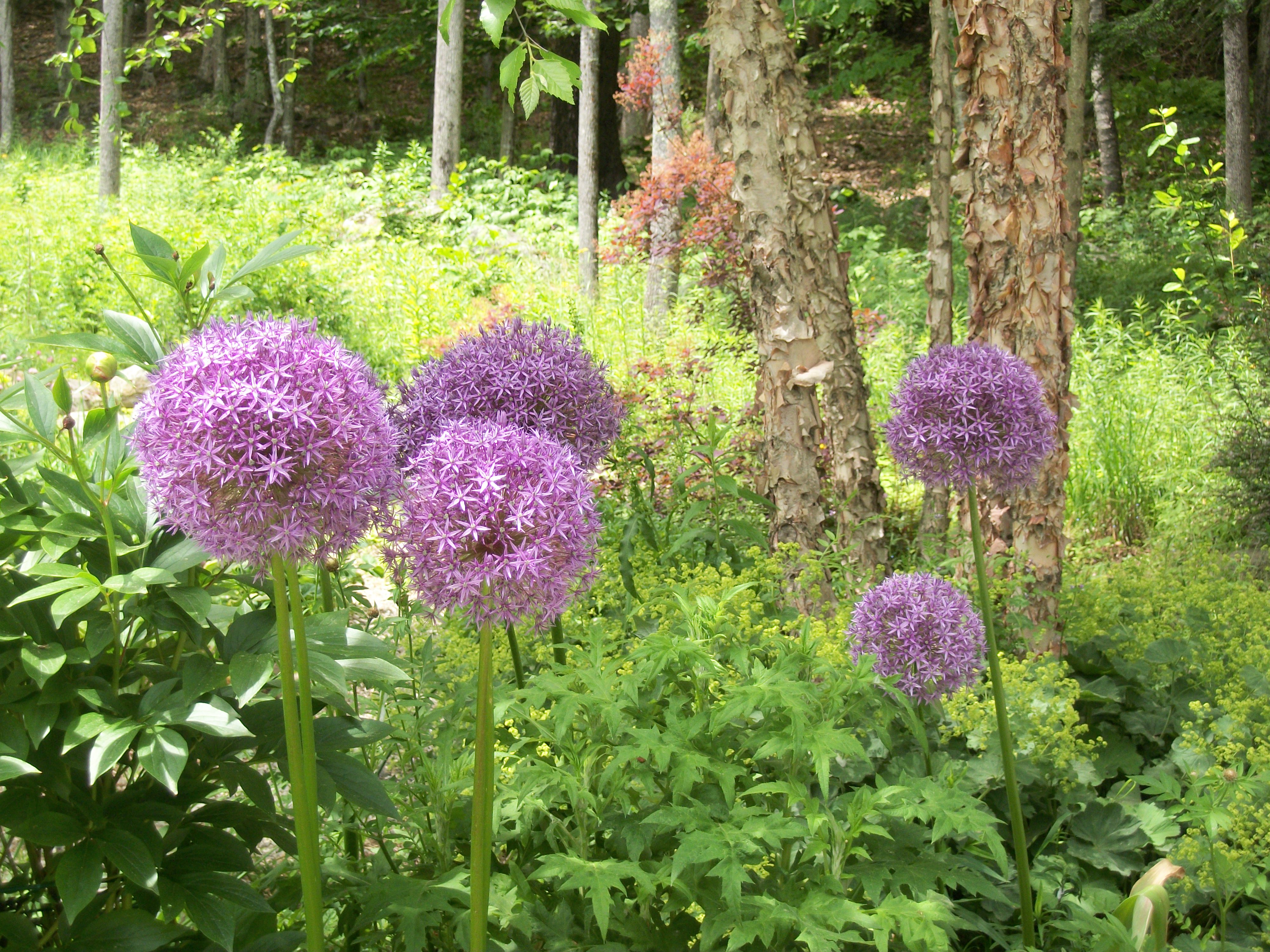
Here’s a picture of the allium bulbs beneath the river birches:

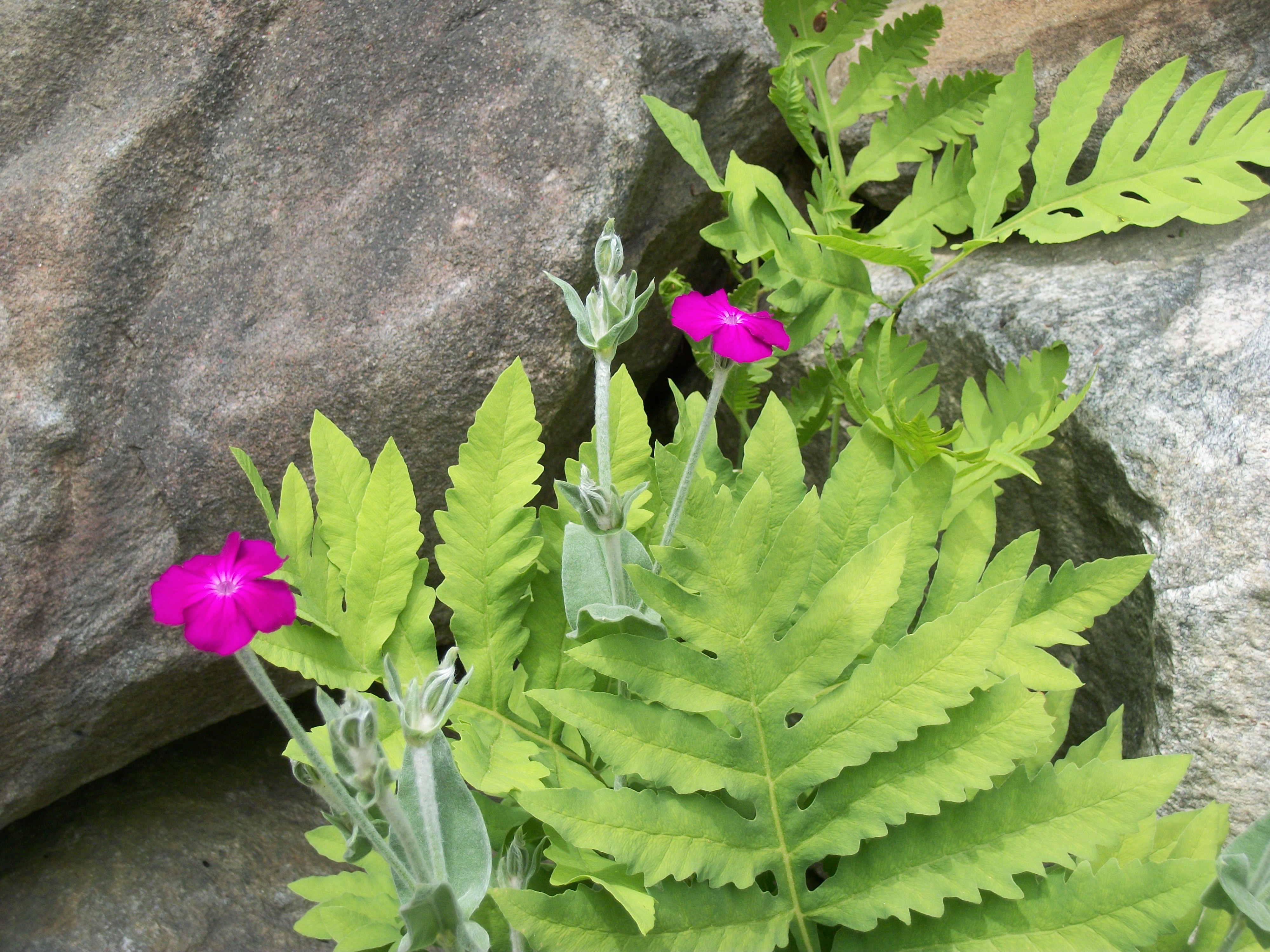
Here’s a pic of a Maine fern and Rose Campion, both of which grow here like weeds, on the rock wall in the back:

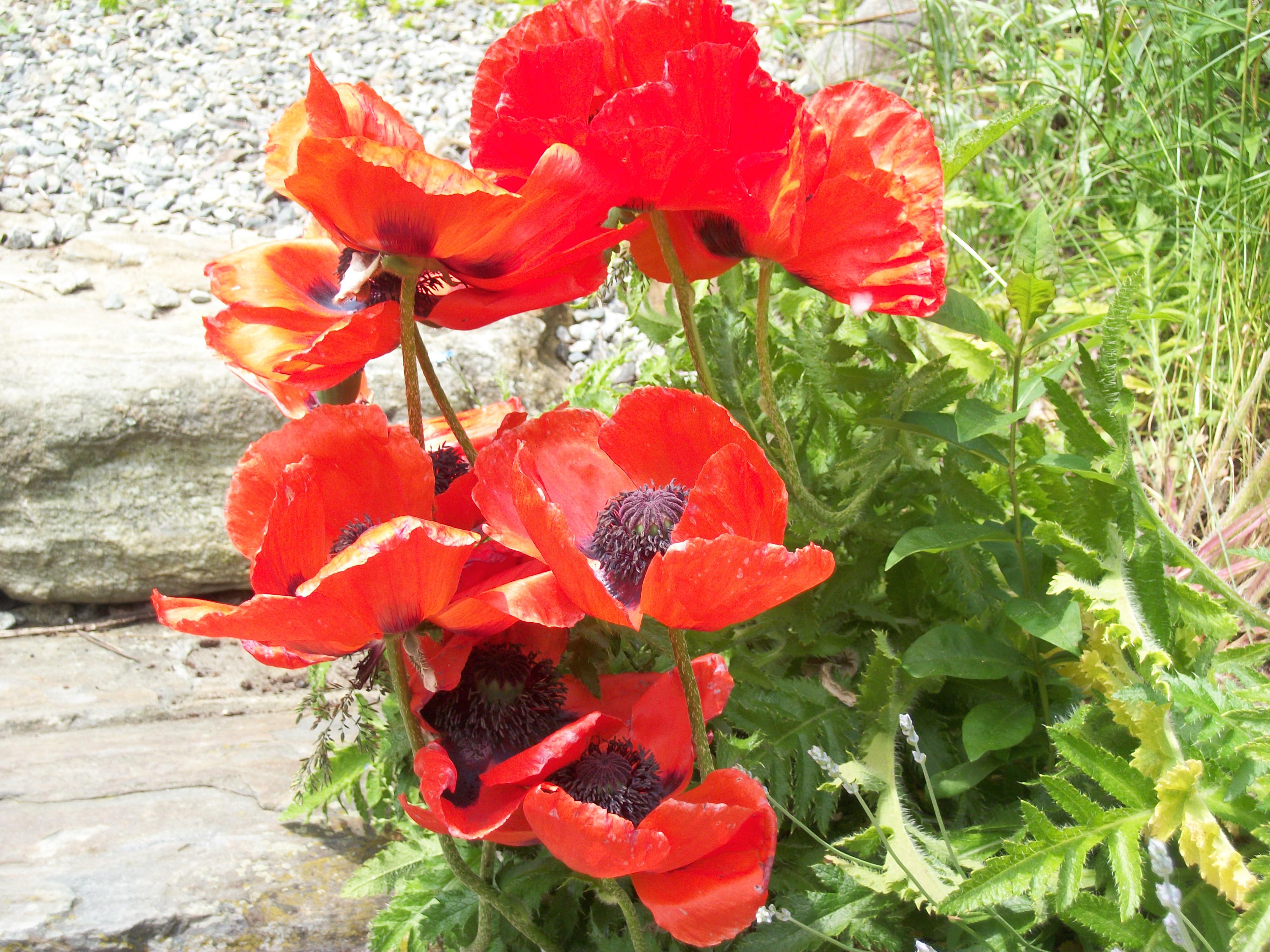
Here’s a pic of red poppies near the stone steps to the upper back of the house:

Here’s a pic of some white peonies just bursting into bloom:

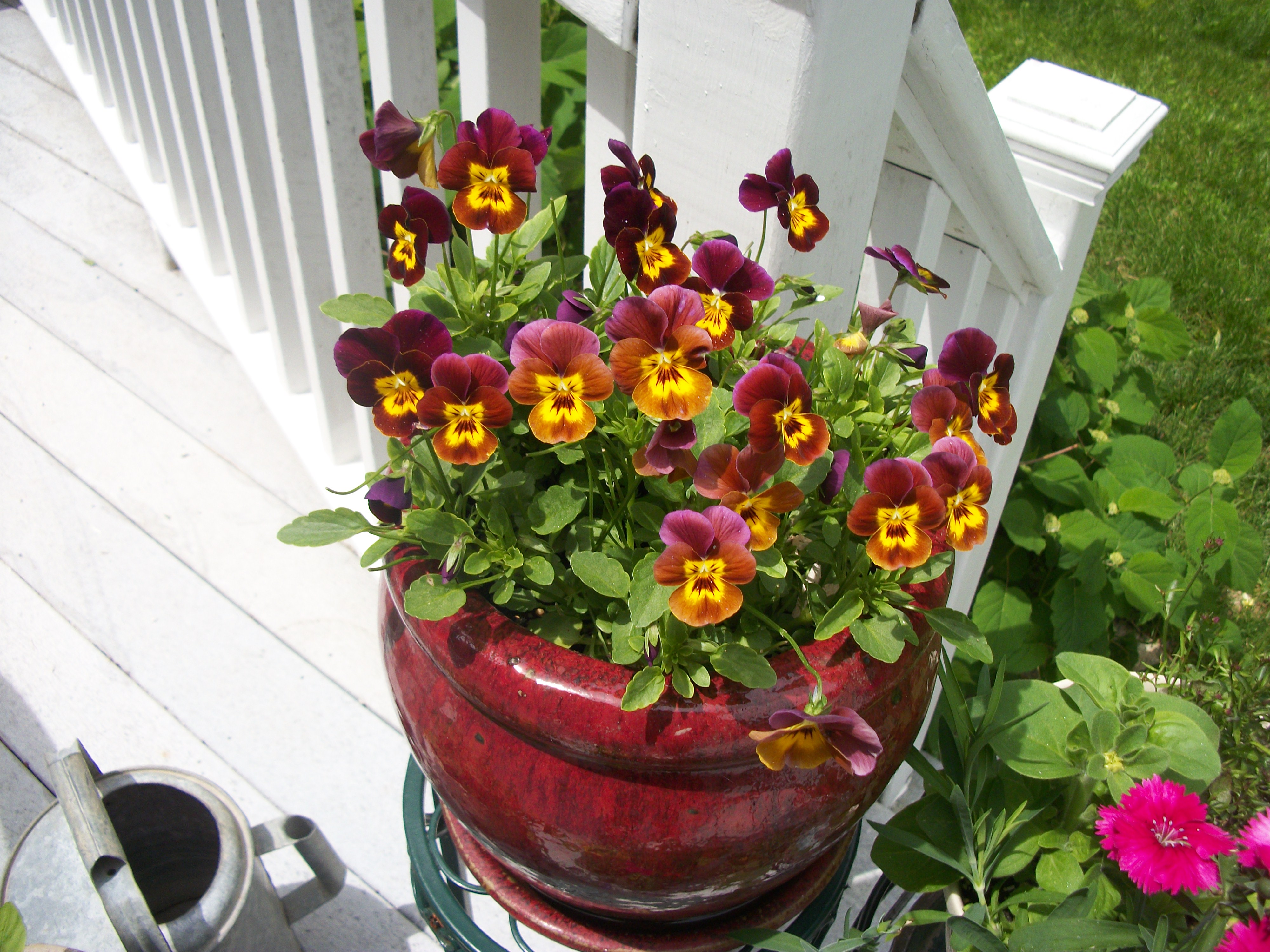
Here’s a picture of some really interesting violas on the back porch.  I knew when I saw them that they would look so great in this particular pot.

Here’s a picture of a hanging basket filled with lavender petunias.   They are so fragrant, especially in the heat.  I love the spicy sweet smell of petunias.

Here’s a pic of geranium, with Lady’s Mantle back of it, atop the driveway rock wall:

And, finally, a picture of the wall garden.  This picture shows how beautiful one’s garden can just blend into the woods.

Book Club Reading List 2011-2010

Our book club gathered last week to pick our next slate of books.  There are six members, and we each present a list of 5 books we have chosen for the book club’s consideration.  The members then each vote on two of our books, votes are counted, and the high counts join the list.  After all the books are chosen, we assign books to particular months.  We try to match shorter books with months where we are busier, for instance.  And similar books get separated across the months, as are the two urban garden books on this slate of books.

Because we are all very different people, we bring different books to the table for consideration.  I wind up reading books I would not choose on my own, and that’s usually a really good thing for me.   It’s also interesting to see who does or does not like a book–interesting discussions reveal aspects of a book we might not have considered on our own.

Book Club Reading List 2011-2010

2011

July:  THE RED THREAD, Nicholas Jose–two pairs of lovers across the centuries, set in Shanghai

August:  MY EMPIRE OF DIRT, Manny Howard–800 square-foot backyard “farm” in Brooklyn changes Howard’s life when he decides to try to eat out of it for one month.

September:  CUTTING FOR STONE, Abraham Verghese–Twin brothers (Indian/British) share a love for medicine.  Novel moves back and forth from Ethiopia and New York.

October:  TO KILL A MOCKINGBIRD, Harper Lee–now classic tale of racism.

November:  THE HARE WITH THE AMBER EYES, Edmund de Waal–family memoir revolving around the inheritance of a collection of ornamental Japanese carvings known as netsuke.

December:  MAJOR PETTIGREW’S LAST STAND, Helen Semonsen–in a small English village, Pettigrew values the quiet life and honor, duty, decorum, but begins a friendship with Jasmina Ali, a Pakistani shopkeeper, which results in culture clashes and a funny, barbed, and winsome book.

2012

January:  THE SWEET LIFE IN PARIS, David Lebovitz–cookbook author and Chez Panisse pastry chef Lebovitz gathers some of his best stories about Paris in this hilarious book.

February:  FARM CITY, Novella Carpenter–in a ghetto in Oakland, CA, Carpenter begins farming a vacant lot next to her apartment.  As she grows bolder, she brings in bees and animals:  chickens, rabbits, and pigs.

March:  THE WHITE WOMAN ON THE GREEN BICYCLE, Monique Roffey–Trinidad, an unforgettable love story that is brimming with passion and politics.

April:  SILK, Allesandro Baricco–powerful and erotic tale that reveals how one man’s desire threatens to ruin his life.

May:  LET THE GREAT WORLD SPIN, Colum McCann–portrait of NYCity, 1974 ; winner, National Book Award, reviewed as “an emotional tour de force.”

June:  LYRICS ALLEY, Leila Aboulela–Egypt and Sudan, a warm, well-crafted story that foregrounds romantic love and the search for spirituality and meaning.