Turkey Tracks: How to Sew On a Button

Turkey Tracks:  February 15, 2011

How to Sew On a Button

A friend told me recently that s/he wanted to learn to sew on a button. 

We meant to sit down so I could demonstrate.  There are a few tricks.

But, the internet is a wonderful thing for this kind of information.  Here’s a terrific video showing exactly how to sew on a button, including the bit of information I would have included about creating a thread shank between the button and the material about equal to the thickness of the material that the button will be handling. 

I would also note that sometimes, if I don’t want to see a knot on the inside of my jacket or sweater or whatever, I will start sewing my button on from the front side, so the knot is hidden.  I also, like the demo here, return to the front side to clip off my thread, but, first, I do a quick knot into the thread shank to doubly secure the thread.

http://www.videojug.com/film/how-to-sew-on-a-button

Turkey Tracks: In Progress: Noro Iro Sweater

Turkey Tracks:  February 12, 2011

In Progress:  Noro Iro Sweater

Well, here’s my Noro Iro sweater in progress.  You may recall that I’m using a pattern from Jane Ellison’s book, KNITTING NORO.

I have run into gauge problems.  The pattern calls for a 7mm needle, which falls somewhere between our 6mm (10 1/2) and 8mm (11) American needles–which means the sweater will fit ok but is going to take more yarn!!!   Fortunately Helen at Heavenly Socks in Belfast, Maine, has two extra skeins since she so generously ordered the yarn for me, which meant she had to order 12 skeins and hope to sell the other 4 since I was only supposed to need 8.  She’s great that way!

 What you see here is the back.  The bottom is knitted in a textured pattern for about 11 inches.  Then you switch to stockinette.  Both showcase the yarn nicely.  I wish I had put that wide dark band fully at the bottom.  I do like the scalloped bottom edge.

Here’s the pattern I’m trying to do.  Notice how matched the yarn is on the sleeves and front body.

I have no idea how my sweater is going to come out because I can already see that the back will be different.  The back is twice as wide as either of the front pieces, right?  So, the yarn color on the front is knitting out twice as thick before changing to a new color.  In other words, the only way you could try to match color would be to do a lot of cutting of yarn.  And, I don’t think that’s the purpose of this yarn anyway.

Oh well!  It will be what it will be!

It’s feeling a little fussy to me though.  Like one of those garments that are wearing you rather than you wearing them!

Turkey Tracks: Dry Body Brushes

Turkey Tracks:  February 12, 2011

Dry Body Brushes

DRY Body Brushes are one of life’s true pleasures!

Instead of feeding your true love a poisonous, tasteless strawberry–shipped across the country in February–or from even further afield–and timed for Valentine’s Day–consider giving a set of body brushes.

Body brushes can be ordered online.  Here’s what ours look like.   The larger one has a handle that slips off so you can use the head in your hand.  The handle is good to reach everywhere on your back.  The smaller brush is softer and perfect for your face.

The skin THRIVES on being brushed daily.  You brush gently, starting in the middle of your body and working the front and, then, the back.  Sit down and brush your feet really well.  Use a softer brush for your face and brush in little circles. 

The brushes remove old dead skin, promote circulation, stimulate nerves, and the brushing feels terrific.  Shower afterwards.  The brushes are for your DRY body.   In less than a week your skin will feel softer.  You’ll notice a real difference. 

After a dry brushing, you tingle all over.


Turkey Tracks: Chicken Feed Recipe

Turkey Tracks:  February 9, 2011

Chicken Feed Recipe

Our chickens are very tired of being “cooped up” in their coop and attached cage, both of which are now banked high with snow and which are, therefore, dark.  You will recall that the chicks were venturing out in the snow paths we made, lured by me and sunflower seeds, until a bird (an owl?) killed May May at dusk one day.

The cage, actually, has about 2 feet of snow on its top as well–which probably provides quite a bit of insulation, especially since I layered tarps over it before the first snow fall.  Inside the coop, we have a red 60 watt translucent light, which gives them a bit more heat.  (The temps up here were in the teens last night.)  I plug in the light in the morning when I feed the chicks so they have some light in their coop during the day.  I turn if off about 8 p.m.  They don’t really like the light on all night, so I only leave it on all night when the temps fall into the single digits.  They get quite cross when they go all night with the light on.

Chickens are very social, so I try to visit them several times a day after they have finished laying.  They don’t like to be disturbed when they are laying.  I open the roof, and they come to see me.  Several will fly up to perch on the opened roof edge and like to be petted and rubbed.  All of them talk to you.  I throw a handful of sunflower seeds into the cage, which is now many inches deep with coop bedding that falls out when the cage door gets opened in the morning.  They scratch around looking for the seeds, and it gives them something to do.  They are VERY bored.  (The dogs are too.)  The other day I sacrificed some of my compost worms and took a full bowl out to the coop.  Mercy me!  Those chickens were so excited.

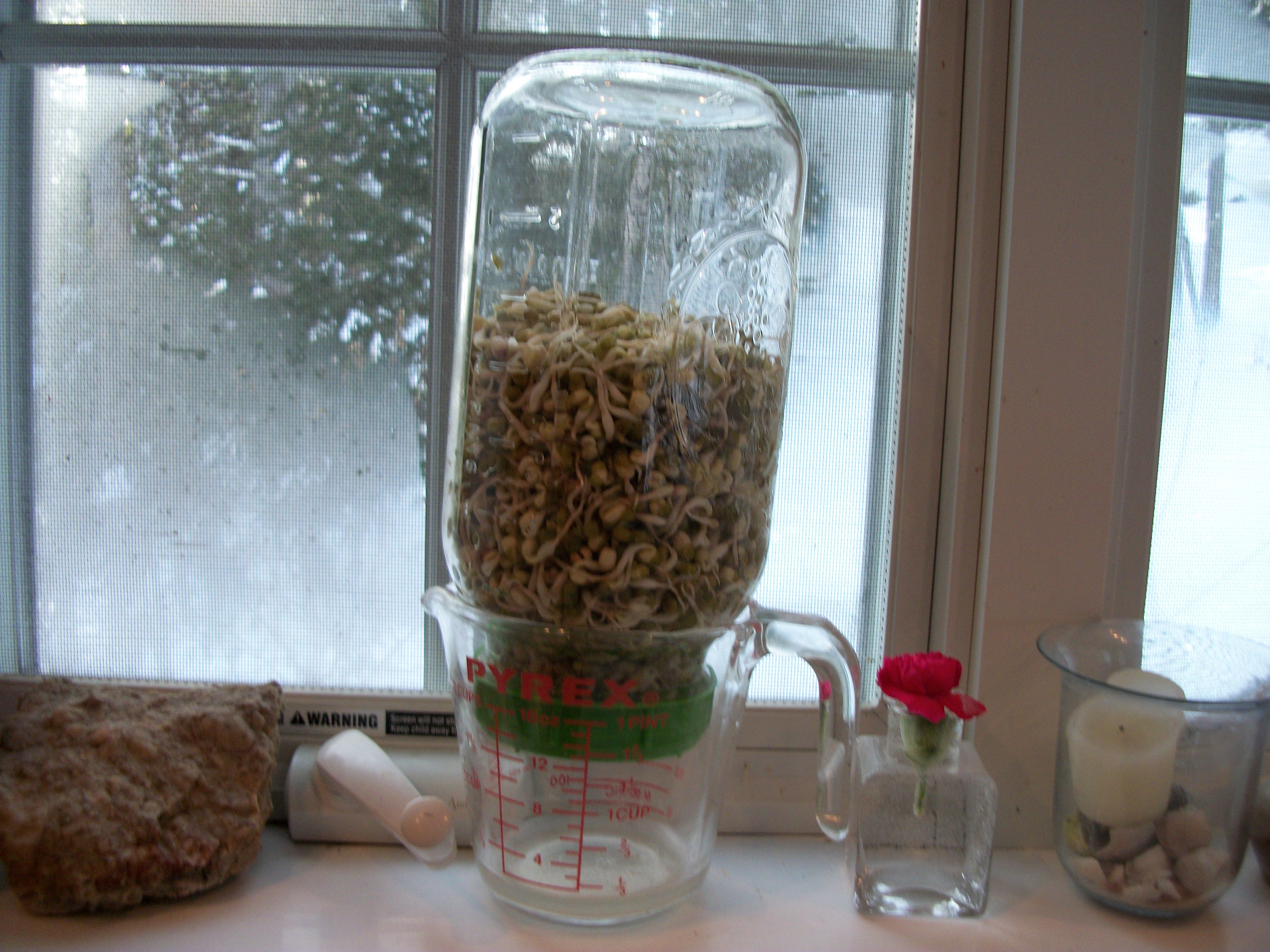
Chickens love greens, and now all the grass is covered with snow.  I give them as many greens as I can–leftover lettuce, cooked greens, the stems from cleaning greens, and so forth.  I’ve even been known to BUY them some lettuce.  But, what the really love are sprouts, so I’ve been sprouting mung beans for them–something I do this time of year anyway to get fresh greens into our diets.  If I leave the sprouts growing longer, they start to grow leaves, and the chicks really like those.  Here are some sprouting in the kitchen window:

 That rock in in the window is a piece of the old, old Bryan mill stone from the mill out on what was once the farm in Reynolds, Georgia.  My Uncle Buddy gave it to me long years ago now.   The mill was gone by the time I was a child, but he remembered it.

I also give the chickens a big bowl of milk, some hamburger, a bit of bread to soak up the milk, kitchen leftovers they like, and whatever greens I can muster up first thing in the morning.  They love cooked oatmeal, like a warm mash, on a cold morning.  Ditto ground corn cooked in a bit of milk.  This food is their second choice, after greens.

I don’t feed my chickens commercial organic feed, which is full of industrial by-products, like spent, rancid oils, SOY, and  synthetic protein, needed because the corn/soy ratio doesn’t supply enough protein.    Chickens fed commercial feed, even organic feed, produce egg yolks with soy isoflavones, which are phytoestrogens that act like hormones and which affect human reproductive and nervous systems.

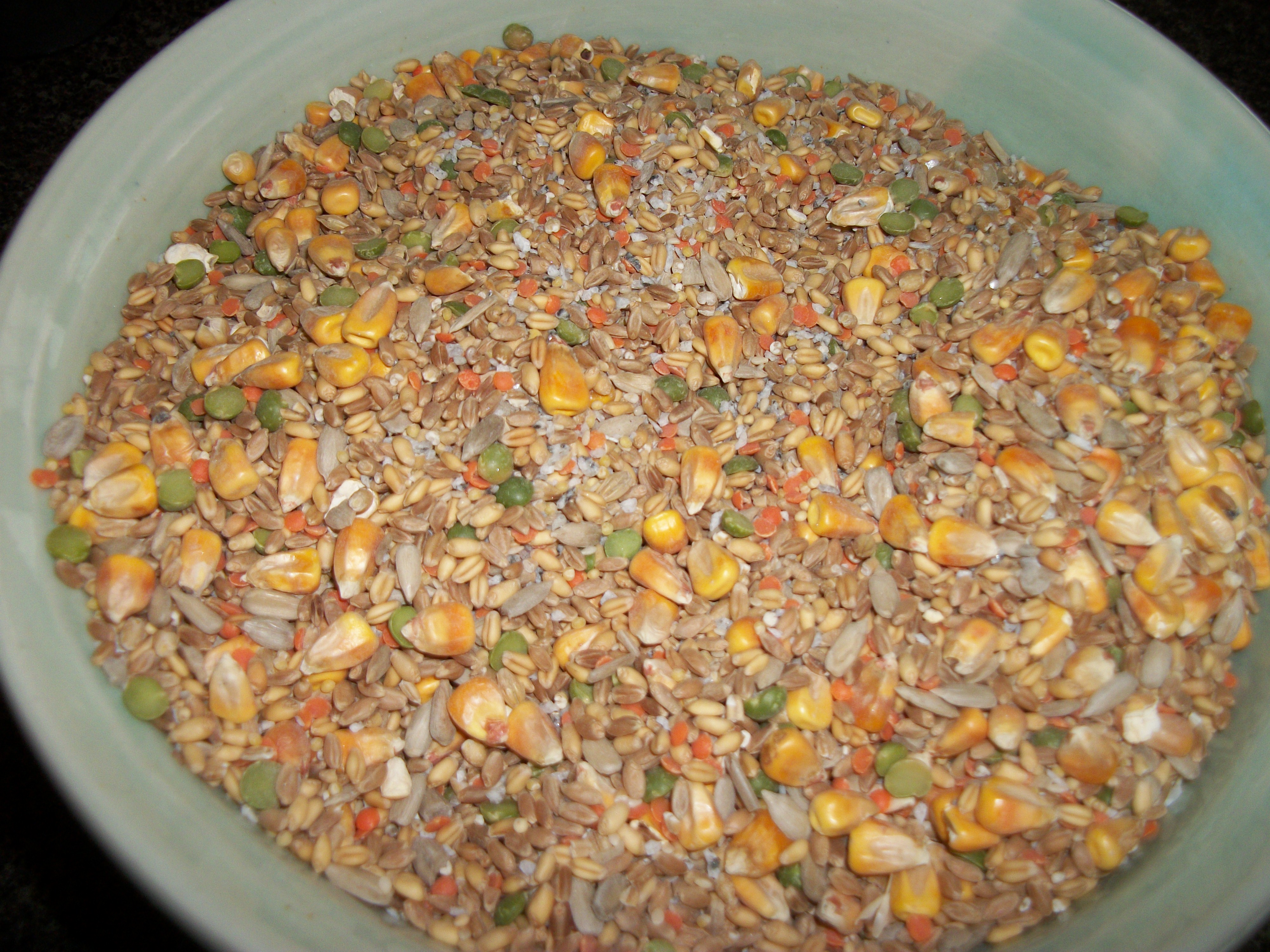
Here’s what the mixture I make for them looks like–and I’m darn lucky to have access to all of these organic grains.  Looks good enough to grind and cook, right?  I could, if I didn’t put grit into the mixture.  See the tiny rocks–grit–mixed it?  That’s what chickens use to help digest their food inside their crop, or gizzard.   Anyway, I keep all the grains, seeds, and beans separate out in the garage, so I can use them if I like.

I got the master recipe from a farm out west somewhere, called Greener Pastures (www.greenerpasturesfarm.com/ChickenFeed Recipe.html).  Thanks so much for sharing, Greener Pastures!

This recipe uses wheat, which has a fair amount of protein, as the base grain and peas and lentils for proteins.  Everything is organic.  So, here’s what I’m mixing up:

3 parts hard red winter wheat

3 parts soft spring wheat

1 part whole corn (I up this in the winter to almost 3 parts to help the chicks gain and hold fat, and in the summer I throw out a bit of whole corn for scratch feed.)

1 part steel-cut oats

1 part hulled barley

1 part hulled sunflower seeds

1 part green split peas

1 part lentils

Any other seeds/grain I think they’ll like for a change:  millet, sesame seeds, etc.

About two cups of grit per mixture.

Turkey Tracks: Camden Harbor, Winter Schooners

Turkey Tracks:  February 8, 2011

Camden Harbor, Winter Schooners


This view of the northeast side of Camden’s inner harbor lies directly below the library.  To the right, the harbor is more bustling, especially in the summer.  The three winter-wrapped windjammers, or schooners, or just “jammers,” are, from right to left, the Mary Day, the Lewis R. French, and the ketch, Angelique.  (Thanks Lewis McGregor for getting the names right–see comment.)

I took this picture a few weeks ago while John ran into the library to return a  book. 


Mainely Tipping Points 25: TAPPED: Bisphenol A

Mainely Tipping Points 25

This essay is the final essay in a series of three essays around the documentary TAPPED.


TAPPED:  Bisphenol A


In the documentary TAPPED, Dr. Frederick Vom Saal says Bisphenol A, or BPA, is “one of the most toxic chemicals known to man.”  BPA, explains Vom Saal, is “the poster child chemical that is going to dismantle the entire regulatory process and demand a re-analysis of all chemicals.”  “BPA,” says Vom Saal, is “frightening to the regulatory community because of the magnitude of the error they have made.”    

BPA leaches into water from water containers made of hard, polycarbonate plastic, stamped with #7 on the bottom of the product.  Examples of problem water containers are the five-gallon hard plastic water jugs used with water cooler systems, baby bottles, and sports bottles. 

Other examples in the general food system include containers for liquid baby formula and the linings of beverage and food cans.  Elaine Shannon of the Environmental Working Group (EWG) reports that because plastics made with BPA “break down easily when heated, microwaved, washed with strong detergents, or wrapped around acidic foods like tomatoes, trace amounts of the potent hormone leach into food from epoxy lacquer can linings, polycarbonate bottles and other plastic food packaging” (Shannon, “What the Chemical Industry Doesn’t Want You to Know,” September 2008, http://www.ewg.org/report/what-chemical-industry-doesnt-want-you-know).  Wikipedia notes that as of April 2010, General Mills had developed a BPA-free alternative can liner that works even with tomatoes.  But, writes Wikipedia, General Mills is only planning on using this new liner with their organic food subsidiary, Muir Glen (http://en.wikipedia.org/wiki/Bispjhenol_A).   

Polycarbonate plastics are ubiquitous today.  BPA, explains Wikipedia, is used in “sports equipment, medical and dental devices, dental fillings and sealants, eyeglass lenses, CDs and DVDs, and household electronics”—like, notes, computers and cell phones.  BPA, details Wikipedia, is used to make other plastics; it’s a “precursor to the flame retardant tetrabromobisphenol A”; it was “formerly used as a fungicide”; it’s the “preferred developer in carbonless copy paper and thermal paper,” including sale receipt paper; it’s used in foundry castings and to line water pipes”   

BPA mimics estrogen in the body, which is something scientists have known since 1930.  Regulatory bodies have determined what they believe to be safe levels for humans by using an idea, explains Vom Saal, dating from the sixteenth century:  “the dose makes the poison.” 

However, Vom Saal says this premise is false for any hormone and explains that  recent studies are showing that even minute levels of BPA are unsafe. 

Vom Saal says in TAPPED that 700 peer-reviewed, published studies show BPA to be dangerous.  He explains that the 38 internationally recognized scientists who served on a 2006 National Institutes of Health panel (Chapel Hill) determined that current levels of BPA pose risks for humans.  Shannon notes in “What the Chemical Industry Doesn’t Want You to Know,” that The National Toxicology Program accepted much of the Chapel Hill panel’s thinking and wrote that low doses of BPA may affect development of the prostate gland and brain and may cause behavioral effects in fetuses, infants, and children.

Shannon notes that Vom Saal, working with Wade Welshons at the University of Missouri-Columbia, “turned up the first hard evidence that miniscule amounts” of BPA “caused irreversible changes in the prostates of fetal mice” in 1997, or 14 years ago.  By 2008, writes Shannon, the global chemical industry was producing 6 billion pounds of BPA annually, which generated “at least $6 billion in sales” 

In order to protect its BPA turf, the chemical industry has followed the very successful tobacco industry model, which Devra Davis details in THE SECRET HISTORY OF THE WAR ON CANCER (2007).  The tobacco industry spent astonishing amounts of money to advertise tobacco use, to delay negative decisions, to hide negative science, to craft favorable legal decisions, to obfuscate science with problematic studies from paycheck scientists, and to fire or discredit anyone saying tobacco use was unhealthy.  The chemical industry is currently running what Shannon calls a “scorched earth” campaign that includes such actions as an “industry email to food banks charging that a BPA ban would mean the end of distributions of canned goods for the poor.”  

Vom Saal describes in TAPPED how a representative from Dow Chemical Company showed up in his and Welshons’ Missouri lab to dispute the data and to declare “`we want you to know how distressed we are by your research.’”  Vom Saal revealed that Dow tried to stop papers critical of BPA from being published.  Shannon describes how the American Chemistry Council attempted to prevent Vom Saal from speaking at a convocation at Stanford University because his work was “`very controversial, and not everybody believes what he’s saying.’”  Shannon quotes Welshons as saying that chemical industry officials made “` blatantly false statements about our research’” and “`they were skilled at creating doubt when none existed.’ “

TAPPED shows footage from a Senate hearing investigating the Food and Drug Administration’s (FDA) use of biased studies produced by the chemical industry’s paycheck scientists.  Senator John Kerry castigates FDA’s Dr. Norris E. Alderson for not asking for independent studies.  Senator Kerry concludes that the FDA is not protecting citizens, and TAPPED concludes that industry has captured the FDA and other regulatory agencies. 

Lyndsey Layton of “The Washington Post” reported that as of 2009, 93 percent of the U.S. population had detectable levels of BPA in their urine (“High BPA levels linked to male sexual problems,” November 11, 2009, http://www.washingtonpost.com/wp-dyn/content/article/2009/11/10/AR2009111017411).  Layton’s article discusses a November 2009 study of 634 male workers from four factories in China showed that exposure to high levels of BPA caused erectile dysfunction and other sexual problems after a few months on the job. 

Vom Saal, in TAPPED, links the following health problems to BPA:  childhood diabetes, obesity, prostate and breast cancers, brain disorders like ADHD, liver disease, ovarian cancer, uterus disease, and low sperm count in men.  Layton lists infertility in general and early-onset puberty. 

Shannon discusses some of the dozens of other scientists who are also studying BPA and who concur with Vom Saal and Welshons.  Patricia Hunt, a reproductive scientist (molecular biologist) from Washington State University, was stunned by what she saw under her microscope after a caustic floor detergent used to clean her lab released BPA into her animals’ food and water.  Hunt said “`Like most Americans, I thought, my government protects me from this kind of stuff.”  She began studying BPA, and, after a decade, determined that “exposure to low levels of BPA—levels that we think are in the realm of current human exposure—can profoundly affect both developing eggs and sperm.” 

A Yale University medical school research team led by Csaba Leranth discovered that BPA affects the neurological system in African green monkeys.  In humans, reported team member Tibor Hajszan, the devastating effect on synapses in the monkey brain could translate to memory and learning problems and depression.      

In September 2010, Canada banned BPA as a toxic substance.  Eight states have banned BPA in children’s’ products:  California, Connecticut, Maryland, Minnesota, New York, Vermont, Washington, and Wisconsin.  In October 2010 the Maine Board of Environmental Protection held hearings on a ban on BPA in baby bottles and sippy cups.  The Board postponed any decision until it studied expanding the ban.

Here’s what you can do:  don’t wait for our government to protect you.  Don’t buy canned foods or beverages unless the container says “BPA free,” avoid the combination of plastic and foods, don’t heat plastic, and don’t reuse plastic containers.  Do buy, cook, and preserve locally grown, organic, nutrient-dense whole foods available in your region.

Turkey Tracks: I Feel Rich: 5 Pounds of Processed Pecans

Turkey Tracks:  February 1, 2011

I Feel Rich:  5 Pounds of Processed Pecans


We’re almost out of the pecans my first cousin Teeny Bryan Epton and her partner brought to us last September.  (Thanks Teeny and Lori!)

With our friends Margaret and Ronald, we order many household items in bulk from Associated Buyers, located in New Hampshire.  AB delivers, also, to all our local coops, or cooperatively owned stores.  I ordered 5 pounds of organic pecans in this last order.  

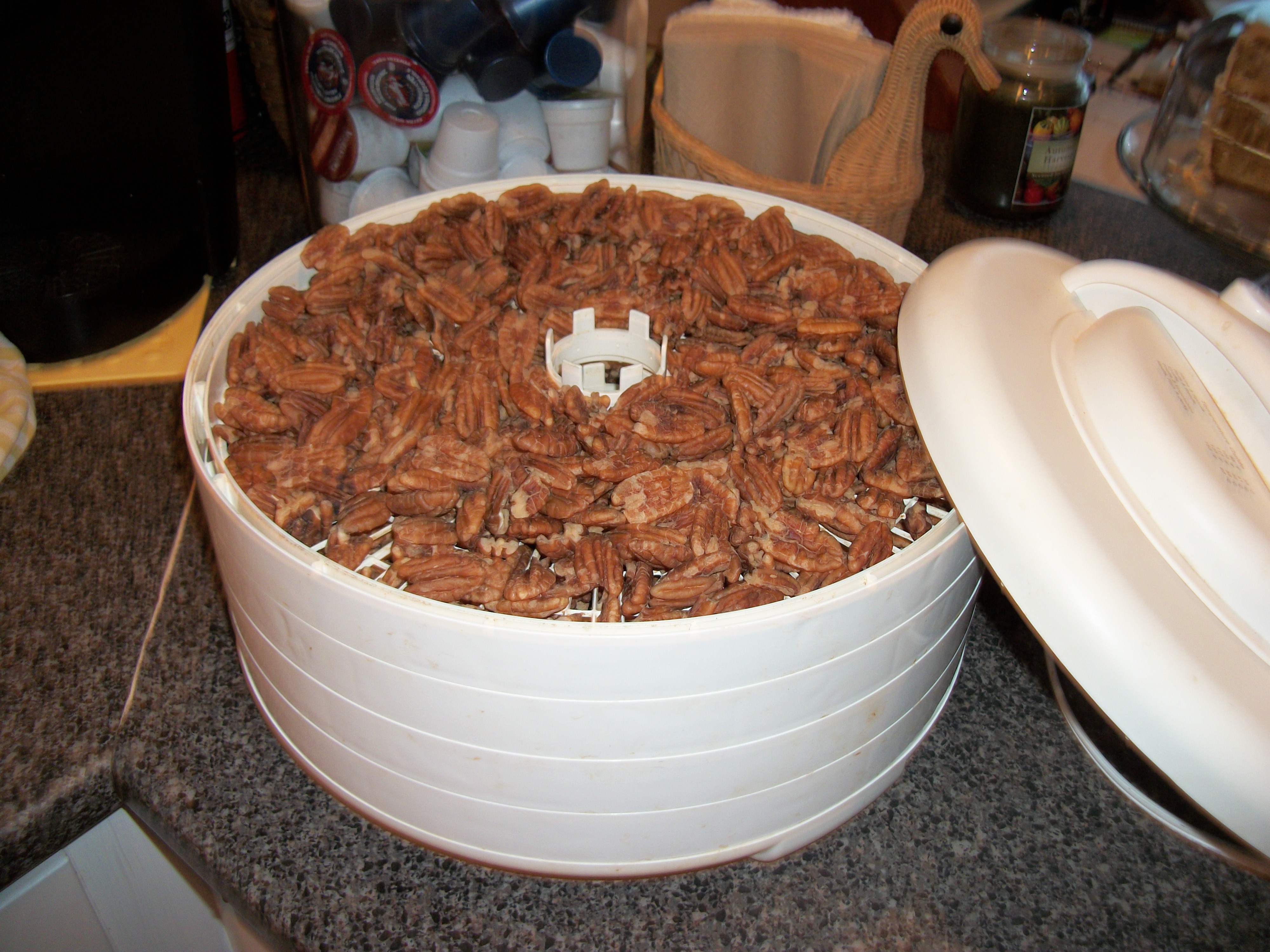
 I soak the nuts over night, dry them gently in the dehydrator, and store them in Mason jars.  Five pounds lasts for months and months.  I keep pumpkin seeds, walnuts, pecans, almonds, and, lately, hazelnuts.  Crispy nuts are delicious! 

ALL nuts, seeds, legumes, and tubers need to be processed in some way to remove the phytates that can prevent your body from absorbing nutrients it needs from many foods.  One prepares most nuts by soaking them in salted water over night and drying then in a dehydrator or an oven on very low heat.  Drying can take, sometimes, well over 24 hours.  I found this information and the recipes in Sally Fallon and Dr. Mary Enig’s treasure trove of a book, NOURISHING TRADITIONS.  Fallon and Enig are part of the Weston A. Price Foundation (www.westonapricefoundation.org).  (Be sure to use .org and NOT .com, which is a scam site.)  I trust the WAPF folks because they have the scientific credentials to understand the chemistry of food and human bodies and because they are not affiliated with industry in any way.

Here are the pecans in the four-tray dehydrator:

And, here they are all jarred up.  The big jar is a half-gallon size with which I’ve recently fallen in love.  Now I’m a rich woman!  I have food assets.

Turkey Tracks: May May Chicken Is Gone

Turkey Tracks:  February 1, 2011

May May Chicken Is Gone

Yesterday, May May Chicken was killed at dusk and partially eaten by a large bird.

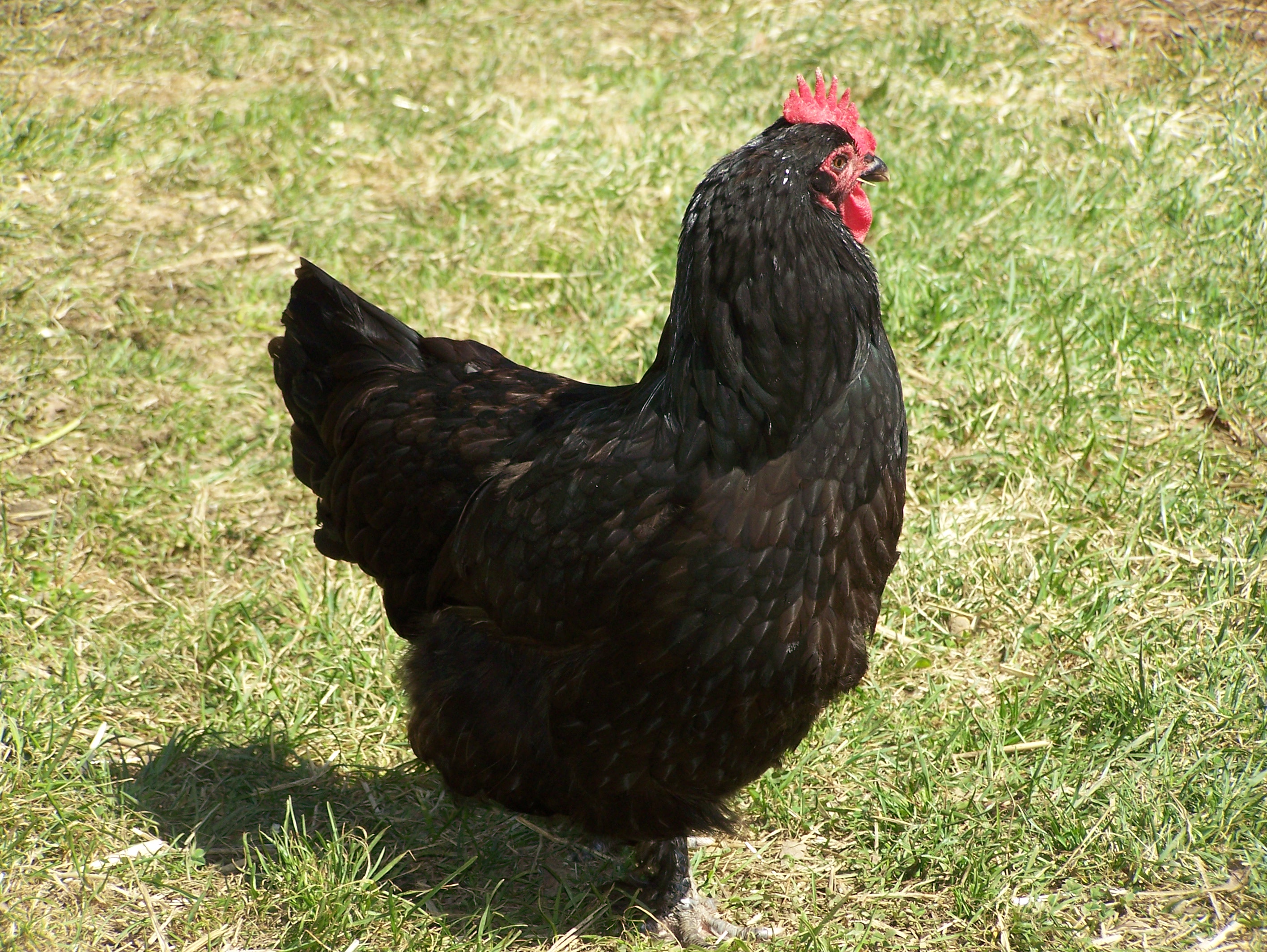
Here’s a picture of her from last spring around the time we first got our chickens in March.  The grass is just greening up.  At that time, the Marans were about 18 months old.  And, maybe even a bit more.  She had a fancier name that I can’t for the life of me remember.  She became May May over the summer.

Yesterday afternoon I was happily engrossed in making Karen Johnson’s purse, and I did not hear a thing.  Neither did John, whose office windows, though closed with blinds to keep out the cold, are no more than 10 feet away.

Anyway, I went out at deep dusk or a bit later–the chickens have been slow to roost as they’ve been enjoying being outside.  Mostly, they’ve been hanging out under the porch, right next to one of John’s office windows.   They have scratched out the rocks and pulled out the black weed cloth and have been trying to take dirt baths.  One night this week I had to climb up the slope back of the birdfood storage bench, pick up two of the Maran hens, and put them into the coop.  Had they had been scared to cross the snow to their coop?  So,  while May May was being killed, I was both occupied with my project and giving the hens plenty of time to go into the coop.

I went out the kitchen door, flashlight in hand, and around the snow path to the coop.  (We have more than 2 feet of snow on the ground and have dug paths to get around the house.)  When I lifted the roof lid to make sure the chickens were all inside, I only saw three Maran hens.  The other hens and the rooster were uncharacteristically subdued I realized later.  I started down the path to where the chickens had spent the day and begin to see black feathers.  At first, it didn’t register.  Then, I saw her body, a dark heap atop the snow.  Crimson, bright blood soaked the little hollow where she lay.   Her neck had obviously been broken, and part of her breast had been torn away so that her flesh was exposed.  I stepped into the bank, went up to my knee in the snow as my boot sought firm ground, and picked her up.  She was surprisingly heavy.  Oh, I thought, I am feeding them right.

For some reason, I put her back down and went to tell John.  I knew he would want to know, would want to see for himself.  He pulled on boots and coat and came immediately.   Together we took in the information left for us to witness.  There were no signs of an epic struggle.  We hoped that meant she had died instantly.  There was a small patch of scratch marks in the snow.  Hers?  Made by her feet as she died?  Either an animal or a bird who walked on the snow would have left prints.  No, it was a bird that got her and then sat on her body to eat her, which is why the soft snow was so hollowed out underneath her.  She was too heavy for the bird to lift.  So, the bird ate until disturbed in some way.  Perhaps, by the dogs who had gone out several times while I had been sewing.  At one point, Reynolds came to see me, as if to tell me something.  But I had ignored her, intent on my project.

I picked up May May’s body again and was again surprised at how heavy she was.  I took her to the garage and put her into a trash can.  What else could I do with her?  Leaving her lying in the snow to at least feed something in this winter of heavy snow was unthinkable.  We do not want to tempt  foxes, weasels (the dreaded weasels), coyotes, or racoons into the chicken area.   Nor did we want to tempt our dogs. In the end, her flesh was wasted, trashed, but for a few mouthfuls.

It’s such a strange thing to contemplate death.  In the early afternoon, I had stroked May May while she sat on the nest in the corner of the coop where the hens have been laying.  She had been sitting on two brown eggs, one of which may have been hers.  She had stayed when I reached beneath her and took out the eggs.  She had allowed me to stroke her back a time or two more before I closed the roof lid.  Perhaps one of the eggs I collected before locking in the remaining chickens for the night had been hers, laid after I had left her.  May May had been warm, alive, interested.  And now, there was the lump of her body.  The life had gone; her spirit had departed.  But, to where?

John’s protective mode went into full gear.  He wanted to “get the sucker,” and he got up early to peer out of the windows to see if he could spot the bird, who might return to try to eat from its prey once more.  He thought he saw an eagle in our trees.  He said the bird had a huge wing span, bigger than a hawk’s.  I do not know if an owl is large enough to take down a hen of May May’s size.  Probably.  And I do think she was killed at dusk because she wasn’t really cold when I picked her up.  Anyway, May May’s death is a reminder that nature is not kind, that nature is rapacious and filled with creatures who must eat to live, including man himself.

I am feeling more than a little guilty today because the chickens did not really want to come out in the snow.  They knew it was dangerous.  They knew they were prime targets against the white snow.  That’s why they had hunkered down under the porch.  They knew they could be killed out on the snow paths.  And, May May was.  But, they came out in the first place because I told them it was ok, because they had followed me down the path as I scattered a bit of seed for them, seed they could not resist.  I am shamed that I listened to anyone say how dumb chickens are because they won’t go out into the snow unless you make them.  What hubris!  What a mistake.  What a lack of understanding about chickens and predators.  Chickens almost always stay beneath plants and trees and porches and buildings.  In the winter, they are so at risk.

Here’s a picture of our original six chickens, taken in the fall before Chickie Annie joined then.  May May is the middle black hen.  She was the “head” hen, and she was fiesty and full of life and altogether wonderful.  We will all miss her and the very large brown eggs she laid.

Turkey Tracks: Wynken, Blynken, and Nod quilt

Turkey Tracks:  January 31, 2011

Wynken, Blynken, and Nod Quilt

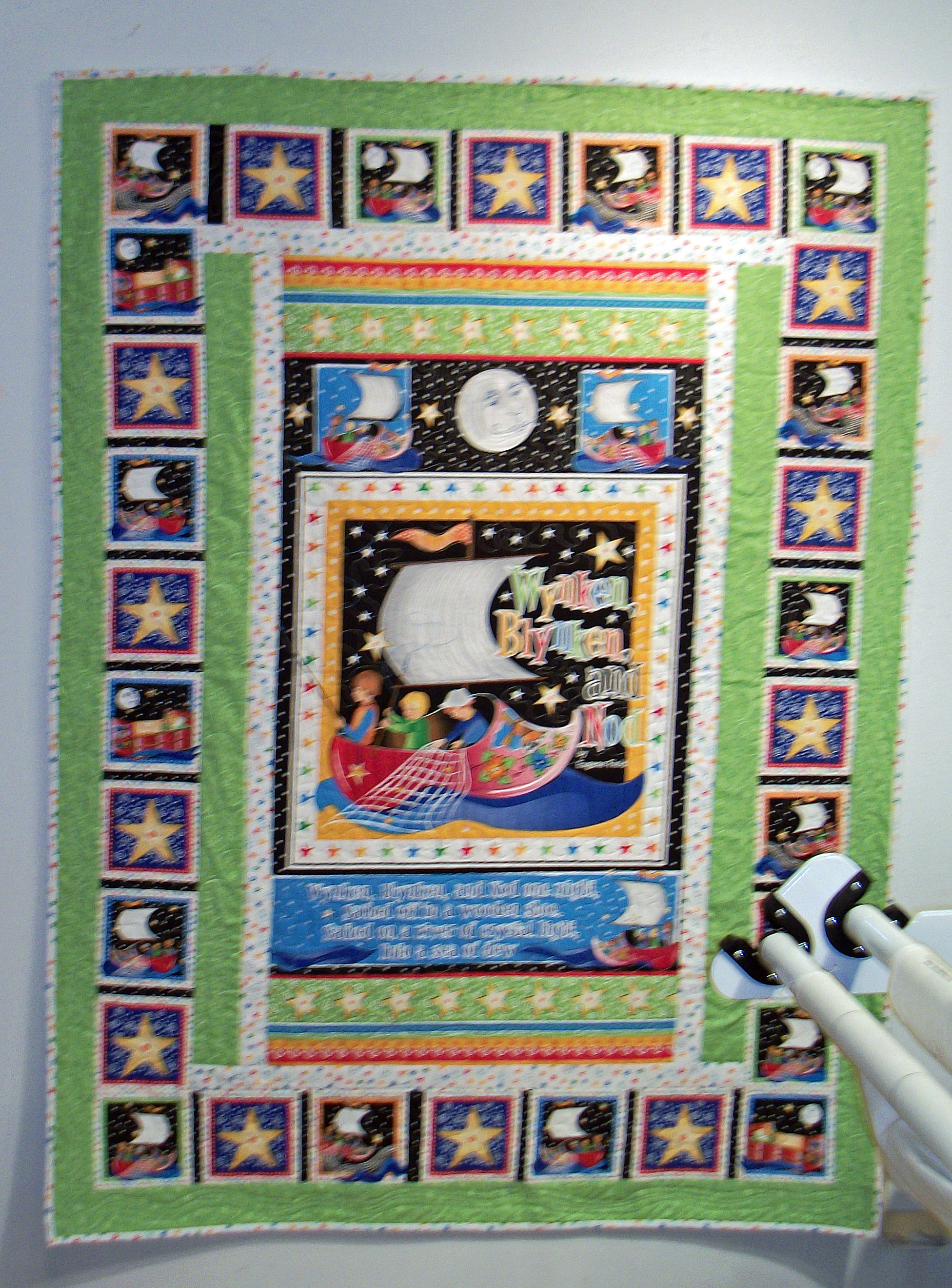
Here’s a very bad picture of the “Wynken, Blynken, and Nod” quilt sent to my great nephew Judah Benjamin Gardner about a week ago.  Judah was born a week before our Ailey. 

This picture is fuzzy and, also, distorted a the bottom.  I’m learning that if I don’t hold my little camera level with the center of something, the bottom gets narrowed.  Oh well.  You can still see it’s a very cute quilt. 


Here’s a close-up of the center panel:


 And here’s a sense of what the back looks like.  I had to piece the back as the quilt turned out larger than I had expected. 


Children’s quilt fabrics are really fun these days!

This quilt is meant to be used and used and washed and used.

Turkey Tracks: Sunday Cooking–French Onion Soup Dinner

Turkey Tracks:  January 25, 2011

Sunday Cooking: 

French Onion Soup Dinner


We have some friends here in Maine who LOVE French Onion Soup.   Jack and Barbara Moore own the schooner Surprise, which takes people out of our Camden harbor for day sails during the summer.  They went to Tufts with John, and we did not know they lived here when we first began to get serious about moving to Camden.   We attempted to rent a cottage from them in January 2004 for the summer of 2004, and John realized who they were.  We all met at Boyton McKay for lunch (Phil had cooked vegetarian French Onion Soup), and the three old friends reconnected.   (Boynton McKay has the best pancakes in America–seriously, it does.) 

A week or so ago, Jack and Barbara invited us to dinner at the newly renovated cottage we once rented–it will now be their home–and it is beautiful–and I promised to make them French Onion soup.   Traditional French Onion Soup begins with a sturdy beef stock, but many French soups just use vegetables and water (leek and potato soup, for instance), though Julia Child always has a variant for a good bone broth stock.  In the winter, especially, bone broths are more prevalent because people are eating hearty meats for warmth.   And, if you know me at all, you  know I’m a passionate advocate for good bone broths.  They are nutrient dense and provide minerals we do not easily get elsewhere.  Besides, they allow the use of all parts of an animal.  Nothing gets wasted and it’s healthy to boot.  How can you go wrong?  Also, onions are storage vegetables, so we have a lot of them in the winter.  What a French Onion soup is, in the end, is a way to use what is prevalent in the winter season, and use ingredients in the most delightful way.

However, Barbara is mostly a vegetarian, so I promised her I’d make a vegetarian French Onion Soup.  And we invited them for Monday night, so I started by making a really good vegetable stock on Sunday afternoon:  2 celery stalks (you don’t want too much celery), some celeriac  I had from Hope’s Edge which is mild, 2 big onions, 3 spring onions greens and all, chard stalks, a small turnip, a parsnip, a few potatoes hanging around the potato basket, 4 carrots, three or four garlic cloves smashed, some of the parsley I froze, some dried lemon thyme, a bay leaf, and some good unrefined sea salt (which is full of minerals like magnesium and good for you,  unlike the fake salt in the grocery store which I never buy).  I would have used 2 leeks and 1 onion if I had had leeks.  Once assembled and brought to a boil, lower the heat, and simmer for about an hour.  You will have gotten all you need from the vegetables by then.  Let the stock cool and strain it through a colendar.   In this household, the dogs get the carrots the next morning mixed into their raw meat, and the chickens get some carrots, the chard stalks, the turnip, parsnip, and a few of the spent potatoes.   If  you can’t part with the vegetables,  pull off a bit of the stock and puree the vegetables in it, reheat,  pour in some heavy REAL cream or put a few tablespoons of butter on top, and you have another lovely soup.  If you don’t have animals, you could compost the spent vegetables.  If you don’t have a composter, put them outside under a shrub.   They don’t have any fat in them, so they won’t attract vermin, and you won’t be adding, mindlessly, to the waste stream.  The shrub will thank you. 

Anyway, here’s what the broth looked like on the stove.  Isn’t it pretty?


Roughly speaking, here’s what you need for the soup  ingredients:

2 quarts of stock minimum–I probably use 2 1/2 quarts–and at least  1/2 cup dry white wine (red isn’t bad if you’re using a beef stock)

8 or 9 medium to large onions cut pole to pole and sliced into 1/4-inch slices  (I use more than Julia who calls for 5 cups I think)

1 tsp. salt, a pinch of sugar, 3 Tablespoons of butter, and 2 Tablespoons of other fat (olive oil, coconut oil, tallow, lard)

Grated swiss cheese–good swiss which is sweet, not bitter, is usually European in origin.  And, if you like, the following enrichments:  3 Tablespoons of Cognac, egg yolks ( 1 to 4)

Really good French Bread Baguette

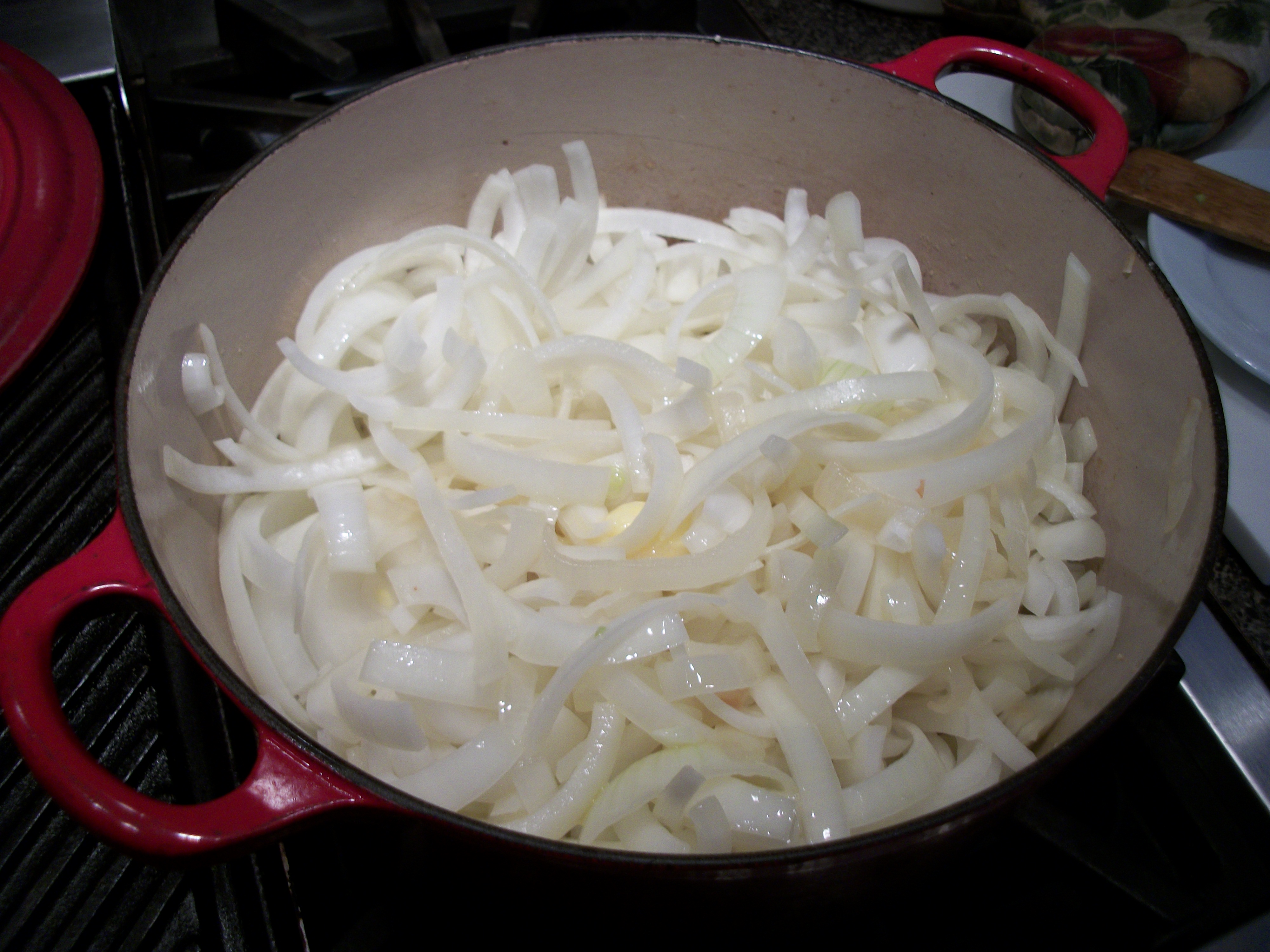
While the stock was cooking, I sliced up the onions, put them into a HEAVY pan with the butter, oil/fat, and salt, and on medium heat, began caramelize them.  When they have all melted down, add the bit of sugar which will help caramelize the onions.  Hang around the kitchen and stir them up every couple of minutes.  Keep the heat from being too hot.  You don’t want to burn them. 
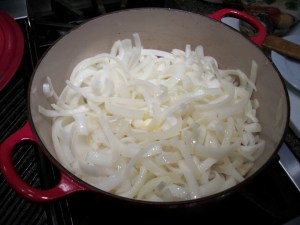
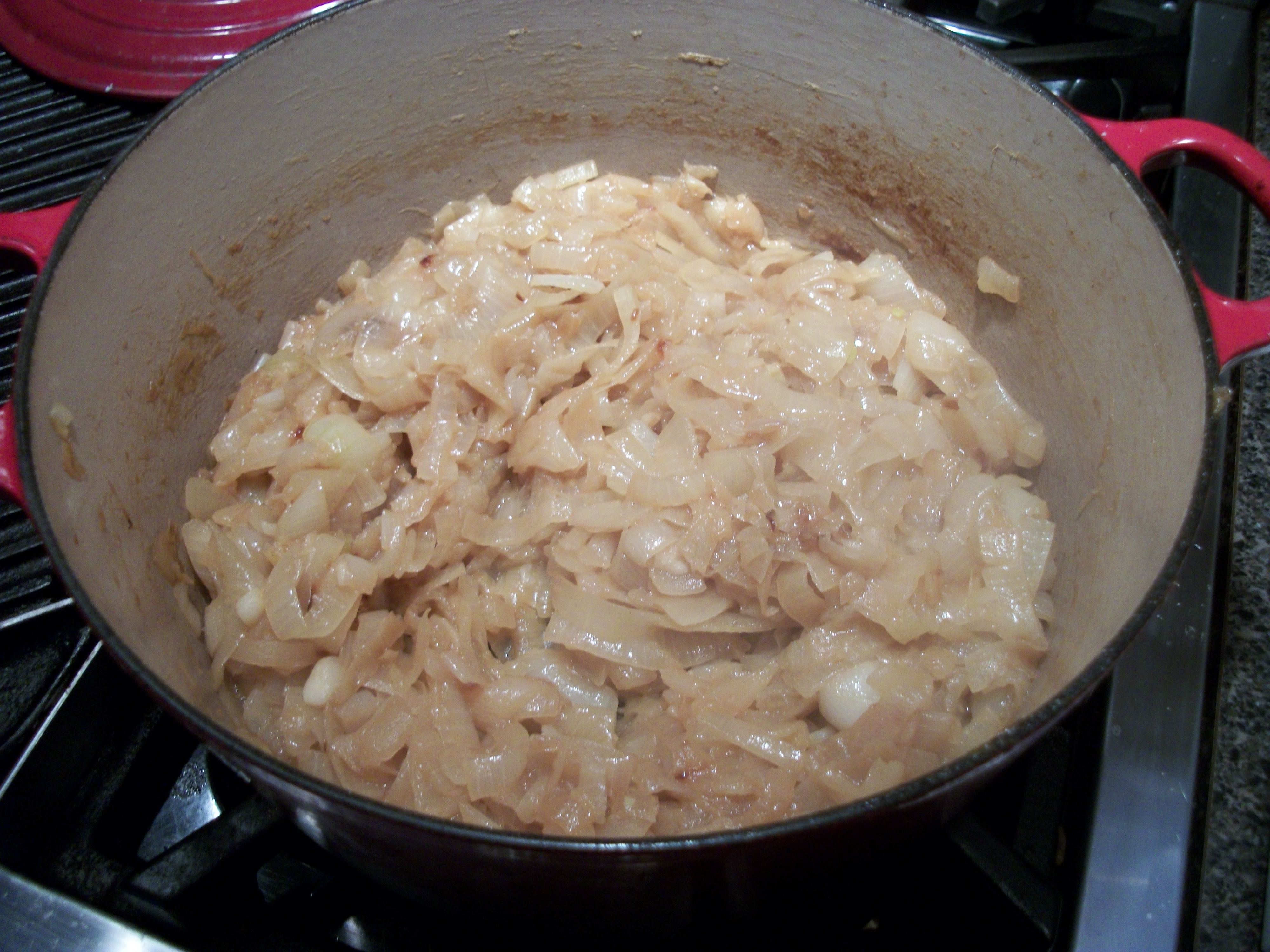
Here are the onions getting close to being done:

The onions are now a soft golden color.  You can get onions to caramelize to a much deeper color, but the taste changes as the process continues.  Since I was using a vegetable stock, I didn’t want the onions to be as strong as I would for a beef stock.  This picture is showing the onions to be a bit light, but they were actually a lovely golden color.  When you think your onions are dark enough, stir in about 1/4 cup of flour and cook, stirring constantly, for about 3 minutes.  Add your stock and stir up all the bits in the bottom of the pan.

At this point, I let the mixture cool and refrigerated it.   All I needed to do on Monday was to heat the soup gently, let it simmer for about 30 to 40 minutes, and taste it for salt when it got warm.  My soup was very sweet.  Onions are sweet, but remember I had also used carrots and a parsnip in the broth.  Chard stalks are sweetish too.  

Here’s the soup on Monday cooking gently for 40 minutes: 
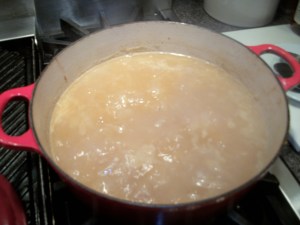
I thought it needed some zip, so just before serving, I added a good 3 Tablespoons of cognac.  (A plain brandy would work too.)  And, I enriched it with 4 egg yolks, which made it silky smooth and gave it some lovely body, not to mention protein the body can use easily. 

To add egg yolks, drizzle a ladle of soup into the eggs while you whisk them.  For safety,  as I had used 4 eggs, I added a second ladle slowly while whisking.  (This is called tempering the eggs.)  Then, with the soup OFF THE HEAT, stir the eggs into the soup and stir the soup until it thickens–just a minute or so.

I put grated swiss cheese (a GOOD swiss) into the bottom of each deep bowl and ladled soup over it.  My gratinee soup bowls are small, and we wanted big bowls of soup for dinner–not a smaller size for a first course.  And, as we had really fresh baguettes, we just quartered them and put a hunk at each person’s plate.  I can get lovely raw butter, so we had that for the bread too.  (We didn’t want to toast sliced bread and put it into our soup this time and put the cheese over it and put everything into the oven to melt the cheese.)

While the stock made and the onions caramelized, I made a three-layer cake–a recipe I had put away to try years ago.  It’s a caramel cake, but not a southern style.  Instead, the batter and the icing are flavored with mocha syrup, Bailey’s cream liquor, a coffee liquor, and vanilla.  I didn’t have a mocha syrup, so I put the other ingredients in a pan and threw in about a tablespoon of chocolate bits and a tablespoon of some caramel syrup I had and let it all sit on the oven shelf to warm and melt the chocolate.  The cake is spectacular and lovely, so that innovation was fine.  Here it is, though the camera distorts the bottoms of things (making them look smaller) if you don’t have it level with the photographed object:
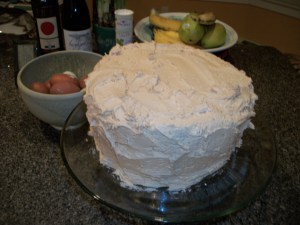
Here it is cut:


It is yummo!  I got it from “Better Homes and Gardens” Dec. 2005, “Secret to a Great Cake:  Cream Caramel Cake,” page 220.  The only downer is that the icing has EIGHT CUPS of confectioner’s sugar in it.  That’s more sugar than I eat in two years!!!! 

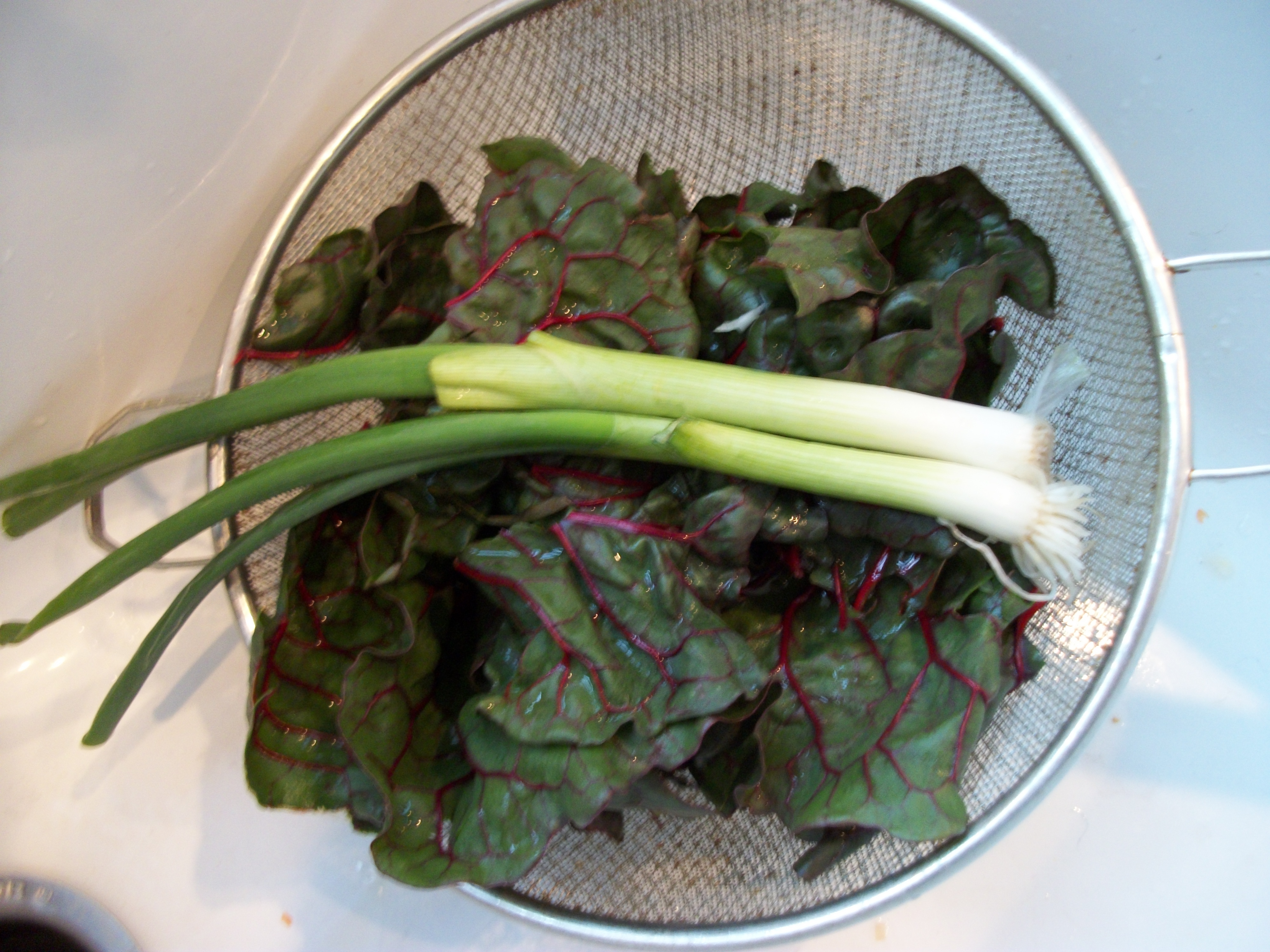
So, you remember those chard stalks I used in the soup stock?  Here are the leaves–with some green onions–all ready to be sauteed for dinner on Sunday night.  Dinner was roasted sweet potato and a seared sirloin steak and some of my sauerkraut.  Aren’t chard leaves pretty?  Chard is in the beet family, you know.  I usually grow a variety called “rainbow” chard that comes in all sorts of electric colors.  It’s quite amazing in the garden.  It’s great sauteed with some coconut oil and when it begins to melt down, a splash of fruity vinegar and a drizzle of honey.  Sometimes I also add some raisins or some sliced apple, peel and all. 

So, on Monday, I only had to make a salad and grate some cheese.  Here’s the salad:
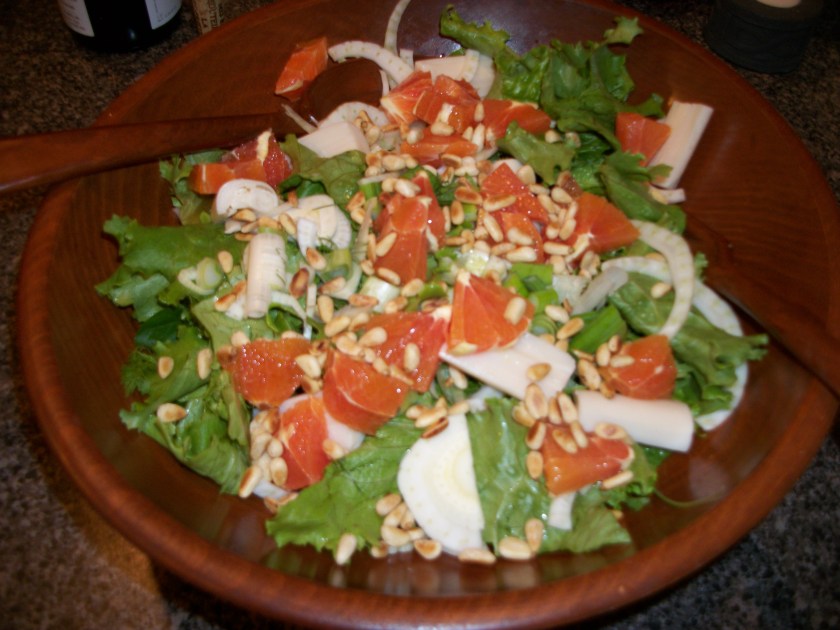
I wanted something citrusy.  Lettuce greens are not in season now, so this salad is from “away.”  It has some water cress, some leaf lettuce, some romaine, a naval orange, some fennel sliced thin on the mandolin cutter, some hearts of palm (I grabbed a CAN thinking I was buying asparagus hearts–bad, bad as can linings leach BPA–I should have NOT used anything else), some green onions, some toasted pine nuts, and a fruity dressing of lemon and olive oil.  It was delicious!

So, Bon Appetit! to all and mega thanks to the incomparable Julia!

PS:  For a good beef stock, put a selection of bones in a roasting pan, add some celery (2 stalks only), carrots, onion, and garlic (I slice the whole bulb in half after seeing son Bryan do that) and roast until brown at high heat–400 degrees–turning and stirring after about 40 minutes.  Usually everything is brown in no more than an hour.   Drop the heat if you think things are moving too fast.  Put everything into a large stock pot.  Put water in the roasting pan and scrape up the goodies and pour all into the stock pot too.  Add more onion, carrots, garlic, fresh or dried herbs (thyme, rosemary, bay leaf, parsley) and GOOD SEA SALT THAT IS DAMP AND GREY and cook for at least 5 to 6 hours and up to 12 hours.  Strain and discard bones and spent veggies.   Freeze extra in Mason quart jars.