Mainely Tipping Points 27: Sprouting Awareness, Growing Change

Mainely Tipping Points 27

SPROUTING AWARENESS:  GROWING CHANGE

 Up on Howe Hill, the paths around our house are banked by shoulder high snow.  Nevertheless, spring is coming.  Daylight is growing longer day by day and will bring an end to the quiet stillness of winter.  Sprouts will soon appear and will grow into a new covering for the earth and into new food for us to eat.  Babies will be born who will replace their parents eventually.  These seasonal cycles nourish the earth and its creatures endlessly. 

Sometimes, ideas that organize society, or paradigms, recede, like green life in winter. Now, the unsustainable market economy paradigm is breaking apart even as its proponents try to intensify their grip on it.  This paradigm is extractive, and we are running out of what can be extracted.  There are limits to what the earth can provide, and we have reached them.  There are only so many mountaintops that can be removed and dumped into valleys, only so many nutrients in the soil to be used before nature-dictated replenishment must occur, only so much oil and water to be pumped.

This exploitive paradigm is harming the earth and its creatures.  For instance, Greenpeace is circulating a petition claiming that this year one American will die every minute from cancer created by the known toxic chemicals allowed in so many of the products and foods we use or eat every day  (https://secure3.convio.net/gpeace/site/Advocacy?cmd=display&page=UserAction&id=787&s_src=taf&JServSessionIdr004=i4hx4u4rh1.app331a).  The President’s Cancer Panel released in April 2010 said 41 percent of people would be diagnosed with cancer in their lifetimes, that children are especially at risk, and that our degraded environment is a key factor (http://deainfo.nci.nih.gov/advisory/pcp/annualReports/index.htm).  Wiki answers says 50 percent of us will get cancer in our lifetime (http://wiki.answers.com/Q/How_many_people_get_cancer_in_their_lifetime).  And, Sandra Steingraber, in LIVING DOWNSTREAM, published in 1997, or 14 years ago, explained that the incidence of cancer in the United States rose 49.3 percent between 1950 and 1991 and that cancer was the leading cause of death for Americans aged thirty-five to sixty-four (40).  Cancer striking between 40 and 50 percent of the population can only be called an epidemic. 

But, what new paradigm could emerge?  We could take part in the sprouting of something wonderfully sustainable, if we, first, sprout awareness of this moment, and, then, act positively out of that awareness.  We could, as a community, become part of growing an Associative Economy paradigm based on 21st Century agrarian values that build and sustain healthy land, healthy community, a healthy economy, and healthy people.  Cooperation, not competition, is a hallmark of this new paradigm. 

Steven McFadden’s THE CALL OF THE LAND:  An Agrarian Primer for the 21st Century is a “sourcebook exploring positive pathways for food security, economic stability, environmental repair, and cultural renewal.”  McFadden lists and describes many of the individuals, organizations, and communities who are implementing models of how to live sustainably.  It’s comforting to realize that there are so many people “out there” who are working hard to make this new paradigm fully emerge.      

People are becoming Locavores, who buy food grown close to their homes; are turning their grass into vegetable gardens; are forming neighborhood cooperatives to share garden produce; are saving seeds; and are forming organizations to create change.  Communities across America are working to build regionally based, self-reliant food economies that include urban gardens, both public and private; Community Shared Agriculture (CSA) programs, including those which “share” products from multiple producers; food cooperatives, some of which are organized by farmers; school gardens and wholesome school lunch programs; land trusts that put willing young people on farms; and community commercial kitchens.  Counties across the country are creating self-reliant food systems within their borders; many of these are all organic.  In Maine, our regional coops and our small stores carrying local, often organic foods are, already, important hubs for this new paradigm as they are generating a local associative economy where farmers and consumers can meet daily on a common terrain.

McFadden, like Will Allen in THE WAR ON BUGS, addresses the justification myth created within the post World War II liaison of academia and agricultural and chemical corporations in order to foster industrial farming methods.  Termed the “green revolution,” this myth promised that it could feed the world and argued that small organic farms could not.  McFadden writes:  “But that argument has been proven wrong.  Nearly half the world’s food already comes from low-input farms of about one hectare (2.5 acres).  That scale can be worked efficiently and wisely, then progressively networked with modern technology.  Acre for acre, small, organic farms use less energy, create less pollution, offer more satisfying work, and produce more clean food from the land” (72).  McFadden notes that Iowa State University has established the nation’s first tenured organic agriculture faculty position and that some of the land grant schools are establishing sustainable agriculture programs (88).   

Paradigm change can begin with the choices we each make about what we eat.  Each choice we make is a vote.  We can vote for members of our own community, for access to clean food filled with nutrients, and for building community resilience that will support us in the, likely, difficult future we face.  Or, we can vote so that our dollars leave our community and enrich a few, already deep pockets.  We can vote for industrial food that is lacking nutrients, is grown with toxic chemicals, and that is tired and old from the polluting practice of being shipped across the country or across the world.  We are voting, then, for a splintered community where individuals have not built fully realized relationships with each other. 

Shannon Hayes, in RADICAL HOMEMAKERS, charts the historical progression that moved households from being centers of production standing alongside other such centers to being isolated units of consumption.  She discusses her family’s decision to not only question received cultural knowledge about how “to be” in the extractive economy, but to make changes that freed her family and gave it a more fully lived life—one with values strongly rooted in the health of the land.  She writes:  “What is our economy for?  Isn’t it supposed to serve everyone?  Are our families truly served by an economy where employees are overworked, where families do not have time to eat meals together, an economy that relentlessly gnaws at our dwindling ecological resources?  In David Korten’s words, a true, living economy `should be about making a living for everyone, rather than making a killing for a few lucky winners’“ (37).  (David Korten published AGENDA FOR A NEW ECONOMY in 2010 which is in my “to read” pile.) 

Shannon addresses the myth of local, organic food being unaffordable for any but the rich:  “…a farmers’ market meal made of roasted local pasture-raised chicken, baked potatoes and steamed broccoli cost less than four meals at Burger King, even when two of the meals came off the kiddie menu.  The Burger King meal had negligible nutritional value and was damaging to our health and planet.  The farmers’ market menu cost less, healed the earth, helped the local economy, was a source of bountiful nutrients for a family of four, and would leave ample leftovers for both a chicken salad and a rich chicken stock, which could then be the base for a wonderful soup.” (12).

McFadden, too, addresses this myth by quoting the legendary Vandana Shiva, physicist, environmental activist, and author:  “`The most important issue is to break the myth that safe, ecological, local, is a luxury only the rich can afford.  The planet cannot afford the additional burden of more carbon dioxide, more nitrogen oxide, more toxins in our food.  Our farmers cannot afford the economic burden of these useless toxic chemicals.  And our bodies cannot afford the bombardment of these chemicals anymore.’” (74)

Shannon makes a strong plea for restoring our lost democracy:  “When women and men choose to center their lives on their homes, creating strong family units and living in a way that honors our natural resources and local communities, they are doing more than dismantling the extractive economy and taking power away from the corporate plutocrats.  They are laying the foundation to re-democratize our society and heal our planet.  They are rebuilding the life-serving economy” (58). 

If you want to help build a sustainable, life-giving paradigm rooted in your local area, start with food.  First, insist on and buy local, organic food.  Consider joining a local CSA; shop at a local farmers’ market and at local stores carrying local food.  Second, begin asking for what you don’t find.  For me, it’s more local winter greens, please.  And, more winter farmers’ markets.  Third, buy foods in their seasons and learn to cook and to preserve some of them for the coming winter.  (Few things are as delicious in winter as tomato sauce spiked with garlic and basil, all taken from the garden on a hot August afternoon and cooked down in a bit of olive oil and frozen.)  Finally, every day, sit down and, together, eat the tasty, nourishing, clean food you have prepared.

Turkey Tracks: Alewives Visits Camden Quilters

Turkey Tracks:  February 17, 2011

Alewives Visits Camden Quilters

Rhea Butler and her mother, Barbara Neeson, came from Alewives quilt shop in Damariscotta Mills, (http://www.alewivesfabrics.com) for our February 12th meeting.  Barbara owns Alewives, and Rhea is the resident quilt artist and designer. 


 Rhea’s on the left, Barbara is in the middle, and CQ member Barb Melchiskey is on the right. 

 Rhea taught us how to make her copyrighted “La La Log Cabin” block and quilt, which derives from a long history of improvisational quilting—which, for Rhea, includes such quilting as that of the Gee Bend quilters and Denise Schmidt of Bridgeport, CT.  This pattern is meant to be made from your stash fabrics, though you could certainly buy new fabrics as well.  Above, you see a soft blue/green version.

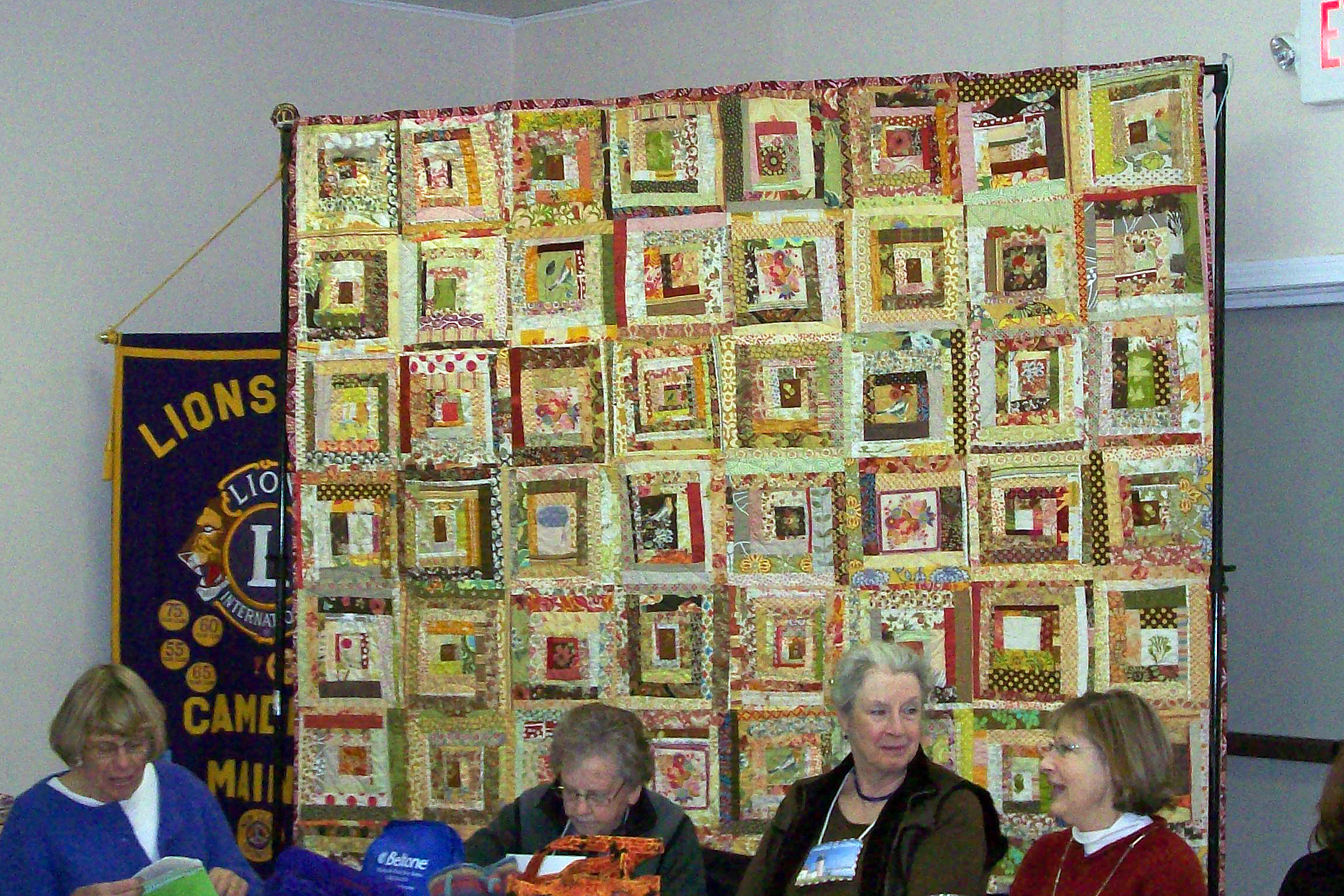
 Rhea loves color and starts her blocks with an overall sense of how she wants the finished quilt to look.  She wanted the big quilt she brought to demonstrate her La La Block to “glow,” and it did.  See?


Barb Melchiskey, Sylvia Lundevall, Eleanor Greenwood, and Patty Courtney.

Rhea used neutrals and added bits of red and green.  She tries to put interesting, clever, or meaningful fabrics into the center of her blocks.  She also loves to mix textures and to employ whimsical bits of cloth, such as the little colored dots on the edges of fabric selvages.  And she tears fabric into strips and roughly cuts centers with just sissors, which helps to give her blocks an interesting “off-center,” funky look.  Rhea used three harmonious fabrics in shades of yellow/gold for the backing, layered in from side to side in big swaths.  

 Rhea provided us with a free pattern for her block/quilt, which is typical of her and Barbara’s generosity.  We had a wonderful meeting with her, and I suspect many of our members will produce  La La Cabin quilts.  I know I will as I’m on a mission to use up more of my stash and will definitely make one.

 Rhea also keeps a lively, interesting blog:  http://alewivesgirl.blogspot.com.

Mainely Tipping Points 26: Strawberries in Winter

Mainely Tipping Points 26:  Strawberries in Winter

STRAWBERRIES IN WINTER

 It’s February, and in Maine, it’s bitter cold more often than not. We seek out heat and the warmth of the fiery color red.  Not surprisingly, along comes St. Valentine’s Day on the 14th—a day set by Pope Gelasius I in 496 AD to honor the martyred Roman Valentine, killed in 269 AD.  This once-Christian holiday was likely overlaid onto a Roman mid-February pagan fertility celebration marking the beginning of spring and of the year’s agricultural calendar.  The associative color red possibly derived from the use of sacrificial blood during the festivities.   

Many of us are longing for spring, and in these mid-February days, along come red, luscious looking strawberries.  These early heralds of “come spring” fruit are shipped to us here in the frozen north mostly from California, which grows “roughly 90 percent of all strawberries sold in the United States” (“Death by Strawberries,” change.org weekly, Nov. 29-December 6, 2010, http://www.askdepkewellness.com/2010/12/death-by-strawberries.html). 

The idea of chocolate-covered strawberries makes your mouth water, doesn’t it?  They’re the ultimate dessert for lovers in February.  But, before you eat them or feed them to your loved ones, consider some cautions.

First, industrially raised strawberries come to you drenched with toxic chemical residues.  Second, the Environmental Working Group (EWG) notes in its “dirty dozen” handout that rinsing “reduces but does not eliminate pesticides” (http://static.foodnews.org/pdf/EWG-shoppers-guide.pdf).  And, third, the 2008-2009 Annual Report of the ,President’s Cancer Panel links exposure to pesticides (including insecticides, herbicides, and fungicides) and fertilizers with the formation of cancer in humans.  The report notes that parental exposure to pesticides can impact children prior to conception, in utero, and during childhood (43). 

Strawberries are ranked third on the EWG’s 2010 Dirty Dozen list, which is formed after residue testing is completed by the U.S. Department of Agriculture (USDA) and the Food and Drug Administration (FDA).  EWG’s rankings reflect at least six factors, including the total amount of pesticide residues found  and the total amount of different pesticides used. 

Will Allen, in THE WAR ON BUGS (2008), notes that between 2000 and 2005, 97.3 percent of nectarines had pesticide residues, followed by 96.6 percent of peaches and 93.6 percent of apples.  Strawberries ranked fourth.  Peaches and apples, writes Allen, had up to 9 pesticides on a single fruit, and strawberries had up to 8 pesticides on single berries.  Apples had the most residues of all with up to 50 pesticides found on samples.  Strawberries had up to 38 pesticides (242). 

Allen also cautions that very few states have mandatory pesticide use reporting, so there is massive underreporting of the amount of pesticides on our food.  Because California does have a reporting requirement, Allen was able to determine that in 2004, California strawberry growers used just over 11 million pounds of pesticides on an estimated 33,200 acres, or 335.40 pounds per acre (243-244).

In 2004, notes Allen, strawberry growers in California used 184 different pesticides.  But, 80.6 percent of these pesticides were confined to six chemicals.  Four of these six chemicals accounted for 74.1 percent of use and are fumigants “designed to kill all soil life and are among the most dangerous pesticides.”  These four fumigants amounted to about 249 pounds per acre of use. 

Among these four fumigants is methyl bromide, or bromomethane, which was banned in 1987 by the Montreal Protocol because it depletes the ozone layer around earth.  In total, 196 states have ratified this international treaty; President Reagan signed it in 1987.

Yet, twenty-four years later, our government is still allowing strawberry growers, principally in California and Florida, to use methyl bromide under “critical use” exemptions.   According to Wikipedia, in 2004, over 7 million pounds of bromomethane were applied in California on tomatoes and strawberries, in ornamental shrub nurseries, and for the fumigation of ham/pork products” (http://en.wikipedia.org/wiki/Bromomethane).  The EPA is now accepting 2011 applications for 15 crops, to include “tomatoes, strawberries, peppers, cucurbits, orchard replants, and post-harvest uses (http://www.epa.gov/ozone/mbr/2010_nomination.html). 

According to the EPA, methyl bromide is “highly toxic,” especially for application workers.  Further, the EPA acknowledges that breathing it damages the lungs.  And, once inside the body, it can have a devastating neurological impact and can impact the thyroid and the male testes, which affects reproduction.  And guess what?  Though methyl bromide has been used agriculturally since the 1930s and though it has always been recognized as being highly toxic, the EPA doesn’t know whether or not it causes cancer (http://www.epa.gov/ttnatw01/hlthef/methylbr.html). 

Indeed, the President’s Cancer Panel notes that “approximately 40 chemicals classified by the International Agency for Research on Cancer (IARC) as known, probably, or possible human carcinogens, are used in EPA-registered pesticides now on the market” (45). 

Allen notes the following:  “Methyl bromide…causes mutations, tumors, and monstrous birth defects.  It is incredibly lethal in very small doses:  consequently very few of its victims survive.  Unlike the case for many other chemicals, pest resistance to methyl bromide has been low, with only a dozen or so organisms that have shown any tolerance to it after almost seventy years of continuous exposure.  This lack of resistance is clearly due to the fact that the chemical kills almost all of the members of a population and leaves few if any resistant survivors” (234). 

Allen demonstrates in THE WAR ON BUGS how the chemical industry replaces a discredited chemical with a new, largely untested chemical.  The EPA approved the fumigant methyl iodide, or iodomethane, in 2007 at 193 parts per billion (ppb).  At the time, fifty-four academic scientists and physicians, among them six Nobel laureates, wrote the EPA and asked for the chemical to be banned ((Jill U. Adams, “A Closer Look:  Pesticides in strawberry fields,” June 28, 2010, The Los Angeles Times, http://articles.latimes.com/2010/jun/28/health/la-he-closer-strawberries-pesticide-20100628; and “Death by Strawberries”).    

On December 20, 2010, the California Department of Pesticide Regulation (DPR) approved methyl iodide for use in strawberry fields, despite the fact that the eight-person independent scientific review panel the DPR appointed to review the chemical declared that it is highly toxic, that its use would expose large numbers of the public, and that it would be difficult to control” (Pesticide Action Network Action Alert, “Because PR can’t trump science, if you speak up,”   http://groups.yahoo.com/group/DeathofCommonSense/message/1351).  Additionally, methyl iodide is listed under California’s Proposition 65 as a carcinogen ((Julie Cart, “Farmworkers challenge approval of methyl iodide on strawberry fields,” The Los Angeles Times, January 3, 2011, http://latimesblogs.latimes.com/greenspace/2010/11/methyl-iodide-pesticide-cancer-california.html?cid=6a00d8341c630a53ef013489abc225970c).  The panel noted that methyl iodide can alter DNA and can contaminate groundwater.  And, the panel cautioned that the lack of research on the chemical should give the DPR pause and that tests on animals link methyl iodide to miscarriages, cognitive impairment and thyroid toxicity (Cart).   

The California DPR mandated 96 ppb, which is more than either the risk assessment scientists within the DPR or the panel recommended.  The DPR scientists settled on 0.8 ppb, and panel member Edward Loechler, a molecular biologist at Brandeis University in Boston, said “we all thought, if anything, it should be lower.”  Panel member Dr. Paul Blanc, head of the occupational and environmental medicine division at UC San Francisco said, “that’s not policy—that’s meddling with the science” (Adams). 

Adams noted that Susan Kegley, who consults for The Pesticide Action Network (PAN), pointed to a study released in June about the air in Sisquoc, California.  Levels of chloropicrine, a soil fumigant, were higher than either the EPA or the California DPR consider safe.  (Treated fields are covered immediately with tarps.) Kegley noted that the same thing could happen with methyl iodide. 

Shortly after the California DPR’s ruling, a group of environmental and community health organizations, representing agricultural workers, challenged the ruling in court on the grounds that it violates, among other laws, the California Environmental Quality Act, the California Birth Defects Prevention Act, and the Pesticide Contamination Prevention Act (Cart).

Strawberries, like all industrial monocrop cultures, are grown in sterile, toxic soil; are lacking nutrients; and will continue to require increasingly heavier toxic chemical loads. It is becoming abundantly clear that commerce has corrupted science and our regulatory mechanisms so that permitted chemical levels are harming humans—which is why the President’s Cancer Panel Report recommends reducing exposure to pesticides by choosing “food grown without pesticides or chemical fertilizers.”

Our own, local, organic strawberries, available in June and for most of the summer, seem more than worth the wait.

Turkey Tracks: How to Sew On a Button

Turkey Tracks:  February 15, 2011

How to Sew On a Button

A friend told me recently that s/he wanted to learn to sew on a button. 

We meant to sit down so I could demonstrate.  There are a few tricks.

But, the internet is a wonderful thing for this kind of information.  Here’s a terrific video showing exactly how to sew on a button, including the bit of information I would have included about creating a thread shank between the button and the material about equal to the thickness of the material that the button will be handling. 

I would also note that sometimes, if I don’t want to see a knot on the inside of my jacket or sweater or whatever, I will start sewing my button on from the front side, so the knot is hidden.  I also, like the demo here, return to the front side to clip off my thread, but, first, I do a quick knot into the thread shank to doubly secure the thread.

http://www.videojug.com/film/how-to-sew-on-a-button

Turkey Tracks: In Progress: Noro Iro Sweater

Turkey Tracks:  February 12, 2011

In Progress:  Noro Iro Sweater

Well, here’s my Noro Iro sweater in progress.  You may recall that I’m using a pattern from Jane Ellison’s book, KNITTING NORO.

I have run into gauge problems.  The pattern calls for a 7mm needle, which falls somewhere between our 6mm (10 1/2) and 8mm (11) American needles–which means the sweater will fit ok but is going to take more yarn!!!   Fortunately Helen at Heavenly Socks in Belfast, Maine, has two extra skeins since she so generously ordered the yarn for me, which meant she had to order 12 skeins and hope to sell the other 4 since I was only supposed to need 8.  She’s great that way!

 What you see here is the back.  The bottom is knitted in a textured pattern for about 11 inches.  Then you switch to stockinette.  Both showcase the yarn nicely.  I wish I had put that wide dark band fully at the bottom.  I do like the scalloped bottom edge.

Here’s the pattern I’m trying to do.  Notice how matched the yarn is on the sleeves and front body.

I have no idea how my sweater is going to come out because I can already see that the back will be different.  The back is twice as wide as either of the front pieces, right?  So, the yarn color on the front is knitting out twice as thick before changing to a new color.  In other words, the only way you could try to match color would be to do a lot of cutting of yarn.  And, I don’t think that’s the purpose of this yarn anyway.

Oh well!  It will be what it will be!

It’s feeling a little fussy to me though.  Like one of those garments that are wearing you rather than you wearing them!

Turkey Tracks: Dry Body Brushes

Turkey Tracks:  February 12, 2011

Dry Body Brushes

DRY Body Brushes are one of life’s true pleasures!

Instead of feeding your true love a poisonous, tasteless strawberry–shipped across the country in February–or from even further afield–and timed for Valentine’s Day–consider giving a set of body brushes.

Body brushes can be ordered online.  Here’s what ours look like.   The larger one has a handle that slips off so you can use the head in your hand.  The handle is good to reach everywhere on your back.  The smaller brush is softer and perfect for your face.

The skin THRIVES on being brushed daily.  You brush gently, starting in the middle of your body and working the front and, then, the back.  Sit down and brush your feet really well.  Use a softer brush for your face and brush in little circles. 

The brushes remove old dead skin, promote circulation, stimulate nerves, and the brushing feels terrific.  Shower afterwards.  The brushes are for your DRY body.   In less than a week your skin will feel softer.  You’ll notice a real difference. 

After a dry brushing, you tingle all over.


Turkey Tracks: Chicken Feed Recipe

Turkey Tracks:  February 9, 2011

Chicken Feed Recipe

Our chickens are very tired of being “cooped up” in their coop and attached cage, both of which are now banked high with snow and which are, therefore, dark.  You will recall that the chicks were venturing out in the snow paths we made, lured by me and sunflower seeds, until a bird (an owl?) killed May May at dusk one day.

The cage, actually, has about 2 feet of snow on its top as well–which probably provides quite a bit of insulation, especially since I layered tarps over it before the first snow fall.  Inside the coop, we have a red 60 watt translucent light, which gives them a bit more heat.  (The temps up here were in the teens last night.)  I plug in the light in the morning when I feed the chicks so they have some light in their coop during the day.  I turn if off about 8 p.m.  They don’t really like the light on all night, so I only leave it on all night when the temps fall into the single digits.  They get quite cross when they go all night with the light on.

Chickens are very social, so I try to visit them several times a day after they have finished laying.  They don’t like to be disturbed when they are laying.  I open the roof, and they come to see me.  Several will fly up to perch on the opened roof edge and like to be petted and rubbed.  All of them talk to you.  I throw a handful of sunflower seeds into the cage, which is now many inches deep with coop bedding that falls out when the cage door gets opened in the morning.  They scratch around looking for the seeds, and it gives them something to do.  They are VERY bored.  (The dogs are too.)  The other day I sacrificed some of my compost worms and took a full bowl out to the coop.  Mercy me!  Those chickens were so excited.

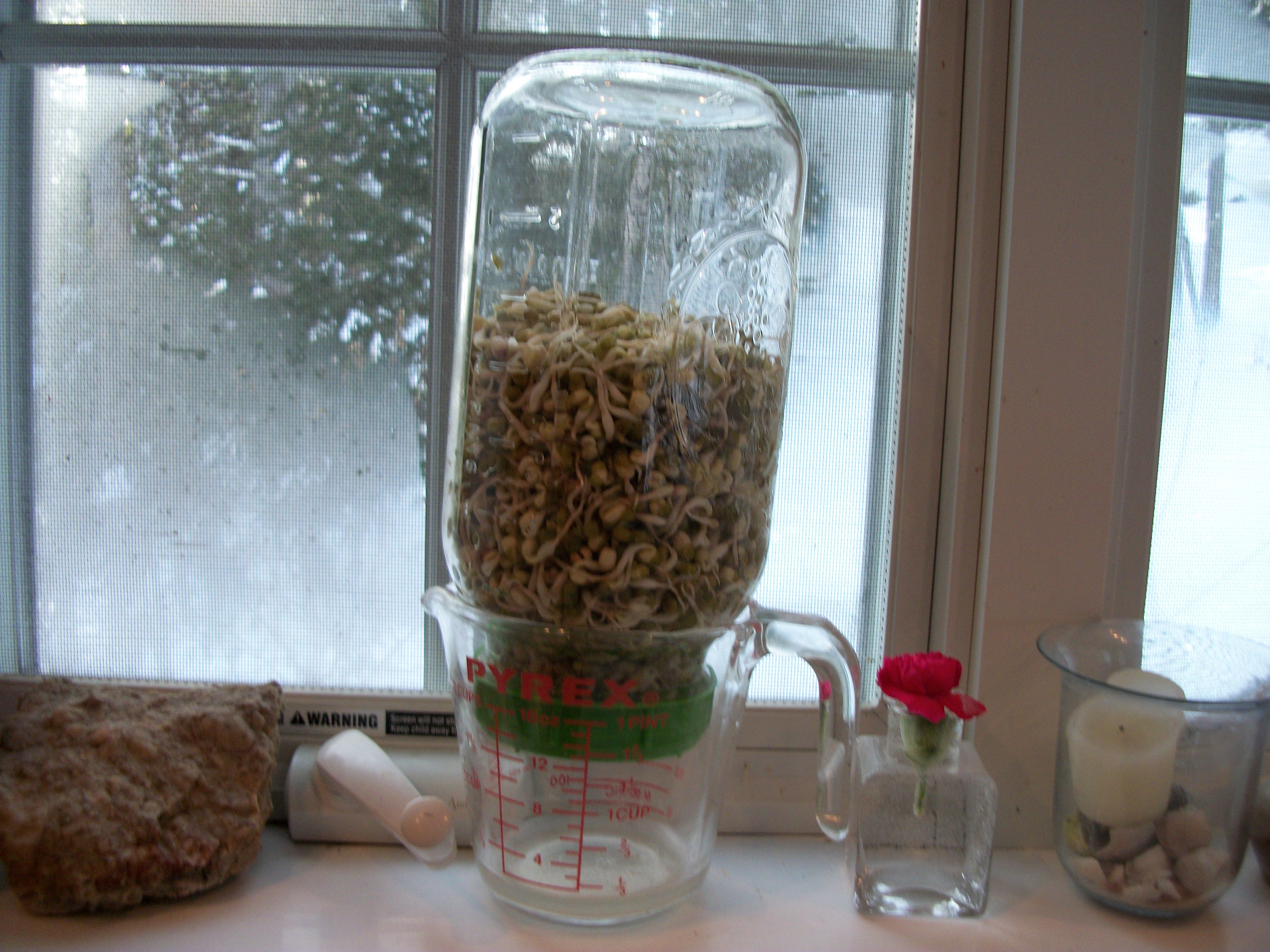
Chickens love greens, and now all the grass is covered with snow.  I give them as many greens as I can–leftover lettuce, cooked greens, the stems from cleaning greens, and so forth.  I’ve even been known to BUY them some lettuce.  But, what the really love are sprouts, so I’ve been sprouting mung beans for them–something I do this time of year anyway to get fresh greens into our diets.  If I leave the sprouts growing longer, they start to grow leaves, and the chicks really like those.  Here are some sprouting in the kitchen window:

 That rock in in the window is a piece of the old, old Bryan mill stone from the mill out on what was once the farm in Reynolds, Georgia.  My Uncle Buddy gave it to me long years ago now.   The mill was gone by the time I was a child, but he remembered it.

I also give the chickens a big bowl of milk, some hamburger, a bit of bread to soak up the milk, kitchen leftovers they like, and whatever greens I can muster up first thing in the morning.  They love cooked oatmeal, like a warm mash, on a cold morning.  Ditto ground corn cooked in a bit of milk.  This food is their second choice, after greens.

I don’t feed my chickens commercial organic feed, which is full of industrial by-products, like spent, rancid oils, SOY, and  synthetic protein, needed because the corn/soy ratio doesn’t supply enough protein.    Chickens fed commercial feed, even organic feed, produce egg yolks with soy isoflavones, which are phytoestrogens that act like hormones and which affect human reproductive and nervous systems.

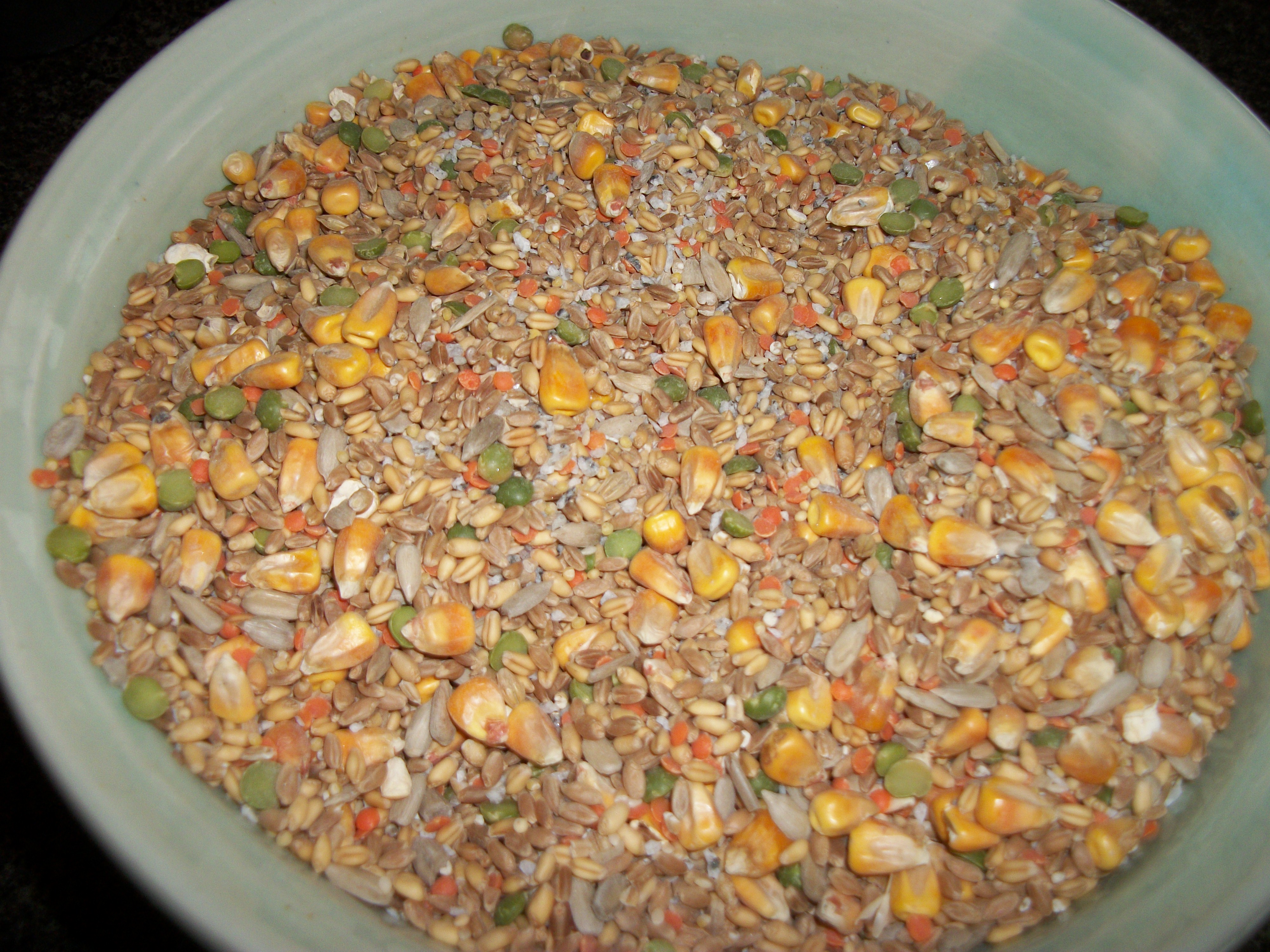
Here’s what the mixture I make for them looks like–and I’m darn lucky to have access to all of these organic grains.  Looks good enough to grind and cook, right?  I could, if I didn’t put grit into the mixture.  See the tiny rocks–grit–mixed it?  That’s what chickens use to help digest their food inside their crop, or gizzard.   Anyway, I keep all the grains, seeds, and beans separate out in the garage, so I can use them if I like.

I got the master recipe from a farm out west somewhere, called Greener Pastures (www.greenerpasturesfarm.com/ChickenFeed Recipe.html).  Thanks so much for sharing, Greener Pastures!

This recipe uses wheat, which has a fair amount of protein, as the base grain and peas and lentils for proteins.  Everything is organic.  So, here’s what I’m mixing up:

3 parts hard red winter wheat

3 parts soft spring wheat

1 part whole corn (I up this in the winter to almost 3 parts to help the chicks gain and hold fat, and in the summer I throw out a bit of whole corn for scratch feed.)

1 part steel-cut oats

1 part hulled barley

1 part hulled sunflower seeds

1 part green split peas

1 part lentils

Any other seeds/grain I think they’ll like for a change:  millet, sesame seeds, etc.

About two cups of grit per mixture.

Turkey Tracks: Camden Harbor, Winter Schooners

Turkey Tracks:  February 8, 2011

Camden Harbor, Winter Schooners


This view of the northeast side of Camden’s inner harbor lies directly below the library.  To the right, the harbor is more bustling, especially in the summer.  The three winter-wrapped windjammers, or schooners, or just “jammers,” are, from right to left, the Mary Day, the Lewis R. French, and the ketch, Angelique.  (Thanks Lewis McGregor for getting the names right–see comment.)

I took this picture a few weeks ago while John ran into the library to return a  book. 


Mainely Tipping Points 25: TAPPED: Bisphenol A

Mainely Tipping Points 25

This essay is the final essay in a series of three essays around the documentary TAPPED.


TAPPED:  Bisphenol A


In the documentary TAPPED, Dr. Frederick Vom Saal says Bisphenol A, or BPA, is “one of the most toxic chemicals known to man.”  BPA, explains Vom Saal, is “the poster child chemical that is going to dismantle the entire regulatory process and demand a re-analysis of all chemicals.”  “BPA,” says Vom Saal, is “frightening to the regulatory community because of the magnitude of the error they have made.”    

BPA leaches into water from water containers made of hard, polycarbonate plastic, stamped with #7 on the bottom of the product.  Examples of problem water containers are the five-gallon hard plastic water jugs used with water cooler systems, baby bottles, and sports bottles. 

Other examples in the general food system include containers for liquid baby formula and the linings of beverage and food cans.  Elaine Shannon of the Environmental Working Group (EWG) reports that because plastics made with BPA “break down easily when heated, microwaved, washed with strong detergents, or wrapped around acidic foods like tomatoes, trace amounts of the potent hormone leach into food from epoxy lacquer can linings, polycarbonate bottles and other plastic food packaging” (Shannon, “What the Chemical Industry Doesn’t Want You to Know,” September 2008, http://www.ewg.org/report/what-chemical-industry-doesnt-want-you-know).  Wikipedia notes that as of April 2010, General Mills had developed a BPA-free alternative can liner that works even with tomatoes.  But, writes Wikipedia, General Mills is only planning on using this new liner with their organic food subsidiary, Muir Glen (http://en.wikipedia.org/wiki/Bispjhenol_A).   

Polycarbonate plastics are ubiquitous today.  BPA, explains Wikipedia, is used in “sports equipment, medical and dental devices, dental fillings and sealants, eyeglass lenses, CDs and DVDs, and household electronics”—like, notes, computers and cell phones.  BPA, details Wikipedia, is used to make other plastics; it’s a “precursor to the flame retardant tetrabromobisphenol A”; it was “formerly used as a fungicide”; it’s the “preferred developer in carbonless copy paper and thermal paper,” including sale receipt paper; it’s used in foundry castings and to line water pipes”   

BPA mimics estrogen in the body, which is something scientists have known since 1930.  Regulatory bodies have determined what they believe to be safe levels for humans by using an idea, explains Vom Saal, dating from the sixteenth century:  “the dose makes the poison.” 

However, Vom Saal says this premise is false for any hormone and explains that  recent studies are showing that even minute levels of BPA are unsafe. 

Vom Saal says in TAPPED that 700 peer-reviewed, published studies show BPA to be dangerous.  He explains that the 38 internationally recognized scientists who served on a 2006 National Institutes of Health panel (Chapel Hill) determined that current levels of BPA pose risks for humans.  Shannon notes in “What the Chemical Industry Doesn’t Want You to Know,” that The National Toxicology Program accepted much of the Chapel Hill panel’s thinking and wrote that low doses of BPA may affect development of the prostate gland and brain and may cause behavioral effects in fetuses, infants, and children.

Shannon notes that Vom Saal, working with Wade Welshons at the University of Missouri-Columbia, “turned up the first hard evidence that miniscule amounts” of BPA “caused irreversible changes in the prostates of fetal mice” in 1997, or 14 years ago.  By 2008, writes Shannon, the global chemical industry was producing 6 billion pounds of BPA annually, which generated “at least $6 billion in sales” 

In order to protect its BPA turf, the chemical industry has followed the very successful tobacco industry model, which Devra Davis details in THE SECRET HISTORY OF THE WAR ON CANCER (2007).  The tobacco industry spent astonishing amounts of money to advertise tobacco use, to delay negative decisions, to hide negative science, to craft favorable legal decisions, to obfuscate science with problematic studies from paycheck scientists, and to fire or discredit anyone saying tobacco use was unhealthy.  The chemical industry is currently running what Shannon calls a “scorched earth” campaign that includes such actions as an “industry email to food banks charging that a BPA ban would mean the end of distributions of canned goods for the poor.”  

Vom Saal describes in TAPPED how a representative from Dow Chemical Company showed up in his and Welshons’ Missouri lab to dispute the data and to declare “`we want you to know how distressed we are by your research.’”  Vom Saal revealed that Dow tried to stop papers critical of BPA from being published.  Shannon describes how the American Chemistry Council attempted to prevent Vom Saal from speaking at a convocation at Stanford University because his work was “`very controversial, and not everybody believes what he’s saying.’”  Shannon quotes Welshons as saying that chemical industry officials made “` blatantly false statements about our research’” and “`they were skilled at creating doubt when none existed.’ “

TAPPED shows footage from a Senate hearing investigating the Food and Drug Administration’s (FDA) use of biased studies produced by the chemical industry’s paycheck scientists.  Senator John Kerry castigates FDA’s Dr. Norris E. Alderson for not asking for independent studies.  Senator Kerry concludes that the FDA is not protecting citizens, and TAPPED concludes that industry has captured the FDA and other regulatory agencies. 

Lyndsey Layton of “The Washington Post” reported that as of 2009, 93 percent of the U.S. population had detectable levels of BPA in their urine (“High BPA levels linked to male sexual problems,” November 11, 2009, http://www.washingtonpost.com/wp-dyn/content/article/2009/11/10/AR2009111017411).  Layton’s article discusses a November 2009 study of 634 male workers from four factories in China showed that exposure to high levels of BPA caused erectile dysfunction and other sexual problems after a few months on the job. 

Vom Saal, in TAPPED, links the following health problems to BPA:  childhood diabetes, obesity, prostate and breast cancers, brain disorders like ADHD, liver disease, ovarian cancer, uterus disease, and low sperm count in men.  Layton lists infertility in general and early-onset puberty. 

Shannon discusses some of the dozens of other scientists who are also studying BPA and who concur with Vom Saal and Welshons.  Patricia Hunt, a reproductive scientist (molecular biologist) from Washington State University, was stunned by what she saw under her microscope after a caustic floor detergent used to clean her lab released BPA into her animals’ food and water.  Hunt said “`Like most Americans, I thought, my government protects me from this kind of stuff.”  She began studying BPA, and, after a decade, determined that “exposure to low levels of BPA—levels that we think are in the realm of current human exposure—can profoundly affect both developing eggs and sperm.” 

A Yale University medical school research team led by Csaba Leranth discovered that BPA affects the neurological system in African green monkeys.  In humans, reported team member Tibor Hajszan, the devastating effect on synapses in the monkey brain could translate to memory and learning problems and depression.      

In September 2010, Canada banned BPA as a toxic substance.  Eight states have banned BPA in children’s’ products:  California, Connecticut, Maryland, Minnesota, New York, Vermont, Washington, and Wisconsin.  In October 2010 the Maine Board of Environmental Protection held hearings on a ban on BPA in baby bottles and sippy cups.  The Board postponed any decision until it studied expanding the ban.

Here’s what you can do:  don’t wait for our government to protect you.  Don’t buy canned foods or beverages unless the container says “BPA free,” avoid the combination of plastic and foods, don’t heat plastic, and don’t reuse plastic containers.  Do buy, cook, and preserve locally grown, organic, nutrient-dense whole foods available in your region.

Turkey Tracks: I Feel Rich: 5 Pounds of Processed Pecans

Turkey Tracks:  February 1, 2011

I Feel Rich:  5 Pounds of Processed Pecans


We’re almost out of the pecans my first cousin Teeny Bryan Epton and her partner brought to us last September.  (Thanks Teeny and Lori!)

With our friends Margaret and Ronald, we order many household items in bulk from Associated Buyers, located in New Hampshire.  AB delivers, also, to all our local coops, or cooperatively owned stores.  I ordered 5 pounds of organic pecans in this last order.  

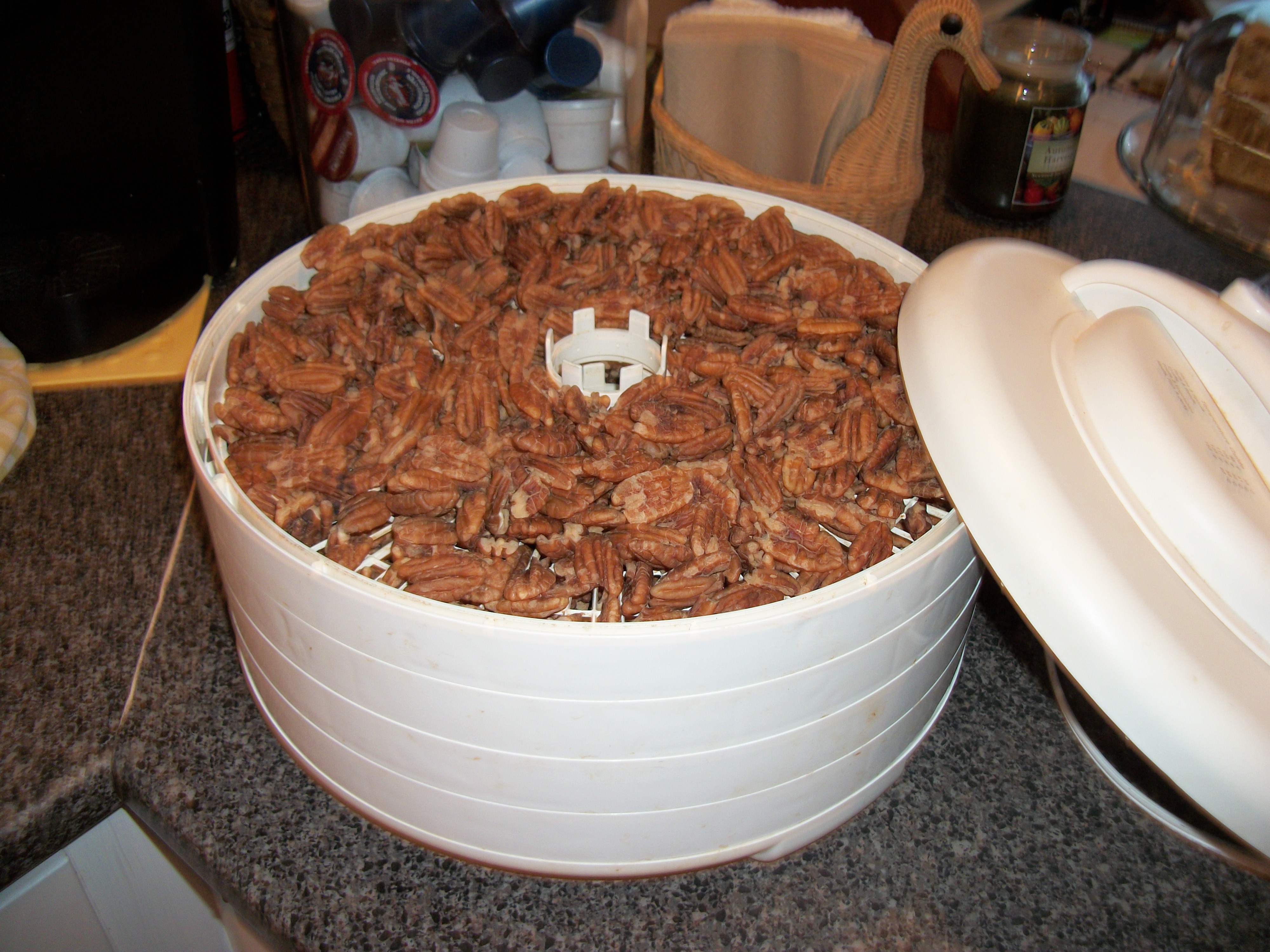
 I soak the nuts over night, dry them gently in the dehydrator, and store them in Mason jars.  Five pounds lasts for months and months.  I keep pumpkin seeds, walnuts, pecans, almonds, and, lately, hazelnuts.  Crispy nuts are delicious! 

ALL nuts, seeds, legumes, and tubers need to be processed in some way to remove the phytates that can prevent your body from absorbing nutrients it needs from many foods.  One prepares most nuts by soaking them in salted water over night and drying then in a dehydrator or an oven on very low heat.  Drying can take, sometimes, well over 24 hours.  I found this information and the recipes in Sally Fallon and Dr. Mary Enig’s treasure trove of a book, NOURISHING TRADITIONS.  Fallon and Enig are part of the Weston A. Price Foundation (www.westonapricefoundation.org).  (Be sure to use .org and NOT .com, which is a scam site.)  I trust the WAPF folks because they have the scientific credentials to understand the chemistry of food and human bodies and because they are not affiliated with industry in any way.

Here are the pecans in the four-tray dehydrator:

And, here they are all jarred up.  The big jar is a half-gallon size with which I’ve recently fallen in love.  Now I’m a rich woman!  I have food assets.