Turkey Tracks: Dog House Chickies Update

Turkey Tracks:  October 20, 2012

Dog House Chickies Update

The Dog House Chickies are now nearly 3 months old and are close to being fully grown.  I closed up the dog house this week and put them into the big coop, where they are having a hard time of it.  As you may know, different coharts of chickens don’t like each other, especially at first, and the older bunch terrorizes the younger bunch.  Also, there is always a chicken who is the lowest on the pecking order, and that chicken takes an almost constant beating from some of the others.  It’s really quilt brutal.

(You can see earlier postings of these chicks by going to the right sidebar and clicking on chickens, under Turkey Tracks.)

Here’s what the three “chicks” look like now:
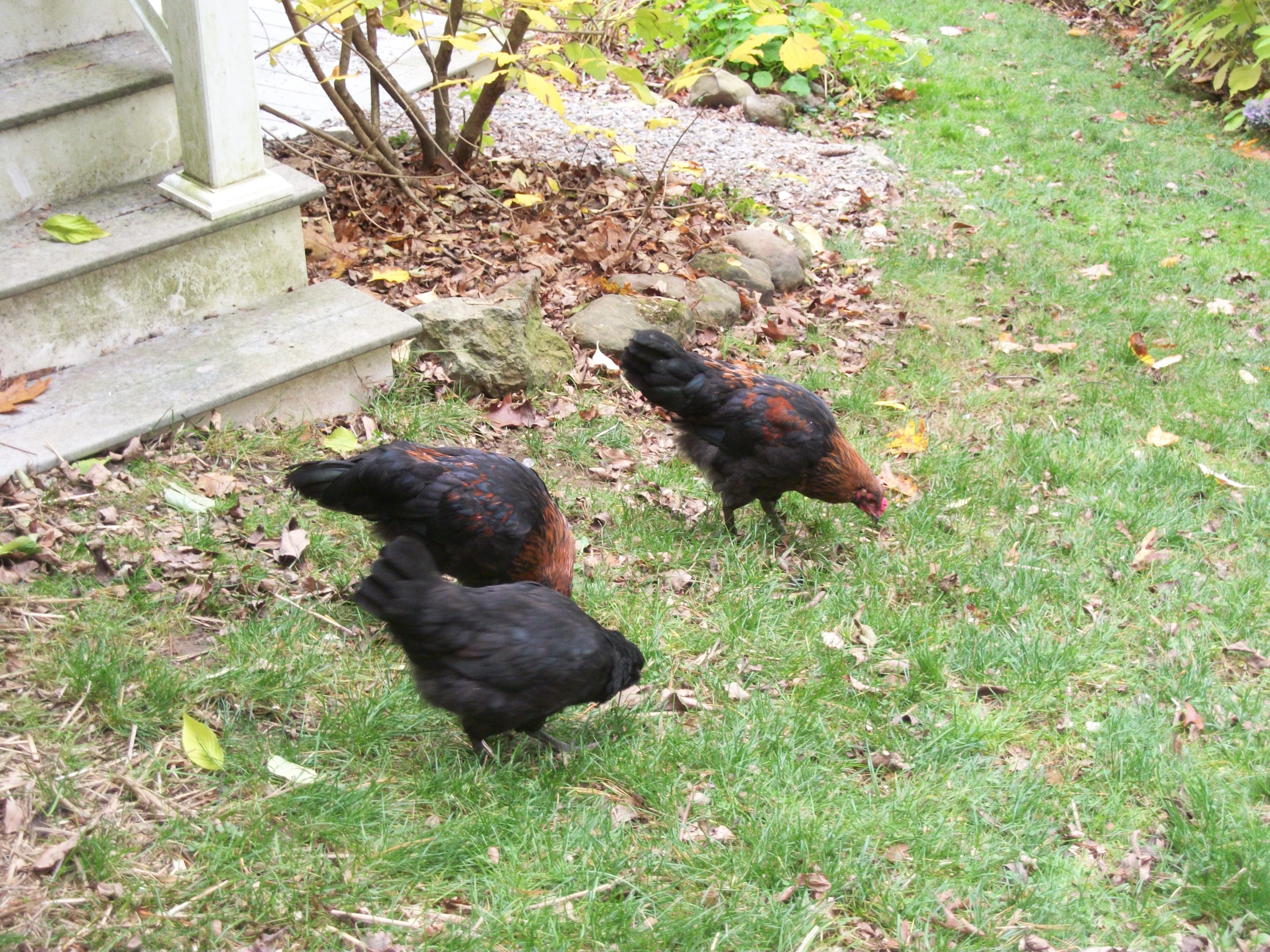
It’s hard to get a picture of all three of them close up as they are mostly wild.  Chickie Mommie (Sally) raised them entirely “on the economy” and taught them how to be safe.  Even when they were still in the dog house, I had to go out each night at dark and capture them in the large viburnum bush where they like to roost and physically put them into the dog house.

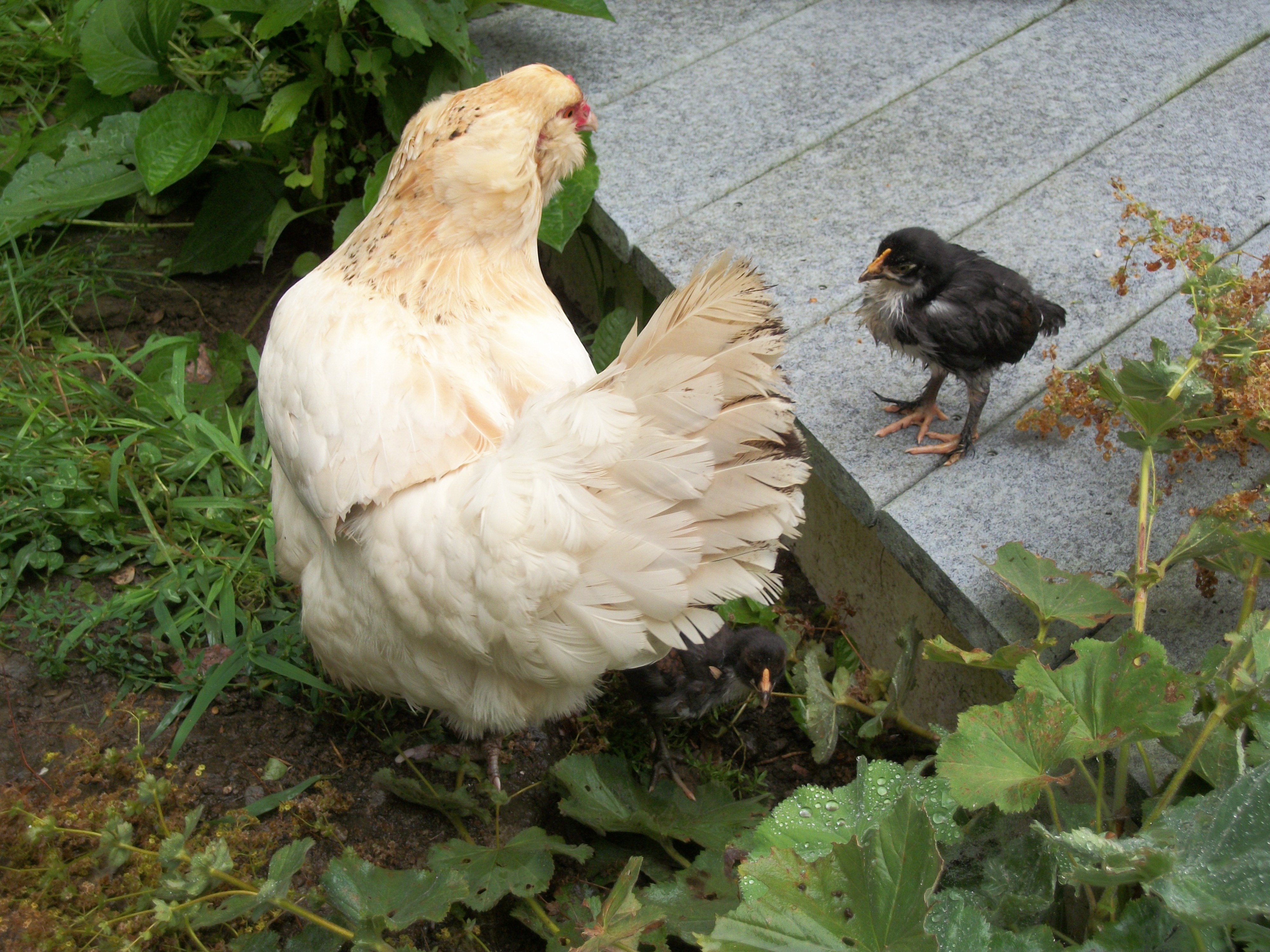
To remind, here’s a pic of Chickie Mommie (Sally) just after she brought her babies out of the dog house.  The chick in the foreground is the full-blooded Copper Black Maran.  See the feathered feet?  Note, too, the chick hiding beneath her body, just under her tail.
Sadly, about two weeks ago, a fox ate two of my chickens:  Annie, a full-blooded Copper Black Maran that I raised from an incubated egg and Chickie Mommie, one of the last two chickens from my original chickens.  She was a Wheaten Americauna and laid beautiful blue eggs.  Now I have one Copper Black Maran hen and one Wheaten Americauna.

I named one of the dog house chickies–Blackbird.  She’s the all-black chicken in the front of the first picture above.  I’m pretty sure she is a she since she’s very docile and acts like a hen.

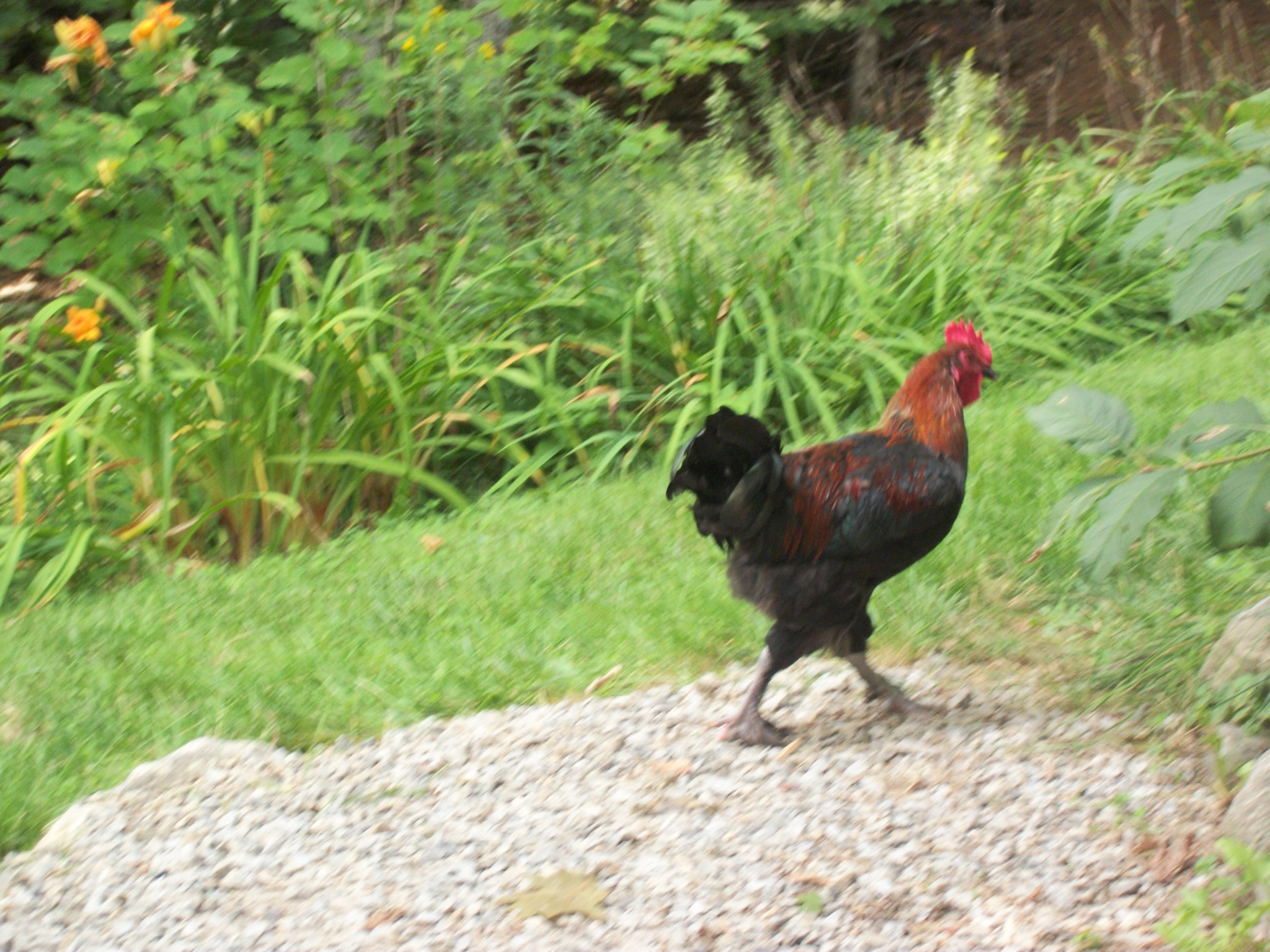
Here’s a pic of the two mystery chickens:

I can’t tell which one is the Maran–I have to see his/her feathered feet.  The other one is the Americauna/Maran cross.  Both are looking like roosters…   The Maran, in particular, behaves like one.  But, the other  may well be a hen.  Maran roosters  have big combs and waddles, but Americaunas do not.  The highly colored feathers look like roosters.  I’ve never had the courage to upend either one of the two roosters we’ve had (Napolean and Cowboy) to look at their equipment to see if one can tell the sex.  Time will tell…

In any case, no names for these two as we cannot keep a second rooster.  Or, three of them.  Roosters fight, which is why on a farm they…provide meat.

x

Turkey Tracks: Pearl’s First Egg

Turkey Tracks:  January 17, 2010

Pearl’s First Egg

Pearl was born in early May.  Rose Thomas hatched about 40 “blue egg” chickens in incubators.  Among the batch were some pure Wheaten Americaunas, and Pearl was one of those.  Rose gave her to me in late summer when we decided she was big enough to leave home.  She was part of the young flock–including the Copper Black Marans from Georgia that Rose raised for both of us–I put together in late summer and early fall.

 Pearl became the “low man on the totem pole” in the flock.  She was the most timid and the last to meld with the group.  She was very attached to me, and whenever I came outside–once I let the flock free range for the fall and winter–she found me and stayed right with me, talking away all the while.  Here’s a picture of Pearl–she’s the tan chicken standing in front of the raspberries next to Rosie, a Copper Black Maran, and Pierre, the new, young rooster, also a CBM:

By early December Pearl was at least seven months old and had not yet layed an egg.  Our two other Wheatens were molting, so we had had no pretty blue eggs for some months.

One early morning a day or so before Mike, Tami, and the four kiddos came for two weeks in mid-December, Pearl flew up from the ground and landed on my shoulder as I was standing in front of the coop.  I picked her up, loved on her a bit, and put her down.  Later that day she laid her first egg–on the mat in front of the back, kitchen door.

Here it is:

Pearl is laying regularly now, still comes to greet me in these cold mornings, and seems more comfortable with the whole flock.

Turkey Tracks: New Chickens

Turkey Tracks:  September 2, 2011

New Chickens

Over the summer, I have replenished and expanded, by one, our chicken flock.

First, two of the older Copper Black Maran hens went to Rose’s farm.  She wanted more dark brown eggs, and we have the new CB chickens, so she will keep the best of those roosters and try to place the rest.  Remember, that we got a “straight run” of 15 CBM chicks from Tom Culpepper last May.  Half of all “straight runs” are, statistically, male.  To no one’s surprise, we have 7 CB Maran roosters.  Indeed, half of all just-born farm animals are male.  And, you cannot keep a lot of males.  Rose has a big flock, so she may be able to have two strong roosters.  But, maybe not.  They still have to go into the same chicken house at night.  Anyway, Rose now has breeding stock to reproduce the CBMs next spring, and I have a back-up CBM rooster.

Napoleon, or “Nappy,” has been rehomed to a lovely woman just starting a flock up north of Belfast.  Rose has agreed to part with one of the two older hens so Julia can have a pair and can raise babies.  Nappy was a terrific rooster with the hens–he took such good care of them–but when they were laying or when he was fenced, he was very protective of the coop and the hens.  He was just too aggressive for the grandchildren or for Jessica’s children–when she comes to take care of the house, chickens, and dogs when we go to Charleston or otherwise travel.  As beautiful as he was–and he was GORGEOUS, it wasn’t worth the risk.

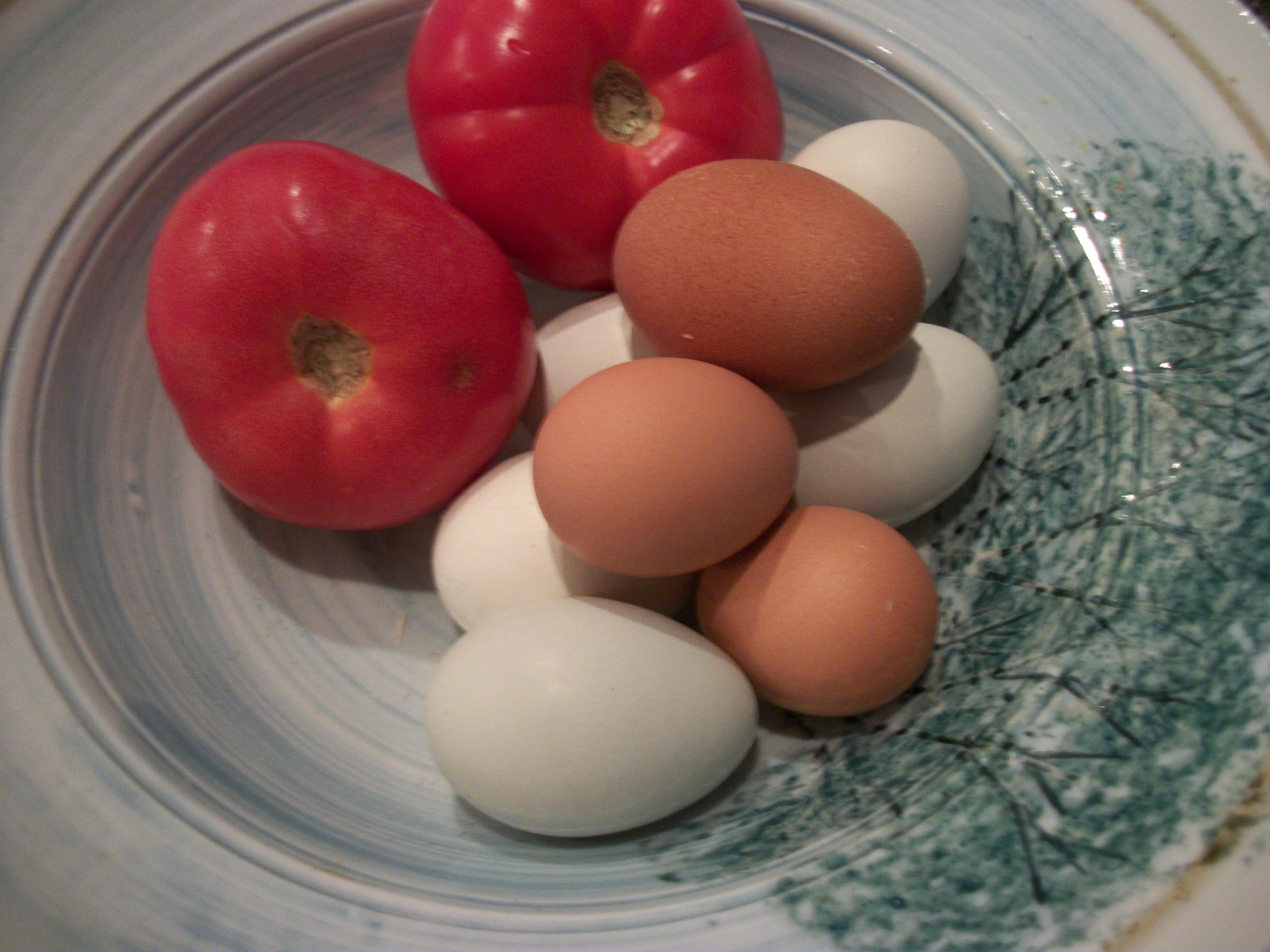
Valentine, otherwise listed here earlier as Chickie Honey Ginger, changed her name when she got a bit bigger.  She’s a sweetheart–a Freedom Ranger meat bird/layer.  She’s HUGE, and, at first, layed a tiny little rosy brown pullet egg when she was only barely four months old.  Here’s a picture.  The larger, darker brown egg is Chickie Annie’s, a CBM who is a year old now.  The cool thing about Valentine’s eggs are that, even as tiny pullet eggs, they are almost always double yolked!

Here’s a picture of Valentine with our 3 “older” hens now–the two wheaten Americaunas, Sally and Nancy, and the CBM chick I raised last summer, Annabelle, or Chickie Annie.

Valentine is only about 10 days older than the CBMaran chicks and the “blue egg” chicks Rose raised this spring.  But, she’s TWICE their size.  She kind of moves between the older hens and the newer three, 2 CBMs and 1 wheaten Americauna from Rose’s rooster William–part of Rose’s “blue egg” chick bunch this spring.  The new girls are scared to death of the old girls and scared of us, though they are gradually settling in now and will come close to us.  I took this picture of them hanging out on the edge of the “chicken briar patch,” the raspberries, about a week ago.

That’s Pearl and Rosie, with our new roo, Pretty Pierre.  Ninja is in the briar patch.  These names come from the grandchildren this summer.

Here’s a picture of Pierre, the best I can do at the moment since he’s new to the group and is only just learning his roo duties.  AND, how to crow.

When Pierre first came, Valentine was very taken with him.  She tried to follow him, and that totally freaked Pierre out.  Remember she’s a very impressive fully grown hen, and he’s just a baby really.  When he got upset, she got even more upset, fluffed up all her feathers, which made her look even bigger, and charged him.  Mercy!  That was his first hour outside the coop cage.  John and I had to get him down out of the tall bushes to put him to bed in the coop that night.

Something happened the next day, as she had a torn comb and was all bloody.  John and I took her inside, washed it off, and put some calendula cream on it.  Here she is with her poor bloody head:

By the second night, she was sleeping next to Pierre in the coop.

So, we go into the fall and winter with 8 chickens–7 hens and a rooster.  The new girls will start laying this month.  We will be rolling in soy-free eggs from healthy chickens.  And, Valentine follows me everywhere when I’m in the yard, earnestly talking to me the whole time.

Chicken love!

Turkey Tracks: Annie’s First Egg

Turkey Tracks:  January 8, 2011

Annie’s First Egg

Yesterday I was in hurry and rushed down the wooden boardwalk to my car.  The chickens were out, and I walked through them.  When I reached the end of the boardwalk, I was aware that our rooster, Napoleon, or Coq Au Vin, depending upon whether you are talking to John or the grandkids, was chasing me.  Mercy!  He has been so docile all winter, often letting me pet him while he makes all sorts of contented noises.  Here’s a winter picture of the chickens hanging out at a back door.  They are very social and come visiting on the porches often.  Annie is closest to the door.

When I got home, I visited the coop to check food and water levels.    There was a dark brown egg in a depression in a corner, under a lower roost!  It could only be Annie’s since it is the smaller size of a pullet just starting to lay.  Here’s a picture of Annie’s first egg  in the middle of Rose Thomas’s eggs.  (The blue eggs are from her wheaten Americaunas and the light brown ones are from, likely, her Red Sex-Links.)

The fact that Roo chased me suddenly made perfect sense.   One of the hens was laying again!

For those of you who don’t know chickens, when the days grow shorter, hens stop laying and rest.  You can see in the picture of the chickens that Annie’s comb is much redder than the older hens.  Depletion of comb and leg color happens because egg production takes everything out of the hens.  You can keep hens laying by artificially lighting them to extend what they think of is daylight.  We don’t do much lighting,  preferring to let the hens rest.  We only light (using a red light bulb if we can find one) for warmth on the coldest days and nights.  But, our days are already getting longer now.  And, lighting the coop with a white light recentlyfor a few hours at dusk to get it warm while we are waiting for ordered red bulbs to come may be a factor.

In any case, you can see why eggs were so valuable around the winter holidays because they would have to have been saved since about mid-November if one wanted a special cake.  And, you can see why Easter is a celebration involving eggs because eggs would, once again, be plentiful.