Turkey Tracks: Coastal Quilters’ 2011 Challenge Quilt

Turkey Tracks:  May 23, 2011

Coastal Quilters’ 2011 Challenge Quilt

This year’s Coastal Quilters’ Challenge asked quilters to create a quilt that evoked a packaged product in the grocery store.  Called “The Grocery Store Challenge,” we had to use the colors in a label–all of them if less than four and at least four if more than four.  We could add black or white if we wanted.  And, we had to use some motif from the label in the quilt in some way.  The size was to be bigger as well:  20 1/2 ” square.

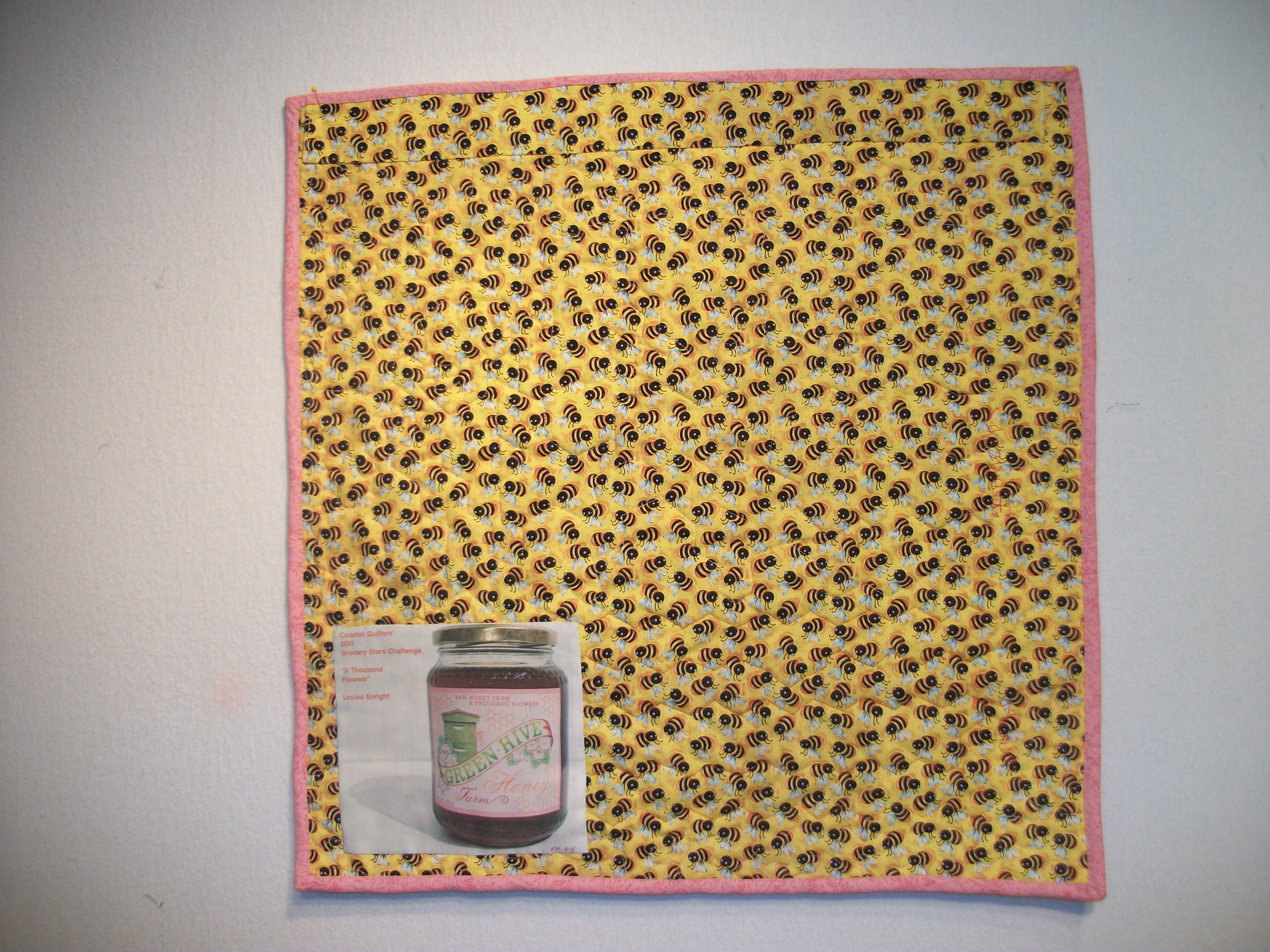
I do not buy many packaged products, if at all, so it took me some time to settle on using one of our local honeys as my product.  We buy it by the case.  I posted a picture of Green Hive Honey Farm earlier on the blog, but I printed my first ever fabric label from that picture for the quilt back.  Here it is on the back of the quilt:
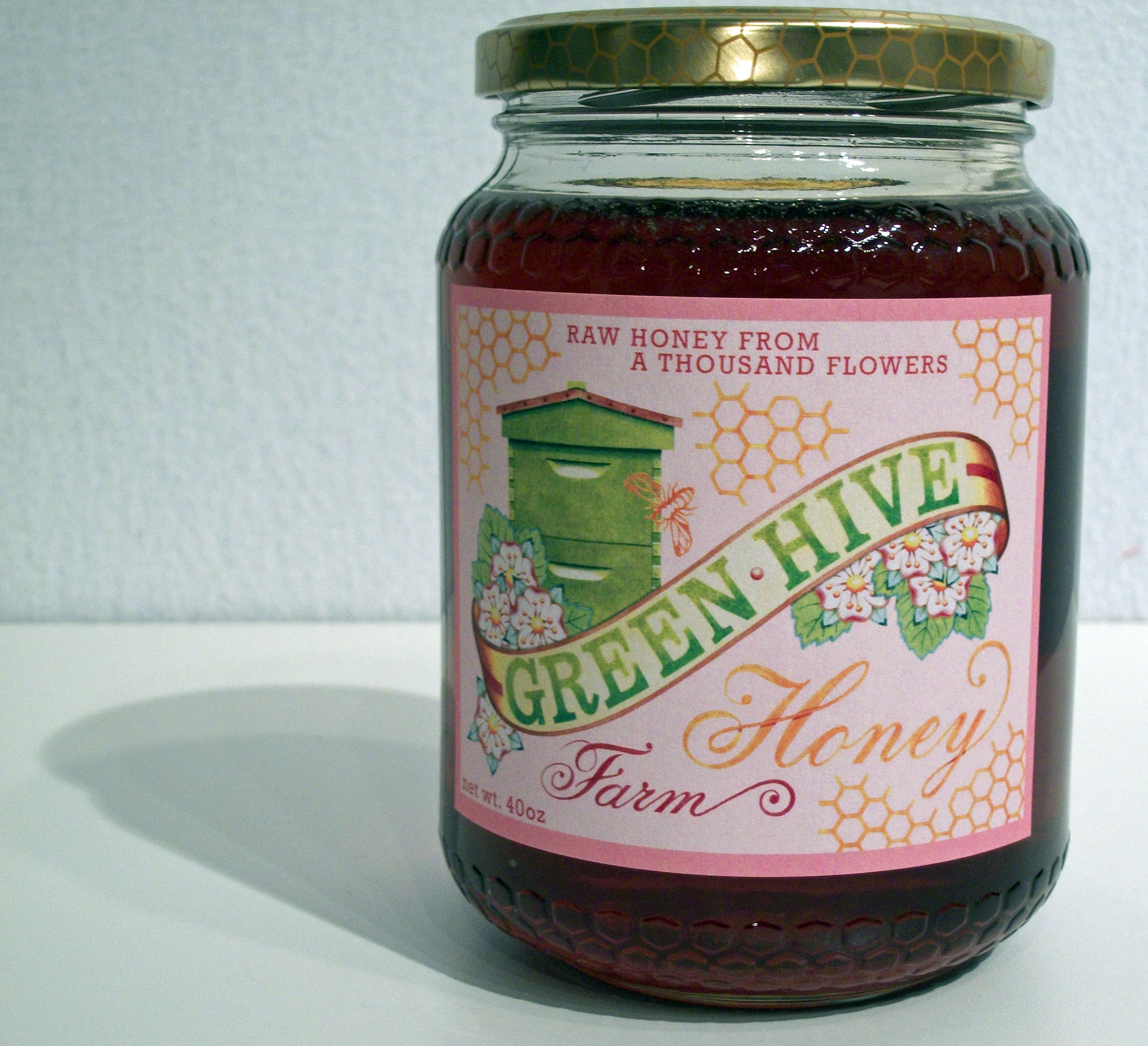
Here’s the jar–which continues to entrance me–close up.  See the hexagon shapes embedded in the glass andn on the lid?
And, here’s the front of  “A Thousand Flowers”:
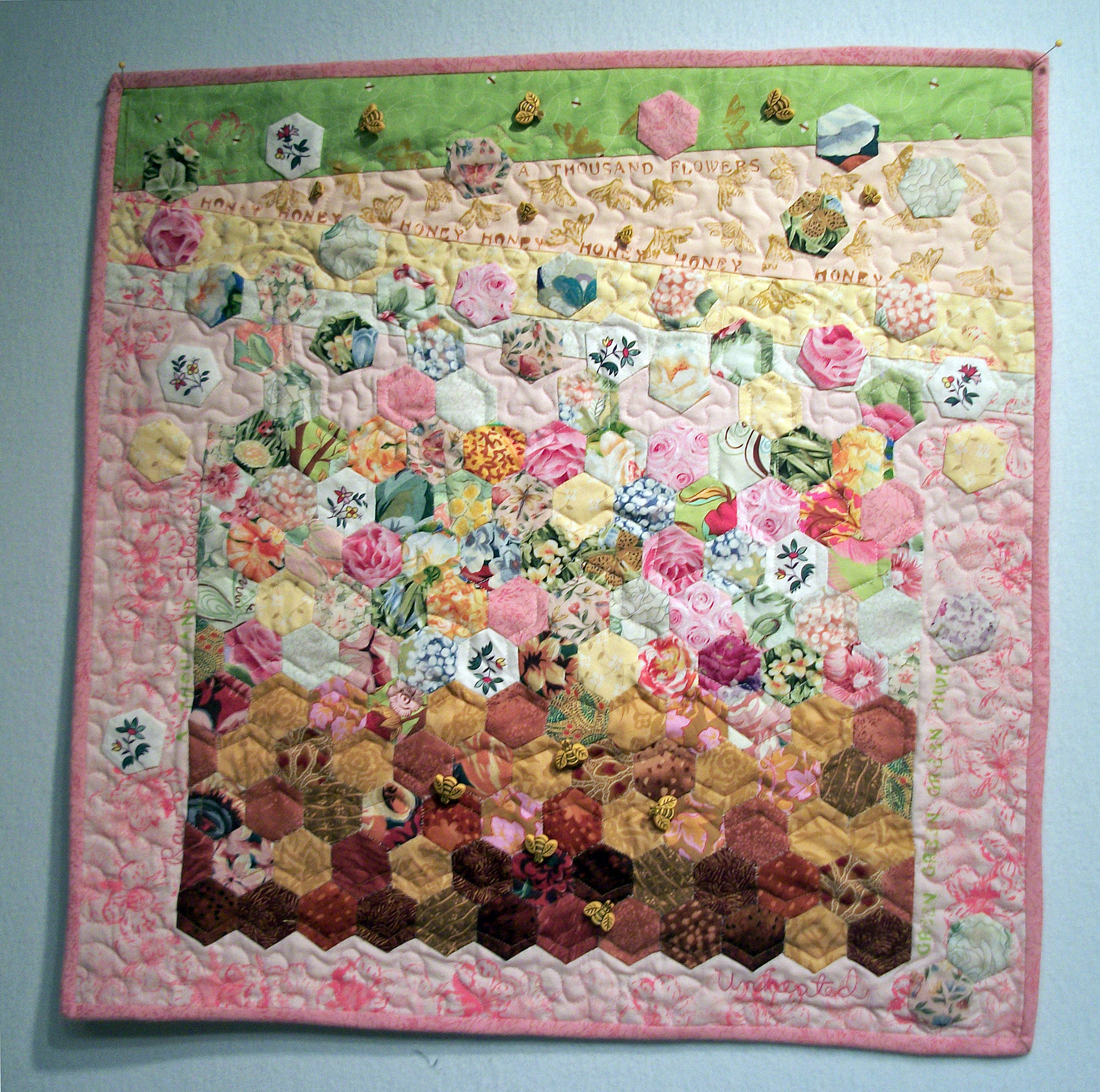
I wanted the flowers to literally be exploding from the honey jar.  The hexagon block is, of course, taken from the same motif on the jar, the label, and from a honey comb.  The green at the top of the quilt (see the tiny bees in the print) symbolizes the top of the “green” hive–and a green hive literally sits in the yard of the Green Hive Honey Farm folks.  The darker blocks at the bottom symbolize thousands of flowers being turned into honey, contained by a jar shape.  I stamped the bees at the top, the flowers in the pink borders, and some of the words.  I sewed in some of the words on the quilt, like “unheated” and “raw.”  I machine quilted long lines in the honey jar and curving lines around the jar.   Like the label, the binding is a darker pink.

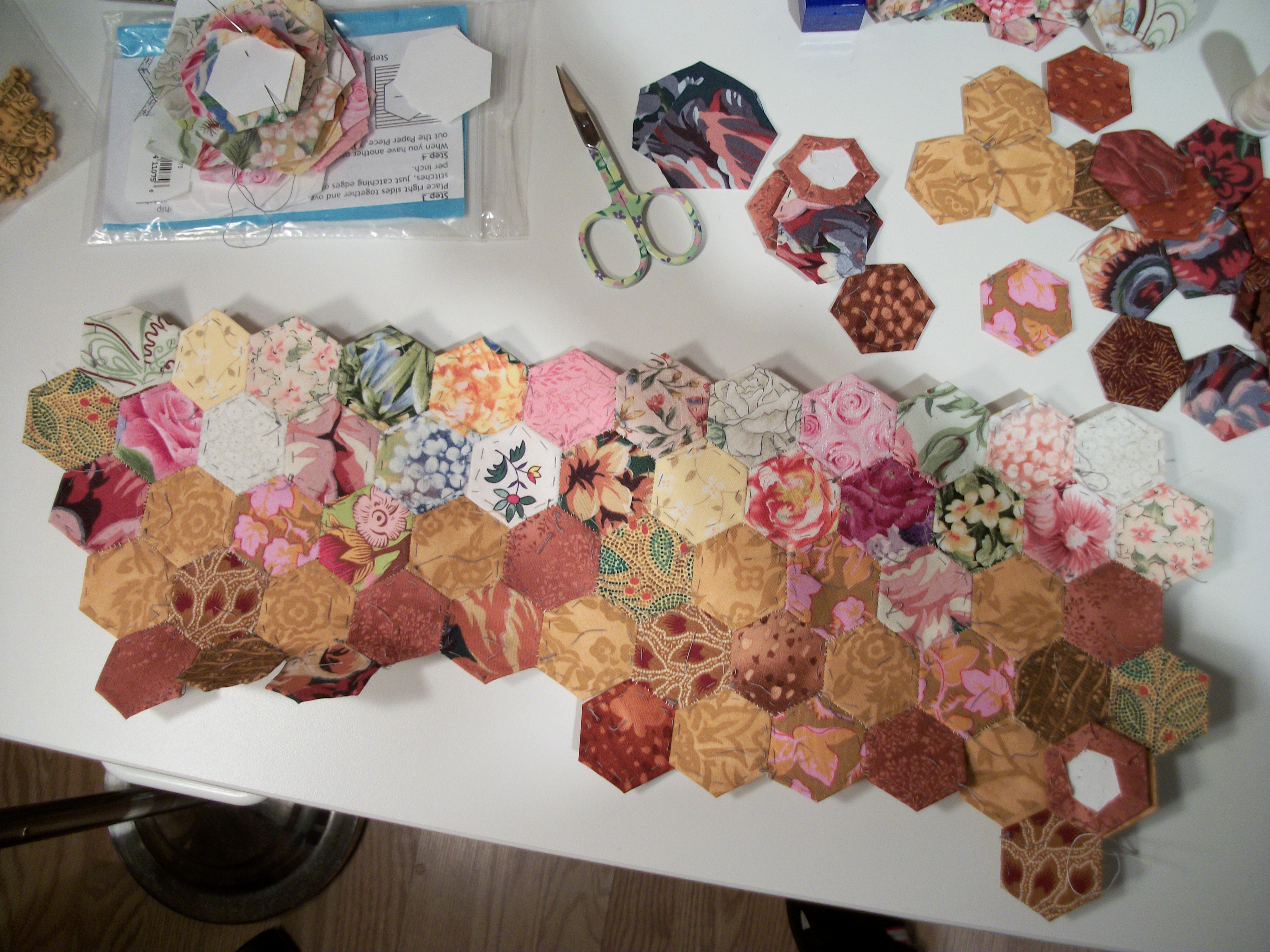
The hexagons are made with the English Paper Piecing method.  One buys or makes paper templates, wraps the fabric around each one and bastes it down, then whip stitiches the blocks together.  Here’s what that process looks like:
Here’s a detail of the stamping (with acrylic paint), of the loose blocks appliqued to the quilt, and of some of the bee buttons, large and small, sewn to the quilt:

I had forgotten how the whip stitching of the blocks pulls, so that one sees those threads.  On the dark honey blocks, the lighter threads were disconcerting, so I painted them with fabric paints that came in pens.  It looks much better now.

I love this quilt.  This little thing took me FOREVER to make.  Many, many hours.  So, now it is done and will hang, with the other CQ Grocery Store Challenge Quilts in the Pine Tree Quilting Guild show in Augusta, Maine, in late July.  After it comes home, it will hang on the wall outside my quilt room.

Turkey Tracks: Green Hive Honey Farm

Turkey Tracks:  January 24, 2011

Green Hive Honey Farm

“Raw Honey From A Thousand Flowers”

 Isn’t this the prettiest jar of honey you ever saw?

From the moment I saw it I fell in love!


For the past five years or so, I’ve made a right hand turn onto Wiley Road from Barnstown Road and, in doing so, passed a house where the most amazing flower garden begin to appear.  Last year some time, a friend told me that the occupants of this house, Clay and Mary King, had put in hives and were going to sell honey.  I’m always looking for local, NONHEATED honey, and that’s what the King’s have.  They have hives located in other places besides their yard, each site carefully chosen to support bees.  Last year, the honey bottles were plain.  This year, when Clay brought us a case of honey, here’s the jar that emerged from the box.  I’ll never be able to throw away a single one of these bottles.  That’s for sure.

For those of you who are local and who are reading my blog, this honey is amazing!  You can reach Clay and Mary at greenhivenoney@gmail.com.  Or, 207-542-3399.  The web site is www.greenhivehoney.com.  Clay and Mary, by the way, have a therapeutic massage practice.

For those of you who are not local, I urge you to find a local source of unheated raw honey.  It’s full of things that are good for you that come from your own region, and you’d be supporting someone who is trying to make a difference. 

Raw honey, combined with raw butter, has been used traditionally as a healing compound and for immune support.  I try to eat some every day.   

Strangely, in the way that things come together all at once some times, Paul Tukey of Safe Lawns sent out a posting listed on his blog this week that shares the fact that the lead researcher for the USDA has definitely connected the use of the class of insectsicides called neonicotinoids, which are synthetic nicotines, with the colony collapse of bees–and at, writes Tukey, “doses so low they cannot even be detected by normal scientific procedures.”   Apparently, Jeffrey Pettis (the lead USDA researcher), has known for two years about the neonicotinoids, but said that official publication of his findings has been stalled.  What a surprise!  This story is as old as industry use of chemicals.  Some names of these synthetic nicotines are imidacloprid and clothiandin.  Pettis, writes Tukey, broke his story to a documentary filmmaker rather than to a government source.  That’s interesting…   That’s one way to get around the “stalling.”

Neonicotinoids act on the central nervous system of insects and are thought to have a lower toxicity to mammals because they block a specific neural pathway that is, according to Wikipedia, “more abundant in insects than warm-blooded animals.”   More abundant…  My first thought is that, as with BPA, they don’t really know how dangerous to us these chemicals are.  And, no one is looking since we operate within the notion that harm has to be proved before our government even begins to look–which translates into having enough dead or harmed bodies.   Imidacloprid is systemic.  It amazes me that people can watch chemicals drop bugs and not connect the dots that those same chemicals can have an impact on their systems as well.  Again and again, the history of chemical use demonstrates that “they don’t know.”  Or, if they do and it’s dangerous, they hide it.  So, I have no confidence in our government’s ability to protect us any more.     

Imidacloprid is widely used as an insecticide worldwide–except in France and Germany where folks seem to have started questioning impact.  Imidacloprid is used, says Wikipedia, against “soil, seed, timber, and animal pests” and is used as “foliar treatments for crops including:  cereals, cotton, grain, legumes, potatoes, pome fruits, rice, turf and vegetables.”  That’s a LOT of poison.

Feral honey bee populations in America, writes Wikipedia about pollinator decline, have declined by 90 percent.   And, two-thirds of managed honey bee colonies have disappeared.  Two thirds.  The economic and human hardship potential for disaster if this scenario continues is enormous.  About one-third of human nutrition depends on bee pollination.  Think about it.  We’re talking about the majority of fruits, nuts, vegetables, and crops we feed to animals, like alfalfa and clover. 

Most bees right now are moved around the country to service crops, which stresses them.  Often, they only have access to one crop, like, say, almonds, which also stresses them since they need more variety.  Often, they’re fed in winter with high fructose corn syrup because we’ve taken all their honey.  No wonder, often, they die.

So, my hat’s off to Clay and Mary.  The honey is beautiful, the bottle’s beautiful, the label’s beautiful, and I will support you.