Turkey Tracks: Blowing My Nose in Style

Turkey Tracks:  March 13, 2011

Blowing My Nose in Style

On January 19, 2011, I wrote a post called “Cutting the Waste Stream and Detoxing the Kitchen.”  One of my issues of the past few years has been how to cut back on the amount of paper we use.  My use of paper towels, napkins, and, now that I think about it, toilet paper, seemed/seems excessive.  So, I’ve been searching for ways to cut back. 

Paper Towels:  I’m happy to report that our paper towel use is practically nonexistent.  So nonexistent that I can’t remember when I used one last.  Putting a bowl of cheap white (so I can see stains) wash cloths on the kitchen counter is working beautifully.  They can be used to where I would have once used paper towels.  (I do not use them to wipe out the cast iron skillet, but more on that in a minute.)  They can also be used inside a bag of lettuce or anything going into the refrigerator than needs a bit of drying.  I could also use them to drain bacon slices, though I’ve mostly just put the cooked slices on a plate.  Once cooled, they reabsorb the fat, and meat fat does not make you fat or hurt your heart, contrary to the low-fat ideology of the past 30-40 years.  As for cleaning the skillet, we pour off extra fat for the dogs and chickens, or for us sometimes, like saving bacon fat or using the glorious fat from a beef or lamb roast on toast the next day–all traditional practices lost over the past 40 years.  A swishing with hot water in the sink takes out the residue in the skillet, and drying the pan with a bit of heat preserves its all-important coating.

I also bought two washcloths for each of our bathrooms, put them under the sink, and use them to spot clean the bathroom.  (Our cleaning woman already uses rags and washcloths to clean the house–she brings them with her.)  That’s working well, too. 

All the washcloths just get thrown into the laundry every week.  If some are dirtier or greasier than others, they go into the pile of dish cloths, etc., that might need either a bit of clorox (winter) or line bleaching (summer). 

Paper Napkins:  We’ve been using our cloth napkins at the dinner table–and reusing them until they are demonstrably dirty.  Growing up, we did not wash cloth table napkins every day.  One had a set place at the table and reused one’s  napkin.  Not doing so saves on water, soap, and energy as well as NOT using paper napkins.  But, for me, who for most of my life has had a chronically runny nose (driven I now realize mostly by food allergies), paper napkins were needed as kleenex just wasn’t strong or thick enough.  So, one day this winter, we had lunch with old Tufts friends of  John’s, Jack and Barbara Moore, of the schooner Surprise, and Jack pulled out a BIG, sturdy, handkerchief from his pants pocket.  It was one of those colored bandanas like we now use to decorate the necks of dogs.  When I said “YES!” and explained my search, he told me he bought them at Reny’s (our local version of a mixed-bag kind of store) for under $2 each.  John and I went that same day and got some.  John got a manly navy blue, and I got these:
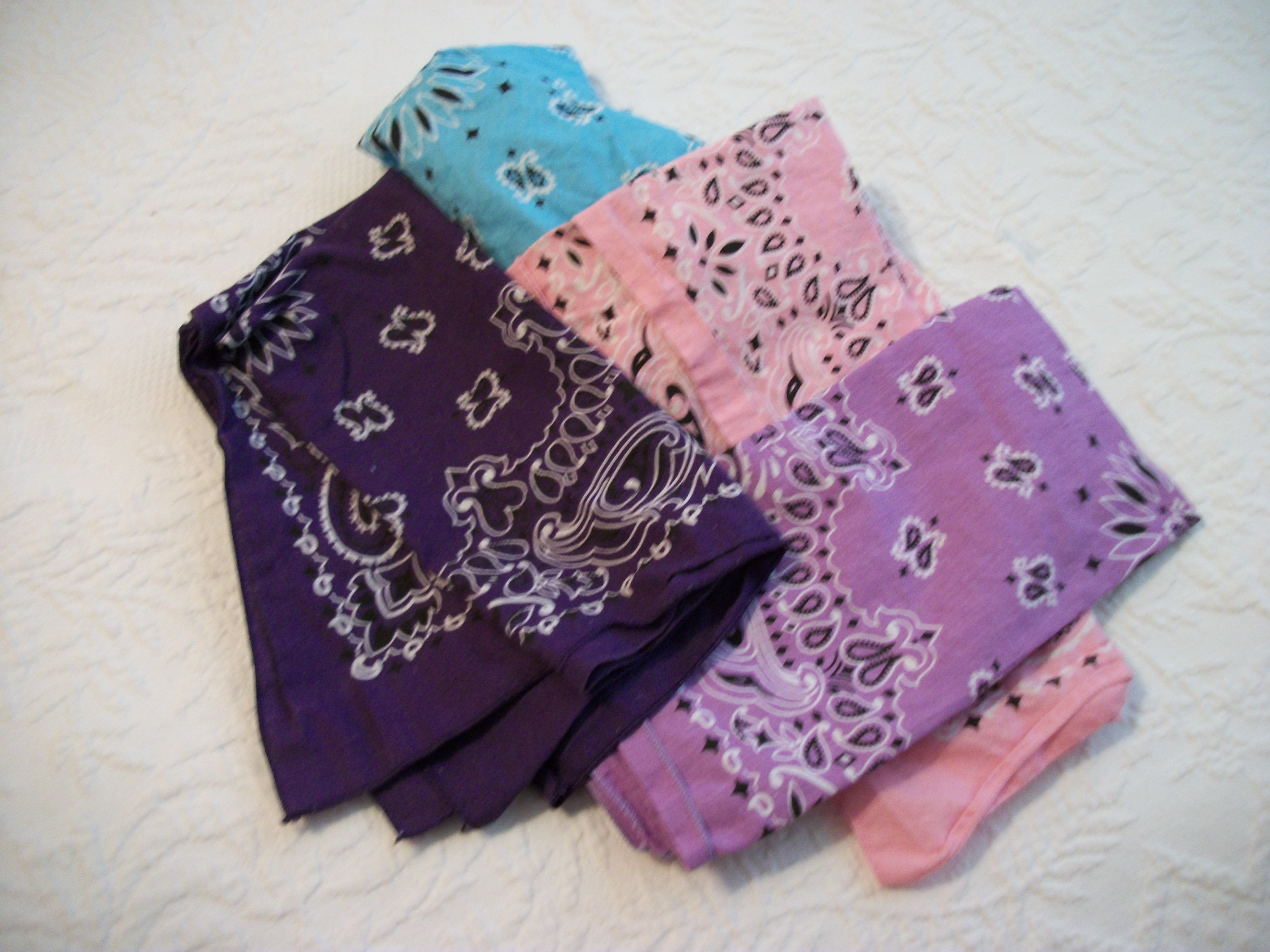
    

They were a little stiff at first, but are now, after several washings, soft as butter.  And, I love them!  They’re so much nicer than paper napkins, and they are so much bigger and sturdier than any of the white handkerchiefs I could find online.

Toilet Paper:   Well this issue is tougher, as Colin Beaven discovered when he started his “No Impact Man” blog and the press became obsessed with the family’s toilet habits.  (Beaven’s blog resulted in a book and a documentary.)  To backtrack, Colin, his wife, and their young daughter attempted to erase or to balance  their energy use footprint for one year, though they lived in New York City.  Toilet paper requires a lot of energy to produce, process in sewage, etc.   And, Beaven points out:  “More than half the world believes that washing their nether regions is far more hygienic than using toilet paper, a practice largely confined to our Western culture.”   I wasn’t surprised to read Beaven’s  information as a few years back, my book club had read Mohja Kahf’s THE GIRL IN THE TANGERINE SCARF:  A NOVEL, wherein the Muslim/American female protagonist does a whole riff on how Muslims view Americans as walking around with and sleeping with dirty nether regions.  Think about it. 

I tried, here at home, to wash rather than to wipe after reading Beaven’s book.  It’s not hard as long as you’re  next to the sink where you can put warm water into a container stored by the toilet.  It’s a bit awkward from lack of practice, of course.  And a container that pours is better than one that doesn’t.  It’s impossible in a public restroom or in someone else’s home.  You do need a container and a drying washcloth or towel–not items one carries around or that friends’ bathrooms supply.  In any case, it is MUCH cleaner, so the half of the world that washes rather than wipes is right about the cleanliness aspect of this issue.

Anyway, I’m pleased with how we’ve been able to curtail our paper use.  It’s a step in a needed direction, a step that refuses to be part of the extraction economy.  And a reminder that sometimes those who live in different cultures or who lived “back in the day” might have better practices than we do.        

Turkey Tracks: Cutting the Waste Stream and Detoxing the Kitchen

Turkey Tracks:  January 19, 2012

Cutting the Waste Stream and Detoxing the Kitchen

When we first moved to Maine, I was clueless about how many paper products we were using.  And, how much of each.  I could go through a whole roll of paper towels while cleaning the kitchen by the time I mopped up the stove, hood, sink, counters, and cabinets.   And, I didn’t think twice about it either.

Our first hint that Mainers don’t use paper like I had done for forever came when we were invited to a potluck.  I made a really nice dish, and off we went.  Only, when we arrived, we discovered that everyone was supposed to bring their own plate, utensils, and drinking cup.  Wow.  It was a revelation.  Fortunately, another couple lent us one of their sets of everything and each couple ate from one plate.   Our journey toward stopping the paper habit started that night.

Except for paper napkins, I’ve not bought any household paper eating supplies in about 6 years.  And, paper napkins get used very little since we use cloth napkins–which we wash when they get dirty, not after every meal.  (I grew up with this practice, actually, in my grandmother’s home.)  Mostly, paper napkins get used to blow our noses since they are sturdier than kleenex!  And that’s going to stop because I lucked into a box of handkerchiefs a while back, and I, at least, have been carrying one of those in a pocket.   But, they are delicate for the most part.  I wonder if sturdy cloth handkerchiefs are on the market anywhere? 

Last fall I bought a stack of white wash cloths at our local Penny’s–about a dozen for $10.  (Along with some GREAT cotton sheets at 1/2 the price of other places.)  I put them in a bowl on the kitchen counter, and I grab one when I need to clean anything in the kitchen, wipe my hands, wipe…anything.  They get thrown in the washer with the cloth kitchen towels, and all get bleached when they really need it–though the sun does a great job in the summer.  And, of course, I have lots of rags from old t-shirts, towels, and the like. 

Next, I need to figure out how to store clean rags in the bathroom instead of using paper towels to wipe out a sink, polish a mirror, or swish out the toilet (with gloves on, of course).  Now that I’ve focused on the problem, it shouldn’t be hard to solve.

When our quilt group meets, we each bring our own coffee/tea cup.  That’s worked well for many years now.  We hardly ever have to buy disposable cups anymore.  Plates and napkins, though, we do still buy.  And, plastic forks and spoons.   Hmmmmm.  This might be worth discussing at the group.   The Lion’s Club where we meet has plates, utensils, etc., but we’d have to wash them afterwards…  That’s the big problem, isn’t it?  We don’t want to expend energy in that way…   We’ve noticed that people from away who visit use napkins like plates, without giving a thought to the trade-off:  wash a plate or trash more trees. 

It’s always a shock when someone from an urban area comes because our trash fills up quickly with all the disposable coffee cups they…”trash.”  Maine has a good bottle law.  It could be better if they upped the tax a bit more.  Studies have shown that the higher the tax, the better the return, which means less goes into the environment.  Anyway, we take our trash to our local dump and pay $1 for the big yellow bags we use.  There are great recycling bins for paper, cardboard, cans, and bottles.  Obviously, the less trash we put into those yellow bags, the less we pay.  We compost all our plant wastes, and the chickens and dogs eat all the kitchen “slop.”    

Packaging creates a huge amount of trash.  In Britain, I read not long ago, shoppers were stripping their produce out of all the packaging and leaving it for the store to manage.  I don’t know how that came out.  I do know many of us in Maine are using our own bags when we shop, and I’ve stopped putting a lot of produce into plastic bags to carry them home.  Lettuce, maybe.  Apples, no.  I shop mostly at a co-op anyway, and they don’t supply shopping bags or pack your groceries for you.   And, they ask you to pay for any bags you use when gathering food.  But, when I do go to a local supermarket, which is not very often, I’ve stopped going blindly along with all the plastic packaging.  I haven’t quite had the nerve to strip off packaging from organic produce I might buy in a supermarket, but that day is coming soon.  Mostly I try to buy local, organic food, and that’s not often in the supermarket anyway.

I stopped buying and using aluminum foil a few years back.  It’s toxic.  It’s metal, so it doesn’t break down in a land fill.  It was a little disconcerting at first because I had all these food habits that made me reach for the foil to cover a pan or wrap something to heat or transport.  But, I’ve learned to cope.  A bit of wax or parchment paper laid over a hot dish, covered with a thick towel transports food really well.  And, I’ve figured out how to use other lids or pans to cover an open dish in the oven. 

I haven’t yet stopped buying plastic wrap.  But, that’s next.  And, for heaven’s sake, don’t heat plastic wrap in a microwave and give that food to anyone!  (Actually, we took the microwave to the garage three years ago, and we haven’t missed it.  The microwave issue is a whole thing on its own, but every holistic or energy person I know does not use one.)  I already use plates to cover most bowls I put in the refrigerator.  That works fine.  The plate even makes a hard place where you can set another dish. 

I got rid of all plastic storage containers years ago.  I do have some glass containers with glass lids, but they are hard to find.  I have some glass or metal containers with plastic lids, but I wash those lids by hand.  I use Mason Jars a lot.  And,  glass food jars get washed and saved. 

So, I’m down to ziplock bags.  And I still use those.  I wash and reuse them, so I feel a bit better.  But, in the end, I don’t want plastic touching my food any more.  I’ve just read too much about how little we know about what’s going on inside a plastic anything.  And, what we do know is scary.  And, I do know that manufacturing plastic is toxic in so many ways.   Plus, it’s all made from oil, which is a limited resource.  Plastic just isn’t something I want to have in my life or to support.  So, I’ll start thinking about exactly how I use plastic bags and trying to figure out how not to. 

 I have discovered that you can hold lettuce or other salad ingredients really well wrapped in a kitchen towel.  I put cut tomatoes cut side down on a plate on the counter.  I don’t like tomatoes refrigerated anyway.  Ditto for an onion.  Both get eaten or used quickly anyway.