Turkey Tracks: November 23, 2010
An Asset: Easy, Enzyme-Rich Sauerkraut
I like to have what I think of as “assets” in my kitchen. If I have a bone broth, for instance, I have the makings of a soup lunch or dinner. Salt-preserved lemons topped off with olive oil provide a tasty addition to everything from mashed potatoes to salad dressings to drizzles for baked fish. Apple chutney is great alongside meat or inside an omelet and keeps for a long time. I keep piima whole cream which operates like crème fraiche or sour cream and which can be used in tea or coffee to add a different kind of zing. (Piima is a Finnish cultured milk product that is chock full of enzymes.) Leftovers can be turned around in new ways for easy meals. And, lacto-fermented vegetables keep for months in the refrigerator and add zip and enzymes to your plate, especially in the winter when local salad greens are scarce in Maine.
Sally Fallon and Dr. Mary Enig, in Nourishing Traditions, write that the lactobacilli in fermented vegetables enhances digestion and promotes the growth of healthy flora throughout the intestine. And, lacto-fermented vegetables have antibiotic and anticarciogenic substances. Plus, eating enzyme-rich food takes pressure off your body to process what you eat. My favorite lacto-fermented vegetable is sauerkraut. I put about ¼ cup of sauerkraut on almost every plate we eat in the winter. People used to lacto-ferment vegetables to preserve them before canning technology arrived.
Not long ago I dropped the old half-gallon sauerkraut container, and it broke into a million pieces all over the kitchen floor. It was full of fairly newly made sauerkraut. So, after I cleaned up the mess, I set about making some more, and in the three days it took to make, we missed having this “asset” around quite a lot.
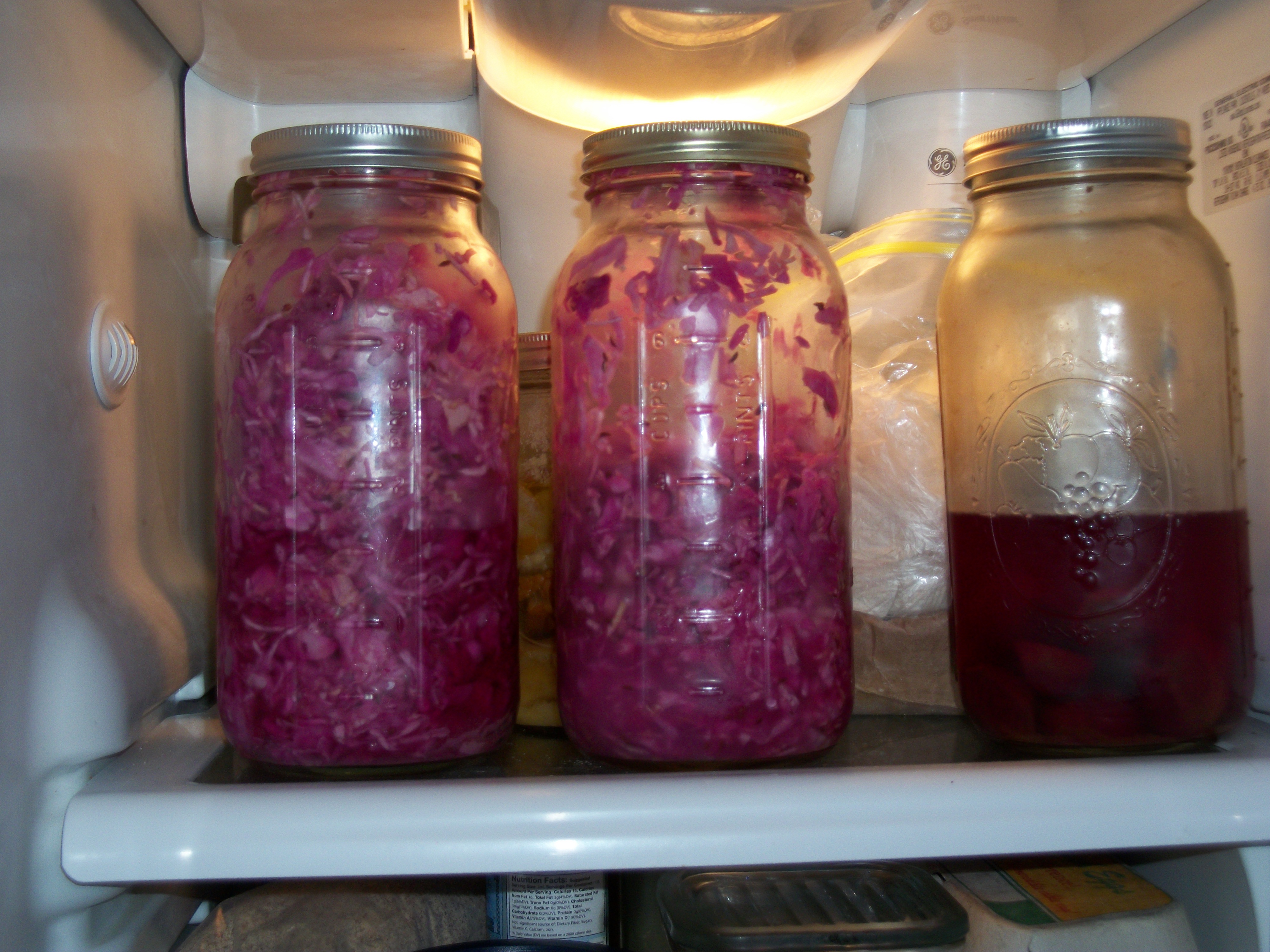
Here’s a picture of the two new half-gallon containers:

I used a red cabbage and part of a green cabbage. In a few days, the red cabbage will turn the new sauerkraut a rosy pink. See? It will get darker along the way, and it will keep for months, if we don’t eat it first. That’s beet kvass on the right, another enzyme-rich, healthy product.
Here’s the recipe from Nourishing Traditions:
1 medium cabbage, cored and shredded. I use the slicer on a food processor.
I Tablespoon caraway seeds
1 Tablespoon sea salt
4 Tablespoons *whey (or use 1 additional Tablespoon of salt).
*Whey is the clear liquid that can be drained from good yogurt. Most commercial yogurt now is so full of pectin and seaweed that it will not drain whey. So, be aware that what you’re paying for isn’t a full-milk product, but a product adulterated with fillers—so the producer makes more money.
I far prefer the whey to additional salt. You can drain yogurt by putting a paper towel or two, or a coffee filter, into a colander and setting it over a bowl. Put yogurt into the paper-covered well of the colander and set it over a deeper bowl. You can put a plate over it if you like. The whey drains off, leaving you with a delicious spreadable cheese you can flavor with herbs or drizzle with honey. Don’t worry; this mixture won’t go bad at room temperature.
I mix the sauerkraut ingredients in a big bowl and pound it a little with something a bit heavy: a mallet, the handle end of a big spoon, or a mortar grinder. When the cabbage starts to release its liquid, pack the cabbage into a clean Mason jar, making sure you leave about an inch of free space. Keep the mixture at room temperature for about three days, turning it upside down to distribute the liquid once or twice a day. (Don’t leave it upside down—just mix it up.) You can eat it most anytime, but it’s best after about three days. Refrigerate it and ENJOY!
 Louisa Enright's Blog