Mainely Tipping Points 44: THE WHOLE SOY STORY

Mainely Tipping Points 44:  December 7, 2012

Part I:  THE WHOLE SOY STORY


Just the other day I stood in front of a store cooler with $40 worth of a premiere brand of bratwurst sausages in my hand.  How delicious they would be for dinner grilled and served alongside applesauce, pan-sautéed cabbage, corn bread, and assorted pickles and mustards.  Almost absentmindedly, I glanced at the ingredients on the label and was startled to see soy protein isolate.  I put the sausages back into the cooler for two reasons:  I don’t think our food should be padded with soy “meat extenders” so industry can make more money, and I don’t think commercial soy is at all safe to eat, especially the highly processed forms like soy protein isolate. 

The person I rely on for soy information is Kaayla T. Daniel, PhD, CCN, the author of THE WHOLE SOY STORY:  THE DARK SIDE OF AMERICA’S FAVORITE HEALTH FOOD (2005).  Daniel is known as the “naughty nutritionist” because with outrageous humor she specializes in debunking food myths, like the myths surrounding commercial soy.  And, Daniel comes with the kinds of credentials and training which allow her to understand the value of what she is researching, like why some studies have good designs and are executed properly and why others are corrupt, in that they have been designed and paid for by industry to make commercial soy appear to be safe and, even, healthy, when it is not. 

If you are totally confused by the alphabet soup that follows many names in the nutrition field, take a look at Daniels article “What Should I Do to Be a Nutritionist?   Making Sense of All Those Confusing Degrees and Credentials,” published in the Weston A. Price Foundation (WAPF) journal, “Wise Traditions,” Fall 2009, http://www.westonaprice.org/health-issues/what-should-i-do-to-be-a-nutritionist.  Daniels walks the reader through what kind of nutritional programs are available and what their strengths and pitfalls are.  She explains what kinds of organizations certify people with dietary and nutritional training, which lets them begin to use the coveted initials behind their names. 

You’ll find, too, that this terrain is a minefield of disingenuous claims.  For instance, , anyone can claim to be a nutritionist, so the alphabet soup tells everyone what kind of training and testing has been involved.   And, Daniels notes that Mary Enig, PhD, MACN, “is fond of saying [that] `Dietitians are trained to dispense processed food.’ (That MACN behind Enig’s name is the coveted Master of the American College of Nutrition, “a prestigious category for those who have made outstanding contributions over an extended period of time to the field of nutrition.”)  

Daniels herself studied under the legendary H. Ira Fritz, PhD, CNS, FACN.  The CNS stands for Certified Nutritional Specialist, and the FACN designates that Fritz is a Fellow of the American College of Nutrition.  The FACNs, explains Daniels, “hold doctoral degrees, [have] expertise as practitioners or educators and [have] a publication track record.”  (Dr. Enig’s MACN is a step above the FACN, which she also holds.) 

Dr. Fritz is now emeritus professor at both Union and Wright State University in Dayton, Ohio, and was, in addition to Daniels, mentor to a number of “superstars” in the field of nutrition.  Daniels herself is a CNN, or Certified Clinical Nutritionist, which is a very respected credential.  And, she is a board member (Vice President) of the WAPF and regularly publishes articles in its journal “Wise Traditions,” where she also has a column on soy issues.  And, she blogs at the WAPF web site and on her own blog, http://liberationwellness.com.    

With the publication of THE WHOLE SOY STORY, Daniels acquired a national reputation.  She appeared on the Dr. Oz show, where that megalomaniac did not allow her to speak more than one sentence.  (Oz ended that segment by passing out stalks of soy to the audience, each fluttering with raw edamame pods.)  She appeared on the Oz show as counter to Dr. Mark Hyman, a pro soy advocate, who did not seem to know that soy milk and tofu are not fermented soy products, which are safer to eat.  Her in-depth response to Hyman in the Fall 2010 “Wise Traditions” is worth reading, in that it discusses in a short article many of the myths and dangers of eating untreated soy:  http://www.westonaprice.org/soy-alert/response-to-dr-mark-hyman.  Daniels has been on ABC’s View From the Bay, NPR’s People’s Pharmacy, and will soon appear on PBS Healing Quest.  She was WAPF’s 2005 recipient of the Integrity in Science Award.

I am taking a lot of time setting up Daniel’s credentials because I hope this activity helps readers understand not only what I am looking for when navigating the maze of whom to believe when it comes to nutrition, but how readers, too, should discern the value of what they are reading.  We can no longer rely on studies from Harvard as being reliable just because they come from Harvard.  One has only to look at the recent study denouncing red meat done to see that Harvard nutrition scientists are perfectly capable of producing terrible, useless studies.  (See my blog, https://louisaenright.wordpress.com/?s=red+meat.).  Daniels has solid credentials, she works with people at the WAPF who also have solid credentials, and for THE WHOLE SOY STORY she looked at the history of soy, at all the major soy studies, at the major soy issues, and at the major soy industry proponents.

We are being besieged at the moment with the idea that we should all eat mostly a plant-based diet.  Vegetables and fruits are touted as being chock full of wonderful ingredients that will make us healthy.  What is being lost in this current moment of insanity is not only that plants are not nutrient dense, but that plants manage their lives chemically and that some of those chemicals are so potent that they can cause quite a bit of harm to humans.  Many of the plants that we eat everyday can, if overdone or eaten without being treated to reduce the chemical load, cause serious trouble.  And, it’s easy to over eat certain foods since they are now available all year round.  Take spinach, for instance. It’s loaded with oxalates, which can cause kidney stones if eaten in excess.  Or, the grains and legumes I wrote about in the  Mainely Tipping Points Essay series on the Paleolithic diet, essays 41, 42, and 43, which are loaded with antinutrients that must be treated to be safe to eat.  For more information in this vein, see Daniels; “Plants Bite Back,” “Wise Traditions,” Spring 2010, http://www.westonaprice.org/food-features/plants-bite-back.  

Soy is a dangerous plant food without a long history of use as a food.  And we are feeding it to animals and fish we eat and whose eggs we eat.  We are dumping soy into processed and packaged foods, including things like canned tuna fish and, unlabeled, in the hamburger in your local grocery store.  We are loading it with sugars and drinking it, to include putting it into baby formula.  We are, in short, wallowing in soy.

Here are some quotes from the flyleaf of THE WHOLE SOY STORY:  “Soy is NOT a health food.  Soy is NOT the answer to world hunger.  Soy is NOT a panacea.  Soy has NOT even been proven safe.”

And, here’s a quote to help start off this series on soy, again from the flyleaf:  “Hundreds of epidemiological, clinical and laboratory studies link soy to malnutrition, digestive problems, thyroid dysfunction, cognitive decline, reproductive disorders, immune system breakdown, even heart disease and cancer.   Most at risk are children given soy formula, vegetarians who eat soy as their main source of protein and adults self-medicating with soy foods and supplements.”   

Next:  how soy got into our food chain.        
Interesting Information: Dangerous Cross Reactivity: Soy/Peanuts

Interesting Information:  August 4, 2012

Dangerous Cross Reactivity:  Soy/Peanuts

This information on cross reactivity is from Kaayla Daniels, writing in WISE TRADITIONS, the journal of the Weston A. Price Foundation, summer 2012.  (Daniel’s book THE WHOLE SOY STORY is the work of someone who has the credentials to read and understand soy studies and the talent to explain the dangers of soy to us in ways we can understand easily, and I will write an essay on it soon.)

Here’s where you can read the article on cross reactivity in full:  http://www.westonaprice.org/soy-alert/the-soy-ling-of-america-second-hand-soy-from-animal-feeds.

The main article is about the amounts of soy showing up in the meat of animals fed a lot of soy and, of course, in eggs.  This has been a worry for me since I read THE WHOLE SOY STORY.  Soy is filled with all kinds of chemicals that are not healthy for people.  And, no, Asians don’t eat all that much soy.  Besides, soy tastes nasty, bitter, and no matter what industry has done, it has not been able to lick this problem or to prove that soy is healthy.  I don’t feed my chickens any soy, so our eggs are soy-free.  If you eat soy, limit it to small amounts of fermented soy:  miso, tempeh, and natto (which you are unlikely to like as it is an acquired taste.)  Tofu is NOT fermented.

The sidebar article, though, is the one I think you should read if you have a peanut allergy or a tree-nut allergy–because you might be subject to a dangerous, if not fatal, allergic reaction to any soy you might eat–and remember that industry is putting soy into everything it can and is padding meat (hamburger, hot dogs, roasted chickens, etc.), so you could eat soy without knowing it.  If you are eating fast food, you most certainly are eating soy.

The title of the sidebar article is “The Odwalla Chocolate Protein Monster:  The Little Known Soy/Peanut Allergy Connection.”

Back in April of this year, four consumers drank Odwalla’s Chocolate Protein Monster and had severe allergic reactions.  The product was recalled.  Contamination from peanuts was ruled out, so experts started looking at cross reactivity as the cause.  Soy and peanuts are members of the grain-legume botanical family, so people allergic to one are, Daniels writes, “often allergic to the other.”  The Odwalla drink contained soy protein.

Daniels writes that “severe reactions to soy were once rare.  Today they are increasingly common, and pose especially high risks to children already afflicted with peanut allergies.”  In 1999, four children in Sweden died of the soy/peanut link.  Other risk factors include “other food allergies, a family history of peanut or soy allergies, a diagnosis of asthma, rhinitis or eczema, and/or a family history of those diseases.”  Researchers “found it took only a tiny, almost indiscernible, amount of soy to create a severe and even life-threatening reaction in susceptible individuals.”  Worse, they found that “severe allergic reactions could happen suddenly and unexpectedly to people with no known soy allergies.”  The Swedish National Food Administration issued warnings.

Daniels laments the fact that Sweden’s warning has “not been publicized much in the U.S.  Indeed, the Soyfoods Association of North America–and even many allergy support groups–recommend soy nut butter and soy nuts for children allergic to peanuts and tree nuts.  As a result, few people have heard of the deadly soy/peanut connection, and numerous adverse reactions have been reported.”

Daniels chronicles several deaths to this cross reaction here in the U.S.

But, why is this severe reaction happening now?

Daniels answers:  “The main reason appears to be the increased number of allergenic proteins found in genetically modified (GMO) soy.”  Apparently, genetic engineering of soy has produced a soy allergen that is “41 percent identical to a known peanut allergen, ara h 3.”  This new allergen is “recognized by 44 percent of peanut allergic individuals.”  And, in the U.S., “90 percent of soy now contains these new proteins, chemicals and allergens.”  (I think almost 100 percent of the soy crop is now GMO–I have to check that fact.)

As soy ingredients are now in “60 percent of processed or packaged foods and nearly 100 percent of fast foods,” writes Daniels, not issuing a warning “is simply irresponsible.”  And, here’s a devastating piece of information:  “Not surprisingly, the reason appears to be the usual principle of profits over people.  According to Robyn O’Brien [AllergyKids website], “`Leading pediatric allergists and researchers have been funded by the agrichemical corporation responsible for engineering these proteins, chemicals and toxins into soy.'”

Note that soy has not yet been identified officially  in the Odwalla Chocolate Protein Monster case, so Daniels is asking that we all make a “concerted grassroots effort to share this information with as many people as possible.”

PLEASE SHARE THIS INFORMATION ON FACEBOOK OR ELSEWHERE.

PS:  Odwalla drinks are not really a health drink.  Their juices are pasteurized, so all the goodies are killed.  Mostly, you’re just drinking sugar and lots of it.  If you want to drink more veggie juices, get a good juicer.  I wrote about mine here on this blog.  Limit all fruit juices to the barest minimum–the sugar loads are just too great.  There are, surely, better sources of protein than an industry-produced Odwalla drink.

Interesting Information: How Much Sugar Are We Eating Today?

Interesting Information:  August 4, 2012

How Much Sugar Are We Eating Today?

Tim Boyd reviews DVDs in the Weston A. Price Foundation’s journal WISE TRADITIONS.  In the summer 2012 issue, which I’ve just finished reading, he reviewed a DVD by Nancy Appleton, PhD, called SWEET SUICIDE–HOW SUGAR IS DESTROYING THE HEALTH OF OUR SOCIETY, made with help from the Price-Pottenger Nutrition Foundation.  (Pottenger did, among other useful things, the famous study of cat health, based on what they were fed.)

Here’s a revealing quote–which answers the question in the title of this entry:

During George Washington’s time we consumed thirteen pounds per year per person on average.  During George Bush’s time we consumed one hundred fifty pounds per person per year.  The difference in cancer and degenerative disease rates during those times is clear.

Those figures would be AVERAGES–which means some of us are eating way more than 150 pounds!!!!! each year.

And, remember, these figures do NOT include the sugars you’re eating that derive from grains and all carbohydrates.  Remember that two slices of whole wheat toast is the daily limit for a woman in Luise Light’s recommendations for the 1980 USDA food guide (that got erased) AND on the Glycenic Index puts more sugar into your bloodstream than a Mars candy bar or a soda (which has about 16 teaspoons of sugar if I remember correctly)  , according to WHEAT BELLY.

So how much sugar are you eating?

I’m finding that my desire for sugar–even the raw honey I use to sweeten my tea–is drastically decreasing since I cut out wheat and most grains.  For whatever that’s worth…

Interesting Information: “Vaccinations, The Ongoing Debate”

Interesting Information:  July 23, 2012

“Vaccinations, The Ongoing Debate”

Well, here’s a must read for everyone from young parents to grandparents.  Vaccinations are a very charged subject in our society and parents who are looking more deeply and asking questions are being called crazy or ill-informed or irresponsible.

Are they?

Leslie Manookian published this piece in The Weston A. Price Foundation’s journal, Wise Traditions, summer 2012 issue.  Manookian has made a film, THE GREATER GOOD, in which she has attempted to determine where the facts and hard science are with relation to vaccinations.  She notes that the “vaccine debate is a scientific debate,” or should be so, and is not “one between emotional parents and their doctors.”

The tagline from the film is the following:  “If you think you know everything about vaccines…think again.”

The School of Public Health at the University of Alabama, Birmingham, awarded the film its Koroni Award “for a documentary feature addressing an issue of importance to public health.”  The film was featured at the Amsterdam Film Festival, where it was awarded the Cinematic Vision Award.  The film was aired nationally on Current TV and has been shown at film festivals all over the world–where it has been “applauded by lay, medical, and film audiences alike….”

You can read Manookian’s article at http://www.westonaprice.org/childrens-health/vaccinations.

Here are some highlights:

Children today receive 26 doses of 9 vaccines by their first birthday.  In 1983, they received 11 doses of 4 vaccines.

By age 18, children today receive 70 doses of 16 vaccines.  In 1983, they received 23 doses of 8 vaccines.

Big Pharma has an estimated 200 vaccines in development for use across the population.  The CDC recommends an annual flu shot from cradle to grave.  There are many adult booster shots for childhood diseases and new vaccines like the shingles vaccine, which I recall reading only covered about 30 percent? of the potential to get shingles.  Flu shots still contain mercury.  “Many diseases vaccinated against today were considered fairly benign in past decades (flu, chicken pox, mumps, rubella) or quite rare (hepatitis A and B, meningitis).”

No one knows if vaccines are safe because no “large, long-term clinical study comparing the medium or long-term health outcomes of vaccinated and unvaccinated groups of people” has ever been done.

Children are given as many as TEN vaccines in one visit, but there are no safety studies evaluating the safety of simultaneous shots.

No study has been done to evaluate the “different ingredients of human infant vaccines taken individually or in combination.”  This list of ingredients can include, “but is not limited to” the following:  “mercury, aluminum, formaldehyde [a known carcinogen], cells from aborted fetuses, cells from monkey kidneys, chicken embryos, viruses, antibiotics, yeast, polysorbate 80 and detergents.

Most vaccine trial only last a few weeks, so long-term effects are not known.  Worse, Big Pharma is allowed “to use another vaccine or a liquid containing an adjuvant such as aluminum as the placebo”–so the “vaccine producer can say that the vaccines cause no more adverse reactions than a placebo.”

Mercury is still used in the manufacturing process and trace amounts remain.  Aluminum–a “demonstrated neurotoxin”–is used as an adjuvant (a substance added to vaccines to stimulate an immune response–without which the vaccine is useless).  Medical science’s “understanding about their mechanisms of action is still remarkably poor….[but] Experimental research…clearly shows that aluminum adjuvants have a potential to induce serious immunological disorders in humans.”

Much evidence exists now that vaccines are harming children, and Manookian discusses some of those peer-reviewed studies.  She includes the notion that ‘there is in fact peer-reviewed scientific evidence connecting both [mercury and vaccines] to autism.”  She notes that “research has also shown impaired immune function and autoimmune disease in humans following the administration of these same compounds [alluminum].”  Neurological damage, “including motor function deficits, cognitive impairment, and behavioral changes in mice given the aluminum in vaccines.”

What is most disturbing are the behavioral changes in vaccinated children. “Normal” reactions are considered to be “swelling, soreness, tenderness and a lump at the injection site, fever, fussiness, tiredness, and vomiting.”  But “no studies exist to determine what happens to the body’s systems and tissues when a vaccine is given.”  Manookian writes:   “In the making of the film and while conducting screenings, we have come across many parents who said their child had these `normal’ reactions after a round of vaccines but never was quite the same again and went on to develop a learning disability, allergies, ADHD, or another type of chronic disease.”

The National Childhood Vaccine Injury Act of 1986, signed by Ronald Reagan, “acknowledged tha vaccines can cause injury or death.”  “To date, the program has paid out more than two billion dollars and has about three billion dollars in reserves” as a tax is paid on each vaccine given.

It’s important to realize that “doctors are taught that vaccines are safe and effective; they are not taught how vaccines are studied, the components of vaccines, or the gaps in research.  Doctors are taught that decades of clinical use of vaccines have demonstrated their safety and that vaccine side effects are rare, but there are no large, long-term clinical trials comparing the health and well being of those vaccinated to those unvaccinated to back up these assumptions” (underlining is mine).   IN OTHER WORDS THIS “KNOWING” IS A BELIEF SYSTEM, CREATED BY BIG PHARMA, THAT IS SOLD TO DOCTORS AND PARENTS USING FEAR ABOUT CHILD SAFETY.  THERE IS NOT DATA BEHIND IT.  Plus, Big Pharma has ZERO LIABILITY for vaccines that cause harm.  You cannot sue them for damages.

What about the notion that vaccines have reduced infectious disease?  Bernard Guyer et al published in Pediatrics (December 2000) a history showing that “`nearly 90 percent of the decline in infectious disease mortality among U. S. children occurred before 1940, when few antibiotics or vaccines were available.”  Guyer et al’s consensus was that public health measures (water treatment, food safety. organized solid waste disposal, and public education about hygienic practices) were what made the difference.  “Moreover,” writes Manookian,” disease outbreaks regularly occur in fully vaccinated populations so vaccinations may not be as effective a preventative as generally believed.”

You should look deeper before making any decisions about vaccinations for yourself or your children.   You might be putting them at more danger than any disease they might catch would.

You should know that in California right now your child who is twelve or over can be vaccinated for a sexually transmitted disease by a school nurse without your consent or knowledge–since parents will have “no access to the child’s medical records that pertain to these shots”!!!!  How can that be in a country that touts freedom as its organizing principle???  This is a perfect example of the power of industry to work its will on a population.

One excellent book is Neil Z. Miller’s VACCINES, ARE THEY REALLY SAFE AND EFFECTIVE.”   This book was my first introduction to the idea that vaccines might be really dangerous.

Here’s an article by Dr. Mercola that came in the past few days about how the Merck mumps vaccine is not effective, how they knew it, and how the whole story, which appeared in the WALL STREET JOURNAL, has now been covered up.

http://articles.mercola.com/sites/articles/archive/2012/07/23/merck-vaccine-fraud-story-buried.aspx?e_cid=20120723_DNL_artNew_1

Here’s The People’s Chemist, Shane Ellison, on why the whole “herd” protection assumptions are nonsense.  Ellison can be flamboyant, but he’s a pretty solid scientist:      http://thepeopleschemist.com/blog/

I can tell you that if I had young children today I would not vaccinate them.  I’d take our chances, knowing I might lose them.  But, losing a child can happen just as easily with vaccines and with all of the other really dangerous things children do every day.  In the end, you can only protect children so much and overprotection is just as harmful to their development.

.

Interesting Information: The China Study Myth

Interesting Information:  July 4, 2012

The China Study Myth:  Flaws in the Vegan Bible

T. Colin Campbell published THE CHINA STUDY in 2006.  Campbell is a “heavy hitter” in terms of credentials:  a PhD from Cornell, authorship of over three hundred scientific papers, and decades of research in the field of nutrition.

Campbell’s premise in THE CHINA STUDY is that ALL animal foods cause modern ailments like heart disease and cancer.  This idea came from a rat study done in India and rat studies Campbell did, from which he extrapolated his flawed conclusions.   The rat studies point to animal protein as being protective, not deadly.

THE CHINA STUDY rocked the nutritional world and about half a million copies have been sold so far.  Vegans call this book their “bible” and have taken to shutting down all questions about the health of their diet choices with “read THE CHINA STUDY.”  But, beware that only one chapter is actually devoted to the actual China study–a tipoff that belief system might well be at work in Campbell’s conclusions.

Chris Masterjohn, who is associated with the Weston A. Price Foundation (WAPF), critiqued Campbell’s work early on.  You can find his analysis on his blog and on the Weston A. Price foundation web site.  See, for instance “The Curious Case of Campbell’s Rats”–http://www.westonaprice.org/blogs/2010/09/22/the-curious-case-of-campbells-rats-does-protein-deficiency-prevent-cancer/  And, Denise Minger, a health writer, editor, researcher, and vegetarian for about a decade, started digging into Campbell’s data.  She concluded that THE CHINA STUDY is “more a work of fiction than a nutritional holy grail.”  And, that the book “is not a work of scientific vigor.”  And, “the book’s most widely repeated claims, particularly involving Campbell’s cancer research and the results of the China-Cornell-Oxford Project, are victims of selection bias, cherry picking, and the woefully misrepresented data.”

 Minger’s article “The China Study Myth:  Flaws in the Vegan Bible” was published in the spring 2012 “Wise Traditions,” the journal of the Weston A. Price Foundation–you can read it for yourself at http://www.westonaprice.org/vegetarianism-and-plant-foods/the-china-study-myth.  And if you harbor the notion that meat is unpure or bad for you and that vegetables are pure and good for you, I hope you take the time to do so.

It’s pretty clear, after reading Minger’s article and Masterjohn’s early analysis, that Campbell’s belief system got in the way of what his data was actually telling him.

Minger explains that Campbell’s now-famous rat study involved exposing “rats to very high levels of aflatoxin–a carcinogen produced by mold that grows on peanuts and corn–and then feeding them a diet containing varying levels of the milk protein casein.”  Rats eating low levels of casein remained tumorless, but rats fed higher levels developed tumors.  Only, the casein was separated from the rest of the components in milk, which “work synergistically” together in countless ways.  Certainly isolated casein can’t be generalized to all forms of animal protein–which Campbell does.  And, Minger notes that “an impressive number of studies shows that the other major milk protein whey, consistently suppresses tumor growth rather than promoting it….”

Campbell’s studies showed that wheat or soy protein did not produce cancer, even at high levels.  But, what he discovered but left out of his book is that “when wheat gluten is supplemented with lysine to make a complete protein, it behaves exactly like casein to promote tumor growth”–which shows that “animal protein doesn’t have some mystical ability to spur cancer by mere virtue of its origin in a sentient creature–just that a full spectrum of amino acids provide the right building blocks for growth, whether it be of malignant cells or healthy ones.”  Minger notes that, therefore, “theoretically, a meal of rice and beans would provide the same so-called cancer-promoting amino acids that animal protein does.”

Minger references Materjohn’s analysis–using the very Indian study that jumpstarted Campbell’s research–which showed that rats on a low-protein diet experienced increases in the acute toxicity of aflatoxin.  The high-protein diet for rats was at least keeping them alive.  Iin other words “when the aflatoxin dose is sky high, animals eating a low-protein diet don’t get cancer because their cells are too busy dying en masse, while animals eating a higher-protein diet are still consuming enough dietary building blocks for the growth of cells–whether healthy or cancerous.”  This fact highlights  a major problem with Campbell’s conclusions about plant-based diets and prompts Minger to write that “in a nutshell, the animal protein fear-mongering in THE CHINA STUDY stems from wildly misconstrued science.”

Campbell, writes Minger, cannot prove a relationship between animal protein and diseases because “that relationship does not exist.”  Indeed, with plant proteins “we find almost three times as many positive correlations with various cancers as we do with animal protein, including colon cancer, rectal cancer, and esophageal cancer.”  And, animal-food eaters in rural China “are getting less cardiovascular disease than their more vegetarian friends.”  In short, once again we see that plants are NOT nutrient dense and do not fully support abundant human health.

Minger goes on to show that “although wheat gets nary a mention in the China Study chapter, Campbell actually found that wheat consumption–in stark contrast to rice–was powerfully associated with higher insulin levels, higher triglycerides, coronary heart diseae, stroke and hypertensive heart disease within the China Study data–far more than any other food.”

Minger’s arguments, born of her in-depth analysis of Campbell’s data and his previous papers, is, obviously, much more detailed than I can repeat here.  Yet, the paper is easy to read.  And, it shows clearly that, once again, correlation has been used to target causation and that belief systems blind one to what science is actually telling us.

Minger writes a blog dedicated to revealing the bad science with regard to food issues (www.rawfoodsos.com), and her upcoming book DEATH BY FOOD PYRAMID will be published in late 2012.  I, for one, look forward to reading it.

Interesting Information: Pantry Intervention

Interesting Information:  Sarah Pope’s Pantry Intervention Video

Sarah Pope’s videos are available on the video tab of the Weston A. Price Foundation’s web site (www.westonapricefoundation.org)  AND on her own web site at http://thehealthyhomeeconomist.com.  But, here’s a quick link to her video on what should and should NOT be in your pantry:

http://www.westonaprice.org/beginner-videos/pantry-intervention-video-by-sarah-pope.

Sarah Pope’s videos are interesting both for beginners and for those of us who have been learning how to think about and cook nutrient dense foods for ourselves and for our families.  I’ve watched two of them now (the pantry intervention and on appropriate cookware), and I’m looking forward to viewing the rest and to spending some time on her web site, which looks excellent.

So, take a peek and let me know what you think.

Interesting Information: Healthy 4 Life and Please Don’t Eat the Wallpaper.

When someone asks me how to start changing their food consumption habits, I usually recommend NOURISHING TRADITIONS, Sally Fallon Morrell and Dr. Mary Enig, both of the Weston A. Price Foundation–which also has a really good web site.

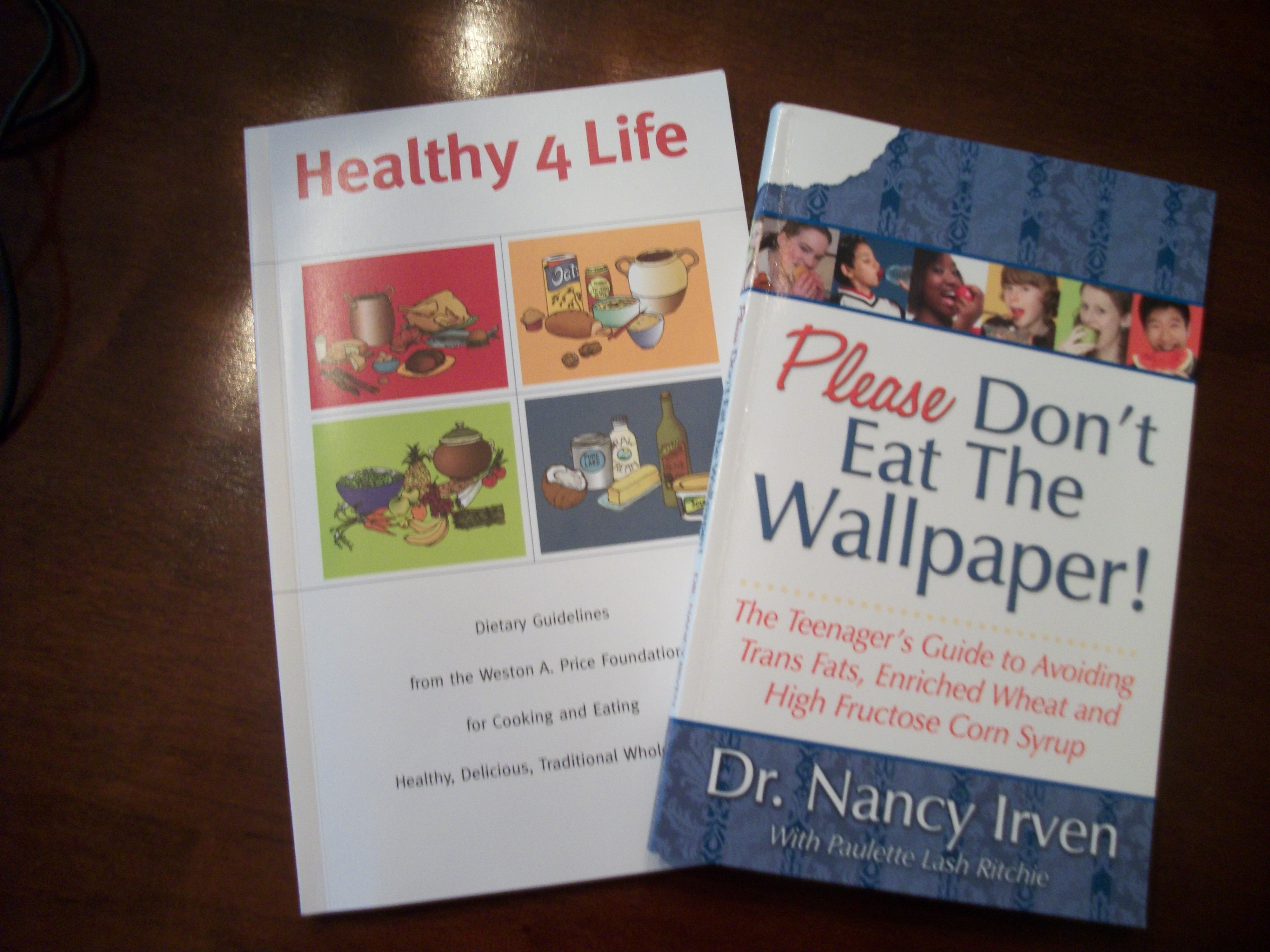
But, this past year, the WAPF came out with a very short little book–their answer to the travesty of the USDA’S food guide, whose formation is driven by the market–not science–and which is guaranteed to make you sick.  I really like this little book.  It’s an excellent and easy guide to changing your life.  NOURISHING TRADITIONS is an amazing book and is chock full of information, so that would be the next place to go in your journey.

WAPF will send you HEALTHY 4 LIFE for about $12.   They also have a great shopping guide and lots of informative pamphlets on soy (really bad), raw milk, and so forth.

In addition, Dr. Nancy Irven, after working with high school students, published PLEASE DON’T EAT THE WALLPAPER, available at amazon.com at least for about $14 as I recall.  Irven’s goal is to get students to own their own health and diet by first understanding why high fructose corn syrup, white flour, and trans fats are really bad sugar, glue, and plastic.  Get those three out of the diet, she explains, and the other bad additives, etc., drop out with them.  Irven has a light touch and funny sense of humor, and the high school program she’s been working with on diet has been highly successful.

In short, there’s so much really bad information out there that teenagers, who are often adrift on their own in terms of food anyway, don’t know what to eat.  Since this same condition is true for many Americans, Irven’s little book is useful for all ages.

Interesting Information: Homogenization of Milk and Cheese

Interesting Information:  June 13, 2011

Homogenization of Milk and Cheese

Steve Bemis is a retired corporate attorney who farms hay in Michigan for local farmers.  He is also a founding Board member of the Weston A. Price Foundation’s Farm-to-Consumer Legal Defense Fund–which works to insure greater access to local foods, especially raw milk.  In the Spring 2011 WAPF journal WISE TRADITIONS, Bemis poses an interesting theory about the real need for homogenization and pasteurization of milk (http://www.realmilk.com/cheese-is-serious.html).  The real reason, poses Bemis, might be the dairy industry’s incredibly profitable cheese business.

Let’s back up for a moment.  In my lifetime, one’s milk was delivered to the door in glass bottles.  One judged the milk by the cream line at the top of the bottle–clearly visible for all to see.  But, the dairy industry wanted that cream to make other products.  Ice cream, yes, but also cheese.

So, industry begin figuring out ways to get that cream.   How they did it was to, first, convince women that milk had to be pasteurized as real milk was unsafe–a claim never proven scientifically.  Second, they instituted, over time, a process of fractionalizing milk into parts and reconstituting some of the parts back into milk–minus all the cream.  (Whole milk might not have the whole amount of cream that came from the cow.)   Says Bemis:  “Milk, milkfat, skim milk powder and other fractions of milk are processed into cheese, butter, ice cream, yogurt, kefir, and other industrial component which are ubiquitous in processed and ultra-processed foods.”  Third, they successfully got the federal government to police this new terrain.  This is how industry works:  maximize profits any way possible, including gaming the information.

Processed, fractionalized milk was then homogenized, so no one could ever see the cream line again.  And, the glass bottles disappeared.  But, here’s where Bemis gets really interesting.  Once milk is homogenized, it “will go rancid within a matter of hours.”  Thus, the milk has to be pasteurized to keep it from going rancid.   “Hence,” writes Bemis, “once the dairy industry took the homogenizing step to follow the dollars, it had to pasteurize.”  Bemis continues:  “And the industry will have to stick with the gospel of pasteurizing, since their current economic structure requires it.”

Hmmmm….  Pasteurization came AFTER homogenization.  Pasteurization was NEVER about food safety.  It was about maximizing profits, fooling customers, and extending shelf life.

So, if you can’t get the whole, raw, living, healthy REAL milk, try to find a dairy that produces a cream line, even if the milk is pasteurized.  Homogenized milk is really, really processed.

Bemis then turns his attention to the cheese issue.  He asks an important question:  “Is contamination of raw milk a huge red herring keeping our eyes off a far more important reason for pasteurizing milk?”  Cheese is a keystone product for the dairy industry.  Cheese is a billion dollar business.  Cheese is probably why both the USDA and the FDA have launched even more intense, fear-based attacks against raw milk and against artisan cheese makers.

The good news, writes Bemis, is that “raw milk consumption continues to surge; FDA’s interstate ban is under legal attack, and FDA’s dogma is regularly being shown to be inconsistent, illogical and unscientific–an embarrassing and ever-deepening quandary in which the agency finds itself due to its steadfast refusal even to hold a dialogue on the subject.”

As for the USDA, one part of it promotes cheese consumption while another part (the new food guide) says its unhealthy.  How’s that for mixed agendas?  It’s time to locate any kind of government recommendations on how to eat somewhere other than the USDA and to put science back into the process.

Turkey Tracks: I Feel Rich: 5 Pounds of Processed Pecans

Turkey Tracks:  February 1, 2011

I Feel Rich:  5 Pounds of Processed Pecans


We’re almost out of the pecans my first cousin Teeny Bryan Epton and her partner brought to us last September.  (Thanks Teeny and Lori!)

With our friends Margaret and Ronald, we order many household items in bulk from Associated Buyers, located in New Hampshire.  AB delivers, also, to all our local coops, or cooperatively owned stores.  I ordered 5 pounds of organic pecans in this last order.  

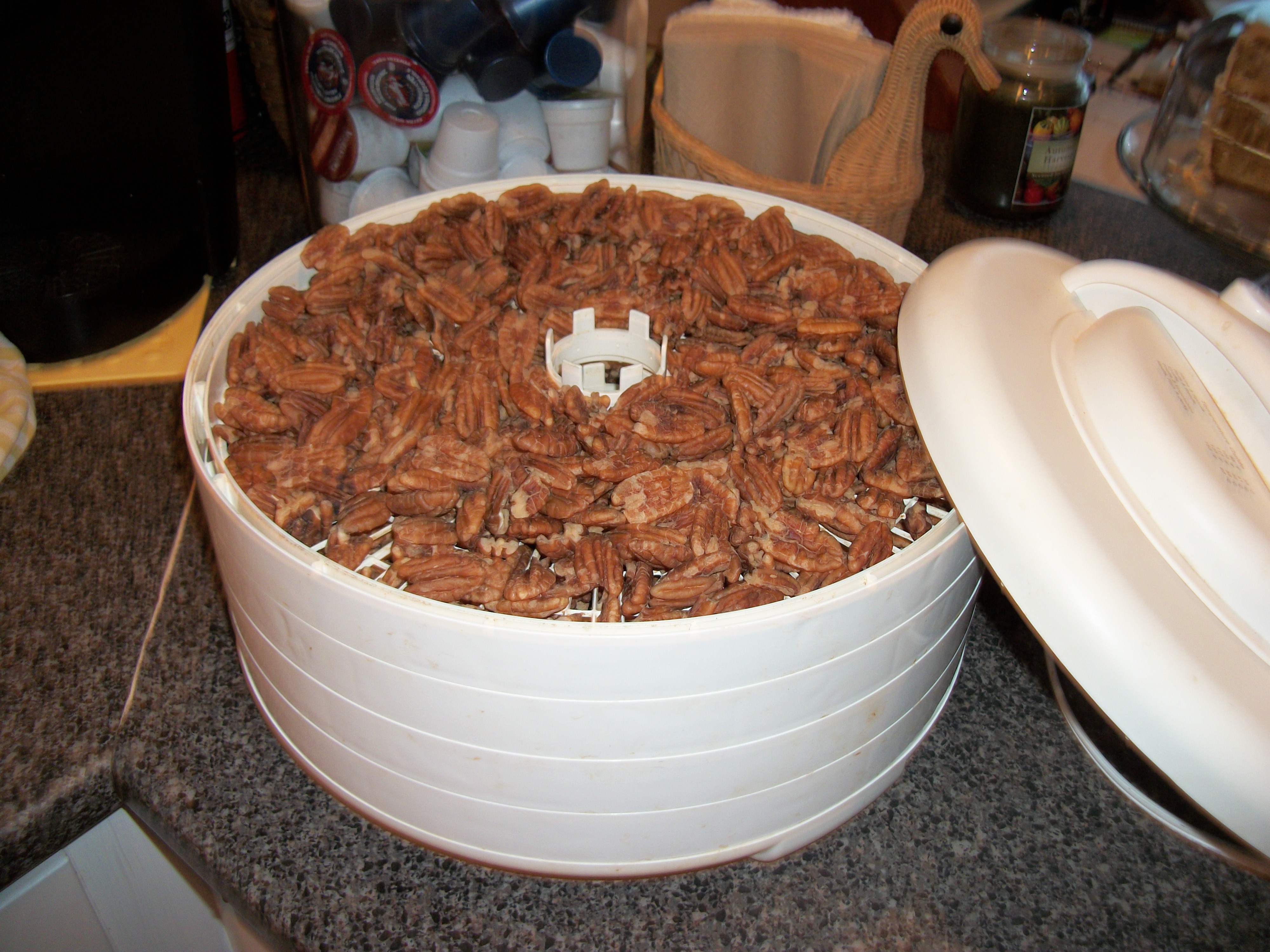
 I soak the nuts over night, dry them gently in the dehydrator, and store them in Mason jars.  Five pounds lasts for months and months.  I keep pumpkin seeds, walnuts, pecans, almonds, and, lately, hazelnuts.  Crispy nuts are delicious! 

ALL nuts, seeds, legumes, and tubers need to be processed in some way to remove the phytates that can prevent your body from absorbing nutrients it needs from many foods.  One prepares most nuts by soaking them in salted water over night and drying then in a dehydrator or an oven on very low heat.  Drying can take, sometimes, well over 24 hours.  I found this information and the recipes in Sally Fallon and Dr. Mary Enig’s treasure trove of a book, NOURISHING TRADITIONS.  Fallon and Enig are part of the Weston A. Price Foundation (www.westonapricefoundation.org).  (Be sure to use .org and NOT .com, which is a scam site.)  I trust the WAPF folks because they have the scientific credentials to understand the chemistry of food and human bodies and because they are not affiliated with industry in any way.

Here are the pecans in the four-tray dehydrator:

And, here they are all jarred up.  The big jar is a half-gallon size with which I’ve recently fallen in love.  Now I’m a rich woman!  I have food assets.

Turkey Tracks: Making Yogurt is Easy and CHEAP

Turkey Tracks:  January 13, 2011

Making Yogurt Is Easy and Cheap

Yesterday morning  when I tasted the yogurt that had been “making” overnight in the oven, I was, again, reminded at how absolutely delicious it is when it is just fresh, when it has not yet been chilled.  This batch had thickened up to a custard consistency, and it was like velvet on the tongue.  John and I each had a big bowl of it drizzled with nonheated local honey and sprinkled with some dried fruits and “crispy” nuts.

CRISPY NUTS:  Crispy nuts have been soaked in salted water over night and dried in a dehydrator or an oven on very, very low heat until “crispy.”  One does this process to remove the phytates present in the nuts and seeds.  Phytates can inhibit the full absorption of nutrients in a serious way.  Plants are way more chemically powerful than people realize.  Put the nuts into a large bowl, fill it with water, and add about 2 tablespoons of salt.  Let them soak from 12 to 24 hours.  They will swell up.  Drain them and dry them.  I prefer to dry my nuts in a dehydrator as it’s easier than my oven.  I never burn the nuts, which are expensive, in the dehydrator.  I got a cheap one for about $30.  But, it’s plastic, and since I use it all the time and since I’m learning that plastic off gasses around heat, I’m saving for a good metal dehydrator.   You can read all about phytates in Sally Fallon and Dr. Mary Enig’s NOURISHING TRADITIONS, which is a book that, among many other things, attempts to recover lost food preparation practices.

Anyway, here’s how you make yogurt so that you don’t even have to dirty a pan.

Milk–I use a half-gallon at a time.  And, of course, I’m using “real” milk.  Try to find milk that is NOT ultrapasteurized as it might not culture.  Ultrapasteurized milk is cooked milk; it’s a dead product.  You can read all about it in my essays.

2 packets of “yogamet”–which is a dried cultured yogurt product.  It comes in a box.  Inside are individual packets.  Look for it in the cooler section of a natural foods store or Whole Foods.  Trader Joe’s might have it.  After your first batch of yogurt, save about about 1/4 cup of yogurt for your next batch.  Yogurt you’ve cultured yourself begins to make the thicker, custardy yogurt that is so delicious–though all the yogurt you make will taste really good.  One packet will culture one quart of milk.

Find a big bowl–non metal–that will hold your milk.

Turn on the oven to 200 degrees, and when it reaches that temperature, turn it off, put your bowl inside and cover it with a plate.   (No plastic or foil please.)  Close the door and go to bed.  In the morning you will have yogurt.  On very cold days, sometimes mine is still too runny.  I put it in a warm place (like under a cabinet light or on the stove or back in the stove with the oven light turned on) and give it more time to jell.  You’ll know if it’s still too runny.  It will not spoil if you leave it out until it jells, and it will jell eventually, as it’s cultured.

****

Greek yogurt is just yogurt with some of the whey–a clear liquid–drained out.  You can make yogurt cheese by draining off all the whey.  Whey is full of protein, though, so when you drain off the whey, you are leaving the milk solids and fat behind, and they need protein to process properly in your body.  So, don’t eat too much Greek Yogurt.

I often drain some of my yogurt to get some whey.  I use it to culture sauerkraut (see that recipe elsewhere on this blog); put some in homemade mayo to culture it so that it lasts for weeks in the refrigerator; use a few tablespoons when soaking dried beans, grains, or flour; and so forth.  Whey is an amazing preservative and a detoxifying agent.   You can drain yogurt by putting a paper towel, a napkin, or some cheesecloth in a colander, putting in some yogurt, and placing the collander over a deep bowl to catch the whey.  I put a plate over the colandar.  Whey keeps for weeks and weeks in the refrigerator.  And yogurt cheese is great drizzled with honey and served with dried fruit (dates!) for a dessert.  Or, drizzled with olive oil and herbs for a spread.

Most prepared yogurt in stores is not only expensive, it is full of additives and sugar.  It is “jelled” with pectin, for instance.  And, the smooth taste comes from seaweed additives.  It won’t even drip out whey.

Wait until you taste your own yogurt.  You’ll understand what has been lost.  And, now, found.