Turkey Tracks: Dog House Chickies Update

Turkey Tracks:  October 20, 2012

Dog House Chickies Update

The Dog House Chickies are now nearly 3 months old and are close to being fully grown.  I closed up the dog house this week and put them into the big coop, where they are having a hard time of it.  As you may know, different coharts of chickens don’t like each other, especially at first, and the older bunch terrorizes the younger bunch.  Also, there is always a chicken who is the lowest on the pecking order, and that chicken takes an almost constant beating from some of the others.  It’s really quilt brutal.

(You can see earlier postings of these chicks by going to the right sidebar and clicking on chickens, under Turkey Tracks.)

Here’s what the three “chicks” look like now:
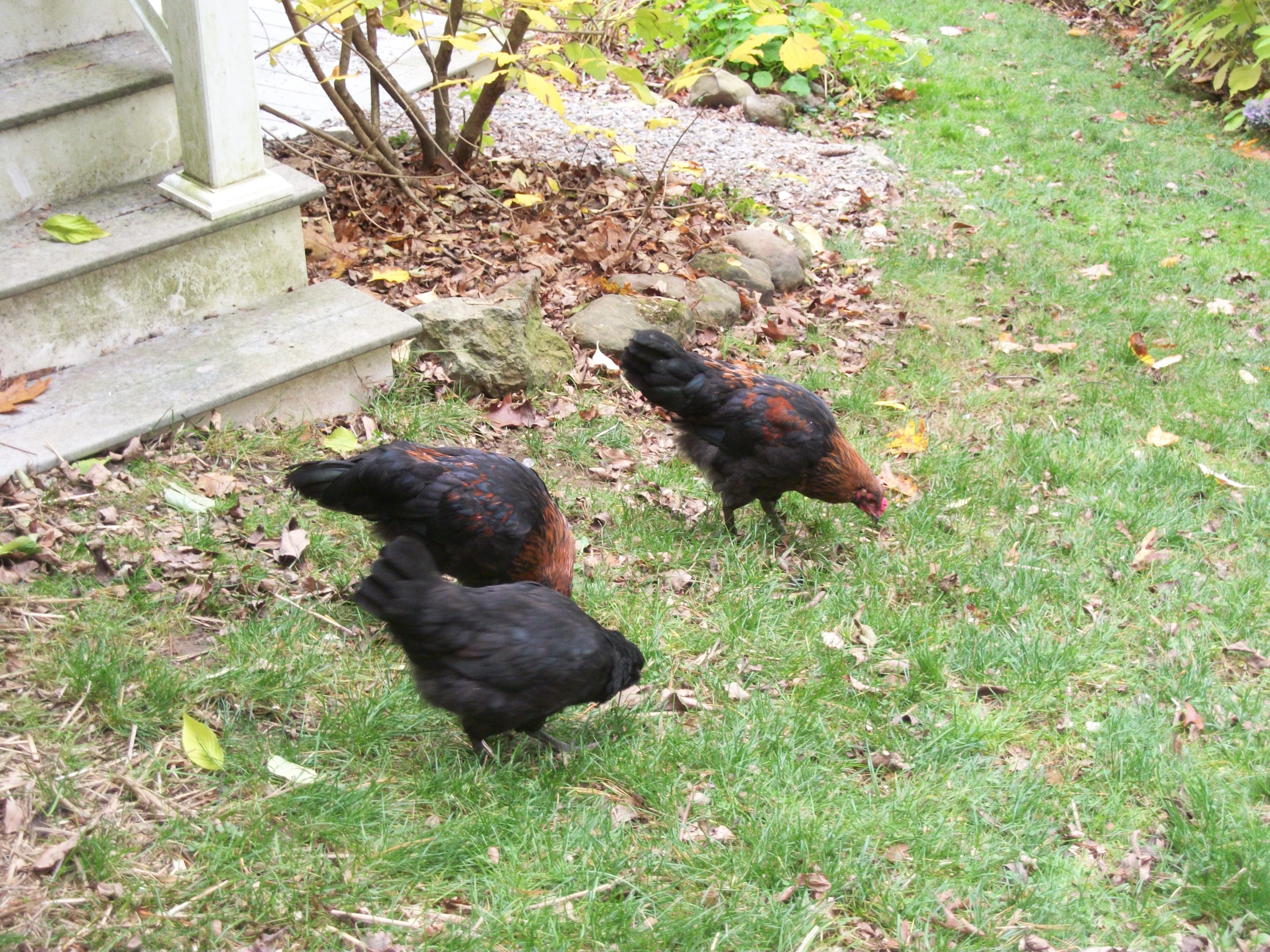
It’s hard to get a picture of all three of them close up as they are mostly wild.  Chickie Mommie (Sally) raised them entirely “on the economy” and taught them how to be safe.  Even when they were still in the dog house, I had to go out each night at dark and capture them in the large viburnum bush where they like to roost and physically put them into the dog house.

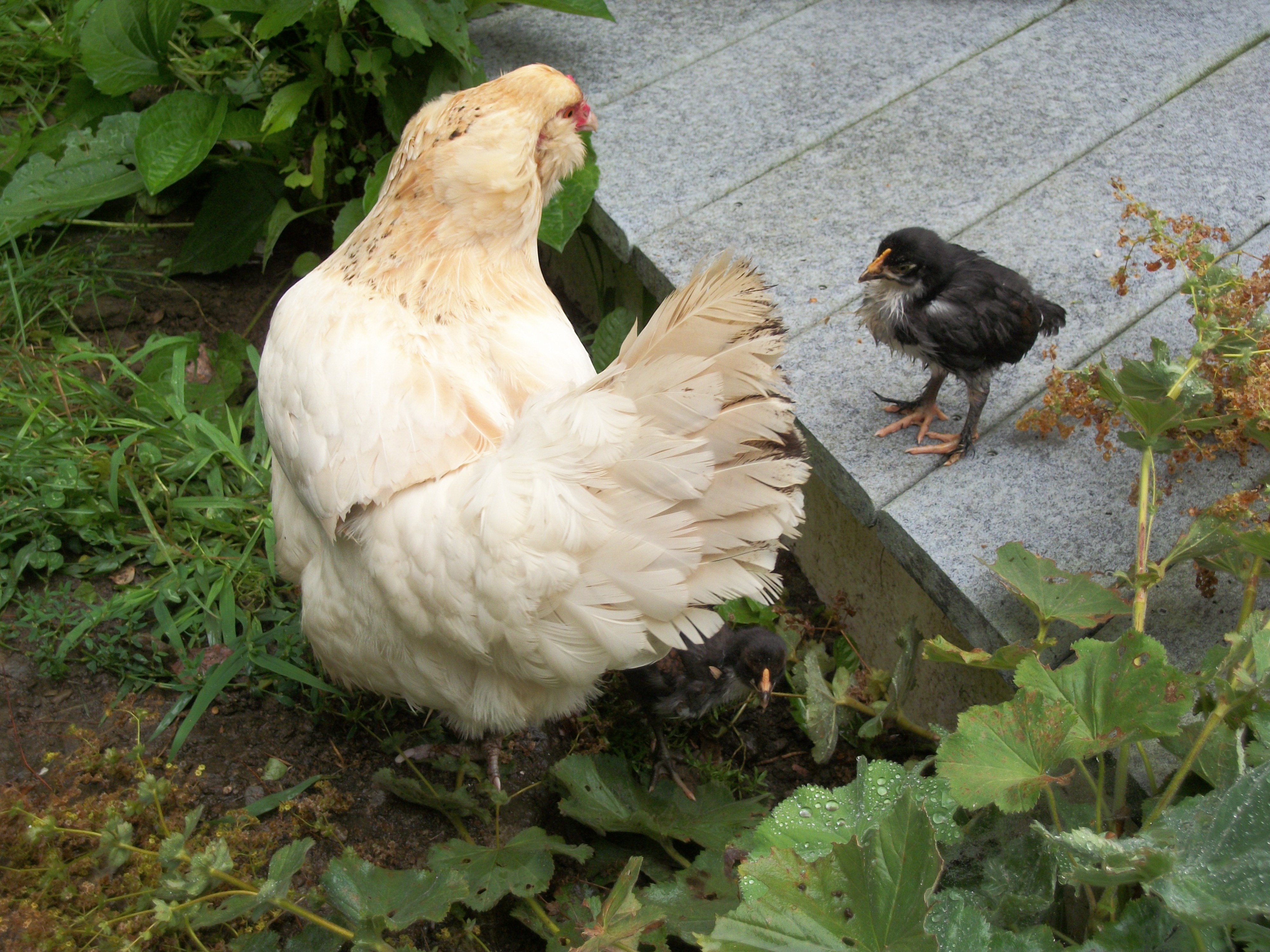
To remind, here’s a pic of Chickie Mommie (Sally) just after she brought her babies out of the dog house.  The chick in the foreground is the full-blooded Copper Black Maran.  See the feathered feet?  Note, too, the chick hiding beneath her body, just under her tail.
Sadly, about two weeks ago, a fox ate two of my chickens:  Annie, a full-blooded Copper Black Maran that I raised from an incubated egg and Chickie Mommie, one of the last two chickens from my original chickens.  She was a Wheaten Americauna and laid beautiful blue eggs.  Now I have one Copper Black Maran hen and one Wheaten Americauna.

I named one of the dog house chickies–Blackbird.  She’s the all-black chicken in the front of the first picture above.  I’m pretty sure she is a she since she’s very docile and acts like a hen.

Here’s a pic of the two mystery chickens:

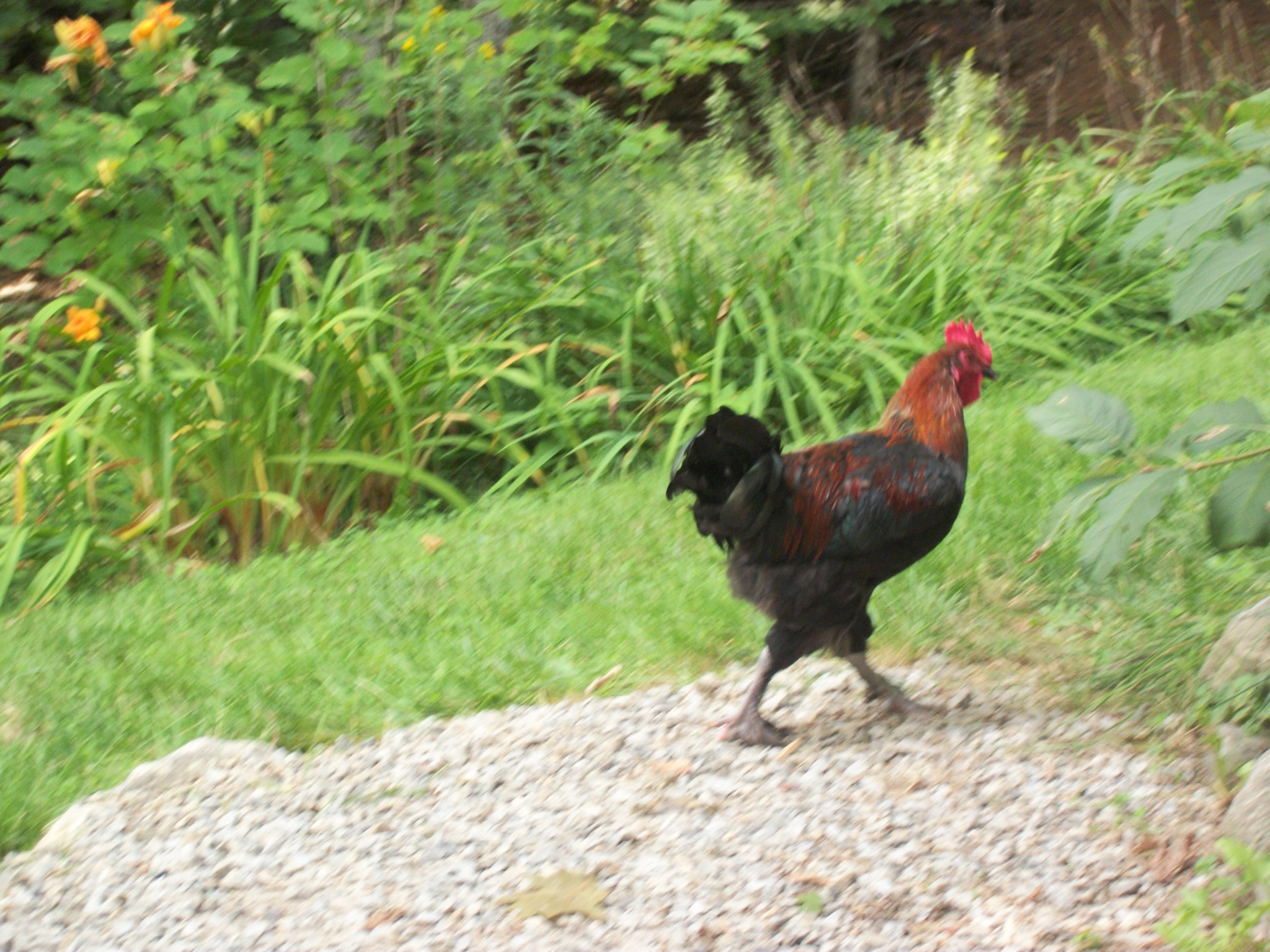
I can’t tell which one is the Maran–I have to see his/her feathered feet.  The other one is the Americauna/Maran cross.  Both are looking like roosters…   The Maran, in particular, behaves like one.  But, the other  may well be a hen.  Maran roosters  have big combs and waddles, but Americaunas do not.  The highly colored feathers look like roosters.  I’ve never had the courage to upend either one of the two roosters we’ve had (Napolean and Cowboy) to look at their equipment to see if one can tell the sex.  Time will tell…

In any case, no names for these two as we cannot keep a second rooster.  Or, three of them.  Roosters fight, which is why on a farm they…provide meat.

x
Turkey Tracks: New Chickens

Turkey Tracks:  September 2, 2011

New Chickens

Over the summer, I have replenished and expanded, by one, our chicken flock.

First, two of the older Copper Black Maran hens went to Rose’s farm.  She wanted more dark brown eggs, and we have the new CB chickens, so she will keep the best of those roosters and try to place the rest.  Remember, that we got a “straight run” of 15 CBM chicks from Tom Culpepper last May.  Half of all “straight runs” are, statistically, male.  To no one’s surprise, we have 7 CB Maran roosters.  Indeed, half of all just-born farm animals are male.  And, you cannot keep a lot of males.  Rose has a big flock, so she may be able to have two strong roosters.  But, maybe not.  They still have to go into the same chicken house at night.  Anyway, Rose now has breeding stock to reproduce the CBMs next spring, and I have a back-up CBM rooster.

Napoleon, or “Nappy,” has been rehomed to a lovely woman just starting a flock up north of Belfast.  Rose has agreed to part with one of the two older hens so Julia can have a pair and can raise babies.  Nappy was a terrific rooster with the hens–he took such good care of them–but when they were laying or when he was fenced, he was very protective of the coop and the hens.  He was just too aggressive for the grandchildren or for Jessica’s children–when she comes to take care of the house, chickens, and dogs when we go to Charleston or otherwise travel.  As beautiful as he was–and he was GORGEOUS, it wasn’t worth the risk.

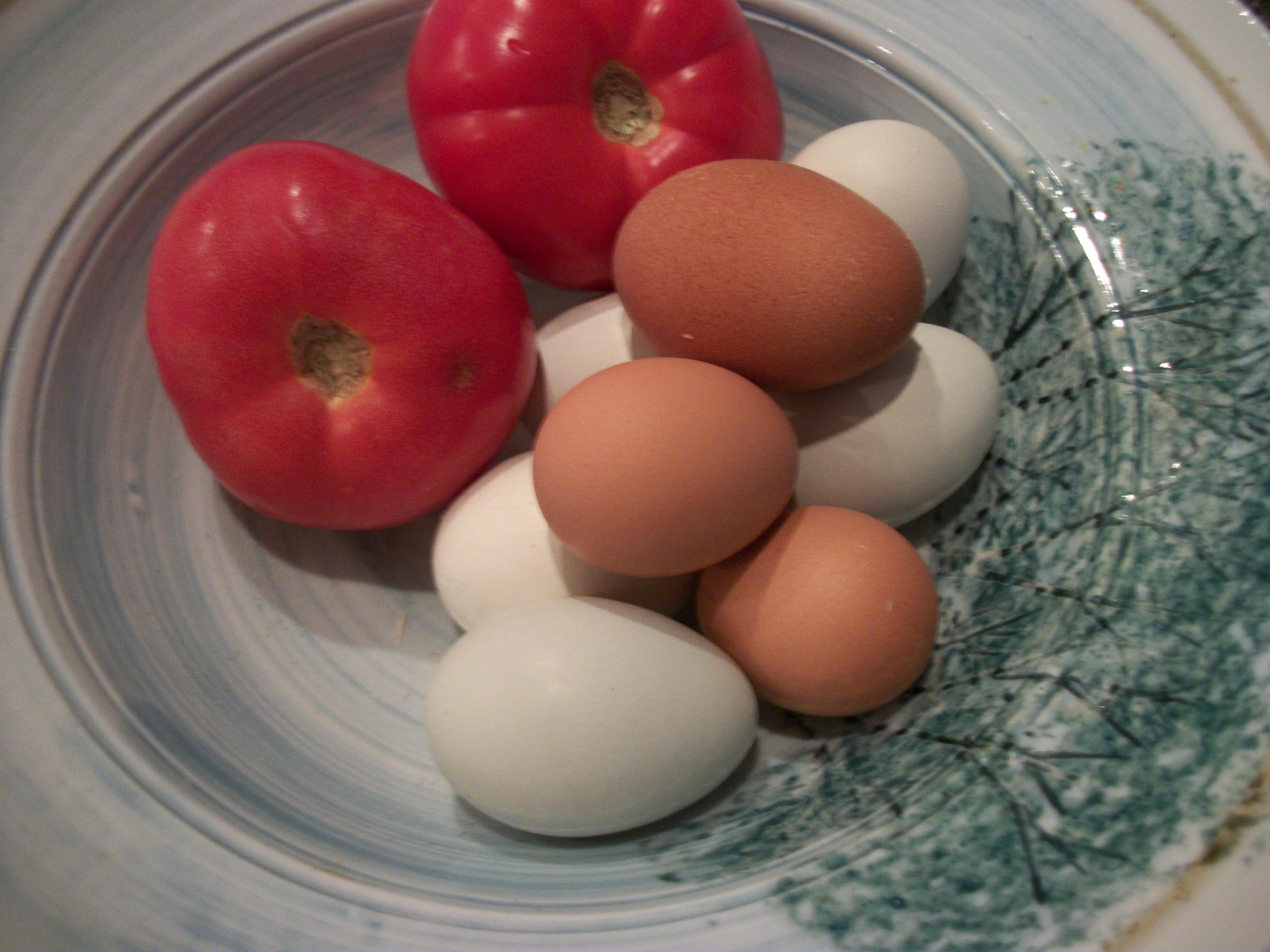
Valentine, otherwise listed here earlier as Chickie Honey Ginger, changed her name when she got a bit bigger.  She’s a sweetheart–a Freedom Ranger meat bird/layer.  She’s HUGE, and, at first, layed a tiny little rosy brown pullet egg when she was only barely four months old.  Here’s a picture.  The larger, darker brown egg is Chickie Annie’s, a CBM who is a year old now.  The cool thing about Valentine’s eggs are that, even as tiny pullet eggs, they are almost always double yolked!

Here’s a picture of Valentine with our 3 “older” hens now–the two wheaten Americaunas, Sally and Nancy, and the CBM chick I raised last summer, Annabelle, or Chickie Annie.

Valentine is only about 10 days older than the CBMaran chicks and the “blue egg” chicks Rose raised this spring.  But, she’s TWICE their size.  She kind of moves between the older hens and the newer three, 2 CBMs and 1 wheaten Americauna from Rose’s rooster William–part of Rose’s “blue egg” chick bunch this spring.  The new girls are scared to death of the old girls and scared of us, though they are gradually settling in now and will come close to us.  I took this picture of them hanging out on the edge of the “chicken briar patch,” the raspberries, about a week ago.

That’s Pearl and Rosie, with our new roo, Pretty Pierre.  Ninja is in the briar patch.  These names come from the grandchildren this summer.

Here’s a picture of Pierre, the best I can do at the moment since he’s new to the group and is only just learning his roo duties.  AND, how to crow.

When Pierre first came, Valentine was very taken with him.  She tried to follow him, and that totally freaked Pierre out.  Remember she’s a very impressive fully grown hen, and he’s just a baby really.  When he got upset, she got even more upset, fluffed up all her feathers, which made her look even bigger, and charged him.  Mercy!  That was his first hour outside the coop cage.  John and I had to get him down out of the tall bushes to put him to bed in the coop that night.

Something happened the next day, as she had a torn comb and was all bloody.  John and I took her inside, washed it off, and put some calendula cream on it.  Here she is with her poor bloody head:

By the second night, she was sleeping next to Pierre in the coop.

So, we go into the fall and winter with 8 chickens–7 hens and a rooster.  The new girls will start laying this month.  We will be rolling in soy-free eggs from healthy chickens.  And, Valentine follows me everywhere when I’m in the yard, earnestly talking to me the whole time.

Chicken love!

Turkey Tracks: Copper Black Maran and Wheaten Americauna Chicks

Turkey Tracks:  May 24, 2011

Copper Black Marans and Wheaten Americaunas

In addition to the Freedom Ranger chicks, Rose and I had two other baby chick endeavors happening.  Because our CBMs have a white feather gene, we didn’t want to reproduce too many of them–although their egg color is a beautiful dark brown.  Also, we felt like we needed other breeding stock.  So, in order to keep the CBMs going–so we get enough for Rose to have more hens and so I could replace ageing hens whose laying has slowed down considerably (but who are as sweet as can be)–I ordered 15 CBM chicks for us from Tom Culpepper in Grantville, Georgia.  Tom’s chickens derive from a famous line–the Wade Jeane line of CBMs.   To recap, CBMs are NOT rare in Europe, but because of the fowl importation laws and avian flu, America has to get along with its own, rare CBM lines.  So, CBMs are rare in America.  Here’s Tom’s web site if you want to see some pictures:    http://www.mydarkeggs.com/home.

CBMs are spectacular.  They are both meat and laying birds, are BIG, and the rooster is gorgeous and a great protector.   The hens are docile and very social and great foragers.  The only problem with CBMs in Maine is that their generous combs can and do get frostbite, so a good owner lubes them up with vaseline a lot during the winter.

In addition to the CBMs, Rose and I wanted to get chicks from her Wheaten Americaunas.  These birds are also spectacular.  The hens are good layers of beautiful blue eggs, they’re lighter and can fly quite well, they’re funny and friendly and emotional, and are great foragers.  So, Rose isolated her Wheatens, collected eggs, borrowed my incubator, bought two more, and started incubating eggs.  She also included “backyarder” eggs, but as William was the father, they could likely be “Easter Eggers” who would lay a blue, olive, or blue-green egg.

Here are eggs starting to hatch:

Here are some newly hatched Wheatens  that are still wet and weak:

 Here’s a picture of the chicks at about 2 1/2 weeks, just after we got back from Charleston.

Now you can understand how fast the Freedom Rangers are growing!  (See below)  They’re only a little over two weeks older than these chicks.  The CBMs are the black shaggy chicks.  See their feathered feet?  They’ll lose the white fluff when they feather out.  The blond on the brick is a Wheaten Americauna.  She’s backed by a backyarder.  The light chicks in the front may be Wheatens as well.  It’s too soon to tell.  the little grey/lavender chick comes from Baby, the Blue Cochin mix (lays a blue egg) that Rose raised by hand.  Rose is keeping her!

Rose and I feel there should be more healthy baby chicks for sale locally, so that’s what Rose is trying to do.  Her backyarders are half Wheaten Americauna, so will have a good shot at laying blue range eggs.  She does have a Barbanter rooster as well, and there are two Barbanters in this batch of chicks.  They are beautiful, tall, rangy, spotted chickens who lay a white egg.  So, Rose’s egg collection is going to be so colorful!