Turkey Tracks: Surprise Big and Little Quilts

Turkey Tracks:  September 30, 2010

Surprise Big and Little Quilts

When fall arrives, I often mark the season, it seems, with some reorganization project.  This year, it has been reorganizing my quilting room.  I’m trying to see if I can get a Handi Quilter Long Arm Machine in there without losing too much functionality.  It will mean replacing some long work tables with the machine, but I won’t need those long tables if I don’t have to hand layer and pin large quilts. 

Getting a long-arm is a long-held dream.  And, it’s a bit scary.  There’s a whole new learning curve for one thing.  Will I be able to master it to my levels of perfection, which are huge?  Will I be able to assemble the thing?  Will I be able to do the classes, which are 3 hours away?  Will I be able to use my existing threads?  It’s a process I’ve been inching toward for about 5 years now.  Getting a long-arm will significantly increase my productivity.  And I have about a dozen quilt projects lined up to do, and I love to piece.  And, I don’t ever want to give up learning something demanding and new.  Especially not something that brings so much pleasure to so many people. 

My younger son Bryan and his wife Corinne are expecting their first child, a girl, in early December, and we are so excited.  When they were here this summer, Corinne and I picked out fabrics for a diaper bag, two sets of fabrics for receiving blankets, and fabrics for a lively, colorful quilt.  I also have fabric for a baby quilt for my niece, who is expecting her first child, a boy, about this time.  And, my older son’s wife, Tami, went home this summer with my placemat loom, her own loom which my husband John made for her, and all her fabric already cut into strips.  She left me with the napkins, which I can hem in short order.  (We’re going to work on the placemats together at Thanksgiving.  I think she has a picture of a finished one on her blog:  http://6enrights.blogspot.com ).  And, I have a new purse cut out for me.  My current purse is in shreds.   

So why aren’t I working on any of these planned projects?  I’ve gotten badly side0tracked, it seems.  What’s going on?

Ok, whenever I finish a quilt, I take all the smallish bits of leftover fabric and cut it into useable sizes:  1 1/2-in strips for log cabins, squares from 2 to 6 inches,and rectangles in two sizes that I use.  I have bags of them now, and I keep telling myself that I need to start using them–though, as I said, I have at least a dozen other quilts to be made.  I’m always cutting out articles about interesting blocks to use “someday” for these scrappy leftovers.  This spring I saw an article in QUILTMAKER (March/April 2010) by Bonnie Hunter about a “Spinner” block that’s nice for scrappy quilts made with leftovers.  Hunter just keeps 4 squares in the block in one color as a unifying strategy.  Hunter says as she works she cuts leftover fabrics into sizes for the Spinner block and sews a block up when she has enough pieces.  Eventually she has a quilt.

I took out my sack of 2 1/2-inch squares and pulled out all the brights.  The unifying block would be red, though I added a few pinks and oranges to shake things up a bit.  Here’s what happened almost immediately:


Yes, there are two quilts.  I made the little one from the tiny triangles leftover from trimming out part of the Spinner block.  I think “possessed” would be the right descriptive word.   It took about a week!  Here’s a better look at the little guy,with which I’ve absolutely fallen in love.  I have no idea how I’m going to quilt it, but it seems to want some beading fringe at the bottom.   And, it will stay in my quilt room.


The big quilt–which is perfectly square despite the camera’s distortion of it–will go to someone.  There are bits of a black fabric with pink pigs in it.  I found more of it to use as the backing.  And, I think what’s going on with this whole surprise quilt thing is that the big quilt is meant to be my first quilt on the long-arm.  It’s made from scraps.  Well, ok, I did have to cut more fabrics in my stash to get all the colors, especially the red unifyling squares.  And I don’t have any emotional investment in it in terms of planning something special for a particular person.  I will be able to work on it without added stress.   

I promise, Bryan and Corinne and Tami, I’m going to get right onto our joint projects now that I’ve worked out this whole “use up the cut scraps” thing and have made the decision to call the long-arm people for prices.

Mainely Tipping Points 18

Mainely Tipping Points 18

 A New Kid on the Block:  Agave Nectar


In 2008, Rami Nagel decided to investigate agave nectar, a new kid on the sweetener block.  He discovered that agave nectar first appeared in 1995 at the Natural Products Expo West in Anaheim, California.  Sellers were advertising agave nectar as being an organic, all natural raw food with a low glycemic index; as being kosher; as being  grown in nutrient-rich soils; as being fair-traded; and as being sustainably harvested (Rami Nagel, “Agave:  Nectar of the Gods?,” WISE TRADITIONS, summer 2008, ). 

However, it is now clear that despite advertising hype and mislabeling issues, all commercial agave nectar sold in this country is highly refined fructose syrup like high fructose corn syrup (HFCS).  It is also clear that commercial agave nectar is particularly dangerous for diabetics.  Finally, it is also clear that agave nectar contains high levels of saponin, a toxic steroid derivative which can cause miscarriages, and should have warning labels.

Agave is not a cactus, but a succulent in the lily family.  Agave syrup is made from either the large, starchy root, which is shaped like a pineapple, or from the sap that appears when its bloom appears and is removed.  Both processes happen when the plant is about eight years old.  Both processes use industrialized practices—though the Nekutli company, whose brand is Madhava Agave Nectar 100% Natural Sweetener, claims otherwise.  Nagel notes that Nekutli vacuum evaporates the raw nectar and uses enzymes to hydrolize it, all of which removes the natural salts and amino acids and creates a high fructose syrup (“Agave:  Nectar of the Gods?”). 

Nagel discovered that some traditional people in Mexico do make an agave sweetener, called aquamiel, by boiling down nectar collected from the agave plant, much as we boil down maple syrup.  Nagel writes that this mineral rich syrup is thick and has a “characteristic smell and strong flavor.”  Aquamiel, however, ferments into sour and smelly fermented pulque within 36 to 48 hours.  And, traditionally made pulque is difficult to find, even in Mexico, as locations of the rare sources are closely guarded secrets and as pulque does not transport well (Nagel, “Agave:  Nectar of the Gods?”). 

The commercial development of agave nectar, Nagel learned, may have begun as a way to use waste products from tequila production, which also uses the agave plant (“Agave:  Nectar of the Gods?”).  In any case, refining agave nectar produces very high levels of fructose:  up to 84 percent (“Sugar by Any Other Name,” NUTRITION ACTION HEALTH LETTER, Jan/Feb 2010, page 4). 

This manmade fructose, as is true for HFCS, is “unbound” because it is no longer part of a plant’s other components, like its fiber and nutrients.  And, this manmade fructose has a different chemical structure than natural fructose.  Research is showing that as our bodies do not know how to manage this unbound fructose, they are turning it into fat, particularly fat that settles unhealthily around the abdomen.  In your body, explain Sally Fallon Morell and Rami Nagel in a 2009 article, agave nectar “may cause mineral depletion, liver inflammation, hardening of the arteries, insulin resistance leading to diabetes, high blood pressure, cardiovascular disease and obesity”  (“Worse Than We Thought,” WISE TRADITIONS, Spring 2009, 44-52).

Morell and Nagel interviewed Russ Bianchi, Managing Director and CEO of Adept Solutions, Inc., which is a “globally recognized food and beverage development company.”  Bianchi says agave nectar and high fructose corn syrup are made the same way, by “ `using a highly chemical process with genetically modified enzymes.’ ”  The process also uses “ `caustic acids, clarifiers, filtration chemicals and so forth in the conversion of agave starches’ “ (“Worse Than We Thought”). 

Morell and Nagel also heard from Dr. Martin Stutsman of the FDA’s Office of Labeling Enforcement, who explained that while corn syrup which is treated with enzymes that enhance fructose levels has to be labeled HFCS, the FDA does not require the label “High Fructose Agave Syrup.”  Dr. Stutsman did note that agave should be labeled as “hydrolyzed inulin syrup.”  So, Morell and Nagel conclude that labeling what is clearly a syrup a “nectar” is a misnomer the FDA is ignoring.  They also conclude that the difference between starches in corn and agave, when each is processed the same way, means that “agave syrup labels do not conform to FDA labeling requirements” and that the result is a “deepening” of the “false illusion of an unprocessed product.”  They further conclude that “if a sweetener contains manufactured fructose, it is neither safe, nor natural,” especially at such high fructose levels.

On October 2009, the Glycemic Research Institute (GRI) halted all agave trials, delisted agave, and banned agave products for use in foods and beverages—which means, according to the GRI web site, that “manufacturers who produce and use Agave and Agave Nectar in products are now warned that they can be held legally liable for negative health incidents related to ingestion of Agave” (www.glycemic.com/AgaveReport.htm). 

These actions were taken because diabetics in the test who had ingested agave nectar had life-threatening reactions and had to be hospitalized (Laura Johannes, “Agave Syrup May Not Be So Simple,” “The Wall Street Journal,” 27 Oct. 2009). GRI researchers believe that the “refined fructose in  Agave Nectar is much more concentrated than the fructose found in High Fructose Corn Syrup” (www.glycemic.com/AgaveReport.htm). 

GRI had performed three earlier trials, but none had included diabetics.  The second trial used agave from Western Commerce Corporation in California and researchers discovered that the agave syrup was adulterated with high fructose corn syrup to increase profits.  When the FDA came calling, company officials had left the country with millions of dollars in assets (www.glylcemic.com/AgaveReport.htm).  In the fourth trial that was halted, GRI used agave nectar from Volcanic Nectar, and it included a “significant amount of maple syrup” (Johannes). 

According to Morell and Nagel, yucca species (in the agave genus) contain “large quantities of saponins,” which are “toxic steroid derivatives, capable of disrupting red blood cells and producing diarrhea and vomiting.”  The saponins in agave should be avoided “during pregnancy or breastfeeding because they might cause or contribute to miscarriage by stimulating blood flow to the uterus.”  At the “very least,” conclude Morell and Nagel, agave products should carry a warning label indicating that the product may cause miscarriage” (“Worse Than We Thought”).

Morell and Nagel also warn that “since the FDA makes no effort to enforce food-labeling laws, consumers cannot be certain that what they are eating is what the label says it is.”  It’s a good warning to heed.  Read labels, question advertising claims, google strange ingredients, and share learning.  Remember, too, that labels change, so keep checking them.   And, avoid using products with lots of ingredients with chemical names.  Instead, use local, organic, nutrient-dense, whole foods and do your own cooking.          

For me, Agave Nectar is too risky.  For something sweet, I eat and cook a lot of local, organic fruit.  Honey Crisp apples are here this week!  I grow and gather and freeze organic, local berries for the winter.  Raw, unheated honey (the label should say unheated) from as local as possible is my sweetener of choice, followed by organic maple syrup.  I choose label-specified unheated honey from away if I cannot get local unheated honey.  I use sugar very sparingly for celebratory baked products.

Turkey Tracks: Cream of Tomato Soup

Turkey Tracks:  September 29, 2010

Cream of Tomato Soup

Late blight hit our tomatoes over the weekend.  I went out Sunday to harvest and realized that the long row of plants were all infected.  If you didn’t know, last year infected  tomato plants from nurseries grown down south and shipped north–mostly by the big box stores like Home Depot and Wal-Mart–wiped out the tomato harvest in New England.  Maine was no exception.  And, late blight also infects potatoes.  The spores from infected plants travel on air currents for as long a distance as forty miles. 

Given the fact that it rained here every day last summer for all of June, July, and the first of August last summer, my tomato plants did not grow and did get the blight.  I was able to harvest my potatoes, but the plants did have signs of the disease.  I carefully bagged all the plants and hoped for the best for this year.  We did not have a really cold winter, so I crossed my fingers.  Mostly, I think I got away with it as we’ve had a bumper crop of tomatoes before last Sunday–though many on the plants were still really green.  I think I need a small hoop house for the tomatoes.  I saw this one at the Common Ground Fair this year.  It’s called a giraffe hoop house, and it does not take up much space:


My potato plants seemed ok, though the harvest was light.  It’s been dry here this summer, and I was afraid to water too much as our well might go dry.  The tomatoes, as I’ve written, have been glorious!  I cannot complain.  But, I’ve spent a lot of time putting up sauce, and now I’m out of freezer space–especially since we just got our annual lamb for the freezer.  Thus, I started looking at other ways to use tomatoes.  And, voila!  I fell upon cream of tomato soup.  It’s dead easy and amazingly delicious!  I’ve combined recipes from several sources, so basically, I think it’s just mine.

Cream of Tomato Soup

Three or four pounds of ripe tomatoes–skinned, which is basically simple.  Just dip them in boiling water for 30 seconds or so, transfer them to cold water.  Use some ice if you have extra.  Take out the core with a small, sharp paring knife, slip off the skin, and drop the tomato into your pot.

Add 5 to 6 tablespoons of organic butter and some salt

Heat the whole mass, covered, until the tomatoes break down.  Cook, covered, for at least an hour.  Two is better.  There should be lots of liquid, but keep an eye on the pot so the liquid does not cook off.

Next, you have a choice.  I mix it up with a hand blender, which is an essential tool in my kitchen.  You could also put the hot soup into a blender and risk burning yourself.  You could mix it with a hand mixer.  You could strain it.  With the hand blender, I’m not straining out the seeds, but I don’t seem to notice them after I’ve used it. 

Next, you had heavy cream to the hot soup.  I am lucky to have local, organic raw cream.  Adding more dilutes the tomato taste, but makes the soup creamy.  Find the balance you like, season with additional salt if you like.

Eat and enjoy.  It’s beyond delicious if you’ve got good tomatoes! 

***

When we were done ripping out and bagging diseased plants on Sunday, we had two big boxes full of green tomatoes and beginning to ripen tomatoes.  We threw out the tomatoes that obviously were going to get late blight spots while ripening.   (Yukko!)  We wrapped the big Brandywines in newspaper and put them into a dark, cool closet.  We put the tomatoes that were tinged with color in the kitchen windows.  And, I cut up the green, hard paste tomatoes and put them into the dehydrator.  We’re going to have “dried green tomatoes” AND “fried green tomatoes.”  I plan to try adding them to soups and stews.  And, I’m going to try to reconstitute them and roast them with winter vegetables.  They should add a nice zing.

Roasting Green Tomatoes

One of my favorite food combos and recipes  in the fall is roasting green tomatoes cut into chunks, with dense sweet squash (like a buttercup) or sweet potatoes, with newly harvested small potatoes (like red or gold)   small, whole onions.   I toss them with olive oil, salt, and generous amounts of rosemary and/or thyme.  I’m pretty sure this combo comes from Anna Thomas’s THE VEGETARIAN EPICURE.  It doesn’t hurt to parboil the potatoes.  Roasting at 350 for about 45 minutes is about right.

Try it!  You’ll like it.     

I still have a pile of ripening tomatoes on the counter to process.  And, all the tomatoes in the kitchen windows, assuming they ripen without being ruined by late blight spots.  So, I’m not done with tomatoes yet. 

FEDCO sent our fall garlic yesterday–the planting of which is the last task in the garden.  Though the cold frame is loaded with seedlings just emerging.  And, oh yes, I have to clean this year’s garlic which is presently drying in the top of the garage.


Mainely Tipping Points 17: High Fructose Corn Syrup

Mainely Tipping Points 17

High Fructose Corn Syrup

 Despite the food industry’s attempt to tell us so, all food calories do not have the same impact on our bodies.  Nor are all sugars equal.  Most sweeteners are formed from three different sugars (sucrose, glucose, and fructose), and each has a different impact on the body. 

 Sugars are carbohydrates, and, according to Dr. Natasha Campbell-McBride in GUT AND PSYCHOLOGY SYNDROME (2004), all carbohydrates are made of tiny molecules, called monosaccharides, or monosugars.  Glucose and fructose are monosugars, so do not need digestion.  They enter the gut directly.  Sucrose is a disaccharides, or double sugar, and it and other double sugars (lactose from milk and maltose from starches) require “quite a bit of” digestive work in a healthy body to reduce them to absorbable monosugars.  Unhealthy bodies harbor these undigested sugars in the gut, and an unfortunate chain of disease begins as these sugars feed “pathogenic bacteria, viruses, Candida and other fungi,” which themselves begin to produce toxic substances that “damage the gut wall and poison the whole body” (79-81).        

Most sweeteners have different sugar compositions.  High Fructose Corn Syrup (HFCS) is typically 42-55 percent fructose and 45-55 percent glucose.  Honey is 50 percent fructose, 44 percent glucose, and 1 percent sucrose.  Only raw sugar is 100 percent sucrose  (“Sugar by Any Other Name,” NUTRITION ACTION HEALTH LETTER, Center for Science in the Public Interest, Jan/Feb 2010, page 4).  But, as Sally Fallon Morell and Rami Nagel explain in WISE TRADITIONS (Spring 2009), the type of fructose in HFCS is not the same as fructose from fruit and our bodies do not know how to process it into energy (“Worse Than We Thought,” 44-52).

Industry creates HFCS from corn starch, which largely comes from genetically modified corn.  For an amusing, but serious explanation of how HFCS is made, take a look at the movie KING CORN (2007).  A not-so-funny fact surfaced recently according to Morell and Nagel :  nearly 50 percent of samples of commercial HFCS contained mercury, which was found also in nearly one-third of “55 brand-name food and beverage products where HFCS is the first- or second-highest labeled ingredient” (47).

 Fructose in fruit, report Morell and Nagel, is “part of a complex that includes fiber, fatty acids, vitamins and minerals.”  The fructose in HFCS is a free, unbound fructose with an important chemical difference.  Most fruit fructose is D-fructose, or levulose, but HFCS fructose is L-fructose, an artificial compound which has “the reversed isomerization and polarity of a refined fructose molecule.”  Thus, the fructose in HFCS is “not recognized in the human Krebs cycle for primary conversion to blood glucose in any significant quantity, and therefore cannot be used for energy utilization.”  Instead, HFCS, like all refined fructose sweeteners” is “primarily converted into triglycerides and adipose tissue (body fat).”  

Indeed, report Morell and Nagel, a new study published in the “Journal of Clinical Endocrinology and Metabolism, “found that obese people who drank a fructose-sweetened beverage with a meal had triglyceride levels almost 200 percent higher than obese people who drank a glucose-sweetened beverage with a meal.”  Chronic, high triglycerides, remind Morell and Nagel, cause increased insulin resistance, inflammation, and heart disease (47).

Nancy Appleton and G. N. Jacobs, in WELL BEING JOURNAL, reported that two published studies (2010) from Princeton University demonstrated that HFCS causes obesity in rats The researchers think that HFCS is more fattening than sugar because it is not bound to anything, which, in turn, allows it to be processed in the liver into fat—substantially abdominal fat—a risk factor for high blood pressure, heart disease, diabetes, and cancer.  Sucrose is” metabolized by insulin from the pancreas and is more readily used as an energy source.”  Additionally, HFCS bypasses the body’s ability to create satiety, or feeling full (“High Fructose Corn Syrup and Obesity,” WELL BEING JOURNAL, Sept/Oct. 2010, 9-10).  Morell and Nagel note that since all fructose is metabolized in the liver, the livers of test animals “fed large amounts of fructose develop fatty deposits and cirrhosis, similar to problems that develop in the livers of alcoholics (48).”

Rats aren’t humans.  But epidemiologist Devra Davis in THE SECRET HISTORY OF THE WAR ON CANCER (2007) notes that industry has been very adept at both decrying and promoting animal studies:  “Where animal studies on the causes of cancer exist, industry faults them as not relevant to humans.  Yet when studies of almost identical design are employed to craft novel treatments and therapies, the physiological differences between animals and humans suddenly become insignificant” (xii).  So, Davis argues, dismissing animal studies is a type of reasoning that is both “morally flawed” and “ignores one simple fact:  the same basic structure of DNA is found in all mammals (8)”  Davis writes that she has witnessed in her professional life “the maturing of the science of doubt promotion,” or “the concerted and well-funded effort to identify, magnify and exaggerate doubts about what we could say that we know as a way of delaying actions to change the way the world operates” (xii).  Thus, “treating people like experimental animals in a vast and largely uncontrolled study,” while ignoring data from animal studies showing direct cause-and-effect data, is ”morally indefensible” (8).

Morell and Nagel report that HFCS entered the market in the early 1970s, but the FDA did not grant it GRAS (Generally Recognized as Safe) status until 1996, “after considerable pressure from the industry” (mainly Archer Daniels Midland and Cargill) as negative research begin to emerge.  Nevertheless, “HFCS represents the major change in the American diet over the last forty years” as it has replaced more expensive sugar in most soft drinks and is “increasingly replacing sugar in baked goods, bread, cereals, canned fruits, jams and jellies, dairy desserts and flavored yoghurts.”  This substitution is occurring despite research showing that while refined sugars have “empty, depleting, addictive calories,” HFCS is “actually worse for you” (44-45).

 The Center for Science in the Public Interest (CPSI) notes that industry has added so many sugars to processed foods that “the average American swallows 350 to 475 calories’ worth of added sugars each day,” all of which are empty calories (“Sugar Overload,” NUTRITION ACTION HEALTH LETTER, Jan/Feb 2010, 3-8).  Dr. David A. Kessler, a former FDA commissioner, in THE END OF OVEREATING (2009), focuses on how industry has added sugar, salt, and bad fats to processed foods, which is changing a pattern where “for thousands of years human body weight stayed remarkably stable” (3). 

The HFCS story gets worse.  A team of researchers at the University of California Los Angeles Jonsson Cancer Center released a study on 2 August 2010 revealing that pancreatic tumor cells use fructose to divide and proliferate.  Dr. Anthony Heaney said that tumor cells thrived on glucose, but used fructose to proliferate.  He specifically referred to Americans’ use of refined fructose consumption.  Our use of HFCS has increased 1000 percent between 1970 and 1990 (Maggie Fox, “Cancer Cells Feed on Fructose, Study Finds,” 2 Aug. 2010, Reuters).         

HFCS can cause high blood pressure.  A study from the University of Colorado Denver Health Sciences Center recorded the eating habits of over 4,500 adults to determine that amount of HFCS each was consuming.  Those consuming “more than 74 grams of HFCS (the equivalent of 2.5 servings of soft drinks) exhibited `significantly increased risk of developing hypertension.’ “  Indeed, “the study concluded that HFCS consumption can raise blood pressure in adults with no history of hypertension, independently of any other causes” (“High Fructose Corn Syrup = High Blood Pressure, WELL BEING JOURNAL, March/April 2010, 6).   

 Connections are being made between HFCS and gout.  Fructose increases uric acid, and uric acid causes gout.  A study of about 46,000 men who got “at least 12 percent of their calories from fructose” were” twice as likely to be diagnosed with gout” (“Sugar Overload,” NUTRITION ACTION HEALTH LETTER, Jan/Feb 2010, 7). 

 I found much more information showing that HFCS is a dangerous product that is causing humans significant harm.  It’s also likely that industry knows how dangerous it is, but uses it anyway because it is sweet and cheap.  Remember that industry is legally organized to behave this way.  What you can do is to eat nutrient-dense, organic, local foods to maintain your health.

Turkey Tracks: Bottled Sunshine

Turkey Tracks:  September 7, 2010

Bottled Sunshine

Fall is here.  The light is changing again, and it is unlikely we’ll feel like swimming any more with the arrival of cooler weather.  The trees have not really started to change much, though a few are tinged with color.  The beans and summer squashes are slowing down, but the tomatoes are coming in.  In Maine, September is the red month.

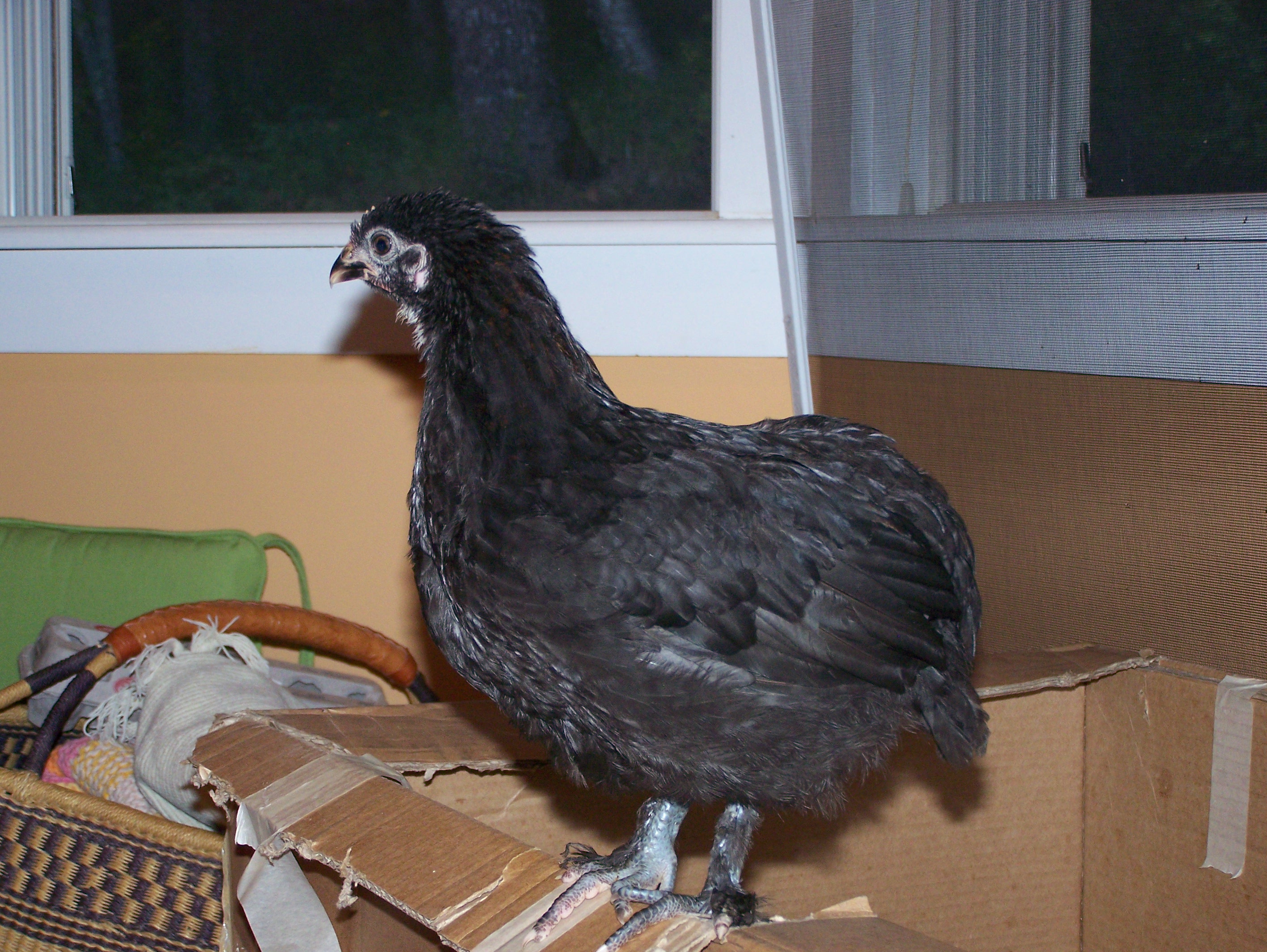
Our solo chickie, Orphan Annie is 2 months old this week.  Here she is, perched on her inside box, which she is rapidly outgrowing.  I put a screen over the top, and we are up to two books now to weight it down.  She was “OUT OUT” to be with us, but she is NOT reliable about pooping.


 She still looks like a female.  And, she scratches like one.  There are some little bumps where spurs might grow, so I have to get one of the big hens down and see if they have marks there.  I’m letting her loose more now with the big hens, as long as John or I are there to run interference.  The Wheatens are not aggressive with her, but her mother and the others are.  Especially if she is eating something they want.  She spends the day outside in a smaller pen that Rose lent me, and she hates it.  Maybe I’ll try penning her under the big coop later today.

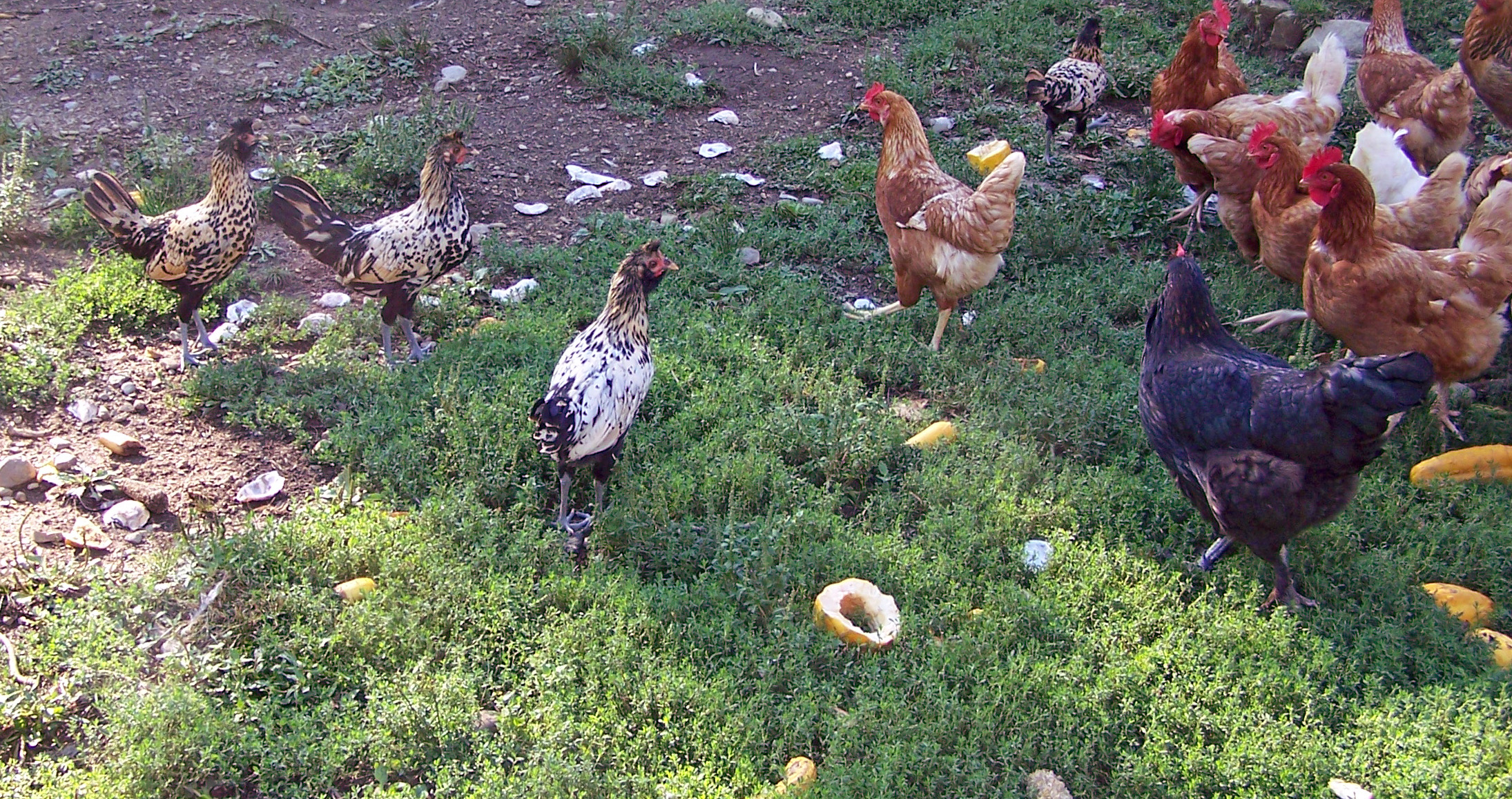
We visited Rose and Pete last Sunday.  I wanted to see how the Barbanter chicks were developing.  They are about 3 weeks older than Annie.  Rose has mixed them into her flock, but they have a protective mother–the large Copper Black Maran to the right.  There are 4 chicks:  the fourth is in the upper right part of the picture.  Look for the speckles.  The red hens are Red Sex-Links.  And, they are egg-laying machines and very sweet.  Their beaks have been cut though; I think I wrote about that in an earlier post.  They lay a dusty rose-brown egg.

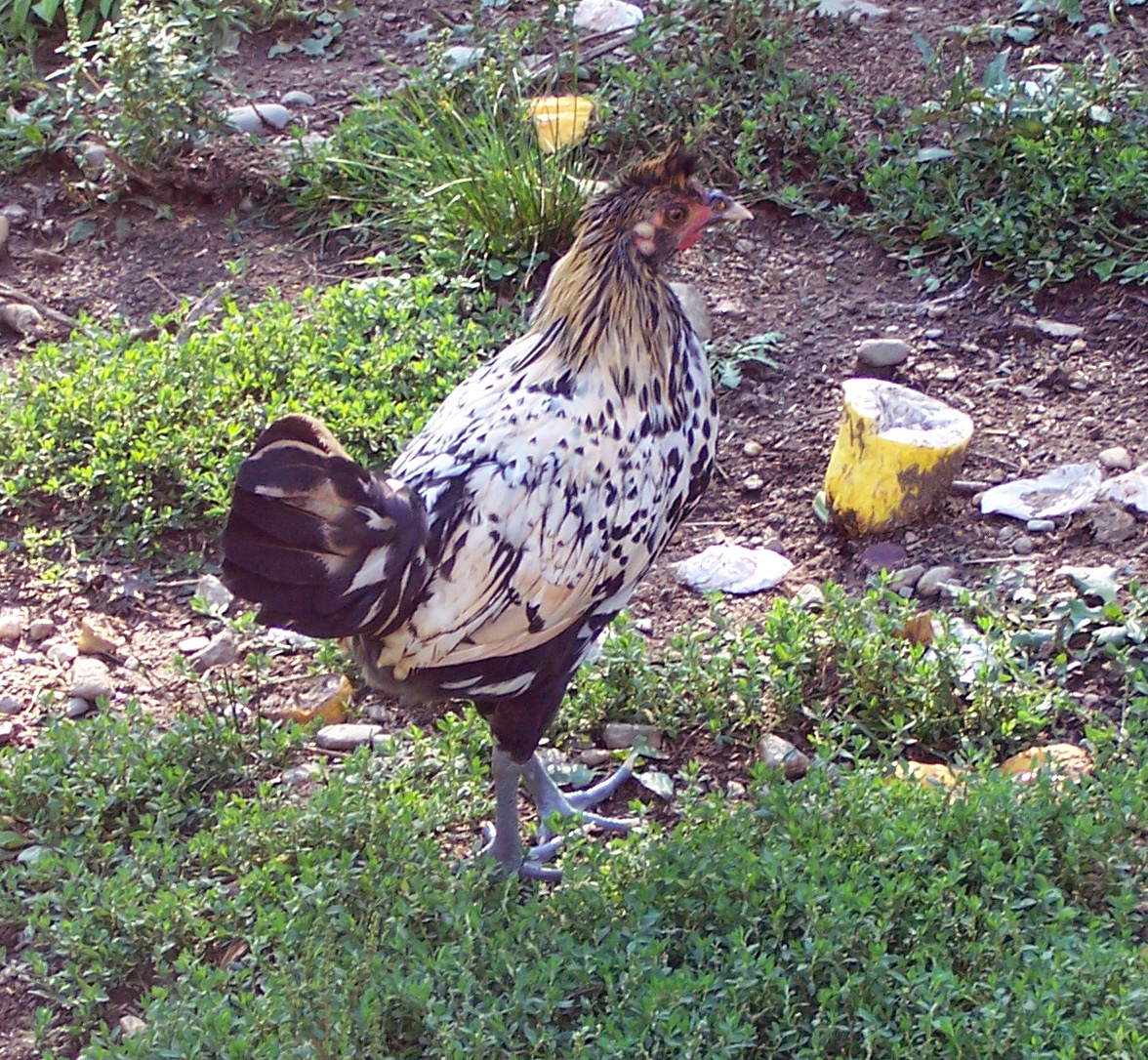
Rose and I first saw the Barbanters when we picked up the Marans and the Americaunas last March.  They are clean-legged and long and slender, with fluffy top-knots on their heads.  They lay a white egg, which in an egg box, can just bring the other colors alive.  Rose thinks one of these four chicks is a rooster.  Yeah!!  That means there will be more next spring… 

Here is a close-up of one of the chicks so you can see the coloring better.  The top knot is not yet fully developed.


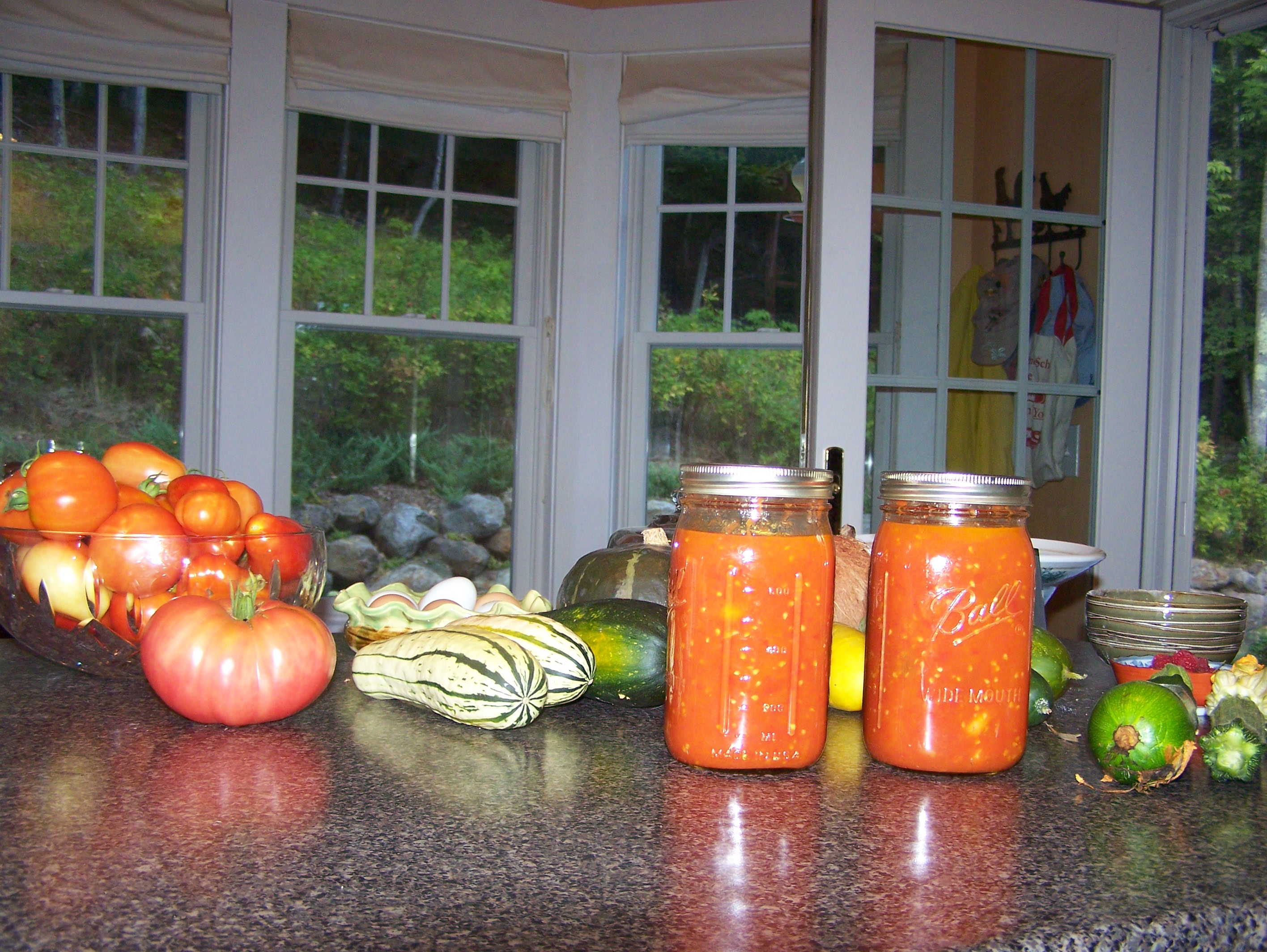
I spent most of yesterday processing food.  I had enough tomatoes to make 2 quarts of sauce.  I have to freeze my sauce since it has oil in it.  The recipe mostly comes from Anna Thomas’s THE VEGETARIAN EPICURE. 

Tomato Sauce:  Bottled Sunshine

I scald the tomatoes, skin them, cut them into chunks and throw them into a WIDE stainless steel skillet that’s about 5 inches deep.  You want to spread out the sauce as much as possible.  I add a good 1/4 cup of REALLY GOOD olive oil, some salt (I only use minimally processed sea salt), and turn on the heat.  When the tomatoes have broken down, I add 5 or 6 garlic cloves–just smashed or cut into big pieces and a handful or two of fresh basil leaves.  Cook down the mixture until the excess water has cooked off and the olive oil is starting to pool on the top.  At the end, you have to stir more frequently.  Spoon into canning jars, turn upside down on the counter until cool, then freeze.  Remember to leave enough room for freezing expansion.  Now you have bottled some sunshine for a cold winter day. 


We don’t eat pasta very often, so it’s quite a treat to reheat one of these quarts, spoon it over penne pasta, and top it all off with freshly grated Parmesan cheese.  It’s a complete meal with some French bread to sop up the sauce and a salad.  But, perhaps a better use is to add one of the jars, especially pint jars, to a chicken bone-broth soup. 


Roast Chicken Bone Broth

Bones have disappeared from American supermarkets.  But, bones are full of fabulous minerals.  It’s one of the healthiest things you can make.  And, it’s dead easy.

I roast a chicken about once a week.  Remember that we raised our current chickens with Rose and Pete Thomas, and we got a slower-growing type that we didn’t slaughter until they were 12 weeks old.  That meant that their bones had fully developed–unlike chickens raised to be 4 to 5 pounds in 6 to 8 weeks.  Having seen this process first hand, I can tell you that raising a chicken to be that big in that period of time is so not ok on so many levels besides the obvious one involving what nutrients they possess. 

I use about a 3-inch high roasting pan, and I make a layer of chunked vegetables:  celery (not too much; it’s strong), onion (the more the sweeter), carrots, and garlic.  I salt it and drizzle fat over it.  I used to use olive oil, but I’m moving toward using coconut oil or rendered duck fat, or chicken fat since they take high heat better.  (I’m saving the olive oil for colder uses.)  Put the chicken on top–after drizzling it with salt and pepper inside and out.  You can put some lemon and herbs inside the cavity.  Use whatever seems good to you and what you have on hand.  Sometimes I sprinkle dried herbs over the top, though I vastly prefer fresh herbs.

After you’ve roasted the chicken and eaten your first meal, take the meat off the bones and put ALL the bones (yes, the ones you’ve gotten from people’s plates), the roasted veggies, and the juices into a bowl for overnight storage.  Put some water into the roasting pan and scrape up the dark bits and pour that into your bowl of bones.  The next day, or the day after that, put the bone mixture into a kettle, fill it with water, salt it, and simmer it for 6 to 8 hours or so.  Replenish water from time to time.  Pour off the liquid through a strainer.  Pick out the used-up meat bits and carrots for the dogs, and throw out the bones.  Let the broth cool before putting it in the refrigerator.

You’ll have enough for a delicious soup, for drinking as a hot drink, and/or to freeze. 

You know, the other thing that is missing from American supermarkets is something that Europeans take for granted.  When they buy a chicken, they get the head/neck and feet attached.  In other words, they buy the WHOLE bird.  We butchered our chickens this way, and let me tell you, the broth made with the neck, head, and feet added back in insanely delicious.  All the neck bones have so much good stuff in them, and the feet are full of gelatin that makes the broth chill out as thick as jello. 

Start asking for slower growing chickens from your LOCAL farmers (Silver Cross or, even better, Freedom Rangers, which are better foragers).  And, ask for the WHOLE carcass.  And USE IT ALL.  The cost of an organic chicken only seems prohibitive until you start using the whole thing.  John and I get–from about a 4 1/2 pound whole chicken–4 meat meals and 6 soup meals.  The cost of the chicken divided by 10 meals makes it seem more reasonable.  It’s definitely healthier, which subtracts from the cost of chronic illness.

Green Bean Overflow

We had at least 3 pounds of beans to process this week after picking up our food from Hope’s Edge, our CSA, and picking our own garden.  I have Dragon’s Tongue beans–the seeds were a gift from Mike and Tami last year.  They are a colorful, lavender and cream striped bean that is big, flat, and very nutty sweet.  I also have the old green, bush bean standby, Provider.  From Hope’s Edge, we got purple beans (they turn green when cooked), yellow beans, and a tender green bean.  Here’s a picture of a mixture of all these beans ready to be steamed.


 Aren’t they pretty?

But, it’s a LOT of beans.  So, after we eat some steamed and with fresh lemon juice and fresh butter, I freeze some in smaller packets.  They are not great to eat as they tend to get a bit mushy.  But, they are great in soups in the winter.  I throw them in a few minutes before the soup is ready, just to heat them through.  I save a few handfuls from the batch, refrigerate them, and use them to make a cold salad that’s quite delicious and that I discovered while combining leftovers with fresh produce.

Cold Green Bean Salad

Combine the cold beans with some freshly cut-up cucumber, some halved SWEET cherry tomatoes (we have Sun Gold here), and some garlicky, mustardy herbed vinaigrette.  The dressing is simple:  smash a garlic clove with some salt  in a mortar with a pestle or a bowl with the back of a spoon.  Add in some Dijon mustard (I’ve grow to love the extra bold kind)–say a tablespoon–some red-wine vinegar–say 3 tablespoons–and slowly stream in some REALLY GOOD (extra virgin, first cold pressed) olive oil while whisking with a whisk or a fork.  When the mixture thickens, taste it to see if you need more olive oil.  Add herbs–whatever you have–and pepper.

Zucchini

The zucchini are finally slowing down.  I’ve got at least one more pile to grate and freeze today.  Like the beans, small grated batches are good to throw into winter soups.  Grated zucchini can also be used to thicken a soup, much like the French use potato to thicken their vegetable soups.


Turkey Tracks: Swimming Through The Heat Wave

Turkey Tracks:  September 4, 2010

Swimming Through the Heat Wave

This week has been sooooooo hot!

I know we’re spoiled in Maine with regard to heat.  When heat and humidity strike, we are wimps.  We wilt, and we wilt fast. 

Our personal strategy is to don swimming suits, drive down to the river (4-5 minutes), swim until we’re cool, go home and keep our swimming suits on until we have to go back to cool off again.  Some people bring chairs and just sit in the water, forming groups of people who visit and laugh and splash water.  Others bring blankets and books and picnic lunches and spend the day.  There always seems to be room for everyone.  You can swim as far as you want upriver, which is a good workout.  Or, you can just get deep, tread water, and visit with a friend you’ve called and said “I’m soooo hot; meet me for a swim.”  I put a picture of Shirttail Point in some posts back, if you want to see our swimming hole.   

The river is glorious.  It’s clean and clear; you can see all the way to the bottom all the time.  The top few inches are warm, but not far down, the water is deliciously cool or, even, cold.   The water feels silky on your skin and leaves it soft and supple.  It does not dry you out like a chlorinated pool.  It’s living water.  I’ve thought a lot about swimming in natural water this summer.  I’m reading more and more about the dangers of all the chemicals we use.  And, how our skin is not a barrier at all, but a tremendous absorber of all these chemicals–which are not mediated by the body, but go right into our bloodstreams.  Our bathing and drinking water, for instance, is loaded with chlorine and fluorides.  Both are deadly for humans.  And, I don’t think anyone really knows how much is too much with repeated exposures.  Or, what the impact is on children who are still developing. 

I’ve just finished Dr. Natasha Campbell-McBride’s GUT AND PSYCOLOGY SYNDROME–or, GAPS, which is primarily about the connections between gut health and neurological disorders.   But, it’s also about the connections between gut health and food allergies, which is, apparently, a big part of my food allergy issues.    McBride argues that swimming in chlorinated pools is dangerous on two levels:  immersion in poisoned water and the layer of gas just over the water that we breathe into our lungs when swimming.   I’ve had two bad, foolish exposures to cleaning in an enclosed environment with chlorine, and I know that I injured my lungs both times.  It took months for them to heal.  McBride also argues that we are not getting access to needed bacteria–such as is found in natural water, around pets, on farms, etc., that we need to develop strong immune systems and to populate our guts.   

I love to swim.  I love everything about being in water.  I am a Pisces, after all.  And I come from a family of swimmers.  But, I don’t think that I’m going to swim in any more chlorinated pools.  I don’t like the way they make me feel.  I can never get the chlorine off of me, so I smell it all day.  It dries out my skin and hair terribly.  And, I seem to have a constant running nose and cough when I use a chlorinated pool.  I’ve learned mucus production is a clear sign of a struggling body. 

In the little town in Georgia where my mother grew up, they swam in a pool fed by three artesian wells–so that the pool had new water every 24 hours.  And, we’ve found enzymes for our hot tub that work just fine.  Surely, with all our technological abilities, we can figure out ways to clean water without dumping poisonous chemicals into them.  Meanwhile, I’m going to enjoy swimming in season and finding other ways to exercise off season.

Hurricane Earl backwashed through here this morning, so things have cooled off a little.  I hope we get more swimming time though, before it gets too cold.


Turkey Tracks: The Union Fair 2010

Turkey Tracks:  September 4, 2010

The UnionFair 2010

The local agricultural fairs begin in mid to late August.  For us, the Union Fair kicks off the season, followed by the Windsor Fair and The Maine Organic Farmers and Growers Association (MOFGA) fair, better known as The Common Ground Fair.  Union and Windsor have TONS of food, carnival rides, entertainers, 4H competitions, serious oxen and horse pulling competitions, pie throwing and pig chasing contests, and all sorts of produce demonstrations and contests–from food to handwork like quilts.  MOFGA celebrates the union of man and the earth and glories in its abundance.  It falls in late September, and I’ll likely post about our trip there this year.         

One highlight of the Union and Windsor Fairs is the harness racing.  Usually, there are 8 to 9 races, and you can place $2 bets.  We go, take healthy food for snacks, and no more than $20 each, and spend a lovely afternoon contemplating racing horses.  John’s sister Maryann loves to come from Boston and go with us.  Usually we go early to see the farm animals, but this year, with one thing and another, we got there nearly at post time.

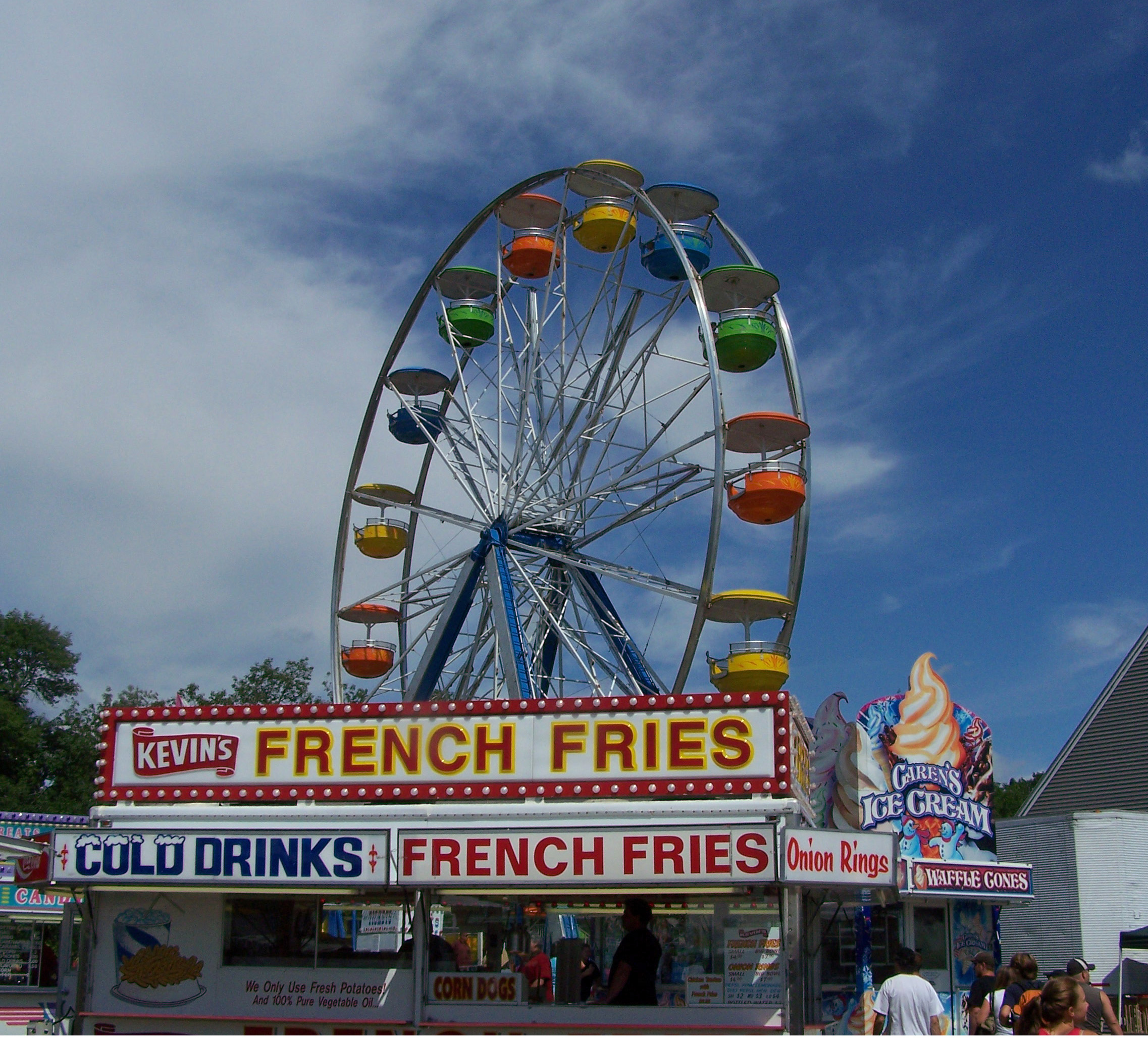
Here’s the first picture I took, as it is emblematic of one side of the fair:

We did pass the chicken house before the races.  We saw a new heritage turkey breed called Royal Palm–quite a gorgeous fellow.  You can see more information on this breed at http://www.efowl.com/Royal_Palm_Turkeys_p/1302.htm.   He is “displaying” and his head is showing blue, if he’s like wild turkeys, because the thinks the female next to him is a real charmer.  Turkeys are quite social and will talk to you as long as you stand and talk back. 


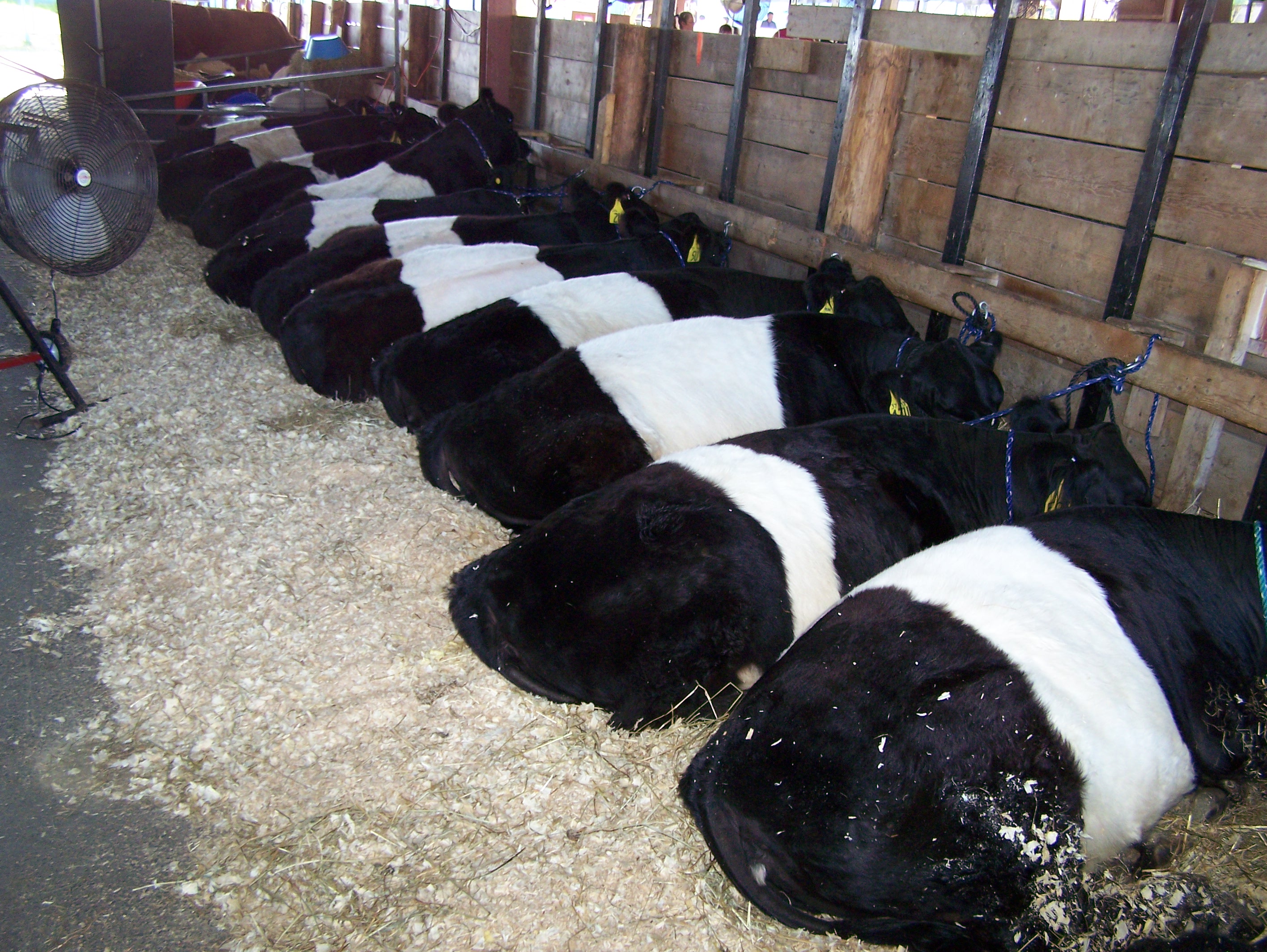
And, from last year, a picture of local celebrities:  Belted Galloway cows, or the “Oreo” cows.  They are a meat cow, and every single one has these exact markings.


 Here’s a pair of the most amazing pair of horses we watched win the pulling contests from last year.  You can’t imagine how determined they are, how they work together, how they want to do the job.  Sometimes I can hardly watch, especially when they get to weights that they cannot pull. 

Here is a picture of one race, seconds before crossing the finishing line:

We didn’t make any money.  We never do.  But we didn’t lose all that much either.  And, we had a glorious, sun-filled afternoon, fun afternoon.

We’re not going to Windsor this year as, sadly, due to the economy, they are not running live harness races, but are showing “simulcast” races piped in from somewhere else.  For us, the races are about much more than the betting, so we aren’t drawn there just to bet.